anaheim-gazette 1950-06-28
Scanned page
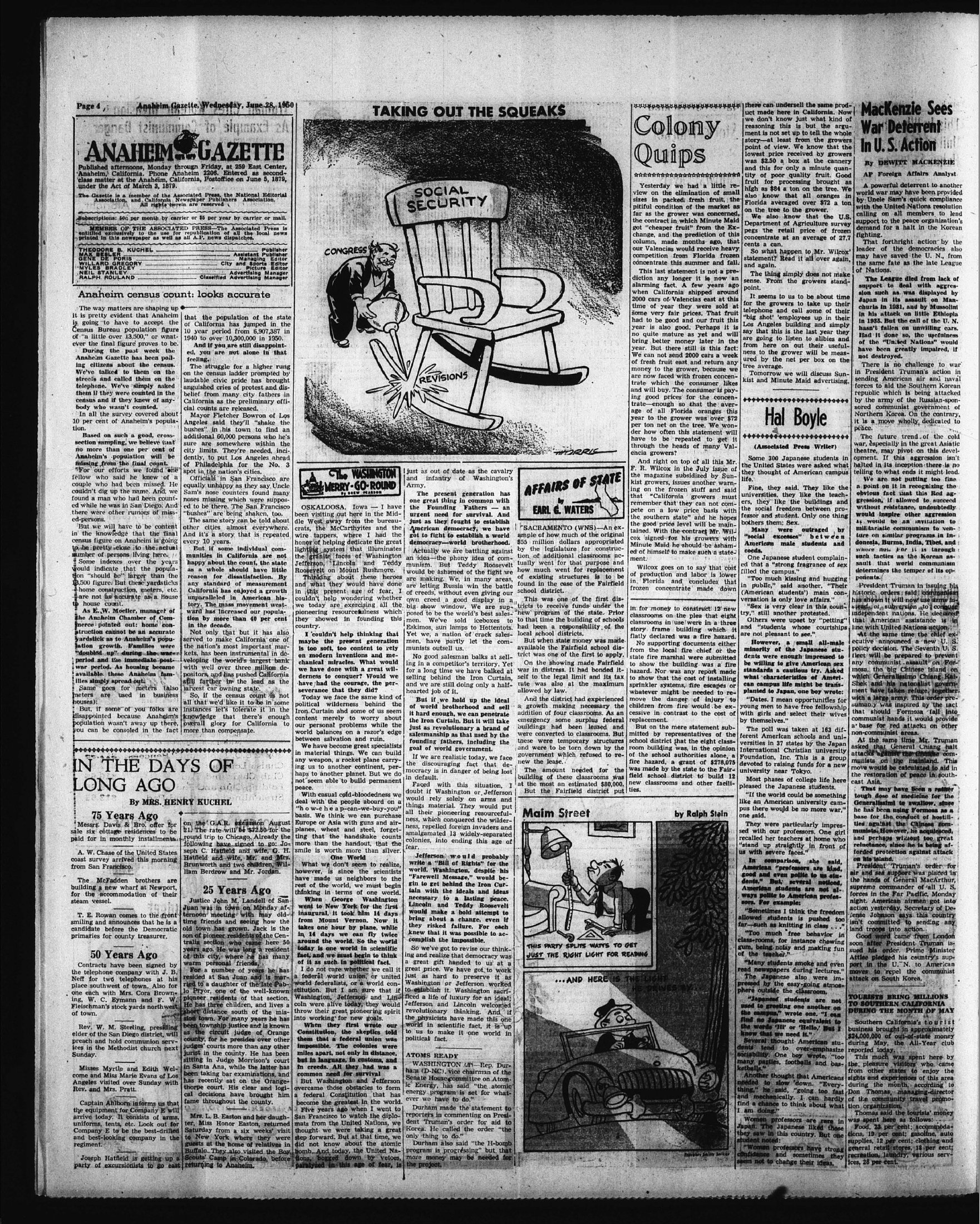
Searchable text
ANAHEIM GAZETTE
Published afternoons, Monday through Friday, at 259 East Center,
Anaheim, California. Phone Anaheim 2206. Entered as second-class matter at the Anaheim, California, Postoffice on June 5, 1879,
under the Act of March 3, 1879.
The Gazette is a member of the Associated Press, the National Editorial Association, and California Newspaper Publishers Association.
All rights herein are reserved
Subscriptions: 50c per month by carrier or $5 per year by carrier or mail.
MEMBER OF THE ASSOCIATED PRESS—The Associated Press is entitled exclusively to the use for republication of all the local news printed in this newspaper as well as all A.P. news dispatches.
THEODORE B. KUCHEL Publisher
MAX BESLER Assistant Publisher
GENE DE PORIS Managing Editor
WILLARD GREGORY City and Sports Editor
MYLES BRADLEY Picture Editor
NEIL STANLEY Advertising Manager
RALPH ROULAND Classified Advertising Manager
Anaheim census count: looks accurate
The way matters are shaping up it is pretty evident that Anaheim is going to have to accept the Census Bureau population figure of "a little over 13,500," or whatever the final figure proves to be.
During the past week the Anaheim Gazette has been polling citizens about the census. We've talked to them on the streets and called them on the telephone. We've simply asked them if they were counted in the census and if they knew of anybody who wasn't counted.
In all the survey covered about 10 per cent of Anaheim's population.
Based on such a good, cross-section sampling, we believe that no more than one per cent of Anaheim's population will that the population of the state of California has jumped in the 10 year period from 6,907,387 in 1940 to over 10,300,000 in 1950.
And if you are still disappointed, you are not alone in that feeling.
The struggle for a higher rung on the census ladder prompted by laudable civic pride has brought anguished cries of protest and disbelief from many city fathers in California as the preliminary official counts are released.
Mayor Fletcher Bowron of Los Angeles said they'll "shake the bushes" in his town to find an additional 60,000 persons who he's sure are somewhere within the city limits. They're needed, incidentally, to put Los Angeles ahead.
ING citizens about the census. We've talked to them on the streets and called them on the telephone. We've simply asked them if they were counted in the census and if they knew of anybody who wasn't counted.
In all the survey covered about 10 per cent of Anaheim's population.
Based on such a good cross-section sampling, we believe that no more than one per cent of Anaheim's population will be missing from the final count.
For our efforts we found one fellow who said he knew of a couple who had been missed. He couldn't dig up the name. And, we found a man who had been counted while he was in San Diego. And there were other rumors of missed-persons.
But we will have to be content in the knowledge that the final census figure on Anaheim is going to be pretty close to the actual number of persons living here.
Some indexes over the years would indicate that the population "should be" larger than the 13,500 figure. But these yardsticks home construction, meters, etc. are not as accurate as a house to house count.
As E. W. Moeller, manager of the Anaheim Chamber of Commerce pointed out: home construction cannot be an accurate yardstick as to Anaheim's population growth. Families were "doubled up" during the war period and the immediate post-war period. As housing became available, these Anaheim families simply spread out.
Same goes for meters (also meters are used in business houses).
But, if some of you folks are disappointed because Anaheim's population wasn't away up there, you can be consoled in the fact
The struggle for a higher rung on the census ladder prompted by laudable civic pride has brought anguished cries of protest and disbelief from many city fathers in California as the preliminary official counts are released.
Mayor Fletcher Bowron of Los Angeles said they'll "shake the bushes" in his town to find an additional 60,000 persons who he's sure are somewhere within the city limits. They're needed, incidentally, to put Los Angeles ahead of Philadelphia for the No. 3 spot in the nation's cities.
Officials in San Francisco are equally unhappy as they say. Uncle Sam's nose counters found many noses missing which were supposed to be there. The San Francisco "bushes" are being shaken, too.
The same story can be told about other cities almost everywhere. And it's a story that is repeated every 10 years.
But if some individual communities in California are not happy about the count, the state as a whole should have little reason for dissatisfaction. By any standard of measurement California has enjoyed a growth unparalleled in American history. The mass movement westward has increased our population by more than 40 per cent in the decade.
Not only that but it has also served to make California one of the nation's most important markets, has been instrumental in developing the world's largest bank with well over three million depositors, and has pushed California still farther in the lead as the largest car owning state.
So, if the census count is not all that we'd like it to be in some instances let's tolerate it in the knowledge that there's enough overall glory for California to more than compensate.
IN THE DAYS OF LONG AGO
By MRS. HENRY KUCHEL
75 Years Ago
Messrs. Davis & Bro. offer for sale six cottage residences to be paid for in monthly installments.
A. W. Chase of the United States coast survey arrived this morning on the G.A.R. excursion August 21. The rate will be $72.50 for the round trip to Chicago. Already the following have signed to go: Joseph C. Hatfield and wife, G. H. Hatfield and wife, Mr. and Mrs. Brunworth and two children Will-
IN THE DAYS OF LONG AGO
By MRS. HENRY KUCHEL
75 Years Ago
Messrs. Davis & Bro. offer for sale six cottage residences to be paid for in monthly installments.
A. W. Chase of the United States coast survey arrived this morning from San Francisco.
The McFadden brothers are building a new wharf at Newport, for the accommodation of their steam vessel.
T. E. Rowan comes to the front smiling and announces that he is a candidate before the Democratic primaries for county treasurer.
50 Years Ago
Contracts have been signed by the telephone company with J. B. Neff for two telephones at his place southwest of town. Also for one each with Mrs. Cora Browning, W. C. Eymann and F. W. Fleischman's stock yards northwest of town.
Rev. W. M. Sterling, presiding elder of the San Diego district, will preach and hold communion services in the Methodist church next Sunday.
Misses Myrtle and Edith Welcome and Miss Marie Evans of Los Angeles visited over Sunday with Rev. and Mrs. Pratt.
Captain Ahlborn informs us that the equipment for Company E will arrive today. It consists of arms, uniforms, tents, etc. Look out for Company E to be the best-drilled and best-looking company in the regiment.
Joseph Hatfield is getting up a party of excursionists to go east on the G.A.R. excursion August 21. The rate will be $72.50 for the round trip to Chicago. Already the following have signed to go: Joseph C. Hatfield and wife, G. H. Hatfield and wife, Mr. and Mrs. Brunworth and two children, William Berdrow and Mr. Jordan.
25 Years Ago
Justice John M. Landell of San Juan was in town on Monday afternoon meeting with may old-time friends and seeing how the old town has grown. Jack is the son of pioneer residents of the Centralia section who came here 50 years ago. He was long a resident of this city, where he has many warm personal friends.
For a number of years he has resided at San Juan and is married to a daughter of the late Pablo Pryor, one of the well-known pioneer residents of that section. He has three children, and lives a short distance south of the mission town. For many years he has been township justice and is known as the circuit judge of Orange county, for he presides over other judges' courts more than any other jurist in the county. He has been sitting in Judge Morrison's court in Santa Ana, while the latter has been taking bar examinations, and has recently sat on the Orange-thorpe court. His clear and logical decisions have brought him fame throughout the county.
Mrs. L. B. Easton and her daughter, Miss Honor Easton, returned Saturday from a six weeks' visit to New York where they were guests at the home of relatives in Buffalo. They also visited the Boy Scouts' Camp in Colorado, before returning to Anaheim.
When George W went to New York for inaugural, it took him from Mount Vernon takes one hour by plane in 14 days we can around the world. So today is one world in fact, and we must begin of it as such in politics.
I do not care whether a federal world union or world federalists, or a constitution. But I am s Washington, Jefferson coln were alive today, throw their great pioneers into working' for new Constitution, the skel them that a federal impossible. The color miles apart, not only but in language, in creeds. All they have common need for sure.
But Washington and overcome those obstacles a federal Constitution become the greatest in Five years ago when San Francisco to watch mats from the United thought we were taking step forward. But at this did not know about bomb And today, the fictions, bogged down paralyzed in this age
TAKING OUT THE SQUEAKS
SOCIAL SECURITY
CONGRESS
REVISIONS
Color Quip
Yesterday we had view on the elimination sizes in packed far pitiful condition of far as the grower the contract in which got "cheaper fruit" change, and the price column, made more our Valencias would competition from concentrate this su.
This last statement diction any longer alarming fact. A when California she 2000 cars of Valenc time of year they some very fair price had to be good and year is also good. no quite mature and bring better money year. But there still We can not send 20 of fresh fruit east a money to the grower are now faced with trate which the c and will buy. The co ing good prices for trate—enough so age of all Florida year to the grower per ton net on the der how often this have to be repeat through the heads encia growers?
OSKALOOSA, Iowa — I have been visiting out here in the Middle West away from the bureaucrats, the McCarthyites and the wire tappers, where I had the honor of helping dedicate the great lighting system that illuminates the granite faces of Washington Jefferson, Lincoln and Teddy Roosevelt on Mount Rushmore.
Thinking about these heroes and what they would have done in this present age of fear, I couldn't help wondering whether we today are exercising all the pioneering resourcefulness which they showed in founding this country.
I couldn't help thinking that maybe the present generation is too soft, too content to rely on modern inventions and mechanical miracles. What would we have done with a great wilderness to conquer? Would we have had the courage, the perseverance that they did?
Today we face the same kind of political wilderness behind the Iron Curtain and some of us seem content merely to worry about our personal problems while the world balances on a razor's edge between salvation and ruin.
We have become great specialists in material things. We can build any weapon, a rocket plane carrying us to another continent, perhaps to another planet. But we do not seem able to build permanent peace.
With casual cold-bloodedness we deal with the people aboard on a "how-c-he-a-p-can-we-buy-you" basis. We think we can purchase Europe or Asia with guns and airplanes, wheat and steel, forgetting that the handshake counts more than the handout, that the smile is worth more than silver.
One World
just as out of date as the cavalry and infantry of Washington's Army.
The present generation has one great thing in common with the Founding Fathers — an urgent need for survival. And just as they fought to establish American democracy, we have got to fight to establish a world democracy—world brotherhood.
Actually we are battling against an idea—the phony idea of communism. But Teddy Roosevelt would be ashamed of the fight we are making. We, in many areas, are letting Russia win the battle of creeds, without even giving our own creed a good display in a big show window. We are supposed to be the world's best salesmen. We've sold iceboxes to Eskimos, sun lamps to Hottenots. Yet we, a nation of crack salesmen, have partly let the communists outsell us.
No good salesman balks at selling in a competitor's territory. Yet for a long time we have balked at selling behind the Iron Curtain, and we are still doing only a half-hearted job of it.
But if we hold up the ideal of world brotherhood and sell it hard enough, we can penetrate the Iron Curtain. But it will take just as revolutionary a brand of salesmanship as that used by the founding fathers, including the goal of world government.
If we are realistic today, we face the discouraging fact that democracy is in danger of being lost in default.
Faced with this situation, I doubt if Washington or Jefferson would rely solely on arms and things material. They would put all their pioneering resourcefulness, which conquered the wilderness, repelled foreign invaders and amalgamated 13 widely-separated colonies, into ending this age of fear.
Jefferson would probably write a "Bill of Rights" for the
SACRAMENTO (WNS)—An example of how much of the original $55 million dollars appropriated by the legislature for construction of additional classrooms actually went for that purpose and how much went for replacement of existing structures is to be found in the case of the Fairfield school district.
This was one of the first districts to receive funds under the new program of the state. Prior to that time the building of schools had been a responsibility of the local school districts.
But when state money was made available the Fairfield school district was one of the first to apply.
On the showing made Fairfield was in distress. It had bonded itself to the legal limit and its tax rate was also at the maximum allowed by law.
And the district had experienced a growth making necessary the addition of four classrooms. As an emergency some surplus federal buildings had been leased and were converted to classrooms. But these were temporary structures and were to be torn down by the government which refused to renew the lease.
The amount needed for the building of these classrooms was at the most an estimated $80,000.
But the Fairfield district put
With casual cold-bloodedness we deal with the people aboard on a "how-c-he ap-can-we-buy-you" basis. We think we can purchase Europe or Asia with guns and airplanes, wheat and steel, forgetting that the handshake counts more than the handout, that the smile is worth more than silver.
One World
What we don't seem to realize, however, is since the scientists have made us neighbors to the rest of the world, we must begin thinking in terms of one world.
When George Washington went to New York for the first inaugural, it took him 14 days from Mount Vernon. Now it takes one hour by plane, while in 14 days we can fly twice around the world. So the world today is one world in scientific fact, and we must begin to think of it as such in political fact.
I do not care whether we call it a federal world union, or united world federalists, or a world constitution. But I am sure that if Washington, Jefferson and Lincoln were alive today, they would throw their great pioneering spirit into working for new goals.
When they first wrote our Constitution, the skeptics told them that a federal union was impossible. The colonies were miles apart, not only in distance, but in language, in customs, and in creeds. All they had was a common need for survival.
But Washington and Jefferson overcame those obstacles to form a federal Constitution that has become the greatest in the world.
Five years ago when I went to San Francisco to watch the diplomats from the United Nations, we thought we were taking a great step forward. But at that time, we did not know about the atomic bomb. And today, the United Nations, bogged down by vetoes, paralyzed in this age of fear, is
Faced with this situation, I doubt if Washington or Jefferson would rely solely on arms and things material. They would put all their pioneering resourcefulness, which conquered the wilderness, repelled foreign invaders and amalgamated 13 widely-separated colonies, into ending this age of fear.
Jefferson would probably write a "Bill of Rights" for the world. Washington, despite his "Farewell Message," would begin to get behind the Iron Curtain with the ideals and ideas necessary to a lasting peace. Lincoln and Teddy Roosevelt would make a bold attempt to bring about a change, even if they risked failure. For each knew that it was possible to accomplish the impossible.
So we've got to revise our thinking and realize that democracy was a great gift handed to us at a great price. We have got to work just as hard to preserve it as Washington or Jefferson worked to establish it. Washington sacrificed a life of luxury for an ideal; Jefferson and Lincoln welcomed revolutionary thinking. And if the physicists have made this one world in scientific fact, it is up to us to make it one world in political fact.
ATOMS READY
WASHINGTON (T)—Rep. Durham (D-NC), vice chairman of the Senate House committee on Atomic Energy, has said "the atomic energy program is set for whatever we have to do."
Durham made the statement to reporters in commenting on President Truman's order for aid to Korea. He called the order "the only thing to do."
Durham also said "the H-bomb program is progressing" but that more money may be needed for the project.
Colony Quips
Yesterday we had a little review on the elimination of small sizes in packed fresh fruit, the pitiful condition of the market as far as the grower was concerned, the contract in which Minute Maid got "cheaper fruit" from the Exchange, and the prediction of this column, made months ago, that our Valencias would receive heavy competition from Florida frozen concentrate this summer and fall.
This last statement is not a prediction any longer it is now an alarming fact. A few years ago when California shipped around 2000 cars of Valencias east at this time of year they were sold at some very fair prices. That fruit had to be good and our fruit this year is also good. Perhaps it is no quite mature as yet and will bring better money later in the year. But there still is this fact: We can not send 2000 cars a week of fresh fruit east and return any money to the grower, because we are now faced with frozen concentrate which the consumer likes and will buy. The consumer is paying good prices for the concentrate—enough so that the average of all Florida oranges this year to the grower was over $72 per ton net on the tree. We wonder how often this statement will have to be repeated to get it through the heads of many Valencia growers?
there can undersell the same product made here in California. Now we don't know just what kind of reasoning this is but the argument is not set up to tell the whole story—at least from the growers point of view. We know that the lowest price received by growers was $2.50 a box at the cannery and this for only a minute quantity of poor quality fruit. Good fruit for processing brought as high as $84 a ton on the tree. We also know that all oranges in Florida averaged over $72 a ton on the tree to the grower.
We also know that the U.S. Department of Agriculture survey pegs the retail price of frozen concentrate at an average of 27.7 cents a can.
So what happen to Mr. Wilcox' statement? Read it all over again, and again.
The thing simply does not make sense. From the growers standpoint.
It seems to us to be about time for the growers to take up their telephone and call some of their "big shot" employees up in their Los Angeles building and simply say that this is the last year they are going to listen to albies and from here on out their usefulness to the grower will be measured by the net per box on the tree average.
Tomorrow we will discuss Sunkist and Minute Maid advertising.
Hal Boyle
(Associated Press Writer)
of fresh fruit east and return any money to the grower, because we are now faced with frozen concentrate which the consumer likes and will buy. The consumer is paying good prices for the concentrate—enough so that the average of all Florida oranges this year to the grower was over $72 per ton net on the tree. We wonder how often this statement will have to be repeated to get it through the heads of many Valencia growers?
And right on top of all this Mr. F. R. Wilcox in the July issue of the magazine subsidized by Sunkist growers, issues another warning on the frozen stuff and said that "California growers must remember that they can not compete on a low price basis with the southern state" and he hopes the good price level will be maintained. With the contract Mr. Wilcox signed for his growers with Minute Maid he should be ashamed of himself to make such a statement.
Wilcox goes on to say that cost of production and labor is lower in Florida and concludes that frozen concentrate made down in for money to construct 12 new classrooms on the plea that eight classrooms in use were in a three story frame building which it flatly declared was a fire hazard.
No supporting documents either from the local fire chief or the state fire marshal were submitted to show the building was a fire hazard. Nor was any report made to show that the cost of installing sprinkler systems, fire escapes or whatever might be needed to remove the danger of injury to children from fire would be excessive in contrast to the cost of replacement.
But on the mere statement submitted by representatives of the school district that the eight classroom building was, in the opinion of the school authorities alone, a fire hazard, a grant of $278,075 was made by the state to the Fairfield school district to build 12 new classrooms and other facilities.
Hal Boyle
(Associated Press Writer)
Some 300 Japanese students in the United States were asked what they thought of American campus life.
Fine, they said. They like the universities, they like the teachers, they like the buildings and the social freedom between professor and student. Only one thing bothers them; Sex.
Many were outraged by "social excesses" between American male students and coeds.
One Japanese student complained that a "strong fragrance of sex filled the campus."
"Too much kissing and hugging in public," said another. "Their (American students') main conversation is only love affairs."
"Sex is very clear in this country," still another protested.
Others were upset by "petting" and "students whose courtships are not pleasant to see."
However, a small all-male minority of the Japanese students were enough impressed to be willing to give American sex standards a cautious try. Asked what characteristics of American campus life might be transplanted to Japan, one boy wrote:
"Dates. I mean opportunities for young men to have free fellowship with girls and select their wives by themselves."
The poll was taken at 163 different American schools and universities in 37 states by the Japan International Christian university Foundation, Inc. This is a group devoted to raising funds for a new university near Tokyo.
Most phases of college life here pleased the Japanese students.
“If the world could be something like an American university campus there would be no more war,” one said.
They were particularly impressed with our professors. One girl recalled her teachers at home who “stand up straightly in front of us with severe faces.”
In comparison, she said,
There is no challenge to war in President Truman's action in sending American air and naval forces to aid the Southern Korean republic which is being attacked by the army of the Russian-sponsored communist government of Northern Korea. On the contrary, it is a move wholly dedicated to peace.
The future trend of the cold war, especially in the great Asiatic theatre, may pivot on this development. If this aggression isn't halted in its inception there is no telling to what ends it might lead.
We are not putting too fine a point on it in recognizing the obvious fact that this Red aggression, if allowed to succeed without resistance, undoubtedly would inspire other aggression as would be an invitation to militaristic communism to venture on similar programs in Indonesia, Burma, India, Tibet, and where not for it is through such tactics as the Korean assault that world communism determines the temper of its opponents.
President Truman in issuing his historic orders said communism has shown it will now use arms instead of subversion to conquer independent nations. He declared that American assistance is in line with United Nations action.
At the same time the chief executive announced a new U.S. policy decision. The Seventh U.S. fleet will be prepared to prevent any communist assault on Formosa, the big Chinese island on which Generalissimo Chiang Kai-shek and his nationalist government have taken refuge together with a large army. This order presumably was inspired by the fact that should Formosa fall into communist hands it would provide a base for red attacks on other non-communist areas.
At the same time Mr. Truman asked that General Chiang halt attacks against the Chinese communists on the mainland. This move would be calculated to aid in the restoration of peace in southeast Asia.
That may have been a rather tough dose of medicine for the Generalissimi to swallow, since he has been using Formosa as a base for the conduct of hostilities against the Chinese communists. However, he acquiesced, and perhaps without too great reluctance, since he is being afforded protection against attack on his island.
Most phases of college life here pleased the Japanese students.
“If the world could be something like an American university campus there would be no more war,” one said.
They were particularly impressed with our professors. One girl recalled her teachers at home who “stand up straightly in front of us with severe faces.”
In comparison, she said, American “professors are kind, good and even polite to us students.” But, several noticed, American students are not always polite to American professors. For example:
“Sometimes I think the freedom allowed students is pushed too far—such as knitting in class . . .
“Too much free behavior in classroom, for instance chowing gum, being noisy and making fun of the teacher.”
“Many students smoke and even read newspapers during lectures.”
The Japanese also were impressed by the easy-going atmosphere outside the classroom.
“Japanese students are not used to greeting one another on the campus,” wrote one. “I can find no Japanese equivalent to the words ‘Hi’ or ‘Hello.’ But I know that we need it.”
Several thought American students tend to over-emphasize sociability. One boy wrote, “too many parties, footballs and basketball.”
Another thought that Americans needed to slow down. “Everything,” he said, “going too fast and mechanically. I can hardly find a chance to think about what I am doing.”
Women professors are rare in Japan. The Japanese liked those they saw in this country. But one student noted:
“Women professors have strong confidence and sometimes they seem not to change their ideas.
That may have been a rather tough dose of medicine for the Generalissimo to swallow, since he has been using Formosa as a base for the conduct of hostilities against the Chinese communists. However, he acquiesced, and perhaps without too great reluctance, since he is being afforded protection against attack on his island.
President Truman’s order for air and sea support was placed in the hands of General MacArthur, supreme commander of all U.S. forces in the Far Pacific, Monday night. American airmen got into action yesterday. Secretary of Defense Johnson says this country isn’t committed to sending any land troops into action.
Good word came from London soon after President Truman issued his order. Prime Minister Attlee pledged his country’s support in the U.N. to American moves to repel the communist attack on South Korea.
TOURISTS BRING MILLIONS TO SOUTHERN CALIFORNIA DURING THE MONTH OF MAY
Southern California’s tourist business brought in approximately $24,000,000 of out-of-state money during May, the All-Year club reported today.
This much was spent here by the pleasure visitors who came from other states to enjoy the sights and experiences of this area during the month, according to Don Thomas, managing-director of the community travel promotion organization.
Thomas said the tourists’ money was spent here as follows:
Food, 23 per cent; accommodations, 19 per cent; gasoline, auto supplies, 12 per cent; clothing and general retail stores, 18 per cent; recreation, laundry; various services, 28 per cent.