anaheim-gazette 1948-03-11
Scanned page
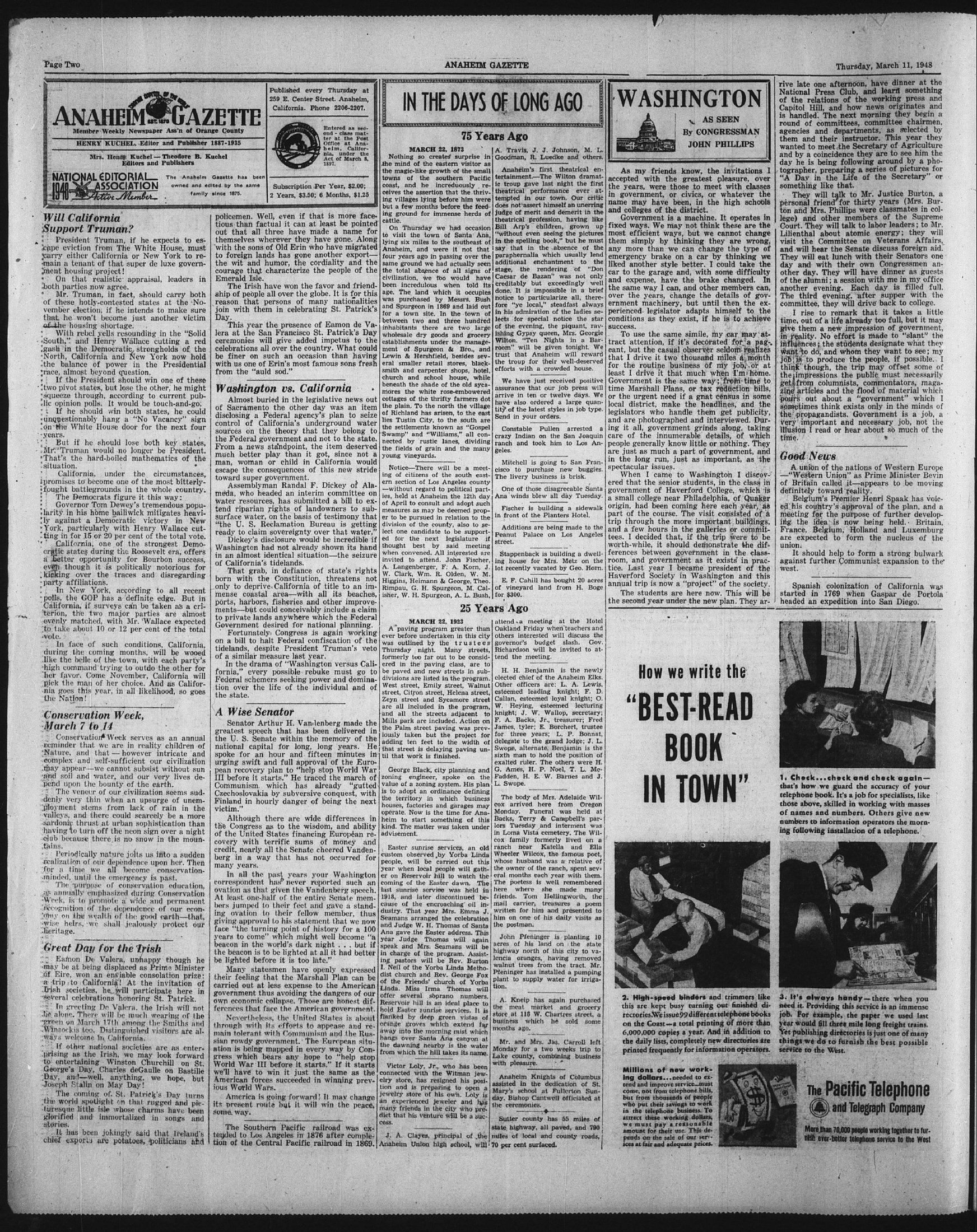
Searchable text
Will California Support Truman?
President Truman, if he expects to escape eviction from The White House, must carry either California or New York to remain a tenant of that super de luxe government housing project!
On that realistic appraisal, leaders in both parties now agree.
Mr. Truman, in fact, should carry both of these hotly-contested states at the November election, if he intends to make sure that he won't become just another victim of the housing shortage.
With rebel yells resounding in the "Solid South," and Henry Wallace cutting a red gash in the Democratic strongholds of the North, California and New York now hold the balance of power in the Presidential race, almost beyond question.
If the President should win one of these two pivot states, but lose the other, he might squeeze through, according to current public opinion polls. It would be touch-and-go.
If he should win both states, he could unquestionably hang a "No Vacancy" sign on the White House door for the next four years.
But if he should lose both key states, Mr. Truman would no longer be President. That's the hard-boiled mathematics of the policemen. Well, even if that is more fictious than factual it can at least be pointed out that all three have made a name themselves wherever they have gone. All with the sons of Old Erin who have migrated to foreign lands has gone another exportion the wit and humor, the cordiality and courage that characterize the people of Emerald Isle.
The Irish have won the favor and frienship of people all over the globe. It is for this reason that persons of many nationalities join with them in celebrating St. Patrick's Day.
This year the presence of Eamon de Lera at the San Francisco St. Patrick's Day ceremonies will give added impetus to celebrations all over the country. What cobe finer on such an occasion than have us one of Erin's most famous sons frm the "auld sod."
Washington vs. California
Almost buried in the legislative news of Sacramento the other day was an irdisclosing a Federal agency's plan to se control of California's underground wasources on the theory that they belong to the Federal government and not to the state. From a news standpoint, the item desert much better play than it got, since no
the balance of power in the Presidential race, almost beyond question.
If the President should win one of these two pivot states, but lose the other, he might squeeze through, according to current public opinion polls. It would be touch-and-go:
If he should win both states, he could unquestionably hang a "No Vacancy" sign on the White House door for the next four years.
But if he should lose both key states, Mr. Truman would no longer be President. That's the hard-boiled mathematics of the situation.
California, under the circumstances, promises to become one of the most bitterly-fought battlegrounds in the whole country.
The Democrats figure it this way:
Governor Tom Dewey's tremendous popularity in his home bailiwick mitigates heavily against a Democratic victory in New York, particularly with Henry Wallace cutting in for 15 or 20 per cent of the total vote.
California, one of the strongest Democratic states during the Roosevelt era, offers a better opportunity for Bourbon success, even though it is politically notorious for kicking over the traces and disregarding party affiliations.
In New York, according to all recent polls, the GOP has a definite edge. But in California, if surveys can be taken as a criterion, the two major parties are almost evenly matched, with Mr. Wallace expected to take about 10 or 12 per cent of the total vote.
In face of such conditions, California, during the coming months, will be wooed like the belle of the town, with each party's high command trying to outdo the other for her favor. Come November, California will pick the man of her choice. And as California goes this year, in all likelihood, so goes the Nation!
Conservation Week,
March 7 to 14
Conservation Week serves as an annual reminder that we are in reality children of Nature, and that—however intricate and complex and self-sufficient our civilization may appear—we cannot subsist without sun and soil and water, and our very lives depend upon the bounty of the earth.
The veneer of our civilization seems suddenly very thin when an upsurge of unemployment stems from lack of rain in the valleys, and there could scarcely be a more sardonic thrust at urban sophistication than having to turn off the neon sign over a night club because there is no snow in the mountains.
Periodically nature jolts us into a sudden realization of our dependence upon her. Then for a time we all become conservation-
Washington vs. California
Almost buried in the legislative news of Sacramento the other day was an itch disclosing a Federal agency’s plan to seize control of California’s underground water sources on the theory that they belong to the Federal government and not to the state.
From a news standpoint, the item deserves much better play than it got, since no man, woman or child in California would escape the consequences of this new struggle toward super government.
Assemblyman Randal F. Dickey of A meda, who headed an interim committee on water resources, has submitted a bill to tend riparian rights of landowners to surface water, on the basis of testimony to “the U. S. Reclamation Bureau is getting ready to claim sovereignty over that water.”
Dickey’s disclosure would be incredibly Washington had not already shown its hand in an almost identical situation—the seizure of California’s tidelands.
That grab, in defiance of state’s right born with the Constitution, threatens only to deprive California of title to an immense coastal area—with all its beach ports, harbors, fisheries and other improvements—but could conceivably include a claim to private lands anywhere which the Federal Government desired for national planning.
Fortunately Congress is again working on a bill to halt Federal confiscation of tidelands, despite President Truman’s vow of a similar measure last year.
In the drama of “Washington versus California,” every possible rebuke must go Federal schemers seeking power and domination over the life of the individual and the state.
A Wise Senator
Senator Arthur H. Vanlenberg made greatest speech that has been delivered by the U. S. Senate within the memory of national capital for long, long years.
He spoke for an hour and fifteen minutes urging swift and full approval of the European recovery plan to “help stop World War III before it starts.” He traced the march Communism which has already “gutted Czechoslovakia by subversive conquest, waking Finland in hourly danger of being the next victim.”
Although there are wide differences between the Congress as to the wisdom, and ability of the United States financing European covery with terrific sums of money and credit, nearly all the Senate cheered Vanderberg in a way that has not occurred many years.
and soil and water, and our very lives depend upon the bounty of the earth.
The veneer of our civilization seems suddenly very thin when an upsurge of unemployment stems from lack of rain in the valleys, and there could scarcely be a more sardonic thrust at urban sophistication than having to turn off the neon sign over a night club because there is no snow in the mountains.
Periodically nature jolts us into a sudden realization of our dependence upon her. Then for a time we all become conservation-minded, until the emergency is past.
The purpose of conservation education, as annually emphasized during Conservation Week, is to promote a wide and permanent recognition of the dependence of our economy on the wealth of the good earth—that, wise heirs, we shall jealously protect our heritage.
Great Day for the Irish
Eamon De Valera, unhappy though he may be at being displaced as Prime Minister of Eire, won an enviable consolation prize: a trip to California! At the invitation of Irish societies, he will participate here in several celebrations honoring St. Patrick.
In greeting De Valera, the Irish will not be alone. There will be much wearing of the green on March 17th among the Smiths and Winsockis too. Distinguished visitors are always welcome in California.
If other national societies are as enterprising as the Irish, we may look forward to entertaining Winston Churchill on St. George's Day, Charles deGaulle on Bastille Day, and—well, anything, we hope, but Joseph Stalin on May Day!
The coming of St. Patrick's Day turns the world spotlight on that rugged and picturesque little isle whose charms have been glorified and immortalized in songs and stories.
It has been jokingly said that Ireland's chief exports are potatoes, politicians and
IN THE DAYS OF LONG AGO
75 Years Ago
MARCH 22, 1873
Nothing so creates surprise in the mind of the eastern visitor as the magic-like growth of the small towns of the southern Pacific coast, and he incredulously receives the assertion that the thriving villages lying before him were but a few months before the feeding ground for immense herds of cattle.
On Thursday we had occasion to visit the town of Santa Ana, lying six miles to the southeast of Anaheim, and were it not that four years ago in passing over the same ground we had actually seen the total absence of all signs of civilization, we too would have been incredulous when told its age. The land which it occupies was purchased by Messrs. Bush and Spurgeon in 1869 and laid out for a town site. In the town of between two and three hundred inhabitants there are two large wholesale dry goods and grocery establishments under the management of Spurgeon & Bro., and Lewin & Hershfield, besides several smaller retail stores, blacksmith and carpenter shops, hotel, church and school house, while beneath the shade of the old sycamores the white rose-embowered cottages of the thrifty farmers dot the plain. To the north the village of Richland has arisen, to the east lies Tustin City, to the south are the settlements known as "Gospel Swamp" and "Williams," all connected by rustic lanes, dividing the fields of grain and the many young vineyards.
A. Travis, J. J. Johnson, M. L. Goodman, R. Luedke and others.
Anaheim's first theatrical entertainment.—The Wilton dramatic troup gave last night the first theatrical performance ever attempted in our town. Our critic does not assert himself an unerring judge of merit and demerit in the theatrical profession, having like Bill Arp's children, grown up "without even seeing the pictures in the spelling book," but he must say that in the absence of the paraphernalia which usually lend additional enchantment to the stage, the rendering of "Don Caesar de Bazan" was not only creditably but exceedingly well done. It is impossible in a brief notice to particularize all, therefore "ye local," steadfast always in his admiration of the ladies selects for special notice the star of the evening, the piquant, ravishing Gypsy queen, Mrs. Georgie Wilton. "Ten Nights in a Barroom" will be given tonight. We trust that Anaheim will reward the troup for their well-deserved efforts with a crowded house.
We have just received positive assurance that our job press will arrive in ten or twelve days. We have also ordered a large quantity of the latest styles in job type. Send in your orders.
Constable Pullen arrested a crazy Indian on the San Joaquin ranch and took him to Los Angeles.
As my friends know accepted with the grace the years, were those in government, or civic name may have been, and colleges of the district.
Government is a more fixed ways. We may not most efficient ways, but them simply by think any more than we can emergency brake on a liked another style because car to the garage and expense, have this same way I can, and over the years, change ernment machinery, be perienced legislator and conditions as they exist success.
To use the same strict attention, if it's an eant, but the casual objection that I drive it two thousand for the routine business least I drive it that no Government is the same time Marshall Plans, or or the urgent need if a local district, make the legislators who handle and are photographed it all, government care of the innumerable people generally know they are just as much a part in the long run just...
MARCH 22, 1923
A paving program greater than ever before undertaken in this city was outlined by the trustees Thursday night. Many streets, formerly too far out to be considered in the paving class, are to be paved and new streets in subdivisions are listed in the program. West street, Emily street, Walnut street, Citron street, Helena street, Zeyn street and Sycamore street are all included in the program, and all the streets adjacent to Mills park are included. Action on the Palm street paving was previously taken but the project for adding ten feet to the width of that street is delaying paving until that work is finished.
George Black, city planning and zoning engineer, spoke on the value of a zoning system. His plan is to adopt an ordinance defining the territory in which business houses, factories and garages may operate. Now is the time for Anaheim to start something of this kind. The matter was taken under advisement.
Easter sunrise services, an old custom observed by Yorba Linda people, will be carried out this year when local people will gather at the Hotel Oakland Friday when teachers and others interested will discuss the governor's budget slash. Gov. Richardson will be invited to attend the meeting.
H. H. Benjamin is the newly elected chief of the Anaheim Elks. Other officers are: L. A. Lewis, esteemed leading knight; F. D. Callan, esteemed loyal knight; O. W. Heying, esteemed lecturing knight; J. W. Wallop, secretary; F. A. Backs, Jr., treasurer; Fred James, tyler; E. Borchert, trustee for three years; L. P. Bonnat, delegate to the grand lodge; J. L. Swope, alternate. Benjamin is the sixth man to hold the position of exalted ruler. The others were H. G. Ames, H. P. Noel, T. L. McFadden, H. E. W. Barnes and J. L. Swope.
The body of Mrs. Adelaide Wilcox arrived here from Oregon Monday. Funeral was held at Backs, Terry & Campbell's parlors Tuesday and interment was in Loma Vista cemetery. The Wilcox family formerly lived on a ranch near Katella and Ella Wheeler Wilcox, the famous poet, whose husband was a relative of the owner of the ranch, spent seven least I drive it that my Government is the same time Marshall Plans, or or the urgent need if a local district, make the legislators who handle and are photographed it all, government care of the innumerable people generally know they are just as much a part in the long run, just spectacular issues.
When I came to Washington versus Cali-ble rebuke must go to seeking power and domina-ness of the individual and of
How we "BEST BOOK IN TO
He traced the march of
has already "gutted
subversive conquest, with
wanger of being the next
are wide differences in
the wisdom, and ability
financing European resums of money and
Senate cheered Vandenhat has not occurred for
years your Washington
never reported such an
in the Vandenberg speech.
In the entire Senate memfer feet and gave a standair fellow member, thus
this statement that we now
point of history for a 100
might well become "a
's dark night . . . but if
lighted at all it had better
is too late."
have openly expressed
the Marshall Plan can be
expense to the American
holding the dangers of our
case. Those are honest difference American government.
United States is about
efforts to appease and reCommunism and the Russent. The European situned in every way by Conany hope to "help stop
it starts." If it starts
just the same as the
preceded in winning prevforward! It may change
it will win the peace,
pacific railroad was exines in 1876 after complePacific railroad in 1869.
Easter sunrise services, an old custom observed by Yorba Linda people, will be carried out this year when local people will gather on Reservoir hill to watch the coming of the Easter dawn. The last sunrise service was held in 1918, and later discontinued because of the encroaching oil industry. That year Mrs. Emma J. Seamans arranged the celebration and Judge W. H. Thomas of Santa Ana gave the Easter address. This year Judge Thomas will again speak and Mrs. Seamans will be in charge of the program. Assisting pastors will be Rev. Burton I. Neil of the Yorba Linda Methodist church and Rev. George Fox of the Friends' church of Yorba Linda. Miss Irma Thomas will offer several sobrano numbers. Reservoir hill is an ideal place to hold Easter sunrise services. It is flanked by deep green vistas of orange groves which extend far away into the morning mist which hangs over Santa Ana canyon at the dawning nearby is the water from which the hill takes its name.
Victor Loly, Jr., who has been connected with the Witman jewelry store, has resigned his position and is preparing to open a jewelry store of his own. Loly is an experienced jeweler and has many friends in the city who predict that his venture will be a success.
J. A. Clayes, principal of the Anaheim Union high school, will Fadden, H. E. W. Barnes and J.
L. Swope.
The body of Mrs. Adelaide Wilcox arrived here from Oregon Monday. Funeral was held at Backs, Terry & Campbell's parlors Tuesday and interment was in Loma Vista cemetery. The Wilcox family formerly lived on a ranch near Katella and Ella Wheeler Wilcox, the famous poet, whose husband was a relative of the owner of the ranch, spent several months each year with them. The poetess is well remembered here where she made many friends. Tom Hollingworth, the mail carrier, treasures a poem written for him and presented to him on one of his daily visits as the postman.
John Pfeninger is planting 10 acres of his land on the state highway north of this city to valencia oranges, having removed walnut trees from the tract. Mr. Pfeninger has installed a pumping plant to supply water for irrigation.
A. Kneip has again purchased the meat market and grocery store at 118 W. Chartres street, a business which he sold some months ago.
Mr. and Mrs. Jas. Carroll left Monday for a two weeks trip to Lake county, combining business with pleasure.
Anaheim Knights of Columbus assisted in the dedication of St. Mary's school at Fullerton Sunday. Bishop Cantwell officiated at the ceremonies.
Sutter county has 55 miles of state highway, all paved, and 790 miles of local and county roads, 70 per cent surfaced.
2. High-speed bimthis are kept busy t
rectories.Weissue990
on the Coast—a total
6,000,000 copies a y
the daily lists, compliprinted frequently fo-
WASHINGTON
AS SEEN
By CONGRESSMAN
JOHN PHILLIPS
As my friends know, the invitations I accepted with the greatest pleasure, over the years, were those to meet with classes in government, or civics, or whatever the same may have been, in the high schools and colleges of the district.
Government is a machine. It operates in mixed ways. We may not think these are the most efficient ways, but we cannot change them simply by thinking they are wrong, any more than we can change the type of emergency brake on a car by thinking we liked another style better. I could take the car to the garage and, with some difficulty and expense, have the brake changed. In the same way I can, and other members can, over the years, change the details of government machinery, but until then the experienced legislator adapts himself to the conditions as they exist, if he is to achieve success.
To use the same simile, my car may attract attention, if it's decorated for a pagan, but the casual observer seldom realizes that I drive it two thousand miles a month for the routine business of my job, or at least I drive it that much when I'm home. Government is the same way; from time to time Marshall Plans, or tax reduction bills, or the urgent need if a gnat census in some local district, make the headlines, and the legislators who handle them get publicity, and are photographed and interviewed. During it all, government grinds along, taking care of the innumerable details, of which people generally know little or nothing. They are just as much a part of government, and in the long run, just as important as therive late one afternoon, have dinner at the National Press Club, and learn something of the relations of the working press and Capitol Hill, and how news originates and is handled. The next morning they begin a round of committees, committee chairmen, agencies and departments, as selected by them and their instructor. This year they wanted to meet the Secretary of Agriculture and by a coincidence they are to see him the day he is being following around by a photographer, preparing a series of pictures for "A Day in the Life of the Secretary" or something like that.
They will talk to Mr. Justice Burton, a personal friend for thirty years (Mrs. Burton and Mrs. Phillips were classmates in college) and other members of the Supreme Court. They will talk to labor leaders; to Mr. Lilienthal about atomic energy; they will visit the Committee on Veterans Affairs, and will hear the Senate discuss foreign aid. They will eat lunch with their Senators one day and with their own Congressmen another day. They will have dinner as guests of the alumni; a session with me in my office another evening. Each day is filled full. The third evening, after supper with the committee, they will drive back to college.
I rise to remark that it takes a little time, out of a life already too full, but it may give them a new impression of government, in reality. No effort is made to "slant" the influences; the students designate what they want to do, and whom they want to see; my job is to produce the people, if possible. I think though, the trip may offset some of the impressions the public must necessarily get from columnists, commentators, magazine articles and the flood of material which pours out about a "government" which I sometimes think exists only in the minds of the propagandists. Government is a job, a very important and necessary job, not the illusion I read or hear about so much of the time.
Good News
for the routine business of my job, or at least I drive it that much when I'm home. Government is the same way; from time to time Marshall Plans, or tax reduction bills, or the urgent need if a gnat census in some local district, make the headlines, and the legislators who handle them get publicity, and are photographed and interviewed. During it all, government grinds along, taking care of the innumerable details, of which people generally know little or nothing. They are just as much a part of government, and in the long run, just as important, as the spectacular issues.
When I came to Washington I discovered that the senior students, in the class in Government of Haverford College, which is a small college near Philadelphia, of Quaker origin, had been coming here each year, as part of the course. The visit consisted of a trip through the more important buildings, and a few hours in the galleries or committees. I decided that, if the trip were to be worth-while, it should demonstrate the differences between government in the classroom, and government as it exists in practice. Last year I became president of the Haverford Society in Washington and this annual trip is now a "project" of the society.
The students are here now. This will be the second year under the new plan. They ar-
Good News
A union of the nations of Western Europe — "Western Union" as Prime Minister Bevin of Britain called it—appears to be moving definitely toward reality.
Belgium's Premier Henri Spaak has voiced his country's approval of the plan, and a meeting for the purpose of further developing the idea is now being held. Britain, France, Belgium, Holland and Luxemburg are expected to form the nucleus of the union.
It should help to form a strong bulwark against further Communist expansion to the west.
Spanish colonization of California was started in 1769 when Gaspar de Portola headed an expedition into San Diego.
How we write the "BEST-READ BOOK IN TOWN"
1. Check...check and check again—that's how we guard the accuracy of your telephone book. It's a job for specialists, like those above, skilled in working with masses of names and numbers. Others give new numbers to information operators the morning following installation of a telephone.
IN TOWN"
1. Check...check and check again—that's how we guard the accuracy of your telephone book. It's a job for specialists, like those above, skilled in working with masses of names and numbers. Others give new numbers to information operators the morning following installation of a telephone.
2. High-speed binders and trimmers like this are kept busy turning out finished directories. We issue 99 different telephone books on the Coast—a total printing of more than 6,000,000 copies a year. And in addition to the daily lists, completely new directories are printed frequently for information operators.
3. It's always handy—there when you need it. Providing this service is an immense job. For example, the paper we used last year would fill three mile long freight trains. Yet publishing directories is just one of many things we do to furnish the best possible service to the West.
Millions of new working dollars...needed to extend and improve service...must come, not from telephone bills, but from thousands of people who put their savings to work in the telephone business. To attract these working dollars, we must pay a reasonable amount for their use. This depends on the sale of our services at fair and adequate prices.
The Pacific Telephone and Telegraph Company
More than 70,000 people working together to furnish ever-better telephone service to the West