anaheim-gazette 1948-02-19
Scanned page
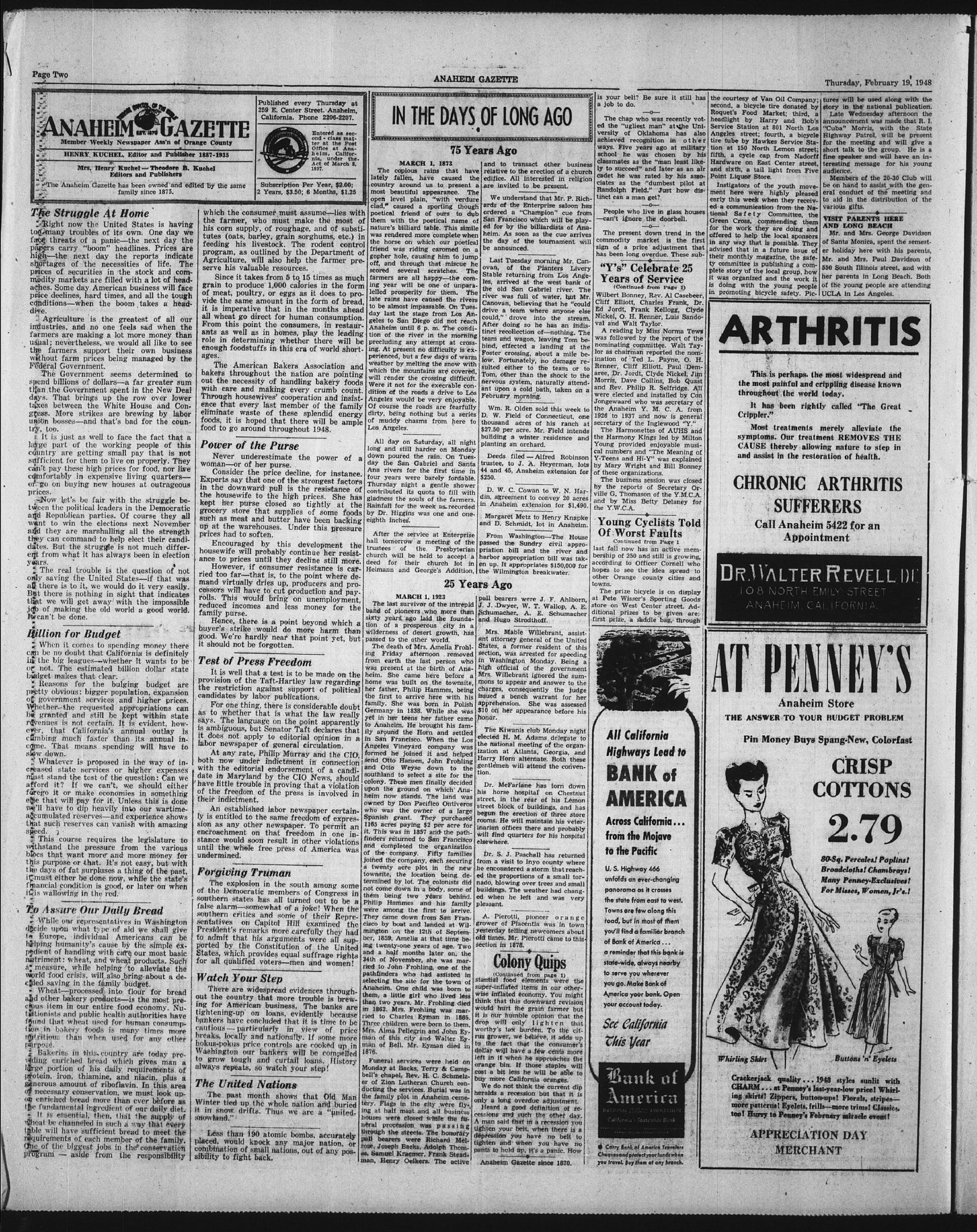
Searchable text
The Struggle At Home
Right now the United States is having too many troubles of its own. One day we face threats of a panic—the next day the papers carry "boom" headlines. Prices are high—the next day the reports indicate shortages of the necessities of life. The prices of securities in the stock and commodity markets are filled with a lot of headaches. Some day American business will face price declines, hard times, and all the tough conditions—when the boom takes a head dive.
Agriculture is the greatest of all our industries, and no one feels sad when the farmers are making a lot more money than usual; nevertheless, we would all like to see the farmers support their own business without farm prices being managed by the Federal Government.
The Government seems determined to spend billions of dollars—a far greater sum than the Government spent in the New Deal days. That brings up the row over lower taxes between the White House and Congress. More strikes are brewing by labor union bosses—and that's bad for the country, too.
It is just as well to face the fact that a large part of the working people of this country are getting small pay that is not sufficient for them to live or prosperly.
which the consumer must assume—lies with the farmer, who must make the most of his corn supply, of roughage, and of substitutes (oats, barley, grain sorghums, etc.) in feeding his livestock. The rodent control program, as outlined by the Department of Agriculture, will also help the farmer preserve his valuable resources.
Since it takes from 5 to 15 times as much grain to produce 1,000 calories in the form of meat, poultry, or eggs as it does to provide the same amount in the form of bread, it is imperative that in the months ahead all wheat go direct for human consumption. From this point the consumers, in restaurants as well as in homes, play the leading role in determining whether there will be enough foodstuffs in this era of world shortages.
The American Bakers Association and bakers throughout the nation are pointing out the necessity of handling bakery foods with care and making every crumb count. Through housewives' cooperation and insistence that every last member of the family eliminate waste of these splendid energy foods, it is hoped that there will be ample food to go around throughout 1948.
Power of the Purse
Never underestimate the power of a
Federal Government.
The Government seems determined to spend billions of dollars—a far greater sum than the Government spent in the New Deal days. That brings up the row over lower taxes between the White House and Congress. More strikes are brewing by labor union bosses—and that's bad for the country, too.
It is just as well to face the fact that a large part of the working people of this country are getting small pay that is not sufficient for them to live on properly. They can't pay these high prices for food, nor live comfortably in expensive living quarters—or go on buying new houses at outrageous prices.
Now let's be fair with the struggle between the political leaders in the Democratic and Republican parties. Of course they all want to win the elections next November and they are marshalling all the strength they can command to help elect their candidates. But the struggle is not much different from what it has always been in election years.
The real trouble is the question of not only saving the United States—if that was all there is to it, we would do it very easily. But there is nothing in sight that indicates that we will get away with the impossible job of making the old world a good world. It can't be done.
Billion for Budget
When it comes to spending money there can be no doubt that California is definitely in the big leagues—whether it wants to be or not. The estimated billion dollar state budget makes that clear.
Reasons for the bulging budget are pretty obvious: bigger population, expansion of government services and higher prices. Whether the requested appropriations can be granted and still be kept within state revenues is not certain. It is evident, however, that California's annual outlay is climbing much faster than its annual income. That means spending will have to slow down.
Whatever is proposed in the way of increased state services or higher expenses must stand the test of the question: Can we afford it? If we can't, we should either forego it or make economies in something else that will pay for it. Unless this is done we'll have to dip heavily into our wartime-accumulated reserves—and experience shows that such reserves can vanish with amazing speed.
This course requires the legislature to withstand the pressure from the various blocks that want more and more money for this purpose or that. It's not easy, but with the days of fat surpluses a thing of the past.
The American Bakers Association and bakers throughout the nation are pointing out the necessity of handling bakery foods with care and making every crumb count. Through housewives' cooperation and insistence that every last member of the family eliminate waste of these splendid energy foods, it is hoped that there will be ample food to go around throughout 1948.
Power of the Purse
Never underestimate the power of a woman—or of her purse.
Consider the price decline, for instance. Experts say that one of the strongest factors in the downward pull is the resistance of the housewife to the high prices. She has kept her purse closed so tightly at the grocery store that supplies of some foods such as meat and butter have been backing up at the warehouses. Under this pressure prices had to soften.
Encouraged by this development the housewife will probably continue her resistance to prices until they decline still more.
However, if consumer resistance is carried too far—that is, to the point where demand virtually dries up, producers and processors will have to cut production and payrolls. This would bring on unemployment, reduced incomes and less money for the family purse.
Hence, there is a point beyond which a buyer's strike would do more harm than good. We're hardly near that point yet, but it should not be forgotten.
Test of Press Freedom
It is well that a test is to be made on the provision of the Taft-Hartley law regarding the restriction against support of political candidates by labor publications.
For one thing, there is considerable doubt as to whether that is what the law really says. The language on the point apparently is ambiguous, but Senator Taft declares that it does not apply to editorial opinion in a labor newspaper of general circulation.
At any rate, Philip Murray and the CIO, both now under indictment in connection with the editorial endorsement of a candidate in Maryland by the CIO News, should have little trouble in proving that a violation of the freedom of the press is involved in their indictment.
An established labor newspaper certainly is entitled to the same freedom of expression as any other newspaper. To permit an encroachment on that freedom in one instance would soon result in other violations until the whole free press of America was undermined.
must stand the test of the question: Can we afford it? If we can't, we should either forego it or make economies in something else that will pay for it. Unless this is done we'll have to dip heavily into our wartime-accumulated reserves—and experience shows that such reserves can vanish with amazing speed.
This course requires the legislature to withstand the pressure from the various blocs that want more and more money for this purpose or that. It's not easy, but with the days of fat surpluses a thing of the past, it must either be done now, while the state's financial condition is good, or later on when it is wallowing in the red.
To Assure Our Daily Bread
While our representatives in Washington decide upon what type of aid we shall give to Europe, individual Americans can be helping humanity's cause by the simple expedient of handling with care our most basic nutriment: wheat, and wheat products. Such a measure, while helping to alleviate the world food crisis, will also bring about a decided saving in the family budget.
Wheat—processed into flour for bread and other bakery products—is the most precious item in our entire food economy. Nutritionists and public health authorities have found that wheat used for human consumption in bakery foods is many times more nutritious than when used for any other purpose.
Bakeries in this country are today providing enriched bread which gives man a large portion of his daily requirements of protein, iron, thiamine, and niacin, plus a generous amount of riboflavin. In this area of necessary conservation, we must look upon enriched bread more than ever before as the fundamental ingredient of our daily diet.
It is essential, then, that the supply of wheat be channeled in such a way that every table will have sufficient bread to meet the requirements of each member of the family. One of the biggest jobs in the conservation program — aside from the responsibility date in Maryland by the CIO News, should have little trouble in proving that a violation of the freedom of the press is involved in their indictment.
An established labor newspaper certainly is entitled to the same freedom of expression as any other newspaper. To permit an encroachment on that freedom in one instance would soon result in other violations until the whole free press of America was undermined.
Forgiving Truman
The explosion in the south among some of the Democratic members of Congress in southern states has all turned out to be a false alarm—somewhat of a joke! When the southern critics and some of their Representatives on Capitol Hill examined the President's remarks more carefully they had to admit that his arguments were all supported by the Constitution of the United States, which provides equal suffrage rights for all qualified voters—men and women!
Watch Your Step
There are widespread evidences throughout the country that more trouble is brewing for American business. The banks are tightening-up on loans, evidently because bankers have concluded that it is time to be cautious—particularly in view of price breaks, locally and nationally. If some more hokus-pokus price controls are cooked up in Washington our bankers will be compelled to grow tough and curtail loans. History always repeats, so watch your step!
The United Nations
The past month shows that Old Man Winter tied up the whole nation and buried it in snow drifts. Thus we are a "united-snowland."
Less than 190 atomic bombs, accurately placed, would knock any major nation, or combination of small nations, out of any possibility to fight back.
IN THE DAYS OF LONG AGO
75 Years Ago
MARCH 1, 1873
The copious rains that have lately fallen, have caused the country around us to present a most beautiful appearance. The open level plain, "with verdure clad," caused a sporting though poetical friend of ours to dub them with the poetical name of nature's billiard table. This simile was rendered more complete when the horse on which our poetical friend was riding caromed on a gopher hole, causing him to jump off, and through that miscue he scored several scratches. The farmers are all happy—the coming year will be one of unparalleled prosperity for them. The late rains have caused the rivers to be almost impassable. On Tuesday last the stage from Los Angeles to San Diego did not reach Anaheim until 6 p.m. The condition of the river in the morning precluding any attempt at crossing. At present no difficulty is experienced, but a few days of warm weather by melting the snow with which the mountains are covered, will render the crossing difficult. Were it not for the execrable condition of the roads a drive to Los Angeles would be very enjoyable. Of course the roads are fearfully dirty, being nothing but a series of muddy chasms from here to Los Angeles.
All day on Saturday, all night long and still harder on Monday down poured the rain. On Tuesday and to transact other business relative to the erection of a church edifice. All interested in religion are invited to be present.
We understand that Mr. P. Richards of the Enterprise saloon has ordered a "Champion" cue from San Francisco which will be played for by the billiardists of Anaheim. As soon as the cue arrives the day of the tournament will be announced.
Last Tuesday morning Mr. Canovan, of the Planters Livery Stable returning from Los Angeles, arrived at the west bank of the old San Gabriel river. The river was full of water, but Mr. Canovan, believing that he "could drive a team where anyone else could," drove into the stream. After doing so he has an indistinct recollection of—nothing. The team and wagon, leaving Tom behind, effected a landing at the Foster crossing, about a mile below. Fortunately, no damage resulted either to the team or to Tom, other than the shock to the nervous system, naturally attendant upon a cold bath, taken on a February morning.
Wm. R. Olden sold this week to D. W. Field of Connecticut, one thousand acres of his ranch at $27.50 per acre. Mr. Field intends building a winter residence and planting an orchard.
Deeds filed — Alfred Robinson is your belt? Be sure it still a job to do.
The chap who was recently edited the "ugliest man" at the university of Oklahoma has achieved recognition in other ways. Five years ago at mil school he was chosen by classmates as the "man least likely to succeed" and later as an cadet he was rated by his ciates as the "dumbest pilot Randolph Field." Just how tinct can a man get?
People who live in glass hoo—can't ignore the doorbell.
The present down trend in commodity market is the sign of a price adjustment has been long overdue. These "Y's" Celebrate 25 Years of Service
(Wilbert Bonney, Rev. Al Casek Cliff Elliott, Charles Frank, Ed Jordt, Frank Kellogg, C.C Nickel, O. H. Renner, Luis San val and Walt Taylor.
A reading by Miss Norma T was followed by the report of nominating committee. Walt T尔or as chairman reported the mation of Ted L. Payne, O.Renner, Cliff Elliott, Paul D aree, Dr. Jordt, Clyde Nickel, Morris, Dave Collins, Bob Q and Rev. Philip R. Selfridge were elected and installed by Jongewaard who was secretary of Anaheim Y. M. C. A. for 1926 to 1937 and now is general secretary of the Inglewood "Y."
The Harmonettes of AUHS the Harmony Kings led by Mil Young provided enjoyable musical numbers and "The Meaning Y-Teens and Hi-Y" was explai
25 Years Ago
MARCH 1, 1923
The last survivor of the intrepid band of pioneers who more than sixty years ago laid the foundation of a prosperous city in a wilderness of desert growth, has passed to the other world.
The death of Mrs. Amelia Frohling Friday afternoon removed from earth the last person who was present at the birth of Anaheim. She came here before a home was built on the townsite, her father, Philip Hammes, being the first to arrive here with his family. She was born in Polish Germany in 1838. While she was yet in her teens her father came to Anaheim. He brought his family around the Horn and settled in San Francisco. When the Los Angeles Vineyard company was formed he joined it and helped send Otto Hansen, John Frohling and Otto Weyse down to the southland to select a site for the colony. These men finally decided upon the ground on which Anaheim now stands. The land was owned by Don Pacifico Ontiveros who was the owner of a large Spanish grant. They purchased 1165 acres paying $2 per acre for it. This was in 1857 and the pathfinders returned to San Francisco and completed the organization of the company. Fifty families joined the company, each securing a twenty acre plot in the new weather by melting the snow with which the mountains are covered, will render the crossing difficult. Were it not for the execrable condition of the roads a drive to Los Angeles would be very enjoyable. Of course the roads are fearfully dirty, being nothing but a series of muddy chasms from here to Los Angeles.
All day on Saturday, all night long and still harder on Monday down poured the rain. On Tuesday the San Gabriel and Santa Ana rivers for the first time in four years were barely fordable. Thursday night a gentle shower contributed its quota to fill with gladness the souls of the farmers. Rainfall for the week as recorded by Dr. Higgins was one and one-eighth inches.
After the service at Enterprise hall tomorrow a meeting of the trustees of the Presbyterian church will be held to accept a deed for their church lot in Heimann and George's Addition,
From Washington—The House passed the Sundry civil appropriation bill and the river and harbor appropriation bill was taken up. It appropriates $150,000 for the Wilmington breakwater.
Mrs. Mable Willebrant, assistant attorney general of the United States, a former resident of this section, was arrested for speeding in Washington Monday. Being a high official of the government Mrs. Willebrant ignored the summons to appear and answer to the charges, consequently the judge issued a bench warrant for her apprehension. She was assessed $10 on her appearance before his honor.
The Kiwanis club Monday night elected H. M. Adams delegate to the national meeting of the organization at Atlanta, Georgia, and Harry Horn alternate. Both these gentlemen will attend the convention.
Dr. McFarlane has torn down his horse hospital on Chestnut street, in the rear of his Lemon street block of buildings, and has begun the erection of three store rooms. He will maintain his veterinarian offices there and probably will find quarters for his hospital elsewhere.
Dr. S. J. Paschall has returned from a visit to Inyo county where he encountered a storm that reached
newspaper certain freedom of express paper. To permit an freedom in one in other violations of America was southland to select a site for the colony. These men finally decided upon the ground on which Anaheim now stands. The land was owned by Don Pacifico Ontiveros who was the owner of a large Spanish grant. They purchased 1165 acres paying $2 per acre for it. This was in 1857 and the pathfinders returned to San Francisco and completed the organization of the company. Fifty families joined the company, each securing a twenty acre plot in the new townsite, the location being determined by lot. The colonists did not come down in a body, some of them being two years behind. Philip Hammes and his family were among the first to arrive. They came down from San Francisco by boat and landed at Wilmington on the 12th of September, 1859, Amelia at that time being twenty-one years of age. Two and a half months later on, the 24th of November, she was married to John Frohling, one of the pathfinders who had assisted in selecting the site for the town of Anaheim. One child was born to them, a little girl who lived less than two years. Mr. Frohling died in 1862. Mrs. Frohling was married to Charles Eyman in 1865. Three children were born to them, Mrs. Alma Pellegrin and John Eyman of this city and Walter Eyman of Bell. Mr. Eyman died in 1876.
Funeral services were held on Monday at Backs, Terry & Campbell's chapel, Rev. H. C. Schmelzer of Zion Lutheran Church conducting the services. Burial was in the family plot in Anaheim cemetery. Flags in the city were flying at half mast and all business houses were closed while the funeral procession was passing through the streets. The honorary pall bearers were Richard Melrose, Joseph Backs, Adolph Thomas, Samuel Kraemer, Frank Steadman, Henry Oelkers. The active
Dr. McFarlane has torn down his horse hospital on Chestnut street, in the rear of his Lemon street block of buildings, and has begun the erection of three store rooms. He will maintain his veterinarian offices there and probably will find quarters for his hospital elsewhere.
Dr. S. J. Paschall has returned from a visit to Inyo county where he encountered a storm that reached the proportions of a small tornado, blowing over trees and small buildings. The weather had changed when he left and was very pleasant.
A. Pierotti, pioneer orange grower of Placentia was in town yesterday telling newcomers about old times. Mr. Pierotti came to this section in 1878.
Colony Quips
(Continued from page 1)
stantial food elements were the super-inflated items in our otherwise inflated economy. You might think that this downward revision would hurt the grain farmer but it is our humble opinion that the drop will only lighten that worthy's tax burden. To the citrus grower, we believe, it adds up to the fact that the consumer's dollar will have a few cents more left in it when he approaches the orange bin. If those staples will cost a bit less he will be able to buy more California oranges.
We do not think the current dip heralds a recession but that it is only a long overdue adjustment.
Heard a good definition of recessions and such the other day. A man said that in a recession you tighten your belt, when there is a depression you have no belt to tighten and when you have no pants to hold up, it's a panic.
Anaheim Gazette since 1870.
Thursday, February 19, 1948
the chap who was recently voted "ugliest man" at the University of Oklahoma has also received recognition in other schools. Five years ago at military school he was chosen by hismates as the "man least like succeed" and later as an air force officer he was rated by his associates as the "dumbest pilot at Dolphin Field." Just how disinterested can a man get?
people who live in glass houses don't ignore the doorbell.
The present down trend in the commodity market is the first of a price adjustment that began long overdue. These subsections celebrate 25 years of Service (Continued from Page 1)
bert Bonney, Rev. Al Casebeer, Elliott, Charles Frank, Dr.ordt, Frank Kellogg, Clydeel, O. H. Renner, Luis Sandoand Walt Taylor.
Reading by Miss Norma Tews followed by the report of theinating committee. Walt Tayler, chairman reported the nomination of Ted L. Payne, O. H. Herer, Cliff Elliott, Paul Dem-Dr. Jordt, Clyde Nickel, Jim Jones, Dave Collins, Bob Quast Rev. Philip R. Selfridge. All selected and installed by Conwayward who was secretary of Annaheim Y. M. C. A. from to 1937 and now is general secretary of the Inglewood "Y."
Harmonettes of AUHS and Harmony Kings led by Milton provided enjoyable music numbers and "The Meaning of Songs and Hi-Y" was explained the courtesy of Van Oil Company; second, a bicycle tire donated by Roquet's Food Market; third, a headlight by Harry and Bob's Service Station at 801 North Los Angeles street; fourth, a bicycle tire tube by Hawkes Service Station at 150 North Lemon street; fifth, a cycle cap from Nadorff Hardware on East Center street, and sixth, a tail light from Five Point Liquor Store.
Instigators of the youth movement here were highly pleased early this week when they received a communication from the National Safety Committee, the Green Cross, commending them for the work they are doing and offered to help the local sponsors in any way that is possible. They advised that in a future issue of their monthly magazine, the safety committee is publishing a complete story of the local group, how it was organized and the work it is doing with the young people in promoting bicycle safety. Pic-
tures will be used along with the story in the national publication.
Late Wednesday afternoon the announcement was made that R. I. "Cuba" Morris, with the State Highway Patrol, will be present for the meeting and will give a short talk to the group. He is a fine speaker and will have an interesting message for his young audience.
Members of the 20-30 Club will be on hand to assist with the general conduct of the meeting and to aid in the distribution of the various gifts.
VISIT PARENTS HERE AND LONG BEACH
Mr. and Mrs. George Davidson of Santa Monica, spent the semester holiday here with his parents, Mr. and Mrs. Paul Davidson of 550 South Illinois street, and with her parents in Long Beach. Both of the young people are attending UCLA in Los Angeles.
ARTHRITIS
This is perhaps the most widespread and the most painful and crippling disease known throughout the world today.
It has been rightly called "The Great Crippler."
Most treatments merely alleviate the symptoms. Our treatment REMOVES THE CAUSE thereby allowing nature to step in and assist in the restoration of health.
This is perhaps the most widespread and
the most painful and crippling disease known
throughout the world today.
It has been rightly called "The Great
Crippler."
Most treatments merely alleviate the
symptoms. Our treatment REMOVES THE
CAUSE thereby allowing nature to step in
and assist in the restoration of health.
CHRONIC ARTHRITIS
SUFFERERS
Call Anaheim 5422 for an
Appointment
DR.WALTER REVELL DC
108 NORTH EMILY STREET
ANAHEIM, CALIFORNIA.
AT PENNEY'S
Anaheim Store
THE ANSWER TO YOUR BUDGET PROBLEM
Pin Money Buys Spang-New, Colorfast
CRISP
COTTONS
2.79
80-Sq. Percale! Poplins!
Broadcloth! Chambras!
COTTONS
2.79
80-Sq. Percale! Poplins!
Broadcloths! Chambrays!
Many Penney-Exclusives!
For Misses, Women, Jr's!
Whirling Skirt
Buttons 'n' Eyelets
Crackerjack quality...1948 styles sunlit with
CHARM...at Penney's last-year-low price! Whirling skirts! Zippers, button-ups! Florals, stripes—
more patterns! Eyelets, frills—more trims! Classics,
too! Hurry to Penney's February miracle event!
APPRECIATION DAY
MERCHANT