anaheim-gazette 1947-12-04
Scanned page
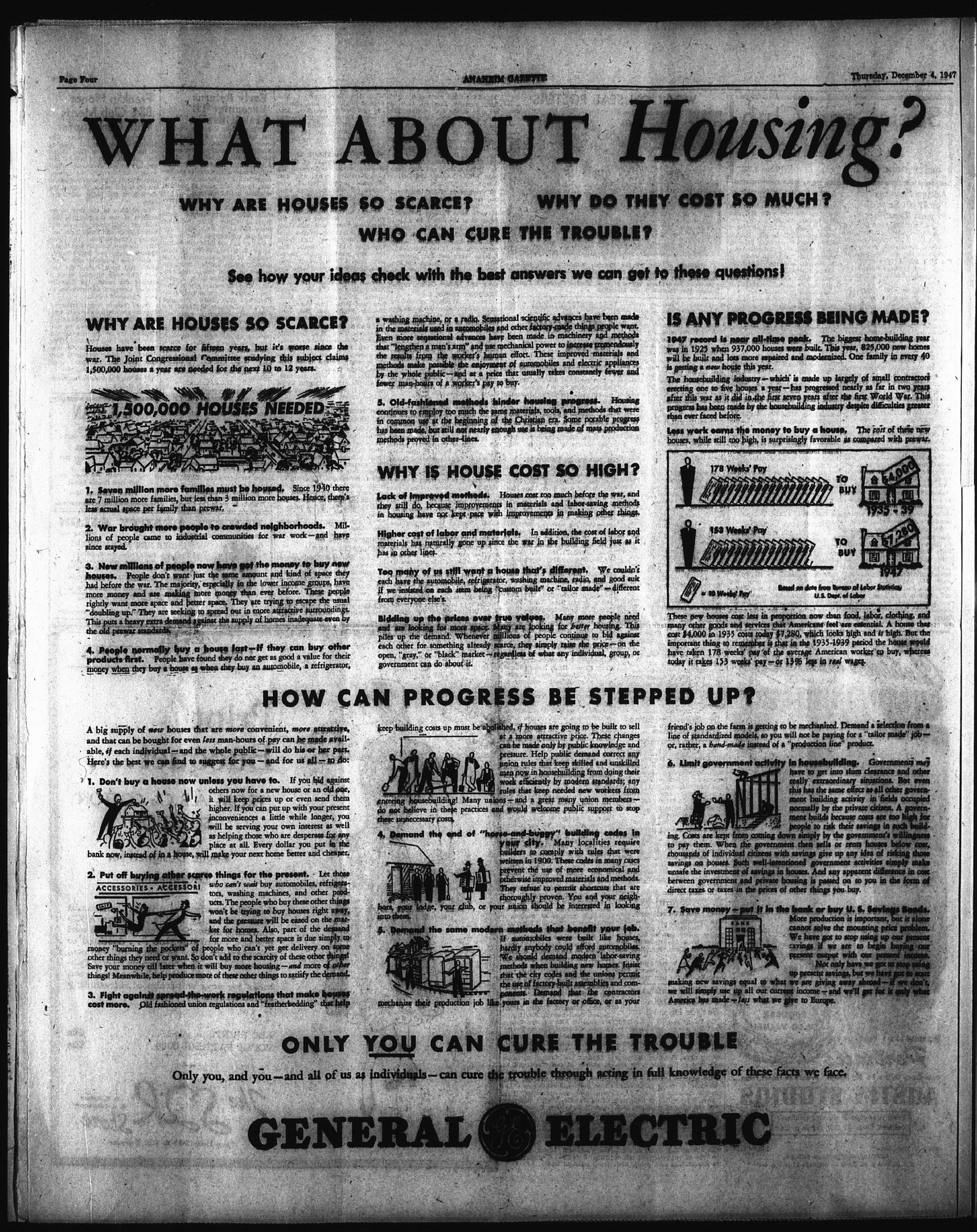
Searchable text
Page Four
WHAT A
WHY ARE HOUSES S
See how your ideas
WHY ARE HOUSES SO SCARCE?
Houses have been scarce for fifteen years, but it's worse since the war. The Joint Congressional Committee studying this subject claims 1,500,000 houses a year are needed for the next 10 to 12 years.
1,500,000 HOUSES NEEDED
1. Seven million more families must be housed. Since 1940 there are 7 million more families, but less than 3 million more houses. Hence, there's less actual space per family than prewar.
2. War brought more people to crowded neighborhoods. Millions of people came to industrial communities for war work—and have since stayed.
3. New millions of people now have got the money to buy new houses. People don't want just the same amount and kind of space they had before the war. The majority, especially in the lower income groups, have more money and are making more money than ever before. These people rightly want more space and better space. They are trying to escape the usual "doubling up." They are seeking to spread out in more attractive surroundings. This puts a heavy extra demand against the supply of homes inadequate even by the old prewar standards.
4. People normally buy a house last—if they can buy other products first. People have found they do not get as good a value for their money when they buy a house as when they buy an automobile, a refrigerator,
A big supply of new houses that are more convenient, more attractive, and that can be bought for even less man-hours of pay can be made available, if each individual—and the whole public—will do his or her part. Here's the best we can find to suggest for you—and for us all—to do:
1. Don't buy a house now unless you have to. If you bid against others now for a new house or an old one, it will keep prices up or even send them higher. If you can put up with your present inconveniences a little while longer, you will be serving your own interest as well as helping those who are desperate for any place at all. Every dollar you put in the bank now, instead of in a house, will make your next home better and cheaper.
1. Don’t buy a house now unless you have to. If you bid against others now for a new house or an old one, it will keep prices up or even send them higher. If you can put up with your present inconveniences a little while longer, you will be serving your own interest as well as helping those who are desperate for any place at all. Every dollar you put in the bank now, instead of in a house, will make your next home better and cheaper.
2. Put off buying other scarce things for the present. Let those who can't wait buy automobiles, refrigerators, washing machines, and other products. The people who buy these other things won't be trying to buy houses right away, and the pressure will be eased on the market for homes. Also, part of the demand for more and better space is due simply to money "burning the pockets" of people who can't yet get delivery on some other things they need or want. So don't add to the scarcity of these other things! Save your money till later when it will buy more housing—and more of other things! Meanwhile, help produce more of these other things to satisfy the demand.
3. Fight against spread-the-work regulations that make houses cost more. Old fashioned union regulations and "featherbedding" that help
ONLY
Only you, and you—and all of us as
T ABOUT Houses so scarce? WHY DO THEY CHOOSE WHO CAN CURE THE TROUBLE?
your ideas check with the best answers we can get to the
CARCE?
worse since the subject claims 12 years.
EDED
a washing machine, or a radio. Sensational scientific advances have been made in the materials used in automobiles and other factory-made things people want. Even more sensational advances have been made in machinery and methods that "lengthen a man's arm" and use mechanical power to increase tremendously the results from the worker's human effort. These improved materials and methods make possible the enjoyment of automobiles and electric appliances by the whole public—and at a price that usually takes constantly fewer and fewer man-hours of a worker's pay to buy.
5. Old-fashioned methods hinder housing progress. Housing continues to employ too much the same materials, tools, and methods that were in common use at the beginning of the Christian era. Some notable progress has been made, but still not nearly enough use is being made of mass production methods proved in other lines.
IS A
1947 was in will be is getting The ho erecting after the progress than ev Less w houses,
5. Old-fashioned methods hinder housing progress. Housing continues to employ too much the same materials, tools, and methods that were in common use at the beginning of the Christian era. Some notable progress has been made, but still not nearly enough use is being made of mass production methods proved in other lines.
WHY IS HOUSE COST SO HIGH?
Lack of improved methods. Houses cost too much before the war, and they still do, because improvements in materials and labor-saving methods in housing have not kept pace with improvements in making other things.
Higher cost of labor and materials. In addition, the cost of labor and materials has naturally gone up since the war in the building field just as it has in other lines.
Too many of us still want a house that's different. We couldn't each have the automobile, refrigerator, washing machine, radio, and good suit if we insisted on each item being "custom built" or "tailor made"—different from everyone else's.
Bidding up the prices over true values. Many more people need and are looking for more space. Many are looking for better housing. This piles up the demand. Whenever millions of people continue to bid against each other for something already scarce, they simply raise the price—on the open, "gray," or "black" market—regardless of what any individual, group, or government can do about it.
HOW CAN PROGRESS BE STEPPED
keep building costs up must be abolished, if houses are going to be built to sell at a more attractive price. These changes can be made only by public knowledge and pressure. Help public demand correct any union rules that keep skilled and unskilled men now in housebuilding from doing their work efficiently by modern standards; any rules that keep needed new workers from entering housebuilding! Many unions—and a great many union members—do not believe in these practices and would welcome public support to stop these unnecessary costs.
4. Demand the end of "horse-and-buggy" building codes in your city. Many localities require builders to comply with rules that were written in 1900. These codes in many cases prevent the use of more economical and
If you bid against house or an old one,
or even send them
up with your present
while longer, you
own interest as well
are desperate for any
alar you put in the
better and cheaper.
4. Demand the end of "horse-and-buggy" building codes in your city. Many localities require builders to comply with rules that were written in 1900. These codes in many cases prevent the use of more economical and otherwise improved materials and methods. They refuse to permit shortcuts that are thoroughly proven. You and your neighbors, your lodge, your club, or your union should be interested in looking into them.
5. Demand the same modern methods that benefit your job.
If automobiles were built like houses,
hardly anybody could afford automobiles.
We should demand modern labor-saving methods when building new homes. Insist that the city codes and the unions permit the use of factory-built assemblies and components. Demand that the contractors yours in the factory or office, or as your mechanize their production job like
ONLY YOU CAN CURE THE TROU
and all of us as individuals—can cure the trouble through acting in full know
GENERAL ELECT
Thursday, December 4, 1947
Housing?
DO THEY COST SO MUCH?
BLE?
can get to these questions!
IS ANY PROGRESS BEING MADE?
1947 record is near all-time peak. The biggest home-building year was in 1925 when 937,000 houses were built. This year, 825,000 new homes will be built and lots more repaired and modernized. One family in every 40 is getting a new house this year.
The housebuilding industry—which is made up largely of small contractors erecting one to five houses a year—has progressed nearly as far in two years after this war as it did in the first seven years after the first World War. This progress has been made by the housebuilding industry despite difficulties greater than ever faced before.
Less work earns the money to buy a house. The cost of these new houses, while still too high, is surprisingly favorable as compared with prewar.
The housebuilding industry—which is made up largely of small contractors erecting one to five houses a year—has progressed nearly as far in two years after this war as it did in the first seven years after the first World War. This progress has been made by the housebuilding industry despite difficulties greater than ever faced before.
Less work earns the money to buy a house. The cost of these new houses, while still too high, is surprisingly favorable as compared with prewar.
These new houses cost less in proportion now than food, labor, clothing, and many other goods and services that Americans feel are essential. A house that cost $4,000 in 1935 costs today $7,280, which looks high and is high. But the important thing to remember is that in the 1935-1939 period the house would have taken 178 weeks' pay of the average American worker to buy, whereas today it takes 153 weeks' pay—or 13% less in real wages.
STEPPED UP?
friend's job on the farm is getting to be mechanized. Demand a selection from a line of standardized models, so you will not be paying for a "tailor made" job—or, rather, a hand-made instead of a "production line" product.
6. Limit government activity in housebuilding. Governments may have to get into slum clearance and other really extraordinary situations. But even this has the same effect as all other government building activity in fields occupied normally by the private citizen. A government builds because costs are too high for people to risk their savings in such building. Costs are kept from coming down simply by the government's willingness to pay them. When the government then sells or rents houses below cost, thousands of individual citizens with savings give up any idea of risking those savings on houses. Such well-intentioned government activities simply make
really extraordinary situations. But even this has the same effect as all other government building activity in fields occupied normally by the private citizen. A government builds because costs are too high for people to risk their savings in such building. Costs are kept from coming down simply by the government's willingness to pay them. When the government then sells or rents houses below cost, thousands of individual citizens with savings give up any idea of risking those savings on houses. Such well-intentioned government activities simply make unsafe the investment of savings in houses. And any apparent difference in cost between government and private housing is passed on to you in the form of direct taxes or taxes in the prices of other things you buy.
7. Save money—put it in the bank or buy U.S. Savings Bonds.
More production is important, but it alone cannot solve the mounting price problem. We have got to stop using up our present savings if we are to begin buying our present output with our present income.
Not only have we got to stop using up present savings, but we have got to start making new savings equal to what we are giving away abroad—if we don't, we will simply use up all our current income—and we'll get for it only what America has made—less what we give to Europe.
THE TROUBLE
ing in full knowledge of these facts we face.
ECTRIC