anaheim-gazette 1947-11-06
Scanned page
Searchable text
Thursday, November 6, 1947
HOW BIG ARE GREAT
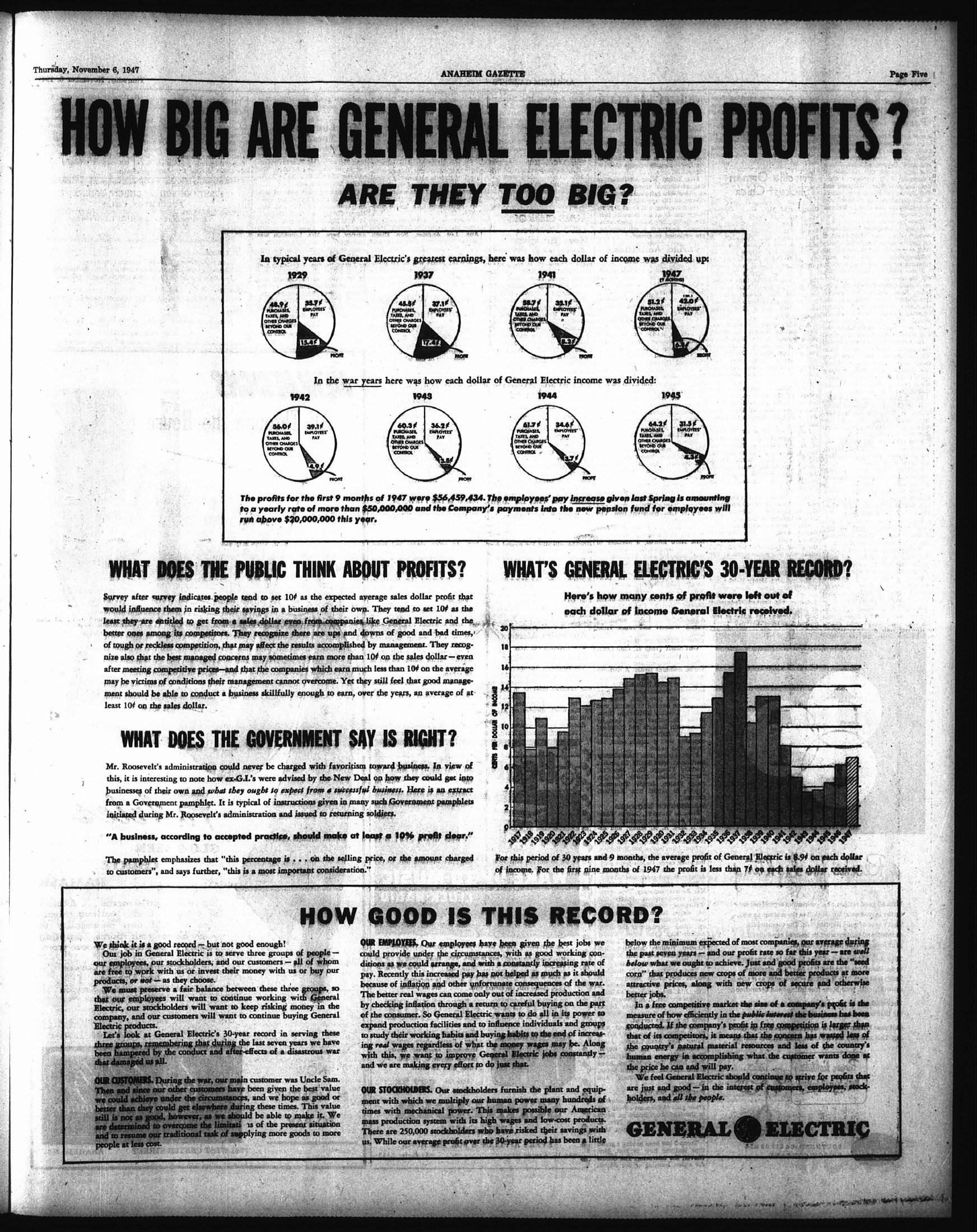
In typical years of Genera
1929
48.9¢ PURCHASES,
TAXES, AND
OTHER CHARGES
BEYOND OUR CONTROL
35.7¢ EMPLOYEES'
PAY
15.4¢ PROFIT
In the war y
1942
56.0¢ PURCHASES,
TAXES, AND
OTHER CHARGES
BEYOND OUR CONTROL
39.1¢ EMPLOYEES'
PAY
WHAT DOES THE PUBLIC THINK ABOUT
Survey after survey indicates people tend to set 10¢ as the expected availwould influence them in risking their savings in a business of their own.
least they are entitled to get from a sales dollar even from companies
better ones among its competitors. They recognize there are ups and d
of tough or reckless competition, that may affect the results accomplished
nize also that the best managed concerns may sometimes earn more than
after meeting competitive prices—and that the companies which earn mu
may be victims of conditions their management cannot overcome. Yet th
ment should be able to conduct a business skillfully enough to earn, ove
least 10¢ on the sales dollar.
WHAT DOES THE GOVERNMENT SAY
Mr. Roosevelt's administration could never be charged with favoritism
this, it is interesting to note how ex-G.I.'s were advised by the New Debies businesses of their own and what they ought to expect from a successful
from a Government pamphlet. It is typical of instructions given in man
initiated during Mr. Roosevelt's administration and issued to returning
"A business, according to accepted practice, should make at
We think it is a good record—but not good enough!
Our job in General Electric is to serve three groups of people—our employees, our stockholders; and our customers—all of whom are free to work with us or invest their money with us or buy our products, or not—as they choose.
We must preserve a fair balance between these three groups, so that our employees will want to continue working with General Electric, our stockholders will want to keep risking money in the company, and our customers will want to continue buying General Electric products.
Let's look at General Electric's 30-year record in serving these three groups, remembering that during the last seven years we have been hampered by the conduct and after-effects of a disastrous war that damaged us all.
OUR CUSTOMERS. During the war, our main customer was Uncle Sam. Then and since our other customers have been given the best value we could achieve under the circumstances, and we hope as good or better than they could get elsewhere during these times. This value still is not as good, however, as we should be able to make it. We are determined to overcome the limitations of the present situation and to resume our traditional task of supplying more goods to more people at less cost.
ANAHEIM GAZETTE
RE GENERAL ELECTRIC
ARE THEY TOO BIG?
ical years of General Electric's greatest earnings, here was how each dollar of income was divided:
1929
35.7¢ EMPLOYEES' PAY
15.4¢ PROFIT
1937
45.8¢ PURCHASES, TAXES, AND OTHER CHARGES BEYOND OUR CONTROL
37.1¢ EMPLOYEES' PAY
17.4¢ PROFIT
1941
58.7¢ PURCHASES, TAXES, AND OTHER CHARGES BEYOND OUR CONTROL
33.1¢ EMPLOYEES' PAY
8.2¢ PROFIT
1947 (9 MONTHS)
51.2¢ PURCHASES, TAXES, AND OTHER CHARGES BEYOND OUR CONTROL
42.6¢ EMPLOYEES' PAY
6.8¢ PROFIT
In the war years here was how each dollar of General Electric income was divided:
1942
39.1¢ EMPLOYEES' PAY
1943
60.3¢ PURCHASES, TAXES, AND OTHER CHARGES BEYOND OUR CONTROL
36.2¢ EMPLOYEES' PAY
1944
61.7¢ PURCHASES, TAXES, AND OTHER CHARGES BEYOND OUR CONTROL
34.6¢ EMPLOYEES' PAY
1945
64.2¢ PURCHASES, TAXES, AND OTHER CHARGES BEYOND OUR CONTROL
31.5¢ EMPLOYEES' PAY
In the war years here was how each dollar of General Electric income was divided:
1942
39.1¢ EMPLOYEES' PAY
4.9¢ PROFIT
1943
60.3¢ PURCHASES, TAXES, AND OTHER CHARGES BEYOND OUR CONTROL
36.2¢ EMPLOYEES' PAY
3.8¢ PROFIT
1944
61.7¢ PURCHASES, TAXES, AND OTHER CHARGES BEYOND OUR CONTROL
34.6¢ EMPLOYEES' PAY
3.7¢ PROFIT
1945
64.2¢ PURCHASES, TAXES, AND OTHER CHARGES BEYOND OUR CONTROL
31.5¢ EMPLOYEES' PAY
4.1¢ PROFIT
for the first 9 months of 1947 were $56,459,434. The employees’ pay increase given last Spring is at a rate of more than $50,000,000 and the Company’s payments into the new pension fund for employees exceed $20,000,000 this year.
THINK ABOUT PROFITS?
10¢ as the expected average sales dollar profit that business of their own. They tend to set 10¢ as the even from companies like General Electric and the there are ups and downs of good and bad times, the results accomplished by management. They recog- times earn more than 10¢ on the sales dollar—even companies which earn much less than 10¢ on the average cannot overcome. Yet they still feel that good manage- lily enough to earn, over the years, an average of at-
GOVNMENT SAY IS RIGHT?
charged with favoritism toward business. In view of revised by the New Deal on how they could get into expect from a successful business. Here is an extract instructions given in many such Government pamphlets issued to returning soldiers.
should make at least a 10% profit clear."
For this period of 30 years and 9 months, the average of income. For the first nine months of 1947 the pro
HOW GOOD IS THIS RECORD?
OUR EMPLOYEES. Our employees have been given the best jobs we could provide under the circumstances, with as good working conditions as we could arrange, and with a constantly increasing rate of pay. Recently this increased pay has not helped as much as it should because of inflation and other unfortunate consequences of the war. The better real wages can come only out of increased production and by checking inflation through a return to careful buying on the part of the consumer. So General Electric wants to do all in its power to expand production facilities and to influence individuals and groups to study their working habits and buying habits to the end of increasing real wages regardless of what the money wages may be. Along with this, we want to improve General Electric jobs constantly—and we are making every effort to do just that.
OUR STOCKHOLDERS. Our stockholders furnish the plant and equipment with which we multiply our human power many hundreds of times with mechanical power. This makes possible our American mass production system with its high wages and low-cost products. There are 250,000 stockholders who have risked their savings with us. While our average profit over the 30-year period has been a little
ECTRIC PROFITS?
income was divided up:
1947
(9 MONTHS)
51.2¢ PURCHASES,
TAXES, AND
OTHER CHARGES
BEYOND OUR CONTROL
42.0¢ EMPLOYEES'
PAY
6.8¢ PROFIT
as divided:
1945
64.2¢ PURCHASES,
TAXES, AND
OTHER CHARGES
BEYOND OUR CONTROL
31.5¢ EMPLOYEES'
PAY
4.3¢
as divided:
1945
64.2% PURCHASES,
TAXES, AND
OTHER CHARGES
BEYOND OUR
CONTROL
31.5% EMPLOYEES'
PAY
4.3%
PROFIT
Given last Spring is amounting
vision fund for employees will
GENERAL ELECTRIC'S 30-YEAR RECORD?
How many cents of profit were left out of
our income General Electric received.
9 months, the average profit of General Electric is 8.9¢ on each dollar
months of 1947 the profit is less than 7¢ on each sales dollar received.
months, the average profit of General Electric is 8.9% on each dollar
months of 1947 the profit is less than 7% on each sales dollar received.
ORD?
below the minimum expected of most companies, our average during
the past seven years — and our profit rate so far this year — are well
below what we ought to achieve. Just and good profits are the "seed
corn" that produces new crops of more and better products at more
attractive prices, along with new crops of secure and otherwise
better jobs.
In a free competitive market the size of a company's profit is the
measure of how efficiently in the public interest the business has been
conducted. If the company's profit in free competition is larger than
that of its competitors, it means that the concern has wasted less of
the country's natural material resources and less of the country's
human energy in accomplishing what the customer wants done at
the price he can and will pay.
We feel General Electric should continue to strive for profits that
are just and good — in the interest of customers, employees, stockholders, and all the people.
GENERAL ELECTRIC