anaheim-gazette 1947-10-30
Scanned page
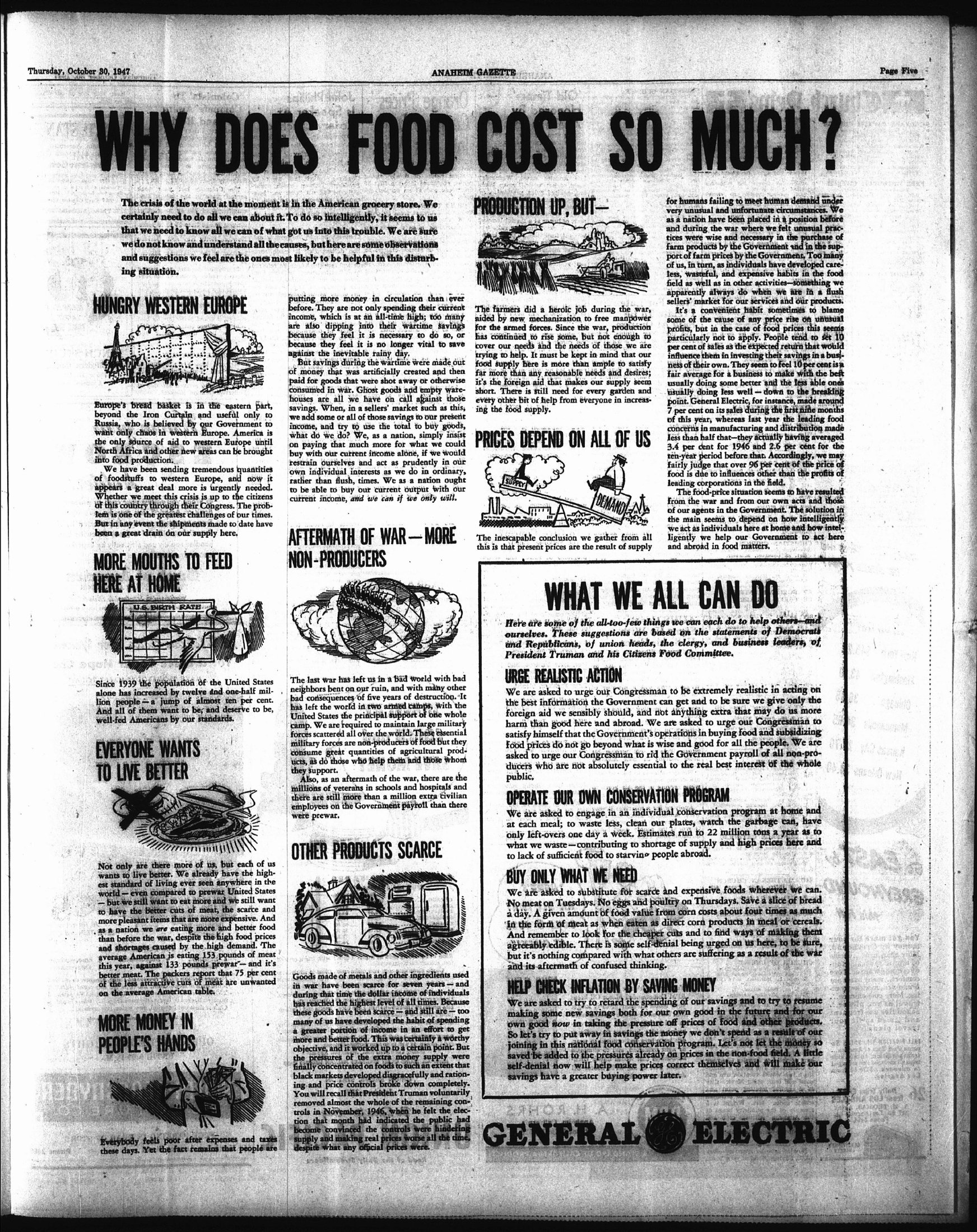
Searchable text
THURSDAY, October 30, 1947
WHY DOES F
The crisis of the world at the moment is in the American g
certainly need to do all we can about it. To do so intelligent
that we need to know all we can of what got us into this tro
we do not know and understand all the causes, but here are s
and suggestions we feel are the ones most likely to be helpf
ing situation.
HUNGRY WESTERN EUROPE
Europe's bread basket is in the eastern part,
beyond the Iron Curtain and useful only to
Russia, who is believed by our Government to
want only chaos in western Europe. America is
the only source of aid to western Europe until
North Africa and other new areas can be brought
putting more money before. They are not
income, which is at a
are also dipping in because they feel it
because they feel it against the inevitabl
But savings during
of money that was a
paid for goods that w
consumed in war. GH
houses are all we L
savings. When, in a
we add some or all of
income, and try to u
what do we do? We
on paying that much
buy with our current
Europe's bread basket is in the eastern part, beyond the Iron Curtain and useful only to Russia, who is believed by our Government to want only chaos in western Europe. America is the only source of aid to western Europe until North Africa and other new areas can be brought into food production.
We have been sending tremendous quantities of foodstuffs to western Europe, and now it appears a great deal more is urgently needed. Whether we meet this crisis is up to the citizens of this country through their Congress. The problem is one of the greatest challenges of our times. But in any event the shipments made to date have been a great drain on our supply here.
MORE MOUTHS TO FEED HERE AT HOME
Since 1939 the population of the United States alone has increased by twelve and one-half million people—a jump of almost ten per cent. And all of them want to be, and deserve to be, well-fed Americans by our standards.
EVERYONE WANTS TO LIVE BETTER
Not only are there more of us, but each of us
Not only are there more of us, but each of us wants to live better. We already have the highest standard of living ever seen anywhere in the world — even compared to prewar United States — but we still want to eat more and we still want to have the better cuts of meat, the scarce and more pleasant items that are more expensive. And as a nation we are eating more and better food than before the war, despite the high food prices and shortages caused by the high demand. The average American is eating 153 pounds of meat this year, against 133 pounds prewar—and it's better meat. The packers report that 75 per cent of the less attractive cuts of meat are unwanted on the average American table.
MORE MONEY IN PEOPLE'S HANDS
Everybody feels poor after expenses and taxes these days. Yet the fact remains that people are
ES FOOD COST SO
in the American grocery store. We
To do so intelligently, it seems to us
got us into this trouble. We are sure
uses, but here are some observations
likely to be helpful in this disturb-
putting more money in circulation than ever before. They are not only spending their current income, which is at an all-time high; too many are also dipping into their wartime savings because they feel it is necessary to do so, or because they feel it is no longer vital to save against the inevitable rainy day.
But savings during the wartime were made out of money that was artificially created and then paid for goods that were shot away or otherwise consumed in war. Ghost goods and empty warehouses are all we have on call against those savings. When, in a sellers' market such as this, we add some or all of those savings to our present income, and try to use the total to buy goods, what do we do? We, as a nation, simply insist on paying that much more for what we could buy with our current income alone, if we would
PRODUCTION UP, BUT—
The farmers did a heroic job during the war, aided by new mechanization to free manpower for the armed forces. Since the war, production has continued to rise some, but not enough to cover our needs and the needs of those we are trying to help. It must be kept in mind that our food supply here is more than ample to satisfy far more than any reasonable needs and desires; it's the foreign aid that makes our supply seem short. There is still need for every garden and every other bit of help from everyone in increasing the food supply.
PRICES DEPEND ON ALL OF US
But savings during the wartime were made out of money that was artificially created and then paid for goods that were shot away or otherwise consumed in war. Ghost goods and empty warehouses are all we have on call against those savings. When, in a sellers' market such as this, we add some or all of those savings to our present income, and try to use the total to buy goods, what do we do? We, as a nation, simply insist on paying that much more for what we could buy with our current income alone, if we would restrain ourselves and act as prudently in our own individual interests as we do in ordinary, rather than flush, times. We as a nation ought to be able to buy our current output with our current income, and we can if we only will.
AFTERMATH OF WAR — MORE NON-PRODUCERS
The last war has left us in a bad world with bad neighbors bent on our ruin, and with many other bad consequences of five years of destruction. It has left the world in two armed camps, with the United States the principal support of one whole camp. We are required to maintain large military forces scattered all over the world. These essential military forces are non-producers of food but they consume great quantities of agricultural products, as do those who help them and those whom they support.
Also, as an aftermath of the war, there are the millions of veterans in schools and hospitals and there are still more than a million extra civilian employees on the Government payroll than there were prewar.
OTHER PRODUCTS SCARCE
PRICES DEPEND ON ALL OF US
The inescapable conclusion we gather from all this is that present prices are the result of supply
WHAT WE ALL
Here are some of the all-too-few things we ourselves. These suggestions are based on Republicans, of union heads, the clear President Truman and his Citizens Food C
URGE REALISTIC ACTION
We are asked to urge our Congressman to be the best information the Government can get foreign aid we sensibly should, and not anyth harm than good here and abroad. We are ask satisfy himself that the Government's operation food prices do not go beyond what is wise and asked to urge our Congressman to rid the Gov ducers who are not absolutely essential to the public.
OPERATE OUR OWN CONSERVATION P
We are asked to engage in an individual con at each meal; to waste less, clean our plates only left-overs one day a week. Estimates run what we waste—contributing to shortage of to lack of sufficient food to starving people ab
Also, as an aftermath of the war, there are the millions of veterans in schools and hospitals and there are still more than a million extra civilian employees on the Government payroll than there were prewar.
OTHER PRODUCTS SCARCE
Goods made of metals and other ingredients used in war have been scarce for seven years — and during that time the dollar income of individuals has reached the highest level of all times. Because these goods have been scarce — and still are — too many of us have developed the habit of spending a greater portion of income in an effort to get more and better food. This was certainly a worthy objective, and it worked up to a certain point. But the pressures of the extra money supply were finally concentrated on foods to such an extent that black markets developed disgracefully and rationing and price controls broke down completely. You will recall that President Truman voluntarily removed almost the whole of the remaining controls in November, 1946, when he felt the election that month had indicated the public had become convinced the controls were hindering supply and making real prices worse all the time, despite what any official prices were.
OPERATE OUR OWN CONSERVATION PRIORITY
We are asked to engage in an individual concern at each meal; to waste less, clean our plates only left-overs one day a week. Estimates run what we waste—contributing to shortage of food to lack of sufficient food to starving people ab
BUY ONLY WHAT WE NEED
We are asked to substitute for scarce and exert No meat on Tuesdays. No eggs and poultry on a day. A given amount of food value from corn in the form of meat as when eaten as direct or And remember to look for the cheaper cuts agreeably edible. There is some self-denial because but it's nothing compared with what others are and its aftermath of confused thinking.
HELP CHECK INFLATION BY SAVING MONEY
We are asked to try to retard the spending of making some new savings both for our own own good now in taking the pressure off price. So let's try to put away in savings the money joining in this national food conservation program saved be added to the pressures already on price self-denial now will help make prices correct savings have a greater buying power later.
GENERAL
SO MUCH?
for humans failing to meet human demand under very unusual and unfortunate circumstances. We as a nation have been placed in a position before and during the war where we felt unusual practices were wise and necessary in the purchase of farm products by the Government and in the support of farm prices by the Government. Too many of us, in turn, as individuals have developed careless, wasteful, and expensive habits in the food field as well as in other activities—something we apparently always do when we are in a flush sellers' market for our services and our products.
It's a convenient habit sometimes to blame some of the cause of any price rise on unusual profits, but in the case of food prices this seems particularly not to apply. People tend to set 10 per cent of sales as the expected return that would influence them in investing their savings in a business of their own. They seem to feel 10 per cent is a fair average for a business to make with the best usually doing some better and the less able ones usually doing less well — down to the breaking point. General Electric, for instance, made around 7 per cent on its sales during the first nine months of this year, whereas last year the leading food concerns in manufacturing and distribution made less than half that—they actually having averaged 3.4 per cent for 1946 and 2.6 per cent for the ten-year period before that. Accordingly, we may
WE ALL CAN DO
Too-few things we can each do to help others—and actions are based on the statements of Democrats on heads, the clergy, and business leaders, of this Citizens Food Committee.
Congressman to be extremely realistic in acting on Government can get and to be sure we give only the would, and not anything extra that may do us more abroad. We are asked to urge our Congressman to government's operations in buying food and subsidizing what is wise and good for all the people. We are also man to rid the Government payroll of all non-profitely essential to the real best interest of the whole
CONSERVATION PROGRAM
In an individual conservation program at home and less, clean our plates, watch the garbage can, have week. Estimates run to 22 million tons a year as toting to shortage of supply and high prices here and starving people abroad.
CONSERVATION PROGRAM
an individual conservation program at home and
ess, clean our plates, watch the garbage can, have
week. Estimates run to 22 million tons a year as to
ting to shortage of supply and high prices here and
starving people abroad.
NEED
for scarce and expensive foods wherever we can.
eggs and poultry on Thursdays. Save a slice of bread
food value from corn costs about four times as much
then eaten as direct corn products in meal or cereals.
the cheaper cuts and to find ways of making them
some self-denial being urged on us here, to be sure,
with what others are suffering as a result of the war
used thinking.
BEN BY SAVING MONEY
ward the spending of our savings and to try to resume
both for our own good in the future and for our
the pressure off prices of food and other products.
savings the money we don’t spend as a result of our
food conservation program. Let’s not let the money so
ensures already on prices in the non-food field. A little
make prices correct themselves and will make our
ying power later.
GE ELECTRIC