anaheim-gazette 1947-06-26
Scanned page
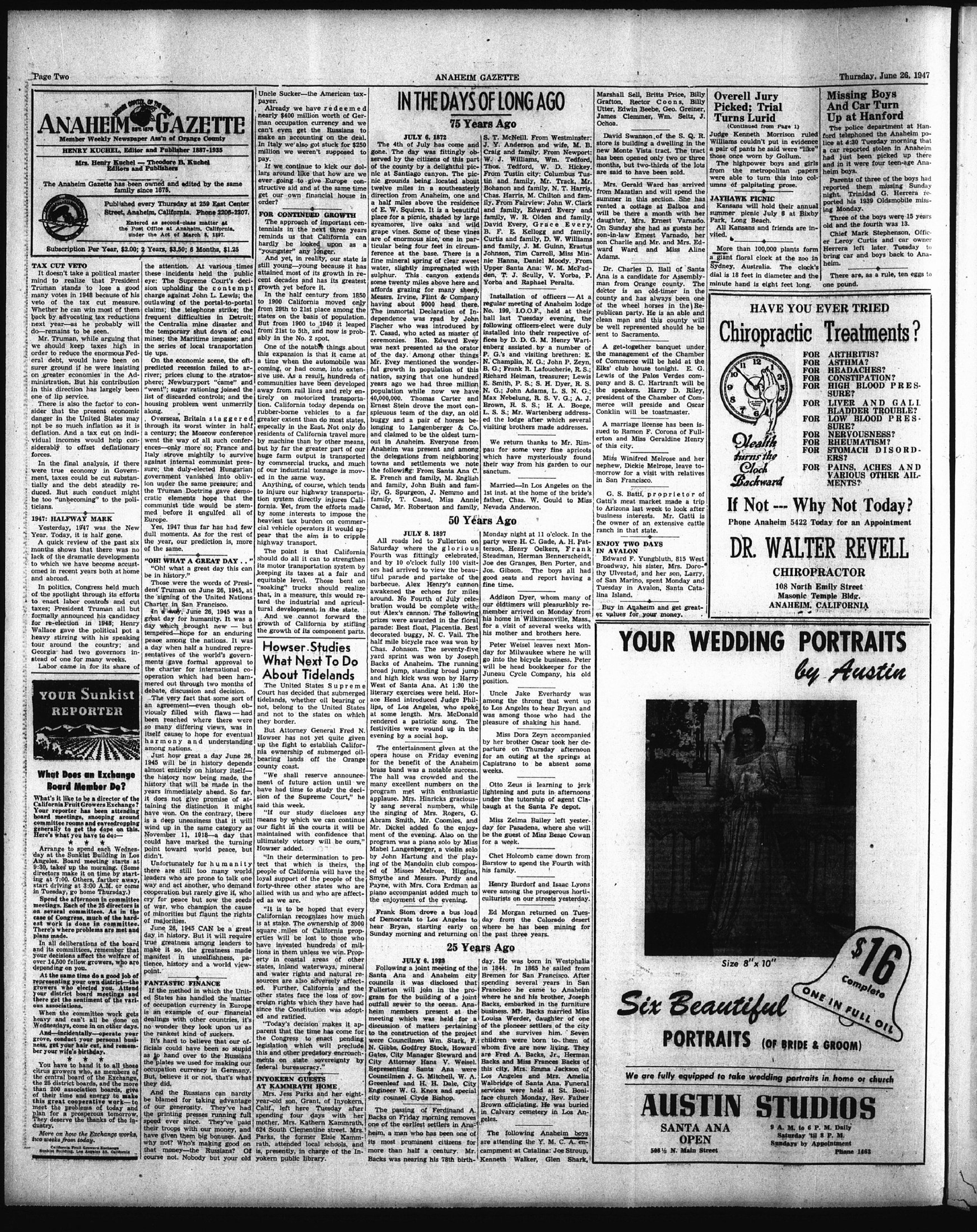
Searchable text
TAX CUT VETO
It doesn’t take a political master mind to realize that President Truman stands to lose a good many votes in 1948 because of his veto of the tax cut measure. Whether he can win most of them back by advocating tax reductions next year—as he probably will do—remains to be seen.
Mr. Truman, while arguing that we should keep taxes high in order to reduce the enormous Federal debt, would have been on surer ground if he were insisting on greater economies in the Administration. But his contribution in this direction has largely been one of lip service.
There is also the factor to consider that the present economic danger in the United States may not be so much inflation as it is deflation. And a tax cut on individual incomes would help considerably to offset deflationary forces.
the attention. At various times these incidents held the public eye: The Supreme Court’s decision upholding the contempt charge against John L. Lewis; the outlawing of the portal-to-portal claims; the telephone strike; the frequent difficulties in Detroit; the Centralia mine disaster and the temporary shut down of coal mines; the Maritime impasse; and the series of local transportation tie ups.
On the economic scene, the oft-predicted recession failed to arrive; prices clung to the stratosphere; Newburyport “came” and “went”;sugar rationing joined the list of discarded controls; and the housing problem went unmerrily along.
Overseas, Britain staggered through its worst winter in half a century; the Moscow conference went the way of all such conferences—only more so; France and Italy strove mightily to survive
Uncle Sucker—the American taxpayer.
Already we have redeemed nearly $400 million worth of German occupation currency and we can’t even get the Russians to make an accounting on the deal. In Italy we also got stuck for $250 million we weren’t supposed to pay.
If we continue to kick our dollars around like that how are we ever going to give Europe constructive aid and at the same time get our own financial house in order?
FOR CONTINUED GROWTH
The approach of important centennials in the next three years reminds us that California can hardly be looked upon as a “youngster” any longer.
And yet, in reality, our state is still young—young because it has attained most of its growth in recent decades and has its greatest growth yet before it.
In the half century from 1850 to 1900 California moved only from 29th to 21st place among the states on the basis of population. But from 1900 to 1940 it leaped from 21st to 5th, and now is probably in the No. 2 spot.
One of the notable things about this expansion is that it came at a time when the automobile was coming, or had come, into extensive use. As a result, hundreds of communities have been developed away from rail lines and rely entirely on motorized transportation. California today depends on rubber-borne vehicles to a far greater extent than do most states, especially in the East. Not only do residents of California travel more by machine than by other means, but by far the greater part of our huge farm output is transported
1947: HALFWAY MARK
Yesterday, 1947 was the New Year. Today, it is half gone.
A quick review of the past six months shows that there was no lack of the dramatic developments to which we have become accustomed in recent years both at home and abroad.
In politics, Congress held much of the spotlight through its efforts to enact labor controls and cut taxes; President Truman all but formally announced his candidacy for re-election in 1948; Henry Wallace gave the political pot a heavy stirring with his speaking tour around the country; and Georgia had two governors instead of one for many weeks.
Labor came in for its share of predicted recession failed to arrive; prices clung to the stratosphere; Newburyport "came" and "went"; sugar rationing joined the list of discarded controls; and the housing problem went unmerrily along.
Overseas, Britain staggered through its worst winter in half a century; the Moscow conference went the way of all such conferences—only more so; France and Italy strove mightily to survive against internal communist pressure; the duly-elected Hungarian government vanished into oblivion under the same pressure; and the Truman Doctrine gave democratic elements hope that the communist tide would be stemmed before it engulfed all of Europe.
Yes, 1947 thus far has had few dull moments. As for the rest of the year, our prediction is, more of the same.
"OH! WHAT A GREAT DAY..."
"Oh! what a great day this can be in history."
Those were the words of President Truman on June 26, 1945, at the signing of the United Nations Charter in San Francisco.
In a way, June 26, 1945 was a great day for humanity. It was a day which brought new — but tempered—hope for an enduring peace among the nations. It was a day when half a hundred representatives of the world's governments gave formal approval to the charter for international cooperation which had been hammered out through two months of debate, discussion and decision.
The very fact that some sort of an agreement—even though obviously filled with flaws—had been reached where there were so many differing views, was in itself cause to hope for eventual harmony and understanding among nations.
Just how great a day June 26, 1945 will be in history depends almost entirely on history itself—the history now being made, the history that will be made in the years immediately ahead. So far, it does not give promise of attaining the distinction it might have won. On the contrary, there is a deep uneasiness that it will wind up in the same category as November 11, 1918—a day that could have marked the turning point toward world peace, but didn't.
Unfortunately for humanity there are still too many worlds a time when the automobile was coming, or had come, into extensive use. As a result, hundreds of communities have been developed away from rail lines and rely entirely on motorized transportation. California today depends on rubber-borne vehicles to a far greater extent than do most states, especially in the East. Not only do residents of California travel more by machine than by other means, but by far the greater part of our huge farm output is transported by commercial trucks, and much of our industrial tonnage is moved in the same way.
Anything, of course, which tends to injure our highway transportation system directly injures California. Yet, from the efforts made by some interests to impose the heaviest tax burden on commercial vehicle operators it would appear that the aim is to cripple highway transport.
The point is that California should do all it can to strengthen its motor transportation system by keeping its taxes at a fair and equitable level. Those bent on "soaking" trucks should realize that, in a measure, this would retard the industrial and agricultural development in the state.
And we cannot forward the growth of California by stifling the growth of its component parts.
Howser. Studies What Next To Do About Tidelands
The United States Supreme Court has decided that submerged tidelands, whether oil bearing or not, belong to the United States and not to the states on which they border.
But Attorney General Fred N. Howser has not yet quite given up the fight to establish California ownership of submerged oil-bearing lands off the Orange county coast.
"We shall reserve announcement of future action until we have had time to study the decision of the Supreme Court," he said this week.
“If our study discloses any means by which we can continue our fight in the courts it will be maintained with confidence that ultimately victory will be ours,” Howser added.
“In their determination to protect that which is theirs, the people of California will have
What's it like to be a director of the California Fruit Growers Exchange? Your reporter has been attending board meetings, snooping around committee rooms and eavesdropping generally to get the dope on this. Here's what you have to do:
Arrange to spend each Wednesday at the Sunkist Building in Los Angeles. Board meeting starts at 9:30, takes up the morning. (Some directors make it on time by starting at 7:00. Others, farther away, start driving at 3:00 A.M. or come in Tuesday, go home Thursday.)
Spend the afternoon in committee meetings. Each of the 25 directors is on several committees. As in the case of Congress, much of the hardest work is done in committee. There’s where problems are met and plans made.
In all deliberations of the board and its committees, remember that your decisions affect the welfare of over 14,500 fellow growers, who are depending on you.
At the same time do a good job of representing your own district—the growers who elected you. Attend your district board meetings and there get the sentiment of the various associations.
When the committee work gets heavy and can't all be done on Wednesdays, come in on other days.
And—incidentally—operate your grove, conduct your personal business, get your hair cut, and remember your wife's birthday.
You have to hand it to all those citrus growers who, as members of the central board of the Exchange, the 25 district boards, and the more than 200 association boards, give this great cooperative work—to meet the problems of today and plan for a prosperous tomorrow. They deserve the thanks of the industry.
More on how the Exchange works, two weeks from today.
FANTASTIC FINANCE
If the method in which the United States has handled the matter of occupation currency in Europe is an example of our financial dealings with other countries, it's no wonder they look upon us as the rankest kind of suckers.
It's hard to believe that our officials could have been so stupid as to hand over to the Russians the plates we used for making our occupation currency in Germany. But, believe it or not, that's what they did.
And the Russians can hardly be blamed for taking advantage of our generosity. They've had the printing presses running full speed ever since. They've paid their troops with our money, and have given them big bonuses. And why not? Who's making good on that money—the Russians?
Of course not. Nobody but your old history now being made, the history that will be made in the years immediately ahead. So far, it does not give promise of attaining the distinction it might have won. On the contrary, there is a deep uneasiness that it will wind up in the same category as November 11, 1918—a day that could have marked the turning point toward world peace, but didn't.
Unfortunately for humanity there are still too many world leaders who are prone to talk one way and act another, who demand cooperation but rarely give it, who cry for peace but sow the seeds of war, who champion the cause of minorities but flaunt the rights of majorities.
June 26, 1945 CAN be a great day in history. But it will require true greatness among leaders to make it so, the greatness made manifest in unselfishness, patience, history and a world view-point.
INYOKERN GUESTS AT KAMMRATH HOME
Mrs. Jess Parks and her eight-year-old son, Grant, of Inyokern, Calif., left here Tuesday after spending four days with her mother, Mrs. Kathern Kammrath, 624 South Clementine street. Mrs. Parks, the former Elsie Kammrath, attended local schools, and is presently, in charge of the Inyokern public library.
ANAHEIM GAZETTE
IN THE DAYS OF LONG AGO
75 Years Ago
JULY 6, 1872
The 4th of July has come and gone. The day was fittingly observed by the citizens of this part of the county by a delightful picnic at Santiago canyon. The picnic grounds being located about twelve miles in a southeasterly direction from Anaheim, one and a half miles above the residence of E. W. Squires. It is a beautiful place for a picnic, shaded by large sycamores, live oaks and wild grape vines. Some of these vines are of enormous size, one in particular being four feet in circumference at the base. There is a fine mineral spring of clear sweet water, slightly impregnated with sulphur. This canyon extends some twenty miles above here and affords grazing for many sheep, Messrs. Irvine, Flint & Company having about 9000 head there. The immortal Declaration of Independence was read by John Fischer who was introduced by T. Casad, who acted as master of ceremonies. Hon. Edward Evey was next presented as the orator of the day. Among other things Mr. Evey mentioned the wonderful growth in population of this nation, saying that one hundred years ago we had three million population while now we have 40,000,000. Thomas Carter and Ernest Stein drove the most conspicuous team of the day, an old buggy and a pair of horses belonging to Langenberger & Co. and claimed to be the oldest turnout in Anaheim. Everyone from Anaheim was present and among the delegations from neighboring Marshall Sell, Britts Price, Grafton, Rector Coons, Utter, Edwin Beebe, Geo. Green James Clemmer, Wm. Seitler Ochoa.
David Swanson of the S. C. store is building a dwelling in new Monte Vista tract. The has been opened only two or three months, but two-thirds of the are said to have been sold.
Mrs. Gerald Ward has arrived from Mazatlan and will spend summer in this section. She rented a cottage at Balboa will be there a month with daughter, Mrs. Ernest Varnell On Sunday she had as guests son-in-law Ernest Varnado, son Charlie and Mr. and Mrs. ward Ward and Miss A Adams.
Dr. Charles D. Ball of San Ana is a candidate for Assemblman from Orange county. Doctor is an old-timer in county and has always been of the wheel horses in the publican party. He is an able clean man and this county will be well represented should he sent to Sacramento.
A get-together banquet under the management of the Chamber of Commerce will be held at Elks' club house tonight. Lewis of the Palos Verdes pany and S. C. Hartranft will the speakers. Harry D. R president of the Chamber of Commerce will preside and C Conklin will be toastmaster.
A marriage license has been sued to Ramon F. Corona of Herton and Miss Geraldine Hof of this city.
Miss Winifred Melrose and
50 Years Ago
JULY 8, 1897
All roads led to Fullerton on Saturday where the glorious Fourth was fittingly celebrated, and by 10 o'clock fully 100 visitors had arrived to view the beautiful parade and partake of the barbecue. Alex Henry's cannon awakened the echoes for miles around. No Fourth of July celebration would be complete without Alex's cannon. The following prizes were awarded in the floral parade: Best float, Placentia. Best decorated buggy, N. C. Vail. The half mile bicycle race was won by Chas. Johnson. The seventy-five yard sprint was won by Joseph Backs of Anaheim. The running broad jump, standing broad jump and high kick was won by Harry West of Santa Ana. At 1:30 the literary exercises were held. Horace Head introduced Judge Phillips, of Los Angeles, who spoke at some length. Mrs. McDonald rendered a patriotic song. The festivities were wound up in the evening by a social hop.
The entertainment given at the opera house on Friday evening for the benefit of the Anaheim brass band was a notable success. The hall was crowded and the many excellent numbers on the program met with enthusiastic applause. Mrs. Hinricks graciously sang several numbers, while the singing of Mrs. Rogers, G. Abram Smith, Mr. Coomles, and Mr. Dickel added to the enjoyment of the evening. Also on the program was a piano solo by Miss Mabel Langenberger, a violin solo by John Hartung and the playing of the Mandolin club composed of Misses Melrose Higgin.
Monday night at 11 o'clock. In the party were H. C. Gade, A. H. Patterson, Henry Oelkers, Frank Steadman, Herman Bennerscheidt, Joe des Granges, Ben Porter, and Jos. Gibson. The boys all had good seats and report having a fine time.
Addison Dyer, whom many of our oldtimers will pleasurably remember arrived on Monday from his home in Wilkinsonville, Mass., for a visit of several weeks with his mother and brothers here.
Peter Weisel leaves next Monday for Milwaukee where he will go into the bicycle business. Peter will be head bookkeeper for the Juneau Cycle Company, his old position.
Uncle Jake Everhardy was among the throng that went up to Los Angeles to hear Bryan and was among those who had the pleasure of shaking his hand.
Miss Dora Zeyn accompanied by her brother Oscar took her departure on Thursday afternoon for an outing at the springs at Capistrano to be absent some weeks.
Otto Zeus is learning to jerk lightening and puts in afternoons under the tutorship of agent Clabaugh at the Santa Fe depot.
Miss Zelma Bailey left yesterday for Pasadena, where she will be the guest of Miss Besse Cowan for a week.
Chet Holcomb came down from Barstow to spend the Fourth with his family.
A marriage license has been sued to Ramon F. Corona of Elks' club house tonight. E Lewis of the Palos Verdes company and S. C. Harttranft will the speakers. Harry D. R president of the Chamber of Commerce will preside and O Conklin will be toastmaster.
A marriage license has been sued to Ramon F. Corona of Elks' club house tonight. E Lewis of the Palos Verdes company and S. C. Harttranft will the speakers. Harry D. R president of the Chamber of Commerce will preside and O Conklin will be toastmaster.
G. S. Batti, proprietor Gatti's meat market made a to Arizona last week to look at business interests. Mr. Gath the owner of an extensive ranch in that state.
ENJOY TWO DAYS IN AVALON
Edward F. Yungbluth, 815 W Broadway, his sister, Mrs. Dhy Ulvestad, and her son, L of San Marino, spent Monday Tuesday in Avalon, Santa Clina Island.
Buy in Anaheim and get great values for your money.
The hall was crowded and the many excellent numbers on the program met with enthusiastic applause. Mrs. Hinricks graciously sang several numbers, while the singing of Mrs. Rogers, G. Abram Smith, Mr. Coomles, and Mr. Dickel added to the enjoyment of the evening. Also on the program was a piano solo by Miss Mabel Langenberger, a violin solo by John Hartung and the playing of the Mandolin club composed of Misses Melrose, Higgins, Smythe and Messrs. Purdy and Payne, with Mrs. Cora Erdman as piano accompanist added much to the enjoyment of the evening.
Frank Stom drove a bus load of Democrats to Los Angeles to hear Bryan, starting early on Sunday morning and returning on
25 Years Ago
JULY 6, 1922
Following a joint meeting of the Santa Ana and Anaheim city councils it was disclosed that Fullerton will join in the program for the building of a joint outfall sewer to the ocean. Anaheim members present at the meeting which was held for a discussion of matters pertaining to the construction of the project were Councilmen Wm. Stark, F. N. Gibbs, Godfrey Stock, Howard Gates, City Manager Steward and City Attorney Hans V. Weisel. Representing Santa Ana were Councilmen J. G. Mitchell, W. A. Greenleaf and H. H. Dale, City Engineer W. G. Knox and special city counsel Clyde Bishop.
The passing of Ferdinand A. Backs on Friday morning removes one of the earliest settlers in Anaheim, a man who has been one of its most prominent citizens for more than half a century. Mr. Backs was nearing his 78th birth-day. He was born in Westphalia in 1844. In 1865 he sailed from Bremen for San Francisco. After spending several years in San Francisco he came to Anaheim where he and his brother, Joseph Backs, embarked in the furniture business. Mr. Backs married Miss Louisa Werder, daughter of one of the pioneer settlers of the city and she survives him. Seven children were born to them of whom five are now living. They are Fred A. Backs, Jr., Herman Backs and Miss Frances Backs of this city, Mrs. Emma Jackson of Los Angeles and Mrs. Amelia Walbridge of Santa Ana. Funeral services were held at St. Boniface church Monday, Rev. Father Brown officiating. He was buried in Calvary cemetery in Los Angeles.
The following Anaheim boys are attending the Y. M. C. A. encampment at Catalina: Joe Stroup, Kenneth Walker, Glen Shark,
Thursday, June 26, 1947
Overell Jury Picked; Trial Turns Lurid
(Continued from Page 1)
Judge Kenneth Morrison ruled Williams couldn't put in evidence a pair of pants he said were "like" those once worn by Gollum.
The highpower boys and girls from the metropolitan papers were able to turn this into columns of palpitating prose.
JAYHAWK PICNIC
Kansans will hold their annual summer picnic July 6 at Bixby Park, Long Beach.
All Kansans and friends are invited.
More than 100,000 plants form a giant floral clock at the zoo in Sydney, Australia. The clock's dial is 18 feet in diameter and the minute hand is eight feet long.
Missing Boys And Car Turn Up at Hanford
The police department at Hanford telephoned the Anaheim police at 4:30 Tuesday morning that a car reported stolen in Anaheim had just been picked up there and in it were four teen-age Anaheim boys.
Parents of three of the boys had reported them missing Sunday night. Trinidad G. Herrera reported his 1939 Oldsmobile missing Monday.
Three of the boys were 15 years old and the fourth was 13.
Chief Mark Stephenson, Officer Leroy Curtis and car owner Herrera left later. Tuesday to bring car and boys back to Anaheim.
There are, as a rule, ten eggs to one pound.
HAVE YOU EVER TRIED Chiropractic Treatments?
FOR ARTHRITIS?
FOR ASTHMA?
FOR HEADACHES?
FOR CONSTIPATION?
FOR HIGH BLOOD PRESSURE?
FOR LIVER AND GALI BLADDER TROUBLE?
FOR LOW BLOOD PRESSURE?
FOR NERVOUSNESS?
FOR RHEUMATISM?
FOR STOMACH DISORDERS?
Health turns the Clock Backward
If Not --- Why Not Today?
Phone Anaheim 5422 Today for an Appointment
DR. WALTER REVELL
CHIROPRACTOR
108 North Emily Street
Masonic Temple Bldg.
ANAHEIM, CALIFORNIA
YOUR WEDDING PORTRAITS
by Austin
Size 8"x10"
$16
Complete
ONE IN FULL OIL
Six Beautiful
PORTRAITS (OF BRIDE & GROOM)
We are fully equipped to take wedding portraits in home or church
AUSTIN STUDIOS
SANTA ANA
OPEN
508½ N. Main Street
9 A. M. to 6 P. M. Daily
Saturday 'til 8 P. M.
Sundays by Appointment
Phone 1463