anaheim-gazette 1945-12-06
Scanned page
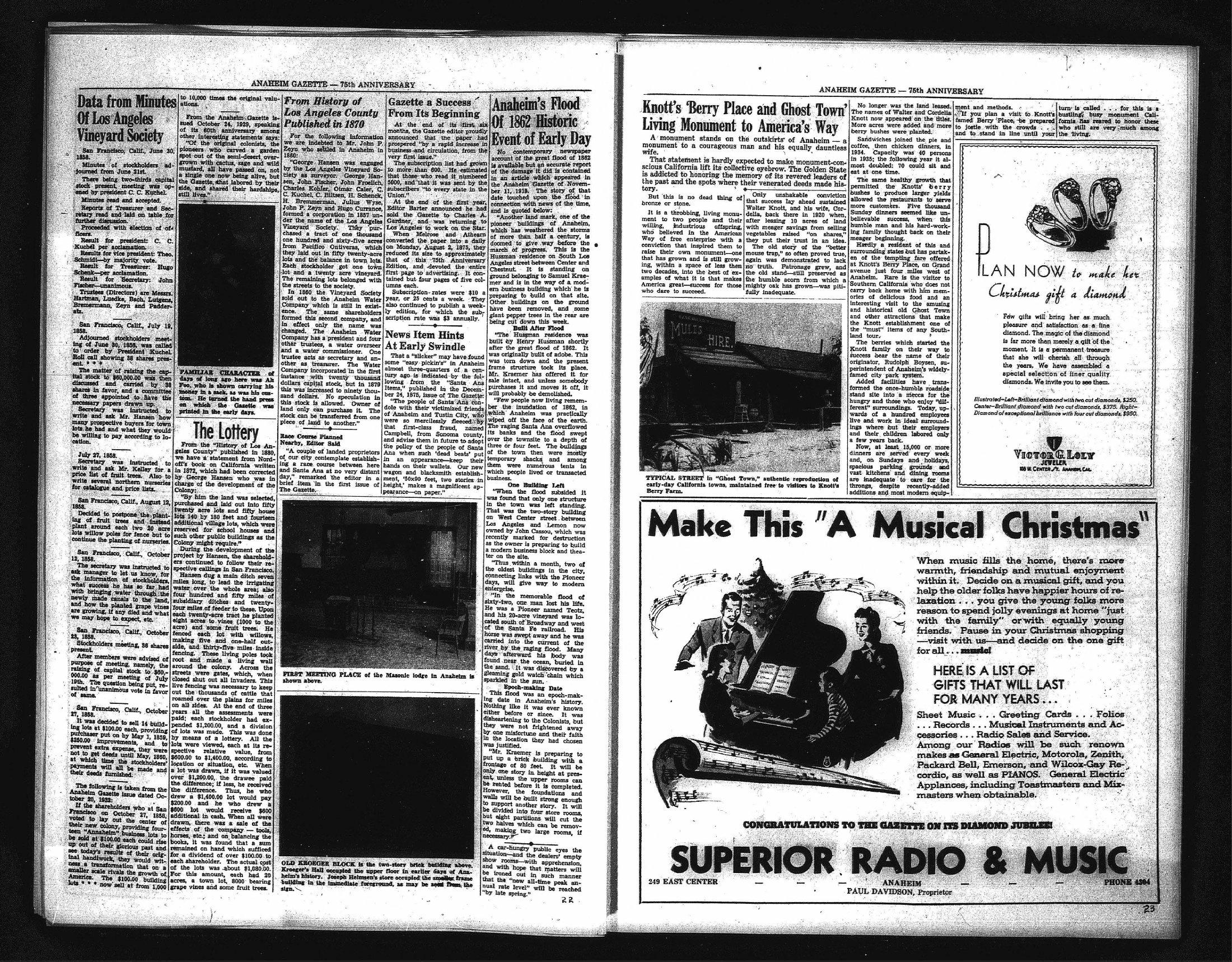
Searchable text
Data from Minutes Of Los Angeles Vineyard Society
San Francisco, Calif., June 30, 1858.
Minutes of stockholders adjourned from June 21st.
There being two-thirds capital stock present, meeting was opened by president C. C. Kuchel.
Minutes read and accepted.
Reports of Treasurer and Secretary read and laid on table for further discussion.
Proceeded with election of officers.
Result for president: C. C. Kuchel per acclamation.
Results for vice president: Theo Schmidt—by majority vote.
Result for Treasurer: Hugo Schenk—per acclamation.
Result for Secretary: John Fischer—unanimous.
Trustees (Directors) are Messrs. Hartman, Luedke, Bach, Lutgens, Bremermann, Zeyn and Padderatz.
San Francisco, Calif., July 19, 1858.
Adjourned stockholders meeting of June 30, 1858, was called to order by President Kuchel. Roll call showing 38 shares to 10,000 times the original valuations.
From the Anaheim Gazette issued October 24, 1929, speaking of its 60th anniversary among other interesting statements says:
"Of the original colonists, the pioneers who carved a garden spot out of the semi-desert overgrown with cactus, sage and wild mustard, all have passed on, not a single one now being alive, but the Gazette that labored by their side, and shared their hardships, still lives."
From History of Los Angeles County Published in 1870
For the following information we are indebted to Mr. John P. Zeyn who settled in Anaheim in 1880:
"George Hansen was engaged by the Los Angeles Vineyard Society as surveyor. George Hansen, John Fischer, John Froelich, Charles Kohler, Otmar Caler, C. C. Kuchel, C. Blitsen, H. Schenck, H. Bremmerman, Julius Wyse, John P. Zeyn and Hugo Currance formed a corporation in 1857 under the name of the Los Angeles Vineyard Society. They purchased a tract of one thousand one hundred and sixty-five acres from Pacifico Ontiveras, which they laid out in fifty twenty-acre lots and the balance in town lots. Each stockholder got one town lot and a twenty acre vineyard. The remaining lots belonged with the streets to the society.
In 1860 the Vineyard Society sold out to the Anaheim Water Company which is still in existence. The same shareholders formed this second company, and in effect only the name was changed. The Anaheim Water Company has a president and four other trustees, a water overseer and a water commissioner. One trustee acts as secretary and an
Gazette a Success From Its Beginning
At the end of its months, the Gazette editor announced that the paper prospered "by a rapid increase in business and circulation," very first issue."
The subscription list had to more than 600. He that those who read it no longer subscribed "to every state Union."
At the end of the first Editor Barter announced sold the Gazette to Chic Gardner, and was retu Los Angeles to work on When Melrose and converted the paper into Monday, August 2, 1859 reduced its size to approve that of this 75th Edition, and devoted the first page to advertising. Tained but four pages of umns each.
Subscription rates were year, or 25 cents a week also continued to publish ly edition, for which tscript rate was $3 an
News Item Hint At Early Swindle
That a "slicker" may ha
Fischer—unanimous.
Trustees (Directors) are Messrs. Hartman, Luedke, Bach, Lutgens, Bremermann, Zeyn and Padderatz.
San Francisco, Calif., July 19, 1858.
Adjourned stockholders meeting of June 30, 1858, was called to order by President Kuchel. Roll call showing 38 shares present.
The matter of raising the capital stock to $60,000.00 was then discussed and carried by 38 shares in favor, and a committee of three appointed to have the necessary papers drawn up.
Secretary was instructed to write and ask Mr. Hansen how many prospective buyers for town lots he had and what they would be willing to pay according to location.
July 27, 1858.
Secretary was instructed to write and ask Mr. Kelley for a price list of fruit trees. Also to write several northern nurseries for catalogue and price lists.
San Francisco, Calif., August 12, 1858.
Decided to postpone the planting of fruit trees and instead plant around each two 20 acre lots willow poles for fence but to continue the planting of nurseries.
San Francisco, Calif., October 13, 1858.
The secretary was instructed to ask manager to let us know, for the information of stockholders, what success he has so far had with bringing water through the newly made canals to the land, and how the planted grape vines are growing, if any died and what we may hope to expect, etc.
San Francisco, Calif., October 23, 1858.
Stockholders meeting, 36 shares present.
After members were advised of purpose of meeting, namely, the raising of capital stock to $60,-000.00 as per meeting of July
FAMILIAR CHARACTER of days of long ago here was Ah Foo, who is shown carrying his money in a sack, as was his custom. He turned the hand press on which the Gazette was printed in the early days.
The Lottery
From the "History of Los Angeles County" published in 1880, we have a statement from Nordoff's book on California written in 1872, which had been corrected by George Hansen who was in charge of the development of the Colony:
"By him the land was selected, purchased and laid out into fifty twenty acre lots and fifty house lots 140 by 180 feet and fourteen additional village lots, which were reserved for school houses and such other public buildings as the Colony might require."
During the development of the project by Hansen, the shareholders continued to follow their respective callings in San Francisco.
Hansen dug a main ditch seven miles long, to lead the irrigating water over the whole area; also four hundred and fifty miles of subsidiary ditches and twenty-four miles of feeder to these. Upon each twenty-acre tract he planted eight acres to vines (1000 to the acre) and some fruit trees. He fenced each lot with willows, making five and one-half outside, and thirty-five miles inside fencing. These living poles took root and made a living wall around the colony. Across the streets were gates, which, when closed shut out all leavers,
In 1860 the Vineyard Society sold out to the Anaheim Water Company which is still in existence. The same shareholders formed this second company, and in effect only the name was changed. The Anaheim Water Company has a president and four other trustees, a water overseer and a water commissioner. One trustee acts as secretary and another as treasurer. The Water Company incorporated in the first instance with twenty thousand dollars capital stock, but in 1879 this was increased to ninety thousand dollars. No speculation in this stock is allowed. Owner of land only can purchase it. The stock can be transferred from one piece of land to another."
Race Course Planned
Nearby, Editor Said
"A couple of landed proprietors of our city contemplate establishing a race course between here and Santa Ana at no very distant day," remarked the editor in a brief item in the first issue of The Gazette.
FIRST MEETING PLACE of the Masonic lodge in Anaheim
San Francisco, Calif., October 23, 1858.
Stockholders meeting, 36 shares present.
After members were advised of purpose of meeting, namely, the raising of capital stock to $80,000.00 as per meeting of July 19th. The question being put, resulted in unanimous vote in favor of same.
San Francisco, Calif., October 27, 1858.
It was decided to sell 14 building lots at $100.00 each, providing purchaser put on by May 1, 1859, $250.00 improvements, and to prevent extra expense, they were not to get deeds until May, 1860, at which time the stockholders' payments will all be made and their deeds furnished.
The following is taken from the Anaheim Gazette issue dated October 20, 1932:
If the shareholders who at San Francisco on October 27, 1858, voted to lay out the center of their new colony, providing fourteen "Annaheim" business lots to be sold at $100.00 each could rise up out of their glorious past and see today's results of their original handiwork, they would witness a transformation that on a smaller scale rivals the growth of America. The $100.00 building lots now sell at from 1,000 four miles of feeder to these. Upon each twenty-acre tract he planted eight acres to vines (1000 to the acre) and some fruit trees. He fenced each lot with willows, making five and one-half outside, and thirty-five miles inside fencing. These living poles took root and made a living wall around the colony. Across the streets were gates, which, when closed shut out all invaders. This live fencing was necessary to keep out the thousands of cattle that roamed over the plains for miles on all sides. At the end of three years all the assessments were paid; each stockholder had expended $1,200.00, and a division of lots was made. This was done by means of a lottery. All the lots were viewed, each at its respective relative value, from $600.00 to $1,400.00, according to location or situation, etc. When a lot was drawn, if it was valued over $1,200.00, the drawee paid the difference; if less, he received the difference. Thus, he who drew a $1,400.00 lot would pay $200.00 and he who drew a $600 lot would receive $600 additional in cash. When all were drawn, there was a sale of the effects of the company — tools, horses, etc.; and on balancing the books, it was found that a sum remained on hand which sufficed for a dividend of over $100.00 to each shareholder. The actual cost of the lots was about $1,080.00. For this amount, each had 20 acres, a town lot, 8000 bearing grape vines and some fruit trees.
OLD KROEGER BLOCK is the two-story brick building abut Kroeger's Hall occupied the upper floor in earlier days of Anaheim's history. Joseph Helmsen's store occupied the smaller building in the immediate foreground, as may be seen from sign.
ANNIVERSARY
Gazette a Success From Its Beginning
At the end of its first six months, the Gazette editor proudly announced that the paper had prospered "by a rapid increase in business and circulation, from the very first issue."
The subscription list had grown to more than 600. He estimated that those who read it numbered 5000, and that it was sent by the subscribers "to every state in the Union."
At the end of the first year, Editor Barter announced he had sold the Gazette to Charles A. Gardner, and was returning to Los Angeles to work on the Star.
When Melrose and Athearn converted the paper into a daily on Monday, August 2, 1875, they reduced its size to approximately that of this 75th Anniversary Edition, and devoted the entire first page to advertising. It contained but four pages of five columns each.
Subscription rates were $10 a year, or 25 cents a week. They also continued to publish a weekly edition, for which the subscription rate was $3 annually.
News Item Hints At Early Swindle
That a "slicker" may have found
Anaheim’s Flood Of 1862 Historic Event of Early Day
No contemporary newspaper account of the great flood of 1862 is available but an accurate report of the damage it did is contained in an article which appeared in the Anaheim Gazette of November 11, 1915. The story of that date touched upon the flood in connection with news of the time, and is quoted below:
"Another land mark, one of the pioneer buildings of Anaheim, which has weathered the storms of more than half a century, is doomed to give way before the march of progress. This is the Hussman residence on South Los Angeles street between Center and Chestnut. It is standing on ground belonging to Samuel Kraemer and is in the way of a modern business building which he is preparing to build on that site. Other buildings on the ground have been removed, and some giant pepper trees in the rear are being cut down this week.
Built After Flood
"The Hussman residence was built by Henry Hussman shortly after the great flood of 1862. It was originally built of adobe. This
Knott’s ‘Berry Place and Ghost Town’ Living Monument to America’s Way
A monument stands on the outskirts of Anaheim—a monument to a courageous man and his equally dauntless wife.
That statement is hardly expected to make monument-conscious California lift its collective eyebrow. The Golden State is addicted to honoring the memory of its revered leaders of the past and the spots where their venerated deeds made history.
But this is no dead thing of bronze or stone.
It is a throbbing, living monument to two people and their willing, industrious offspring, who believed in the American Way of free enterprise with a conviction that inspired them to raise their own monument—one that has grown and is still growing, within a space of less than two decades, into the best of examples of what it is that makes America great—success for those who dare to succeed.
Only unshakable conviction that success lay ahead sustained Walter Knott, and his wife, Cordella, back there in 1920 when, after leasing 10 acres of land with meager savings from selling vegetables raised “on shares,” they put their trust in an idea.
The old story of the “better mouse trap,” so often proved true, again was demonstrated to lack no truth. Patronage grew, and the old stand—still preserved as the humble acorn from which a mighty oak has grown—was pitifully inadequate.
News Item Hints At Early Swindle
That a "slicker" may have found some "easy pickin's" in Anaheim almost three-quarters of a century ago is indicated by the following from the "Santa Ana Items," published in the December 24, 1875, issue of The Gazette:
"The people of Santa Ana condole with their victimized friends of Anaheim and Tustin City, who were so mercilessly fleeced by that first-class fraud, named Campbell, from Sonoma county, and advise them in future to adopt the policy of the people of Santa Ana when such 'dead beats' put in an appearance—keep their hands on their wallets. Our new wagon and blacksmith establishment, '50x90 feet, two stories in height,' makes a magnificent appearance—on paper."
Bullt After Flood
"The Hussman residence was built by Henry Hussman shortly after the great flood of 1862. It was originally built of adobe. This was torn down and the present frame structure took its place. Mr. Kraemer has offered it for sale intact, and unless somebody purchases it and moves it off, it will probably be demolished.
"Few people now living remember the inundation of 1862, in which Anaheim was practically wiped off the face of the earth. The raging Santa Ana overflowed its banks and the flood swept over the townsite to a depth of three or four feet. The buildings of the town then were mostly temporary shacks and among them were numerous tents in which people lived or transacted business."
One Building Left
"When the flood subsided it was found that only one structure in the town was left standing. That was the two-story building on West Center street between Los Angeles and Lemon now owned by John Cassou, which was recently marked for destruction as the owner is preparing to build a modern business block and theater on the site.
"Thus within a month, two of the oldest buildings in the city, connecting links with the Pioneer days, will give way to modern enterprise.
"In the memorable flood of sixty-two, one man lost his life. He was a Pioneer named Teotz, and his 20-acre vineyard was located south of Broadway and west of the Santa Fe railroad. His horse was swept away and he was carried into the current of the river by the raging flood. Many days afterward his body was found near the ocean, buried in the sand. It was discovered by a gleaming gold watch chain which America great—success for those who dare to succeed.
TYPICAL STREET in "Ghost Town," authentic reproduction of early-day California towns, maintained free to visitors to Knott's Berry Farm."
He was a Pioneer named Teotz,
and his 20-acre vineyard was located south of Broadway and west
of the Santa Fe railroad. His horse was swept away and he was
carried into the current of the river by the raging flood. Many
days afterward his body was found near the ocean, buried in
the sand. It was discovered by a gleaming gold watch chain which
sparkled in the sun.
Epoch-making Date
This flood was an epoch-making date in Anaheim's history.
Nothing like it was ever known either before or since. It was
disheartening to the Colonists, but they were not frightened away
by one misfortune and their faith in the location they had chosen
was justified.
"Mr. Kraemer is preparing to put up a brick building with a frontage of 80 feet. It will be only one story in height at present, unless the upper rooms can be rented before it is completed. However, the foundations and walls will be built strong enough to support another story. It will be divided into four store rooms, but eight partitions will cut the two halves which can be removed, making two large rooms, if necessary."
A car-hungry public eyes the situation—and the dealers' empty show rooms—with apprehension,
and with hope that matters will be troned out in such manner
that the "new all-time peak annual rate level" will be reached
"by late spring."
ANAHEIM GAZETTE — 75th ANNIVERSARY
Ghost Town' America's Way
pirits of Anaheim — a city his equally dauntless
to make monument-control. The Golden State
has its revered leaders of
operated deeds made hisunshakable conviction
access lay ahead sustained
Knott, and his wife, Corck there in 1920 when,
using 10 acres of land
lager savings from selling
is raised "on shares,"
their trust in an idea.
Old story of the "better tap," so often proved true,
was demonstrated to lack.
Patronage grew, and
stand—still preserved as
able acorn from which a
sk has grown—was pitidequate.
No longer was the land leased.
The names of Walter and Cordelia Knott now appeared on the titles.
More acres were added and more berry bushes were planted.
Sandwiches joined the pie and coffee, then chicken dinners, in 1934. Capacity was 40 persons in 1935; the following year it almost doubled: 70 could sit and eat at one time.
The same healthy growth that permitted the Knotts' berry bushes to produce larger yields allowed the restaurants to serve more customers. Five thousand Sunday dinners seemed like unbelievable success, when this humble man and his hard-working family thought back on their meager beginning.
Hardly a resident of this and surrounding states but has partaken of the tempting fare offered at Knott's Berry Place, on Grand avenue just four miles west of Anaheim. Rare is the visitor to Southern California who does not carry back home with him memories of delicious food and an interesting visit to the amusing and historical old Ghost Town and other attractions that make the Knott establishment one of the "must" items of any Southland tour.
The berries which started the Knott family on their way to success bear the name of their ment and methods.
If you plan a visit to Knott's famed Berry Place, be prepared to jostle with the crowds and to stand in line until your turn is called... for this is a bustling busy monument California has reared to honor these who still are very much among the living.
PLAN NOW to make her Christmas gift a diamond
Few gifts will bring her as much pleasure and satisfaction as a fine diamond. The magic of the diamond is far more than merely a gift of the moment. It is a permanent treasure that she will cherish all through
Christmas gift a diamond
Few gifts will bring her as much pleasure and satisfaction as a fine diamond. The magic of the diamond is far more than merely a gift of the moment. It is a permanent treasure that she will cherish all through the years. We have assembled a special selection of finer quality diamonds. We invite you to see them.
Illustrated—Left—Brilliant diamond with two cut diamonds, $250.
Center—Brilliant diamond with two cut diamonds, $375. Right—Diamond of exceptional brilliance with four cut diamonds, $950.
VICTOR G. LOLY
JEWELER
100 W. CENTER ST. ANAHEM CAL.
This "A Musical Christmas"
When music fills the home, there's more warmth, friendship and mutual enjoyment within it. Decide on a musical gift, and you help the older folks have happier hours of relaxation ... you give the young folks more reason to spend jolly evenings at home "just with the family" or with equally young friends. Pause in your Christmas shopping —visit with us—and decide on the one gift for all...muscle!
HERE IS A LIST OF
reason to spend jolly evenings at home "just with the family" or with equally young friends. Pause in your Christmas shopping—visit with us—and decide on the one gift for all...music!
HERE IS A LIST OF
GIFTS THAT WILL LAST
FOR MANY YEARS...
Sheet Music ... Greeting Cards ... Folios
Records ... Musical Instruments and Accessories ... Radio Sales and Service.
Among our Radios will be such renown makes as General Electric, Motorola, Zenith,
Packard Bell, Emerson, and Wilcox-Gay Recordio, as well as PIANOS. General Electric Applances, including Toastmasters and Mix-masters when obtainable.
GRATULATIONS TO THE GAZETTE ON ITS DIAMOND JUBILEE!
IOR RADIO & MUSIC
ANAHEIM
PAUL DAVIDSON, Proprietor
23