anaheim-gazette 1945-12-06
Scanned page
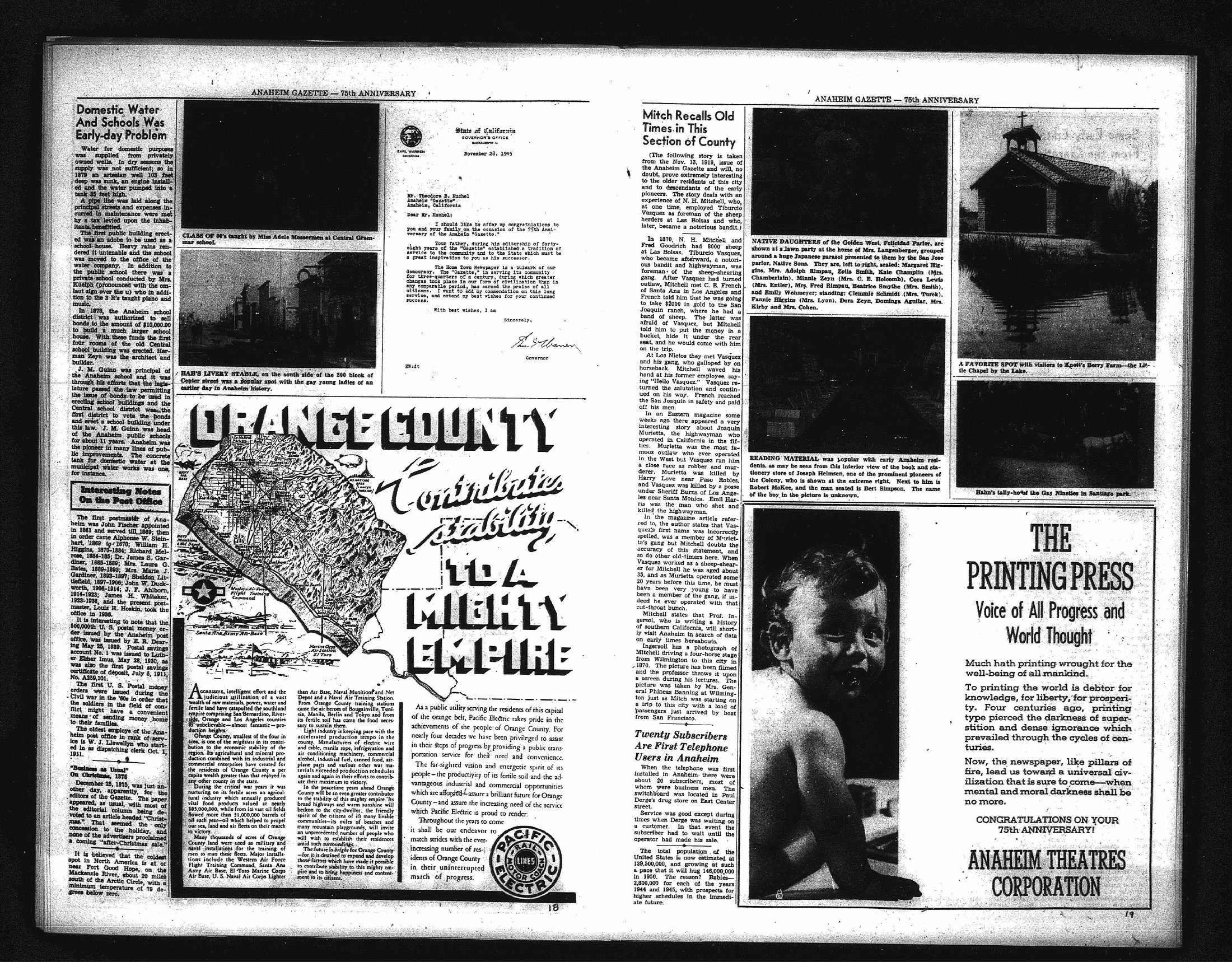
Searchable text
Domestic Water And Schools Was Early-day Problem
Water for domestic purposes was supplied from privately owned wells. In dry seasons the supply was not sufficient; so in 1879 an artesian well 103 feet deep was sunk, an engine installed and the water pumped into a tank 85 feet high.
A pipe line was laid along the principal streets and expenses incurred in maintenance were met by a tax levied upon the inhabitants benefitted.
The first public building erected was an adobe to be used as a school-house. Heavy rains rendered it untenable and the school was moved to the office of the water company. In addition to the public school there was a private school conducted by Mrs. Kuelph (pronounced with the omlaut sign over the u) who in addition to the 3 R's taught piano and music.
In 1878, the Anaheim school district was authorized to sell bonds to the amount of $10,000.00 to build a much larger school house. With these funds the first four rooms of the old Central school building was erected. Herman Zeyn was the architect and
CLASS OF 90's taught by Miss Adele Mossermen at Central Grammar school.
Kuelph (pronounced with the om-laut sign over the u) who in addition to the 3 R's taught piano and music.
In 1878, the Anaheim school district was authorized to sell bonds to the amount of $10,000.00 to build a much larger school house. With these funds the first four rooms of the old Central school building was erected. Herman Zeyn was the architect and builder.
J. M. Guinn was principal of the Anaheim school and it was through his efforts that the legislature passed the law permitting the issue of bonds to be used in erecting school buildings and the Central school district was the first district to vote the bonds and erect a school building under this law. J. M. Guinn was head of the Anaheim public schools for about 11 years. Anaheim was the pioneer in many lines of public improvements. The concrete tank for domestic water at the municipal water works was one, for instance.
Interesting Notes On the Post Office
The first postmaster of Anaheim was John Fischer appointed in 1861 and served till 1869; then in order came Alphonse W. Steinhart, 1869 to 1870; William H. Higgins, 1870-1884; Richard Melrose, 1884-185; Dr. James S. Gardiner, 1885-1889; Mrs. Laura G. Bates, 1889-1893; Mrs. Marie J. Gardiner, 1893-1897; Sheldon Littlefield, 1897-1906; John W. Duckworth, 1906-1914; J. F. Ahlborn, 1914-1923; James H. Whitaker, 1923-1938, and the present postmaster, Louis H. Hoskin, took the office in 1936.
It is interesting to note that the 500,000th U.S. postal money order issued by the Anaheim post office, was issued by E.R.Dearing May 25, 1939. Postal savings account No. 1 was issued to Luther Elmer Imus, May 28, 1930, as was also the first postal savings certificate of deposit, July 5, 1911, No.A259.101
It is interesting to note that the 500,000th U.S. postal money order issued by the Anaheim post office, was issued by E.R. Dearing May 25, 1939. Postal savings account No. 1 was issued to Luther Elmer Imus, May 28, 1930, as was also the first postal savings certificate of deposit, July 5, 1911, No. A259,101.
The first U.S. Postal money orders were issued during the Civil war in the '60s in order that the soldiers in the field of conflict might have a convenient means of sending money home to their families.
The oldest employee of the Anaheim post office in rank of service is W.J. Llewellyn who started in as dispatch clerk Oct. 1, 1911.
"Business as Usual"
On Christmas, 1875
December 25, 1875, was just another day, apparently, for the editors of the Gazette. The paper appeared, as usual, with most of the editorial column being devoted to an article headed "Christmas." That seemed the only concession to the holiday, and none of the advertisers proclaimed a coming "after-Christmas sale."
It is believed that the coldest spot in North America is at or near Fort Good Hope, on the Mackenzie River, about 20 miles south of the Arctic Circle, with a minimum temperature of 79 degrees below zero.
Aggressive, intelligent effort and the judicious utilization of a vast wealth of raw materials, power, water and fertile land have catapulted the southland empire comprising San Bernardino, Riverside, Orange and Los Angeles counties to unbelievable—almost fantastic—production heights.
Orange County, smallest of the four in area, is one of the mightiest in its contribution to the economic stability of the region. Its agricultural and mineral production combined with its industrial and commercial enterprises have created for the residents of Orange County a per capita wealth greater than that enjoyed in any other county in the state.
During the critical war years it was nurturing on its fertile acres an agricultural industry which annually produced vital food products valued at nearly 185,000,000, while from its vast oil fields flowed more than 31,000,000 barrels of oil each year—oil which helped to propel our sea, land and air fleets on their march to victory.
Many thousands of acres of Orange County land were used as military and naval installations for the training of men to man these fleets. Major installations include the Western Air Force Flight Training Command, Santa Ana Army Air Base, El Toro Marine Corps Air Base, U.S. Naval Air Corps Lighter than Air Base, Naval Munitions and Net Depot and a Naval Air Training Station. From Orange County training stations came the air heroes of Bougainville, Tunisia, Manila, Berlin and Tokyo and from its fertile soil has come the food necessary to sustain them.
Light industry is keeping pace with the accelerated production tempo in the county. Manufacturers of electric wire and cable, manila rope, refrigeration and air conditioning machinery, commercial alcohol, industrial fuel, canned food, airplane parts and various other war materials exceeded production schedules again and again in their efforts to contribute their maximum to victory.
In the peacetime years ahead Orange County will be an even greater contributor to the stability of this mighty empire. Its broad highways and warm sunshine will beckon to the city-dweller; the friendly spirit of the citizens of its many livable communities—its miles of beaches and many mountain playgrounds, will invite an unprecedented number of people who will wish to establish their residences amid such surroundings.
The future is bright for Orange County—for it is destined to expand and develop those factors which have made it possible to contribute stability to this mighty empire and to bring happiness and contentment to its citizens.
ANNIVERSARY
State of California
GOVERNOR'S OFFICE
SACRAMENTO 14
November 28, 1945
Mr. Theodore B. Kuchel
Anaheim "Gazette"
Anaheim, California
Dear Mr. Kuchel:
I should like to offer my congratulations to you and your family on the occasion of the 75th Anniversary of the Anaheim "Gazette."
Your father, during his editorship of forty-eight years of the "Gazette," established a tradition of service to the community and to the State which must be a great inspiration to you as his successor.
The Home Town Newspaper is a bulwark of our democracy. The "Gazette," in serving its community for three-quarters of a century, during which greater changes took place in our form of civilization than in any comparable period, has earned the praise of all citizens. I want to add my commendation on this long service, and extend my best wishes for your continued success.
With best wishes, I am
Sincerely,
Governor
COUNTY
Contribute
stability
TO A
MIGHTY
EMPIRE
outlaw, Mitchell met C. E. French of Santa Ana in Los Angeles and French told him that he was going to take $2000 in gold to the San Joaquin ranch, where he had a band of sheep. The latter was afraid of Vasquez, but Mitchell told him to put the money in a bucket, hide it under the rear seat, and he would come with him on the trip.
At Los Nietos they met Vasquez and his gang, who galloped by on horseback. Mitchell waved his hand at his former employee, saying "Hello Vasquez." Vasquez returned the salutation and continued on his way. French reached the San Joaquin in safety and paid off his men.
In an Eastern magazine some weeks ago there appeared a very interesting story about Joaquin Murietta, the highwayman who operated in California in the fifties. Murietta was the most famous outlaw who ever operated in the West but Vasquez ran him a close race as robber and murderer. Murietta was killed by Harry Love near Paso Robles, and Vasquez was killed by a posse under Sheriff Burns of Los Angeles near Santa Monica. Emil Harris was the man who shot and killed the highwayman.
In the magazine article referred to, the author states that Vasquez's first name was incorrectly spelled, was a member of Murietta's gang but Mitchell doubts the accuracy of this statement, and so do other old-timers here. When Vasquez worked as a sheep-shearer for Mitchell he was aged about 35, and as Murietta operated some 20 years before this time, he must have been very young to have been a member of the gang, if indeed he ever operated with that cut-throat bunch.
Mitchell states that Prof. Ingersol, who is writing a history of southern California, will shortly visit Anaheim in search of data on early times hereabouts.
Ingersoll has a photograph of Mitchell driving a four-horse stage from Wilmington to this city in 1870. The picture has been filmed and the professor throws it upon a screen during his lecture.
As a public utility serving the residents of this capital of the orange belt, Pacific Electric takes pride in the achievements of the people of Orange County. For nearly four decades we have been privileged to assist in their steps of progress by providing a public transportation service for their need and convenience.
The far-sighted vision and energetic spirit of its people—the productivity of its fertile soil and the advantageous industrial and commercial opportunities which are afforded—assure a brilliant future for Orange County—and assure the increasing need of the service which Pacific Electric is proud to render.
Throughout the years to come it shall be our endeavor to match strides with the ever-increasing number of residents of Orange County in their uninterrupted march of progress.
Twenty Subscribers Are First Telephone Users in Anaheim
When the telephone was first installed in Anaheim there were about 20 subscribers, most of whom were business men. The switchboard was located in Paul Derge's drug store on East Center street.
Service was good except during times when Derge was waiting on a customer. In that event the subscriber had to wait until the operator had made his sale.
The total population of the United States is now estimated at 139,500,000, and growing at such a pace that it will hug 148,000,000 in 1950. The reason? Babies—2,800,000 for each of the years 1944 and 1945, with prospects for higher schedules in the immediate future.
ANAHEIM GAZETTE — 75th ANNIVERSARY
THE DAUGHTERS of the Golden West, Felicidad Parlor, are at a lawn party at the home of Mrs. Langenberger, grouped with a huge Japanese parasol presented to them by the San Jose Native Sons. They are, left to right, seated: Margaret Higgins, Mrs. Adolph Rimpau, Zoila Smith, Kate Champlin (Mrs. Merlain), Minnie Zeyn (Mrs. C. E. Holcomb), Cora Lewis Entler), Mrs. Fred Rimpau, Beatrice Smythe (Mrs. Smith), Emily Wehmeyer; standing: Clemmie Schmidt (Mrs. Turck), Higgins (Mrs. Lyon), Dora Zeyn, Dominga Aguilar, Mrs. and Mrs. Cohen.
ENTLER), Mrs. Fred Rimpau, Beatrice Smythe (Mrs. Smith),
mily Wehmeyer; standing: Clemmie Schmidt (Mrs. Turek),
Higgins (Mrs. Lyon), Dora Zeyn, Dominga Agullar, Mrs.
and Mrs. Cohen.
A FAVORITE SPOT with visitors to Knott's Berry Farm—the Little Chapel by the Lake.
NG MATERIAL was popular with early Anaheim residents may be seen from this interior view of the book and store of Joseph Helmsen, one of the prominent pioneers ofony, who is shown at the extreme right. Next to him is McKee, and the man seated is Bert Simpson. The nameoy in the picture is unknown.
THE PRINTING PRESS
Voice of All Progress and World Thought
Much hath printing wrought for the well-being of all mankind.
Voice of All Progress and World Thought
Much hath printing wrought for the well-being of all mankind.
To printing the world is debtor for knowledge, for liberty, for prosperity. Four centuries ago, printing type pierced the darkness of superstition and dense ignorance which prevailed through the cycles of centuries.
Now, the newspaper, like pillars of fire, lead us toward a universal civilization that is sure to come—when mental and moral darkness shall be no more.
CONGRATULATIONS ON YOUR 75th ANNIVERSARY!
ANAHEIM THEATRES CORPORATION