anaheim-gazette 1944-11-16
Scanned page
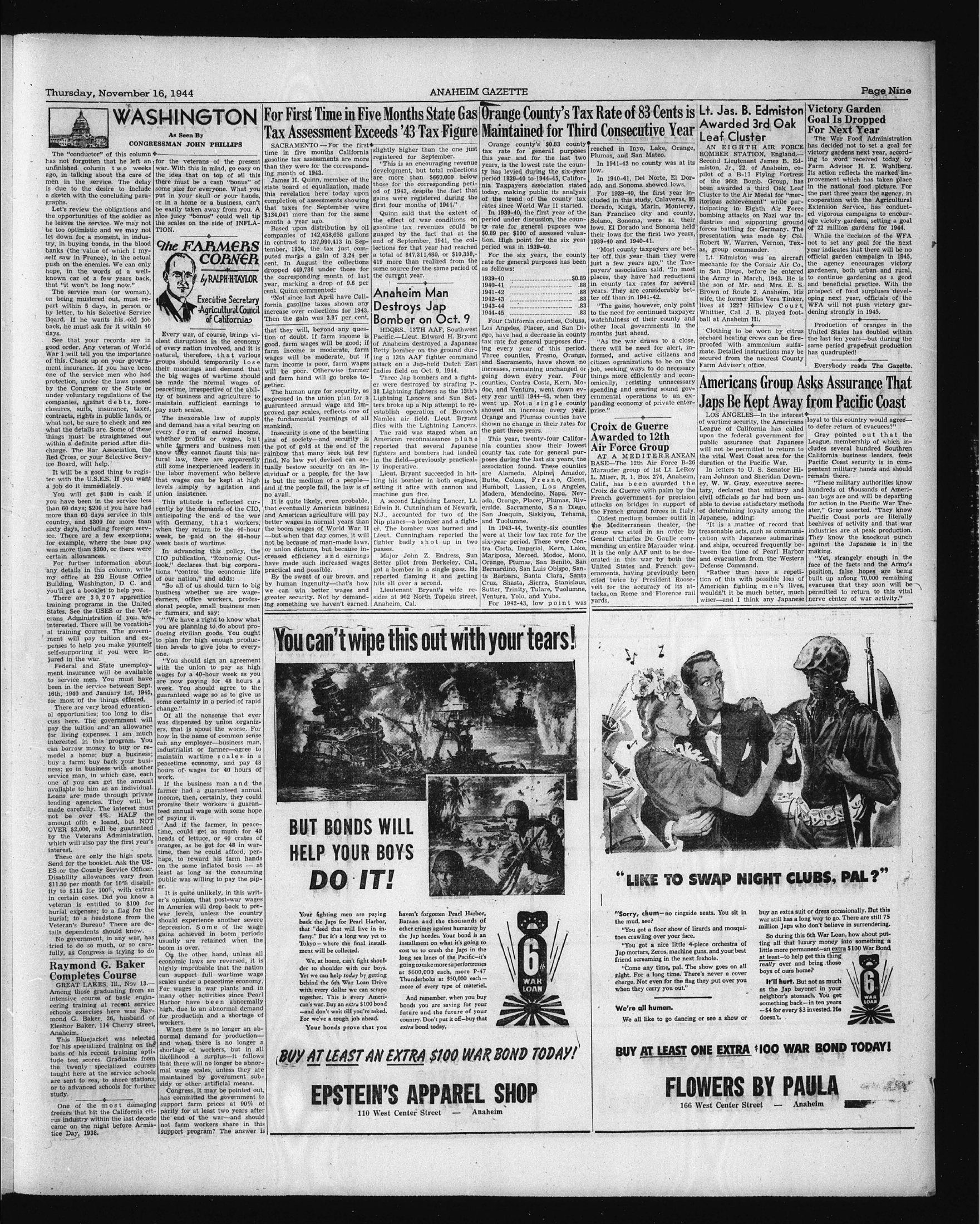
Searchable text
Thursday, November 16, 1944
WASHINGTON
As Seen By
CONGRESSMAN JOHN PHILLIPS
The "conductor" of this column has not forgotten that he left an unfinished column two weeks ago, in talking about the care of men in the service. The delay is due to the desire to include a sketch with the concluding paragraphs.
Let's review the obligations and the opportunities of the soldier as he leaves the service. We may not be too optimistic and we may not let down for a moment, in industry, in buying bonds, in the blood banks (the value of which I myself saw in France), in the actual push on the enemies. We can only hope, in the words of a well-known car of a few years back, that "it won't be long now."
The service man (or woman), on being mustered out, must report within 5 days, in person or by letter, to his Selective Service Board. If he wants his old job back, he must ask for it within 40 days.
See that your records are in good order. Any veteran of World War I will tell you the importance of this. Check up on your government insurance. If you have been one of the service men who had protection, under the laws passed by the Congress or the State or under voluntary regulations of the companies, against debts, foreclosures, suits, insurance, taxes, contracts, rights in public lands, or what not, be sure to check and see what the details are. Some of these things must be straightened out within a definite period after discharge. The Bar Association, the Red Cross, or your Selective Service
Every war, of course, brings violent disruptions in the economy of every nation involved, and it is natural, therefore, that various groups should temporarily lose their moorings and demand that the big wages of wartime should be made the normal wages of peacetime, irrespective of the ability of business and agriculture to maintain sufficient earnings to pay such scales.
The inexorable law of supply and demand has a vital bearing on every form of earned income, whether profits or wages, but while farmers and business men know they cannot flaunt this na-
For First Time in FI Tax Assessment Ex
SACRAMENTO — For the first time in five months California gasoline tax assessments are more than they were for the corresponding month of 1943.
James H. Quinn, member of the state board of equalization, made this revelation here today upon completion of assessments showing that taxes for September were $134,047 more than for the same month a year ago.
Based upon distribution by our companies of 142,458,658 gallons in contrast to 137,990,413 in September, 1934, the tax just computed marks a gain of 3.24 percent. In August the collection dropped 449,786 under those for the corresponding month of last year, marking a drop of 9.6 percent. Quinn commented:
"Not since last April have California gasoline taxes shown any increase over collections for 1943 Then the gain was 3.97 per cent that they will, beyond any question of doubt. If farm income is good, farm wages will be good; if farm income is moderate, farm wages will be moderate; but if farm income is poor, farm wages will be poor. Otherwise farmer and farm hand will go broke to gether.
The human urge for security, expressed in the union plan for guaranteed annual wage and improved pay scales, reflects one of the fundamental yearnings of all mankind.
Insecurity is one of the besetting sins of society—and security is the pot of gold at the end of the rainbow that many seek but few."
of this. Check up on your government insurance. If you have been one of the service men who had protection, under the laws passed by the Congress or the State or under voluntary regulations of the companies, against debts, foreclosures, suits, insurance, taxes, contracts, rights in public lands, or what not, be sure to check and see what the details are. Some of these things must be straightened out within a definite period after discharge. The Bar Association, the Red Cross, or your Selective Service Board, will help.
It will be a good thing to register with the U.S.E.S. If you want a job do it immediately.
You will get $100 in cash if you have been in the service less than 60 days; $200 if you have had more than 60 days service in this country, and $300 for more than sixty days, including foreign service. There are a few exceptions; for example, where the base pay was more than $200, or there were certain allowances.
For further information about any details in this column, write my office at 239 House Office Building, Washington, D. C. and you'll get a booklet to help you.
There are 30,207 apprentice training programs in the United States. See the USES or the Veterans Administration if you are interested. There will be vocational training courses. The government will pay tuition and expenses to help you make yourself self-supporting if you were injured in the war.
Federal and State unemployment insurance will be available to service men. You must have been in the service between Sept. 16th, 1940 and January 1st, 1945, for most of the things offered.
There are very broad educational opportunities; too long to discuss here. The government will pay the tuition and an allowance for living expenses. I am much interested in this program. You can borrow money to buy or remodel a home; buy a business; buy a farm; buy back your business; go in business with another service man, in which case, each one of you can get the amount available to him as an individual. Loans are made through private lending agencies. They will be made carefully. The interest must not be over 4%. HALF the amount of e loan, but NOT OVER $2,000, will be guaranteed by the Veterans Administration, which will also pay the first year's interest.
These are only the high spots. Send for the booklet. Ask the US-
groups should temporarily lose their moorings and demand that the big wages of wartime should be made the normal wages of peacetime, irrespective of the ability of business and agriculture to maintain sufficient earnings to pay such scales.
The inexorable law of supply and demand has a vital bearing on every form of earned income, whether profits or wages, but while farmers and business men know they cannot flaunt this natural law, there are apparently still some inexperienced leaders in the labor movement who believe that wages can be kept at high levels simply by agitation and union insistence.
This attitude is reflected currently by the demands of the CIO, anticipating the end of the war with Germany, that workers, when they return to the 40-hour week, be paid on the 48-hour week basis of wartime.
In advancing this policy, the CIO publication, "Economic Outlook," declares that big corporations "control the economic life of our nation," and adds:
"So all of us should turn to big business whether we are wage earners, office workers, professional people, small business men or farmers, and say:
"We have a right to know what you are planning to do about producing civilian goods. You ought to plan for high enough production levels to give jobs to everyone.
"You should sign an agreement with the union to pay as high wages for a 40-hour week as you are now paying for 48 hours a week. You should agree to the guaranteed wage so as to give us some certainty in a period of rapid change."
Of all the nonsense that ever was dispensed by union organizers, that is about the worse. For how in the name of common sense can any employer—business man, industrialist or farmer—agree to maintain wartime scales in a peacetime economy, and pay 48 hours of wages for 40 hours of work.
If the business man and the farmer had a guaranteed annual income, then, certainly, they could promise their workers a guaranteed annual wage with some hope of paying it.
And if the farmer, in peacetime, could get as much for 40 heads of lettuce, or 40 crates of oranges, as he got for 48 in wartime, then he could afford, perhaps, to reward his farm hands on the same inflated basis at
ness; go in business with another service man, in which case, each one of you can get the amount available to him as an individual. Loans are made through private lending agencies. They will be made carefully. The interest must not be over 4%. HALF the amount of the loan, but NOT OVER $2,000, will be guaranteed by the Veterans Administration, which will also pay the first year's interest.
These are only the high spots. Send for the booklet. Ask the USES or the County Service Officer. Disability allowances vary from $11.50 per month for 10% disability to $115 for 100%, with extras in certain cases. Did you know a veteran is entitled to $100 for burial expenses; to a flag for the burial; to a headstone from the Veteran's Bureau? There are details dependents should know.
No government, in any war, has tried to do so much, or so carefully, as Congress is trying to do
Raymond G. Baker Completes Course
GREAT LAKES, Ill., Nov 13.—Among those graduating from an intensive course of basic engineering training at recent service schools exercises here was Raymond G. Baker, 26, husband of Eleanor Baker, 114 Cherry street, Anaheim.
This Bluejacket was selected for his specialized training on the basis of his recent training aptitude test scores. Graduates from the twenty specialized courses taught here at the service schools are sent to sea, to shore stations, or to advanced schools for further study.
One of the most damaging freezes that hit the California citrus industry within the last decade came on the night before Armistice Day, 1938.
First Time in Five Months State Gas Tax Assessment Exceeds '43 Tax Figure
PARAMENTO — For the first five months California tax assessments are more they were for the correspondent month of 1943.
Miss H. Quinn, member of the board of equalization, made revelation here today upon questioning of assessments showing taxes for September were more than for the same year ago.
Ul upon distribution by oil lines of 142,458,658 gallons must rest to 137,990,413 in September 1934, the tax just commarks a gain of 3.24 per cent in August the collections of 449,786 under those for corresponding month of last marking a drop of 9.6 per quinn commented:
since last April have Cali-gasoline taxes shown any over collections for 1943. The gain was 3.97 per cent.
They will, beyond any question, doubt. If farm income is farm wages will be good; if income is moderate, farm will be moderate, but if income is poor, farm wages are poor. Otherwise farmer farm hand will go broke too.
Anaheim Man Destroys Jap Bomber on Oct. 9
HDQRS., 13TH AAF, Southwest Pacific.—Lieut. Edward H. Bryant of Anaheim destroyed a Japanese Betty bomber on the ground during a 13th AAF fighter command attack on a Jap-held Dutch East Indies field on Oct. 9, 1944.
Three Jap bombers and a fighter were destroyed by strafing P-38 Lightning fighters as the 13th's Lightning Lancers and Sun Setters broke up a Nip attempt to reestablish operation of Borneo's Namlea air field. Lieut. Bryant flies with the Lightning Lancers.
The raid was staged when an American reconnaissance plane reported that several Japanese fighters and bombers had landed slightly higher than the one just registered for September.
"This is an encouraging revenue development, but total collections are more than $660,000 below those for the corresponding period of 1943, despite the fact that gains were registered during the first four months of 1944."
Quinn said that the extent of the effect of war conditions on gasoline tax revenues could be guaged by the fact that at the end of September, 1941, the collections for that year had reached a total of $47,311,480, or $10,359,-419 more than realized from the same source for the same period of the current year.
Anaheim Man Destroys Jap Bomber on Oct. 9
HDQRS., 13TH AAF, Southwest Pacific.—Lieut. Edward H. Bryant of Anaheim destroyed a Japanese Betty bomber on the ground during a 13th AAF fighter command attack on a Jap-held Dutch East Indies field on Oct. 9, 1944.
Three Jap bombers and a fighter were destroyed by strafing P-38 Lightning fighters as the 13th's Lightning Lancers and Sun Setters broke up a Nip attempt to reestablish operation of Borneo's Namlea air field. Lieut. Bryant flies with the Lightning Lancers.
The raid was staged when an American reconnaissance plane reported that several Japanese fighters and bombers had landed slightly higher than the one just registered for September.
"This is an encouraging revenue development, but total collections are more than $660,000 below those for the corresponding period of 1943, despite the fact that gains were registered during the first four months of 1944."
Quinn said that the extent of the effect of war conditions on gasoline tax revenues could be guaged by the fact that at the end of September, 1941, the collections for that year had reached a total of $47,311,480, or $10,359,-419 more than realized from the same source for the same period of the current year.
Anaheim Man Destroys Jap Bomber on Oct. 9
HDQRS., 13TH AAF, Southwest Pacific.—Lieut. Edward H. Bryant of Anaheim destroyed a Japanese Betty bomber on the ground during a 13th AAF fighter command attack on a Jap-held Dutch East Indies field on Oct. 9, 1944.
Three Jap bombers and a fighter were destroyed by strafing P-38 Lightning fighters as the 13th's Lightning Lancers and Sun Setters broke up a Nip attempt to reestablish operation of Borneo's Namlea air field. Lieut. Bryant flies with the Lightning Lancers.
The raid was staged when an American reconnaissance plane reported that several Japanese fighters and bombers had landed slightly higher than the one just registered for September.
"This is an encouraging revenue development, but total collections are more than $660,000 below those for the corresponding period of 1943, despite the fact that gains were registered during the first four months of 1944."
Quinn said that the extent of the effect of war conditions on gasoline tax revenues could be guaged by the fact that at the end of September, 1941, the collections for that year had reached a total of $47,311,480, or $10,359,-419 more than realized from the same source for the same period of the current year.
Anaheim Man Destroys Jap Bomber on Oct. 9
HDQRS., 13TH AAF, Southwest Pacific.—Lieut. Edward H. Bryant of Anaheim destroyed a Japanese Betty bomber on the ground during a 13th AAF fighter command attack on a Jap-held Dutch East Indies field on Oct. 9, 1944.
Three Jap bombers and a fighter were destroyed by strafing P-38 Lightning fighters as the 13th's Lightning Lancers and Sun Setters broke up a Nip attempt to reestablish operation of Borneo's Namlea air field. Lieut. Bryant flies with the Lightning Lancers.
The raid was staged when an American reconnaissance plane reported that several Japanese fighters and bombers had landed slightly higher than the one just registered for September.
Orange County’s Tax Rate of 83 Cents is Maintained for Third Consecutive Year
Orange county’s $0.83 county tax rate for general purposes this year and for the last two years, is the lowest rate the county has levied during the six-year period 1939-40 to 1944-45, California Taxpayers association stated today, making public its analysis of the trend of the county tax rates since World War II started.
In 1939-40, the first year of the period under discussion, the county rate for general purposes was $0.89 per $100 of assessed valuation. High point for the six year period was in 1939-40.
For the six years, the county rate for general purposes has been as follows:
1939-40 ... $0.89
1940-41 ... .88
1941-42 ... .88
1942-43 ... .83
1943-44 ... .83
1944-45 ... .83
Four California counties, Colusa, Los Angeles, Placer, and San Diego, have had a decrease in county tax rate for general purposes during every year of this period. Three counties, Fresno, Orange, and Sacramento, have shown no increases, remaining unchanged or going down every year. Four counties, Contra Costa, Kern, Modoc, and Ventura, went down every year until 1944-45, when they went up. Not a single county showed an increase every year. Orange and Plumas counties have shown no change in their rates for the past three years.
This year, twenty-four California counties show their lowest county tax rate for general purposes
become is poor, farm wages are poor. Otherwise farmer hand will go broke to human urge for security, as used in the union plan for a need annual wage and impay scales, reflects one of fundamental yearnings of all.
Security is one of the besetting society—and security is of gold at the end of the day that many seek but few law yet devised can accepstow security on an inflict or a people, for the law the medium of a people—one people fail, the law is of al.
quite likely, even probable, eventually American business american agriculture will pay wages in normal years than from wages of World War II when that day comes, it will because of man-made laws, dictums, but because efficiency and earnings made such increased wages real and possible.
The sweat of our brows, and man ingenuity—that's how we win better wages and security. Not by demand—thing we haven't earned.
Three Jap bombers and a fighter were destroyed by strafing P-38 Lightning fighters as the 13th's Lightning Lancers and Sun Setters broke up a Nip attempt to reestablish operation of Borneo's Namlea air field. Lieut. Bryant flies with the Lightning Lancers.
The raid was staged when an American reconnaissance plane reported that several Japanese fighters and bombers had landed in the field—previously practically inoperative.
Lieut. Bryant succeeded in hitting his bomber in both engines, setting it afire with cannon and machine gun fire.
A second Lightning Lancer, Lt. Edwin R. Cunningham of Newark, N.J., accounted for two of the Nip planes—a bomber and a fighter. The bomber was burned and Lieut. Cunningham reported the fighter badly shot up in two passes.
Major John Z. Endress, Sun Setter pilot from Berkeley, Cal., got a bomber in a single pass. He reported flaming it and getting hits all over a second.
Lieutenant Bryant's wife resides at 902 North Topeka street, Anaheim, Cal.
and Sacramento, have shown no increases, remaining unchanged or going down every year. Four counties, Contra Costa, Kern, Modoc, and Ventura, went down every year until 1944-45, when they went up. Not a single county showed an increase every year. Orange and Plumas counties have shown no change in their rates for the past three years.
This year, twenty-four California counties show their lowest county tax rate for general purposes during the last six years, the association found. These counties are Alameda, Alpine Amador, Butte, Colusa, Fresno, Glenn, Humbolt, Lassen, Los Angeles, Madera, Mendocino, Napa, Nevada, Orange, Placer, Plumas, Riverside, Sacramento, San Diego, San Joaquin, Siskiyou, Tehama, and Tuolumne.
In 1943-44, twenty-six counties were at their low tax rate for the six-year period. These were Contra Costa, Imperial, Kern, Lake Mariposa, Merced, Modoc, Mono, Orange, Plumas, San Benito, San Bernardino, San Luis Obispo, Santa Barbara, Santa Clara, Santa Cruz, Shasta, Sierra, Stanislaus, Sutter, Trinity, Tulare, Tuolumne, Ventura, Yolo, and Yuba.
For 1942-43, low point was citizen organizations to be on the job, seeking ways to do necessary things more efficiently and economically, resisting unnecessary spending and gearing sound governmental operations to an expanding economy of private enterprise.”
Croix de Guerre Awarded to 12th Air Force Group
AT A MEDITERRANEAN BASE—The 12th Air Force B-2 Marauder group of 1st Lt. LeRoL. L. Miser, R. 1, Box 274, Anaheim Calif., has been awarded the Croix de Guerre with palm by the French government for precision attacks on bridges in support of the French ground forces in Italy.
Oldest medium bomber outfit in the Mediterranean theater, the group was cited in an order by General Charles De Gaulle commending an entire Marauder wing. It is the only AAF unit to be decorated in this war by both the United States and French governments, having previously been cited twice by President Roosevelt for the accuracy of its attacks on Rome and Florence rail yards.
BUT BONDS WILL HELP YOUR BOYS DO IT!
Your fighting men are paying back the Japs for Pearl Harbor, that "deed that will live in infamy." But it's a long way yet to Tokyo—where the final installment will be collected.
We, at home, can't fight shoulder to shoulder with our boys. Yet we can help today by getting behind the 6th War Loan Drive with every dollar we can scrape together. This is every American's war. Buy an extra $100 bond—and don't wait till you're asked. For we've a tough job ahead.
Your bonds prove that you haven't forgotten Pearl Harbor, Bataan and the thousands of other crimes against humanity by the Jap hordes. Your bond is an installment on what it's going to cost us to crush the Japs in the long sea lanes of the Pacific—it's going to take more superfortresses at $600,000 each, more P-47 Thunderbolts at $50,000 each—more of every type of materiel.
And remember, when you buy bonds you are saving for your future and the future of your country. Don't put it off—buy that extra bond today.
BUY AT LEAST AN EXTRA $100 WAR BOND TODAY!
EPSTEIN'S APPAREL SHOP
110 West Center Street — Anaheim
"LIKE TO S
"Sorry, chum—no ringside the mud, see?
"You got a floor show of toes crawling over your face.
"You got a nice little Jap mortars, Zeros, machine friend screaming in the next.
"Come any time, pal. The night. For a long time. The charge. Not even for the flag when they carry you out."
We're all human.
We all like to go dancing
State of 83 Cents is Consecutive Year
in Inyo, Lake, Orange,
and San Mateo.
40-41, Del Norte, El Dorado
Sonoma showed lows.
1939-40, the first year in this study, Calaveras, El Kings, Marin, Monterey, Francisco city and county, Sonoma, were at their Dorado and Sonoma held lows for the first two years, and 1940-41.
County taxpayers are betthis year than they were few years ago," the Tax association said. "In most they have had reductions in tax rates for several They are considerably bethan in 1941-42.
Gains, however, only point need for continued taxpayer illness of their county and local governments in the just ahead.
The war draws to a close, will be need for alert, in- and active citizens and organizations to be on the taking ways to do necessary more efficiently and economy, resisting unnecessary rig and gearing sound government operations to an execonomy of private enter-
Lt. Jas. B. Edmiston Awarded 3rd Oak Leaf Cluster
AN EIGHTH AIR FORCE BOMBER STATION, England.—Second Lieutenant James B. Edmiston, Jr., 22, of Anaheim, copilot of a B-17 Flying Fortress of the 96th Bomb. Group, has been awarded a third Oak Leaf Cluster to the Air Medal for "meritorious achievement" while participating in Eighth Air Force bombing attacks on Nazi war industries and supporting ground forces battling for Germany. The presentation was made by Col. Robert W. Warren, Vernon, Texas, group commander.
Lt. Edmiston was an aircraft mechanic for the Corsair Air Co., in San Diego, before he entered the Army in March, 1943. He is the son of Mr. and Mrs. E. S. Brown of Route 2, Anaheim. His wife, the former Miss Vera Tinker, lives at 1227 Hillview Court, Whittier, Cal. J. B. played football at Anaheim Hi.
Clothing to be worn by citrus orchard heating crews can be fire-proofed with ammonium sulfamate. Detailed instructions may be secured from the nearest County Farm Adviser's office.
Victory Garden Goal Is Dropped For Next Year
The War Food Administration has decided not to set a goal for victory gardens next year, according to word received today by Farm Advisor H. E. Wahlberg. Its action reflects the marked improvement which has taken place in the national food picture. For the past three years the agency, in cooperation with the Agricultural Extension Service, has conducted vigorous campaigns to encourage victory gardens, setting a goal of 22 million gardens for 1944.
While the decision of the WFA not to set any goal for the next year indicates that there will be no official garden campaign in 1945, the agency encourages victory gardeners both urban and rural, to continue gardening as a good and beneficial practice. With the prospect of food surpluses developing next year, officials of the WFA will not push victory gardening strongly in 1945.
Production of oranges in the United States has doubled within the last ten years—but during the same period grapefruit production has quadrupled!
Everybody reads The Gazette.
Americans Group Asks Assurance That Japs Be Kept Away from Pacific Coast
LOS ANGELES—In the interest of wartime security, the Americans League of California has called upon the federal government for public assurance that Japanese will not be permitted to return to the vital West Coast area for the loyal to this country would agree—to defer return of evacuees?
Gray pointed out that the League, membership of which includes several hundred Southren California business leaders, feels
Americans Group Asks Assurance That Japs Be Kept Away from Pacific Coast
LOS ANGELES—In the interest of wartime security, the Americans League of California has called upon the federal government for public assurance that Japanese will not be permitted to return to the vital West Coast area for the duration of the Pacific War.
In letters to U. S. Senator Hiram Johnson and Sheridan Downey, W. W. Gray, executive secretary, declared that military and civil officials so far had been unable to devise satisfactory methods of determining loyalty among the Japanese, adding:
"It is a matter of record that treasonable acts, such as communication with Japanese submarines and ships, occurred frequently between the time of Pearl Harbor and evacuation from the Western Defense Command.
"Rather than have a repetition of this with possible loss of American fighting men's lives, wouldn't it be much better, much wiser—and I think any Japanese loyal to this country would agree—to defer return of evacuees?"
Gray pointed out that the League, membership of which includes several hundred Southren California business leaders, feels Pacific Coast security is in competent military hands and should remain there.
"These military authorities know hundreds of thousands of American boys are and will be departing for action in the Pacific War Theater," Gray asserted. "They know Pacific Coast ports are literally beehives of activity and that war industries are at peak production. They know the knockout punch against the Japanese is in the making."
"Yet, strangely enough in the face of the facts and the Army's position, false hopes are being built up among 70,000 remaining evacuees that they soon will be permitted to return to this vital nerve center of war activity."
"LIKE TO SWAP NIGHT CLUBS, PAL?"
"Sorry, chum—no ringside seats. You sit in the mud, see?
“You got a floor show of lizards and mosquitoes crawling over your face.
“You got a nice little 4-piece orchestra of Jap mortars, Zeros, machine guns, and your best friend screaming in the next foxhole.
“Come any time, pal. The show goes on all night. For a long time. There’s never a cover charge. Not even for the flag they put over you when they carry you out.”
We’re all human.
We all like to go dancing or see a show or buy an extra suit or dress occasionally. But this war still has a long way to go. There are still 75 million Japs who don’t believe in surrendering.
So during this 6th War Loan, how about putting all that luxury money into something a little more permanent—an extra $100 War Bond at least—to help get this thing really over and bring those boys of ours home?
It’ll hurt. But not as much as the Jap bayonet in your neighbor’s stomach. You get something back—in ten years—$4 for every $3 invested. He doesn’t."
BUY AT LEAST ONE EXTRA $100 WAR BOND TODAY!
FLOWERS BY PAULA
166 West Center Street — Anaheim