anaheim-gazette 1940-12-12
Scanned page
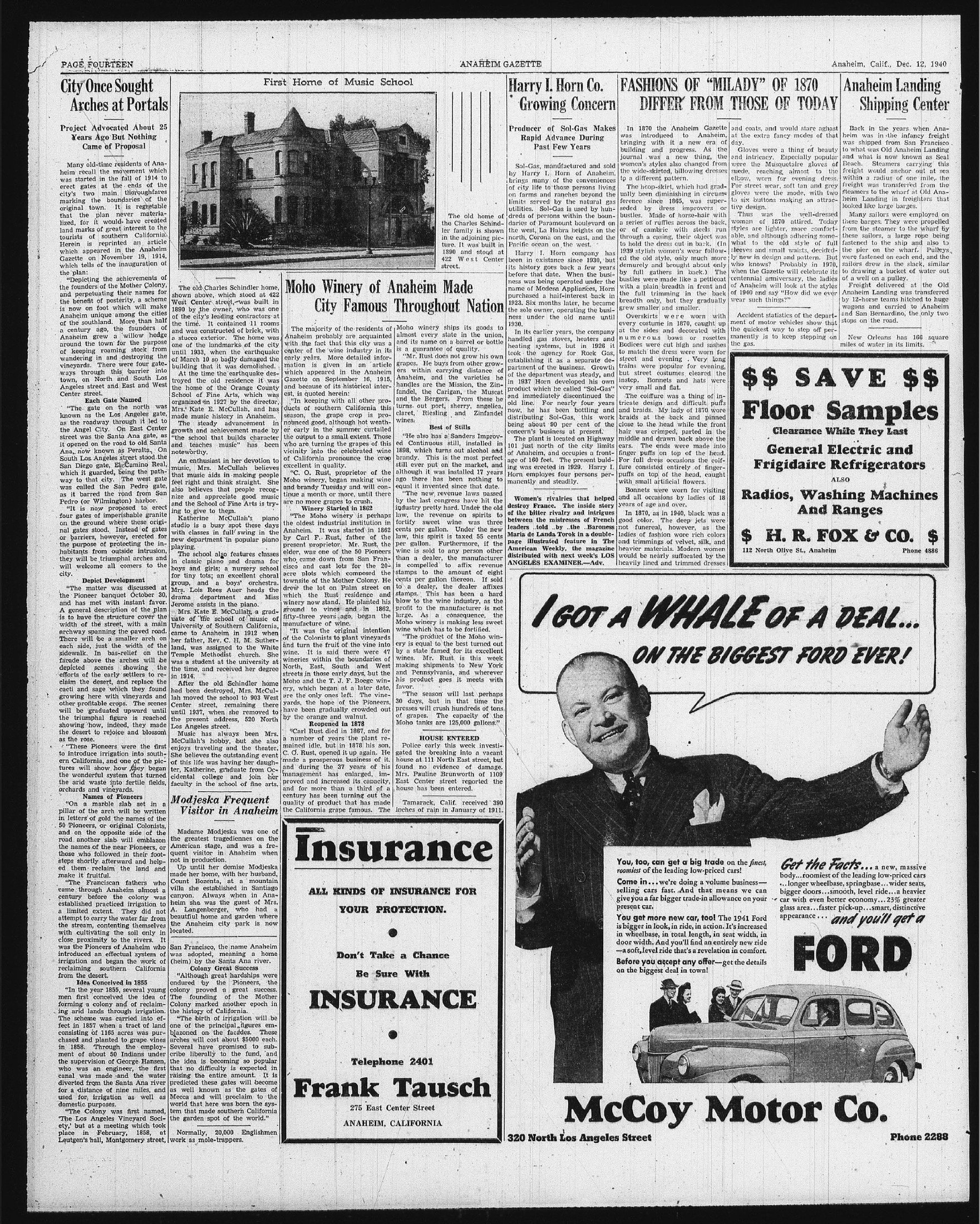
Searchable text
City Once Sought Arches at Portals
Project Advocated About 25 Years Ago But Nothing Came of Proposal
Many old-time residents of Anaheim recall the movement which was started in the fall of 1914 to erect gates at the ends of the city's two main thoroughfares marking the boundaries of the original town. It is regretable that the plan never materialized, for it would have created land marks of great interest to the tourists of southern California. Herein is reprinted an article which appeared in the Anaheim Gazette on November 19, 1914, which tells of the inauguration of the plan:
"Depicting the achievements of the founders of the Mother Colony, and perpetuating their names for the benefit of posterity, a scheme is now on foot which will make Anaheim unique among the cities of the southland. More than half a century ago, the founders of Anaheim grew a willow hedge around the town for the purpose of keeping roaming stock from wandering in and destroying the vineyards. There were four gateways through this barrier into town, on North and South Los Angeles street and East and West Center street.
Each Gate Named
"The gate on the north was known as the Los Angeles gate, as the roadway through it led to the Angel City. On East Center street was the Santa Ana gate, as it opened on the road to old Santa Ana, now known as Peralta." On San Diego Street stood the
The old Charles Schindler home, shown above, which stood at 422 West Center street, was built in 1890 by the owner, who was one of the city's leading contractors at the time. It contained 11 rooms and was constructed of brick, with a stucco exterior. The home was one of the landmarks of the city until 1933, when the earthquake of March 10 so badly damaged the building that it was demolished.
At the time the earthquake destroyed the old residence it was the home of the Orange County School of Fine Arts, which was organized in 1927 by the director, Mrs. Kate E. McCullah, and has made music history in Anaheim.
The steady advancement in growth and achievement made by "the school that builds character and teaches music" has been noteworthy.
Moho Winery City Farm
The majority of the residents Anaheim probably are accustomed with the fact that this city center of the wine industry early years. More detailed mation is given in an which appeared in the Anaheim Gazette on September 1 and because of its historic est, is quoted herein:
"In keeping with all other ducts of southern California season, the grape crop is nonced good, although hoer early in the summer or the output to a small extent who are turning the grape vicinity into the celebrat
Each Gate Named
"The gate on the north was known as the Los Angeles gate, as the roadway through it led to the Angel City. On East Center street was the Santa Ana gate, as it opened on the road to old Santa Ana, now known as Peralta, On South Los Angeles street stood the San Diego gate, El Camino Real, which it guarded, being the pathway to that city. The west gate was called the San Pedro gate, as it barred the road from San Pedro (or Wilmington) harbor.
"It is now proposed to erect four gates of imperishable granite on the ground where these original gates stood. Instead of gates or barriers, however, erected for the purpose of protecting the inhabitants from outside intrusion, they will be triumphal arches and will welcome all comers to the city.
Depict Development
"The matter was discussed at the Pioneer banquet October 30, and has met with instant favor. A general description of the plan is to have the structure cover the width of the street, with a main archway spanning the paved road. There will be a smaller arch on each side, just the width of the sidewalk. In bas-relief on the facade above the arches will be depicted scenes showing the efforts of the early settlers to reclaim the desert, and replace the cacti and sage which they found growing here with vineyards and other profitable crops. The scenes will be graduated upward until the triumphal figure is reached showing how, indeed, they made the desert to rejoice and blossom as the rose.
"These Pioneers were the first to introduce irrigation into southern California, and one of the pictures will show how they began the wonderful system that turned the arid waste into fertile fields, orchards and vineyards."
Names of Pioneers
"On a marble slab set in a pillar of the arch will be written in letters of gold the names of the 50 Pioneers, or original Colonists, and on the opposite side of the road another slab will emblazon the names of the near Pioneers, or those who followed in their footsteps shortly afterward and help-"
Modjeska Frequent Visitor in Anaheim
Madame Modjeska was one of the greatest tragediennes on the American stage, and was a frequent visitor in Anaheim when not in production.
At the time the earthquake destroyed the old residence it was the home of the Orange County School of Fine Arts, which was organized in 1927 by the director, Mrs. Kate E. McCullah, and has made music history in Anaheim.
The steady advancement in growth and achievement made by "the school that builds character and teaches music" has been noteworthy.
An enthusiast in her devotion to music, Mrs. McCullah believes that music aids in making people feel right and think straight. She also believes that people recognize and appreciate good music and the School of Fine Arts is trying to give to them.
Katherine McCullah's piano studio is a busy spot these days with classes in full swing in the new department in popular piano playing.
The school also features classes in classic piano and drama for boys and girls; a nursery school for tiny tots; an excellent choral group, and a boys' orchestra.
Mrs. Lois Rees Auer heads the drama department and Miss Jerome assists in the piano.
Mrs. Kate E. McCullah, a graduate of the school of music of University of Southern California, came to Anaheim in 1912 when her father, Rev. C. H., M. Sutherland, was assigned to the White Temple Methodist church. She was a student at the university at the time, and received her degree in 1914.
After the old Schindler home had been destroyed, Mrs. McCullah moved the school to 903 West Center street, remaining there until 1937, when she removed to the present address, 520 North Los Angeles street.
Music has always been Mrs. McCullah's hobby, but she also enjoys traveling and the theater. She believes the outstanding event of this life was having her daughter, Katherine, graduate from Occidental college and join her faculty in the school of fine arts.
"It was the original idea of the Colonists to plant vines and turn the fruit of the vine. It is said there were wineries within the bounding North, East, South and streets in those early days," Madame Modjeska wrote at T. J. F. Boeery, which began at a lathe are only ones left. The yards, the hope of the F have been gradually crowded by the orange and walnut."
Reopened in 1878
"Carl Rust died in 1867, a number of years after he mained idle, but in 1878 C. O. Rust, opened it up again made a prosperous business and during the 37 years management has enlarged proved and increased its size and for more than a third century has been turning quality of product that has California grape famous."
Names of Pioneers
"On a marble slab set in a pillar of the arch will be written in letters of gold the names of the 50 Pioneers, or original Colonists, and on the opposite side of the road another slab will emblazon the names of the near Pioneers, or those who followed in their footsteps shortly afterward and helped them reclaim the land and make it fruitful.
"The Franciscan fathers who came through Anaheim almost a century before the colony was established practiced irrigation to a limited extent. They did not attempt to carry the water far from the stream, contenting themselves with cultivating the soil only in close proximity to the rivers. It was the Pioneers of Anaheim who introduced an effectual system of irrigation and began the work of reclaiming southern California from the desert.
Idea Conceived in 1855
"In the year 1855, several young men first conceived the idea of forming a colony and of reclaiming arid lands through irrigation. The scheme was carried into effect in 1857 when a tract of land consisting of 1165 acres was purchased and planted to grape vines in 1858. Through the employment of about 50 Indians under the supervision of George Hansen, who was an engineer, the first canal was made and the water diverted from the Santa Ana river for a distance of nine miles, and used for irrigation as well as domestic purposes.
"The Colony was first named, 'The Los Angeles Vineyard Society,' but at a meeting which took place in February, 1858, at Leutgen's hall, Montgomery street, Madame Modjeska was one of the greatest tragediennes on the American stage, and was a frequent visitor in Anaheim when not in production.
Up until her demise Modjeska made her home, with her husband, Count Bozenta, at a mountain villa she established in Santiago canyon. Always when in Anaheim she was the guest of Mrs. A. Langenberger, who had a beautifiul home and garden where the Anaheim city park is now located.
San Francisco, the name Anaheim was adopted, meaning a home (heim) by the Santa Ana river.
Colony Great Success
"Although great hardships were endured by the Pioneers, the colony proved a great success. The founding of the Mother Colony marked another epoch in the history of California.
"The birth of irrigation will be one of the principal figures emblazoned on the facades. These arches will cost about $5000 each. Several have promised to subcribe liberally to the fund, and the idea is becoming so popular that no difficulty is expected in raising the entire amount. It is predicted these gates will become as well known as the gates of Mecca and will proclaim to the world that here was born the system that made southern California the garden spot of the world."
Normally, 20,000 Englishmen work as mole-trappers."
Home of Music School
The old home of the Charles Schindler family is shown in the adjoining picture. It was built in 1890 and stood at 422 West Center street.
Moho Winery of Anaheim Made City Famous Throughout Nation
The majority of the residents of Anaheim probably are acquainted with the fact that this city was a center of the wine industry in its early years. More detailed information is given in an article which appeared in the Anaheim Gazette on September 16, 1915, and because of its historical interest, is quoted herein:
"In keeping with all other products of southern California this season, the grape crop is produced good, although hot weather early in the summer curtailed the output to a small extent. Those who are turning the grapes of this vicinity into the celebrated wine
Moho winery ships its goods to almost every state in the union, and its name on a barrel or bottle is a guarantee of quality.
Mr. Rust does not grow his own grapes. He buys from other growers within carrying distance of Anaheim, and the varieties he handles are the Mission, the Zinfandel, the Carigan, the Muscat and the Bergers. From these he turns out port, sherry, angelica, claret, Riesling and Zinfandel wines:
Best of Stills
"He also has a Sanders Improved Continuous still, installed in 1898, which turns out alcohol and brandy. This is the most perfect"
Harry I. Horn Co. Growing Concern
Producer of Sol-Gas Makes Rapid Advance During Past Few Years
Sol-Gas, manufactured and sold by Harry I. Horn of Anaheim, brings many of the conveniences of city life to those persons living on farms and ranches beyond the limits served by the natural gas utilities. Sol-Gas is used by hundreds of persons within the boundaries of Paramount boulevard on the west, La Habra heights on the north, Corona on the east, and the Pacific ocean on the west.
Harry I. Horn company has been in existence since 1930, but its history goes back a few years before that date. When the business was being operated under the name of Modern Appliances, Horn purchased a half-interest back in 1923. Six months later, he became the sole owner, operating the business under the old name until 1930.
In its earlier years, the company handled gas stoves, heaters and heating systems, but in 1926 it took the agency for Rock Gas, establishing it as a separate department of the business. Growth of the department was steady, and in 1937 Horn developed his own product which he called "Sol-Gas" and immediately discontinued the old line. For nearly four years now, he has been bottling and distributing Sol-Gas, this work being about 90 per cent of the concern's business at present.
The plant is located on Highway 101 just north of the city limits of Anaheim, and occupies a front-facing design and diffuse braids. My lady of braids at the back close to the head while hair was crimped, part middle and drawn back ears. The ends were finger puffs on top of
In keeping with all other products of southern California this season, the grape crop is produced good, although hot weather early in the summer curtailed the output to a small extent. Those who are turning the grapes of this vicinity into the celebrated wine of California pronounce the crop excellent in quality.
"C. O. Rust, proprietor of the Moho winery, began making wine and brandy Tuesday and will continue a month or more, until there are no more grapes to crush.
Winery Started in 1862
"The Moho winery is perhaps the oldest industrial institution in Anaheim. It was started in 1862 by Carl F. Rust, father of the present proprietor. Mr. Rust, the elder, was one of the 50 Pioneers who came down from San Francisco and cast lots for the 20-acre plots which composed the townsite of the Mother Colony. He grew the lot on Palm street on which the Rust residence and winery now stand. He planted his ground to vines and in 1862, fifty-three years ago, began the manufacture of wine.
"It was the original intention of the Colonists to plant vineyards and turn the fruit of the vine into wine. It is said there were 47 wineries within the boundaries of North, East, South and West streets in those early days, but the Moho and the T. J. F. Boege winery, which began at a later date, are the only ones left. The vineyards, the hope of the Pioneers, have been gradually crowded out by the orange and walnut.
Reopened in 1878
"Carl Rust died in 1867, and for a number of years the plant remained idle, but in 1878 his son, C. O. Rust, opened it up again. He made a prosperous business of it, and during the 37 years of his management has enlarged, improved and increased its capacity, and for more than a third of a century has been turning out the quality of product that has made the California grape famous. The grapes. He buys from other growers within carrying distance of Anaheim, and the varieties he handles are the Mission, the Zinfandel, the Carigan, the Muscat and the Bergers. From these he turns out port, sherry, angelica, claret, Riesling and Zinfandel wines:
Best of Stills
"He also has a Sanders Improved Continuous still, installed in 1898, which turns out alcohol and brandy. This is the most perfect still ever put on the market, and although it was installed 17 years ago there has been nothing to equal it invented since that date.
"The new revenue laws passed by the last congress have hit the industry pretty hard. Under the old law, the revenue on spirits to fortify sweet wine was three cents per gallon. Under the new law, this spirit is taxed 55 cents per gallon. Furthermore, if the wine is sold to any person other than a dealer, the manufacturer is compelled to affix revenue stamps to the amount of eight cents per gallon thereon. If sold to a dealer, the dealer affixes stamps. This has been a hard blow to the wine industry, as the profit to the manufacturer is not large. As a consequence, the Moho winery is making less sweet wine which has to be fortified.
"The product of the Moho winery is equal to the best turned out by a state famed for its excellent wines. Mr. Rust is this week making shipments to New York and Pennsylvania, and wherever his product goes it meets with favor.
"The season will last perhaps 30 days, but in that time the presses will crush hundreds of tons of grapes. The capacity of the Moho tanks are 125,000 gallons."
HOUSE ENTERED
Police early this week investigated the breaking into a vacant house at 111 North East street, but found no evidence of damage. Mrs. Pauline Brunworth of 1109 East Center street reported the house has been entered.
Tamarack, Calif. received 390 inches of rain in January of 1911.
Women's rivalries that helped destroy France. The inside story of the bitter rivalry and intrigues between the mistresses of French leaders told by ...the Baroness Maria de Landa Torok in a double-page illustrated feature in The American Weekly, the magazine distributed with next week's LOS ANGELES EXAMINER.-Adv.
The plant is located on Highway 101 just north of the city limits of Anaheim, and occupies a frontage of 160 feet. The present building was erected in 1929. Harry I. Horn employees four persons permanently and steadily.
The coiffure was a tricate design and difficult braids. My lady of braids at the back while hair was crimped; part middle and drawn back ears. The ends were finger puffs on top of For full dress occasion; fure consisted entirely of puffs on top of the head with small artificial flowers.
Bonnets were worn and all occasions by late years of age and over.
In 1870, as in 1940, bonnet good color. The deepest not funereal; however ladies of fashion wore and trimmings of velvet heavier materials. Mode would be nearly suffocated heavily lined and trimmed.
Insurance
ALL KINDS OF INSURANCE FOR YOUR PROTECTION.
Don’t Take a Chance
Be Sure With INSURANCE
Telephone 2401
Frank Tausch
275 East Center Street
ANAHEIM, CALIFORNIA
McCoy
320 North Los Angeles Street
FASHIONS OF “MILADY” OF 1870 DIFFER FROM THOSE OF TODAY
In 1870 the Anaheim Gazette was introduced to Anaheim, bringing with it a new era of building and progress. As the journal was a new thing, the women's styles also changed from the wide-skirted, billowing dresses to a different pattern.
The hcop-skirt, which had gradually been diminishing in circumference since 1865, was superseeded by dress improvers or bustles. Made of horse-hair with a series of ruffles across the back, or of cambric with steels run through a casing, their object was to hold the dress out in back. (In 1939 stylish women's wear followed the old style, only much more demurely and brought about only by full gathers in back.) The bustles were made like a petticoat with a plain breadth in front and the full trimming in the back breadth only, but they gradually grew smaller and smaller.
Overskirts were worn with every costume in 1870, caught up at the sides and decorated with numerous bows or rosettes. Bodices were cut high and sashes to match the dress were worn for street and evening. Very long trains were popular for evening, but street costumes cleared the instep. Bonnets and hats were very small and flat.
The coiffure was a thing of intricate design and difficult puffs and braids. My lady of 1870 wore braids at the back and pinned close to the head while the front hair was crimped, parted in the middle and drawn back above the ears. The ends were made into finger puffs on top of the head.
Anaheim Landing Shipping Center
Back in the years when Anaheim was in the infancy freight was shipped from San Francisco to what was Old Anaheim Landing and what is now known as Seal Beach. Steamers carrying this freight would anchor out at sea within a radius of one mile, the freight was transferred from the steamers to the wharf at Old Anaheim Landing in freighters that looked like large barges.
Many sailors were employed on these barges. They were propelled from the steamer to the wharf by these sailors, a large rope being fastened to the ship and also to the pier on the wharf. Pulleys were fastened on each end, and the sailors drew in the slack, similar to drawing a bucket of water out of a well on a pulley.
Freight delivered at the Old Anaheim Landing was transferred by 12-horse teams hitched to huge wagons and carried to Anaheim and San Bernardino, the only two stops on the road.
New Orleans has 166 square miles of water in its limits.
$$ SAVE $$
Floor Samples
Clearance While They Last
General Electric and
Frigidaire Refrigerators
ALSO
Radios, Washing Machines
And Ranges
$ H. R. FOX & CO. $
112 North Olive St., Anaheim Phone 4886
A WHALE OF A DEAL...
ON THE BIGGEST FORD EVER!
You, too, can get a big trade on the finest, roomiest of the leading low-priced cars!
Come in...we're doing a volume business—selling cars fast. And that means we can give you a far bigger trade-in allowance on your present car.
You get more new car, tool! The 1941 Ford is bigger in look, in ride, in action. It's increased in wheelbase, in total length, in seat width, in door width. And you'll find an entirely new ride—a soft, level ride that's a revelation in comfort.
Before you accept any offer—get the details on the biggest deal in town!
Get the Facts...a new, massive body...roomiest of the leading low-priced cars...longer wheelbase, springbase...wider seats, bigger doors...smooth, level ride...a heavier car with even better economy...23% greater glass area...faster pick-up...smart, distinctive appearance...
and you'll get a
FORD
McCoy Motor Co.
Street
Phone 2288