anaheim-gazette 1939-10-26
Scanned page
Searchable text
Former Publisher Outlines Orange County Formation
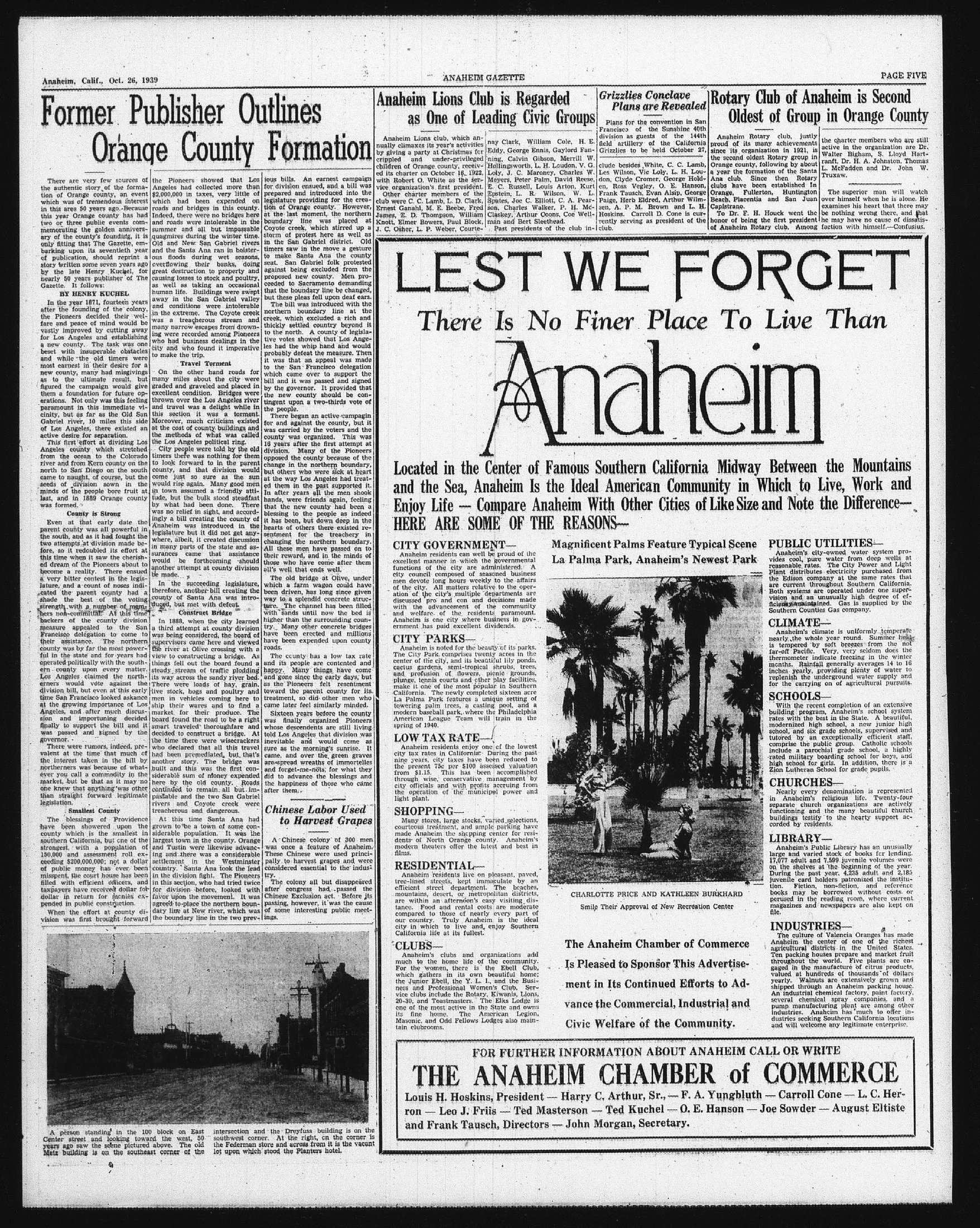
There are very few sources of the authentic story of the formation of Orange county, an event which was of tremendous interest in this area 50 years ago. Because this year Orange county has had two or three public events commemorating the golden anniversary of the county's founding, it is only fitting that The Gazette, embarking upon its seventieth year of publication, should reprint a story written some seven years ago by the late Henry Kuchel, for nearly 50 years publisher of The Gazette. It follows:
BY HENRY KUCHEL
In the year 1871, fourteen years after the founding of the colony, the Pioneers decided their welfare and peace of mind would be vastly improved by cutting away for Los Angeles and establishing a new county. The task was one beset with insuperable obstacles and while the old timers were most earnest in their desire for a new county, many had misgivings as to the ultimate result, but figured the campaign would give them a foundation for future operations. Not only was this feeling paramount in this immediate vicinity, but as far as the Old San Gabriel river, 10 miles this side of Los Angeles, there existed an active desire for separation.
This first effort at dividing Los Angeles county which stretched from the ocean to the Colorado the Pioneers showed that Los Angeles had collected more than $2,000,000 in taxes, very little of which had been expended on roads and bridges in this county. Indeed, there were no bridges here and roads were intolerable in the summer and all but impassable quagmires during the winter time. Old and New: San Gabriel rivers and the Santa Ana ran in boisterous floods during wet seasons, overflowing their banks, doing great destruction to property and causing losses to stock and poultry, as well as taking an occasional human life. Buildings were swept away in the San Gabriel valley and conditions were intolerable in the extreme. The Coyote creek was a treacherous stream and many narrow escapes from drowning were recorded among Pioneers who had business dealings in the city and who found it imperative to make the trip.
Travel Torment
On the other hand roads for many miles about the city were graded and graveled and placed in excellent condition. Bridges were thrown over the Los Angeles river and travel was a delight while in this section it was a torment. Moreover, much criticism existed at the cost of county buildings and the methods of what was called the Los Angeles political ring.
City people were told by the old timers there was nothing for themious bills. An earnest campaign for division ensued, and a bill was prepared and introduced into the legislature providing for the creation of Orange county. However, at the last moment, the northern boundary line was placed by Coyote creek, which stirred up storm of protest here as well as in the San Gabriel district. Our timers saw in the move a gesture to make Santa Ana the county seat. San Gabriel folk protested against being excluded from the proposed new county. Men proceeded to Sacramento demanding that the boundary line be changed but these pleas fell upon deaf ears.
The bill was introduced with the northern boundary line at the creek, which excluded a rich and thickly settled country beyond it to the north. A county of legislative votes showed that Los Angeles had the whip hand and would probably defeat the measure. Then it was that an appeal was made to the San Francisco delegation which came over to support the bill and it was passed and signed by the governor. It provided that the new county should be contingent upon a two-thirds vote of the people.
There began an active campaign for and against the county, but it was carried by the voters and the county was organized. This was 16 years after the first attempt at division. Many of the Pioneers opposed the county because of
most earnest in their desire for a new county, many had misgivings as to the ultimate result, but figured the campaign would give them a foundation for future operations. Not only was this feeling paramount in this immediate vicinity, but as far as the Old San Gabriel river, 10 miles this side of Los Angeles, there existed an active desire for separation.
This first effort at dividing Los Angeles county which stretched from the ocean to the Colorado river and from Kern county on the north to San Diego on the south came to naught, of course, but the seeds of division sown in the minds of the people bore fruit at last, and in 1889 Orange county was formed.
County Is Strong
Even at that early date the parent county was all powerful in the south, and as it had fought the two attempts at division made before, so it redoubled its effort at this time when it saw the cherished dream of the Pioneers about to become a reality. There ensued a very bitter contest in the legislature, and a count of noses indicated the parent county had a shade the best of the voting strength with a number of members non-committtl. At this time backers of the county division measure appealed to the San Francisco delegation to come to their assistance. The northern county was by far the most powerful in the state and for years had operated politically with the southern county upon every matter. Los Angeles claimed the northerners would vote against the division bill, but even at this early time San Francisco looked askance at the growing importance of Los Angeles, and after much discussion and importuning decided finally to support the bill and it was passed and pigned by the governor.
There were rumors, indeed, prevalent at the time that much of the interest taken in the bill by northerners was because of whatever you call a commodity in the market, but be that as it may no one knew that anything 'was other than straight forward legitimate legislation.
Smallest County
The blessings of Providence have been showered upon the county which is the smallest in southern California, but one of the strongest, with a population of 150,000 and assessment roll exceeding $200,000,000; not a dollar of public money has ever been
Travel Torment
On the other hand roads for many miles about the city were graded and graveled and placed in excellent condition. Bridges were thrown over the Los Angeles river and travel was a delight while in this section it was a torment. Moreover, much criticism existed at the cost of county buildings and the methods of what was called the Los Angeles political ring.
City people were told by the old timers there was nothing for them to look forward to in the parent county, and that division would come just so sure as the sun would rise again. Many good men in town assumed a friendly attitude, but the bulk stood steadfast by what had been done. There was no relief in sight, and accordingly a bill creating the county of Anaheim was introduced in the legislature but it did not get anywhere, albeit, it created discussion in many parts of the state and assurances came that assistance would be forthcoming should another attempt at county division be made.
In the succeeding legislature, therefore, another bill creating the county of Santa Ana was introduced, but met with defeat.
Construct Bridge
In 1888, when the city learned a third attempt at county division was being considered, the board of supervisors came here and viewed the river at Olive crossing with a view to constructing a bridge. As things fell out the board found a steady stream of traffic plodding its way across the sandy river bed. There were loads of hay, grain live stock, hogs and poultry and men in vehicles coming here to ship their wares and to find a market for their produce. The board found the road to be a right smart traveled thoroughfare and decided to construct a bridge. At the time there were wisecrackers who declared that all this travel had been premediated, but that's another story. The bridge was built and this was the first considerable sum of money expended here by the old county. Roads continued to remain all but impassable and the two San Gabriel rivers and Coyote creek were treacherous and dangerous.
At this time Santa Ana had grown to be a town of some considerable population. It was the largest town in the county. Orange and Tustin were likewise advancing and there was a considerable settlement in the Westminster country. Santa Ana took the lead
Chinese Labor Used to Harvest Grape
A Chinese colony of 300 mln was once a feature of Anaheim. These Chinese were used principally to harvest grapes and we considered essential to the indi
ever you call a commodity in the market, but be that as it may no one knew that anything was other than straight forward legitimate legislation.
Smallest County
The blessings of Providence have been showered upon the county which is the smallest in southern California, but one of the strongest, with a population of 150,000 and assessment roll exceeding $200,000,000; not a dollar of public money has ever been misspent, the court house has been filled with efficient officers, and taxpayers have received dollar for dollar in return for menies expended in public construction.
When the effort at county division was first brought forward
A person standing in the 100 block on East Center street and looking toward the west, 50 years ago saw the scene pictured above. The old Metz building is on the southeast corner of the intersection and the Dreyfuss building is on the southwest corner. At the right, on the corner, the Federman store and across from it is the vacant lot upon which stood the Planters hotel.
ANAHEIM GAZETTE
Anaheim Lions Club is Regarded as One of Leading Civic Groups
Anaheim Lions club, which annually climaxes its year’s activities by giving a party at Christmas for crippled and under-privileged children of Orange county, received its charter on October 16, 1922, with Robert O. White as the service organization's first president.
Other charter members of the club were C. C. Lamb, L. D. Clark, Ernest Ganahl, M. E. Beebe, Fred James, E. D. Thompson, William Knott, Elmer Bowers, Paul Block, J. C. Osher, L. P. Weber, Courte-nay Clark, William Cole, H. E. Eddy, George Ennis, Gaylord Fanning, Calvin Gibson, Merrill W. Hollingsworth, L. H. Loudon, V. G. Loly, J. C. Maroney, Charles W. Meyers, Peter Palm, David Reese, E. C. Russell, Louis Arton, Kurt Epstein, L. R. Wilson, W. L. Spates, Joe C. Elliott, C. A. Pearson, Charles Walker, P. H. McClaskey, Arthur Coons, Coe Wellman and Bert Sleethead.
Past presidents of the club include besides White, C. C. L., Les Wilson, Vic Loly, L. H. Dion, Clyde Cromer, George Henen, Ross Vegley, O. E. Harper Frank Tausch, Evan Alsip, Gea Paige, Herb Eldred, Arthur Wesen, A. P. M. Brown and L. Hoskins.
Carroll D. Cone is currently serving as president of club.
LEST WE FIND
There Is No Finer Place
Located in the Center of Famous Southern California and the Sea, Anaheim Is the Ideal American Community Enjoy Life — Compare Anaheim With Other Cities HERE ARE SOME OF THE REASONS—
CITY GOVERNMENT—
Anaheim residents can well be proud of the excellent manner in which the governmental functions of the city are administered. A city council composed of seasoned business men devote long hours weekly to the affairs of the city. All matters relative to the operation of the city's multiple departments are discussed pro and con and decisions made with the advancement of the community and welfare of the residents paramount. Anaheim is one city where business in government has paid excellent dividends.
CITY PARKS—
Anaheim is noted for the beauty of its parks. The City Park comprises twenty acres in the center of the city, and its beautiful lily ponds, cactus gardens, semi-tropical shrubs, trees, and profusion of flowers, picnic grounds, plunge, tennis courts and other play facilities, make it one of the most popular in Southern California. The newly completed sixteen acre La Palma Park features a unique setting of towering palm trees, a casting pool, and a modern baseball park, where the Philadelphia American League Team will train in the spring of 1940.
LOW TAX RATE—
Anaheim residents enjoy one of the lowest city tax rates in California. During the past nine years, city taxes have been reduced to the present 75c per $100 assessed valuation from $1.15. This has been accomplished through wise, conservative management by city officials and with profits accruing from the operation of the municipal power and light plant.
SHOPPING—
Many stores, large stocks, varied selections, courteous treatment, and ample parking have made Anaheim the shopping center for residents of North Orange county. Anaheim's modern theaters offer the latest and best in films.
RESIDENTIAL—
SHOPPING—
Many stores, large stocks, varied selections,
courteous treatment, and ample parking have
made Anaheim the shopping center for residents of North Orange county. Anaheim's
modern theaters offer the latest and best in
films.
RESIDENTIAL—
Anaheim residents live on pleasant, paved,
tree-lined streets, kept immaculate by an
efficient street department. The beaches,
mountains, desert, or metropolitan districts,
are within an afternoon's easy visiting distance. Food and rental costs are moderate
compared to those of nearly every part of
our country. Truly Anaheim is the ideal
city in which to live and enjoy Southern
California life at its fullest.
CLUBS—
Anaheim's clubs and organizations add
much to the home life of the community.
For the women, there is the Ebell Club,
which gathers in its own beautiful home;
the Junior Ebell, the Y. L. I., and the Business and Professional Women's Club. Service clubs include the Rotary, Kiwanis, Lions,
20-30, and Toastmasters. The Elks Lodge is
one of the most active in the State and owns
its fine home. The American Legion,
Masonic, and Odd Fellows Lodges also maintain clubrooms.
FOR FURTHER INFORMATION ABOUT AN
THE ANAHEIM CHAMBER
Louis H. Hoskins, President — Harry C. Arthur, Sr., — F.
ron — Leo J. Friis — Ted Masterson — Ted Kuchel — O.
and Frank Tausch, Directors — John Morgan, Secretary.
Rotary Club of Anaheim is Second Oldest of Group in Orange County
Anaheim Rotary club, justly proud of its many achievements since its organization in 1921, is the second oldest Rotary group in Orange county, following by about a year the formation of the Santa Ana club. Since then Rotary clubs have been established in Orange, Fullerton, Huntington Beach, Placentia and San Juan Capistrano.
To Dr. F. H. Houck went the honor of being the first president of Anaheim Rotary club. Among the charter members who are still active in the organization are Dr. Walter Bigham, S. Lloyd Hartranft, Dr. H. A. Johnston, Thomas L. McFadden and Dr. John W. Truxaw.
The superior man will watch over himself when he is alone. He examines his heart that there may be nothing wrong there, and that he may have no cause of dissatisfaction with himself.—Confusius.
Southern California Midway Between the Mountains
American Community in Which to Live, Work and
Other Cities of Like Size and Note the Difference—
Palms Feature Typical Scene
Park, Anaheim’s Newest Park
PUBLIC UTILITIES—
Anaheim’s city-owned water system provides cool, pure water from deep wells at reasonable rates. The City Power and Light Plant distributes electricity purchased from the Edison company at the same rates that are current throughout Southern California. Both systems are operated under one supervision and an unusually high degree of efficiency maintained. Gas is supplied by the Southern Counties Gas company.
CLIMATE—
Anaheim’s climate is uniformly temperate nearly the whole year round. Summer heat is tempered by soft breezes from the not far-off Pacific. Very, very seldom does the thermometer indicate freezing in the winter months. Rainfall generally averages 14 to 16 inches yearly, providing plenty of water to replenish the underground water supply and for the carrying on of agricultural pursuits.
SCHOOLS—
With the recent completion of an extensive building program, Anaheim’s school system rates with the best in the State. A beautiful, modernized high school, a new junior high school, and six grade schools, supervised and tutored by an exceptionally efficient staff, comprise the public group. Catholic schools include a parochial grade school, a highly rated military boarding school for boys, and high school for girls. In addition, there is a Zion Lutheran School for grade pupils.
CHURCHES—
Nearly every denomination is represented in Anaheim’s religious life. Twenty-four separate church organizations are actively functioning and the many beautiful church buildings testify to the hearty support accorded by residents.
LIBRARY—
Anaheim’s Public Library has an unusually large and varied stock of books for lending. 17,077 adult and 7,599 juvenile volumes were on the shelves at the beginning of the year.
CHURCHES—
Nearly every denomination is represented in Anaheim's religious life. Twenty-four separate church organizations are actively functioning and the many beautiful church buildings testify to the hearty support accorded by residents.
LIBRARY—
Anaheim's Public Library has an unusually large and varied stock of books for lending. 17,077 adult and 7,599 juvenile volumes were on the shelves at the beginning of the year. During the past year, 4,235 adult and 2,185 juvenile card holders patronized the institution. Fiction, non-fiction, and reference books may be borrowed without costs or perused in the reading room, where current magazines and newspapers are also kept on file.
INDUSTRIES—
The culture of Valencia Oranges has made Anaheim the center of one of the richest agricultural districts in the United States. Ten packing houses prepare and market fruit throughout the world. Five plants are engaged in the manufacture of citrus products, valued at hundreds of thousands of dollars yearly. Walnuts are extensively grown and shipped through an Anaheim packing house. An industrial chemical factory, paint factory, several chemical spray companies, and a pump manufacturing plant are among other industries. Anaheim has much to offer industries seeking Southern California locations and will welcome any legitimate enterprise.
TION ABOUT ANAHEIM CALL OR WRITE
CHAMBER of COMMERCE
Arthur, Sr., — F. A. Yungbluth — Carroll Cone — L. C. Her-ed Kuchel — O. E. Hanson — Joe Sowder — August Eltiste Logan, Secretary.