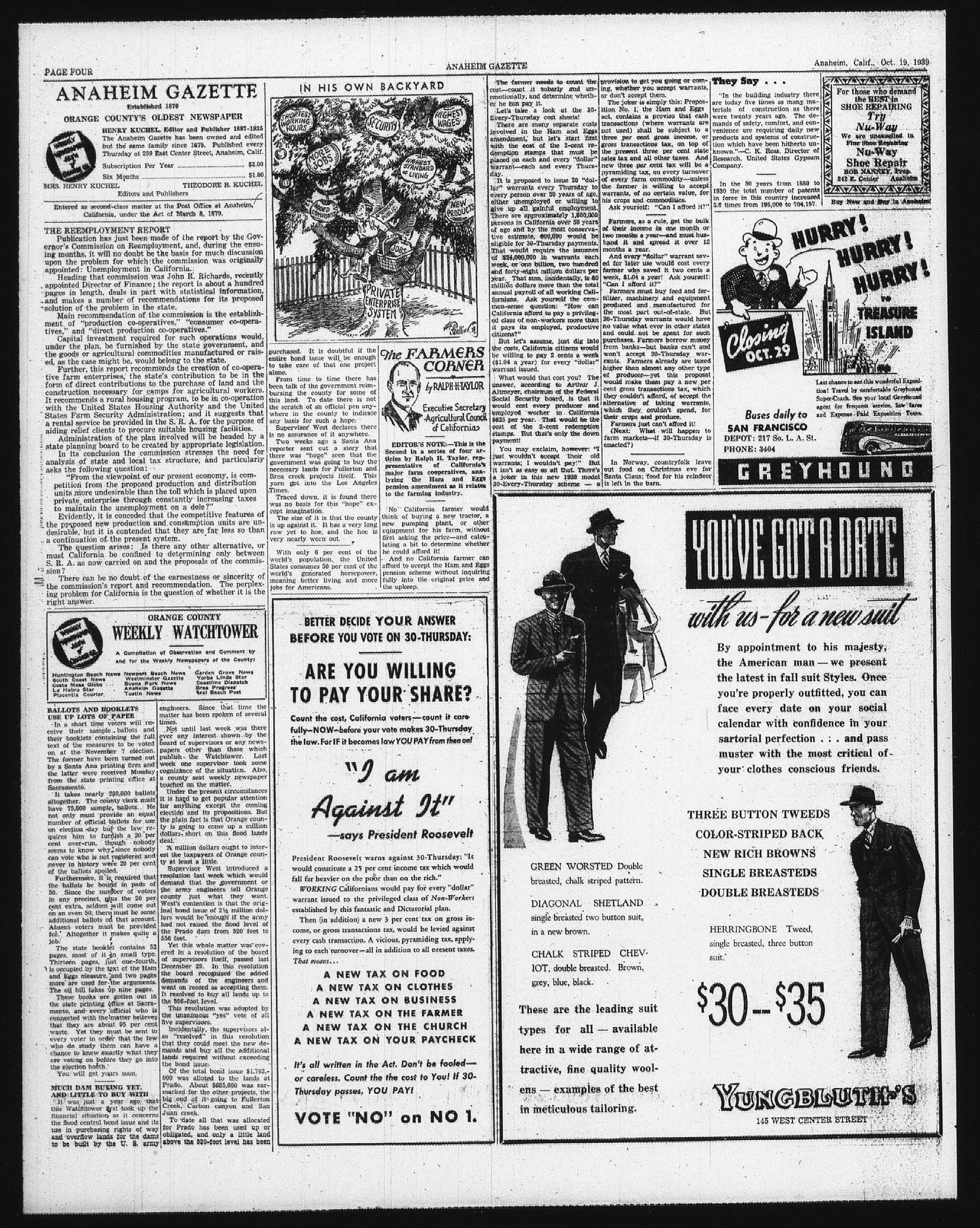
anaheim-gazette 1939-10-19
Scanned page
Searchable text
ANAHEIM GAZETTE
Established 1870
ORANGE COUNTY'S OLDEST NEWSPAPER
HENRY KUCHEL, Editor and Publisher 1887-1935
The Anaheim Gazette has been owned and edited but the same family since 1875. Published every Thursday at 259 East Center Street, Anaheim, Calif.
Subscription Per Year ... $2.00
Six Months ... $1.00
MRS. HENRY KUCHEL
THEODORE B. KUCHEL
Editors and Publishers
Entered as second-class matter at the Post Office at Anaheim,
California, under the Act of March 8, 1870.
THE REEMPLOYMENT REPORT
Publication has just been made of the report by the Governor's Commission on Reemployment, and, during the ensuing months, it will no doubt be the basis for much discussion upon the problem for which the commission was originally appointed: Unemployment in California.
Heading that commission was John R. Richards, recently appointed Director of Finance; the report is about a hundred pages in length, deals in part with statistical information, and makes a number of recommendations for its proposed solution of the problem in the state.
Main recommendation of the commission is the establishment of "production co-operatives," "consumer co-operatives," and "direct production co-operatives."
Capital investment required for such operations would, under the plan, be furnished by the state government, and the goods or agricultural commodities manufactured or raised, as the case might be, would belong to the state.
Further, this report recommends the creation of co-operative farm enterprises, the state's contribution to be in the form of direct contributions to the purchase of land and the construction necessary for camps for agricultural workers. It recommends a rural housing program, to be in co-operation with the United States Housing Authority and the United States Farm Security Administration; and it suggests that a rental service be provided in the S. R. A. for the purpose of aiding relief clients to procure suitable housing facilities.
Administration of the plan involved will be headed by a state planning board to be created by appropriate legislation.
In its conclusion the commission stresses the need for purchased. It is doubtful if entire bond issue will be enough to take care of that one project alone.
From time to time there has been talk of the government re-bursting the county for some land. To date there is no scratch of an official pen and where in the county to indicate any basis for such a hope.
Supervisor West declares that no assurance of it anywhere.
Two weeks ago a Santa Ana reporter sent out a story that there was "hope" seen that
Further, this report recommends the creation of co-operative farm enterprises, the state's contribution to be in the form of direct contributions to the purchase of land and the construction necessary for camps for agricultural workers. It recommends a rural housing program, to be in co-operation with the United States Housing Authority and the United States Farm Security Administration; and it suggests that a rental service be provided in the S. R. A. for the purpose of aiding relief clients to procure suitable housing facilities.
Administration of the plan involved will be headed by a state planning board to be created by appropriate legislation.
In its conclusion the commission stresses the need for analysis of state and local tax structure, and particularly asks the following question:
"From the viewpoint of our present economy, is competition from the proposed production and distribution units more undesirable than the toll which is placed upon private enterprise through constantly increasing taxes to maintain the unemployment on a dole?"
Evidently, it is conceded that the competitive features of the proposed new production and consumption units are undesirable, but it is contended that they are far less so than a continuation of the present system.
The question arises: Is there any other alternative, or must California be confined to determining only between S. R. A. as now carried on and the proposals of the commission?
There can be no doubt of the earnestness or sincerity of the commission's report and recommendation. The perplexing problem for California is the question of whether it is the right answer.
ORANGE COUNTY
WEEKLY WATCHTOWER
A Compilation of Observation and Comment by and for the Weekly Newspapers of the County:
Huntington Beach News
South Coast News
Costa Mesa Globe
La Habra Star
Placentia Courier
Newport Beach News
Westminster Gazette
Buena Park News
Anahalm Gazette
Tustin News
Garden Grove News
Yorba Linda Star
Coastline Dispatch
Brea Progress
Seal Beach Post
BALLOTS AND BOOKLETS USE UP LOTS OF PAPER
In a short time voters will receive their sample ballots and their booklets containing the full text of the measures to be voted on at the November 7 election. The former have been turned out by a Santa Ana printing firm and the latter were received Monday from the state printing office at Sacramento.
It takes nearly 200,000 ballots altogether. The county clerk must have 75,000 sample ballots. He not only must provide an equal number of official ballots for use on election day but the law requires him to furnish a 20 per cent over-run, though nobody seems to know why since nobody can vote who is not registered and never in history were 20 per cent engineers. Since that time the matter has been spoken of several times.
Not until last week was there ever any interest shown by the board of supervisors or any newspapers other than those which publish the Watchtower. Last week one supervisor took some cognizance of the situation. Also, a county seat weekly newspaper touched on the matter.
Under the present circumstances it is hard to get popular attention for anything except the coming election and its propositions. But the plain fact is that Orange county is going to come up a million dollars short on this flood lands deal.
A million dollars ought to interest the taxpayers of Orange county at least a little.
Supervisor West introduced
the latter were received Monday from the state printing office at Sacramento.
It takes nearly 200,000 ballots altogether. The county clerk must have 75,000 sample, ballots. He not only must provide an equal number of official ballots for use on election day but the law requires him to furnish a 20 per cent over-run, though nobody seems to know why since nobody can vote who is not registered and never in history were 20 per cent of the ballots spoiled.
Furthermore, it is required that the ballots be bound in pads of 50. Since the number of voters in any precinct, plus the 20 per cent extra, seldom will come out on an even 50; there must be some additional ballots of that account. Absent voters must be provided for. Altogether it makes quite a job.
The state booklet contains 52 pages, most of it in small type. Thirteen pages, just one-fourth, is occupied by the text of the Ham and Eggs measure, and two pages more are used for the arguments. The oil bill takes up nine pages.
These books are gotten out in the state printing office at Sacramento, and every official who is connected with the matter believes that they are about 95 per cent waste. Yet they must be sent to every voter in order that the few who do study them can have a chance to know exactly what they are voting on before they go into the election booth.
You will get yours soon.
MUCH DAM BUYING YET, AND LITTLE TO BUY WITH
It was just a year ago that this Watchtower first took up the financial situation as it concerns the flood control bond issue and its use in purchasing rights of way and overflow lands for the dams to be built by the U. S. army.
INAHEIM GAZETTE
IN HIS OWN BACKYARD
The farmer needs to count the cost—count it soberly and emotionally, and determine whether he can pay it.
Let's take a look at the 30-Every-Thursday cost sheets!
There are many separate costs involved in the Ham and Eggs amendment, but let's start first with the cost of the 2-cent redemption stamps that must be placed on each and every "dollar" warrant—each and every Thursday.
It is proposed to issue 30 "dollar" warrants every Thursday to every person over 50 years of age, either unemployed or willing to give up all gainful employment. There are approximately 1,600,000 persons in California over 50 years of age and by the most conservative estimate, 800,000 would be eligible for 30-Thursday payments. That would require the issuance of $24,000,000 in warrants each week, or one billion, two hundred and forty-eight million dollars per year. That sum, incidentally, is 80 million dollars more than the total annual payroll of all working Californians. Ask yourself the common-sense question: "How can California afford to pay a privileged class of non-workers more than it pays its employed, productive citizens?"
But let's assume, just dig into the costs, California citizens would be willing to pay 2 cents a week ($1.04 a year) for every "dollar" warrant issued.
What would that cost you? The answer, according to Arthur J. Altmeyer, chairman of the Federal Social Security board, is that it would cost every producer and employed worker in California $625 per year. That would be the cost of the 2-cent redemption stamps. But that's only the down payment!
You may exclaim, however: "I just wouldn't accept their old provision to get you going or doing anything, whether you accept warrants or don't accept them.
The joker is simply this: Provision No. I, the Ham and Eggs act, contains a proviso that transactions (where warrant not used) shall be subject to three per cent gross income gross transactions tax, on the present three per cent sales tax and all other taxes. New three per cent tax will pyramiding tax, on every turn of every farm commodity—the farmer is willing to add warrants, of no certain value his crops and commodities.
Ask yourself: "Can I afford Farmers, as a rule, get their of their income in one month two months a year—and must band it and spread it over months a year.
And every "dollar" warranted for later use would cost a farmer who saved it two cents a week, $1.04 a year! Ask you "Can I afford it?" Farmers must buy feed and fertilizer, machinery and equipment produced and manufactured the most part out-of-state. 30-Thursday warrants would no value what ever in other areas could not be spent for purchases. Farmers borrow money from banks—but banks cannot accept 30-Thursday warrants. Farmers already are higher than almost any other of producer—yet this price would make them pay a new cent gross transactions tax, they couldn't afford, of access alternative of taking warrants which they couldn't spend their crops and produce.
Farmers just can't afford it.
(Next: What will happy farm markets—if 30-Thursdays enacted?)
CORNER
by RALPH H. TAYLOR
Executive Secretary
Agricultural Council
of California
EDITOR'S NOTE:—This is the Second in a series of four articles by Ralph H. Taylor, representative of California's major farm cooperatives, analyzing the Ham and Eggs pension amendment as it relates to the farming industry.
No California farmer would think of buying a new tractor, a new pumping plant, or other equipment for his farm, without first asking the price—and calculating a bit to determine whether he could afford it!
And no California farmer can afford to accept the Ham and Eggs pension scheme without inquiring fully into the original price and the upkeep.
BETTER DECIDE YOUR ANSWER BEFORE YOU VOTE ON 30-THURSDAY:
ARE YOU WILLING TO PAY YOUR SHARE?
Count the cost, California voters—count it carefully—NOW—before your vote makes 30-Thursday the law. For IF it becomes law YOU PAY from then on!
"I am Against It"
—says President Roosevelt
President Roosevelt warns against 30-Thursday: "It would constitute a 25 per cent income tax which would
President Roosevelt warns against 30-Thursday: "It would constitute a 25 per cent income tax which would fall far heavier on the poor than on the rich."
WORKING Californians would pay for every "dollar" warrant issued to the privileged class of Non-Workers established by this fantastic and Dictatorial plan.
Then (in addition) a new 3 per cent tax on gross income, or gross transactions tax, would be levied against every cash transaction. A vicious, pyramiding tax, applying to each turnover—all in addition to all present taxes.
That means...
A NEW TAX ON FOOD
A NEW TAX ON CLOTHES
A NEW TAX ON BUSINESS
A NEW TAX ON THE FARMER
A NEW TAX ON THE CHURCH
A NEW TAX ON YOUR PAYCHECK
It's all written in the Act. Don't be fooled—or careless. Count the cost to You! If 30-Thursday passes, YOU PAY!
VOTE "NO" on NO 1.
GREEN WORSTED Double breasted, chalk striped pattern.
DIAGONAL SHETLAND single breasted two button suit, in a new brown.
CHALK STRIPED CHEV-IOT, double breasted. Brown, grey, blue, black.
These are the leading suit types for all — available here in a wide range of attractive, fine quality woolens — examples of the best in meticulous tailoring.
Anaheim, Calif., Oct. 19, 1939
They Say . . .
"In the building industry there are today five times as many materials of construction as there were twenty years ago. The demands of safety, comfort, and convenience are requiring daily new products and systems of construction which have been hitherto unknown."—C. K. Ross, Director of Research, United States Gypsum Company.
In the 50 years from 1880 to 1930 the total number of patents in force in this country increased 3.6 times from 195,000 to 704,157.
For those who demand the BEST in SHOE REPAIRING
Try Nu-Way
We are unexcelled in Fine Shoe Repairing
Nu-Way Shoe Repair
BOB NANNEY, Prop.
242 E. Center Anaheim
Buy Now and Buy In Anaheim!
Closing
OCT. 29
Last chance to see this wonderful Exposition! Travel by comfortable Greyhound Super-Coach. See your local Greyhound agent for frequent service, low fares and Expense-Paid Exposition Tours.
Buses daily to
SAN FRANCISCO
DEPOT: 217 So. L. A. St.
PHONE: 3404
YOU'VE GOT A DATE
with us-for a new suit
By appointment to his majesty,
the American man—we present
the latest in fall suit Styles. Once
you're properly outfitted, you can
face every date on your social
calendar with confidence in your
sartorial perfection . . . and pass
muster with the most critical ofyour clothes conscious friends.
THREE BUTTON TWEEDS
COLOR-STRIPED BACK
NEW RICH BROWNS
THREE BUTTON TWEEDS
COLOR-STRIPED BACK
NEW RICH BROWNS
SINGLE BREASTEDS
DOUBLE BREASTEDS
HERRINGBONE Tweed,
single breasted, three button suit.
$30--$35
YUNGBLUTH'S
145 WEST CENTER STREET