anaheim-gazette 1939-09-28
Scanned page
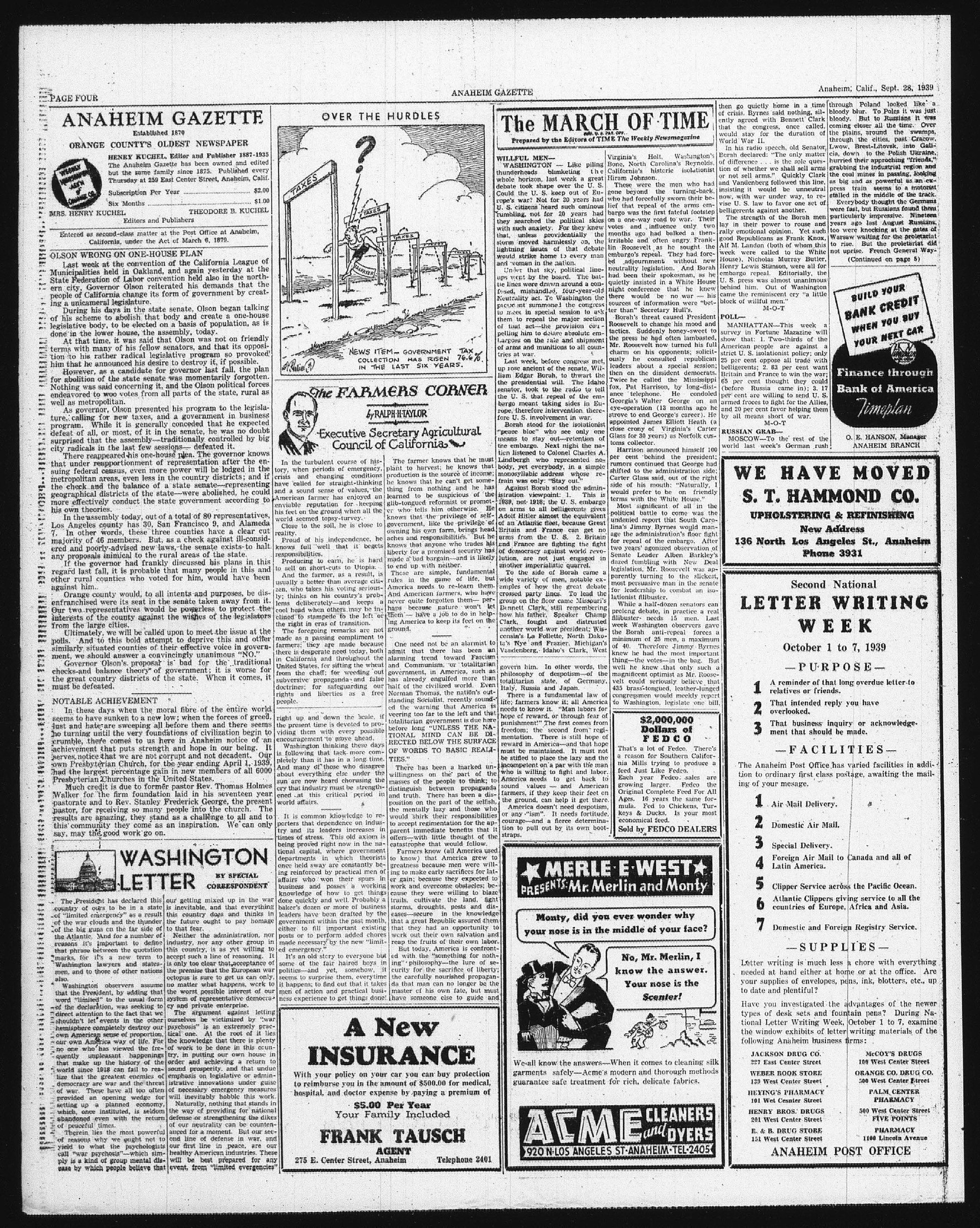
Searchable text
ANAHEIM GAZETTE
Established 1870
ORANGE COUNTY'S OLDEST NEWSPAPER
HENRY KUCHEL, Editor and Publisher 1887-1935
The Anaheim Gazette has been owned and edited but the same family since 1875. Published every Thursday at 259 East Center Street, Anaheim, Calif.
Subscription Per Year $2.00
Six Months $1.00
MRS. HENRY KUCHEL THEODORE B. KUCHEL
Editors and Publishers
Entered as second-class matter at the Post Office at Anaheim,
California, under the Act of March 6, 1879.
OLSON WRONG ON ONE-HOUSE PLAN
Last week at the convention of the California League of Municipalities held in Oakland, and again yesterday at the State Federation of Labor convention held also in the northern city, Governor Olson reiterated his demands that the people of California change its form of government by creating a unicameral legislature.
During his days in the state senate, Olson began talking of his scheme to abolish that body and create a one-house legislative body, to be elected on a basis of population, as is done in the lower house, the assembly, today.
At that time, it was said that Olson was not on friendly terms with many of his fellow senators, and that its opposition to his rather radical legislative program so provoked him that he announced his desire to destroy it, if possible.
However, as a candidate for governor last fall, the plan for abolition of the state senate was momentarily forgotten. Nothing was said concerning it, and the Olson political forces endeavored to woo votes from all parts of the state, rural as well as metropolitan.
As governor, Olson presented his program to the legislature, calling for new taxes, and a government in business program. While it is generally conceded that he expected defeat of all, or most, of it in the senate, he was no doubt surprised that the assembly—traditionally controlled by big city radicals in the last few sessions—defeated it.
There reappeared his one-house plea. The governor knows
However, as a candidate for governor last fall, the plan for abolition of the state senate was momentarily forgotten. Nothing was said concerning it, and the Olson political forces endeavored to woo votes from all parts of the state, rural as well as metropolitan.
As governor, Olson presented his program to the legislature, calling for new taxes, and a government in business program. While it is generally conceded that he expected defeat of all, or most, of it in the senate, he was no doubt surprised that the assembly—traditionally controlled by big city radicals in the last few sessions—defeated it.
There reappeared his one-house plea. The governor knows that under reapportionment of representation after the ensuing federal census, even more power will be lodged in the metropolitan areas, even less in the country districts; and if the check and the balance of a state senate—representing geographical districts of the state—were abolished, he could more effectively conduct the state government according to his own theories.
In the assembly today, out of a total of 80 representatives, Los Angeles county has 30, San Francisco 9, and Alameda 7. In other words, these three counties have a clear cut majority of 46 members. But, as a check against ill-considered and poorly-advised new laws, the senate exists to halt any proposals inimical to the rural areas of the state.
If the governor had frankly discussed his plans in this regard last fall, it is probable that many people in this and other rural counties who voted for him, would have been against him.
Orange county would, to all intents and purposes, be disenfranchised were its seat in the senate taken away from it. Our two representatives would be powerless to protect the interests of the county against the wishes of the legislators from the large cities.
Ultimately, we will be called upon to meet the issue at the polls. And to this bold attempt to deprive this and other similarly situated counties of their effective voice in government, we should answer a convincingly unanimous "NO."
Governor Olson's proposal is bad for the traditional checks-and balance theory of government; it is worse for the great country districts of the state. When it comes, it must be defeated.
NOTABLE ACHIEVEMENT
In these days when the moral fibre of the entire world seems to have sunken to a new low; when the forces of greed, lust and hate are sweeping all before them and there seems no turning until the very foundations of civilization begin to crumble, there comes to us here in Anaheim notice of an achievement that puts strength and hope in our being. It serves notice that we are not corrupt and not decadent. Our own Presbyterian Church, for the year ending April 1, 1939, had the largest percentage gain in new members of all 6000 Presbyterian Churches in the United States.
Much credit is due to former pastor Rev. Thomas Holmes Walker for the firm foundation laid in his seventeen year pastorate and to Rev. Stanley Frederick George, the present pastor, for receiving so many people into the church. The results are amazing, they stand as a challenge to all and to this community they come as an inspiration. We can only say, may the good work go on.
In the turbulent course of history, when periods of emergency crisis and changing conditions have called for straight-thru and a sound sense of values American farmer has enjoyed enviable reputation for keeping his feet on the ground when a world seemed topsy-turvey.
Close to the soil, he is close reality.
Proud of his independence knows full well that it has responsibilities.
Producing to earn, he is to sell on short-cuts to Utopia.
And the farmer, as a rest usually a better than averageizen, who takes his voting seriously; thinks on his country's lems deliberately—and keeps cool head when others may cline to stampede to the left in eras of transition.
The foregoing remarks are made as a passing compliment farmers; they are made because there is desperate need today in California and throughout United States; for sifting the from the chaff; for weeding subversive propaganda; and doctrines; for safeguarding rights and liberties as a people.
right up and down the sea—the present time is devoted to viding them with every possible encouragement to move ahead.
Washington thinking these is following that tack morepletely than it has in a long And many of those who discuss everything else under sun are now heard chorus cry that industry must be strened at this critical period world affairs.
It is common knowledge porters that dependence on industry and its leaders increase times of stress. This old axe being proved right now in national capital, where gover departments in which they once held sway are constant.
The President has declared this country of ours to be in a state of "limited emergency" as a result of the war clouds and the thunder of the big guns on the far side of the Atlantic. And for a number of reasons it's important to define that phrase between the quotation marks, for it's a new term to Washington lawyers and statesmen, and to those of other nations also.
Washington observers assume that the President, by adding that word "limited" to the usual form of the declaration, was seeking to direct attention to the fact that we shouldn't let events in the other hemisphere completely destroy our own American sense of proportion, our own America way of life. For no one who has viewed the frequently unpleasant happenings that make up the history of the world since 1918 can fail to realize that the greatest enemies of democracy are war and the threat of war. These have all too often provided an opening wedge for setting up a planned economy, which, once instituted, is seldom abandoned even with the return of peaceful times.
Therein lies the most powerful of reasons why we ought not to yield to what the psychologists call "war psychosis"—which simply is a kind of group mental disease by which people believe that our getting mixed up in the war is inevitable, and that everything this country does and thinks in the future ought to pay homage to that fear.
Neither the administration, nor industry, nor any other group in this country, is as yet willing to accept such a line of reasoning. It is only too clear that acceptance of the premise that the European war octopus is sure to get us can only, no matter what happens, work to the worst possible interest of our system of representative democracy and private enterprise.
The argument against letting ourselves be victimized by "war psychosis" is an extremely practical one. At the root of it lies the knowledge that there is plenty of work to be done in this country, in putting our own house in order and achieving a return to sound prosperity, and that undue emphasis on legislative or administrative innovations under guise of necessary emergency measures will inevitably hobble this work.
Naturally, nothing that stands in the way of providing for national defense or strengthening the dikes of our neutrality can be countenanced for a moment. But our second line of defense in war, and our first line in peace, are our healthy American industries. These will be best prepared for any event, from "limited evergencies".
OVER THE HURDLES
NEWS ITEM—GOVERNMENT TAX COLLECTION HAS RISEN 76.6% IN THE LAST SIX YEARS.
The MARCH OF TIME
Prepared by the Editors of TIME The Weekly Newsmagazine
WILLFUL MEN—
WASHINGTON — Like piling thunderheads blanketing the whole horizon, last week a great debate took shape over the U. S. Could the U. S. keep out of Europe's war? Not for 20 years had U. S. citizens heard such ominous rumbling, not for 20 years had they searched the political skies with such anxiety. For they knew that, unless providentially the storm moved harmlessly on, the lightning issues of that debate would strike home to every man and woman in the nation.
Under that sky, political line-ups went by the board. The battle lines were drawn around a confused, mishandled, four-year-old Neutrality act. To Washington the president summoned the congress to meet in special session to ask them to repeal the major section of that act—the provision compelling him to deter absolute embargoes on the sale and shipment of arms and munitions to all countries at war.
Last week, before congress met, up rose ancient of the senate, William Edgar Borah, to thwart the presidential will. The Idaho senator, took to the radio to tell the U. S. that repeal of the embargo meant taking sides in Europe, therefore intervention, therefore U. S. involvement in war.
Borah stood for the isolationist "peace bloc" who see only one means to stay out—retention of the embargo. Next night the nation listened to Colonel Charles A. Virginia's Holt, Washington Bone, North Carolina's Re- California's historic isolat Hiram Johnson.
These were the men who gone beyond the turning who had forcefully sworn their lief that repeal of the arm embargo was the first fateful lie on a one-way road to war. votes and influence only months ago had balked an irritable and often angry lin Roosevelt as he soug embargo's repeal. They had adjournment without neutrality legislation. And had been their spokesman quietly insisted in a White night conference that there would be no war sources of information weiter than" Secretary Hull's.
Borah's threat caused Mr. Roosevelt to change his tactics. Suddenly honey-scented the press he had often lanced Mr. Roosevelt now turned charm on his opponents; ousely he consulted reps leaders about a special then on the dissident der Twice he called the Miss Fox, Pat Harrison, by lonce telephone. He o Georgia's Walter George eye-operation (13 months) strove to end George's care appointed James Elliott H close crony of Virginia's Glass for 30 years) as Norf toms collector.
Harrison announced him per cent behind the pro
The FARMERS CORNER
by RALPH H. TAYLOR
Executive Secretary Agricultural Council of California
In the turbulent course of history, when periods of emergency, wars and changing conditions called for straight-thinking a sound sense of values, the American farmer has enjoyed an able reputation for keeping feet on the ground when all the old seemed topsy-turvey. Close to the soil, he is close to unity.
Broad of his independence, he knows full well that it begets consolibilities. Producing to earn, he is hard well on short-cuts to Utopia. And the farmer, as a result, is really a better than average citizen who takes his voting serious thinks on his country's probabilities deliberately—and keeps a head when others may be in need to stampede to the left or right in eras of transition.
The foregoing remarks are not made as a passing compliment to farmers; they are made because he is desperate need today, both California and throughout the United States, for sifting the wheat on the chaff; for weeding out invasive propaganda and false trines; for safeguarding our crops and liberties as a free people.
At up and down the scale, if present time is devoted to propping them with every possible encouragement to move ahead, Washington thinking these days following that tack more comely than it has in a long time. Many of those who disagree about everything else under the new heard chorusing that industry must be strengthened at this critical period in world affairs.
It is common knowledge to readers that dependence on industrials and its leaders increases in stress. This old axiom is being proved right now in the national capital, where government departments in which the theorists held sway are constantly beaten to the soil, he is close to unity.
The farmer knows that he must plant to harvest; he knows that production is the source of income; he knows that he can't get something from nothing and he has learned to be suspicious of the glib-tongued reformist or promoter who tells him otherwise. He knows that the privilege of self-government, like the privilege of owning his own farm, brings headaches and responsibilities. But he knows that anyone who trades his liberty for a promised security has made a bad bargain—and is likely to end up with neither.
Those are simple, fundamental rules in the game of life, but America needs to re-learn them. And American farmers, who have never quite forgotten them—perhaps because nature won't let them—have a job to do in helping America to keep its feet on the ground.
One need not be an alarmist to admit that there has been an alarming trend toward Fascism and Communism; or totalitarian government, in America, such as has already engulfed more than half of the civilized world. Even Norman Thomas, the nation's outstanding Socialist, recently sounded the warning that America is veering too far to the left and that totalitarian government is due here before long "UNLESS THE NATIONAL MIND CAN BE DIRECTED BELOW THE SURFACE OF WORDS TO BASIC REALITIES."
There has been a marked unwillingness on the part of the masses of the people to think; to distinguish between propaganda and truth. There has been a disposition on the part of the selfish, the mentally lazy and those who would shirk their responsibilities to accept regimentation for the apparent immediate benefits that it offers—with little thought of the catastrophe that would follow.
Farmers know (all America used to know) that America grew to greatness because men were will-
Last week, before congress met, up rose ancient of the senate, William Edgar Borah, to thwart the presidential will. The Idaho senator, took to the radio to tell the U.S. that repeal of the embargo meant taking sides in Europe, therefore intervention, therefore U.S. involvement in war.
Borah stood for the isolationist "peace bloc" who see only one means to stay out—retention of the embargo. Next night the nation listened to Colonel Charles A. Lindbergh who represented nobody, yet everybody, in a simple monosyllabic address whose refrain was only: "Stay out."
Against Borah stood the administration viewpoint: 1. This is 1939, not 1918; the U.S. embargo on arms to all belligerents gives Adolf Hitler almost the equivalent of an Atlantic fleet, because Great Britain and France can get no arms from the U.S. 2. Britain and France are fighting the fight of democracy against world revolution, are not just engaged in another imperialistic quarrel.
To the side of Borah came a wide variety of men, notable examples of how the great debate crossed party lines. To lead the group on the floor came Missouri's Bennett Clark, still remembering how his father, Speaker Champ Clark, fought and distrusted another world war president; Wisconsin's La Follette, North Dakota's Nye and Frazier, Michigan's Vandenberg, Idaho's Clark, West govern him. In other words, the philosophy of despotism—of the totalitarian state, of Germany, Italy, Russia and Japan.
There is a fundamental law of life; farmers know it; all America needs to know it. "Man labors for hope of reward, or through fear of punishment!" The first comes from freedom; the second from regimentation. There is still hope of reward in America—and that hope must be maintained. It must not be stifled to place the lazy and the incompetent on a par with the man who is willing to fight and labor. America needs to get back to sound values—and American farmers, if they keep their feet on the ground, can help it get there.
America doesn't need despotism, or any "ism". It needs fortitude, courage—and a fierce determination to pull out by its own bootstraps.
$2,000,000
Dollars of
FED CO
That's a lot of Fedco. A reason for Southern Mills trying to produce Just Like Fedco. Each year Fedco said growing larger. Fed Original Complete Feed Ages. 16 years she sailed mula. Fed Chicken keys & Ducks. Is your economical feed.
Sold by FEDCO DEA
It is common knowledge to resters that dependence on industry and its leaders increases in stress. This old axiom is being proved right now in the national capital, where government departments in which theorists held sway are constantly being reinforced by practical men of affairs who won their spurs in business and posses a working knowledge of how to get things done quickly and well. Probably a worker's dozen or more of business owners have been drafted by the government within the past month, never to fill important existing posts or to perform added chores due necessary by the new "limit-emergency."
It's an old story to everyone but none of the fair haired boys in cities—and yet, somehow, it seems to surprise them, everytime happens; to find out that it takes no action and practical business experience to get things done!
Farmers know (all America used to know) that America grew to greatness because men were willing to make early sacrifices for later gain; because they expected to work and overcome obstacles; because they were willing to blaze trails, cultivate the land, fight storms, droughts, pests and diseases—secure in the knowledge that a great Republic assured them that they had an opportunity to work out their own salvation and reap the fruits of their own labor.
But today, America is confronted with the "something for nothing": philosophy—the lure of security for the sacrifice of liberty; the carefully nourished propaganda that man can no longer be the master of his own fate, but must have someone else to guide and
A New INSURANCE
With your policy on your car you can buy protection to reimburse you in the amount of $500.00 for medical, hospital, and doctor expense by paying a premium of
$5.00 Per Year
Your Family Included
FRANK TAUSCH
AGENT
275 E. Center Street, Anaheim Telephone 2401
We all know the answers—When it comes to clean garments safely—Acme's modern and thorough guarantee safe treatment for rich, delicate fabric
Anaheim; Calif., Sept. 28, 1939
ILL OF TIME
The Weekly Newsmagazine
Virginia's Holt, Washington's one, North Carolina's Reynolds, California's historic isolationistism, Fram Johnson.
These were the men who had gone beyond the turning-back, who had forcefully sworn their belief that repeal of the arms embargo was the first fateful footstep in a one-way road to war. Their votes and influence only two months ago had balked a then-righteous and often angry Frank Roosevelt as he sought the embargo's repeal. They had forced adjournment without new neutrality legislation. And Borah had been their spokesman, as he quietly insisted in a White House night conference that he knew there would be no war — his sources of information were "better than" Secretary Hull's.
Borah's threat caused President Roosevelt to change his mood and tactics. Suddenly honey-sweet to the press he had often lambasted, Mr. Roosevelt now turned his full arm on his opponents; solicitously he consulted republican leaders about a special session; even on the dissident democrats. Twice he called the Mississippi box, Pat Harrison, by long-distance telephone. He condoled Georgia's Walter George on an over-operation (13 months ago he drove to end George's career). He appointed James Elliott Heath (a loose crony of Virginia's Carter class for 30 years) as Norfolk customs collector.
Harrison announced himself 100 per cent behind the president; then go quietly home in a time of crisis. Byrnes said nothing, silently agreed with Bennett Clark that the congress, once called, would stay for the duration of World War II.
In his radio speech, old Senator Borah declared: "The only matter of difference . . . is the sole question of whether we shall sell arms or not sell arms." Quickly Clark and Vandenberg followed this line, insisting it would be unneutral now, with war under way, to revise U. S. law to favor one set of belligerents against another.
The strength of the Borah men lay in their power to rouse and rally emotional opinion. Yet such good Republicans as Frank Knox, Alf M. Landon (both of whom this week were called to the White House), Nicholas Murray Butler, Henry Lewis Stimson, were all for embargo repeal. Editorially, the U. S. press was almost unanimous behind him. Out of Washington came the reminiscent cry "a little block of willful men."
M-O-T
POLL—
MANHATTAN—This week a survey in Fortune Magazine will show that: 1. Two-thirds of the American people are against a strict U. S. isolationist policy; only 25 per cent oppose all trade with belligerents; 2. 83 per cent want Britain and France to win the war; 65 per cent thought they could (before Russia came in); 3. 17 per cent are willing to send U. S. armed forces to fight for the Allies, and 20 per cent favor helping them by all means short of war.
RUSSIAN GRAB—
MOSCOW—To the rest of the world last week's German rush through Poland looked like a bloody blur. To Poles it was just bloody. But to Russians it was coming closer all the time. Over the plains, around the swamps, through the cities, past Cracow, Lwow, Brest-Litovsk, into Gallicia, down to the Polish Ukraine, hurried their approching "friends," grabbing the industrial region and the coal mines in passing, looking as big and as powerful as an express train seems to a motorist stalled in the middle of the track.
Everybody thought the Germans were fast, but Russians found them particularly impressive. Nineteen years ago last August Russians, too were knocking at the gates of Warsaw waiting for the proletariat to rise. But the proletariat did not uprise. French General Way-
(Continued on page 5)
BUILD YOUR BANK CREDIT WHEN YOU BUY YOUR NEXT CAR
Finance through Bank of America Timeplan
O. E. HANSON, Manager ANAHEIM BRANCH
WE HAVE MOVED
S. T. HAMMOND CO.
UPHOLSTERING & REFINISHING
New Address
136 North Los Angeles St., Anaheim
Phone 3931
Second National
LETTER WRITING
WEEK
October 1 to 7, 1939
—PURPOSE—
1 A reminder of that long overdue letter to relatives or friends.
2 That intended reply you have overlooked.
3 That business inquiry or acknowledgment that should be made.
The Anaheim Post Office has varied facilities in addition to ordinary first class postage, awaiting the mailing of your message.
1 Air Mail Delivery.
2 Domestic Air Mail.
3 Special Delivery.
4 Foreign Air Mail to Canada and all of Latin America.
E WEST
rlin and Monty
ever wonder why middle of your face?
No, Mr. Merlin, I know the answer.
Your nose is the Scenter!
When it comes to cleaning silk modern and thorough methods or rich, delicate fabrics.
Each year Fedco sales are growing larger. Fedco the Original Complete Feed For All Ages. 16 years the same formula. Fed to Chickens, Turkeys & Ducks. Is your most economical feed.
Sold by FEDCO DEALERS
tion to ordinary first class postage, awaiting the mailing of your mesage.
1 Air Mail Delivery.
2 Domestic Air Mail.
3 Special Delivery.
4 Foreign Air Mail to Canada and all of Latin America.
5 Clipper Service across the Pacific Ocean.
6 Atlantic Clippers giving service to all the countries of Europe, Africa and Asia.
7 Domestic and Foreign Registry Service.
— SUPPLIES —
Letter writing is much less a chore with everything needed at hand either at home or at the office. Are your supplies of envelopes, pens, ink, blotters, etc., up to date and plentiful?
Have you investigated the advantages of the newer types of desk sets and fountain pens? During National Letter Writing Week, October 1 to 7, examine the window exhibits of letter writing materials of the following Anaheim business firms:
JACKSON DRUG CO.
227 East Center Street
McCOY'S DRUGS
100 West Center Street
WEBER BOOK STORE
139 West Center Street
ORANGE CO. DRUG CO.
500 West Center Street
HEYING'S PHARMACY
101 Wet Cesnter Street
PALM CENTER
PHARMACY
HENRY BROS.' DRUGS
201 West Center Street
500 West Center Street
FIVE POINTS
R. & B. DRUG STORE
151 West Center Street
PHARMACY
1100 Lincoln Avenue
ANAHEIM POST OFFICE