anaheim-gazette 1939-08-03
Scanned page
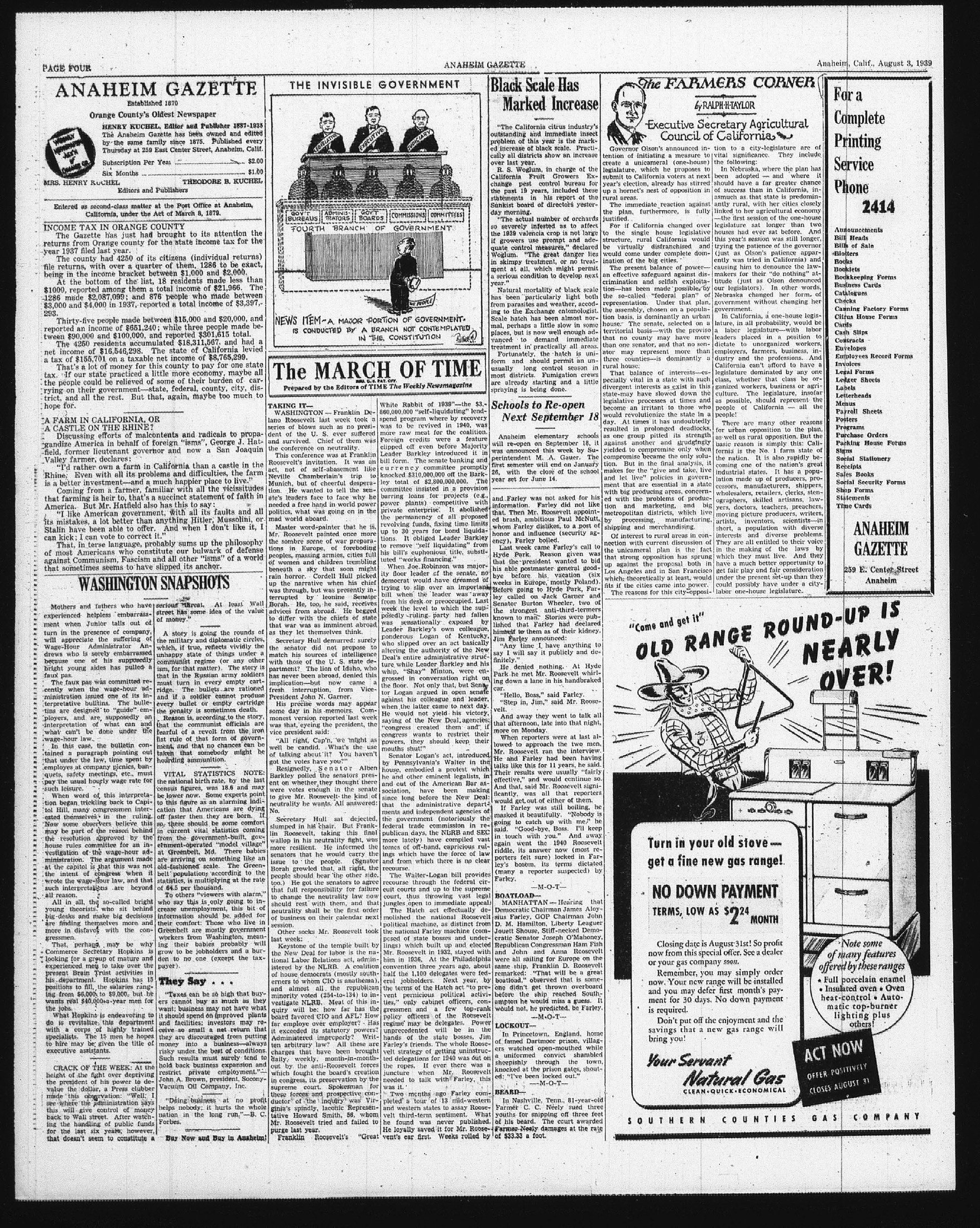
Searchable text
ANAHEIM GAZETTE
Established 1870
Orange County's Oldest Newspaper
HENRY KUCHEL, Editor and Publisher 1887-1935
The Anaheim Gazette has been owned and edited by the same family since 1875. Published every Thursday at 259 East Center Street, Anaheim, Calif.
Subscription Per Year ... $2.00
Six Months ... $1.00
MRS. HENRY KUCHEL
THEODORE B. KUCHEL
Editors and Publishers
Entered as second-class matter at the Post Office at Anaheim,
California, under the Act of March 8, 1879.
INCOME TAX IN ORANGE COUNTY
The Gazette has just had brought to its attention the returns from Orange county for the state income tax for the year 1937 filed last year.
The county had 4250 of its citizens (individual returns) file returns, with over a quarter of them, 1286 to be exact, being in the income bracket between $1,000 and $2,000.
At the bottom of the list, 18 residents made less than $1000, reported among them a total income of $21,966. The 1286 made $2,087,099; and 876 people who made between $3,000 and $4,000 in 1937, reported a total income of $3,397,-293.
Thirty-five people made between $15,000 and $20,000, and reported an income of $651,240; while three people made between $90,000 and $100,000, and reported $301,615 total.
The 4250 residents accumulated $18,311,567, and had a net income of $16,546,298. The state of California levied a tax of $155,701 on a taxable net income of $8,765,299.
That's a lot of money for this county to pay for one state tax. If our state practiced a little more economy, maybe all the people could be relieved of some of their burden of carrying on their government—state, federal, county, city, district, and all the rest. But that, again, maybe too much to hope for.
A FARM IN CALIFORNIA, OR
A CASTLE ON THE RHINE?
Discussing efforts of malcontents and radicals to propagate America in behalf of foreign "isms", George J. Hatfield, former lieutenant governor and now a San Joaquin Valley farmer.
That's a lot of money for this county to pay for one state tax. If our state practiced a little more economy, maybe all the people could be relieved of some of their burden of carrying on their government—state, federal, county, city, district, and all the rest. But that, again, maybe too much to hope for.
A FARM IN CALIFORNIA, OR
A CASTLE ON THE RHINE?
Discussing efforts of malcontents and radicals to propagate America in behalf of foreign "isms", George J. Hatfield, former lieutenant governor and now a San Joaquin Valley farmer, declares:
"I'd rather own a farm in California than a castle in the Rhine; Even with all its problems and difficulties, the farm is a better investment—and a much happier place to live."
Coming from a farmer, familiar with all the vicissitudes that farming is heir to, that's a succinct statement of faith in America. But Mr. Hatfield also has this to say:
"I like American government, with all its faults and all its mistakes, a lot better than anything Hitler, Mussolini, or Stalin have been able to offer. And when I don't like it, I can kick; I can vote to correct it."
That, in terse language, probably sums up the philosophy of most Americans who constitute our bulwark of defense against Communism, Fascism and all other "isms" of a world that sometimes seems to have slipped its anchor.
WASHINGTON SNAPSHOTS
Mothers and fathers who have experienced helpless embarrassment when Junior talls out of turn in the presence of company, will appreciate the suffering of Wage-Hour Administrator Andrews who is sorely embarrassed because one of his supposedly bright young aides has pulled a faux pas.
The faux pas was committed recently when the wage-hour administration issued one of its interpretative bulltins. The bulletins are designed to "guide" employers, and are supposedly an interpretation of what can and what can't be done under the wage-hour law.
In this case, the bulletin contained a paragraph pointing out that under the law, time spent by employees at company picnics, banquets, safety meetings, etc., must pay the usual hourly wage rate for such leisure.
When word of this interpretation began trickling back to Capitol Hill, many congressmen interested themselves in the ruling. Now some observers believe this may be part of the reason behind the resolution approved by the house rules committee for an investigation of the wage-hour administration. The argument made at the capitol is that this was not serious threat. At least Wall street has some idea of the value of money.
A story is going the rounds of the military and diplomatic circles, which, if true, reflects vividly the unhappy state of things under a communist regime (or any other ism, for that matter). The story is that in the Russian army soldiers must turn in every empty cartridge. The bullets are rationed and if a soldier cannot produce every bullet or empty cartridge the penalty is sometimes death.
Reason is, according to the story, that the communist officials are fearful of a revolt from the iron list rule of that form of government, and that no chances can be taken that somebody might be hoarding ammunition.
VITAL STATISTICS NOTE: the national birth rate, by the last census figures, was 18.6 and may be lower now. Some experts point to this figure as an alarming indication that Americans are dying off faster then they are born. If so, there should be some comfort in current vital statistics coming from the government-built, government-operated "model village" at Greenbelt, Md. There babies are arriving on something like an old-fashioned scale. The Green-
TAKING IT—
WASHINGTON — Franklin Lano Roosevelt last week took series of blows such as no president of the U.S. ever suffered and survived. Chief of them wished the conference on neutrality.
This conference was at Franklin Roosevelt's invitation. It was not act, not of self-abasement by Neville Chamberlain's trip to Munich, but of cheerful despair. He wanted to tell the state's leaders face to face why needed a free hand in world politics, what was going on in mad world aboard.
Master word-painter that he Mr. Roosevelt painted once more the sombre scene of war preparations in Europe, of forebodied peoples, massing armies, cities of women and children tremble beneath a sky that soon mira rain horror. Cordell Hull pick up the narrative when his client was through, but was presently terrupted by Leonine Seneborah. He, too, he said, received advice from abroad. He began to differ with the chiefs of state that war was as imminent abrasal as they let themselves think.
Secretary Hull demurred: sure the senator did not propose match his sources of intelligence with those of the U.S. state department? The lion of Idaho, has never been abroad, denied implication—but now came fresh interruption, from V.President John N. Garner.
His precise words may apply some day in his memoirs. Cohenest version reported last year was that eyeing the president, vice president said:
"All right, Cap'n, we might well be candid. What's theOf talking about it? You have got the votes have you?"
Resignedly, Senator Al Barkley polled the senators pention on whether they thought they were votes enough in the senate to give Mr. Roosevelt the kind neutrality he wants. All answer No.
Secretary Hull sat dejected slumped in his chair. But Franklin Roosevelt, taking this wallop in his neutrality fight, more resilient. He informed senators that he would carry issue to the people. (Senior Barkley provided that all rights.)
When word of this interpretation began trickling back to Capitol Hill, many congressmen interested themselves in the ruling. Now some observers believe this may be part of the reason behind the resolution approved by the house rules committee for an investigation of the wage-hour administration. The argument made at the capitol is that this was not the intent of congress when it wrote the wage-hour law, and that such interpretations are beyond all reason.
All in all, the so-called bright young theorists who sit behind big-desks and make big decisions are finding themselves more and more in disfavor with the congressmen.
That, perhaps, may be why Commerce Secretary Hopkins is looking for a group of mature and experienced men to take over the present Brain Trust activities in his department. Hopkins has 15 positions to fill, the salaries ranging from $6,000 to $9,000, but he wants real $40,000-a-year men for the jobs.
What Hopkins is endeavoring to do is revitalize this department with a corps of highly trained specialists. The 15 men he hopes to hire may be given the title of executive assistants.
CRACK OF THE WEEK: At the height of the fight over depriving the president of his power to deviate the dollar, a Press clubber made this observation: "Well; I see where the administration says this will give control of money back to Wall street. After watching the handling of public funds for the last six years, however, that doesn't seem to constitute a VITAL STATISTICS NOTE: the national birth rate, by the last census figures, was 18.6 and may be lower now. Some experts point to this figure as an alarming indication that Americans are dying off faster then they are born. If so, there should be some comfort in current vital statistics coming from the government-built, government-operated "model village" at Greenbelt, Md. There babies are arriving on something like an old-fashioned scale. The Greenbelt populations according to the statistics, is multiplying at the rate of 64.5 per thousand.
To others "viewers with alarm," who say this is only going to increase unemployment, this bit of information should be added for their comfort: Those who live in Greenbelt are mostly government workers from Washington, meaning their babies probably will grow to be jobholders and a burden to no one (except the taxpayer).
They Say ...
"Taxes can be so high that buyers cannot buy as much as they want; business may not have what it should spend on improved plants and facilities; investors may receive so small a net return that they are discouraged from putting money into a business—always risky under the best of conditions. Such results must surely tend to hold back business expansion and restrict private employment." — John A. Brown, president, Socony-Vacuum Oil Company, Inc.
"Doing business at no profit helps nobody; it hurts the whole nation in the long run." — B. C. Forbes.
Buy Now and Buy in Anaheim!
Barkley polled the senators present on whether they thought they were votes enough in the senate to give Mr. Roosevelt the kind neutrality he wants. All answer No.
Secretary Hull sat dejectedly slumped in his chair. But Franklin Roosevelt, taking this fall wallop in his neutrality fight, more resilient. He informed senators that he would carry issue to the people. (Sgn Borah growled that, all right, people should hear the other too.) He got the senators to ask that full responsibility for failure to change the neutrality law should rest with them, and neutrality shall be the first order of business on their calendar session.
Other socks Mr. Roosevelt last week:
Keystone of the temple built the New Deal for labor is the national Labor Relations act, administered by the NLRB. A coalition of house democrats (mostly soermen to whom CIO is anathema) and almost all the republican minority voted (254-to-134) to vestigate NLRB. Meat of this quirk will be: how far has board favored CIO and AFL? My far employee over employer? It exceeded its statutory power Administered improperly? We ten arbitrary law? All these charges that have been brought daily, weekly, month-in-month out by the anti-Roosevelt force which fought the board's creed in congress, its preservation by supreme court. Spokesman of these forces and prospective director of the inquiry was Virginia's spindly, laconic Representative Howard Smith, 56, wife Mr. Roosevelt tried and failed purge last year.
Franklin Roosevelt's "G
THE INVISIBLE GOVERNMENT
Black Scale Has Marked Increase
"The California citrus industry's outstanding and immediate insect problem of this year is the marked increase of black scale. Practically all districts show an increase over last year.
R. S. Woglum, in charge of the California Fruit Growers Exchange pest control bureau for the past 19 years, included these statements in his report of the Sunkist board of directors yesterday morning.
"The actual number of orchards so severely infested as to affect the 1939 valencia crop is not large if growers use prompt and adequate control measures," declared Woglum. "The great danger lies in skimpy treatment, or no treatment at all, which might permit a serious condition to develop next year."
Natural mortality of black scale has been particularly light both from parasites and weather, according to the Exchange entomologist. Scale hatch has been almost normal, perhaps a little slow in some places, but is now well enough advanced to demand immediate treatment in practically all areas.
Fortunately, the hatch is uniform and should permit an unusually long control season in most districts. Fumigation crews are already starting and a little spraying is being done.
Schools to Re-open Next September 18
Anaheim elementary schools will re-open on September 18, it was announced this week by Superintendent M. A. Gauer. The
Governor Olson's announcement tion of initiating a measure create a unicameral (one-house) legislature, which he proposit submit to California voters a year's election, already has set up a hornet's nest of opposition rural areas.
The immediate reaction to the plan, furthermore, is justified.
For if California changed to the single house legislative structure, rural California be virtually disfranchised would come under complete limitation of the big cities.
The present balance of power an effective safeguard against crimination and selfish expction—has been made possible the so-called "federal plan representation. Under that the assembly, chosen on a position basis, is dominantly an house. The senate, selected territorial basis—with the pro-that no county may have more than one senator, and that no actor may represent more than three counties—is dominant rural house.
That balance of interest pecially vital in a state with divergent interests as exist in state-may have slowed down legislative processes at time become an irritant to those would revolutionize the state day. At times it has undoubtedly resulted in prolonged deadlock against another and grudely yielded to compromise only compromise became the only
WHISHTON — Franklin De-roosevelt last week took a tour of blows such as no president of the U.S. ever suffered survived. Chief of them was conference on neutrality.
The conference was at Franklin De-roosevelt's invitation. It was an outfit of self-abasement like the Chamberlain's trip to India, but of cheerful desperation. He wanted to tell the senators face to face why he had a free hand in world power, what was going on in the world aboard.
After word-painter that he is, De-roosevelt painted once moreombre scene of war prepara-tion in Europe, of foreboding massing armies, cities full men and children trembling with a sky that soon might horror. Cordell Hull picked the narrative when his chief through, but was presently invited by leonine Senator He, too, he said, receives his from abroad. He begged offer with the chiefs of state war was as imminent abroad they let themselves think.
Secretary Hull demurred: surely senator did not propose to his sources of intelligence those of the U.S. state de-vent? The lion of Idaho, who never been abroad, denied this nation—but now came a interruption, from Vice-President John N. Garner.
Precise words may appear day in his memoirs. Com-ment version reported last week that, eyeing the president, the president said:
"Right, Cap'n, we might as be candid. What's the use taking about it? You haven't be votes have you?"
Signedly, Senator Albeney polled the senators pres-sure whether they thought there were votes enough in the senate Mr. Roosevelt—the kind of reality he wants. All answered:
Secretary Hull sat dejected, used in his chair. But Frank-De-roosevelt, taking this final up in his neutrality fight, was resilient. He informed theors that he would carry the to the people. (Signator White Rabbit of 1939"—the $3,-880,000,000 "self-liquidating" lend-spend program where by recovery was to be revived in 1940, was more raw meat for the coalition. Foreign credits were a feature clipped off even before Majority Leader Barkley introduced it in bill form. The senate banking and currency committee promptly knocked $310,000,000 off the Barkley total of $2,800,000,000. The committee insisted in a provision barring loans for projects (e.g., power plants) competitive with private enterprise. It abolished the permanency of all proposed revolving funds, fixing time limits up to 30 years for bond liquidations. It obliged Leader Barkley to remove "self liquidating" from his bill's euphonious title, substituted "works financing."
When Joe Robinson was majority floor leader of the senate, no democrat would have dreamed of trying to slip over an important bill when the leader was away from his desk or preoccupied. Last week the level to which the supposedly-ruling party had fallen was sensationally exposed by Leader Barkley's own colleague, ponderous Logan of Kentucky, who slipped over an act basically altering the authority of the New Deal's entire administrative structure while Leader Barkley and his whip, "Shay" Minton, were engrossed in conversation right on the floor. Not only that, but Senator Logan argued in open Senate against his colleague and leader, when the latter came to next day. He would not yield his victory, saying of the New Deal agencies; "congress created them and if congress wants to restrict their powers, they should keep their mouths shut!"
Senator Logan's act, introduced by Pennsylvania's Walter in the house, embodied a protest which he and other eminent legalists, in and out of the American Bar association, have been making since long before the New Deal: that the administrative departments and independent agencies of the government (notoriously the federal trade commission in republican days, the NLRB and SEC more lately) have compiled vast tomes of off-hand, capricious rulings which have the force of law and from which there is no clear resource.
Schools to Re-open Next September 18
Anaheim elementary schools will re-open on September 18, it was announced this week by Superintendent M. A. Gauer. The first semester will end on January 26, with the close of the school year set for June 14.
and Farley was not asked for his information. Farley did not like that. Then Mr. Roosevelt appointed brash, ambitious Paul McNutt, whom Farley dislikes, to a post of honor and influence (security agency), Farley boiled.
Last week came Farley's call to Hyde Park. Reason given was that the president wanted to bid his able postmaster general goodbye before his vacation (six weeks in Europe, mostly Poland). Before going to Hyde Park, Farley called on Jack Garner and Senator Burton Wheeler, two of the strongest anti-third-termers known to man. Stories were published that Farley had declared himself to them as of their kidney. Jim Farley announced:
"Any time I have anything to say I will say it publicly and definitely."
He denied nothing. At Hyde Park he met Mr. Roosevelt whirling down a lane in his handbraked car.
"Hello, Boss," said Farley.
"Step in, Jim," said Mr. Roosevelt.
And away they went to talk all that afternoon, late into that night, more on Monday.
When reporters were at last allowed to approach the two men, Mr. Roosevelt ran the interview. He and Farley had been having talks like this for 11 years, he said. Their results were usually "fairly effective," and would continue so. And that, said Mr. Roosevelt significantly, was all that reporters would get out of either of them.
If Farley was still boiling, he masked it beautifully. "Nobody is going to catch up with me," he said. "Good-bye, Boss. I'll keep in touch with you." And away again went the 1940 Roosevelt riddle, its answer now (most reporters felt sure) locked in Farley's bosom, its terms dictated
Of interest to rural areas in nectice with current discussi-nes the unicameral plan is tha-t that strong opposition has s-u-p-up against the proposal be-Los Angeles and in San Fran-cis which theoretically at least-fits if the cities came into p-lace.
The reasons for this city-o
they polled the senators presiding whether they thought there were votes enough in the Senate that Mr. Roosevelt the kind of reality he wants. All answered:
Secretary Hull sat dejected, seated in his chair. But Frank-Roosevelt, taking this final step in his neutrality fight, was resilient. He informed theors that he would carry the case to the people. (Senator Hull growled that, all right, the ors should hear the other side. He got the senators to agree full responsibility for failure change the neutrality law now rest with them, and that reality shall be the first order business on their calendar next month.
Other socks Mr. Roosevelt took week:
- Stone of the temple built by New Deal for labor is the national Labor Relations act, administered by the NLRB. A coalition house democrats (mostly south-to whom CIO is anathema), almost all, the republican authority voted (254-to-134) to integrate NLRB. Meat of this issue will be: how far has the favored CIO and AFL? How employe over employer? Has preceded its statutory powers? Registered improperly? Writ-tribrary law? All these are cases that have been brought weekly, month-in-month-by-the anti-Roosevelt forces in fought the board's creationgress, its preservation by the same court. Spokesman for forces and prospective conferrers of the inquiry was Virus spindly, laconic Representative Howard Smith, 56, whom Roosevelt tried and failed to last year.
Franklin Roosevelt's "Great House," embodied a protest within he and other eminent legalists, in and out of the American Bar association, have been making since long before the New Deal: that the administrative departments and independent agencies of the government (notoriously the federal trade commission in republican days, the NLRB and SEC more lately) have compiled vast tomes of off-hand, capricious rulings which have the force of law and from which there is no clear recourse.
The Walter-Logan bill provides recourse through the federal circuit courts and up to the supreme court, thus throwing vast legal jungles open to immediate appeal.
The Hatch act effectually demolished the national Roosevelt political machine, as distinct from the national Farley machine (composed of state bosses and underlings) which built up and elected Mr. Roosevelt in 1932, stayed with him in 1936. At the Philadelphia convention three years ago, about half the 1,100 delegates were federal jobholders. Next year, by the terms of the Hatch act "to prevent pernicious political activities," only cabinet officers, congressmen and a few top-rank policy officers of the Roosevelt regime may be delegates. Power unprecedented will be in the hands of the state bosses, Jim Farley's friends. The whole Roosevelt strategy of getting uninstructed delegations for 1940 was out on the ropes. If ever there was a juncture when Mr. Roosevelt needed to talk with Farley, this was it.
Two months ago Farley completed a tour of 13 mid-western and western states to assay Roosevelt third-term sentiment. What he found was never published. He layally saved it for Mr. Roosevelt's ear first. Weeks rolled by
Their results were usually "fairly effective," and would continue so. And that, said Mr. Roosevelt significantly, was all that reporters would get out of either of them.
If Farley was still boiling, he masked it beautifully. "Nobody is going to catch up with me," he said. "Good-bye, Boss. I'll keep in touch with you." And away again went the 1940 Roosevelt riddle, its answer now (most reporters felt sure) locked in Farley's bosom, its terms dictated (many a reporter suspected) by Farley.
-M-O-T—
BOATLOAD—
MANHATTAN — Hearing that Democratic Chairman James Aloysius Farley, GOP Chairman John D. M. Hamilton, Liberty Leaguer Jouett Shouse, Stiff-necked Democratic Senator Joseph O'Mahoney, Republican Congressman Ham Fish and John and Anna Roosevelt were all sailing for Europe on the same ship, Franklin D. Roosevelt remarked: "That will be a great boatload," observed that is someone didn't get thrown overboard before the ship reached Southampton he would miss a guess. It would not, he predicted, be Farley.
-M-O-T—
LOCKOUT—
In Princetown, England, home of famed Dartmoor prison, villagers watched open-mouthed while a uniformed convict shambled sheepishly through the town, knocked at the prison gates, shouted: "I've been locked out."
-M-O-T—
BEARD—
In Nashville, Tenn., 81-year-old Farmer C. C. Neely sued three youths for snipping off three feet of his beard. The court awarded Farmer Neely damages at the rate of $33.33 a foot.
The FARMERS CORNER
by RALPH H-TAYLOR
Executive Secretary Agricultural Council of California
Governor Olson's announced intention to a city-legislature are of vital significance. They include the following:
In Nebraska, where the plan has been adopted — and where it should have a far greater chance of success than in California, inasmuch as that state is predominantly rural, with her cities closely linked to her agricultural economy—the first session of the one-house legislature sat longer than two houses had ever sat before. And this year's session was still longer, trying the patience of the governor (just as Olson's patience apparently was tried in California) and causing him to denounce the lawmakers for their "do nothing" attitude (just as Olson denounced our legislators). In other words, Nebraska changed her form of government without changing her government.
In California, a one-house legislature, in all probability, would be a labor legislature—with labor leaders placed in a position to dictate to unorganized workers, employers, farmers, business, industry and the professions. And California can't afford to have a legislature dominated by any one class, whether that class be organized workers, business or agriculture. The legislature, insofar as possible, should represent the people of California — all the people!
There are many other reasons for urban opposition to the plan, as well as rural opposition. But the basic reason is simply this: California is the No. 1 farm state of the nation. It is also rapidly being announced.
Announcements
Bill Heads
Bills of Sale
Blootters
Books
Booklets
Bookkeeping Forms
Business Cards
Catalogues
Checks
Canning Factory Forms
Citrus House Forms
Cards
Cash Slips
Contracts
Envelopes
Employees Record Forms
Invoices
Legal Forms
Ledger Sheets
Labels
Letterheads
Menus
Payroll Sheets
Posters
Programs
Purchase Orders
Packing House Forms
Signs
What balance of interests—especially vital in a state with such urgent interests as exist in this one—may have slowed down the legislative processes at times and some an irritant to those who would revolutionize the state in a way. At times it has undoubtedly resulted in prolonged deadlocks, one group pitted its strength against another and grudgingly added to compromise only when compromise became the only solution. But in the final analysis, it takes for the "give and take, live and let live" policies in government that are essential in a state with big producing areas, concern with the problems of production and marketing, and big metropolitan districts, which live in processing, manufacturing, shipping and merchandising.
Of interest to rural areas in condition with current discussion of the unicameral plan is the fact that strong opposition has sprung against the proposal both in Los Angeles and in San Francisco which theoretically at least, would if the cities came into power. The reasons for this city-opposi-
California can't afford to have a legislature dominated by any one class, whether that class be organized workers, business or agriculture. The legislature, insofar as possible, should represent the people of California — all the people!
There are many other reasons for urban opposition to the plan, as well as rural opposition. But the basic reason is simply this: California is the No. 1 farm state of the nation. It is also rapidly becoming one of the nation's great industrial states. It has a population made up of producers, processors, manufacturers, shippers, wholesalers, retailers, clerks, stenographers, skilled artisans, lawyers, doctors, teachers, preachers, moving picture producers, writers, artists, inventors, scientists—in short, a population with diverse interests and diverse problems. They are all entitled to their voice in the making of the laws by which they must live. And they have a much better opportunity to get fair play and fair consideration under the present set-up than they could possibly have under a city-labor one-house legislature.
"Come and get it"
OLD RANGE ROUND-UP IS NEARLY OVER!
Turn in your old stove—get a fine new gas range!
Turn in your old stove—get a fine new gas range!
NO DOWN PAYMENT
TERMS, LOW AS $24 MONTH
Closing date is August 31st! So profit now from this special offer. See a dealer or your gas company soon.
Remember, you may simply order now. Your new range will be installed and you may defer first month's payment for 30 days. No down payment is required.
Don't put off the enjoyment and the savings that a new gas range will bring you!
Your Servant
Natural Gas
CLEAN • QUICK • ECONOMICAL
Note some of many features offered by these ranges
• Full porcelain enamel
• Insulated oven • Oven heat-control • Automatic top-burner lighting plus others!
ACT NOW
OFFER POSITIVELY
CLOSES AUGUST 31
SOUTHERN COUNTIES GAS COMPANY