anaheim-gazette 1939-06-08
Scanned page
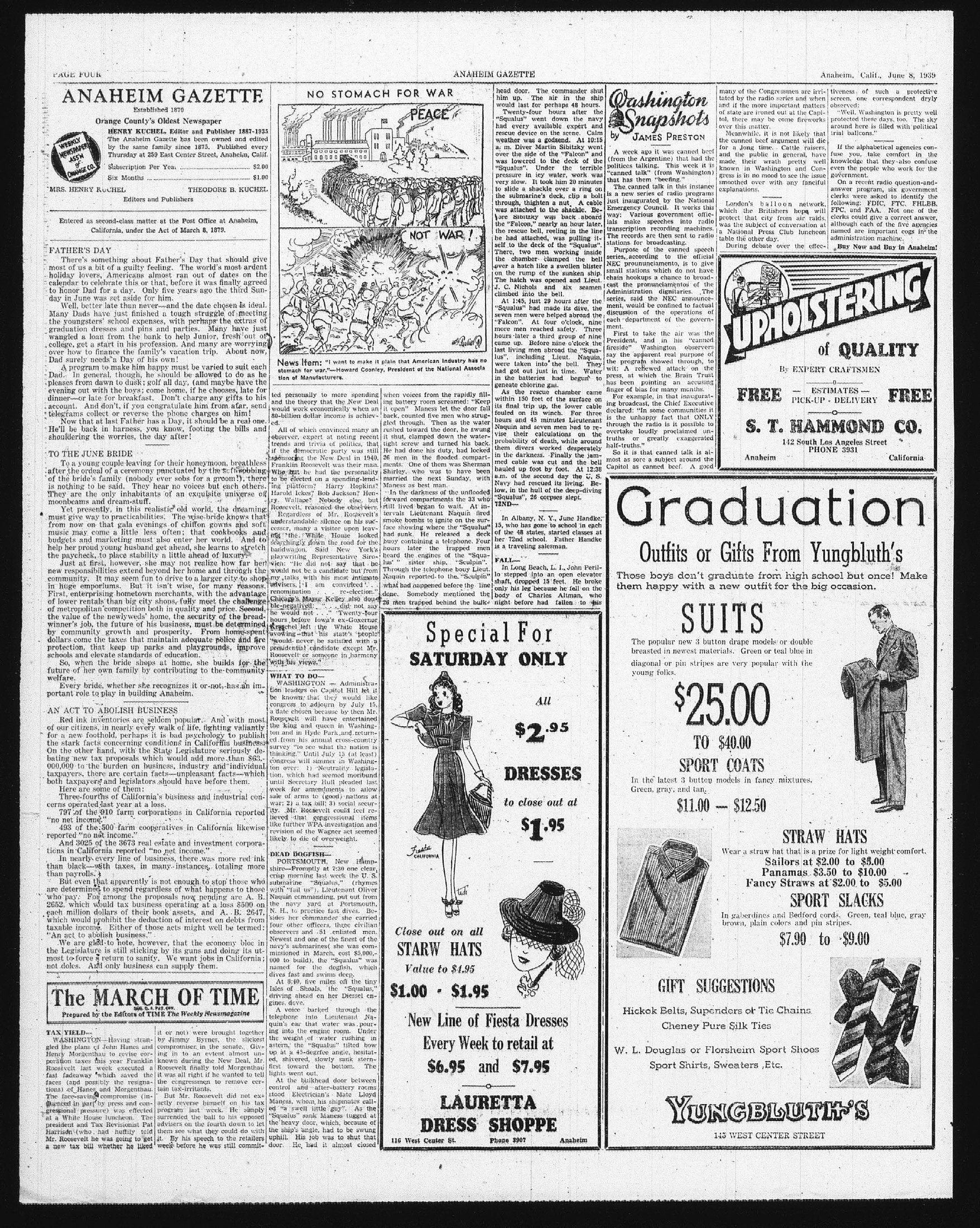
Searchable text
ANAHEIM GAZETTE
Established 1870
Orange County's Oldest Newspaper
HENRY KUCHEL, Editor and Publisher 1887-1935
The Anaheim Gazette has been owned and edited by the same family since 1875. Published every Thursday at 259 East Center Street, Anaheim, Calif.
Subscription Per Year $2.00
Six Months $1.00
MRS. HENRY KUCHEL THEODORE B. KUCHEL
Editors and Publishers
Entered as second-class matter at the Post Office at Anaheim,
California, under the Act of March 8, 1879.
FATHER'S DAY
There’s something about Father’s Day that should give most of us a bit of a guilty feeling. The world’s most ardent holiday lovers, Americans almost ran out of dates on the calendar to celebrate this or that, before it was finally agreed to honor Dad for a day. Only five years ago the third Sunday in June was set aside for him.
Well, better late than never—and the date chosen is ideal. Many Dads have just finished a tough struggle of meeting the youngsters’ school expenses, with perhaps the extras of graduation dresses and pins and parties. Many have just wangled a loan from the bank to help Junior, fresh out of college, get a start in his profession. And many are worrying over how to finance the family’s vacation trip. About now, Dad surely needs a Day of his own!
A program to make him happy must be varied to suit each Dad. In general, though, he should be allowed to do as he pleases from dawn to dusk; golf all day, (and maybe have the evening out with the boys); come home, if he chooses, late for dinner—or late for breakfast. Don’t charge any gifts to his account. And don’t, if you congratulate him from afar, send telegrams collect or reverse the phone charges on him!
Now that at last Father has a Day, it should be a real one. He’ll be back in harness, you know, footing the bills and shouldering the worries, the day after!
TO THE JUNE BRIDE
A program to make him happy must be varied to suit each Dad. In general, though, he should be allowed to do as he pleases from dawn to dusk; golf all day, (and maybe have the evening out with the boys; come home, if he chooses, late for dinner—or late for breakfast. Don’t charge any gifts to his account. And don’t, if you congratulate him from afar, send telegrams collect or reverse the phone charges on him!
Now that at last Father has a Day, it should be a real one. He’ll be back in harness, you know, footing the bills and shouldering the worries, the day after!
TO THE JUNE BRIDE
To a young couple leaving for their honeymoon, breathless after the ordeal of a ceremony punctuated by the soft sobbing of the bride’s family (nobody ever sobs for a groom!), there is nothing to be said. They hear no voices but each others. They are the only inhabitants of an exquisite universe of moonbeams and dream-stuff.
Yet presently, in this realistic old world, the dreaming must give way to practicabilities. The wise-bride knows that from now on that gala evenings of chiffon gowns and soft music may come a little less often; that cookbooks and budgets and marketing must also enter her world. And to help her proud husband get ahead, she learns to stretch the paycheck, to place stability a little ahead of luxury.
Just at first, however, she may not realize how far her new responsibilities extend beyond her home and through the community. It may seem fun to drive to a larger city to shop in huge emporiums. But it isn’t wise, for many reasons. First, enterprising hometown merchants, with the advantage of lower rentals than big city shops, fully meet the challenge of metropolitan competition both in quality and price. Second, the value of the newlyweds’ home, the security of the breadwinner’s job, the future of his business, must be determined by community growth and prosperity. From home-spent dollars come the taxes that maintain adequate police and fire protection, that keep up parks and playgrounds, improve schools and elevate standards of education.
So, when the bride shops at home, she builds for the future of her own family by contributing to the community welfare.
Every bride, whether she recognizes it or-not,-has an important role to play in building Anaheim.
AN ACT TO ABOLISH BUSINESS
Red ink inventories are seldom popular. And with most of our citizens, in nearly every walk of life, fighting valiantly for a new foothold, perhaps it is bad psychology to publish the stark facts concerning conditions in California business. On the other hand, with the State Legislature seriously debating new tax proposals which would add more than $63,000,000 to the burden on business, industry and individual taxpayers, there are certain facts—unpleasant facts—which both taxpayers and legislators should have before them.
Here are some of them:
Three-fourths of California’s business and industrial concerns operated last year at a loss.
797 of the 910 farm corporations in California reported “no net income.”
493 of the 500 farm cooperatives in California likewise reported “no net income.”
And 3025 of the 3673 real estate and investment corporations in California reported “no net income.”
In nearly every line of business, there was more red ink than black—with taxes, in many instances, totaling more
All of which convinced manly observer, expert at noting trends and trivia of politics, if the democratic party was sponsoring the New Deal in Franklin Roosevelt was their richest who had the personal responsibility on a spending-leaving platform? Harry Hopkinson Harold Ickes? Bob Jackson? Henry Wallace? Nobody else?
Roosevelt, reasoned the observance.
Regardless of Mr. Roosevelt understandable silence on his successor, many a visitor upon learning the White House looked searchingly down the road for bandwagon. Said New York playwriting Representative Sylvie: “He did not say that would not be a candidate but for my talks with his most intiring advisers,” I am convinced renomination re-election Chicago’s Mayor Kelley also owed negativeliness.” did not he would not.” Twenty-nine hours before Iowa’s ex-Goxen Kraschel left the White House avowing—that his state’s people would never be satisfied with presidential candidate except Roosevelt or someone in harm with his views.”
WHAT TO DO—
WASHINGTON — Administration leaders on Capitol Hill know that they would congress to adjourn by July 1st a date chosen because by then Roosevelt will have entertained the king and queen in Washington and in Hyde Park and returned from his annual cross-country survey “to see what the nation thinking.” Until July 15 (at least congress will simmer in Washington over: 1) Neutrality legislation, which had seemed moribund until Secretary Hull pleaded a week for amendments to allow sale of arms to (good) national war; 2) a tax bill; 3) social security. Mr. Roosevelt could feel relieved that congressional it like further WPA-investigation revision of the Wagner act seemed likely to die of overweight.
DEAD DOGFISH—
PORTSMOUTH, New Hampshire
taxpayers, there are certain facts—unpleasant facts—which both taxpayers and legislators should have before them.
Here are some of them:
Three-fourths of California's business and industrial concerns operated last year at a loss.
797 of the 910 farm corporations in California reported "no net income."
493 of the 500 farm cooperatives in California likewise reported "no net income."
And 3025 of the 3673 real estate and investment corporations in California reported "no net income."
In nearly every line of business, there was more red ink than black—with taxes, in many instances, totaling more than payrolls.
But even that apparently is not enough to stop those who are determined to spend regardless of what happens to those who pay: For among the proposals now pending are A. B. 2652, which would tax business operating at a loss $500 on each million dollars of their book assets, and A. B. 2647, which would prohibit the deduction of interest on debts from taxable income. Either of those acts might well be termed: "An act to abolish business."
We are glad to note, however, that the economy bloc in the Legislature is still sticking by its guns and doing its utmost to force a return to sanity. We want jobs in California; not doles. And only business can supply them.
The MARCH OF TIME
Prepared by the Editors of TIME The Weekly Newsmagazine
TAX YIELD—
WASHINGTON—Having strangled the plans of John Hanes and Henry Morgenthau to revise corporation taxes this year Franklin Roosevelt last week executed a fast fadeaway which saved the faces (and possibly the resignations) of Hanes and Morgenthau. The face-saving compromise (influenced in part by press and congressional pressure) was effected at a White House luncheon. The president and Tax Revisionist Pat Harrison (who had huffily told Mr. Roosevelt he was going to get a new tax bill whether he liked it or not) were brought together by Jimmy Byrnes, the slickest compromiser in the senate. Giving in to an event almost unknown during the New Deal, Mr. Roosevelt finally told Morgenthau it was all right if he wanted to tell the congressmen to remove certain tax-irritants.
But Mr. Roosevelt did not exactly reverse himself on his tax program last week. He simply surrendered the ball to his opposed advisers on the fourth down to let them see what they could do with it. By his speech to the retailers week before he was still commit-
DEAD DOGFISH—
PORTSMOUTH, New Hampshire—Promptly at 7:30 one christ morning last week the U.S. submarine "Squalus," (rhymes with "fail us"), Lieutenant Olivia Naquin commanding, put out for the navy yard at Portsmouth N. H., to practice fast dives. sides her commander she carried four other officers, three civic observers and 51 enlisted men. Newest and one of the finest of navy's submarines (she was commissioned in March, cost $5,000 to build), the "Squalus" named for the dogfish, who dives fast and swims deep.
At 8:40, five miles off the Isles of Shoals, the "Squalus" driving ahead on her Diessel gines, dove.
A voice barked through the telephone into Lieutenant Olivia Naquin's ear that water was pooled into the engine room. Until the weight of water rushing astern, the "Squalus" tilted up at a 45-degree angle, hesitated, shivered, slowly sank steep first toward the bottom. Lights went out.
At the bulkhead door between control and after-battery rooftop stood Electrician's Mate Lloyd Maness, whom his shipmates called "a swell little guy." As "Squalus" sank Maness tugged the heavy door, which, because the ship's angle, had to be swuphill. His job was to shut the door. He had it almost close...
NO STOMACH FOR WAR
PEACE
NOT WAR!
News Item: "I want to make it plain that American Industry has no mach for war."—Howard Coonley, President of the National Association of Manufacturers.
personally to more spending the theory that the New Deal work economically when an billion dollar income is achievable of which convinced many an expert at noting recent and trivia of politics, that democratic party was still when voices from the rapidly filling battery room screamed: "Keep it open" Maness let the door fall back, counted five men who struggled through. Then as the water rushed toward the door, he swung it shut, clamped down the water-tight screw and turned his back. He had done his duty, had locked head door. The commander shut him up. The air in the ship would last for perhaps 48 hours.
Twenty-four hours after the "Squalus" went down the navy had every available expert and rescue device on the scene. Calm weather was a godsend. At 10:15 a.m. Diver Martin Sibitzky went over the side of the "Falcon" and was lowered to the deck of the "Squalus". Under the terrible pressure in icy water, work was very slow. It took him 20 minutes to slide a shackle over a ring on the submarine's deck, clip a bolt through, thighen a nut. A cable was attached to the shackle. Before Sibitzky was back aboard the "Falcon," nearly an hour later, the rescue bell, reeling in the line he had attached, was pulling itself to the deck of the "Squalus". There, two men working inside the chamber clamped the bell over a hatch like a swollen blister on the rump of the sunken ship. The hatch was opened and Lieut. J. C. Nichols and six seamen climbed into the bell.
At 1:45, just 29 hours after the "Squalus" had made its dive, the seven men were helped abroad the "Falcon". At four o'clock, nine more men reached safety. Three hours later a third group of nine came up. Before nine o'clock the last living men abroad the "Squalus", including Lieut. Naquin, were taken into the bell. They had got out just in time. Water in the batteries had begun to geneate chlorine gas.
As the rescue chamber came within 150 feet of the surface on its final trip up, the lower cable fouled on its winch. For three hours and 45 minutes Lieutenant Naquin and seven men had to revise their calculations on the probability of death, while around them divers worked desperately in the darkness. Finally the jam-head door.
Washington Snapshots by James Prestie
A week ago it was canned (from the Argentine) that we politicos talking. This week "canned talk" (from Washington that has them "beefing").
The canned talk in this issue is a new series of radio programs inaugurated by the NEC Emergency Council. It works way: Various government officials make speeches into transcription recording media. The records are then sent to stations for broadcasting.
Purpose of the canned series, according to the NEC pronunciamento, is to small stations which do not chain hookups a chance to cast the pronunciamentos of Administration dignitaries series, said the NEC amendment, would be confined to discussion of the operation each department of the government.
First to take the air w President, and in his fireside" Washington obey say the apparent real purpule the program showed through wit: A renewed attack press, at which the Brain has been pointing an ad finger of bias for many more.
For example, in that inaugural broadcast, the Chief Exec declared: "In some communities is the unhappy fact that through the radio is it posses overtake loudly proclaimed truths or greatly exaggerated half-truths."
So it is that canned talk...
personally to more spending the theory that the New Deal work economically when an million dollar income is achievable of which convinced many an ever, expert at noting recent and trivia of politics, that democratic party was still boring the New Deal in 1940, John Roosevelt was their man, but he had the personality elected on a spending-lend-platform? Harry Hopkins? And Ickes? Bob Jackson? Hen-Wallace? Nobody else, but Velt, reasoned the observers. regardless of Mr. Roosevelt's standable silence on his success, many a visitor upon leave the White House looked nervously down the road for the wagon. Said New York's writing Representative Sirocha: "He did not say that he did not be a candidate but from folks with his most intimate ers." I am convinced re-election. Roosevelt Kelley also doug-gatived: "I did not say would not." Twenty-four before Iowa's ex-Goxernor, he left the White House -- that his state's people had never be satisfied with an essential candidate except Mr. Roosevelt or someone in harmony with his views."
when voices from the rapidly filling battery room screamed: "Keep it open" Maness let the door fall back, counted five men who struggled through. Then as the water rushed toward the door, he swung it shut, clamped down the water-tight screw and turned his back. He had done his duty, had locked 26 men in the flooded compartments. One of them was Sherman Shirley, who was to have been married the next Sunday, with Maness as best man.
In the darkness of the unflooded forward compartments the 33 who still lived began to wait. At intervals Lieutenant Naquin fired smoke bombs to ignite on the surface showing where the "Squalus" had sunk. He released a deck buoy containing a telephone. Four hours later the trapped men heard the engines of the "Squalus" sister ship, "Sculpin". Through the telephone bouy Lieut. Naquin reported to the "Sculpin" what had happened before the line done. Somebody mentioned the 28 men trapped behind the bulkhead were taken into the bell. They had got out just in time. Water in the batteries had begun to geneate chlorine gas.
As the rescue chamber came within 150 feet of the surface on its final trip up, the lower cable fouled on its winch. For three hours and 45 minutes Lieutenant Naquin and seven men had to revise their calculations on the probability of death, while around them divers worked desperately in the darkness. Finally the jammed cable was cut and the bell hauled up foot by foot. At 12:38 a.m. of the second day the U.S. Navy had rescued its living. Below, in the hull of the deep-diving "Squalus", 26 corpses slept.
72ND—
In Albany, N. Y., June Handke, 15, who has gone to school in each of the 48 states, started classes at her 72nd school. Father Handke is a traveling salesman.
FALL—
In Long Beach, L. I., John Perillo stepped into an open elevator shaft, dropped 15 feet. He broke only his leg because he fell on the body of Charles Altman, who night before had fallen to his
Special For
SATURDAY ONLY
All
$2.95
DRESSES
to close out at
$1.95
DRESSES
to close out at
$1.95
Close out on all
STARW HATS
Value to $4.95
$1.00 - $1.95
New Line of Fiesta Dresses
Every Week to retail at
$6.95 and $7.95
LAURETTA
DRESS SHOPPE
116 West Center St. Phone 3907 Anaheim
A week ago it was canned beef from the Argentine) that had the militics talking. This week it is canned talk" (from Washington) that has them "beefing."
The canned talk in this instance is a new series of radio programs inaugurated by the National Emergency Council. It works this day: Various government offices make speeches into radio transcription recording machines. The records are then sent to radio stations for broadcasting.
Purpose of the canned speech series, according to the official NEC pronunciamento, is to give small stations which do not have main hookups a chance to broadcast the pronunciamentos of the administration dignitaries. The series, said the NEC announcement, would be confined to factual discussion of the operations of each department of the government.
First to take the air was the president, and in his "canned beside" Washington observers by the apparent real purpose of the program showed through, to tell: A refreshed attack on the press, at which the Brain Trust has been pointing an accusing finger of bias for many months.
For example, in that inaugurating broadcast, the Chief Executive declared: "In some communities it is the unhappy fact that ONLY through the radio is it possible to undertake loudly proclaimed truths or greatly exaggerated self-truths."
Many of the Congressmen are irritated by the radio series and when and if the more important matters of state are ironed out at the Capitol, there may be come fireworks over this matter.
Meanwhile, it is not likely that the canned beef argument will die for a long time. Cattle raisers, and the public in general, have made their wrath pretty well known in Washington and Congress is in no mood to see the issue smoothed over with any fanciful explanations.
London's balloon network, which the Britishers hope will protect that city from air raids, was the subject of conversation at a National Press Club luncheon table the other day.
During debate over the effectiveness of such a protective screen, one correspondent dryly observed:
"Well, Washington is pretty well protected these days, too. The sky around here is filled with political trial ballons."
If the alphabetical agencies confuse you, take comfort in the knowledge that they also confuse even the people who work for the government.
On a recent radio question-and-answer program, six government clerks were asked to identify the following: FDIC, FTC, FHLBB, FPC, and FAA. Not one of the clerks could give a correct answer, although each of the five agencies named are important cogs in the administration machine.
Buy Now and Buy in Anaheim!
By EXPERT CRAFTSMEN
FREE ESTIMATES FREE
PICK-UP - DELIVERY
S. T. HAMMOND CO.
142 South Los Angeles Street
PHONE 3931
Anaheim California
Graduation
Outfits or Gifts From Yungbluth's
Those boys don't graduate from high school but once! Make them happy with a new outfit for the big occasion.
SUITS
The popular new 3 button drape models or double breasted in newest materials. Green or teal blue in diagonal or pin stripes are very popular with the young folks.
$25.00
TO $40.00
SPORT COATS
In the latest 3 button models in fancy mixtures.
Green, gray, and tan.
$11.00 — $12.50
STRAW HATS
Wear a straw hat that is a prize for light weight comfort.
Sailors at $2.00 to $5.00
In the latest 3 button models in fancy mixtures.
Green, gray, and tan.
$11.00 — $12.50
STRAW HATS
Wear a straw hat that is a prize for light weight comfort.
Sailors at $2.00 to $5.00
Panamas $3.50 to $10.00
Fancy Straws at $2.00 to $5.00
SPORT SLACKS
In gaberdines and Bedford cords. Green, teal blue, gray brown, plain colors and pin stripes.
$7.90 to $9.00
GIFT SUGGESTIONS
Hickok Belts, Supenders or Tie Chains
Cheney Pure Silk Ties
W. L. Douglas or Florsheim Sport Shoes
Sport Shirts, Sweaters, Etc.
YUNGBLUTH'S
145 WEST CENTER STREET