anaheim-gazette 1939-03-16
Scanned page
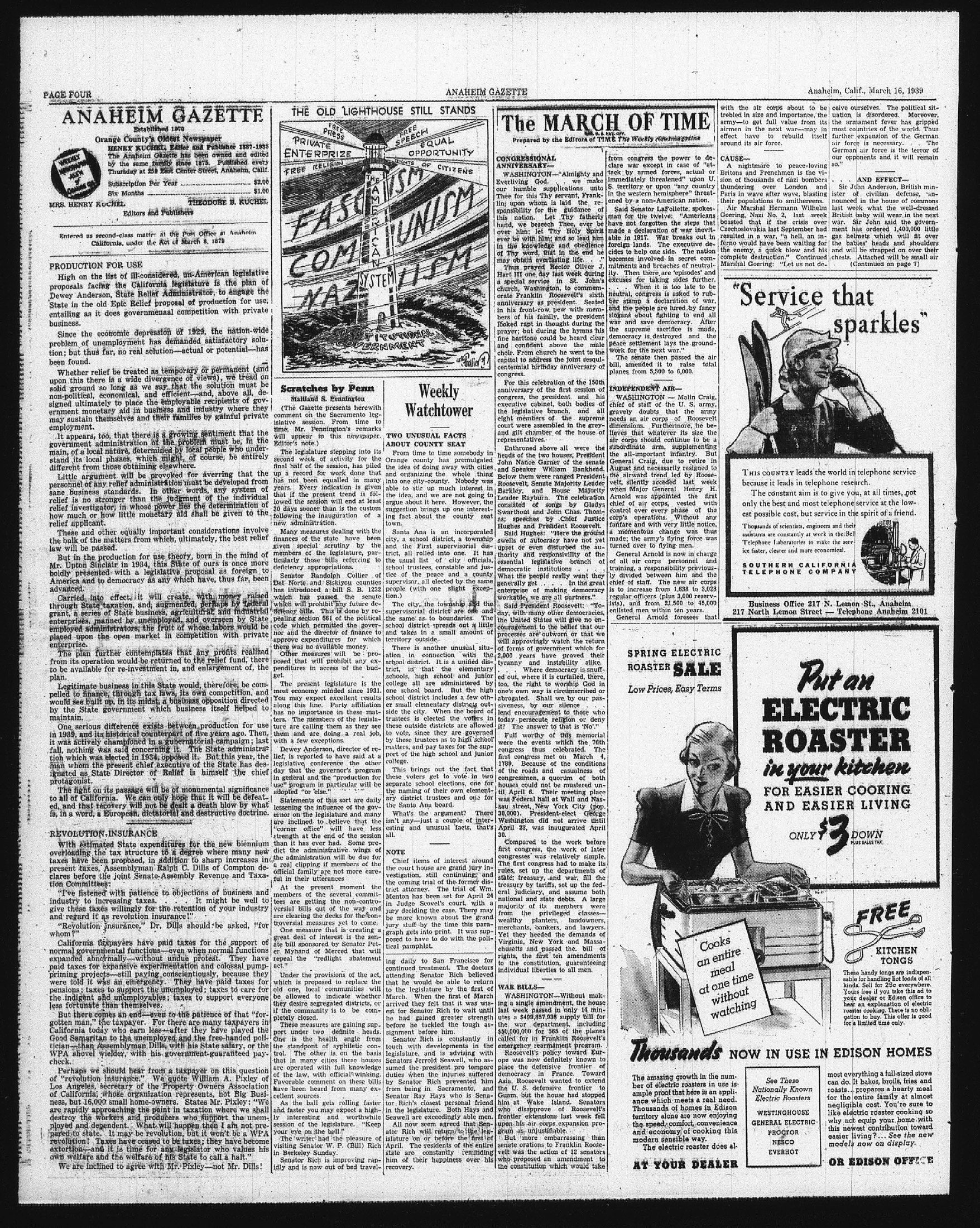
Searchable text
ANAHEIM GAZETTE
Established 1870
Orange County's Oldest Newspaper
HENRY KUCHEL, Editor and Publisher 1887-1935
The Anaheim Gazette has been owned and edited by the same family since 1875. Published every Thursday at 259 East Center Street, Anaheim, Calif.
Subscription Per Year $2.00
Six Months $1.00
MRS. HENRY KUCHEL THEODORE B. KUCHEL
Editors and Publishers
Entered as second-class matter at the Post Office at Anaheim
California, under the Act of March 8, 1879
PRODUCTION FOR USE
High on the list of ill-considered, un-American legislative proposals facing the California legislature is the plan of Dewey Anderson, State Relief Administrator, to engage the State in the old Epic Relief proposal of production for use; entailing as it does governmenaal competition with private business.
Since the economic depression of 1929, the nation-wide problem of unemployment has demanded satisfactory solution; but thus far, no real solution—actual or potential—has been found.
Whether relief be treated as temporary or permanent (and upon this there is a wide divergence of views), we tread on solid ground so long as we say that the solution must be non-political, economical, and efficient—and, above all, designed ultimately to place the employable recipients of government monetary aid in business and industry where they may sustain themselves and their families by gainful private employment.
It appears, too, that there is a growing sentiment that the government administration of the problem must be, in the main, of a local nature, determined by local people who under-
Whether relief be treated as temporary or permanent (and upon this there is a wide divergence of views), we tread on solid ground so long as we say that the solution must be non-political, economical, and efficient—and above all, designed ultimately to place the employable recipients of government monetary aid in business and industry where they may sustain themselves and their families by gainful private employment.
It appears, too, that there is a growing sentiment that the government administration of the problem must be, in the main, of a local nature, determined by local people who understand its local phases, which might, of course, be entirely different from those obtaining elsewhere.
Little argument will be provoked for averring that the personnel of any relief administration must be developed from sane business standards. In other words, any system of relief is no stronger than the judgment of the individual relief investigator, in whose power lies the determination of how much or how little monetary aid shall be given to the relief applicant.
These and other equally important considerations involve the bulk of the matters from which, ultimately, the best relief law will be passed.
But in the production for use theory, born in the mind of Mr. Upton Sinclair in 1934, this State of ours is once more boldly presented with a legislative proposal as foreign to America and to democracy as any which have, thus far, been advanced.
Carried into effect, it will create, with money raised through State taxation, and, augmented, perhaps by federal grant, a series of State business, agricultural, and industrial enterprises, manned by unemployed, and overseen by State employed administrators; the fruit of whose labors would be placed upon the open market in competition with private enterprise.
The plan further contemplates that any profits realized from its operation would be returned to the relief fund, there to be available for re-investment in, and enlargement of, the plan.
Legitimate business in this State would, therefore, be compelled to finance, through tax laws, its own competition, and would see built up, in its midst, a business opposition directed by the State government which business itself helped to maintain.
One serious difference exists between production for use in 1939, and its historical counterpart of five years ago. Then, it was actively championed in a gubernatorial-campaign; last fall, nothing was said concerning it. The State administration which was elected in 1934, opposed it. But this year, the man whom the present chief executive of the State has designated as State Director of Relief is himself the chief protagonist.
The fight on its passage will be of monumental significance to all of California. We can only hope that it will be defeated, and that recovery will not be dealt a death blow by what is, in a word, a European dictatorial and destructive doctrine.
REVOLUTION-INSURANCE
With estimated State expenditures for the new biennium overloading the tax structure to a degree where many new taxes have been proposed, in addition to sharp increases in present taxes. Assemblyman Ralph C. Dills of Compton de-
REVOLUTION-INSURANCE
With estimated State expenditures for the new biennium overloading the tax structure to a degree where many new taxes have been proposed, in addition to sharp increases in present taxes, Assemblyman Ralph C. Dills of Compton declares before the joint Senate-Assembly Revenue and Taxation Committees:
"I've listened with patience to objections of business and industry to increasing taxes. It might be well to give these taxes willingly for the retention of your industry and regard it as revolution insurance!"
"Revolution insurance," Dr. Dills should be asked, "for whom?"
California taxpayers have paid taxes for the support of normal governmental functions—even when normal functions expanded abnormally—without undue protest. They have paid taxes for expansive experimentation and colossal pumppriming projects—still paying conscientiously, because they were told it was an emergency. They have paid taxes for pensions; taxes to support the unemployed; taxes to care for the indigent and unemployables; taxes to support everyone less fortunate than themselves.
But there comes an end—even to the patience of that "forgotten man," the taxpayer. For there are many taxpayers in California today who earn less—after they have played the Good Samaritan to the unemployed and the free-handed politician—than Assemblyman Dills, with his State salary, or the WPA shovel wielder, with his government-guaranteed pay-check.
Perhaps we should hear from a taxpayer on this question of "revolution insurance." We quote William A. Pixley of Los Angeles, secretary of the Property Owners Association of California, whose organization represents, hot Big Business, but 16,000 small home owners. States Mr. Pixley: "We are rapidly approaching the point in taxation where we shall destroy the workers and producers who support the unemployed and dependent. What will happen then I am not prepared to state. It may be revolution, but it won't be a WPA revolution! Taxes have ceased to be taxes; they have become extortion—and it is time for any legislator who values his own welfare and the welfare of his State to call a halt."
We are inclined to agree with Mr. Pixley—not Mr. Dills!
THE OLD LIGHTHOUSE STILL STANDS
ANAHEIM GAZETTE
The MARCH OF TIME
Prepared by the Editors of TIME The Weekly Newspaper
CONGRESSIONAL ANNIVERSARY—
WASHINGTON—"Almighty and Everliving God... we make our humble supplications unto Thee for this Thy servant, Franklin; upon whom is laid the responsibility for the guidance of this nation. Let Thy fatherly hand, we beseech Thee, ever be over him; let Thy Holy Spirit ever be with him; and so lead him in the knowledge and obedience of Thy word, that in the end he may obtain everlasting life."
Thus prayed Rector Oliver J. Hart III one day last week during a special service in St. John's church, Washington, to commemorate Franklin Roosevelt's sixth anniversary as president. Seated in his front-row pew with members of his family, the president looked rapt in thought during the prayer; but during the hymns his fine baritone could be heard clear and confident above the male choir. From church he went to the capitol to address the joint sesquicentennial birthday anniversary of congress.
For this celebration of the 150th anniversary of the first session of congress, the president, and his executive cabinet, both bodies of the legislative branch, and all eight members of the supreme court were assembled in the grey-and gilt chamber of the house of representatives.
Enthroned above all were the heads of the two houses, President from congress the power to clare war except in case it immediately threatened us S. territory or upon "any in the western hemisphere" ened by a non-American man.
Said Senator LaFollette, man for the twelve: "An have not forgotten the steal made a declaration of war able in 1917. War breaks foreign lands. The executives to help one side. They becomes involved in secret mitments and breaches of nature. Then there are 'episode excuses for taking sides.' ... When it is too late neutral, congress is asked ber stamp a declaration and the people are lured by slogans about fighting to war and save democracy. The supreme sacrifice is democracy is destroyed and peace settlement lays the work for the next war."
The senate then passed bill, amended it to raise planes from 5,500 to 6,000.
INDEPENDENT AIR—
WASHINGTON — Malibu chief of staff of the U.S. gravely doubts that the needs an air corps of R dimensions. Furthermore, lies that whatever its air corps should continue subordinate arm, supplies the all-important infantry.
Weekly Watchtower
TWO UNUSUAL FACTS ABOUT COUNTY SEAT
From time to time somebody in Orange county has promulgated the idea of doing away with cities and organizing the whole thing into one city-county. Nobody was able to stir up much interest in the idea, and we are not going to argue about it here. However, the suggestion brings up one interesting fact about the county seat town.
Santa Ana is an incorporated city, a school district, a township and the First supervisorial district, all rolled into one. It has the usual list of city officials, school trustees, constable and justice of the peace and a county supervisor, all elected by the same people (with one slight exception.) The city, the township and the supervisorial district are one and the same as to boundaries. The school district spreads out a little and takes in a small amount of territory outside.
There is another unusual situation in connection with the school district. It is a unified district, in that the elementary schools, high school and junior college all are administered by one school board. But the high school district includes a few other small elementary districts outside the city. When the board of trustees is elected the voters in these outside districts are allowed to vote, since they are governed by these trustees as to high school matters, and pay taxes for the support of the high school and junior college.
This brings out the fact that these voters get to vote in two separate school elections, one for the naming of their own elementary district trustees and one for the Santa Ana board.
What's the argument? There isn't any—just a couple of interesting and unusual facts, that's all.
NOTE
Chief items of interest around the court house are grand jury indictments of this sort are daily newsing the influence of the governor on the legislature and many inclined to believe that the inner office” will have less length at the end of the session it has ever had. Some pre-register administrative wings of administration will be due for final clipping if members of the legislature stepping into its week of activity for the half of the session, has piled in record for work done that not been equalled in many cases. Every indication is given if the present trend is followed the session will end at least days sooner than is the custom wishing the inauguration of a new administration.
Many measures dealing with the prices of the state have been taken special scrutiny by the members of the legislature, partly those bills referring to lenency appropriations.
Senator Randolph Collier of Norte and Siskiyou counties introduced a bill S. B. 1232 which has passed the senate which will prohibit any future delay bills. This is done by re-reading section 661 of the political code which permitted the governor and the director of finance to move expenditures for which he was no available money. Other measures will be provided that will prohibit any exigencies in access of the budget.
The present legislature is the economy minded since 1931. May expect excellent results using this line. Party affiliation no importance in these matters. The members of the legislature are calling them as they see it and are doing a real job, a few exceptions.
Way Anderson, director of relief is reported to have said at a relative conference the other that the governor’s program general and the “production for a program in particular will be called “or else.” Statements of this sort are daily newsing the influence of the governor on the legislature and many inclined to believe that the inner office” will have less length at the end of the session it has ever had. Some pre-register administrative wings of administration will be due for final clipping if members of the legislature stepping into its week of activity for the half of the session, has piled in record for work done that not been equalled in many cases. Every indication is given if the present trend is followed the session will end at least days sooner than is the custom wishing the inauguration of a new administration.
Weekly Watchtower
TWO UNUSUAL FACTS ABOUT COUNTY SEAT
From time to time somebody in Orange county has promulgated the idea of doing away with cities and organizing the whole thing into one city-county. Nobody was able to stir up much interest in the idea, and we are not going to argue about it here. However, the suggestion brings up one interesting fact about the county seat town.
Santa Ana is an incorporated city, a school district, a township and the First supervisorial district, all rolled into one. It has the usual list of city officials, school trustees, constable and justice of the peace and a county supervisor, all elected by the same people (with one slight exception.) The city, the township and the supervisorial district are one and the same as to boundaries. The school district spreads out a little and takes in a small amount of territory outside.
There is another unusual situation in connection with the school district. It is a unified district, in that the elementary schools, high school and junior college all are administered by one school board. But the high school district includes a few other small elementary districts outside the city. When the board of trustees is elected the voters in these outside districts are allowed to vote, since they are governed by these trustees as to high school matters, and pay taxes for the support of the high school and junior college.
This brings out the fact that these voters get to vote in two separate school elections, one for the naming of their own elementary district trustees and one for the Santa Ana board.
What's the argument? There isn’t any—just a couple of interesting and unusual facts, that’s all.
For this celebration of the 150th anniversary of the first session of congress, the president, and his executive cabinet, both bodies of the legislative branch, and all eight members of the supreme court were assembled in the grey-and gilt chamber of the house of representatives.
Entroned above all were the heads of the two houses, President John Nance Garner of the senate and Speaker William Bankhead. Below them were ranged President Roosevelt, Senate Majority Leader Barkley, and House Majority Leader Rayburn. The celebration consisted of songs by Gladys Swarthout and John Chas. Thomas; speeches by Chief Justice Hughes and President Roosevelt.
Said Hughes: “Here the ground swells of autocracy have not yet upset or even disturbed the authority and responsivity of the essential legislative branch of democratic institutions... What the people really want they generally get... In the great enterprise of making democracy workable, we are all partners.”
Said President Roosevelt: “Today, with many other democracies, the United States will give no encouragement to the belief that our processes are outworn or that we will approvingly watch the return of forms of government which for 2,000 years have proved their tyranny and instability alike... Where democracy is snuffed out, where it is curtailed, there too, the right to worship God in one's own way is circumscribed or abrogated. Shall we by our passiveness, by our silence... lend encouragement to those who today persecute religion or deny it? The answer to that is ‘No.’”
Full worthy of this memorial were the events which the 76th congress thus celebrated. The first congress met on March 4, 1789. Because of the conditions of the roads and casualness of congressmen, a quorum of both houses could not be mustered until April 6. Their meeting place was Federal hall at Wall and Nassau street, New York City (pop. 30,000). President-elect George Washington did not arrive until April 23, was inaugurated April 30.
Compared to the work before first congress, the work of later congresses was relatively simple. The first congress had to make its bill, amended it to raise planes from 5,500 to 6,000
the governor's program
general and the "production for
program in particular will be
edited "or' else."
statements of this sort are daily
warning the influence of the gover on the legislature and many
inclined to believe that the
mer office" will have less
length at the end of the session
it has ever had. Some precede the administrative wings of
administration will be due for
clipping if members of the
family are not more cared
in their utterances
The present moment the
members of the several committees are getting the non-controrial bills out of the way and
clearing the decks for the consensial measures yet to come.
The measure that is creating a
treat deal of interest is the senill sponsored by Senator PetMyhand of Merced that will
all the "redlight abatement
Under the provisions of the act,
which is proposed to replace the
one, local communities will
allowed to indicate whether
desire segregated districts, or
the community is to be comclosed.
These measures are gaining supunder two definite heads.
is the health angle from
standpoint of syphiletic conduction.
The other is on the basis
in many cities these houses
operated with full knowledge
of law, with official winking.
writable comment on these bills
been heard from many ex-
In the ball gets rolling faster
faster you may expect a highinteresting and worthwhile
on of the legislature. "Keep
eye on the ball."
The writer had the pleasure of
sing Senator W. P. (Bill) Rich
Berkeley Sunday.
Senator Rich is improving rapand is now out of bed travel-
This brings out the fact that
these voters get to vote in two
separate school elections, one for
the naming of their own elementary district trustees and one for
the Santa Ana board.
What's the argument? There isn't any—just a couple of interesting and unusual facts, that's all.
NOTE
Chief items of interest around
the court house are grand jury investigation, still continuing, and the coming trial of the former district attorney. The trial of Wm.
Menton has been set for April 24
in Judge Scovel's court, with a jury deciding the case. There may be more known about the grand jury stuff-by-the time this paragraph gets into print. It was supposed to have to do with the political pamphlet.
ing daily to San Francisco for continued treatment. The doctors attending Senator Rich believed that he would be able to return to the legislature by the first of March. When the first of March arrived they felt that it was wisest for Senator Rich to wait until he had gained greater strength before he tackled the tough assignment before him.
Senator Rich is constantly in touch with developments in the legislature, and is advising with Senators Jerrold Seawell, who assumed the president pro tempore duties when the injuries suffered by Senator Rich prevented him from being in Sacramento, and Senator Ray Hays who is Senator Rich's closest personal friend in the legislature. Both Hays and Seawell are exceedingly able men.
All now seem agreed that Senator Rich will return to the legislature on or before the first of April. The residents of the entire state are constantly reminding him of their happiness over his recovery.
WAR BILLS—
WASHINGTON—Without making a single amendment, the house last week passed in only 14 minutes a $499,857,936 supply bill for the war department, including $50,000,000 for 565 of the planes called for in Franklin Roosevelt's emergency rearmament program.
Roosevelt's policy toward Europe was now definitely known to place the defensive frontier of democracy in France. Toward Asia, Roosevelt wanted to extend the U.S. defensive frontier to Guam, but the house had stopped him at Wake Island. Senators who disapprove of Roosevelt's frontier extensions last week fell upon his air corps expansion program as unjustifiable.
But more embarrassing than senate orations to Franklin Roosevelt was the action of 12 senators who proposed an amendment to the constitution which would take
Anaheim, Calif., March 16, 1939
FROM congress the power to declare war except in case of "attack by armed forces, actual or immediately threatened" upon U.S. territory or upon "any country in the western hemisphere" threatened by a non-American nation.
Said Senator LaFollette, spokesman for the twelve: "Americans have not forgotten the steps that made a declaration of war inevitable in 1917. War breaks out in foreign lands. The executive deeds to help one side. The nation becomes involved in secret commitments and breaches of neutrality. Then there are 'episodes' and focuses for taking sides further."
When it is too late to be neutral, congress is asked to rubber stamp a declaration of war, and the people are lured by fancy logans about fighting to end all war and save democracy. After the supreme sacrifice is made, democracy is destroyed and the peace settlement lays the groundwork for the next war."
The senate then passed the air bill, amended it to raise total planes from 5,500 to 6,000.
INDEPENDENT AIR—WASHINGTON — Malin Craig, chief of staff of the U.S. army, bravely doubts that the army needs an air corps of Roosevelt dimensions. Furthermore, he believes that whatever its size the air corps should continue to be a subordinate arm, supplementing the all-important infantry. But with the air corps about to be trebled in size and importance, the army—to get full value from its airmen in the next war—may in effect have to rebuild itself around its air force.
CAUSE—A nightmare to peace-loving Britons and Frenchmen is the vision of thousands of nazi bombers thundering over London and Paris in wave after wave, blasting their populations to smithereens.
Air Marshal Hermann Wilhelm Goering, Nazi No. 2, last week boasted that if the crisis over Czechoslovakia last September had resulted in a war, "a hell, an inferno would have been waiting for the enemy, a quick blow and his complete destruction." Continued Marshal Goering: "Let us not delay ourselves. The political situation is disordered. Moreover, the armament fever has gripped most countries of the world. Thus further expansion of the German air force is necessary. The German air force is the terror of our opponents and it will remain so."
AND EFFECT—Sir John Anderson, British minister of civilian defense, announced in the house of commons last week what the well-dressed British baby will wear in the next war. Sir John said the government has ordered 1,400,000 little gas helmets which will fit over the babies' heads and shoulders and will be strapped on over their chests. Attached will be small air (Continued on page 7)
"Service that sparkles"
INDEPENDENT AIR—
WASHINGTON — Malin Craig,
chief of staff of the U. S. army,
travelly doubts that the army
needs an air corps of Roosevelt
dimensions. Furthermore, he beveves that whatever its size the
air corps should continue to be a
subordinate arm, supplementing
the all-important infantry. But
General Craig, due to retire in
August and necessarily resigned to
the airward trend led by Rooseelt, silently acceded last week
when Major General Henry H.
Arnold was appointed the first
brief of air corps, vested with
control over every phase of the
corp's operations. Without any
confidence and with very little notice,
momentous change was thus
made; the army's flying force was
turned over to flying men.
General Arnold is now in charge
of all air corps personnel and
training, a responsibility previously divided between him and the
brief of staff. The new air corps
to increase from 1,638 to 3,023
regular officers (plus 3,000 reservents), and from 21,500 to 45,000
enlisted men within ten years.
SOUTHERN CALIFORNIA
TELEPHONE COMPANY
Business Office 217 N. Lemon St., Anaheim
217 North Lemon Street — Telephone Anaheim 2101
SPRING ELECTRIC ROASTER SALE
Low Prices, Easy Terms
Put an
ELECTRIC ROASTER
in your kitchen
FOR EASIER COOKING
AND EASIER LIVING
ONLY $3 DOWN
PLUS SALES TAX.
FOR EASIER COOKING AND EASIER LIVING
ONLY $3 DOWN
PLUS SALES TAX
Cooks an entire meal at one time without watching
FREE
KITCHEN TONGS
These handy tongs are indispensable for handling hot foods of all kinds. Sell for 25c everywhere. Yours free if you take this ad to your dealer or Edison office to hear an explanation of electric roaster cooking. There is no obligation to buy. This offer is good for a limited time only.
Thousands NOW IN USE IN EDISON HOMES
The amazing growth in the number of electric roasters in use isample proof that here is an appliance which meets a real need. Thousands of homes in Edison territory alone are now enjoying the speed, comfort, convenience and economy of cooking this modern sensible way.
The electric roaster does al-
AT YOUR DEALER
See These Nationally Known Electric Roasters
WESTINGHOUSE GENERAL ELECTRIC PROCTOR NESCO EVERHOT
most everything a full-sized stove can do. It bakes, broils, fries and roasts...prepares a hearty meal for the entire family at almost negligible cost. You're sure to like electric roaster cooking so why not equip your home with this newest contribution toward easier living?... See the new models now on display.
OR EDISON OFFICE