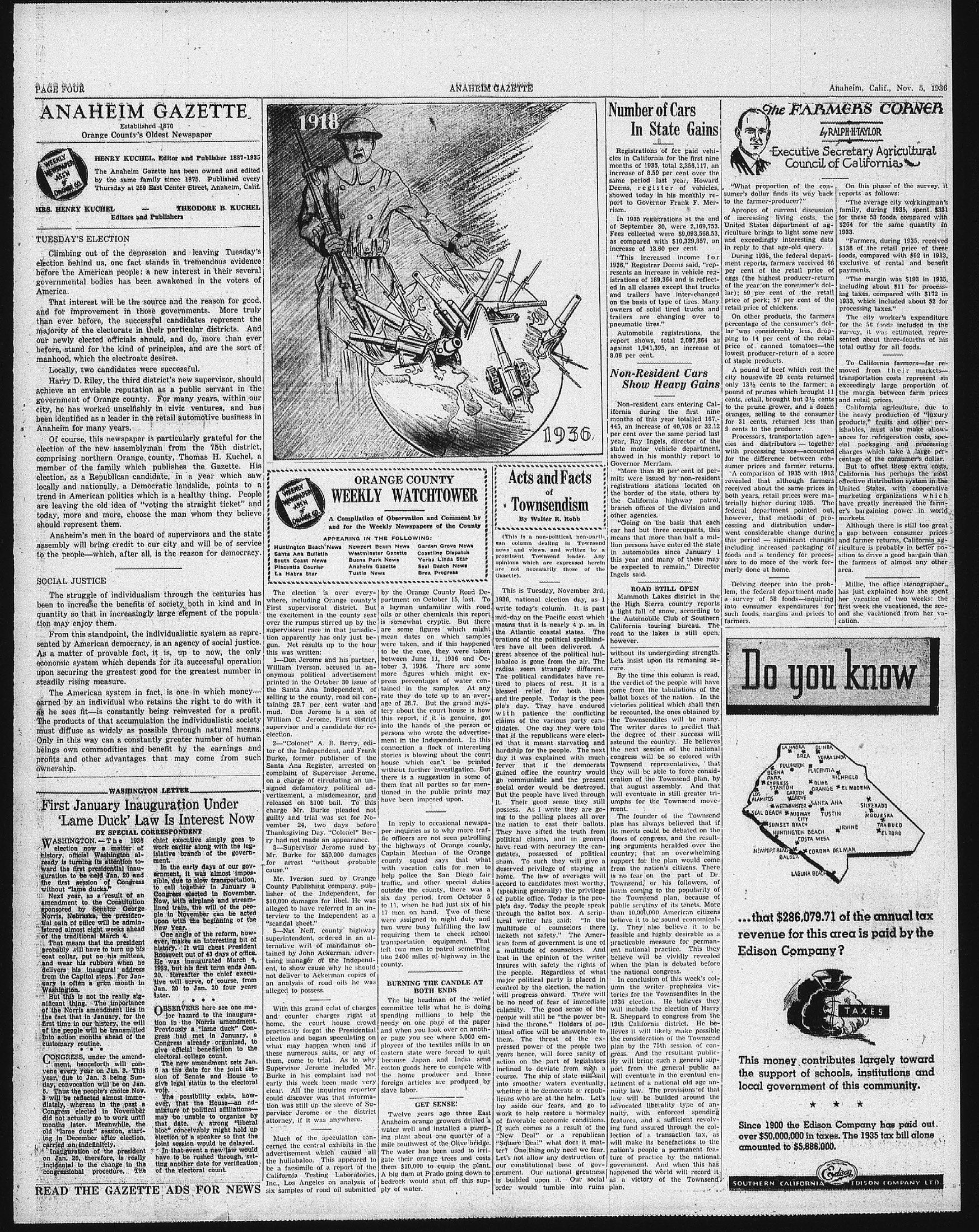
anaheim-gazette 1936-11-05
Scanned page
Searchable text
ANAHEIM GAZETTE
Established 1870
Orange County's Oldest Newspaper
HENRY KUCHEL, Editor and Publisher 1887-1935
The Anaheim Gazette has been owned and edited by the same family since 1875. Published every Thursday at 259 East Center Street, Anaheim, Calif.
MRS. HENRY KUCHEL — THEODORE B. KUCHEL
Editors and Publishers
TUESDAY'S ELECTION
Climbing out of the depression and leaving Tuesday's election behind us, one fact stands in tremendous evidence before the American people: a new interest in their several governmental bodies has been awakened in the voters of America.
That interest will be the source and the reason for good, and for improvement in those governments. More truly than ever before, the successful candidates represent the majority of the electorate in their particular districts. And our newly elected officials should, and do, more than ever before, stand for the kind of principles, and are the sort of manhood, which the electroate desires.
Locally, two candidates were successful.
Harry D. Riley, the third district's new supervisor, should achieve an enviable reputation as a public servant in the government of Orange county. For many years, within our city, he has worked unselfishly in civic ventures, and has been identified as a leader in the retail automotive business in Anaheim for many years.
Of course, this newspaper is particularly grateful for the election of the new assemblyman from the 75th district, comprising northern Orange county, Thomas H. Kuchel, a
Locally, two candidates were successful.
Harry D. Riley, the third district's new supervisor, should achieve an enviable reputation as a public servant in the government of Orange county. For many years, within our city, he has worked unselfishly in civic ventures, and has been identified as a leader in the retail automotive business in Anaheim for many years.
Of course, this newspaper is particularly grateful for the election of the new assemblyman from the 75th district, comprising northern Orange county, Thomas H. Kuchel, a member of the family which publishes the Gazette. His election, as a Republican candidate, in a year which saw locally and nationally, a Democratic landslide, points to a trend in American politics which is a healthy thing. People are leaving the old idea of "voting the straight ticket" and today, more and more, choose the man whom they believe should represent them.
Anaheim's men in the board of supervisors and the state assembly will bring credit to our city and will be of service to the people—which, after all, is the reason for democracy.
SOCIAL JUSTICE
The struggle of individualism through the centuries has been to increase the benefits of society both in kind and in quantity so that in increasingly large element of the population may enjoy them.
From this standpoint, the individualistic system as represented by American democracy, is an agency of social justice. As a matter of provable fact, it is, up to now, the only economic system which depends for its successful operation upon securing the greatest good for the greatest number in steadily rising measure.
The American system in fact, is one in which money—earned by an individual who retains the right to do with it as he sees fit—is constantly being reinvested for a profit. The products of that accumulation the individualistic society must diffuse as widely as possible through natural means. Only in this way can a constantly greater number of human beings own commodities and benefit by the earnings and profits and other advantages that may come from such ownership.
WASHINGTON LETTER
First January Inauguration Under 'Lame Duck' Law Is Interest Now
BY SPECIAL CORRESPONDENT
WASHINGTON. — The 1936 election now a matter of history, official Washington already is turning its attention toward the first presidential inauguration.
In the early days of our government,
The election is over everywhere, including Orange county. First supervisoral district. The excitement in the county is over the rumpus stirred up by supervisoral race in that jurisdiction apparently has only just begun. Net results up to the hour this was written:
1—Don Jerome and his partner William Iverson, accused in anonymous political advertisement printed in the October 30 issue of the Santa Ana Independent, selling to the county, road oil containing 28.7 per cent water mud. Don Jerome is a son William C. Jerome, First district supervisor and a candidate for election.
2—"Colonel" A. B. Berry, director of the Independent, and Fran Burke, former publisher of Santa Ana Register, arrested complaint of Supervisor Jerome on a charge of circulating an unsigned defamatory political vertisement, a misdemeanor, released on $100 bail. To charge Mr. Burke pleaded guilty and trial was set for November 24, two days before Thanksgiving Day. "Colonel" Berry had not made an appearance.
3—Supervisor Jerome sued Mr. Burke for $50,000 damage for arrest "without probable cause."
First January Inauguration Under ‘Lame Duck’ Law Is Interest Now
BY SPECIAL CORRESPONDENT
WASHINGTON. — The 1936 election now a matter of history, official Washington already is turning its attention toward the first presidential inauguration to be held Jan. 20 and the first session of Congress without “lame ducks.”
Next year, as a result of an amendment to the Constitution sponsored by Senator George Norris, Nebraska, the presidential oath of office will be administered almost eight weeks ahead of the traditional March 4.
That means that the president probably will have to turn up his coat collar, put on his mittens, and wear his rubbers when he delivers his inaugural address from the Capitol steps. For January is often a grim month in Washington.
But this is not the really significant thing. The importance of the Norris amendment lies in the fact that in January, for the first time in our history, the will of the people will be transmitted into action months ahead of the customary routine.
CONGRESS, under the amendment, henceforth will convene every year on Jan. 3. This year, due to Jan. 3 being Sunday, convocation will be on Jan. 5. Thus the people's choice Nov. 3 will be reflected almost immediately, whereas in the past a Congress elected in November did not actually go to work until months later. Meanwhile, the old “lame duck” session, starting in December after election, carried on indefinitely.
Inauguration of the president on Jan. 20, therefore, is really incidental to the change in the congressional procedure. The chief executive simply goes to work earlier along with the legislative branch of the government.
In the early days of our government, it was almost impossible, due to slow transportation, to call together in January a Congress elected in November. Now, with airplane and streamlined train, the will of the people in November can be acted upon with the beginning of the New Year.
One angle of the reform, however, makes an interesting bit of history. It will cheat President Roosevelt out of 43 days of office. He was inaugurated March 4, 1932, but his first term ends Jan. 20. Hereafter the chief executive will serve, of course, from Jan. 20 to Jan. 20 four years later.
OBSERVERS here see one major hazard to the inauguration in the Norris amendment. Previously a “lame duck” Congress had met in January, a Congress already organized, to give official benediction to the electoral college count.
The new amendment sets Jan. 6 as the date for the joint session of Senate and House to give legal status to the electoral vote.
The possibility exists, however, that the House—an admixture of political affiliations—may be unable to organize by that date. A strong “liberal block” concevably might hold up election of a speaker so that the joint session would be delayed.
In that event a new law would have to be rushed through, setting another date for verification of the electoral count.
READ THE GAZETTE ADS FOR NEWS
1918
1936.
Number of Cars In State Cities
Registrations of fee payables in California for the first months of 1936, total 2,350 increase of 8.59 per cent over the same period last year, Deems, register of the port to Governor Frank Riordan.
In 1935 registrations at of September 30, were 27 Fees collected were $9,094 as compared with $10,325 increase of 13.60 per cent.
"This increased income in 1936," Registrar Deems said, resents an increase in vehicle registrations of 189,364 and is included in all classes except those and trailers have inter- on the basis of type of tire owners of solid tired true trailers are changing pneumatic tires."
Automobile registration report shows, total 2,099 against 1,941,395, an increase of 8.06 per cent.
Non-Resident Cars Show Heavy Cars
Non-resident cars enterifornia during the first months of this year total 445, an increase of 40,708 per cent over the same period, Ray Ingels, director state motor vehicle department showed in his monthly report.
ORANGE COUNTY
WEEKLY WATCHTOWER
A Compilation of Observation and Comment by
and for the Weekly Newspapers of the County
APPEARING IN THE FOLLOWING:
Bellington Beach News
Newport Beach News
Garden Grove News
Ana Ana Bulletin
Westminster Gazette
Coastline Dispatch
Buena Park News
Yorba Linda Star
Montia Courler
Anahelm Gazette
Seal Beach News
Habra Star
Tustin News
Brea Progress
election is over everyincluding Orange county's
supervisoral district. But
citizens in the county seat
one rumpus stirred up by the
soral race in that jurisdiction,
has only just benet results up to the hour
as written:
Don Jerome and his partner,
Don Iverson, accused in annous political advertisement
in the October 30 issue of
Santa Ana Independent, of
to the county, road oil con28.7 per cent water and
Don Jerome is a son of
Don C. Jerome, First district
censor and a candidate for relon.
Colonel" A. B. Berry, editive the Independent, and Frank
former publisher of the
Ana Register, arrested on
point of Supervisor Jerome,
charge of circulating an undefamatory political addment, a misdemeanor, and
ed on $100 bail. To this
Mr. Burke pleaded not
and trial was set for Nov24, two days before
giving Day. "Colonel" Bernot made an appearance.
supervisor Jerome sued by
burke for $50,000 damages
arrest "without probable
by the Orange County Road Department on October 15, last. To a layman unfamiliar with road oils or other chemicals this report is somewhat cryptic. But there are some figures which might mean dates on which samples were taken, and if this happened to be the case, they were taken between June 11, 1936 and October 3, 1936. There are some more figures which might express percentages of water contained in the samples. At any rate they do tote up to an average of 28.7. But the grand mystery about the court house is how this report, if it is genuine, got into the hands of the person or persons who wrote the advertisement in the Independent. In this connection a flock of interesting stories is blowing about the court house which can't be printed without further investigation. But there is a suggestion in some of them that all parties so far mentioned in the public prints may have been imposed upon.
In reply to occasional newspaper inquiries as to why more traffic officers are not seen patrolling the highways of Orange county, Captain Meehan of the Orange county squad says that what with vacation calls for men to
This is Tuesday, November 3rd, 1936, national election day, as I write today's column. It is past mid-day on the Pacific coast which means that it is nearly 4 p.m. in the Atlantic coastal states. The orations of the political spellbinders have all been delivered. A great absence of the political hullabaloo is gone from the air. The radios seem strangely different. The political candidates have retired to places of rest. It is a blessed relief for both them and the people. Today is the people's day. They have endured with patience the conflicting claims of the various party candidates. One day they were told that if the republicans were elected that it meant starvation and hardship for the people. The next day it was explained with much ferver that if the democrats gained office the country would go communistic and the present social order would be destroyed. But the people have lived through it. Their good sense they still possess. As I write they are going to the polling places all over the nation to cast their ballots. They have sifted the truth from political claims, and in general have read with accuracy the candidates, possessed of political sham. To such they will give a deserved privilege of staying at
Non-Resident Cars enter
ifornia during the first
months of this year total445, an increase of 40,708,
per cent over the same poyear, Ray Ingels, director
state motor vehicle depenshowed in his monthly m
Governor Merrlam.
"More than 86 per centmits were issued by nonregistrations stations locathe border of the state, owethe California highway,
branch offices of the diviother agencies.
"Going on the basis t
car had but three occupameans that more than haulion persons have entered d
in automobiles since Janthis year and many of th
be expected to remain,"
Ingels said.
ROAD STILL OPEN
Mammoth Lakes district
the High Sierra country,
a light fall of snow, accothe Automobile Club of SCalifornia touring burearoad to the lakes is still
however.
without its undergirding
Lets insist upon its remacure.
By the time this column,
the verdict of the people wicome from the tabulation
ballot boxes of the nation,
victories which she be recounted, the ones obey
the Townsendites will be.
The writer dares to precethe degree of their succeastound the country. Hec
the next session of thе
congress will be so coloTownsend representatives
they will be able to forceeration of the Townsend
that august assembly. A
will eventuate in still groumphs for the Townsend
The founder of the T
plan has always believed
its merits could be debatefloors of congress, and thieing arguments heralded
country; that an overvisupport for the plan woulfrom the nation's citizen
In reply to occasional newspaper inquiries as to why more traffic officers are not seen patrolling the highways of Orange county, Captain Mechan of the Orange county squad says that what with vacation calls for men to help police the San Diego fair traffic, and other special duties outside the county, there was a six day period, from October 5 to 11, when he had just six of his 17 men on hand. Two of these were assigned to night duty and two were busy fulfilling the law requiring them to check school transportation equipment. That left two men to patrol something like 2400 miles of highway in the county.
BURNING THE CANDLE AT BOTH ENDS
The big headman of the relief committee tells what he is doing spending millions to help the needy on one page of the paper and when you look over on another page you see where 5,000 employees of the textiles mills in an eastern state were forced to quit because Japan and India send cotton goods here to compete with the home producer and those foreign articles are produced by slave labor.
GET SENSE!
Twelve years ago three East Anaheim orange growers drilled a water well and installed a pumping plant about one quarter of a mile southwest of the Olive bridge. The water has been used to irrigate their orange trees and costs them $10,000 to equip the plant. A big dam at Prado going down to bedrock would shut off this supply of water.
In conclusion of this work unmn the writer prophesies for the Townsendit 1036 election. He believes will include the election of R. Sheppard to congress and 19th California district. It will likely make the consideration of the T plan by the 75th session gross. And the resultantity will bring such a general port from the general will eventuate in the even actment of a national old nuity law. The provision law will be built around advocated liberality type nuity, with enforced features, and a sufficient fund assured through lection of a transaction will make its benefaction nation's people a permanent ture of practice by the government. And when happened the world will be as a victory of the T plan.
Number of Cars In State Gains
Registrations of fee paid vehicles in California for the first nine months of 1936, total 2,356,117, an increase of 8.59 per cent over the same period last year, Howard Deems, register of vehicles, showed today in his monthly report to Governor Frank F. Meriam.
In 1935 registrations at the end of September 30, were 2,169,753. Fees collected were $9,093,568.53, compared with $10,329,857, an increase of 13.60 per cent.
“This increased income for 1936,” Registrar Deems said, “represents an increase in vehicle registrations of 189,364 and is reflected in all classes except that trucks and trailers have inter-changed on the basis of type of tires. Many owners of solid tired trucks and trailers are changing over to pneumatic tires.”
Automobile registrations, the report shows, total 2,097,864 against 1,941,395, an increase of 0.06 per cent.
Non-Resident Cars Show Heavy Gains
Non-resident cars entering California during the first nine months of this year totalled 167,-45, an increase of 40,708 or 32.12 per cent over the same period last year, Ray Ingels, director of the state motor vehicle department, showed in his monthly report to Anaheim, Calif., Nov. 5, 1936.
“What proportion of the consumer’s dollar finds its way back to the farmer-producer?”
Apropos of current discussion of increasing living costs, the United States department of agriculture brings to light some new and exceedingly interesting data in reply to that age-old query.
During 1935, the federal department reports, farmers received 66 per cent of the retail price of eggs (the highest producer-return of the year on the consumer’s dollar); 59 per cent of the retail price of pork; 57 per cent of the retail price of chickens.
On other products, the farmers percentage of the consumer’s dollar was considerably less, dropping to 14 per cent of the retail price of canned tomatoes—the lowest producer-return of a score of staple products.
A pound of beef which cost the city housewife 29 cents returned only 13½ cents to the farmer; a pound of prunes which brought 11 cents, retail, brought but 3½ cents to the prune grower, and a dozen oranges, selling to the consumer for 31 cents, returned less than 9 cents to the producer.
Processors, transportation agencies and distributors — together with processing taxes—accounted for the difference between con-
On this phase of the survey, it reports as follows:
“The average city workingman’s family, during 1935, spent $391 for these 58 foods, compared with $264 for the same quantity in 1933.
“Farmers, during 1935, received $138 of the retail price of these foods, compared with $92 in 1933, exclusive of rental and benefit payments.
“The margin was $193 in 1935, including about $11 for processing taxes, compared with $172 in 1933, which included about $2 for processing taxes.”
The city worker’s expenditure for the 58 foods included in the survey, it was estimated, represented about three-fourths of his total outlay for all foods.
To California farmers—far removed from their markets—transportation costs represent an exceedingly large proportion of the margin between farm prices and retail prices.
California agriculture, due to the heavy production of “luxury products,” fruits and other perishables, must also make allowances for refrigeration costs, special packaging and processing charges which take a large percentage of the consumer’s dollar.
Non-resident cars entering California during the first nine months of this year totalled 167,455, an increase of 40,708 or 32.12 per cent over the same period last year, Ray Ingels, director of the state motor vehicle department, showed in his monthly report to Governor Merrlam.
"More than 86 percent of permits were issued by non-resident registrations stations located on the border of the state, others by the California highway patrol, branch offices of the division and other agencies."
"Going on the basis that each car had but three occupants, this means that more than half a million persons have entered the state in automobiles since January 1 this year and many of these may be expected to remain," Director Ingels said.
ROAD STILL OPEN
Mammoth Lakes district in the High Sierra country reports a light fall of snow, according to the Automobile Club of Southern California touring bureau. The road to the lakes is still open, however.
without its undergirding strength,ets insist upon its remaining secure.
By the time this column is read, the verdict of the people will have come from the tabulations of the ballot boxes of the nation. In the victories political which shall then be recounted, the ones obtained by the Townsendites will be many. The writer dares to predict that the degree of their success will astound the country. He believes the next session of the national congress will be so colored with Townsend representatives, that they will be able to force consideration of the Townsend plan, by that august assembly. And that will eventuate in still greater triumphs for the Townsend movement.
The founder of the Townsend plan has always believed that if its merits could be debated on the doors of congress, and the resulting arguments heralded over the country; that an overwhelming support for the plan would come from the nation's citizens. There
A pound of beef which cost the city housewife 29 cents returned only 13½ cents to the farmer; a pound of prunes which brought 11 cents, retail, brought but 3½ cents to the prune grower, and a dozen oranges, selling to the consumer for 31 cents, returned less than 9 cents to the producer.
Processors, transportation agencies and distributors — together with processing taxes—accounted for the difference between consumer prices and farmer returns.
A comparison of 1935 with 1913 revealed that although farmers received about the same prices in both years, retail prices were materially higher during 1935. The federal department pointed out, however, that methods of processing and distribution underwent considerable change during this period — significant changes including increased packaging of foods and a tendency for processors to do more of the work formerly done at home.
Delving deeper into the problem, the federal department made a survey of 58 foods—inquiring into consumer expenditures for such foods, margins and prices to farmers.
To California farmers—far removed from their markets—transportation costs represent an exceedingly large proportion of the margin between farm prices and retail prices.
California agriculture, due to the heavy production of "luxury products," fruits and other perishables, must also make allowances for refrigeration costs, special packaging and processing charges which take a large percentage of the consumer's dollar.
But to offset these extra costs, California has perhaps the most effective distribution system in the United States, with cooperative marketing organizations which have greatly increased the farmer's bargaining power in world markets.
Although there is still too great a gap between consumer prices and farmer returns, California agriculture is probably in better position to drive a good bargain than the farmers of almost any other area.
Millie, the office stenographer., has just explained how she spent her vacation of two weeks: the first week she vacationed, the second she vacationed from her vacation.
...that $286,079.71 of the annual tax revenue for this area is paid by the Edison Company?
This money contributes largely toward the support of schools, institutions and local government of this community.
Since 1900 the Edison Company has paid out over $50,000,000 in taxes. The 1935 tax bill alone amounted to $5,886,000.
SOUTHERN CALIFORNIA EDISON COMPANY LTD.