anaheim-gazette 1936-08-06
Scanned page
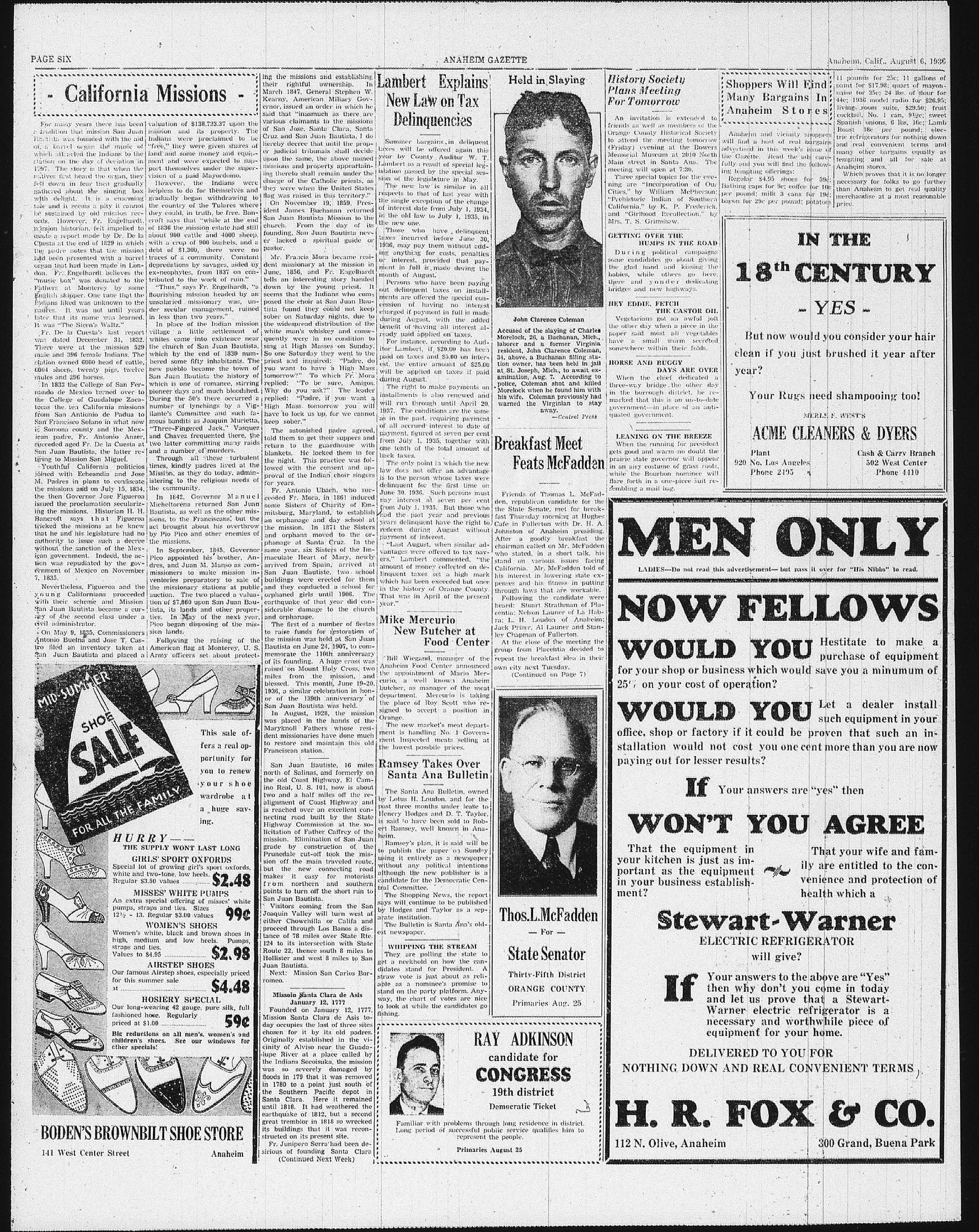
Searchable text
- California Missions -
For many years there has been a tradition that mission San Juan Bautista was founded with the aid of a barrel organ the music of which attracted the Indians to the station on the day of declaration in 1797. The story is that when the natives first heard the organ, they fell down in fear then gradually gathered about the singing box with delight. It is a charming tale and it seems a pity it cannot be sustained by old mission records. However, Fr. Engelhardt, mission historian, felt impelled to quote a report made by Dr. De la Cuesta at the end of 1829 in which the padre notes that the mission had been presented with a barrel organ that had been made in London. Fr. Engelhardt believes "music box" was donated to the Fathers at Monterey by some English skipper. One tune that the Indians liked was unknown to the padres. It was not until years later that its name was learned. It was "The Siren's Waltz."
Fr. De la Cuesta's last report was dated December 31, 1832. There were at the mission 529 male and 396 female Indians. The station owned 6000 head of cattle, 6004 sheep, twenty pigs, twelve mules and 296 horses.
In 1833 the College of San Fernando de Mexico turned over to the College of Guadalupe Zacatecas the ten California missions from San Antonio de Padua to San Francisco Solano in what now is Somona county and the Mexican padre, Fr. Antonio Anzer, succeeded aged Fr. De la Cuesta at San Juan Bautista, the latter retiring to Mission San Miguel evaluation of $138,723.37 upon the mission and its property. The Indians were proclaimed to be "free," they were given shares of land and some money and equipment and were expected to support themselves under the supervision of a paid Mayordomo.
However, the Indians were helpless to do for themselves and gradually began withdrawing to the country of the Tulares where they could, in truth, be free. Bancroft says that "while at the end of 1836 the mission estate had still about 900 cattle and 4000 sheep, with a crop of 900 bushels, and a debt of $1,300, there were no traces of a community. Constant depredations by savages, aided by ex-neophytes, from 1837 on contributed to the work of ruin."
Thus," says Fr. Engelhardt, "a flourishing mission headed by an unsalaried missionary was, under secular management, ruined in less than two years."
In place of the Indian mission village a little settlement of whites came into existence near the church of San Juan Bautista, which by the end of 1839 numbered some fifty inhabitants. The new pueblo became the town of San Juan Bautista the history of which is one of romance, stirring pioneer days and much bloodshed. During the 50's there occurred a number of lynchings by a Vigilante's Committee and such famous bandits as Joaquin Murietta, "Three-Fingered Jack," Vasquez and Chavez frequented there, the two latter committing many raids and a number of murders.
Through all these turbulent ing the missions and establishing their rightful ownership. March 1847, General Stephen W. Kearny, American Military Governor, issued an order in which said that "inasmuch as there are various claimants to the mission of San Jose, Santa Clara, San Cruz and San Juan Bautista, I hereby decree that until the proper judicial tribunals shall decide upon the same, the above many missions and property appearanting thereto shall remain under charge of the Catholic priests; they were when the United States flag was raised in this territory.
On November 19, 1859, President James Buchanan returned San Juan Bautista Mission to the church. From the day of founding, San Juan Bautista never lacked a spiritual guide pastor.
Mr. Francis Mora became resident missionary at the mission June, 1856, and Fr. Engelhardt tells an interesting story handed down by the young priest. Seems that the Indians who composed the choir at San Juan Bautista found they could not keep sober on Saturday nights, due to the widespread distribution of white man's whiskey and consequently were in no condition sing at High Masses on Sunday. So one Saturday they went to a priest and inquired: "Padre, you want to have a High Mass tomorrow?" To which Fr. Mora replied: "To be sure, Amigo Why do you ask?" The leader replied: "Padre, if you want High Mass tomorrow you will have to lock up us, for we can keep sober."
The astonished padre agreed told them to get their suppers a return to the guardhouse with blankets. He locked them in
In 1833 the College of San Fernando de Mexico turned over to the College of Guadalupe Zacatecas the ten California missions from San Antionio de Padua to San Francisco Solano in what now is Somona county and the Mexican padre, Fr. Antonio Anzer, succeeded aged Fr. De la Cuesta at San Juan Bautista, the latter retiring to Mission San Miguel.
Youthful California politicians joined with Echeandia and Jose M. Padres in plans to confiscate the missions and on July 15, 1834, the then Governor Jose Figueroa issued the proclamation secularizing the missions. Historian H. H. Bancroft says that Figueroa tricked the missions as he knew that he and his legislature had no authority to issue such a decree without the sanction of the Mexican government. Indeed, the action was repudiated by the government of Mexico on November 7, 1835.
Nevertheless, Figueroa and the young Californians proceeded with their scheme and Mission San Juan Bautista became a curry of the second class under a civil administrator.
On May 9, 1835, Commissioners Antonio Buelna and Jose T. Castro filed an inventory taken at San Juan Bautista and placed a new pueblo became the town of San Juan Bautista the history of which is one of romance, stirring pioneer days and much bloodshed. During the 50's there occurred a number of lynchings by a Vigilante's Committee and such famous bandits as Joaquin Murietta, "Three-Fingered Jack," Vasquez and Chavez frequented there, the two latter committing many raids and a number of murders.
Through all these turbulent times, kindly padres lived at the Mission, as they do today, administering to the religious needs of the community.
In 1842, Governor Manuel Micheltorena returned San Juan Bautista, as well as other missions, to the Franciscans; but the act brought about his overthrow by Pio Pico and other enemies of the missions.
In September, 1845, Governor Pico appointed his brother, Andres, and Juan M. Manso as commissioners to make mission inventories preparatory to sale of the missionary stations at public auction. The two placed a valuation of $7,860 upon San Juan Bautista, its lands and other properties. In May of the next year, Pico began disposing of the mission lands.
Following the raising of the American flag at Monterey, U. S. Army officers set about protect-
This sale offers a real opportunity for you to renew your shoe wardrobe at a huge saving.
HURRY — THE SUPPLY WONT LAST LONG GIRLS' SPORT OXFORDS Special lot of growing girl's sport oxfords,
The astonished padre agreed told them to get their suppers back to return to the guardhouse with blankets. He locked them in the night. This practice was followed with the consent and approval of the Indian choir singing for years.
Fr. Antonio Ubach, who succeeded Fr. Mora, in 1861 induced some Sisters of Charity of Elmitsburg, Maryland, to establish an orphanage and day school in the mission. In 1871 the Sisters and orphans moved to the phanage at Santa Cruz. In same year, six Sisters of the Maculate Heart of Mary, arrived from Spain, arrived at San Juan Bautiste, two schools buildings were erected for them and they conducted a school orphaned girls until 1906.
Tearache of that year did considerable damage to the church and orphanage.
The first of a number of fires to raise funds for restoration of the mission was held at San Juan Bautista on June 24, 1907, to commemorate the 110th anniversary of its founding. A huge cross was raised on Mount Holy Cross, three miles from the mission, blessed. This month, June 19, 1936, a similar celebration in honor of the 139th anniversary of San Juan Bautista was held.
In August, 1928, the mississippi was placed in the hands of Maryknoll Fathers whose resident missionaries have done much to restore and maintain this Franciscan station.
San Juan Bautiste, 16 miles north of Salinas, and formerly the old Coast Highway, El Camino Real, U. S. 101, now is about two and a half miles off the alignment of Coast Highway and is reached over an excellent connecting road built by the Sta Highway Commission at the solicitation of Father Caffrey of the mission. Elimination of San Juana grade by construction of Prunedale cut-off took the mission off the main traveled route but the new connecting road owned some fifty inmigrants. The new pueblo became the town of San Juan Bautista the history of which is one of romance, stirring pioneer days and much bloodshed. During the 50's there occurred a number of lynchings by a Vigilante's Committee and such famous bandits as Joaquin Murietta, "Three-Fingered Jack," Vasquez and Chavez frequented there, the two latter committing many raids and a number of murders.
Through all these turbulent times, kindly padres lived at the Mission, as they do today, administering to the religious needs of the community.
In 1842, Governor Manuel Micheltorena returned San Juan Bautista, as well as other missions, to the Franciscans; but the act brought about his overthrow by Pio Pico and other enemies of the missions.
In September, 1845, Governor Pico appointed his brother, Andres, and Juan M. Manso as commissioners to make mission inventories preparatory to sale of the missionary stations at public auction. The two placed a valuation of $7,860 upon San Juan Bautista, its lands and other properties. In May of the next year, Pico began disposing of the mission lands.
Following the raising of the American flag at Monterey, U. S. Army officers set about protect-
HURRY —
THE SUPPLY WONT LAST LONG
GIRLS' SPORT OXFORDS
Special lot of growing girl's sport oxford,
white and two-tone, low heels.
Regular $3.50 values ... $2.48
MISSES' WHITE PUMPS
An extra special offering of misses' white
pumps, straps and ties. Sizes
12½ - 13. Regular $3.00 values ... 99¢
WOMEN'S SHOES
Women's white, black and brown shoes in
high, medium and low heels. Pumps,
straps and ties.
Values to $4.95 ... $2.98
AIRSTEP SHOES
Our famous Airstep shoes, especially priced
for this summer sale
at ... $4.48
HOSIERY SPECIAL
Our long-wearing 42 gauge, pure silk, full
fashioned hoe. Regularly
priced at $1.00 ... 59¢
Big reductions on all men's, women's and
children's shoes. See our windows for
other specials!
BODEN'S BROWNBILT SHOE STORE
141 West Center Street Anaheim
Missoin Santa Clara de Asis
January 12, 1777
Founded on January 12, 1777
Mission Santa Clara de Asis the day occupies the last of three sites chosen for it by its old padre.
Originally established in the vicinity of Alviso near the Guadalupe River at a place called the Indians Socoisuka, the mission was so severely damaged by floods in 179 that it was removed in 1780 to a point just south of the Southern Pacific depot Santa Clara. Here it remains until 1818. It had weathered the earthquake of 1812, but a second great tremblor in 1818 so wrecked its buildings that it was reconstructed on its present site.
Fr. Junipero Serra had been desirous of founding Santa Clara (Continued Next Week)
Lambert Explains New Law on Tax Delinquencies
Summer bargains in deliquent taxes will be offered again this year by County Auditor W. T. Lambert as a result of special legislation passed by the special session of the legislature in May.
The new law is similar in all respects to that of last year with the single exception of the change of interest date from July 1, 1934, in the old law to July 1, 1935, in the new one.
Those who have delinquent taxes incurred before June 30, 1936, may pay them without adding anything for costs, penalties or interest, provided that payment in full is made during the month of August.
Persons who have been paying out delinquent taxes on installments are offered the special concession of having no interest charged if payment in full is made during August, with the added benefit of having all interest already paid applied on taxes.
For instance, according to Auditor Lambert, if $20.00 has been paid on taxes and $5.00 on interest, the entire amount of $25.00 will be applied on taxes if paid during August.
The right to make payments on installments is also renewed and will run through until April 20, 1937. The conditions are the same as in the past, requiring payment of all accrued interest to date of payment, figured at seven per cent from July 1, 1935, together with one tenth of the total amount of back taxes.
Held in Slaying
John Clarence Coleman
Accused of the slaying of Charles Morelock, 26, a Buchanan, Mich., laborer and a former Virginia resident, John Clarence Coleman, 34, above, a Buchanan filling station owner, has been held in jail at St. Joseph, Mich., to await examination, Aug. 7. According to police, Coleman shot and killed Morelock when he found him with his wife. Coleman previously had warned the Virginian to stay away.
Breakfast Meet
History Society Plans Meeting For Tomorrow
An invitation is extended friends as well as members Orange County Historical Society to attend the meeting today (Friday) evening at the Memorial Museum at 201 Main street in Santa Ana meeting will open at 7:30.
Three special topics for the meeting are "Incorporation of Cities," by William McKee; "Prehistoric Indian of South California," by K. P. Franck; and "Girlhood Recollection Mrs. T. S. Grimshaw."
GETTING OVER THE HUMPS IN THE DURING POLITICAL CASES
Some candidates go about the glad hand and kiss babies, while others go there and yonder do bridges and new highway.
HEY EDDIE, FETCH THE CASTLE
Vegetarians got an awful other day when a piece paper said most all you have a small worm somewhere within their tummy.
HORSE AND BUGGY DAYS ARE
When the chief dedi- three-way bridge, the other in the burrough district, marked that this is an ungovernment—in place of a quoted government.
LEANING ON THE BRIDGE
When the running for post gets good and warm no doubt prairie state governor will
first of a number of fiestas the funds for restoration of mission was held at San Juan on June 24, 1907, to commute the 110th anniversary rounding. A huge cross was on Mount Holy Cross, two from the mission, and this month, June 19-20, similar celebration in honour the 139th anniversary of Juan Bautista was held. August, 1928, the mission faced in the hands of the moll Fathers whose reservationaries have done much more and maintain this old can station.
Juan Bautiste, 16 miles of Salinas, and formerly on Coast Highway, El Camino, U. S. 101, now is about a half mile off the resort of Coast Highway and used over an excellent con road built by the State City Commission at the solemn of Father Caffrey of the Elimination of San Juan by construction of the male cut-off took the misfit the main traveled route, the new connecting road.
Antonio Ubach, who succeeds Fr. Mora, in 1861 induced Sisters of Charity of Emigre, Maryland, to establishphanage and day school at session. In 1871 the Sisters ephans moved to the ordee at Santa Cruz. In the year, six Sisters of the Imate Heart of Mary, newly from Spain, arrived at Juan Bautiste, two school girls were erected for them they conducted a school for red girls until 1906. The make of that year did considerable damage to the church chanage.
Mike Mercurio New Butcher at Food Center
Bill Wiegand, manager of the Anaheim Food Center announced the appointment of Mario Mercurio, a well known Anaheim butcher, as manager of the meat department. Mercurio is taking the place of Roy Scott who resigned to accept a position in Orange.
The new market's meat department is handling No. 1 Government Inspected meats selling at the lowest possbile prices.
Ramsey Takes Over Santa Ana Bulletin
The Santa Ana Bulletin, owned by Lotus H. Loudon, and for the past three months under lease to Henery Hodges and D. T. Taylor, is said to have been sold to Robert Ramsey, well known in Anaheim.
Ramsey's plan, it is said will be to publish the paper on Sunday using it entirely as a newspaper without any political intentions.
Breakfast Meet Feats McFadden
Friends of Thomas L. McFadden, republican candidate for the State Senate, met for breakfast Thursday morning at Hughes Cafe in Fullerton with Dr. H. A. Johnston of Anaheim presiding. After a goodly breakfast the chairman called on Mr. McFadden who stated, in a short talk, his stand on various issues facing California. Mr. McFadden told of his interest in lowering state expenses and his fitness in putting through laws that are workable.
Following the candidate were heard: Stuart Strathman of Placeia; Nelson Launer of La Habra; L. H. Loudon of Anaheim; Jack Prizer, Al Launer and Stanley Chapman of Fullerton.
At the close of the meeting the group from Placeia decided to repeat the breakfast idea in their own city next Tuesday.
(Continued on Page 7)
The Santa Ana Bulletin, owned by Lotus H. Loudon, and for the past three months under lease to Henery Hodges and D. T. Taylor, is said to have been sold to Robert Ramsey, well known in Anaheim.
Ramsey's plan, it is said will be to publish the paper on Sunday using it entirely as a newspaper without any political intentions although the new publisher is a candidate for the Democratic Central Committee.
The Shopping News, the report says will continue to be published by Hodges and Taylor as a separate institution.
The Bulletin is Santa Ana's oldest newspaper.
WHIPPING THE STREAM
They are polling the state to get a neckhold on how the candidates stand for President. A straw vote is just about as reliable as a nominee's promise to stand on the party platform. Anyway, the chart of votes are nice to look at while the candidates go fishing.
RAY ADKINSON
candidate for CONGRESS
19th district
Democratic Ticket
Familiar with problems through long residence in district. Long period of successful public service qualifies him to represent the people.
Primaries August 25
History Society Plans Meeting For Tomorrow
An invitation is extended to friends as well as members of the Orange County Historical Society to attend the meeting tomorrow Friday) evening at the Bowers Memorial Museum at 2010 North Main street in Santa Ana. The meeting will open at 7:30.
Three special topics for the evening are "Incorporation of Our Enties," by William McPherson; Prehistoric Indian of Southern California," by K. P. Frederick; and "Girlhood Recollection," by Mrs. T. S. Grimshaw.
GETTING OVER THE HUMPS IN THE ROAD
During political campaigns some candidates go about giving the glad hand and kissing the babies, while others go here, here and yonder dedicating bridges and new highways.
EY EDDIE, FETCH
THE CASTOR OIL
Vegetarians got an awful jolt the other day when a piece in the paper said most all vegetables have a small worm secreted somewhere within their folds.
ORSE AND BUGGY
DAYS ARE OVER
When the chief dedicated a three-way bridge the other day in the burrough district, he remarked that this is an up-to-date government—in place of an anti-antiquated government.
LEANING ON THE BREEZE
When the running for president gets good and warm-no doubt the rainy state governor will appear.
Shoppers Will Find Many Bargains In Anaheim Stores
Anaheim and vicinity shoppers will find a host of real bargains advertised in this week's issue of the Gazette. Read the ads carefully and you will find the following tempting offerings:
Regular $4.95 shoes for 59¢; Bathing caps for 9¢; coffee for 10¢ per pound; milk 3 cans for 19¢; bacon for 29¢ per pound; potatoads 11 pounds for 25¢; 11 gallons of paint for $17.98; quart of mayonnaise for 35¢; 24 lbs. of flour for 44¢; 1926 model radio for $26.95; living-room suite, $29.50; fruit cocktail, No. 1 can, 91¢; sweet Spanish onions, 6 lbs., 10¢; Lamb Roast 18¢ per pound; electric refrigerators for nothing down and real convenient terms and many other bargains equally as tempting and all for sale at Anaheim stores.
Which proves that it is no longer necessary for folks to go further than Anaheim to get real quality merchandise at a most reasonable price.
IN THE
18th CENTURY
- YES -
But now would you consider your hair clean if you just brushed it year after year?
Your Rugs need shampooing too!
MERLE E. WEST'S
ACME CLEANERS & DYERS
Plant Cash & Carry Branch
DAYS ARE OVER
When the chief dedicated a three-way bridge, the other day in the burrough district, he remarked that this is an up-to-date government—in place of an anti-agricultural government.
LEANING ON THE BREEZE
When the running for president gets good and warm no doubt the rairie state governor will appear on an airy costume of grass roots, while the Bourbon nominee will be forth in a one-piece suit reembling a mail bag.
year?
Your Rugs need shampooing too!
MERLE F. WEST'S
ACME CLEANERS & DYERS
Plant
920 Nc. Los Angeles
Phone 2195
Cash & Carry Branch
502 West Center
Phone 4110
MEN ONLY
LADIES—Do not read this advertisement—but pass it over for “His Nibbs” to read.
NOW FELLOWS
WOULD YOU Hestitate to make a purchase of equipment for your shop or business which would save you a minimum of 25% on your cost of operation?
WOULD YOU Let a dealer install such equipment in your office, shop or factory if it could be proven that such an installation would not cost you one cent more than you are now paying out for lesser results?
If Your answers are “yes” then
WON'T YOU AGREE
That the equipment in your kitchen is just as important as the equipment That your wife and family are entitled to the con-
If Your answers are "yes" then
WON'T YOU AGREE
That the equipment in your kitchen is just as important as the equipment in your business establishment?
That your wife and family are entitled to the convenience and protection of health which a Stewart-Warner electric refrigerator will give?
If Your answers to the above are "Yes" then why don't you come in today and let us prove that a Stewart-Warner electric refrigerator is a necessary and worthwhile piece of equipment for your home.
DELIVERED TO YOU FOR NOTHING DOWN AND REAL CONVENIENT TERMS
H. R. FOX & CO.
112 N. Olive, Anaheim 300 Grand, Buena Park