anaheim-gazette 1936-07-30
Scanned page
Searchable text
ANAHEIM GAZETTE
Established 1870
Orange County's Oldest Newspaper
HENRY KUCHEL, Editor and Publisher 1887-1935
The Anaheim Gazette has been owned and edited by the same family since 1875. Published every Thursday at 259 East Center Street, Anaheim, Calif.
MRS. HENRY KUCHEL — THEODORE B. KUCHEL
Editors and Publishers
THE GOVERNOR ACCEPTS
From the lips of a 'common American,' the governor of what the Postmaster General calls, derisively, a 'typical prairie state,' there came last Thursday evening, in Topeka, Kans., an honest declaration of high duty: Acceptance of the nomination, by the Republican party; for the Presidency of the country.
Multitudinous comparison and contrast between the acceptances and the backgrounds of Alfred Mossman Landon and Franklin D. Roosevelt, have been made during the week; and little remains unsaid, in the public print, regarding them. But, within Governor Landon's speech — in the customarily sincere character of the man — it occurs to this newspaper that two excerpts appear from which the basic concern of the nation is revealed.
"The country is ripe for recovery," stated the Governor. And when the consumer-demand of the nation is released from the shackles placed upon it by the administration, the problem will be, in his words, "not where to find work for the workers, but where to find workers for the work."
The New Deal policy has been as an opiate to many of our laborers. With the reckless freedom of the great federal dole, there comes now the aftermath: a disinclination by many to return to gainful employment. Many there are in these days who now believe that the national administration owes them a living, and that it is better to while away the years as a member of some alphabetical club than to pitch in and work at some constructive enterprise.
from the shackles placed upon it by the administration, the problem will be, in his words, "not where to find work for the workers, but where to find workers for the work."
The New Deal policy has been as an opiate to many of our laborers. With the reckless freedom of the great federal dole, there comes now the aftermath: a disinclination by many to return to gainful employment. Many there are in these days who now believe that the national administration owes them a living, and that it is better to while away the years as a member of some alphabetical club than to pitch in and work at some constructive enterprise.
Not one, but many local business men daily recount how nearly impossible it is to hire labor. The honest working man further testifies to the fact that he, himself, is derided and laughed at by his indolent brother who eats upon the dole, either in return for 'play-time labor' or else in return for nothing at all.
Every decent believer in democracy stands in utter amazement of this startling truth: that tomorrow's problem will be to find 'workers for the work.'
As to the question of alteration of our present form of government, take the governor's sturdy words: "... change must come by and through the people, and not by usurpation."
That is what Governor Landon believes. That is what this newspaper believes. And that is what the people of the nation will, in November, go on record as believing.
Originally, the checks and balances of the federal government were placed in the American system, so that, thereafter, no one man might gather within himself an all powerful authority.
But that fundamental of American government was smilingly committed to oblivion by the New Deal. The swarm of officers and offices set loose by the administration took unto themselves all power: they interpreted as they pleased the laws which a subservient congress obligingly gave to them; they administered them according to their own like; and then, wonder of wonders, they sat in judgment in cases which arose under their administration of them.
The government is constructed, so that, in constitutional fashion, it may be changed when the country so desires. But thus far, the attitude of the administration has cared little for what the changes should contain, and cared not at all for the desires of the people.
But the day of reckoning is not far distant. If the United States desires a continuance of the New Deal, it has opportunity in November. The alternative is to go forward under the guidance of a sane, sincere, progressive leader, who has been successful both in private business, and in the administration of high public office as well.
There is the selection. Every citizen, according as he sees the light, must make his choice. We make ours. We follow Alf Landon this year.
GIVE US THE GRIP
Next Wednesday, Phi Chi, national men's fraternity, opens its five-day convention on Anaheim. From the north, the midwest, and the south, young men, delegates to the affair, will come to this city. Their choice is, we believe, a wise one, a fact to which encampments of other organizations, held during the last year within our midst, bear
There is the selection. Every citizen, according as he sees the light, must make his choice. We make ours. We follow Alf Landon this year.
GIVE US THE GRIP
Next Wednesday, Phi Chi, national men's fraternity, opens its five-day convention on Anaheim. From the north, the midwest, and the south, young men, delegates to the affair, will come to this city. Their choice is, we believe, a wise one, a fact to which encampments of other organizations, held during the last year within our midst, bear witness.
Midway between beach and mountain, close to the metropolitan area, and nestled within the fragrance of great citrus orchards, this community does offer the visitor and the tourist variety—and plenty of it.
To these young men, the city offers its most pleasant welcome. Give us the grip.
PROPOSED SCHOOL BUDGET
School Year Ending June 30, 1937
MAGNOLIA ELEMENTARY SCHOOL DISTRICT
ORANGE COUNTY, CALIFORNIA
Notice is hereby given that a public hearing will be held before the governing board of the school district at the schoolhouse on August 3, 1936 at 7:30 o'clock p.m., at which time and place any taxpayer in the district may appear and object to this proposed budget or any item thereof.
PROPOSED EXPENDITURES
Administration ... $ 50.00
Instruction
Salaries, Certified ... 11,800.00
Other Instructional Expense
Library ... 200.00
Operation of Plant ... 3,150.00
Maintenance of Plant ... 705.00
Auxiliary Agencies ... 450.00
Undistributed Reserve ... 300.00
Special Expense Charges ...
Capital Outlays ... 300.00
Payments to Board of Public Building Reconstruction ...
TOTAL BUDGETED EXPENDITURES, 1936-37 ... $ 16,935.00
Outstanding Obligations, July 1, 1936 ... 900.00
General Reserve, 1937-38 ...
TOTAL FUND REQUIREMENTS ... $ 17,855.00
Estimated income at the current District Tax ... $ 14,974.00
DISTRICT TAX REQUIREMENT ... $ 2,881.00
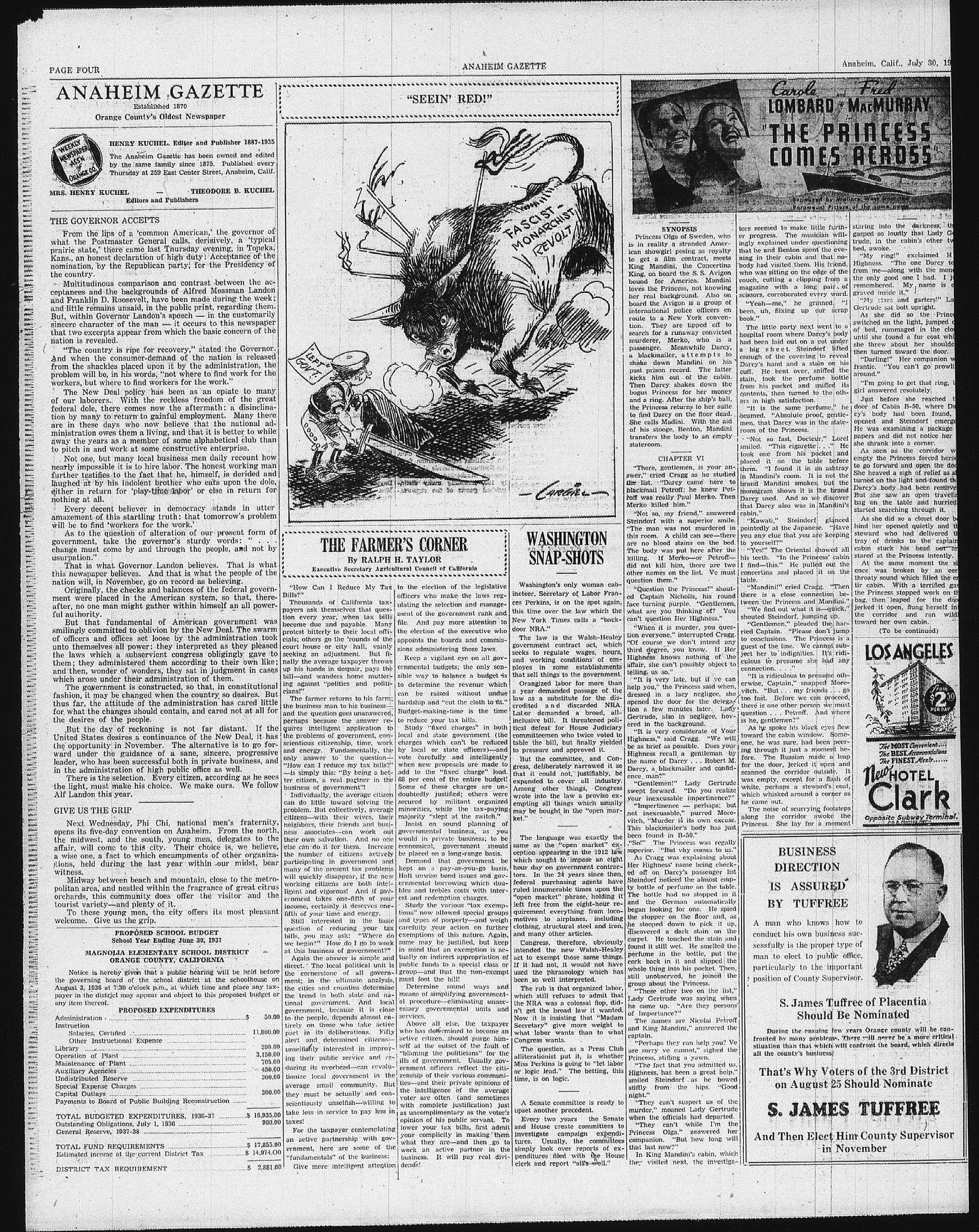
"SEEIN' RED!"
FASCIST - MONARCHIST REVOLT
LEFT GOV'T
SYNOPSIS
Princess Olga of Siena is in reality a straitcan showgirl posing to get a film con King Mandini, the King, on board the bound for America loves the Princess, her real background board the Avigon is international police route to a New Ytion. They are tire search for a runaway murderer, Merko, passenger. Meanwhile a blackmailer, a shake down Man past prison record. Kicks him out of Then Darcy shakes bogus Princess for and a ring. After the Princess returns to find Darcy on the She calls Madini. Of his stooge, Bent transfers the body stateroom.
CHAPTER
THE FARMER'S CORNER
By RALPH H. TAYLOR
Executive Secretary Agricultural Council of California
"How Can I Reduce My Tax bills?"
Thousands of California taxpayers ask themselves that question every year, when tax bills become due and payable. Many protest bitterly to their local officials; others go the 'rounds of the court house or city hall, vainly seeking an adjustment. But finally the average taxpayer throws up his hands in despair, pays the bill—and wanders home muttering against "politics and politicians!"
The farmer returns to his farm; the business man to his business—and the question goes unanswered, perhaps because the answer requires intelligent application to the problems of government, concientious citizenship, time, work and energy. Fundamentally, the only answer to the question—How can I reduce my tax bills?"—is simply this: "By being a better citizen, a real partner in the business of government!!"
Individually, the average citizen can do little toward solving the problem. But collectively, average citizens—with their wives, their neighbors, their friends and business associates—can work out their own salvation. And no one else can do it for them. Increase the number of citizens actively participating in government and many of the present tax problems to the election of the legislative officers who make the laws regulating the selection and management of the government rank and file. And pay more attention to the election of the executive who appoints the boards and commissions administering those laws.
Keep a vigilant eye on all governmental budgets; the only sensible way to balance a budget is to determine the revenue which can be raised without undue hardship and "cut the cloth to fit." Budget-making-time is the time to reduce your tax bills.
Study "fixed charges" in both local and state government (the charges which can't be reduced by local or state officers)—and vote carefully and intelligently when new proposals are made to add to the "fixed charge" load. 68 per cent of the entire budget! Some of these charges are undoubtedly justified; others were secured by militant organized minorities, while the tax-paying majority " slept at the switch."
Insist on sound planning of governmental business, as you would in private business; to be economical, government should be placed on a long-range basis.
Demand that government be kept on a pay-as-you-go basis.
WASHINGTON SNAP-SHOTS
Washington's only woman cabineter, Secretary of Labor Frances Perkins, is on the spot again, this time over the law which the New York Times calls a "backdoor NRA."
The law is the Walsh-Healey government contract act, which seeks to regulate wages, hours, and working conditions' of employees in some establishments that sell things to the government.
Orangized labor for more than a year demanded passage of the law as a substitute for the discredited and discarded NRA. Lalor demanded a broad, all-inclusive bill. It threatened political defeat for House Judiciary committeemen who twice voted to table the bill, but finally yielded to pressure and approved it.
But the committee, and Congress, deliberately narrowed it so that it could not, justifiably, be expanded to cover all industry. Among other things, Congress wrote into the law a proviso exempting all things which usually may be bought in the "open market."
The language was exactly the same as the "open market" exception appearing in the 1912 law which sought to impose an eight hour day on government contraction.
"There, gentlemen swer," cried Cragg and the list. "Darcy shakes bogus Princess for a ring. After that the Princess returns to find Darcy on the She calls Madini. Of his stooge, Bentt transfers the body stateroom.
CHAPTER II
"Not so, my friend Steindorf with a suitor. The man was not this room. A child does not have blood stains. The body was put down killing. If Merko did not kill him, other names on the question them."
"Question the Pride ed Captain Nicholls face turning purple. What are you thinking can't question Her Husband."
"When it is murdered help you," the Prince dressed in a lace opened the door for a few minutes Gertrude, also in revered in the backgroun.
"It is very late, I help you," the Prince dressed in a lace opened the door for a few minutes Gertrude, also in revered in the backgroun.
"It is very consider Highness," said Cragg be as brief as possible Highness recall a name of Darcy Darcy, a blackmailed ence man?"
"Gentlemen!" Law swept forward. "Do your inexcusable irritation? Impertinence — not inexcusable," pivitch, "Murder is it! This blackmailer's been found in B-500." "So!" The Princes superior. "But why As Cragg was expelled Her Highness' name..."
Individually, the average citizen can do little toward solving the problem. But collectively, average citizens—with their wives, their neighbors, their friends and business associates—can work out their own salvation. And no one else can do it for them. Increase the number of citizens actively participating in government and many of the present tax problems will quickly disappear, if the new working citizens are both intelligent and vigorous! And if government takes one-fifth of your income, certainly it deserves one-fifth of your time and energy.
Still interested in the basic question of reducing your tax bills, you may ask: "Where do we begin?" How do I go to work at this business of government? Again the answer is simple and direct. The local political unit is the cornerstone of all government; in the ultimate analysis, the cities and counties determine the trend in both state and national government. And local government, because it is close to the people, depends almost entirely on those who take active part in its deliberations. Fifty alert and determined citizens—unselfishly interested in improving their public service and reducing its overhead—can revolutionize local government in the average small community. But they must be actually and conscientiously unselfish—willing to take less in service to pay less in taxes!
For the taxpayer contemplating an active partnership with government, here are some of the "fundamentals" of the business:
Give more intelligent attention
Some of these charges are undoubtedly justified; others were secured by militant organized minorities, while the tax-paying majority "slept at the switch."
Insist on sound planning of governmental business, as you would in private business; to be economical, government should be placed on a long-range basis.
Demand that government be kept on a pay-as-you-go basis. Halt unwise bond issues and governmental borrowing which doubles and trebles costs with interest and redemption charges.
Study the various "tax exemptions" now allowed special groups and types of porperty—and weigh carefully your action on further exemptions of this nature. Again, some may be justified, but keep in mind that an exemption is actually on indirect appropriation of public funds to a special class or group—and that the non-exempt must foot the bill!
Determine sound ways and means of simplifying governmental procedure—eliminating unnecessary governmental units and services.
Above all else, the taxpayer who has determined to become an active citizen, should purge himself at the outset of the fault of "blaming the politicians" for the ills of government. Usually government officers reflect the citizenship of their various communities—and their private opinions of the intelligence of the average voter are often (and sometimes with complete justification) just as uncomplimentary as the voter's opinion of his public servant. To lower your tax bills, first admit your complicity in making them what they are—and then go to work an active partner in the business. It will pay real dividends!
The language was exactly the same as the "open market" exception appearing in the 1912 law which sought to impose an eight hour day on government contractors. In the 24 years since then, federal purchasing agents have ruled innumerable times upon the "open market" phrase, holding it left free from the eight-hour requirement everything from locomotives to airplanes, including clothing, structural steel and iron, and many other articles.
Congress, therefore, obviously intended the new Walsh-Healey act to exempt those same things. If it had not, it would not have used the phraseology which has been so well interpreted.
The rub is that organized labor, which still refuses to admit that the NRA was a colossal flop, didn't get the broad law it wanted. Now it is insisting that "Madam Secretary" give more weight to what labor wants than to what Congress wants.
The question, as a Press Club alliterationist put it, is whether Miss Perkins is going to "let labor or logic lead." The betting, this time, is on logic.
A Senate committee is ready to upset another precedent.
Every two years the Senate and House create committees to investigate campaign expenditures. Usually, the committees simply look over reports of expenditures filed with the House clerk and report "all's well."
The language was exactly the same as the "open market" exception appearing in the 1912 law which sought to impose an eight hour day on government contractors. In the 24 years since then, federal purchasing agents have ruled innumerable times upon the "open market" phrase, holding it left free from the eight-hour requirement everything from locomotives to airplanes, including clothing, structural steel and iron, and many other articles.
Congress, therefore, obviously intended the new Walsh-Healey act to exempt those same things. If it had not, it would not have used the phraseology which has been so well interpreted.
The rub is that organized labor, which still refuses to admit that the NRA was a colossal flop, didn't get the broad law it wanted. Now it is insisting that "Madam Secretary" give more weight to what labor wants than to what Congress wants.
The question, as a Press Club alliterationist put it, is whether Miss Perkins is going to "let labor or logic lead." The betting, this time, is on logic.
A Senate committee is ready to upset another precedent.
Every two years the Senate and House create committees to investigate campaign expenditures. Usually, the committees simply look over reports of expenditures filed with the House clerk and report "all's well."
Gentlemen!" Law swept forward. "Do your inexcusable in 'Impertinence' — not inexcusable," vipitch. "Murder is it! This blackmailer's been found in B-500," So!" The Princess superior. "But why? As Cragg was expelled off Darcy's Steindorf noticed that bottle of perfume The bottle had no oil and the German began looking for oil he stopped down to discovered a dark carpet. He touched found it still wet. He perfume in the booth cork back in it and whole thing into his still unobserved, hick group about the Prince "These other two Lady Gertrude was he came up." "Are of Importance?" The names are Nand King Mandini," captain.
"Perhaps they can are sorry ve cannot Princess, stifling a yacht The fact that your Highness, has been smiled Steindorf a stiffly from the night." "They can't suspense murder," moaned I when the officials lined up "They can't whip Princess Olga," a companion. "But I that last now?" In King Mandini" they visited next."
SYNOPSIS
Princess Olga of Sweden, who is in reality a stranded American showgirl posing as royalty to get a film contract, meets King Mandini, the Concertina King, on board the S.S. Avigon bound for America. Mandini loves the Princess, not knowing her real background. Also on board the Avigon is a group of international police officers en route to a New York convention. They are tipped off to search for a runaway convicted murderer, Merko, who is a passenger. Meanwhile Darcy, a blackmailer, attempts to shake down Mandini on his past prison record. The latter kicks him out of the cabin. Then Darcy shakes down the bogus Princess for her money and a ring. After the ship's ball, the Princess returns to her suite to find Darcy on the floor dead. She calls Madini. With the aid of his stooge, Benton, Mandini transfers the body to an empty stateroom.
tors seemed to make little further progress. The musician willingly explained under questioning that he and Benton spent the evening in their cabin and that nobody had visited them. His friend, who was sitting on the edge of the couch, cutting a clipping from a magazine with a long pair of scissors, corroborated every word.
"Yeah—me," he grinned. "I been, uh, fixing up our scrap book."
The little party next went to a hospital room where Darcy's body had been laid out on a cot under a big sheet. Steindorf lifted enough of the covering to reveal Darcy's hand and a stain on his cuff. He bent over, sniffed the stain, took the perfume bottle from his pocket and sniffed its contents; then turned to the others in high satisfaction.
"It is the same perfume," he beamed. "Absolute proof, gentlemen, that Darcy was in the stateroom of the Princess."
"Not so fast, Docteur," Lorel smiled. "This cigarette... He took one from his pocket and staring into the darkness, the gasped so loudly that Lady Gortrude, in the cabin's other two bed, awoke.
"My ring!" exclaimed Highness. "The one Darcy to from me—along with the monkey the only good one I had. I remembered. My name is Graved inside it."
"My stars and garters!" La Gertrude sat bolt upright.
As she did so the Prince switched on the light, jumped o'f bed, rummaged in the closet until she found a fur coat whi she threw about her shoulder then turned toward the door.
"Darling!" Her companion w frantic. "You can't go prowl around."
"I'm going to get that ring, girl answered resolutely.
Just before she reached the door of Cabin B-50, where Darcy's body had been found, opened and Steindorf emerged. He was examining a package papers and did not notice her she shrank into a corner.
As soon as the corridor w empty the Princess forced her
CHAPTER VI
“There, gentlemen, is your answer,” cried Cragg as he studied the list. “Darcy came here to blackmail Petroff; he knew Petroff was really Paul Merko. Then Merko killed him.”
“Not so, my friend,” answered Steindorf with a superior smile. “The man was not murdered in this room. A child can see—there are no blood stains on the bed. The body was put here after the killing. If Merko—or Petroff—did not kill him, there are two other names on the list. Ve must question them.”
“Question the Princess!” shouted Captain Nicholls, his round face turning purple. “Gentlemen, what are you thinking of? You can't question Her Highness.”
“When it is murder, you question everyone,” interrupted Cragg. “Of course we don't intend any third degree, you know. If Her Highness knows nothing of the affair, she can't possibly object to telling us so.”
“It is very late, but if we can help you,” the Princess said when dressed in a lace negligee, she opened the door for the delegation a few minutes later. Lady Gertrude, also in negligee, hovered in the background.
“It is very considerate of Your Highness,” said Cragg. “We will be as brief as possible. Does your Highness recall a gentleman by the name of Darcy ... Robert M. Darcy, a blackmailer and confidence man?”
“Gentlemen!” Lady Gertrude swept forward. “Do you realize your inexcusable impertinence?”
“Impertinence — perhaps; but not inexcusable,” purred Morevitch. “Murder is its own excuse. This blackmailer's body has just been found in B-50.”
“So!” The Princess was regally superior. “But why comes to us.”
As Cragg was explaining about Her Highness’ name being check-drawn down Mandini on his past prison record. The latter kicks him out of the cabin. Then Darcy shakes down the bogus Princess for her money and a ring. After the ship's ball, the Princess returns to her suite to find Darcy on the floor dead. She calls Madini. With the aid of his stooge, Benton, Mandini transfers the body to an empty stateroom.
Darcy's hand and a stain on his euff. He bent over, sniffed the stain, took the perfume bottle from his pocket and sniffed its contents, then turned to the others in high satisfaction.
"It is the same perfume," he beamed. "Absolute proof, gentlemen, that Darcy was in the state-of-the-Princess."
"Not so fast, Docteur," Lorel smiled. "This cigarette...." He took one from his pocket and placed it on the table before them. "I found it in an ashtray in Mandini's room. It is not the brand Mandini smokes, but the monogram shows it is the brand Darcy used. And so we discover that Darcy also was in Mandini's cabin."
“Kawati,” Steindorf glanced pointedly at the Japanese. “Have you any clue that you are keeping to yourself?”
"Yes!" The Oriental showed all his teeth. "In the Princess' cabin I find—this." He pulled out the concertina and placed it on the table.
“Mandini!” cried Cragg. “Then there is a close connection between the Princess and Mandini.”
"We find out what it is—quick," shouted Steindorf, jumping up.
“Gentlemen,” pleaded the harried Captain. “Please don't jump to conclusions. The Princess is a guest of the line. We cannot subject her to indignities. It's ridiculous to presume she had any connection...”
"It is ridiculous to presume otherwise, Captain," snapped Morevitch. "But... my friends... go too fast. Before we can proceed, there is one other person we must question... Petroff. And where is he, gentlemen?" As he spoke his black eyes flew toward the cabin window. Someone, he was sure, had been peering through it just a moment before. The Russian made a leap for the door, jerked it open and scanned the corridor outside. It was empty, except for a flash of white, perhaps a steward's coat, which whisked around a corner as he came out.
The noise of scurrying footsteps along the corridor awoke the Princess. She lay for a moment frantic. "You can't go prowl around."
"I'm going to get that ring, the girl answered resolutely.
Just before she reached the door of Cabin B-50, where Darcy's body had been found, opened and Steindorf emerged. He was examining a package of papers and did not notice her she shrank into a corner.
As soon as the corridor was empty the Princess forced herself to go forward and open the door. She heaved a sigh of relief as she turned on the light and found the Darcy's body had been removed. But she saw an open travelin bag on the table and hurried started searching through it.
As she did so a closet door behind her opened quietly and the steward who had delivered the tray of drinks to the captain cabin stuck his head out and stared at the Princess intently.
At the same moment the silence was broken by an ear-throaty sound which filled the entire cabin. With a terrified gas the Princess stopped work on the bag, then leaped for the door jerked it open, flung herself in the corridor and ran wild toward her own cabin.
(To be continued)
Gentlemen! Lady Gertrude swept forward. "Do you realize your inexcusable impertinence?"
"Imperinence — perhaps; but not inexcusable," purred Morevitch. "Murder is its own excuse. This blackmailer's body has just been found in B-50."
"So!" The Princess was regally superior. "But why comes to us."
As Cragg was explaining about Her Highness' name being checked off on Darcy's passenger list Steindorf noticed the almost empty bottle of perfume on the table. The bottle had no stopped in it and the German automatically began looking for one. He spied the stopper on the floor and, as he stooped down to pick it up, discovered a dark stain on the carpet. He touched the stain and found it still wet. He smelled the perfume in the bottle, put the cork back in it and slipped the whole thing into his pocket. Then, still unobserved, he joined the group about the Princess.
"These other two on the list," Lady Gertrude was saying when he came up. "Are they persons of Importance?"
The names are Nicolai Petroff and King Mandini," answered the captain.
"Perhaps they can help you? We are sorry we cannot," sighed the Princess, stifling a yawn.
"The fact that you admitted us, Highness, has been a great help," smiled Steindorf as he bowed stiffly from the hips. "Good night."
"They can't suspect us of the murder," moaned Lady Gertrude when the officials had departed.
"They can't while I'm the Princess Olga," answered her companion. "But how long will that last now?"
In King Mandini's cabin, which they visited next, the investiga-
BUSINESS DIRECTION IS ASSURED BY TUFFREE
A man who knows how to conduct his own business successfully is the proper type of man to elect to public office, particularly to the important position of County Supervisor.
S. James Tuffree of Placentia Should Be Nominated
During the ensuing few years Orange county will be confronted by many problems. There will never be a more critical situation than that which will confront the board, which directs all the county's business.
That’s Why Voters of the 3rd District on August 25 Should Nominate
S. JAMES TUFFREE
And Then Elect Him County Supervisor in November