anaheim-gazette 1936-07-09
Scanned page
Searchable text
ANAHEIM GAZETTE
Established 1870
Orange County's Oldest Newspaper
HENRY KUCHEL, Editor and Publisher 1887-1935
The Anaheim Gazette has been owned and edited by the same family since 1875. Published every Thursday at 259 East Center Street, Anaheim, Calif.
MRS. HENRY KUCHEL — THEODORE B. KUCHEL
Editors and Publishers
HOW MUCH CONCENTRATION
Up to and including the campaign of 1932, the Republican party preached and practiced a philosophy of a strong central government, but not of an all-powerful one. Contrariwise, the adherents of Jeffersonian democracy advocated the principle of strong state control, of limitation upon the federal government, so that no undue encroachment upon the rights of the several states might develop.
It is somewhat of an amazing thing to him who studies the history of partisan faiths in this country to find that those who were elected to power four years ago have, with complete abandon, departed from the original and basic tenets of their party. The cry of "states' rights," reminiscent of yesterday democrats, is replaced today by one of "complete concentration of power" in Washington by the New Dealers.
The election this year presents the citizen with an overwhelmingly important problem to be met, and decision to be made. Either the federal government will all but replace state sovereignty in America; or else the right of local, i.e., state, government will remain a reality under the traditional American system of government.
It should be conceded by all that the best interests of the nation demand universal regulation and control, under a national government, of nationwide problems. Thus, the Constitution provides that the congress shall regulate inter-state commerce, determine our monetary system, control our waterways, and the like.
But it cannot, upon the other hand, be denied that much of the necessary governmental regulation to take place in this country in the future is, and will be, local in nature; and that,
state sovereignty in America; or else the right of local, i.e., state, government will remain a reality under the traditional American system of government.
It should be conceded by all that the best interests of the nation demand universal regulation and control, under a national government, of nationwide problems. Thus, the Constitution provides that the congress shall regulate inter-state commerce, determine our monetary system, control our waterways, and the like.
But it cannot, upon the other hand, be denied that much of the necessary governmental regulation to take place in this country in the future is, and will be, local in nature; and that, for the best interests of the people local governments should have the right and the duty to care for local problems.
The New Deal has sought to shame the idea that local government should have any power. Concentration of power has been its theme. And, many times in the last session of the congress, democratic senators and representatives declined to follow the path, sought to be blazed by the executive department of the country, which would lead—in the words of one United States Senator—to "government by executive decree."
If we are to remain a republic, the doctrine of states' rights must not be allowed to die. And it is rather paradoxical that the Republican party, having seen its theory of a strong central government accepted by the people, now—itself—must be the agency through which the people may prevent that principle from being carried too far.
A WOLF IN SHEEP'S CLOTHING
One of the most serious decisions California has been called upon to make is repeal of the Sales Tax and substitution of the Single Tax. This amendment faces us on our ballot of November 3rd and it is not at all too soon to be thinking about making a decision. Passage of the 'Single Tax' amendment would be real calamity to every citizen of the State, whether he makes his living by the use of his brains or the sweat of his brow.
This amendment would place the bulk of the tax burden on land. The rancher unable to regulate the price of his produce would be ruined by it. The store owner forced to pay two and three times his normal rent would be forced out of business. Landlords would be compelled to raise their rentals several times the present level or go bankrupt. The owner of a small home, paid for or not, would lose either his home or his equity. The man owning no property would pay more than his share as the great advance in rents and life's essential commodities would increase his living costs to a prohibitive degree.
Government's, by and for mirror the lives of their people reflecting their personal life their standards, their characteristics!
The individual, looking back in his mirror for reassurance may be tempted to challenge accuracy of that statement fundamentally—as regards majority of the citizenry—it remains true today as it was during time of the Roman Empire.
Government and the ramifications of its citizens in the United States, for example, discard installment-plan buying simultaneously. And the payment cycle, which began automobiles, radios and refrigerators, extended into environmental projects which brought the bonded debt nation to an appalling total.
Looking at the situation worst—as the individual moves when the first of the month around—the United States government owes approximately thirty billions of dollars. Must be added another billion of debt piled up by and other local governments a grand total of more than billion dollars!
And the penalties of whether the government individual multiply pyra and then multiply and pay again. Back in 1910, for interest and redemptionments on California's public (State and local) amount $5,200,000 annually. By 1918 annual payments for interest redemption had mounted to $00,000. Today they total $75,000,000 annually!
Not far away
THE FAMILY at seaside or mountain resort or touring the highways and byways of Vacationland can reach those at home so easily—why not arrange a definite "telephone hour"? You’ll find “Long Distance” operators particularly helpful.
Just Call
BUSINESS OFFICE
217 N. LEMON ST., ANAHEIM
SOUTHERN CALIFORNIA TELEPHONE COMPANY
Anaheim 2101
ANAHEIM GAZETTE
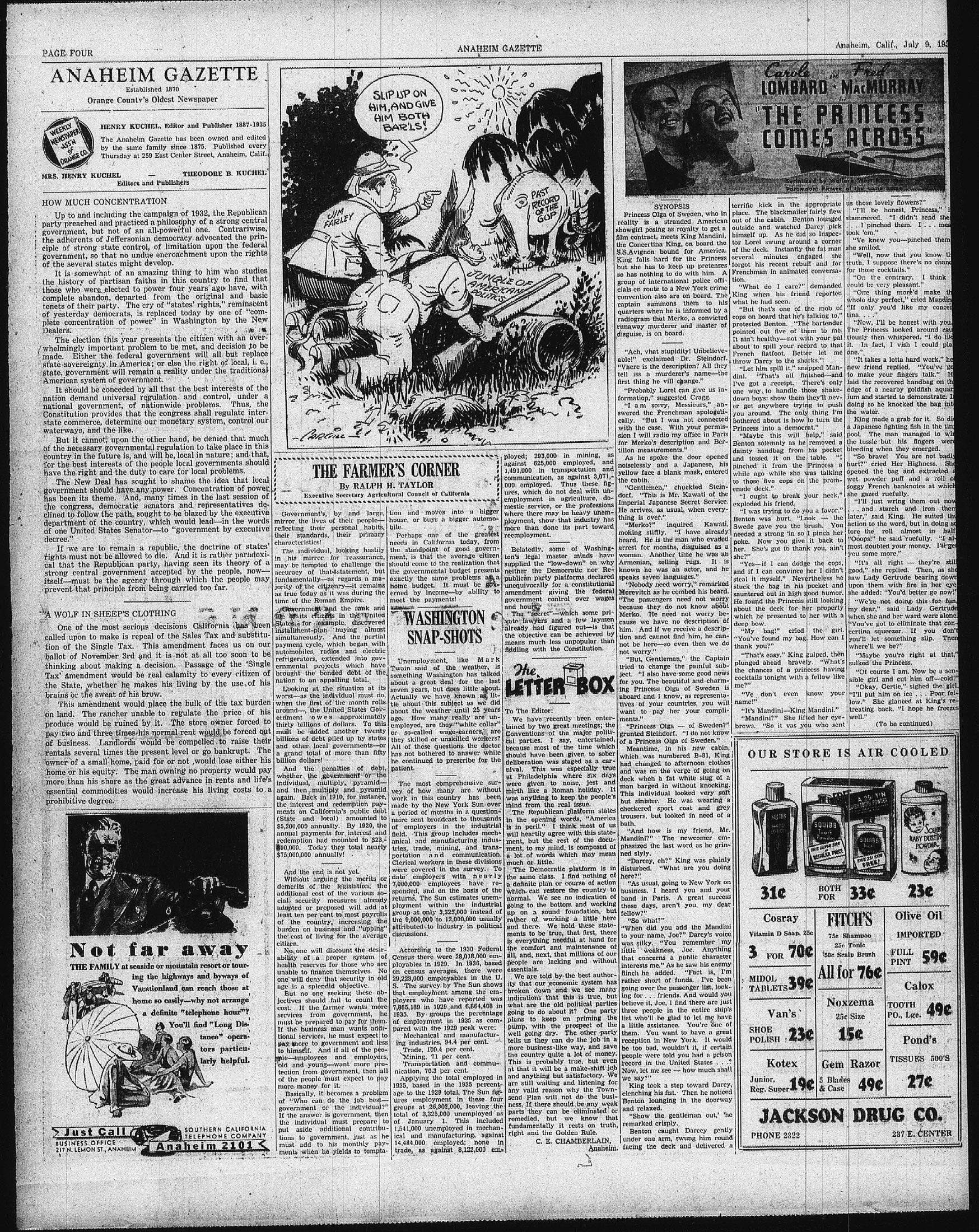
SLIP UP ON HIM, AND GIVE HIM BOTH BAR'LS!
PAST RECORD OF THE GOP
JIM FARLEY
DUNGLE OF AMERICAN POLITICS
SYNOPSIS
Princess Olga of Sweden reality is a stranded showgirl posing as royal film contract, meets King the Concertina King, on S.S.Avignon bound for King falls hard for the but she has to keep up so has nothing to do with group of international clans en route to a New convention also are on captain summons the quarters when he is infiltrated radiogram that Merko, runaway murderer and disguise, is on board.
"Ach, what stupidity! able!" exclaimed Dr.
"Where is the description tell iss a murderer's first thing he vill change."
"Probably Lorel can formation," suggested O.
"I am sorry, Messi swerved the Frenchman cally. 'But I was not with the case. With you sion I will radio my off for Merko's description tillon measurements."
As he spoke the de
THE FARMER'S CORNER
By RALPH H. TAYLOR
Executive Secretary Agricultural Council of California
Government's, by and large, for the lives of their people—acting their personal habits, or standards, their primary characteristics!
The individual, looking hastily this mirror for reassurance, may be tempted to challenge the accuracy of that statement, but fundamentally—as regards a majority of the citizenry—it remains true today as it was during the time of the Roman Empire.
Government and the rank and file of its citizens in the United States, for example, discovered a millage-plan buying almost simultaneously. And the partial payment cycle, which began with automobiles, radios and electric generators, extended into governmental projects which have taught the bonded debt of the nation to an appalling total.
Looking at the situation at its best—as the individual must do, when the first of the month rolls and—the United States Government owes approximately fifty billions of dollars. To this it be added another twenty亿 of debt piled up by states other local governments—and grand total of more than fifty billion dollars!
And the penalties of debt, either the government or the individual, multiply, pyramid—then multiply and pyramid in. Back in 1910, for instance, interest and redemption payments on California's public debt rate and state) amounted to 200,000 annually. By 1920, the usual payments for interest and emplosion had mounted to $23,000. Today they total nearly 200,000 annually!
Unemployment, like Mark Twain said of the weather, is something Washington has talked about a great deal for the last seven years, but does little about. Actually we have known as little about this subject as we did about the weather until 25 years ago. How many really are unemployed, are they "white collar" or so-called wage-earners, are they skilled or unskilled workers? All of these questions the doctor has not bothered to answer while he continued to prescribe for the patient.
The most comprehensive survey of how many are without work in this country has been made by the New York Sun over a period of months in a questionnaire sent broadcast to thousands of employers in the industrial field. This group includes mechanical and manufacturing industries, trade, mining, and transportation and communication. Clerical workers in these divisions were covered in the survey. To employed; 293,000 in mining, as against 625,000 employed, and 1,491,000 in transportation and communication, as against 3,071,-000 employed. Thus these figures, which do not deal with unemployment in agriculture, domestic service, or the professions where there may be heavy unemployment, show that industry has more than done its part toward reemployment.
Belatedly, some of Washington's legal master minds have supplied the "low-down" on why neither the Democratic nor Republican party platforms declared unequivocally for a constitutional amendment giving the federal government control over wages and hours.
The "secret"—which some private lawyers and a few laymen already had figured out—is that the objective can be achieved by means much less unpopular than fiddling with the Constitution.
The Letter Box
To The Editor:
We have recently been entertained by two great meetings; the Conventions of the major political parties. I say, entertained, because most of the time which should have been given to sober deliberation was staged as a carnival. This was especially true at Philadelphia where six days were given to noise, jest and mirth like a Roman holiday. It was anything to keep the people's mind from the real issue.
The Republican platform states in the opening words, "America is peril." I think most of us will heartily agree with this statement, but the rest of the document, to my mind, is composed of a lot of words which may mean much or little.
The Democratic platform is in "Where is the description tell us a murderer's first thing he vill change."
"Probably Lorel can form information," suggested O'Mearn.
"I am sorry, Messie swered the Frenchman cally." But I was not with the case. With youSION I will radio my office for Merko's description tillon measurements."
As he spoke the day noiselessly and a Japanese Secreta He arrives, as usual, what thing is over."
Merko? inquired moking stiffly. "I hau heard. He is the man arrested for months, disg woman. Another time Armenian, selling ru known he was an act speaks seven languages."
Nobody need worry. Morevitch as he combed "The passengers need because they do not lie Merko. He need not cause we have no decem. And if we receive tion and cannot find him not here—so even not worry."
But, Gentlemen," tried to change the project. "I also have some for you. The beautiful ling Princess Olga of aboard and I know, as tives of your countrie want to pay her yoments."
"Princess Olga — o grunted Steindorf." "I o of a Princess Olga of S Meantime, in his which was numbered had changed to afterr and was on the verge deck when a fat whit man barged in without This individual looked but sinister. He was checkered sport coat trousers, but looked in bath.
"And how is my Mandini?" The new phasized the last word ned slyly.
"Darcey, eh?" King disturbed. "What are..."
Without arguing the merits or merits of the legislation, the additional cost of the various social security measures already adopted or proposed will add at least ten per cent to most payrolls in the country, increasing the burden on business and "upping" the cost of living for the average citizen.
No one will discount the desirability of a proper system of health reserves for those who are able to finance themselves. No one will deny that security in old age is a splendid objective.
But no one seeking these objectives should fail to count the cost. If the farmer wants more services from government, he must be prepared to pay for them. The business man wants additional services, he must expect to be more to government and less himself. And if all of the people—employees and employers, and young—want more provision from government, then all the people must expect to pay more money for it.
Basically, it becomes a problem "Who can do the job best—government or the individual?" The answer is government, then the individual must prepare to assist additional contributions to government, just as he must add to his monthly payments when he yields to temptation.
The most comprehensive survey of how many are without work in this country has been made by the New York Sun over a period of months in a questionnaire sent broadcast to thousands of employers in the industrial field. This group includes mechanical and manufacturing industries, trade, mining, and transportation and communication. Clerical workers in these divisions were covered in the survey. To date, employers with nearly 7,000,000 employees have responded, and on the basis of the returns, The Sun estimates unemployment within the industrial group at only 3,325,000 instead of the 9,000,000 to 12,000,000 usually attributed to industry in political discussions.
According to the 1930 Federal Census there were 28,018,000 employables in 1929. In 1936, based on census averages, there were 29,223,000 employables in the U.S. The survey by The Sun shows that employment among the employers who have reported was 7,865,189 in 1929 and 6,864,408 in 1935. By groups the percentage of employment in 1935 as compared with the 1929 peak were:
Mechanical and manufacturing industries, 94.4 per cent.
Trade, 109.4 per cent.
Mining, 71 per cent.
Transportation and communication, 70.3 per cent.
Applying the total employed in 1935, based in the 1935 percentage to the 1929 total, The Sun figures employment in these four groups at 26,302,000, leaving the total of 3,325,000 unemployed as of January 1. This included 1,541,000 unemployed in mechanical and manufacturing, against 14,484,000 employed; none in trade, as against 8,122,000 em-
at Philadelphia where six days were given to noise, jest and mirth like a Roman holiday. It was anything to keep the people's mind from the real issue.
The Republican platform states in the opening words, "America is in peril." I think most of us will heartily agree with this statement, but the rest of the document, to my mind, is composed of a lot of words which may mean much or little.
The Democratic platform is in the same class. I find nothing of a definite plan or course of action which can restore the country to normal. We see no indication of going to the bottom and working up on a sound foundation, but rather of working a little here and there. We hold these statements to be true, that first, there is everything needful at hand for the comfort and maintenance of all, and next, that millions of our people are lacking and without essentials.
We are told by the best authority that our economic system has broken down and we see many indications that this is true, but what are the old political parties going to do about it? One party plans to keep on priming the pump, with the prospect of the well going dry. The other party tells us they can do the job in a more business-like way, and save the country quite a lot of money. This is probably true, but even at that it will be a make-shift job and anything but satisfactory. We are still waiting and listening for any valid reason why the Townsend Plan will not do the business. If there should be any weak parts they can be eliminated or remedied, but we know that fundamentally it rests on truth, right and the Golden Rule.
C. E. CHAMBERLAIN
Anaheim.
SYNOPSIS
Princess Olga of Sweden, who in reality is a stranded American showgirl posing as royalty to get a film contract, meets King Mandini, the Concertina King, on board the S.S.Avignon bound for America. King falls hard for the Princess but she has to keep up pretenses so has nothing to do with him. A group of international police officials en route to a New York crime convention also are on board. The captain summons them to his quarters when he is informed by a radiogram that Merko, a convicted runaway murderer and master of disguise, is on board.
"Ach, what stupidity! Unbelievable!" exclaimed Dr. Steindorf. "Where is the description? All they tell iss a murderer's name—the first thing he vill change."
"Probably Lorel can give us information," suggested Cragg.
"I am sorry, Messieurs," answered the Frenchman apologetically. "But I was not connected with the case. With your permission I will radio my office in Paris for Merko's description and Bertillon measurements."
As he spoke the door opened terrific kick in the appropriate place. The blackmailer fairly flew out of the cabin. Benton lounged outside and watched Darcy pick himself up. As he did so Inspector Lorel swung around a corner of the deck. Instantly the fat man several minutes engaged the forgot his recent rebuff and for Frenchman in animated conversation.
"What do I care?" demanded King when his friend reported what he had seen.
"But that's one of the mob of cops on board that he's talking to," protested Benton. "The bartender pointed out five of them to me. It ain't healthy—not with your pal about to spill your record to that French flatfoot. Better let me throw Darcy to the sharks."
"Let him spill it," snapped Mandini. "That's all finished—and I've got a receipt. There's only one way to handle those shake-down boys: show them they'll never get anywhere trying to push you around. The only thing I'm bothered about is how to turn the Princess into a democrat."
"Maybe this will help," said Benton solemnly as he removed a dainty handbag from his pocket and tossed it on the table.
us those lovely flowers?"
"I'll be honest, Princess," he stammered. "I didn't send them... I pinched them. I . . . meant took 'em."
"Ve knew you—pinched them she smiled."
"Well, now that you know the truth, I suppose there's no chance for those cocktails."
"On the contrary. I think would be very pleasant."
"One thing more'd make the whole day perfect," cried Mandini. "If only you'd like my concern tina...."
"Now, I'll be honest with you. The Princess looked around cautiously then whispered. 'I do like it. In fact, I wish I could play one.'"
"It takes a lotta hard work," he new friend replied. "You've go to make your fingers talk." He laid the recovered handbag on the edge of a nearby goldfish aquarium and started to demonstrate. I doing so he knocked the bag into the water.
King made a grab for it. So did a Japanese fighting fish in the tiny pool. The man managed to win the tussle but his fingers were bleeding when they emerged.
"So brave! You are not badly..."
"Where is the description? All they tell iss a murderer’s name—the first thing he vill change."
"Probably Lorel can give us information," suggested Cragg.
"I am sorry, Messieurs," answered the Frenchman apologetically. "But I was not connected with the case. With your permission I will radio my office in Paris for Merko's description and Bertillon measurements."
As he spoke the door opened noiselessly and a Japanese, his yellow face a blank mask, entered the cabin.
"Gentlemen," chuckled Steindorf. "This is Mr. Kawati of the Imperial Japanese Secret Service. He arrives, as usual, when everything is over."
"Merko?" inquired Kawati, moking stiffly. "I have already heard. He is the man who evaded arrest for months, disguised as a woman. Another time he was an Armenian, selling rugs. It is known he was an actor, and he speaks seven languages."
"Nobody need worry," remarked Morevitch as he combed his beard. "The passengers need not worry because they do not know about Merko. He need not worry because we have no description of him. And if we receive a description and cannot find him, he cannot be here—so even then we do not worry."
"But, Gentlemen," the Captain tried to change the painful subject. "I also have some good news for you. The beautiful and charming Princess Olga of Sweden is aboard and I know, as representatives of your countries, you will want to pay her your compliments."
"Princess Olga — of Sweden?" grunted Steindorf. "I do not know of a Princess Olga of Sweden."
Meantime, in his new cabin, which was numbered B-81, King had changed to afternoon clothes and was on the verge of going on deck when a fat white slug of a man barged in without knocking. This individual looked very soft but sinister. He was wearing a checkered sport coat and grey trousers, but looked in need of a bath.
"And how is my friend, Mr. Mandini?" The newcomer emphasized the last word as he grinned slyly.
"Darcey, eh?" King was plainly disturbed. "What are you doing"
"Let him spill it," snapped Mandini. "That's all finished—and I've got a receipt. There's only one way to handle those shake-down boys: show them they'll never get anywhere trying to push you around. The only thing I'm bothered about is how to turn the Princess into a democrat."
"Maybe this will help," said Benton solemnly as he removed a dainty handbag from his pocket and tossed it on the table. "I pinched it from the Princess a while ago while she was talking to those five cops on the promenade deck."
"I ought to break your neck," exploded his friend.
"I was trying to do you a favor." Benton was hurt. "Look — the Swede gave you the brush. You needed a strong 'in so I pinch her poke. Now you give it back to her. She's got to thank you, ain't she?"
"Yes—if I can dodge the cops, and if I can convince her I didn't steal it myself." Nevertheless he stuck the bag in his pocket and sauntered out in high good humor. He found the Princess still looking about the deck for her property which he presented to her with a deep bow.
"My bag!" cried the girl. "You've found my bag. How can I thank you?"
"That’s easy." King gulped, then plunged ahead bravely. "What’s the chances of a princess having cocktails tonight with a fellow like me?"
"Ve don't even know your name!"
"It's Mandini—King Mandini."
Mandini?" She lifted her eyebrows. "So it vas you who sent new friend replied. "You've got to make your fingers talk." He laid the recovered handbag on the edge of a nearby goldfish aquarium and started to demonstrate. I doing so he knocked the bag into the water.
King made a grab for it. So did a Japanese fighting fish in the tiny pool. The man managed to win the tussle but his fingers were bleeding when they emerged.
"So brave! You are not badly hurt?" cried Her Highness. She opened the bag and extracted a wet powder puff and a roll of soggy French banknotes at which she gazed ruefully.
"I'll just wring them out now... and starch and iron them later," said King. He suited the action to the word, but in doing so store the roll almost in half.
"Ooops!" he said ruefully. "I almost doubled your money. I'll get you some more."
"It's all right — they're still good," she replied. Then, as she saw Lady Gertrude bearing down upon them with fire in her eye she added: "You'd better go now!
"We're not doing this for fun my dear," said Lady Gertrude when she and her ward were alone. "You've got to eliminate that concertina squeezer. If you don't you'll let something slip. Then where'll we be?"
"Maybe you're right at that," sulked the Princess.
"Of course I am. Now be a sensible girl and cut him off—cold!"
"Okay, Gertie," sighed the girl.
"I'll put him on ice . . . Poor fellow." She glanced at King's retreating back. "I hope he freezes well."
(To be continued)
deck when a fat white slug of a man barged in without knocking. This individual looked very soft but sinister. He was wearing a checkered sport coat and grey trousers, but looked in need of a bath.
"And how is my friend, Mr. Mandini?" The newcomer emphasized the last word as he grinned slyly.
"Darcey, eh?" King was plainly disturbed. "What are you doing here?"
"As usual, going to New York on business. I heard you and your band in Paris. A great success these days, aren't you, my dear fellow?"
"So what?"
"When did you add the Mandini to your name, Joe?" Darcey's voice was silky. "You remember my little weakness, Joe. Anything that concerns a public character interests me." As he saw his enemy flinch he added. "Fact is, I'm rather short of funds. I've been going over the passenger list, looking for... friends. And would you believe it, Joe, I find there are just three people in the entire ship's list who'll be glad to let me have a little assistance. You're one of them. You want to have a great reception in New York. It would be too bad, wouldn't it, if certain people were told you had a prison record in the United States... Now, let me see — how much shall we say?"
King took a step toward Darcey, elenching his fist. Then he noticed Benton lounging in the doorway and relaxed.
"Show the gentleman out," he remarked crisply.
Benton caught Darcey gently under one arm, swung him round facing the deck and delivered a