anaheim-gazette 1936-04-16
Scanned page
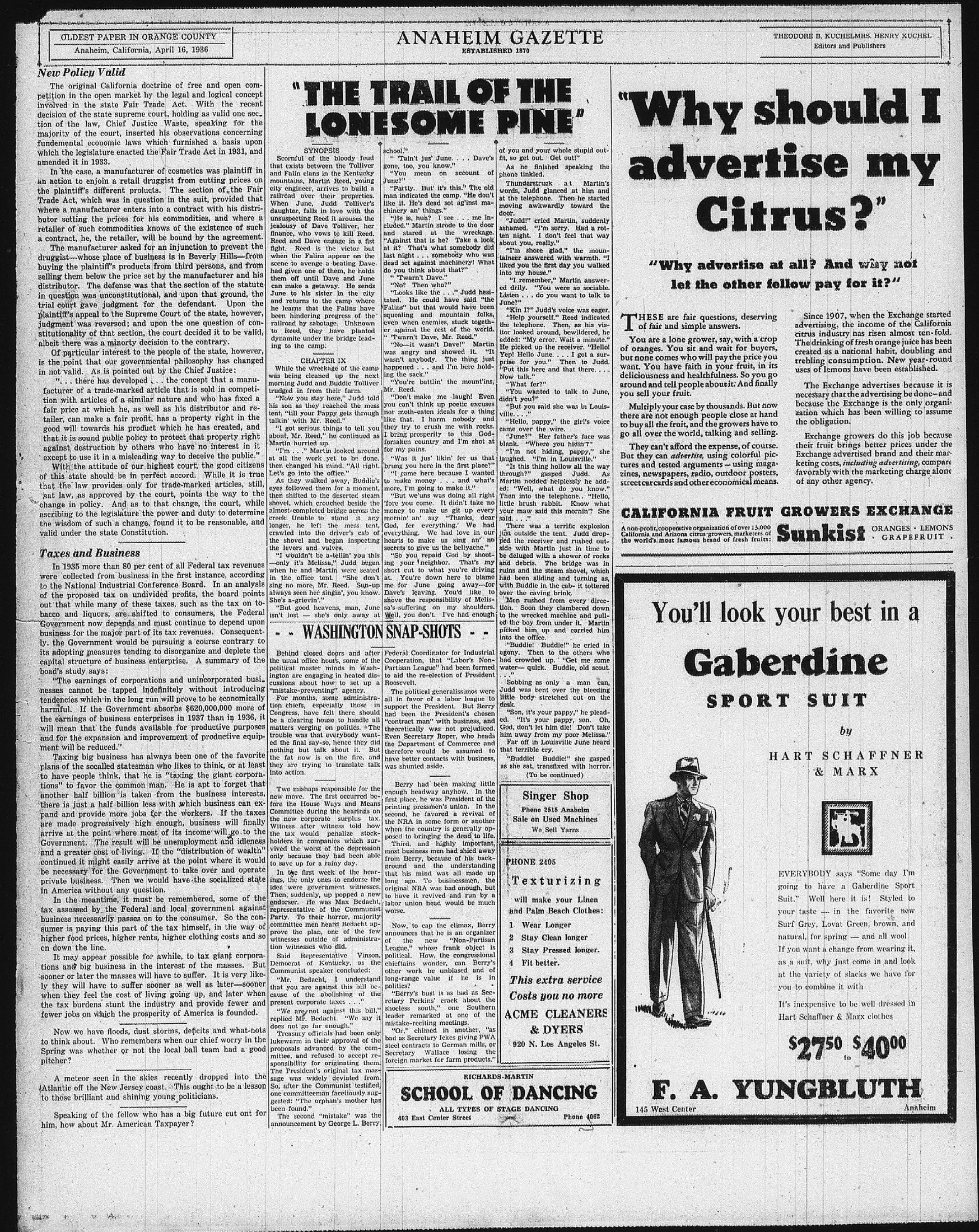
Searchable text
OLDEST PAPER IN ORANGE COUNTY
Anaheim, California, April 16, 1936
New Policy Valid
The original California doctrine of free and open competition in the open market by the legal and logical concept involved in the state Fair Trade Act. With the recent decision of the state supreme court, holding as valid one section of the law, Chief Justice Waste, speaking for the majority of the court, inserted his observations concerning fundamental economic laws which furnished a basis upon which the legislature enacted the Fair Trade Act in 1931, and amended it in 1933.
In the case, a manufacturer of cosmetics was plaintiff in an action to enjoin a retail druggist from cutting prices on the plaintiff’s different products. The section of the Fair Trade Act, which was in question in the suit, provided that where a manufacturer enters into a contract with his distributor setting the prices for his commodities, and where a retailer of such commodities knows of the existence of such a contract, he, the retailer, will be bound by the agreement.
The manufacturer asked for an injunction to prevent the druggist—whose place of business is in Beverly Hills—from buying the plaintiff’s products from third persons, and from selling them below the price set by the manufacturer and his distributor. The defense was that the section of the statute in question was unconstitutional, and upon that ground, the trial court gave judgment for the defendant. Upon the plaintiff’s appeal to the Supreme Court of the state, however, judgment was reversed; and upon the one question of constitutionality of that section, the court decided it to be valid, albeit there was a minority decision to the contrary.
Of particular interest to the people of the state, however, is the point that our governmental philosophy has changed in not valid. As is pointed out by the Chief Justice:
“... there has developed ... the concept that a manufacturer of a trade-marked article that is sold in competition with articles of a similar nature and who has fixed a fair price at which he, as well as his distributor and retailer, can make a fair profit, has a property right in the good will towards his product which he has created, and that it is sound public policy to protect that property right against destruction by others who have no interest in it except to use it in a misleading way to deceive the public.”
is the point that our governmental philosophy has changed in not valid. As is pointed out by the Chief Justice:
"... there has developed ... the concept that a manufacturer of a trade-marked article that is sold in competition with articles of a similar nature and who has fixed a fair price at which he, as well as his distributor and retailer, can make a fair profit, has a property right in the good will towards his product which he has created, and that it is sound public policy to protect that property right against destruction by others who have no interest in it except to use it in a misleading way to deceive the public."
With the attitude of our highest court, the good citizens of this state should be in perfect accord. While it is true that the law provides only for trade-marked articles, still, hat law, as approved by the court, points the way to the change in policy. And as to that change, the court, while ascribing to the legislature the power and duty to determine the wisdom of such a change, found it to be reasonable, and valid under the state Constitution.
Taxes and Business
In 1935 more than 80 per cent of all Federal tax revenues were collected from business in the first instance, according to the National Industrial Conference Board. In an analysis of the proposed tax on undivided profits, the board points out that while many of these taxes, such as the tax on tobacco and liquors, are shifted to consumers, the Federal Government now depends and must continue to depend upon business for the major part of its tax revenues. Consequently, the Government would be pursuing a course contrary to its adopting measures tending to disorganize and deplete the capital structure of business enterprise. A summary of the board's study says:
"The earnings of corporations and unincorporated businesses cannot be tapped indefinitely without introducing tendencies which in the long run will prove to be economically harmful. If the Government absorbs $620,000,000 more of the earnings of business enterprises in 1937 than in 1936, it will mean that the funds available for productive purposes and for the expansion and improvement of productive equipment will be reduced."
Taxing big business has always been one of the favorite plans of the so-called statesman who likes to think, or at least to have people think, that he is "taxing the giant corporations" to favor the common man. He is apt to forget that another half billion is taken from the business interests, there is just a half billion less with which business can expand and provide more jobs for the workers. If the taxes are made progressively high enough, business will finally arrive at the point where most of its income will go to the Government. The result will be unemployment and idleness and a greater cost of living. If the "distribution of wealth" continued it might easily arrive at the point where it would be necessary for the Government to take over and operate
While the wreckage of the city was being cleaned up the morning Judd and Buddie Toll trudged in from their farm.
"Now you stay here," Judd said his son as they reached the tent, "till your Pappy gets three talkin' with Mr. Reed."
"I got serious things to tell about, Mr. Reed," he continued Martin hurried up.
"I'm . . ." Martin looked around at all the work yet to be done then changed his mind. "All my Let's go into the office."
As they walked away, Budd eyes followed them for a moment then shifted to the deserted shovel, which crouched beside almost-completed bridge across creek. Unable to stand it longer, he left the mess crawled into the driver's car; the shovel and began inspecting the levers and valves.
"I wouldn't be a-tellin' you—only it's Melissa," Judd bade when he and Martin were seated in the office tent. "She singing no more, Mr. Reed. Sure always seen her singin', you knew She's a-grievin'."
"But good heavens, man, isn't lost — she's only awake"
- WASHINGTOWN -
Behind closed doors and in the usual office hours, some political master minds in Washington are engaging in heated cussions about how to set up "mistake-preventing" agency.
For months, some administration chiefs, especially those Congress, have felt there should be a clearing house to handle matters verging on politics. The trouble was that everybody wished the final say-so, hence they nothing but talk about it. The fat now is on the fire, they are trying to translate into action.
Two mishaps responsible for new move. The first occurred forethe House Ways and M Committee during the hearingthe new corporate surplusWitness after witness toldthe tax would penalize staffers in companies which vivied the worst of the depression only because they had been able to save up for a rainy day.
to have people think, that he is "taxing the giant corporations" to favor the common man. He is apt to forget that another half billion is taken from the business interests, there is just a half billion less with which business can expand and provide more jobs for the workers. If the taxes are made progressively high enough, business will finally arrive at the point where most of its income will go to the Government. The result will be unemployment and idleness and a greater cost of living. If the "distribution of wealth" continued it might easily arrive at the point where it would be necessary for the Government to take over and operate private business. Then we would have the socialized state in America without any question.
In the meantime, it must be remembered, some of the tax assessed by the Federal and local government against business necessarily passes on to the consumer. So the consumer is paying this part of the tax himself, in the way of higher food prices, higher rents, higher clothing costs and so on down the line.
It may appear possible for awhile, to tax giant corporations and big business in the interest of the masses. But sooner or later the masses will have to suffer. It is very likely they will have to suffer sooner as well as later—sooner when they feel the cost of living going up, and later when the tax burdens stunt the industry and provide fewer and fewer jobs on which the prosperity of America is founded.
Now we have floods, dust storms, deficits and what-nots to think about. Who remembers when our chief worry in the Spring was whether or not the local ball team had a good pitcher?
A meteor seen in the skies recently dropped into the Atlantic off the New Jersey coast. This ought to be a lesson to those brilliant and shining young politicians.
Speaking of the fellow who has a big future cut out for him, how about Mr. American Taxpayer?
"THE TRAIL OF THE LONESOME PINE"
SYNOPSIS
Fearful of the bloody feud exists between the Tolliver Falin clans in the Kentuckyains, Martin Reed, young engineer, arrives to build a road over their properties. June, Judd Tolliver's later, falls in love with the expecting Reed it arouses the usy of Dave Tolliver, her face, who vows to kill Reed, and Dave engage in a fist fight. Reed is the victor but the Falins appear on the road to avenge a beating Dave given one of them, he holds off until Dave and June make a getaway. He sends to his sister in the city returns to the camp where the Falins have hindered progress of the road by sabotage. Unknown Reed, they have planted snite under the bridge lead-wo the camp.
CHAPTER IX
The wreckage of the camp being cleaned up the next day Judd and Buddie Tolliver died in from their farm. Now you stay here," Judd told me as they reached the mess still your Pappy gets through "with Mr. Reed." Got serious things to tell you "Mr. Reed," he continued as in hurried up.
Martin looked around the work yet to be done.
school."
"'Tain't jus' June... Dave's gone, too, you know.'
"You mean on account of June?"
"Partly. But' it's this." The old man indicated the camp. "He don't like it. He's dead sot ag'inst machinery an' things."
"He is, huh? I see . . . me included." Martin strode to the door and stared at the wreckage. "Against that is he? Take a look at it? That's what somebody did last night . . . somebody who was dead set against machinery! What do you think about that?"
"Twarn't Dave."
"No? Then who?"
"Looks like the . . ." Judd hesitated. He could have said "the Falins" but that would have been squealing and mountain folks, even when enemies, stuck together against the rest of the world.
"Twarn't Dave, Mr. Reed."
"No—it wasn't Dave!" Martin was angry and showed it. "It wasn't anybody. The thing just happened . . . and I'm here holding the sack."
"You're battlin' the mount'ins, Mr. Reed."
"Don't make me laugh! Even you can't think up poetic excuses nor moth-eaten ideals for a thing like that. I harm nobody and they try to crush me with rocks. I bring prosperity to this God-forsaken country and I'm shot at for my pains."
"Was it ius' likin' fer us that of you and your whole stupid outfit, so get out. Get out!"
As he finished speaking the phone tinkled.
Thunderstruck at Martin's words, Judd glanced at him and at the telephone. Then he started moving awkwardly toward the door.
"Judd!" cried Martin, suddenly ashamed. "I'm sorry. Had a rotten night. I don't feel that way about you, really."
"I'm shore glad," the mountaineer answered with warmth. "I liked you the first day you walked into my house."
"I remember," Martin answered drily. "You were so sociable. Listen . . . do you want to talk to June?"
"Kin I?" Judd's voice was eager.
"Help yourself." Reed indicated the telephone. Then, as his visitor looked around, bewildered, he added: "My error. Wait a minute." He picked up the receiver. "Hello! Yep! Hello June.... I got a surprise for you." Then to Judd. "Put this here and that there.... Now talk."
"What fer?"
"You wanted to talk to June, didn't you?"
"But you said she was in Louisville...."
"Hello, pappy," the girl's voice came over the wire.
"June?" Her father's face was blank. "Where you hid'in'?"
"I'm not hiding, pappy," she laughed. "I'm in Louisville."
WHY
LET
THESE are fair of fair and simiYou are a lone g
of oranges. You si
but none comes wh
want. You have fa
deliciousness and h
around and tell peo
you sell your fruit.
Multiply your case there are not enough to buy all the fruit, a go all over the wor
They can't afford But they can adver
the wreckage of the camp being cleaned up the next day Judd and Buddie Tolliver died in from their farm.
Now you stay here," Judd told on as they reached the mess still your Pappy gets through with Mr. Reed."
got serious things to tell you Mr. Reed," he continued as on hurried up.
Martin looked around the work yet to be done. Changed his mind. "All right. Go into the office."
They walked away, Buddie's followed them for a moment, shifted to the deserted steam rail, which crouched beside the completed bridge across the Unable to stand it any longer, he left the mess tent, led into the driver's cab of the hotel and began inspecting servers and valves.
wouldn't be a-tellin' you this day it's Melissa," Judd began he and Martin were seated in the office tent. "She don't no more, Mr. Reed. Sun-up is seen her singin', you know a-grievin'."
At good heavens, man, June lost — she's only away at closed doors and after usual office hours, some of the local master minds in Washington are engaging in heated discussions about how to set up a make-preventing" agency.
months, some administra-chiefs, especially those in press, have felt there should clearing house to handle all wars verging on politics. The idea was that everybody want-the final say-so, hence they did not talk about it. But now is on the fire, and are trying to translate talk action.
to mishaps responsible for the move. The first occurred because the House Ways and Means Committee during the hearings on new corporate surplus tax, less after witness told how tax would penalize stock-ers in companies which sur-ried the worst of the depression because they had been able to pay up for a rainy day.
Federal Coordinator for Industrial Cooperation, that "Labor's Non-Partisan League" had been formed to aid the re-election of President Roosevelt.
The political generalissimos were all in favor of a labor league to support the President. But Berry had been the President's chosen "contract man" with business, and theoretically was not prejudiced. Even Secretary Roper, who heads the Department of Commerce and therefore would be assumed to have better contacts with business, was shunted aside.
Berry had been making little enough headway anyhow. In the first place, he was President of the printing pressmen's union. In the second, he favored a revival of the NRA in some form or another when the country is generally opposed to bringing the dead to life.
Third, and highly important, most business men had shied away from Berry, because of his background and the understanding
put this here and that there... Now talk."
What fer?"
You wanted to talk to June, didn't you?
But you said she was in Louisville..."
Hello, pappy," the girl's voice came over the wire.
June?" Her father's face was blank. "Where you hidin'?"
I'm not hiding, pappy," she laughed. "I'm in Louisville."
Is this thing hollow all the way through? gasped Judd. As Martin nodded helplessly he added: "Well, what do you know." Then into the telephone.. "Hello, little brush rabbit. Know what your maw said this mornin'? She said..."
There was a terrific explosion just outside the tent. Judd dropped the receiver and rushed outside with Martin just in time to be deluged with a shower of rocks and debris. The bridge was in ruins and the steam shovel, which had been sliding and turning as, with Buddie in the cab- it tottered over the caving brink.
Men rushed from every direction. Soon they clambered down to the wrecked machine and pulled the boy from under it. Martin picked him up and carried him into the office.
"Buddie! Buddie!" he cried in agony. Then to the others who had crowded up. "Get me some water—quick. Buddie, old scout..."
Sobbing as only a man can, Judd was bent over the bleeding little body stretched out on the desk.
"Son, it's your pappy," he pleaded. "It's your pappy, son. Oh, God, don't let him die! Don't take him away from my poor Melissa."
Far off in Louisville June heard that terrible cry.
"Buddie! Buddie!" she gasped as she sat, transfixed with horror.
(To be continued)
Singer Shop
Phone 2515 Anaheim
Sale on Used Machines
We Sell Yarns
PHONE 2405
Berry had been making little enough headway anyhow. In the first place, he was President of the printing pressmen's union. In the second, he favored a revival of the NRA in some form or another when the country is generally opposed to bringing the dead to life.
Third, and highly important, most business men had shied away from Berry, because of his background and the understanding that his mind was all made up long ago. To businessmen, the original NRA was bad enough, but to have it revived and run by a labor union head would be much worse.
Now, to cap the climax, Berry announces that he is an organizer of the new "Non-Partisan League," whose frank object is political. How, the congressional chieftains wonder, can Berry's other work be unbiased and of long-range value if he is in politics?
"Berry's bust is as bad as Secretary Perkins' crack about the shoeless south," one Southern leader remarked at one of the mistake-reciting meetings.
"Or," chimed in another, "as bad as Secretary Ickes giving PWA steel contracts to German mills, or Secretary Wallace losing the foreign market for farm products."
RICHARDS-MARTIN
SCHOOL OF DANCING
ALL TYPES OF STAGE DANCING
403 East Center Street
Phone 4062
"Why should I advertise my Citrus?"
"Why advertise at all? And why not let the other fellow pay for it?"
THESE are fair questions, deserving of fair and simple answers.
You are a lone grower, say, with a crop of oranges. You sit and wait for buyers, but none comes who will pay the price you want. You have faith in your fruit, in its deliciousness and healthfulness. So you go around and tell people about it: And finally you sell your fruit.
Multiply your case by thousands. But now there are not enough people close at hand to buy all the fruit, and the growers have to go all over the world, talking and selling.
They can't afford the expense, of course. But they can advertise, using colorful pic-
Since 1907, when the Exchange started advertising, the income of the California citrus industry has risen almost ten-fold. The drinking of fresh orange juice has been created as a national habit, doubling and trebling consumption. New year-round uses of lemons have been established.
The Exchange advertises because it is necessary that the advertising be done—and because the Exchange is the only organization which has been willing to assume the obligation.
Exchange growers do this job because their fruit brings better prices under the Exchange advertised brand and their mar-
want. You have faith in your fruit, in its deliciousness and healthfulness. So you go around and tell people about it: And finally you sell your fruit.
Multiply your case by thousands. But now there are not enough people close at hand to buy all the fruit, and the growers have to go all over the world, talking and selling.
They can't afford the expense, of course. But they can advertise, using colorful pictures and tested arguments — using magazines, newspapers, radio, outdoor posters, street car cards and other economical means.
CALIFORNIA FRUIT GROWERS EXCHANGE
A non-profit, cooperative organization of over 13,000 California and Arizona citrus growers, marketers of the world's most famous brand of fresh fruits:
Sunkist ORANGES • LEMONS • GRAPEFRUIT
You'll look your best in a Gaberdine SPORT SUIT
by
HART SCHAFFNER & MARX
EVERYBODY says "Some day I'm going to have a Gaberdine Sport Suit." Well here it is! Styled to your taste — in the favorite new Surf Grey, Lovat Green, brown, and natural, for spring — and all wool. If you want a change from wearing it, as a suit, why just come in and look at the variety of slacks we have for you to combine it with.
It's inexpensive to be well dressed in Hart Schaffner & Marx clothes
$2750 to $4000
F. A. YUNGBLUTH
145 West Center Anaheim