anaheim-gazette 1936-03-19
Scanned page
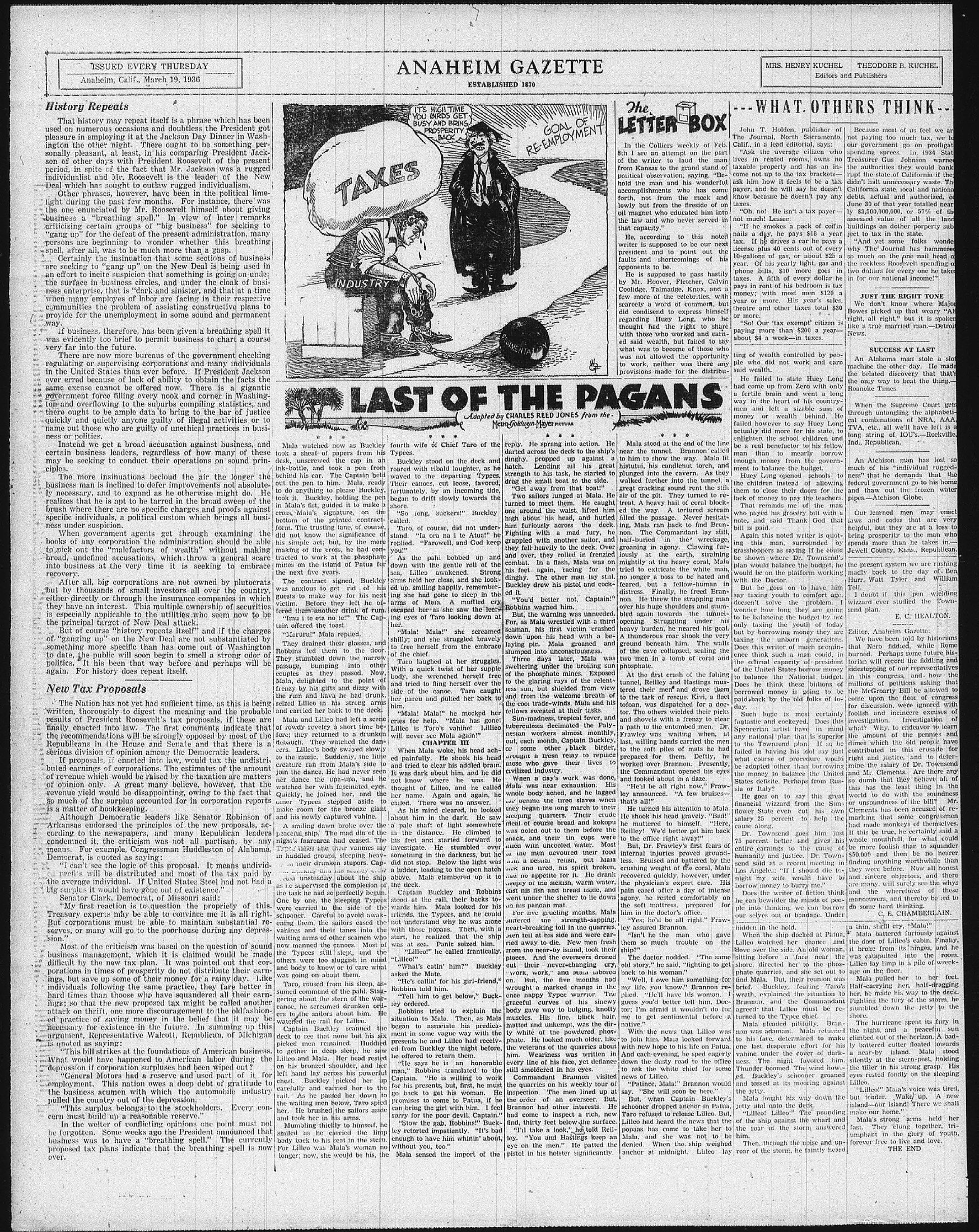
Searchable text
History Repeats
That history may repeat itself is a phrase which has been used on numerous occasions and doubtless the President got pleasure in employing it at the Jackson Day Dinner in Washington the other night. There ought to be something personally pleasant, at least, in his comparing President Jackson of other days with President Roosevelt of the present period, in spite of the fact that Mr. Jackson was a rugged individualist and Mr. Roosevelt is the leader of the New Deal which has sought to outlaw rugged individualism.
Other phrases, however, have been in the political limelight during the past few months. For instance, there was the one enunciated by Mr. Roosevelt himself about giving business a "breathing spell." In view of later remarks criticizing certain groups of "big business" for seeking to "gang up" for the defeat of the present administration, many persons are beginning to wonder whether this breathing spell, after all, was to be much more than a gasp.
Certainly the insinuation that some sections of business are seeking to "gang up" on the New Deal is being used in an effort to incite suspicion that something is going on under the surface in business circles, and under the cloak of business enterprise, that is "dark and sinister," and that at a time when many employees of labor are facing in their respective communities the problem of assisting constructive plans to provide for the unemployment in some sound and permanent way.
If business, therefore, has been given a breathing spell it was evidently too brief to permit business to chart a course very far into the future.
There are now more bureaus of the government checking regulating or supervising corporations and many individuals in the United States than ever before. If President Jackson ever erred because of lack of ability to obtain the facts the same excuse cannot be offered now. There is a gigantic government force filling every nook and corner in Washington and overflowing to the suburbs compiling statistics, and there ought to be ample data to bring to the bar of justice quickly and quietly anyone guilty of illegal activities or to name out those who are guilty of unethical practices in business or politics.
Instead we get a broad accusation against business, and certain business leaders, regardless of how many of these
regulating or supervising corporations and many individuals in the United States than ever before. If President Jackson ever erred because of lack of ability to obtain the facts the same excuse cannot be offered now. There is a gigantic government force filling every nook and corner in Washington and overflowing to the suburbs compiling statistics, and there ought to be ample data to bring to the bar of justice quickly and quietly anyone guilty of illegal activities or to name out those who are guilty of unethical practices in business or politics.
Instead we get a broad accusation against business, and certain business leaders, regardless of how many of these may be seeking to conduct their operations on sound principles.
The more insinuations becloud the air the longer the business man is inclined to defer improvements not absolutely necessary, and to expand as he otherwise might do. He realizes that he is apt to be tarred in the broad sweep of the brush where there are no specific charges and proofs against specific individuals, a political custom which brings all business under suspicion.
When government agents get through examining the books of any corporation the administration should be able to pick out the "malefactors of wealth" without making broad, undefined accusations, which throw a general scare into business at the very time it is seeking to embrace recovery.
After all, big corporations are not owned by plutocrats but by thousands of small investors all over the country, either directly or through the insurance companies in which they have an interest. This multiple ownership of securities is especially applicable to the utilities who seem now to be the principal target of New Deal attack.
But of course "history repeats itself" and if the charges of "ganging up" on the New Deal are not substantiated by something more specific than has come out of Washington to date, the public will soon begin to smell a strong odor of politics. It his been that way before and perhaps will be again. For history does repeat itself.
New Tax Proposals
The Nation has not yet had sufficient time, as this is being written, thoroughly to digest the meaning and the probable results of President Roosevelt's tax proposals, if these are finally enacted into law. The first comments indicate that the recommendations will be strongly opposed by most of the Republicans in the House and Senate and that there is a serious division of opinion among the Democratic leaders.
If proposals, if enacted into law, would tax the undistributed earnings of corporations. The estimates of the amount of revenue which would be raised by the taxation are matters of opinion only. A great many believe, however, that the revenue yield would be disappointing, owing to the fact that so much of the surplus accounted for in corporation reports is a matter of bookkeeping.
Although Democratic leaders like Senator Robinson of Arkansas endorsed the principles of the new proposals, according to the newspapers, and many Republican leaders condemned it, the criticism was not all partisan, by any means. For example, Congressman Huddleston of Alabama, Democrat, is quoted as saying:
"I can't see the logic of this proposal. It means undivid-
Mala watched now as B took a sheaf of papers from desk, unscrewed the cap ink-bottle, and took a pen behind his ear. The Captain out the pen to him. Mala, to do anything to please B took it. Buckley, holding th in Mala's fist, guided it to m cross, Mala's signature, on bottom of the printed con form. The trusting tane, of it did not know the significance his simple act; but, by the making of the cross, he had traced to work at the pho mines on the island of Pathe the next five years.
The contract signed, B was anxious to get rid of guests to make way for his victim. Before they left fered them another drink or "Imu i te eta no te!" The tain offered the toast.
"Maruru! Mala replied.
They drained their glasses Robbins led them to the They stumbled down the passage, bumping into couples as they passed. Mala, delighted to the po frenzy by his gifts and dizz e the rum and kava he had seized Lilleo in his strong and carried her back to the Mala and Lilleo had left a rowdy revelry a short time fore; they returned to a da debauch. They watched th ers. Lilleo's body swayed to the music. Suddenly, the creature ran from Mala's s join the dance. He had never her dance the upa-upa, a watched her with fascinated Quickly, he joined her, an other Types stepped ast make room for the bronze and his newly captured vah
A smiling dawn broke over peaceful ship. The mad dim night's faarearea had ceased Types tunes and their vanin huddled groups, sleeping...
of revenue which would be raised by the taxation are matters of opinion only. A great many believe, however, that the revenue yield would be disappointing, owing to the fact that so much of the surplus accounted for in corporation reports is a matter of bookkeeping.
Although Democratic leaders like Senator Robinson of Arkansas endorsed the principles of the new proposals, according to the newspapers, and many Republican leaders condemned it, the criticism was not all partisan, by any means. For example, Congressman Huddleston of Alabama, Democrat, is quoted as saying:
"I can't see the logic of this proposal. It means undividend profits will be distributed and most of the tax paid by the average individual. If United States Steel had not had a big surplus it would have gone out of existence."
Senator Clark, Democrat, of Missouri said:
"My first reaction is to question the propriety of this Treasury experts may be able to convince me it is all right. But corporations must be able to maintain substantial reserves, or many will go to the poorhouse during any depression."
Most of the criticism was based on the question of sound business management, which it is claimed would be made difficult by the new tax plan. It was pointed out that corporations in times of prosperity do not distribute their earnings, but save up some of their money for a rainy day. Like individuals following the same practice, they fare better in hard times than those who have squandered all their earnings; so that the new proposed tax might be called another attack on thrift, one more discouragement to the old fashioned practice of saving money in the belief that it may be necessary for existence in the future. In summing up this argument, Representative Walcott, Republican, of Michigan is quoted as saying:
"This bill strikes at the foundations of American business. What would have happened to American labor during the depression if corporation surpluses had been wiped out?
General Motors had a reserve and used part of it for employment. This nation owes a deep debt of gratitude to the business acumen with which the automobile industry pulled the country out of the depression.
This surplus belongs to the stockholders. Every concern must build up a reasonable reserve."
In the welter of conflicting opinions one point must not be forgotten. Some weeks ago the President announced that business was to have a "breathing spell." The currently proposed tax plans indicate that the breathing spell is now over.
ANAHEIM GAZETTE
ESTABLISHED 1870
IT'S HIGH TIME YOU BIRDS GET BUSY AND BRING PROSPERITY BACK
GOAL OF RE-EMPLOYMENT
TAXES
INDUSTRY
LAST OF THE PAGAN
Adapted by CHARLES REED JONES from the Metro-Goldwyn-Mayer PICTURE
Mala watched now as Buckley fourth wife of Chief Taro of the sheaf of papers from his Typeses.
reply. He sprang into action. He darted across the deck to the ship's dinghy, propped up against a Mala stood at the end near the tunnel. Braved him to show the wa
LAST OF THE PAGAN
Adapted by CHARLES REED JONES from the
Metro Goldwyn-Mayer PICTURE
Mala watched now as Buckley took a sheaf of papers from his ink, unscrewed the cap in an ink bottle, and took a pen from his ear. The Captain held the pen to him. Mala, ready to anything to please Buckley, hit it. Buckley, holding the pen, Mala's fist, guided it to make a kiss, Mala's signature, on the rim of the printed contract. The trusting tane, of course, not know the significance of simple act; but, by the mere king of the cross, he had conceived to work at the phosphate lines on the island of Patua for next five years.
The contract signed, Buckley is anxious to get rid of his hosts to make way for his next him. Before they left he offered them another drink of rum. Imu i te eta no te!" The Capella offered the toast.
Marurul!" Mala replied. They drained their glasses, and robins led them to the door. They stumbled down the narrow passage, bumping into other apples as they passed. Now, Mala, delighted to the point of lazy by his gifts and dizzy with rum and kava he had drunk, led Lilleo in his strong arms carried her back to the deck. Mala and Lilleo had left a scene snowy revelry a short time before; they returned to a drunken laugh. They watched the dancers. Lilleo's body swayed slowly to music. Suddenly, the little nature ran from Mala's side to the dance. He had never seen dance the upa-upa, and he cheered her with fascinated eyes. Quickly, he joined her, and the Typese stepped aside to take room for the bronze giant his newly captured vahine.
He smiling dawn broke over the careful ship. The mad din of the汁's faarearea had ceased. The tapes and their vannes layuddled groups, sleeping heavier than their drunken stupors. Capella offered the toast.
fourth wife of Chief Taro of the Typees.
Buckley stood on the deck and roared with ribald laughter, as he waved to the departing Typeses. Their canoes, cut loose, favored fortunately, by an incoming tide, began to drift slowly towards the shore.
"So long, suckers!" Buckley called.
Taro, of course, did not understand. "Ia ora na i te Atua!" he replied. "Farewell, and God keep you!"
As the pahi bobbed up and down with the gentle roll of the sea, Lilleo awakened. Strong arms held her close, and she looked up, smiling happily, remembering she had gone to sleep in the arms of Mala. A muffled cry escaped her as she saw the leering eyes of Taro looking down at her.
"Mala! Mala!" she screamed shilly; and she struggled bravely to free herself from the embrace of the chief.
Taro laughed at her struggles. With a quick twist of her supple body, she wrenched herself free and tried to fling herself over the side of the canoe. Taro caught her pareu and pulsed her back to him.
"Mala! Mala!" he mocked her cries for help. "Mala has gone! Lilleo is Taro's vahine! Lilleo will never see Mala again!"
CHAPTER III
When Mala woke, his head ached painfully. He shook his head and tried to clear his addled brain. It was dark about him, and he did not know where he was. He thought of Lilleo, and he called her name. Again and again, he called. There was no answer.
As his mind cleared, he looked about him in the dark. He saw a pale shaft of light somewhere in the distance. He climbed to his feet and started forward to investigate. He stumbled over something in the darkness, but he did not stop. Below the light was a ladder leading to the open hatch reply. He sprang into action. He darted across the deck to the ship's dinghy, propped up against a hatch. Lending all his great strength to his task, he started to drag the small boat to the side.
"Get away from that boat!"
Two sailors lunged at Mala. He turned one around the waist, lifted him high about his head, and hurled him furiously across the deck. Fighting with a mad fury, he grappled with another sailor, and they fell heavily to the deck. Over and over, they rolled in frenzied combat. In a flash, Mala was on his feet again, racing for the dinghy. The other man lay still. Buckley drew his pistol and cocked it.
"You'd better not, Captain!" Robbins warned him.
But, the warning was unneeded. For, as Mala wrestled with a third scaman, his first victim crashed down upon his head with a belaying pin. Mala groaned and slumped into unconsciousness.
Three days later, Mala was sweltering under the broiling sun of the phosphate mines. Exposed to the glaring rays of the relentless sun, but shielded from view and from the welcome breath of the cool trade-winds, Mala and his fellows sweated at their tasks.
Sun-madness, tropical fever, and tuberculosis decimated the Polynesian workers almost monthly, out each month, Captain Buckley, or some other black birder, brought a tres reiay to replace those who gave their lives to civilized industry.
When a day's work was done, Mala was near exhaustion. His whole body ached, and he lagged far behind the tired slaves when they began the long march to their sleeping quarters. Their crude meal of course bread and kokopu was cooled out to them before the snack, and their tin cups were mixed with uncooed water. Most of the men devoured their food with a besian reusn, but Malauck and tured, his spirit broken,
Mala stood at the end near the tunnel. Braved to him to show the water histutui, his candlenut plunged into the cavern walked further into the great cracking sound air of the pit. They treated A heavy hail of fire the way. A tortu filled the passage. Needing Mala ran back to non. The Commandant half-buried in the groaning in agony. Ciously at the earth mightily at the heavy tried to extricate them no longer a boss to be feared, but a fellow distress. Finally, he fell non. He threw the strangle over his huge shoulder bleed again towards opening. Struggling heavy burden, he nearly A thunderous roar shot ground beneath him. Of the cave collapsed two men in a tomb of phosphate.
At the first crash of tunnel, Reilley and Haterted their men and took to the task of rescue. Tooan was dispatched tor. The others wielded and shovels with a free path to the entombment Frawley was waiting last, willing hands carry to the soft piles of metal prepared for them worked over Brannon. The Commandant opened and looked about in a hall that feels all that's!
He'll be all right miley announced. "A feel that's all."
He turned his attention He shook his head grateh muttered to himself Reilley! We'd better go to the office right away But, Dr. Frawley's internal injuries provoked Bruised and battling weight of these
A smiling dawn broke over the peaceful ship. The mad din of the Taro's faearacea had ceased. The tames and their vanness lay unstyled groups, sleeping heavily in their drunken stupors. Cap-taro and his money crew unsteadily about the ship, supervised the completion of task he had so perfectly begun. By one, the sleeping Typeses were carried to the side of the sooner. Careful to avoid awakening them, the sailors eased the tines and their tanes into the setting arms of other scamen who may manned the canoes. Most of Typeses still slept, and the sails were too sluggish in mind to body to know or to care what was going on about them.
Taro, roused from his sleep, assisted command of the pahi. Stag-ing about the stern of the war-oce, he screamed drunken ordnance to the sailors about him. He reached the rail for Lilleo.
Captain Buckley scanned the rock to see that none but his six men remained. Huddied together in deep sleep, he saw Taro and Mala. Her head rested on his bronzed shoulder, and her hand lay across his powerful chest. Buckley picked her up carefully and carried her to the dock. As he passed her down to waiting men below, Taro spied. He brushed the sailors aside and took her in his arms.
Humbling thickly to himself, he led as he carried the limp back to his seat in the stern. Lilleo was Mala's woman no longer; now, she would be his, the Mala sensed the import of the situation to Mala. Then, as Mala began to associate his predicament in some vague way with the presents he and Lilleo had received from Buckley the night before, he offered to return them.
"He says he is an honorable man," Robbins translated to the Captain. "He is willing to work for his presents, but, first, he must go back to get his woman. He promises to come to Patua, if he can bring the girl with him. I feel sorry for the poor devil, Captain."
"Slow the gab, Robbins!" Buckley retorted impatiently. "It's bad enough to have him whinin' about, without you, too."
Mala was near exhaustion. His whole body ached, and he lagged far behind the tired slaves when they began the long march to their sleeping quarters. Their crude meal of course bread and kokopu was cooled out to them before the snack, and their tin cups were filled with uncooled water. Most of the men ovewed their food with a pesent reusin, but Mala lacked and tired, his spirit broken, had no appetite for it. He drank deeply of the sickin', warm water, cast his fish and bread aside, and went under the shelter to lie down on his pandan mat.
For nine grueling months, Mala suffered the strength-sapping, heart-breaking toll in the quarries. Men tell at his side and were carried away to die. New men fresh from the near-by island, took their places. And the overseers droned out their never-changing cry, work, work," and Mala labored on. But, the five months had wrought a marked change in the once nappy Typee warrior. The graceful curves of his sinewy body gave way to bulging, knotty muscles. His fine, black hair, matted and unkempt, was the dirty white of the powdered phosphate. He looked much older, like the veterans of the quarries about him. Weariness was written in every line of his face, yet defiance still smoldered in his eyes.
Commandant Brannon visited the quarries on his weekly tour of inspection. The men lined up at the order of an overseer. But, Brannon had other interests. He had come to inspect a rich, new find, thirty feet below the surface.
"I'll take a look," he told Reilley. "You and Hastings keep an eye on the men." He patted the pistol in his holster significantly.
When a day's work was done, Mala was near exhaustion. His whole body ached, and he lagged far behind the tired slaves when they began the long march to their sleeping quarters. Their crude meal of course bread and kokopu was cooled out to them before the snack, and their tin cups were filled with uncooled water. Most of the men ovewed their food with a pesent reusin, but Mala lacked and tired, his spirit broken, had no appetite for it. He drank deeply of the sickin', warm water, cast his fish and bread aside, and went under the shelter to lie down on his pandan mat.
For nine grueling months, Mala suffered the strength-sapping, heart-breaking toll in the quarries. Men tell at his side and were carried away to die. New men fresh from the near-by island, took their places. And the overseers droned out their never-changing cry, work, work," and Mala labored on. But, the five months had wrought a marked change in the once nappy Typee warrior. The graceful curves of his sinewy body gave way to bulging, knotty muscles. His fine, black hair, matted and unkempt, was the dirty white of the powdered phosphate. He looked much older, like the veterans of the quarries about him. Weariness was written in every line of his face, yet defiance still smoldered in his eyes.
Commandant Brannon visited the quarries on his weekly tour of inspection. The men lined up at the order of an overseer. But, Brannon had other interests. He had come to inspect a rich, new find, thirty feet below the surface.
"I'll take a look," he told Reilley. "You and Hastings keep an eye on the men." He patted the pistol in his holster significantly.
When a day's work was done, Mala was near exhaustion. His whole body ached, and he lagged far behind the tired slaves when they began the long march to their sleeping quarters. Their crude meal of course bread and kokopu was cooled out to them before the snack, and their tin cups were filled with uncooled water. Most of the men ovevedowed their food with a pesent reusin, but Mala lacked and tired, his spirit broken, had no appetite for it. He drank deeply of the sickin', warm water, cast his fish and bread aside, and went under the shelter to lie down on his pandan mat.
For nine grueling months, Mala suffered the strength-sapping, heart-breaking toll in the quarries. Men tell at his side and were carried away to die. New men fresh from the near-by island, took their places. And the overseers droned out their never-changing cry, work, work," and Mala labored on. But, the five months had wrought a marked change in the once nappy Typee warrior. The graceful curves of his sinewy body gave way to bulging, knotty muscles. His fine, black hair, matted and unkempt, was the dirty white of the powdered phosphate. He looked much older, like the veterans of the quarries about him. Weariness was written in every line of his face, yet defiance still smoldered in his eyes.
Commandant Brannon visited the quarries on his weekly tour of inspection. The men lined up at the order of an overseer. But, Brannon had other interests. He had come to inspect a rich, new find,thirty feet below the surface.
"I'll take a look," he told Reilley. "You and Hastings keep an eye on the men." He patted the pistol in his holster significantly.
When a day's work was done, Mala was near exhaustion. His whole body ached,and he lagged far behind the tired slaves when they began the long march to their sleeping quarters. Their crude meal of course bread and kokopu was cooled out to them before the snack,and their tin cups were filled with uncooled water.Most ofthemen ovevedowed their food with a pesent reusin,but Mala lacked and tired,his spirit broken,had no appetite for it。He drank deeply ofthe sickin', warm water,cast his fish and bread aside,and went underthe shelterto liedownonhis pandanmat.
For nine grueling months,Mala sufferedthe strength-sapping,theheart-breakingtollinthequarries.men tellathissideandwerecarriedawaytodie.NewmenfreshfromthenearbysinterlushroomofthesmallnewsofLilleo.
"Yes;he'llbeallrileyassuredBrannon."
"Isn'themanthemso muchtroubleship?"The doctor nodded.Old story,"he said,"figbacktohiswoman."
"Well.Iowehimseymelife.youknow,"Iplied."He'llhaveyouguess you'dbettertelor;I'mafraiditwouldmegetsentimentnative."
Withthenewsthattojoinhim,MalalookwithnewhopetohisLifeAndcachevening;hedownthedustyroadtoaskthewhitechidnewsofLilleo.
"Patince,Mala!"Bra say."Shewill soonbebutwhenCaptainschooner droppedanchTarorefusedtoreleaseLilleohadheardthempopaashascometoMala,andshewasdenied.Whenthe.sanchoratmidnight."
In the Colliers weekly of Feb. 8th I see an attempt on the part of the writer to laud the man from Kansas to the grand stand of political observation, saying, "Behold the man and his wonderful accomplishments who has come forth, not from the meek and lowly but from the fireside of on oil magnet who educated him into the law and who never served in that capacity."
He, according to this noted writer is supposed to be our next president and to point out the faults and shortcomings of his opponents to be.
He is supposed to pass hastily by Mr. Hoover, Fletcher, Calvin Coolidge, Talmadge, Knox, and a few more of the celebrities, with scarcely a word of comment, but did condisend to express himself regarding Huey Long, who he thought had the right to share with those who worked and earned said wealth, but failed to say what was to become of those who was not allowed the opportunity to work, neither was there any provisions made for the distribution of wealth controlled by people who did not work and earn said wealth.
He failed to state Huey Long had come up from Zero with only a fertile brain and went a long way in the heart of his country-men and left a sizable sum of money or wealth behind. He failed however to say Huey Long actually did more for his state, to enlighten the school children and be a real benefactor to his fellow man than to nearly borrow Because most of us feel we are not paying too much tax, we let our government go on profligate spending sprees. In 1934 State Treasurer Gus Johnson warned the authorities they would bankrupt the state of California if they didn't halt unnecessary waste. The California state, local and national debts, actual and authorized, of June 30 of that year totalled nearly $3,500,000,000, or 57% of the assessed value of all the land buildings an dother porperty subject to tax in the state.
"And yet some folks wonder why The Journal has hammered so much on the one nail head on the reckless Roosevelt spending two dollars for every one he takes in for our national income!"
JUST THE RIGHT TONE
We don't know where Major Bowes picked up that weary "Ab right, all right," but it is spoken like a true married man.—Detroit News.
SUCCESS AT LAST
An Alabama man stole a slot machine the other day. He made the belated discovery that that's the only way to beat the thing—Roanoke Times.
When the Supreme Court gets through untangling the alphabetical combinations of NRA, AAA, TVA, etc., all we'll have left is a long string of IOU's.—Rockville, Ind., Republican.
Mala stood at the end of the line near the tunnel. Brannon called to him to show the way. Mala lit histutui, his candlenut torch, and plunged into the cavern. As they walked further into the tunnel, a great cracking sound rent the still air of the pit. They turned to retreat. A heavy hail of coral blocked the way. A tortured scream filled the passage. Never hesitating, Mala ran back to find Brannon. The Commandant lay still, half-buried in the wreckage, groaning in agony. Clawing furiously at the earth, straining mightily at the heavy coral, Mala tried to extricate the white man, no longer a boss to be hated and feared, but a fellow-human in distress. Finally, he freed Brannon. He threw the strapping man over his huge shoulders and stumbled again towards the tunnel-opening. Struggling under his heavy burden, he neared his goal. A thunderous roar shook the very ground beneath him. The walls of the cave collapsed, sealing the two men in a tomb of coral and phosphate.
At the first crash of the falling tunnel, Reilley and Hastings mustered their men and drove them to the task of rescue. Kivi, a fleet tofoan, was dispatched for a doctor. The others wielded their picks and shovels with a frenzy to clear a path to the entombed men. Dr. Frawley was waiting when, at last, willing hands carried the men to the soft piles of mats he had prepared for them. Deftly, he worked over Brannon. Presently, the Commandant opened his eyes and looked about in a daze.
"He'll be all right now," Frawley announced. "A few bruises—that's all!"
He turned his attention to Mala. He shook his head gravely. "Bad!" he muttered to himself. "Here, Reilley! We'd better get him back to the office right away!"
But, Dr. Frawley's first fears of internal injuries proved groundless. Bruised and battered by the crushing weight of the coral, Mala stood at the end of the line near the tunnel. Brannon called to him to show the way. Mala lit histutui, his candlenut torch, and plunged into the cavern. As they walked further into the tunnel, a great cracking sound rent the still air of the pit. They turned to retreat. A heavy hail of coral blocked the way. A tortured scream filled the passage. Never hesitating, Mala ran back to find Brannon. The Commandant lay still, half-buried in the wreckage, groaning in agony. Clawing furiously at the earth, straining mightily at the heavy coral, Mala tried to extricate the white man, no longer a boss to be hated and feared, but a fellow-human in distress. Finally, he freed Brannon. He threw the strapping man over his huge shoulders and stumbled again towards the tunnel-opening. Struggling under his heavy burden, he neared his goal. A thunderous roar shook the very ground beneath him. The walls of the cave collapsed, sealing the two men in a tomb of coral and phosphate.
At the first crash of the falling tunnel, Reilley and Hastings mustered their men and drove them to the task of rescue. Kivi, a fleet tofoan, was dispatched for a doctor. The others wielded their picks and shovels with a frenzy to clear a path to the entombed men. Dr. Frawley was waiting when, at last, willing hands carried the men to the soft piles of mats he had prepared for them. Deftly, he worked over Brannon. Presently, the Commandant opened his eyes and looked about in a daze.
"He'll be all right now," Frawley announced. "A few bruises—that's all!"
He turned his attention to Mala. He shook his head gravelly. "Bad!" he muttered to himself. "Here, Reilley! We'd better get him back to the office right away!"
But, Dr. Frawley's first fears of internal injuries proved groundless. Bruised and battered by the crushing weight of the coral, Mala stood at the end of the line near the tunnel. Brannon called to him to show the way. Mala lit histutui, his candlenut torch, and plunged into the cavern. As they walked further into the tunnel, a great cracking sound rent the still air of the pit. They turned to retreat. A heavy hail of coral blocked the way. A tortured scream filled the passage. Never hesitating, Mala ran back to find Brannon. The Commandant lay still, half-buried in the wreckage, groaning in agony. Clawing furiously at the earth, straining mightily at the heavy coral, Mala tried to extricate the white man, no longer a boss to be hated and feared, but a fellow-human in distress. Finally, he freed Brannon. He threw the strapping man over his huge shoulders and stumbled again towards the tunnel-opening. Struggling under his heavy burden, he neared his goal. A thunderous roar shook the very ground beneath him. The walls of the cave collapsed, sealing the two men in a tomb of coral and phosphate.
At the first crash of the falling tunnel, Reilley and Hastings mustered their men and drove them to the task of rescue. Kivi, a fleet tofoan, was dispatched for a doctor. The others wielded their picks and shovels with a frenzy to clear a path to the entombed men. Dr. Frawley was waiting when, at last, willing hands carried the men to the soft piles of mats he had prepared for them. Deftly, he worked over Brannon. Presently, the Commandant opened his eyes and looked about in a daze.
"He'll be all right now," Frawley announced. "A few bruises—that's all!"
He turned his attention to Mala. He shook his head gravelly. "Bad!" he muttered to himself. "Here, Reilley! We'd better get him back to the office right away!"
But, Dr. Frawley's first fears of internal injuries proved groundless. Bruised and battered by the crushing weight of the coral, Mala stood at the end of the line near the tunnel. Brannon called to him to show the way. Mala lit histutui, his candlenut torch, and plunged into the cavern. As they walked further into the tunnel, a great cracking sound rent the still air of the pit. They turned to retreat. A heavy hail of coral blocked the way. A tortured scream filled the passage. Never hesitating, Mala ran back to find Brannon. The Commandant lay still, half-buried in the wreckage, groaning in agony. Clawing furiously at the earth, straining mightily at the heavy coral, Mala tried to extricate the white man, no longer a boss to be hated and feared, but a fellow-human in distress. Finally, he freed Brannon. He threw the strapping man over his huge shoulders and stumbled again towards the tunnel-opening. Struggling under his heavy burden, he neared his goal. A thunderous roar shook the very ground beneath him. The walls of the cave collapsed, sealing the two men in a tomb of coral and phosphate.
At first crash of the falling tunnel, Reilley and Hastings mustered their men and drove them to the task of rescue. Kivi, a fleet tofoan, was dispatched for a doctor. The others wielded their picks and shovels with a frenzy to clear a path to the entombed men. Dr. Frawley was waiting when, at last, willing hands carried the men to the soft piles of mats he had prepared for them. Deftly, he worked over Brannon. Presently, the Commandant opened his eyes and looked about in a daze.
"He'll be all right now," Frawley announced. "A few bruises—that's all!"
He turned his attention to Mala. He shook his head gravelly. "Bad!" he muttered to himself. "Here, Reilley! We'd better get him back to the office right away!"
But, Dr. Frawley's first fears of internal injuries proved groundless. Bruised and battered by the crushing weight of the coral, Mala stood at the end of the line near the tunnel. Brannon called to him to show the way. Mala lit histutui, his candlenut torch, and plunged into the cavern. As they walked further into the tunnel, a great cracking sound rent the still air of the pit. They turned to retreat. A heavy hail of coral blocked the way. A tortured screaming filled the passage. Never hesitating, Mala ran back to find Brannon. The Commandant lay still, half-buried in the wreckage, groaning in agony. Clawing furiously at the earth, straining mightily at the heavy coral, Mala tried to extricate the white man, no longer a boss to be hated and feared, but a fellow-human in distress. Finally, he freed Brannon. He threw the strapping man over his huge shoulders and stumbled again towards the tunnel-opening. Struggling under his heavy burden, he neared his goal.
A thunderous roar shook the very ground beneath him. The walls of the cave collapsed, sealing the two men in a tomb of coral and phosphate.
At first crash of the falling tunnel, Reilley and Hastings mustered their men and drove them to the task of rescue. Kivi, a fleet tofoan, was dispatched for a doctor. The others wielded their picks and shovels with a frenzy to clear a path to the entombed men.
Dr. Frawley was waiting when, at last, willing hands carried them tothe soft pilesof matshe had prepared forthem.Deftly,theworkoverBrannon.Presently,theCommandantopenedseyesandlookedaboutinadaze.
"He'llbeallrightnow,"Frawleyannounced.“A fewbruises—that'sall!”
He turned his attentiontoMala.Hewookhisheadgravely.“Bad!”hemuttertedtohimself.“Here.Reilley!We'dbetergethimbacktotheofficerightaway!”
But,Dr.Frawley'sfirstfearsoffinternalinjuriesprovedgroundless.Bruisedandbatteredbythecrushingweightofthecoral,Malastoodattheendofthelinenearthetunnel.Brannoncalledtohimshowtheway.Malalithistutui,handsdrownagentlyattheheavycoral,Mala triedtocrushtheverygroundfromthegovernmenttobalancethebudget。但他去ontohavehim说 Taxingyoutho comfort age。doesn'tsolvetheproblem.Iwonderhowlongtheyaregoingtobebalancingthebudget但onlytaxingtheyof todaybutbyborrowingmoneythey are taxingtheunborngenerations。DoesthiswriterofmuchpromineninthplanthatissuperiortotheTownsendplanIfsohefailedinhavinghisidol sayjustwhatcourseofprocedure wouldbe adoptedother thanborrowingthemtobalancetheUnitedStatesdefisite.PershapsfromRussiaorItaly?He goes onto say thisgreatfinancialwizardfromtheSunflowerStateevencuthisownsalary25percenttohelpthecausealong。Dr.Townsendgoeshimjust75percentbetterandgiveshisentireearningstothecauseofhumanityandjustice。Dr.TownsendsaidatacurrentmeetinginLosAngeles“IfIshoulddigtohimworkfortheremaintenanceorunsoundnessofthebill?Mr.ClementshasbeenaccusedofremarkingtothosecongressmenhadmademonkeysofthemselvesIfthisbetrue,hecertainlysaidawholemouthfull,forwhatcouldbemorefoolishthantosquander$50000andthenbeenoarerfindanyworthwhilethantheywerebefore.Nowallhonest
He turned his attention to Mala. He shook his head gravely. "Bad!" he muttered to himself. "Here, Reilley! We'd better get him back to the office right away!"
But, Dr. Frawley's first fears of internal injuries proved groundless. Bruised and battered by the crushing weight of the coral, Mala recovered quickly, however, under the physician's expert care. His pain eased after a day of intense agony, he rested comfortably on the soft mattress, prepared for him in the doctor's office.
"Yes; he'll be all right," Frawley assured Brannon.
"Isn't he the man who gave them so much trouble on the ship?"
The doctor nodded. "The same old story," he said, "fighting to get back to his woman."
"Well, I owe him something for my life, you know," Brannon replied. "He'll have his woman. I guess you'd better tell him, Doctor; I'm afraid it wouldn't do for me to get sentimental before a native."
With the news that Lilleo was to join him, Mala looked forward with new hope to his life on Patua. And each evening, he sped eagerly down the dusty road to the office to ask the white chief for some news of Lilleo.
"Patince, Mala!" Brannon would say. "She will soon be here."
But, when Captain Buckley's schooner dropped anchor in Patua, Taro refused to release Lilleo. But, Lilleo had heard the news that the popaas has come to take her to Mala, and she was not to be denied. When the ship weighed anchor at midnight, Lilleo lay hidden in the hold.
When the ship docked at Patun, Lilleo watched her chance and dove over the side. An old woman, sitting before a fare near the shore, directed her to the phosphate quarries, and she set out to find Mala. But, their reunion was brief. Buckley, fearing Taro's wrath, explained the situation to Brannon, and the Commandant agreed that Lilleo must be returned to the Typee chief.
Mala pleaded pitifully. Brannon was adamant. Mala returned to his fare, determined to make one last desperate effort for his vahine under the cover of darkness. The night favored him. Thunder boomed: The wind howled. Buckley's schooner groaned and tossed at its mooring against the jetty.
Mala fought his way down the jetty and onto the deck.
"Lilleo! Lilleo!" The pounding of the ship against the wharf and the roar of the storm answered him.
Then, through the noise and uproar of the storm, he faintly heard a thin, shrill cry, "Mala!"
Mala battered furiously against the door of Lilleo's cabin. Finally, it broke from its hinges, and he was catapulted into the room. Lilleo lay limp in a pile of wreckage on the floor.
Mala pulled her to her feet. Half-carrying her, half-dragging her, he made his way to the deck. Fighting the fury of the storm, he stumbled down the jetty to the shore.
The hurricane spent its fury in the night, and a peaceful sun climbed out of the horizon. A badly battered cutter floated towards a near-by island. Mala stood silently at the stern-post, holding the tiller in his strong grasp. His eyes rested fondly on the sleeping Lilleo.
"Lilleo!" Mala's voice was tired, but tender. Wako up. A new island—our island! There we shall make our home."
Mala's strong arms held her fast. They clung together, triumphant in the glory of youth, forever free to live and love.
C. E. CHAMBERLAIN