anaheim-gazette 1936-02-27
Scanned page
Searchable text
ANAHEIM GAZETTE
MRS. HENRY KUCHEL THEODORE B. KUCHEL
Editors and Publishers
ESTABLISHED 1870
ISSUED EVERY THURSDAY
SUBSCRIPTION PER YEAR $2.00
SIX MONTHS $1.00
Entered at the Anaheim, California Postoffice as second-class matter.
More Taxation Is Coming
With governmental expenditures increasing by the billion, with the budget still badly out of balance and the national debt growing each day, there still seem to be some people at least who think that Uncle Sam can "get by" without an increase of taxes. Just how this can be done, without destroying the substance of the people through inflation, nobody yet seems to have figured out. For increased taxes are coming, just as surely as the year 1936 will be succeeded by the year 1937.
There is no way to avoid it. Uncle Sam has no real way of getting genuine money out of the air. Whenever the government spends a dollar, that dollar must be raised through taxation. Either the taxpayers now alive and doing business will have to make it good, or it will be necessary for us to place a staggering burden on generations yet unborn—generations who are entirely innocent of this depression and its causes—entirely innocent of the follies of their forefathers who made the present situation inevitable.
There are some people who intimate that we will make the rich bear the tax burden. This is an old loose statement which has never been borne out and never will be. In the first place there are not enough rich in the United States to pay for the present tremendous outlay of money even if we take all of their tangible possessions. The total income of the millionaires, if confiscated, would only keep Uncle Sam spending money for a few weeks under the New Deal dispensation.
In the second place, taxes always come off the consumer, who pays the bill in the end, and the poorer he is, down to a certain point, the more he has to consume and the more sheltered pool.
So began a typical day on the island of Tofoa, a last Eden, far even today from the ever widening realm of civilization. A gorgoous nature provided plentiful for the sparse needs of the islanders: tree-bark and pith to
There are some people who intimate that we will make the rich bear the tax burden. This is an old loose statement which has never been borne out and never will be. In the first place there are not enough rich in the United States to pay for the present tremendous outlay of money even if we take all of their tangible possessions. The total income of the millionaires, if confiscated, would only keep Uncle Sam spending money for a few weeks under the New Deal dispensation.
In the second place, taxes always come off the consumer, who pays the bill in the end, and the poorer he is, down to a certain point, the more he has to consume and the more taxes he has to pay, in comparison with his ability to pay.
Of course the destitute, those who are on government relief, who own no homes, pay no rent, buy no food or clothing with their own money—these cannot be expected to pay taxes.
There is, however, in the United States, the great middle class on whom we have always been taught, the safety, the solidity and the future hope of our nation depended. The great burden of taxes is falling, and will continue to fall in increasing weight, on the middle class, on the men and women who are trying to earn a fair and decent living, to maintain a home and rear their children in the proper spirit of Americanism. Unbearable taxes, a division of wealth through socialism or any other program, means a destruction of this middle class. We have seen this class destroyed in Russia where we now have only master and slave. We do not want the same thing to happen in America.
Of course we are told that there are no immediate general increases of taxes in the offing just now. There is a reason. This is campaign year. A new national administration is to be chosen in November. Any party which increased taxes now could not expect to stand the wrath of the people if there were a general tax increase at present. So the evil day is being postponed. But it is coming. Unfortunately the campaign only lasts until the first Tuesday after the first Monday in November. After that date we will soon realize just what New Deal experimentation is really going to cost us.
Bad Time To Change
Attention has been called to the fact recently that there are 65 resolutions in Congress tending toward changing the Constitution of the United States. Some of these may be constructive, but it is undoubtedly true that a great many of them are designed to destroy or cripple the balanced system of government that was set up by the framers of our fundamental law.
There has been, of course, some increased demand for alterations of the Constitution. The Socialists are always against our constitutional government because it stands squarely against the distatorship of the proletariat which they desire to set up. Of late there have been demands for a change from some of those who have favored, for one reason or another, the legislation tending toward a more complete Federalism, which has been nullified by our Supreme Court.
Any proposed change to our Constitution should be carefully considered and thought out even in the best of times. But just now, when we are still "wandering in the wilderness" after six years of depression, the time is certainly not auspicious for altering our fundamental law. We are in no mood, temperamentally or psychologically, to make any
bamboo. The vahines, the young girls, were already at their morning bath, disporting themselves with gay abandon in the crystal clear, green-blue waters of sheltered pool.
So began a typical day on the island of Tofoa, a last Eden, far even today from the ever widening realm of civilization. A gerrous nature provided plentiful for the sparse needs of the islanders: tree-bark and pith to beaten into tapa cloth for parchment and maros; many fish, wild boar taros yams, breadfruit, orange pineapples, guavas, and mangoes for their food; and the pain whose root provided an effect bleach for the women's skins.
The vahines were pounded of pale tan of their satiny skins, even as they scampered about mossy banks of the pool, carefully avoided the darken rays of the sun. Swimming ashore, their only garment was pareu, a wide, brightly colored tapa cloth, that revealed rather than concealed, the health allure of the fine, young body beneath it.
Now, as Lilleo and her friends were playing about the quiet peace twenty pairs of powerful men pushed a Typee war-canoe silently towards the beach. They grizzled chief of the warriors stood forward on the high prowling his men to greater speed. Taro was resplendent in his regalia. A towering head-dress brilliant tropical plumage crowded his head. Heavy necklaces boars' teeth hung about his neck. A maro of dark tapa cloth from his waist, ending in cluster of braided tassels. Dark loops human hair, the hair of vanquished foes, encircled his ankles and wrists. In his right hand, he had an elaborately carved paddle spear of koar wood.
As the canoe slipped silently onto the beach, Taro led the way ashore. Mala was close behind him. The men deployed, advancing towards the pool of water vahines. As they waited for the chief's signal for the raid, ear man gasped eagerly at the paddle beauty of the girls, pale in maroon contrast to the darker skins their own women; and each noted carefully the vahine was to be his prize. Mala spat Lilleo, and his quest was ended. But, Taro saw her, too, and
Any proposed change to our Constitution should be carefully considered and thought out even in the best of times. But just now, when we are still "wandering in the wilderness" after six years of depression, the time is certainly not auspicious for altering our fundamental law. We are in no mood, temperamentally or psychologically, to make any change of the kind, even admitting that a change were called for.
Dean G. Acheson, former member of President Roosevelt's administration, brought out this point in an admirable way in an address to the National Canners' Association, when he said:
“This is the worst possible time for debate as to whether the Constitution, as the Supreme Court has construed it, is adequate or needs amendment. We have seen social and economic changes since the war which no man yet understands. We cannot possibly have learned what new powers the Federal Government may need to deal with forces which are not understood to achieve ends which are not formulated.
“At a time when only four or five years have elapsed since we have even been conscious that something was wrong, when we have hardly begun to acquire perspective and calm after the maddest of panics, we are not ready for the final judgment that American politics knows—whether the Constitution should be altered.
“Unless we devote ourselves to the business of understanding and using and improving what we have, meeting issues with forthright candor instead of the platitudes of constitutionalism or the empty promises of Utopia, I fear we may soon discover that both freedom and the reign of law have forever slipped our grasp.”
Let us finish our “emotional orgy” before we propose seriously to make any change in our Constitution.
Well it may be true that we don't know where we are going but one thing is certain—we are going some place pretty fact.
The abundant life means taxing the people of Portland, Maine, for taking a tree census at San Diego, Calif., or vice versa.
What has become of the old fashioned New Dealer who used to say “We invite criticism and suggestions”?
LAST OF THE PAGAN
Adapted by CHARLES REED JONES from the Metro Goldwyn-Mayer PICTURE
CHAPTER I
not, tropical sun beat down
slowly upon the white sands
sea. A lazy sea threw a
spray out of its deep blue
olls against the shore.
And, the yellow-blossomed
trees and giant cocoanutwayed gently in the mornzee, while gaily bedecked
and tits chirped their cherges from the uppermost
us. Playful monkeys swung
from limb to limb, chatterily at their mad game
only monkeys can undercome the village, deep in
the men loafed at their tasks,
giving fish-nets of tapa rope,
making new barbs for their
bed spears, or polishing
and boars' teeth for their
necklaces. Boys played at
the beach and javelin-throwing. The
protecting the creamy tan
skin from the burning
of the sun, stayed within the
crue huts of thatched
roof. The vahines, the younger
here already at their mornth, disporting themselves
by abandon in the crystalgreen-blue waters of a
pool.
Began a typical day on the
of Tofoa, a last Eden, free
day from the ever widening
limb of civilization. A genature provided plentifully
sparse needs of the islantree-bark and pith to be
towards Lilleo.
"Kia mou! Seize them!"
At Taro's sharp command, the
men broke forward upon the
frightened girls. Turning to flee,
the vahines found the Typees advancing from all sides. Lilleo drove into the pool, swam under water with swift, sure strokes, scrambled up the far side, and made a frenzied dash up the side of the hill. Mala spied her and sped after her. Straining every muscle of her fine, young body, she forged ahead, but she knew that she could not escape.
Other girls fought fiercely to free themselves from the crushing arms of the raiders. A few escaped and fled towards the villages, screaming their warnings of the dreaded Typees as they ran. Soon, the resounding boom of the log-drum echoed and reechoed through the island, and the Tofoan warriors responded to the call to arms.
When Taro heard of the first threatening zoom of the log-drums, he issued the command to retreat. Re luctant to leave their captives behind, his warriors, however, feared to disobey their chief, and they fled to the beach at the first signal of the Typee conch-horn. The elaborately decorated war-canoe rested there in three feet of water, and the disgrunted warriors splashed it to and embarked. For Taro, supported by a scant sixty men was reluctant to face the Tofoans, whose vast numbers he knew.
Silent. She laughed at him and cried out again. His heavy fist crashed high on her head, and she fell limp into his arms. Unhampered by his burden, he broke through the brush to the clearing about the pool. He stepped into the water and waded swiftly towards the falls that poured down from above. A desperate lunge carried him through the rushing torrent of the cascade, and he found the safety of seclusion on the smooth, flat ledge of stone behind the opaque sheet of falling water.
The war-song of the warriors, searching for the missing Lilleo came closer and closer. Presently Mala could hear them above the din of the rushing water, as they beat about the brush at the sides of the pool. While he listened intently for any sign that he had been discovered, he held the unconscious vahine tenderly in his arms. She breathed evenly and quietly, as though in sleep, and he knew that she would soon awaken.
When Lilleo's eyes opened, she saw a kindly, friendly face close to hers. She recoiled quickly, and Mala did not try to restrain her. Instead, he reached forward, his cupped hands barely touching the sheet of roaring, falling water before them. He extended his hands to her, offering her a drink. She pushed him away, and the water splashed down the front of her pareu. Lilleo shuddered at the sudden chill, and Mala laughed. She was inclined to laugh too but
"No!"
Mala paddled on in silile sun was already high in tents when the first dim o an island appeared before Lilleo peered forward to when she saw that Mala watching her with an smile, she turned away to mask her child-like She feigned sleep, but not fooled.
Mala was sighted by the beach who sped to this spread the news. F dropped their tapa nets paired another day; war aside their mariri spear sharpened later; youngs sook their games; and suspended their househo Taro, their chief, led ther whole village surged to the beach to welcome Mala.
The crowd lined the Mala beached the canoe into the shallow water. Lilleo in his arms and sw onto the dry white sand villagers stepped back to path for them, and, as Lilleo through the double Typees joined in-the song come to the vahine who become one of them.
Taro stood at the end line. Mala raised his righ high before him in salute ignored the greeting. Her Lilleo by the wrist and around, facing him. T recoiled in terror, but Tara foot intertwined with Mala.
The vahines, the younger were already at their morn-ath, disporting themselves away abandon in the crystal-green-blue waters of a pool.
began a typical day on the roof of Tofoa, a last Eden, free today from the ever widen-alm of civilization. A gen-ature provided plentifully sparse needs of the islan-tree-bark and pith to be into tapa cloth for pareus arros; many fish, wild boars, yams, breadfruit, oranges,oles, guavas, and mangoes their food; and the papa, root provided an effective for the women's skins.
vahines were pround of the sun of their satiny skins, and they scampered about the banks of the pool, they avoided the darkening of the sun. Swimming or their only garment was a wide, brightly colored tapa cloth, that revealed, than concealed, the healthy of the fine, young bodies in it.
As Lilleo and her friends playy about the quiet pool, pairs of powerful arms in a Typee war-canoe silent-waves the beach. Taro, chief of the warriors, forward on the high prow, his men to greater speed. A towering head-dress of hot tropical plumage crown-head. Heavy necklaces of teeth hung about his neck.
so of dark tapa cloth fell his waist, ending in clusters dotted tassels. Dark loops of hair, the hair of vanquish-s, encircled his ankles and In his right hand, he held elaborately carved paddle-of koar wood.
the canoe slipped silently the beach, Taro led the way. Mala was close behind The men deployed, advance-wards the pool of the s. As they waited for their signal for the raid, each aspired eagerly at the pale of the girls, pale in markrast to the darker skins of own women; and each man carefully the vahine who be his prize. Mala spied and his quest was ended. Taro saw her, too, and he drums, he issued the command to retreat. Re luctant to leave their captives behind, his warriors, however, feared to disobey their chief, and they fled to the beach at the first signal of the Typee conch-horn. The elaborately decorated war-canoe rested there in three feet of water, and the disgrunted warriors splashed to it and embarked. For Taro, supported by a scant sixty men was reluctant to face the Tofoans, whose vast numbers, he knew, would more than compensate for their inferior mettle.
Lilleo continued her mad flight towards the village. Mala forgot his own safety and sped after her. Overtaking her, he grasped her roughly by the arm and started to join the retreat of his fell ow Typeses. But, Lilleo did not submit without a struggle. Fighting furiously to escape, she retarded his progress at every turn. Then, as they reached a clearing that overlooked the sea, Mala stopped aghast, for he saw that he had been forsaken by his comrades and that the Typee war-canoe was racing from the shore in glorious retreat. Lilleo laughed derisively; for now Mala was in her power, alone on Tofoa, her island, the land of the sworn enemies of the Typeses.
As they watched the retreat of the Typere warriors from their vantage-point, high on the hill, they saw that Taro had acted none too soon. For now the Tofoan hosts lined the shore, shouting imprecations at the fleeing raiders.
The Tofoans were not a warlike people. Having chased the Typeses from their shores, they had no desire to follow them to sea and engage them in conflict. Rather, they returned to their homes and their habitual indolence, singing a warrior's song that belied their nature.
When Lilleo joined in the song, Mala was indifferent. But, when she screamed shrilling to attract her people, he held her securely with his right arm while he clamped his left hand over her mouth. She had long before found the futility of resistance, and, so, she submitted as he caught her in his arms and carried her back into the seclusion of the dense tropical shrubbery.
Now, Lilleo screamed again. Her piercing shriek rose high
When Lilleo's eyes opened, she saw a kindly, friendly face close to hers. She recoiled quickly, and Mala did not try to restrain her. Instead, he reached forward, his cupped hands barely touching the sheet of roaring, falling water before them. He extended his hands to her, offering her a drink. She pushed him away, and the water splashed down the front of her paure. Lilleo shuddered at the sudden chill, and Mala laughed. She was inclined to laugh, too, but she checked herself and beat angry hands against their tawny chest.
Then, when Lilleo had spent her anger in her futile gesture of defiance, Mala tried to talk with her of the beauties of the Typee valley, that was to be her home. He told her, too, of his prowess as a warrior and a hunter, but she showed no interest. At times, she chose to ignore him completely; and again, she laughed derisively as he boasted of his virtues, after the traditional custom of a Typee suitor.
When, at last, they were engulfed by darkness, Mala led her to the beach. Once, when she started to cry out for help, he threatened her with his club-like fist. His cars and eyes strained for any chance Tofoan, who might see them, he followed the shoreline, searching for a boat that would take them back to the land of the Typeses. Rounding a bend, Mala spied a small canoe of barring-tenia wood, a typical Tofoa fishing vessel. He caught Lilleo in his arms and carried her to the boat. Running the canoe out into the surf, he vaulted over the side and was soon paddling with deep strong strokes towards the open sea.
Lilleo sat tensely, her eyes straining for a last, lingering glimpse of Tofoa, the home of her childhood.
Mala paddled on tirelessly, mata reva, guiding him over the dark waters towards his goal. Lilleo slept. Exhausted from the wearing events of the day, she slumbered on until the bright sun of a new day crept slowly out of the blue sea. Awaking, she stared in confusion at the sky above her. Then, spying the friendly face of Mala, she turned on him savagely.
"Atae hoil!" she demanded angrily. "Where are you taking me?" "To my island," he told her.
When two horses are from one stable,and they pick one of them to win; if that pony is scratch-lively and put your doug stable mate. Step high,handsome.
THEN YOU KNOW THERE'S A SANTA CLAI
When lots of the fans favorite to win and there mazuma in the pot—if pick one of the off bloom him—and he wins,say you're sitting pretty.
Mala was close behind
The men deployed, advancewards the pool of the
s. As they waited for their
signal for the raid, each
asped eagerly at the pale
of the girls, pale in markrast to the darker skins of
own women; and each man
carefully the vahine who
be his prize. Mala spied
and his quest was ended.
Aro saw her, too, and he
nined to have her for his
Ordering Mala to wait, he
further through the brush
Mala was indifferent. But, when
she screamed shrilling to attract
her people, he held her securely
with his right arm while he
clamped his left hand over her
mouth. She had long before found
the futility of resistance, and, so,
she submitted as he caught her in
his arms and carried her back
into the seclusion of the dense
tropical shrubbery.
Now, Lilleo screamed again.
Her piercing shriek rose high
above the deep drone of the warrior's song. Mala shook her
roughly and warned her to be
reva, guiding him over the dark
waters towards his goal. Lilleo
slept. Exhausted from the wearing events of the day, she slumbered on until the bright sun of a
new day crept slowly out of the
blue sea. Awaking, she stared in
confusion at the sky above her.
Then, spying the friendly face of
Mala, she turned on him savagely.
"Atae hoi!" she demanded angrily. "Where are you taking me?"
"To my island," he told her.
"Now, you are Mala's woman."
"No!" Lilleo was defiant.
"Yes!"
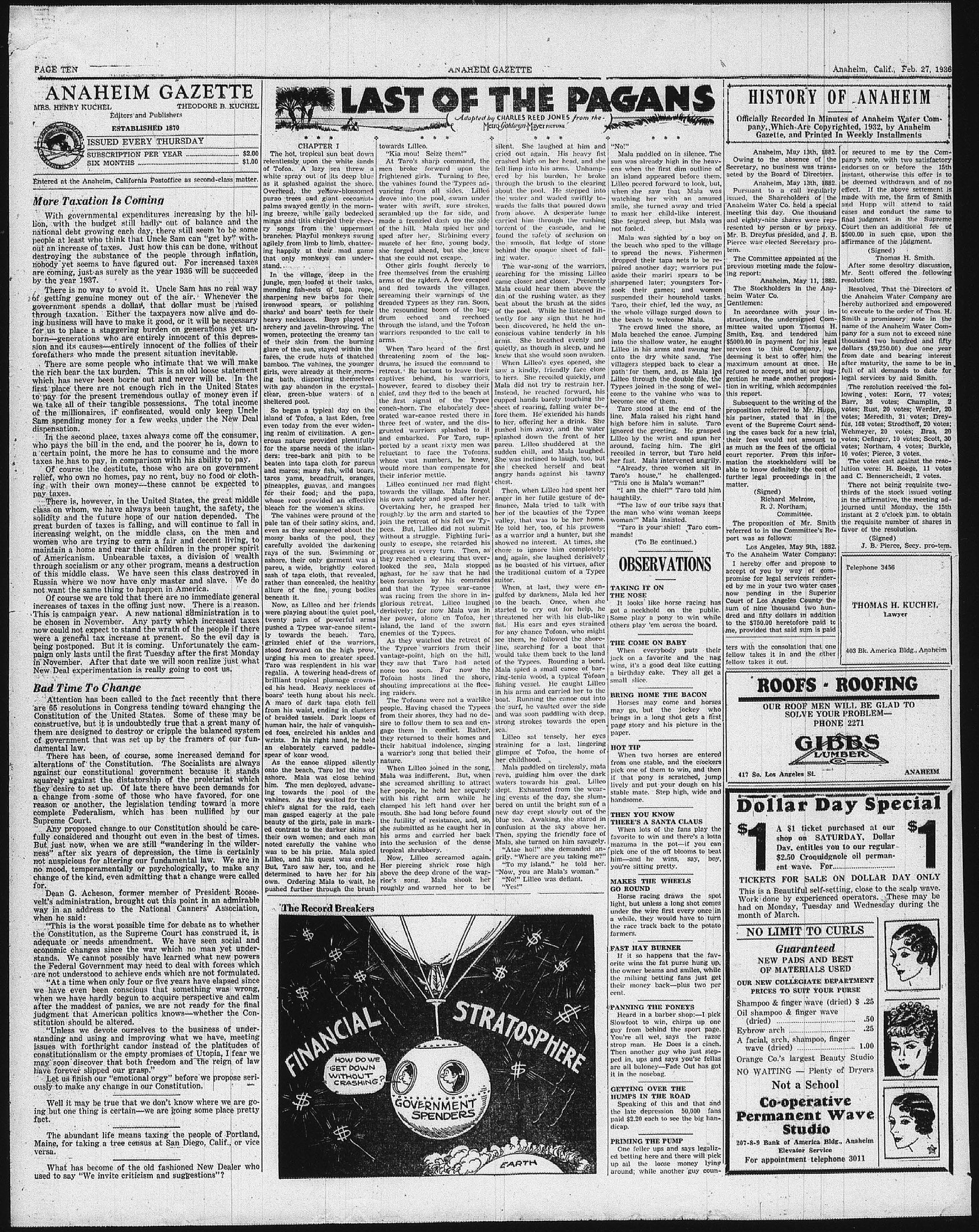
The Record Breakers
FINANCIAL STRATOSPHERE
HOW DO WE GET DOWN WITHOUT CRASHING?
GOVERNMENT SPENDERS
EARTH
HISTORY OF ANAHEIM
Officially Recorded In Minutes of Anaheim Water Company, Which Are Copyrighted, 1932, by Anaheim Gazette, and Printed In Weekly Installments
Mala paddled on in silence. The sun was already high in the heavens when the first dim outline of an island appeared before them. Lilleo peered forward to look, but, when she saw that Mala was watching her with an amused smile, she turned away and tried to mask her child-like interest. She feigned sleep, but Mala was not fooled.
Mala was sighted by a boy on the beach who sped to the village to spread the news. Fishermen dropped their tapa nets to be repaired another day; warriors put aside their mariri spears to be sharpened later; youngsters Torook their games; and women suspended their household tasks. Taro, their chief, led the way, as the whole village surged down to the beach to welcome Mala.
The crowd lined the shore, as Mala beached the canoe. Jumping into the shallow water, he caught Lilleo in his arms and swung her onto the dry white sand. The villagers stepped back to clear a path for them, and, as Mala led Lilleo through the double file, the Ypees joined in the song of welcome to the vahine who was to become one of them.
Taro stood at the end of the line. Mala raised his right hand high before him in salute. Taro ignored the greeting. He grasped Lilleo by the wrist and spun her round, facing him. The girl recoiled in terror, but Taro held firm.
Anaheim, May 13th, 1882. Owing to the absence of the Secretary, no business was transacted by the Board of Directors.
Anaheim, May 13th, 1882. Pursuant to a call regularly issued, the Shareholders of the Anaheim Water Co. held a special meeting this day. One thousand and eighty-nine shares were represented by person or by proxy. Mr. B. Dreyfus presided, and J. B. Pierce was elected Secretary pro tem.
The Committee appointed at the previous meeting made the following report:
Anaheim, May 11, 1882. The Stockholders in the Anaheim Water Co. Gentlemen:
In accordance with your instructions, the undersigned Committee waited upon Thomas H. Smith, Esq., and tendered him $5000.00 in payment for his legal services to this Company, we deem it best to offer him the maximum amount at once. He refused to accept, and at our suggestion he made another proposition in writing, which accompanies this report.
Subsequent to the writing of the proposition referred to Mr. Hupp, his partner, stated that in the event of the Supreme Court sending the cases back for a new trial, their fees would not amount to as much as the fees of the official court reporter. From this information secured to me by the Company's note, with two satisfactory endorsees on or before the 15th instant, otherwise this offer is to be deemed withdrawn and of no effect. If the above settlement is made with me, the firm of Smith and Hupp will attend to said cases and conduct the same to final judgment in the Supreme Court then an additional fee of $500.00 in such case, upon the affirmance of the judgment.
(Signed)
Thomas H. Smith.
After some desoltry discussion, Mr. Scott offered the following resolution:
Resolved That the Directors of the Anaheim Water Company are hereby authorized and empowered to execute to the order of Thos. H. Smith a promissory note in the name of the Anaheim Water Company for a sum not to exceed nine thousand two hundred and fifty dollars ($9,250.00) due one year from date and bearing interest after maturity, the same to be in full of all demands to date for legal services by said Smith.
The resolution received the following votes: Korn, 77 votes; Barr, 36 votes; Champlin, 2 votes; Rust, 20 votes; Werder, 20 votes; Meredith, 31 votes; Dreyfus, 168 votes; Strodthoff, 20 votes; Wehmeyer, 20 votes; Bras, 20 votes; Oefinger, 10 votes; Scott, 30 votes; Northam, 4 votes; Burkle, 10 votes; Pierce, 3 votes.
willagers stepped back to clear a path for them, and, as Mala led Milleo through the double file, the Cyppees joined in the song of welcome to the vahine who was to become one of them.
Taro stood at the end of the line. Mala raised his right hand high before him in salute. Taro ignored the greeting. He grasped Milleo by the wrist and spun her around, facing him. The girl recoiled in terror, but Taro held her fast. Mala intervened angrily.
"Already, three women sit in 'Taro's house,' he challenged. This one is Mala's woman!"
"I am the chief!" Taro told him naughtily.
"The law of our tribe says that the man who wins woman keeps woman!" Mala insisted.
"Taro is your shief! Taro commands!
(To Be continued.)
OBSERVATIONS
TAKING IT ON
THE NOSE
It looks like horse racing has not a neckhold on the public. Some play a pony to win while others play 'em across the board.
THE COME ON BABY
When everybody puts their back on a favorite and the nag wins, it's a good deal like cutting birthday cake. They all get a small slice.
BRING HOME THE BACON
Horses may come and horses may go, but the jockey who brings in a long shot gets a first page story and his picture in the paper.
HOT TIP
When two horses are entered from one stable, and the clockers pick one of them to win, and then if that pony is scratched, jump lively and put your dough on his table mate. Step high, wide and handsome.
THEN YOU KNOW
HERE'S A SANTA CLAUS
When lots of the fans play the favorite to win and there's a lotta mazuma in the pot—if you can pick one of the off blooms to beat him—and he wins, say, boy, you're sitting pretty.
Subsequent to the writing of the proposition referred to Mr. Hupp, his partner, stated that in the event of the Supreme Court sending the cases back for a new trial, their fees would not amount to as much as the fees of the official court reporter. From this information the stockholders will be able to know definitely the cost of further legal proceedings in the matter.
(Signed)
Richard Melrose,
R. J. Northam,
Committee.
The proposition of Mr. Smith referred to in the Committee's Report was as follows:
Los Angeles, May 9th, 1882.
To the Anaheim Water Company:
I hereby offer and propose to accept of you by way of compromise for legal services rendered by me in your two water cases now pending in the Superior Court of Los Angeles County the sum of nine thousand two hundred and fifty dollars in addition to the $750.00 heretofore paid to me, provided that said sum is paid
ters with the consolation that one fellow takes it in and the other fellow takes it out.
ROOFS - ROOFING
OUR ROOF MEN WILL BE GLAD TO SOLVE YOUR PROBLEM—PHONE 2271
GIBBS LUMBER
417 So. Los Angeles St.
ANAHEIM
Dollar Day Special
$1 ticket purchased at our shop on SATURDAY, Dollar Day, entitles you to our regular $2.50 Croquidgnole oil permanent wave. For...
Dollar Day Special
$1 A $1 ticket purchased at our shop on SATURDAY. Dollar Day, entitles you to our regular $2.50 Croquidnole oil permanent wave. For.....
TICKETS FOR SALE ON DOLLAR DAY ONLY
This is a Beautiful self-setting, close to the scalp wave. Work done by experienced operators. These may be had on Monday, Tuesday and Wednesday during the month of March.
NO LIMIT TO CURLS
Guaranteed
NEW PADS AND BEST OF MATERIALS USED
OUR NEW COLLEGIATE DEPARTMENT PRICES TO SUIT YOUR PURSE
Shampoo & finger wave (dried) $.25
Oil shampoo & finger wave (dried) .50
Eyebrow arch .25
A facial, arch, shampoo, finger wave (dried) 1.00
Orange Co.'s largest Beauty Studio
NO WAITING — Plenty of Dryers
Not a School
Co-operative Permanent Wave Studio
207-8-9 Bank of America Bldg., Anaheim Elevator Service
For appointment telephone 3011