anaheim-gazette 1935-12-12
Scanned page
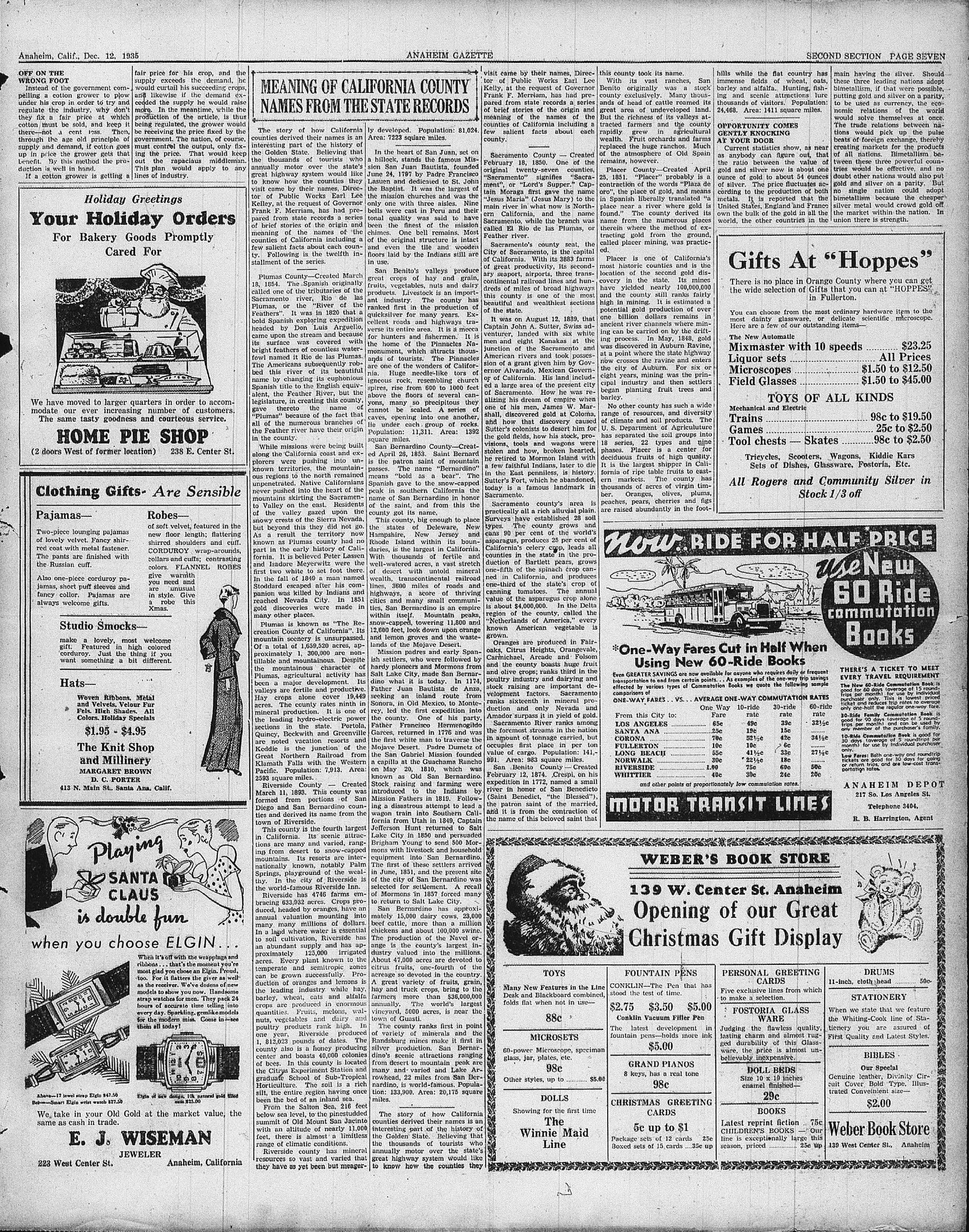
Searchable text
OFF ON THE WRONG FOOT
Instead of the government compelling a cotton grower to plow under his crop in order to try and regulate the industry, why don't they fix a fair price at which cotton must be sold, and keep it there—not a cent less. Then, through the age old principle of supply and demand, if cotton goes up in price the grower gets that benefit. By this method the production is well in hand.
If a cotton grower is getting a fair price for his crop, and the supply exceeds the demand, he would curtail his succeeding crops, and likewise if the demand exceeded the supply he would raise more. In the meantime, while the production of the article, is thus being regulated, the grower would be receiving the price fixed by the government. The nation, of course, must control the output, only fixing the price. That would keep out the rapaciaus middleman. This plan would apply to any lines of industry.
Holiday Greetings
Your Holiday Orders
For Bakery Goods Promptly Cared For
We have moved to larger quarters in order to accommodate our ever increasing number of customers. The same tasty goodness and courteous service.
HOME PIE SHOP
(2 doors West of former location) 238 E. Center St.
MEANING OF CALIF NAMES FROM THE
The story of how California counties derived their names is an interesting part of the history of the Golden State. Believing that the thousands of tourists who annually motor over the state's great highway system would like to know how the counties they visit came by their names, Director of Public Works Earl Lee Kelley, at the request of Governor Frank F. Merriam, has had prepared from state records a series of brief stories of the origin and meaning of the names of the counties of California including a few salient facts about each county. Following is the twelfth installment of the series.
Plumas County—Created March 18, 1954. The Spanish originally called one of the tributaries of the Sacramento river, Rio de las Plumas, or the "River of the Feathers". It was in 1820 that a bold Spanish exploring expedition headed by Don Luis Arguello came upon the stream and because its surface was covered with bright feathers of countless waterfowl named it Rio de las Plumas. The Americans subsequently robbed this river of its beautiful name by changing its euphonious Spanish title to the English equivalent, the Feather River, but the legislature, in creating this county gave thereto the name of "Plumas" because of the fact that all of the numerous branches of the Feather river have their origin in the county.
While missions were being built along the California coast and ex-
We have moved to larger quarters in order to accommodate our ever increasing number of customers.
The same tasty goodness and courteous service.
HOME PIE SHOP
(2 doors West of former location) 238 E. Center St.
Clothing Gifts- Are Sensible
Pajamas—
Two-piece lounging pajamas of lovely velvet. Fancy shirred coat with metal fastener. The pants are finished with the Russian cuff.
Also one-piece corduroy pajamas, short puff sleeves and fancy collar. Pajamas are always welcome gifts.
Robes—
of soft velvet, featured in the new floor length; flattering shirred shoulders and cuff. CORDUROY wrap-arounds, collars and cuffs; contrasting colors. FLANNEL ROBES give warmth you need and are unusual in style. Give a robe this Xmas.
Studio Smocks—
make a lovely, most welcome gift. Featured in high colored corduroy. Just the thing if you want something a bit different.
Hats—
Woven Ribbons. Metal and Velvets. Velour Fur Fels. High Shades. All Colors. Holiday Specials
$1.95 - $4.95
The Knit Shop and Millinery
MARGARET BROWN
D. C. PORTER
413 N. Main St., Santa Ana, Calif.
Playing
Playing SANTA CLAUS is double fun
when you choose ELGIN...
When it's off with the wrappings and ribbons... that's the moment you're most glad you chose an Elgin. Proud, too. For it flatters the giver as well as the receiver. We've dozens of new models to show you now. Handsome strap watches for men. They pack 24 hours of accurate time telling into every day. Sparkling, gemlike models for the modern miss. Come in—see them all today!
Above—17 jewel strap Elgin $47.50
Below—Smart Elgin wrist watch $27.50
Elgin of new design, 10k natural gold filled watch $25.00
We take in your Old Gold at the market value, the same as cash in trade.
E. J. WISEMAN
JEWELER
223 West Center St.
Anaheim, California
Riverside County — Create March 11, 1893. This county was formed from portions of San Diego and San Bernardino counties and derived its name from the town of Riverside.
This county is the fourth largest in California. Its scenic attractions are many and varied, ranging from desert to snow-capped mountains. Its resorts are internationally known, notably Palm Springs, playground of the weak thy. In the city of Riverside is the world-famous Riverside Inn.
Riverside has 4746 farms embodying 633,932 acres. Crops produced, headed by oranges, have an annual valuation mounting into many many millions of dollars. In a land where water is essential to soil cultivation, Riverside has an abundant supply and has approximately 125,000 irrigated acres. Every plant known to the temperate and semitropic zone can be grown successfully. Production of oranges and lemons in the leading industry while hay barley, wheat, cats and alfalfa crops are produced in enormous quantities. Fruits, melons, walnuts, vegetables and dairy are poultry products rank high. One year, Riverside produces 1,812,023 pounds of dates. The county also is a honey producing center and boasts 40,000 colonies of bees. In this county is located the Citrus Experiment Station and graduate School of Sub-Tropical Horticulture. The soil is a rich silt, the entire region having one been the bed of an inland sea.
From the Salton Sea, 216 feet below sea level, to the pinestudded summit of Old Mount San Jacinto with an altitude of nearly 11,000 feet, there is almost a limitless range of climatic conditions.
Riverside county has mineral resources so vast and varied that they have as yet been but meager
ANING OF CALIFORNIA COUNTY
MILES FROM THE STATE RECORDS
History of how California derived their names is an important part of the history of San State. Believing that lands of tourists who motor over the state's highway system would like to show the counties they have by their names, Direc- public Works Earl Lee and the request of Governor Merriam, has had preeminent state records a series of stories of the origin and of the names of the of California including a fact about each counting is the twelfth inof the series.
County—Created March The Spanish originally of the tributaries of the Rio river, Rio de las Merriam, has had preeminent state records a series of stories of the origin and of the names of the of California including a fact about each counting is the twelfth inof the series.
County—Created March The Spanish originally of the tributaries of the Rio river, Rio de las Merriam, has had preeminent state records a series of stories of the origin and of the names of the of California including a fact about each counting is the twelfth inof the series.
San Benito's valleys produce great crops of hay and grain, fruits, vegetables, nuts and dairy products. Livestock is an important industry. The county has ranked first in the production of quicksilver for many years. Excellent roads and highways traverse its entire area. It is a mecca for hunters and fishermen. It is the home of the Pinnacles National monument, which attracts thousands of tourists. The Pinnacles are one of the wonders of California. Huge needle-like tors of igneous rock, resembling church spires, rise from 600 to 1000 feet above the floors of several canyons, many so precipitous they cannot be scaled. A series of caves, opening into one another, lie under each group of rocks. Population: 11,311. Area: 1392 square miles.
San Bernardino County—Created April 26, 1853. Saint Bernard visit came by their names, Director of Public Works Earl Lee Kelly, at the request of Governor Frank F. Merriam, has had prepared from state records a series of brief stories of the origin and meaning of the names of the counties of California including a few salient facts about each county.
Sacramento County — Created February 18, 1850. One of the original twenty-seven counties, "Sacramento" signifies "Sacrament", or "Lord's Supper." Captain Moraga first gave the name "Jesus Maria" (Jesus Mary) to the main river in what now is Northern California, and the name Sacramento, while the branch was called El Rio de las Plumas, or Feather river.
Sacramento's county seat, the City of Sacramento, is the capital of California. With its 3883 farms of great productivity, its secondary seaport, airports, three transcontinental railroad lines and hundreds of miles of broad highways this county is one of the most beautiful and wealthiest sections of the state.
It was on August 12, 1839, that Captain John A. Sutter, Swiss adventurer, landed with six white men and eight Kanakas at the junction of the Sacramento and American rivers and took possession of a grant given him by Governor Alvarado, Mexican Governor of California. His land included a large area of the present city of Sacramento. How he was realizing his dream of empire when one of his men, James W. Marshall, discovered gold at Coloma, and how that discovery caused Sutter's colonists to desert him for the gold fields, how his stock, provisions, tools and wagons were stolen and how broken hearted, he retired to Mormon Island with this county took its name.
With its vast rancho Benito originally was a county exclusively. Many ands of head of cattle roost great area of undeveloped But the richness of its valley tracted farmers and the rapidly grew in agrivital wealth. Fruit orchards are replaced the huge ranchos of the atmosphere Of Old remains, however.
Placer County—Created 25, 1851. "Placer" probably contraction of the words "ploro", the place of gold, and in Spanish liberally transfer place near a river where found. The county derives name from the numerous therein where the method tracing gold from the called placer mining was ed.
Placer is one of Californiest historic counties and location of the second govcovery in the state. Its have yielded nearly 100 and the county still ranks high in mining. It is esti- potential gold production one billion dollars remen ancient river channels whil ing can be carried on by th ing process. In May, 1839 was discovered in Auburn at a point where the state now crosses the ravine and the city of Auburn. For eight years, mining was cipal industry and then began planting fruit tree barley.
No other county has such range of resources, and o f climate and soil produc U.S. Department of Agriculture has separated the soil grow 18 series, 22 types and phases. Placer is a cer- deciduous fruits of high
Americans subsequently robbed the river of its beautiful changing its euphonious title to the English equiv. Feather River, but the river, in creating this county, dereto the name of because of the fact that numerous branches of the river have their origin county.
Missions were being built California coast and ex-ere were pushing into un-nerritories, the mountainous to the north remained intact. Native Californians entered into the heart of the skirting the Sacramento on the east. Residents valley gazed upon the rests of the Sierra Nevada, and this they did not go. Result the territory now Plumas county had no one early history of California is believed Peter Lassen More Meyerwitz were the white to set foot there. All of 1849 a man named escaped after his com-mas killed by Indians and Nevada City. In 1851 recoveries were made in other places.
It is known as "The Re-County of California". Its scenery is unsurpassed. A total of 1,659,520 acres, ap-ly 1,300,000 are non-land mountainous. Despite containant character of agricultural activity has major development. Its are fertile and productive. Copps alone cover 19,449 the county rates ninth in production. It is one of long hydro-electric power in the state. Portola, Beckwith and Greenville had vacation resorts and is the junction of the northern Railroad from Falls with the Western Population: 7,913. Area: rare miles.
De County — Created April 26, 1853. Saint Bernard is the patron saint of mountain passes. The name "Bernardino" means "bold as a bear". The Spanish gave to the snow-capped peak in southern California the name of San Bernardino in honor of the saint, and from this the county got its name.
This county, big enough to place the states of Deleware, New Hampshire, New Jersey and Rhode Island within its boundaries, is the largest in California. With thousands of fertile and well-watered acres, a vast stretch of desert with untold mineral wealth, transcontinental railroad lines, 3600 miles of roads and highways, a score of thriving cities and many small communities, San Bernardino is an empire within itself. Mountain peaks, snow-capped, towering 11,800 and 12,600 feet, look down upon orange and lemon groves and the wastelands of the Mojave Desert.
Mission padres and early Spanish settlers, who were followed by hardy pioneers and Mormons from Salt Lake City, made San Bernardino what it is today. In 1174, Father Juan Bautista de Anza, seeking an inland route from Sonora, in Old Mexico, to Monterey, led the first expedition into the county. One of his party, Father Francisco Hermenogildo Garces, returned in 1776 and was the first white man to traverse the Mojave Desert. Padre Dumetz of the San Gabriel Mission founded a capilla at the Guachama Rancho on May 20, 1810, which was known as Old San Bernardino. Stock raising and farming were introduced to the Indians by Mission Fathers in 1819. Following a disastrous attempt to lead a wagon train into Southern California from Utah in 1849, Captain Jefferson Hunt returned to Salt Lake City in 1850 and persuaded Brigham Young to send 500 Mormons with livestock and household equipment into San Bernardino. The first of these settlers arrived on one of the wonders of California. Huge needle-like tors of igneous rock, resembling church spires, rise from 600 to 1000 feet above the floors of several canyons, many so precipitous they cannot be scaled. A series of caves, opening into one another, lie under each group of rocks. Population: 11,311. Area: 1392 square miles.
San Bernardino County—Created April 26, 1853. Saint Bernard is the patron saint of mountain passes. The name "Bernardino" means "bold as a bear". The Spanish gave to the snow-capped peak in southern California the name of San Bernardino in honor of the saint, and from this the county got its name.
This county, big enough to place the states of Deleware, New Hampshire, New Jersey and Rhode Island within its boundaries, is the largest in California. With thousands of fertile and well-watered acres, a vast stretch of desert with untold mineral wealth, transcontinental railroad lines, 3600 miles of roads and highways, a score of thriving cities and many small communities, San Bernardino is an empire within itself. Mountain peaks, snow-capped, towering 11,800 and 12,600 feet, look down upon orange and lemon groves and the wastelands of the Mojave Desert.
Mission padres and early Spanish settlers, who were followed by hardy pioneers and Mormons from Salt Lake City, made San Bernardino what it is today. In 1174, Father Juan Bautista de Anza, seeking an inland route from Sonora, in Old Mexico, to Monterey, led the first expedition into the county. One of his party, Father Francisco Hermenogildo Garces, returned in 1776 and was the first white man to traverse the Mojave Desert. Padre Dumetz of the San Gabriel Mission founded a capilla at the Guachama Rancho on May 20, 1810, which was known as Old San Bernardino. Stock raising and farming were introduced to the Indians by Mission Fathers in 1819. Following a disastrous attempt to lead a wagon train into Southern California from Utah in 1849, Captain Jefferson Hunt returned to Salt Lake City in 1850 and persuaded Brigham Young to send 500 Mormons with livestock and household equipment into San Bernardino. The first of these settlers arrived on one of the wonders of California. Huge needle-like tors of igneous rock, resembling church spires, rise from 600 to 1000 feet above the floors of several canyons, many so precipitous they cannot be scaled. A series of caves, opening into one another, lie under each group of rocks. Population: 11,311. Area: 1392 square miles.
San Bernardino County—Created April 26, 1853. Saint Bernard is the patron saint of mountain passes. The name "Bernardino" means "bold as a bear". The Spanish gave to the snow-capped peak in southern California the name of San Bernardino in honor of the saint, and from this the county got its name.
This county, big enough to place the states of Deleware, New Hampshire, New Jersey and Rhode Island within its boundaries, is the largest in California. With thousands of fertile and well-watered acres, a vast stretch of desert with untold mineral wealth, transcontinental railroad lines, 3600 miles of roads and highways, a score of thriving cities and many small communities, San Bernardino is an empire within itself. Mountain peaks, snow-capped, towering 11,800 and 12,600 feet, look down upon orange and lemon groves and the wastelands of the Mojave Desert.
Mission padres and early Spanish settlers, who were followed by hardy pioneers and Mormons from Salt Lake City, made San Bernardino what it is today. In 1174, Father Juan Bautista de Anza, seeking an inland route from Sonora, in Old Mexico, to Monterey, led the first expedition into the county. One of his party, Father Francisco Hermenogildo Garces, returned in 1776 and was the first white man to traverse the Mojave Desert. Padre Dumetz of the San Gabriel Mission founded a capilla at the Guachama Rancho on May 20, 1810, which was known as Old San Bernardino. Stock raising and farming were introduced to the Indians by Mission Fathers in 1819. Following a disastrous attempt to lead a wagon train into Southern California from Utah in 1849,Captain Jefferson Hunt returned to Salt Lake City in 1850 and persuaded Brigham Young to send 500 Mormons with livestock and household equipment into San Bernardino. The first of these settlers arrived on one of the wonders of California. Huge needle-like tors of igneous rock,resembling church spires,rise from 600 to 1000 feet above the floors of several canyons,many so precipitous they cannot be scaled. A series of caves,opening into one another,lie under each group of rocks. Population: 11,311。Area: 1392 square miles.
San Bernardino County—Created April 26,1853.Saint Bernard is the patron saint of mountain passes.The name "Bernardino" means "bold as a bear".The Spanish gave to the snow-capped peak in southern Californiathe nameofSan Bernardinoin honorofthesaint'sstockprovedinoneofthepresentcityofSacramentoHowhewasrealizinghisdreamofempirewhenoneofhismenJamesW.MarshalldiscoveredgoldatColoma,andhowthatdiscoverycausedSutter'scoloniststodeserthimforthegoldfields,howhisstock.provisions.towelsandwagonswerestolenandhowbrokenhearted,the retiredtoMormonIslandwitha fewfaithfulIndians,toredieintheEastpenniless,hishistory.Sutter'sFort,thewhichheabandoned,todayisafamouslandmarkinSacramento.
Sacramentocounty'sareais practicallyalla rich alluvialplain.Surveyshaveestablished28soiltypes.Thecountygrowsandscans90percentoftheworld'sasparagus,produces25percentofCalifornia'scelerycrop,leadsallcountiesinthestateintheproductionofBartlettpears,growsone-fifthofthespinachcropcannedinCalifornia,andproducesone-thirdofthestate'scropofcanningtomatoes.Theannualvalueofthesparaguscropaloneisabout$4,$000,$000.IntheDeltaregionofthecounty,thecalled"TheNetherlandsofAmerica,"everyknownAmerican vegetableisgrown.
OrangesareproducedinFairoaks,CitrusHeightsOrangevale,Carnichael,andthecountyboastshugefruitandolive crops;ranksthirdinthepoultryindustryanddairyingandstockraisingareimportantdevelopmentfactors.SacramentoranksixteenthinmineralproductionandonlyNevadaandAmadorsurpassitinyieldofgold.
SacramentoRiverranks amongtheforemoststreamsinthenationinamountoftonnagecarriedbutoccupiestfirstplaceinpertonvalueof cargo.Population:141,-991.Area:983squaremiles.
SanBenitoCounty—CreatedFebruary12,1874.Crespi.onhisexpeditionin1772,namedasmallriverinhonorofSanBenedicto(SaintBenedict,"theBlessed"),thepatronsaintofthemarried,anditisfromthecontractionofthenameofthisbelovedsaintthat
*One-WayUsingN*
EvenGREATERSAVINGSaretransportationtoandfromcomffectedbyvarioustypescomparisonsofONE-WAYFARES...VS.
FromthisCityto:
LOSANGELES
SANTA ANA
CORONA
FULLERTON
LONG BEACH
NORWALK
RIVERSIDE
WHITTIER
andotherpoints
County is the fourth largest in California. Its scenic attractions and varied landscapes extend to snow-capped peaks. Its resorts are intermixed known, notably Palm playground of the wealder city of Riverside is well-famous Riverside Inn. County has 4746 farms emerald 33,932 acres. Crops produced by oranges, have an evaluation mounting into many millions of dollars. Where water is essential cultivation, Riverside has plant supply and has applied 125,000 irrigated every plant known to the area and semitropic zones grown successfully. Proof of oranges and lemons is being industry while hay, wheat, cats and alfalfa are produced in enormous quantities. Fruits, melons, walnuts and dairy products rank high. In Riverside produced 13 pounds of dates. The county is a honey producing land boasts 40,000 colonies. In this county is located the Experiment Station and School of Sub-Tropicalulture. The soil is a rich entire region having once bed of an inland sea. The Salton Sea, 216 feet a level, to the pinestudded Old Mount San Jacinto altitude of nearly 11,000 feet is almost a limitless climatic conditions. County has mineral so vast and varied that it as yet been but meager-known as Old San Bernardino. Stock raising and farming were introduced to the Indians by Mission Fathers in 1819. Following a disastrous attempt to lead a wagon train into Southern California from Utah in 1849, Captain Jefferson Hunt returned to Salt Lake City in 1850 and persuaded Brigham Young to send 500 Mormons with livestock and household equipment into San Bernardino. The first of these settlers arrived in June, 1851, and the present site of the city of San Bernardino was selected for settlement. A recall of Mormons in 1857 forced many to return to Salt Lake City.
San Bernardino has approximately 15,000 dairy cows, 23,000 beef cattle, more than a million chickens and about 100,000 swine. The production of the Navel orange is the county's largest industry valued into the millions. About 47,000 acres are devoted to citrus fruits, one-fourth of the acreage so devoted in the country. A great variety of fruits, grain, hay and truck crops, bring to the farmers more than $36,000,000 annually. The world's largest vineyard, 5000 acres, is near the town of Guasti.
The county ranks first in point of variety of minerals and the Randsburg mines make it first in silver production. San Bernardino's scenic attractions ranging from desert to mountain peak are many and varied and Lake Arrowhead, 22 miles from San Bernardino, is world-famous. Population: 133,900. Area: 20,175 square miles.
The story of how California counties derived their names is an interesting part of the history of the Golden State. Believing that the thousands of tourists who annually motor over the state's great highway system would like to know how the counties they
SECOND SECTION PAGE SEVEN
With its vast ranches, San Antonio originally was a stock county exclusively. Many thousands of head of cattle roamed its great area of undeveloped land. At the richness of its valleys attracted farmers and the county rapidly grew in agricultural health. Fruit orchards and farms placed the huge ranchos. Much in the atmosphere of Old Spain remains, however.
Placer County—Created April 1851. "Placer" probably is a contraction of the words "Plaza de," the place of gold, and means Spanish liberally translated "a place near a river where gold is found." The county derived its name from the numerous places wherein the method of extracting gold from the ground, called placer mining, was practiced.
Placer is one of California's most historic counties and is the location of the second gold discovery in the state. Its mines have yielded nearly 100,000,000 and the county still ranks fairly high in mining. It is estimated a potential gold production of over the billion dollars remains in ancient river channels where mining can be carried on by the drift process. In May, 1848, gold was discovered in Auburn Ravine, a point where the state highway now crosses the ravine and enters the city of Auburn. For six or eight years, mining was the principal industry and then settlers began planting fruit trees and arley.
No other county has such a wide range of resources, and diversity climate and soil products. The U.S. Department of Agriculture separated the soil groups into series, 22 types and nine classes. Placer is a center for deciduous fruits of high quality.
hills while the flat country has immense fields of wheat, oats, barley and alfalfa. Hunting, fishing and scenic attractions lure thousands of visitors. Population: 24,468. Area: 1411 square miles.
OPPORTUNITY COMES GENTLY KNOCKING AT YOUR DOOR
Current statistics show, as near as anybody can figure out, that the ratio between the value of gold and silver now is about one ounce of gold to about 54 ounces of silver. The price fluctuates according to the production of both metals. It is reported that the United States, England and France own the bulk of the gold in all the world, the other countries in the main having the silver. Should these three leading nations adopt bimetallism, if that were possible, putting gold and silver on a parity, to be used as currency, the economic relations of the world would solve themselves at once. The trade relations between nations would pick up the pulse beats of foreign exchange, thereby creating markets for the products of all nations. Bimetallism between these three powerful countries would be effective, and no doubt other nations would also put gold and silver on a parity. But no single nation could adopt bimetallism because the cheaper silver metal would crowd gold off the market within the nation. In union there is strength.
Gifts At “Hoppes”
There is no place in Orange County where you can get the wide selection of Gifts that you can at "HOPPES" in Fullerton.
You can choose from the most ordinary hardware item to the most dainty glassware, or delicate scientific microscope. Here are a few of our outstanding items—
The New Automatic
Mixmaster with 10 speeds $23.25
Liquor sets All Prices
Microscopes $1.50 to $12.50
Field Glasses $1.50 to $45.00
TOYS OF ALL KINDS
Mechanical and Electric
Trains $98c to $19.50
Games $25c to $2.50
Tool chests — Skates $98c to $2.50
Tricycles, Scooters, Wagons, Kiddie Kars
No other county has such a wide range of resources, and diversity in climate and soil products. The U.S. Department of Agriculture has separated the soil groups into series, 22 types and nine classes. Placer is a center for deciduous fruits of high quality. It is the largest shipper in California of ripe table fruits to easton markets. The county has thousands of acres of virgin timber. Oranges, olives, plums,aches, pears, cherries and figs are raised abundantly in the foot-
Microscopes $1.50 to $12.50
Field Glasses $1.50 to $45.00
TOYS OF ALL KINDS
Mechanical and Electric
Trains $98c to $19.50
Games $25c to $2.50
Tool chests — Skates $98c to $2.50
Tricycles, Scooters, Wagons, Kiddie Kars
Sets of Dishes, Glassware, Fostoria, Etc.
All Rogers and Community Silver in Stock 1/3 off
Now RIDE FOR HALF PRICE
Use New 60 Ride commutation Books
*One-Way Fares Cut in Half When Using New 60-Ride Books
Even GREATER SAVINGS are now available for anyone who requires daily or frequent transportation to and from certain points. As examples of the one-way trip savings effected by various types of Commutation Books we quote the following sample comparisons of ONE-WAY FARES...VS... AVERAGE ONE-WAY COMMUTATION RATES
From this City to:
One Way 10-ride 30-ride 60-ride
LOS ANGELES 65¢ 49¢ 39¢ 32½¢
SANTA ANA 25¢ 19¢ 15¢ .....
CORONA 70¢ 52½¢ 42¢ 34½¢
FULLERTON 10¢ 10¢ 6¢ .....
LONG BEACH 55¢ 41½¢ 33¢ 27½¢
NORWALK 30¢ *22½¢ 18¢ .....
RIVERSIDE 1.00 75£ 60£ 50£
WHITTIER 40£ 30£ 24£ 20£
and other points at proportionately low commutation rates.
THERE'S A TICKET TO MEET EVERY TRAVEL REQUIREMENT
The New 60-Ride Commutation Book is good for 60 days (average of 15 round-trips per month) for use by individual purchaser only. This is lowest price ticket and reduces trip rates to average only one-half the regular one-way fare.
30-Ride Family Commutation Book is good for 90 days (average of 5 round-trips per month) and can be used by any member of the purchaser's family.
10-Ride Commutation Book is good for 30 days (average of 5 round-trips per month) for use by individual purchaser only.
Low Fares: Both one-way and roundtrip tickets are good for 30 days for going or return trips, and are low-cost transportation rates.
ANAHEIM DEPOT
217 So. Los Angeles St.
Telephone 3404,
R. B. Harrington, Agent
WEBER'S BOOK STORE
WEBER'S BOOK STORE
139 W. Center St. Anaheim
Opening of our Great Christmas Gift Display
FOUNTAIN PENS
CONKLIN—The Pen that has stood the test of time.
$2.75 $3.50 $5.00
Conklin Vacuum Filler Pen
The latest development in fountain pens—holds more ink
$5.00
GRAND PIANOS
8 keys, has a real tone
98c
CHRISTMAS GREETING CARDS
5¢ up to $1
Package sets of 12 cards 25¢
Boxed sets of 15 cards ...35¢ up
PERSONAL GREETING CARDS
Five exclusive lines from which to make a selection.
FOSTORIA GLASS WARE
Judging the flawless quality, lasting charm and almost rugged durability of this Glassware, the price is almost unbelievably inexpensive.
DOLL BEDS
Size 10 x 19 inches
enamel finished—29¢
BOOKS
Latest reprint fiction ...75¢
CHILDREN'S BOOKS — Our line is exceptionally large this season, priced ...25¢ up
DRUMS
11-inch, cloth head ...50¢
STATIONERY
When we state that we feature the Whiting-Cook line of Stationery you are assured of First Quality and Latest Styles.
BIBLES
Our Special
Genuine leather, Divinity Circuit Cover Bold Type, Illustrated Conveinient size—$2.00
Weber Book Store
139 West Center St., Anaheim