anaheim-gazette 1935-09-26
Scanned page
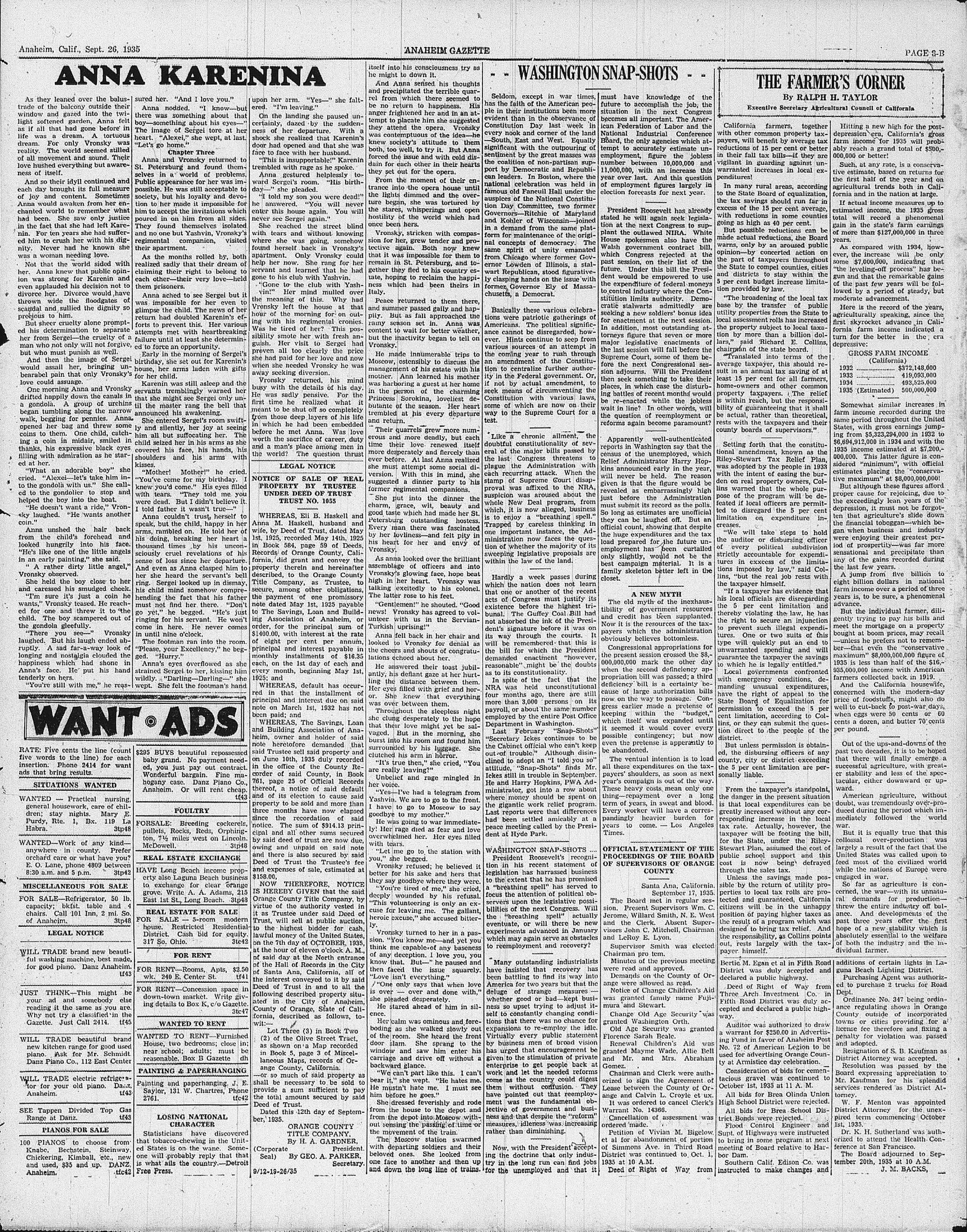
Searchable text
ANNA KARENINA
As they leaned over the balustrade of the balcony outside their window and gazed into the twilight softened garden, Anna felt as if all that had gone before in life was a dream. A tortuous dream. For only Vronsky was reality. The world seemed stilled of all movement and sound. Their love hushed everything but awareness of itself.
And so their idyll continued and each day brought its full measure of joy and content. Sometimes Anna would awaken from her enchanted world to remember what had been. She saw only justice in the fact that she had left Karenin. For ten years she had suffered him to crush her with his dignity. Never had he known she was a woman needing love.
Not that the world sided with her. Anna knew that public opinion was strong for Karenin and even applauded his decision not to divorce her. Divorce would have thrown wide the floodgates of scandal and sullied the dignity so prejudiced to him.
But sheer cruelty alone prompted his determination to separate her from Sergei—the cruelty of a man who not only will not forgive, but who must punish as well.
And then the image of Sergei would assail her, bringing bearable pain that only Vronsky's love could assuage.
One morning Anna and Vronsky drifted happily down the canals in a gondola. A group of urchins began tumbling along the narrow walk, begging for pennies. Anna opened her bag and threw some coins to them. One child, catching a coin in midair, smiled in thanks, his expressive black eyes filling with admiration as he starred her. "And I love you."
Anna nodded. "I know—but there was something about that boy—something about his eyes—" The image of Sergei tore at her heart. "Alexei," she wept, at last. "Let's go home."
Chapter Three
Anna and Vronsky returned to St. Petersburg and found themselves in a world of problems. Public appearance for her was impossible. He was still acceptable to society, but his loyalty and devotion to her made it impossible for him to accept the invitations which poured in on him from all sides. They found themselves isolated and no one but Yashvin, Vronsky's regimental companion, visited their apartment.
As the months rolled by, both realized sadly that their dream of claiming their right to belong to each other—their very love—held them prisoners.
Anna ached to see Sergei but it was impossible for her even to glimpse the child. The news of her return had doubled Karenin's efforts to prevent this. Her various attempts met with heartbreaking failure until at least she determined to force an opportunity.
Early in the morning of Sergei's birthday, she set out for Karenin's house, her arms laden with gifts for her child.
Karenin was still asleep and the servants tremblingly warned her that she might see Sergei only until the master rang the bell that announced his awakening.
She entered Sergei's room swiftly and silently, her joy at seeing him all but suffocating her. The child seized her in his arms as she covered his face, his hands, his shoulders and his arms upon her arm. "Yes—" she faltersed. "I'm leaving."
On the landing she paused uncertainly, dazed by the suddenness of her departure. With a shock she realized that Karenin's door had opened and that she was face to face with her husband.
“This is insupportable!” Karenin trembled with rage as he spoke.
Anna gestured helplessly to ward Sergel's room. "His birthday—” she pleaded.
"I told my son you were dead!" he answered. "You will never enter this house again. You will never see Sergei again."
She reached the street blinding with tears and without knowing where she was going, somehow found herself back in Vronsky's apartment. Only Vronsky could help her now. She rang for her servant and learned that he had gone to his club with Yashvin.
"Gone to the club with Yashvin!" Her mind mulled over the meaning of this. Why had Vronsky left the house at that hour of the morning for on outing with his regimental cronies? Was he tired of her? This possibility smote her with fresh anguish. Her visit to Sergei had proven all too clearly the price she had paid for her love and now when she needed Vronsky he was away seeking diversion.
Vronsky returned, his mind busy with the details of his day. He was sadly pensive. For the first time he realized what it meant to be shut off so completely from those deep layers of his life in which he had been embedded before he met Anna. Was love worth the sacrifice of career, duty and a man's place among men in the world? The question thrus
One morning Anna and Vronsky drifted happily down the canals in a gondola. A group of urchins began tumbling along the narrow walk, begging for pennies. Anna opened her bag and threw some coins to them. One child, catching a coin in midair, smiled in thanks, his expressive black eyes filling with admiration as he starred at her.
"What an adorable boy" she cried. "Alexei—let's take him into the gondola with us." She called to the gondolier to stop and helped the boy into the boat.
"He doesn't want a ride," Vronsky laughed. "He wants another coin."
Anna unshed the hair back from the child's forehead and looked hungrily into his face. "He's like one of the little angels in an early painting," she said.
"A rather dirty little angel," Vronsky observed.
She held the boy close to her and caressed his smudged cheek.
"I'm sure it's just a coin he wants," Vronsky teased. He reached for one and threw it to the child. The boy scampered out of the gondola gleefully.
"There you see—" Vronsky laughed. But his laugh ended abruptly. A sad far-a-way look of longing and nostalgia clouded the happiness which had shone in Anna's face. He put his hand tenderly on hers.
"You're still with me," he reasured herself to speak, but the child, happy in her arms, rambled on. He told her of his doing, breaking her heart a thousand times by his unconsciously cruel revelations of his sense of loss since her departure. And even as Anna clasped him to her she heard the servant's bell ring. Sergel looked up in dismay, his child mind somehow comprehending the fact that his father must not find her there. "Don't go yet," he begged. "He's just ringing for his servant. He won't come in here. He never comes in until nine o'clock."
The footman ran into the room. "Please, your Excellency," he begged. "Hurry."
Anna's eyes overflowed as she strained Sergel to her, kissing him wildly. "Darling—Darling—" she wept. She felt the footman's hand
WANT ADS
RATE: Five cents the line (count five words to the line) for each insertion. Phone 2414 for want ads that bring results.
SITUATIONS WANTED
WANTED — Practical nursing, general housework, care of children; stay nights. Mary E. Purdy, Rte. I, Bx. 119 La Habra.
WANTED—Work of any kind—anywhere in county. Prefer orchard care or what have you? E. O. Lane, phone 4809 between
$295 BUYS beautiful repossessed baby grand. No payment needed, you just pay out contract. Wonderful bargain. Fine mahogany case. Danz Piano Co., Anaheim. Or will rent cheap.
POULTRY
FORSALE: Breeding cockerels, pullets, Rocks, Reds, Orphington, 7½ miles west on Lincoln McDowell.
REAL ESTATE EXCHANGE
HAVE Long Beach income property, her arms laden with gifts for her child.
Karenin was still asleep and the servants tremblingly warned her that she might see Sergei only until the master rang the bell that announced his awakening.
She entered Sergel's room swiftly and silently, her joy at seeing him all but suffocating her. The child seized her in his arms as she covered his face, his hands, his shoulders and his arms with kisses.
"Mother! Mother!" he cried. "You've come for my birthday. I knew you'd come." His eyes filled with tears. "They told me you were dead. But I didn't believe it. I told father it wasn't true—"
Anna couldn't trust herself to speak, but the child, happy in her arms, rambled on. He told her of his doing, breaking her heart a thousand times by his unconsciously cruel revelations of his sense of loss since her departure. And even as Anna clasped him to her she heard the servant's bell ring. Sergel looked up in dismay, his child mind somehow comprehending the fact that his father must not find her there. "Don't go yet," he begged. "He's just ringing for his servant. He won't come in here. He never comes in until nine o'clock."
The footman ran into the room. "Please, your Excellency," he begged. "Hurry."
Anna's eyes overflowed as she strained Sergel to her, kissing him wildly. "Darling—Darling—" she wept. She felt the footman's hand
WHEREAS, Eli B. Haskell and Anna M. Haskell, husband and wife, by Deed of Trust, dated May 1st, 1925, recorded May 14th, 1925 in Book 584, page 59 of Deeds Records of Orange County, California; did grant and convey the property therein and hereinafter described, to the Orange County Title Company, as Trustee; to secure, among other obligations the payment of one promissory note dated May 1st, 1925 payable to The Savings, Loan and Building Association of Anaheim, or order, for the principal sum of $1400.00, with interest at the rate of eight per cent per annum principal and interest payable in monthly installments of $16.38 each, on the 1st day of each and every month, beginning May 1st 1925; and
WHEREAS, default has occurred in that the installment or principal and interest due on said note on March 1st, 1932 has not been paid; and
WHEREAS, The Savings, Loan and Building Association of Anaheim, owner and holder of said note heretofore demanded that said Trustee sell said property and on June 10th, 1935 duly recorded in the office of the County Recorder of said County, in Book 761, page 25 of Official Records thereof, a notice of said default and of its election to cause said property to be sold and more than three months have now elapsed since the recordation of said notice. The sum of $914.13 principal and all other sums secured by said deed of trust are now due owing and unpaid on said note and there is also secured by said Deed of Trust the Trustee's fee and expenses of sale estimated a
SITUATIONS WANTED
WANTED — Practical nursing, general housework, care of children; stay nights. Mary E. Purdy, Rte. 1, Bx. 119 La Habra.
WANTED—Work of any kind—anywhere in county. Prefer orchard care or what have you? E. O. Lane, phone 4809 between 8:30 a.m. and 5 p.m.
MISCELLANEOUS FOR SALE
FOR SALE—Refrigerator, 50 lb. capacity; bkfst. table and 4 chairs. Call 101 Inn, 2 mi. So. of Anaheim.
LEGAL NOTICE
WILL TRADE brand new beautiful washing machine, best made, for good piano. Danz Anaheim.
JUST THINK—This might be your ad and somebody else reading it the same as you are. Why not try a classified in the Gazette. Just Call 2414.
WILL TRADE beautiful brand new kitchen range for good used piano. Ask for Mr. Schmidt. Danz Piano Co., 112 East Center.
WILL TRADE electric refrigerator for your old piano. Danz Anaheim.
SEE Tappen Divided Top Gas Range at Danz.
PIANOS FOR SALE
100 PIANOS to choose from: Knabe, Bechstein, Steinway, Chickering, Kimball, etc., new and used, $35 and up. DANZ, Anaheim.
POULTRY
FORSALE: Breeding cockerels, pullets, Rocks, Reds, Orpington, 7½ miles west on Lincoln. McDowell.
REAL ESTATE EXCHANGE
HAVE Long Beach income property also Laguna Beach business to exchange for clear orange grove. Write A. A. Adams, 215 East 1st St., Long Beach.
REAL ESTATE FOR SALE
FOR SALE — 5-room modern house. Restricted Residential District. Cash bid for equity. 317 So. Ohio.
FOR RENT
FOR RENT—Rooms, Apts, $2.50 wk. 240 E. Center St.
FOR RENT—Concession space in down-town market. Write giving details to Box K, c/o Gazette.
WANTED TO RENT
WANTED TO RENT—Furnished House, two bedrooms; close in; near school; adults; must be reasonable. Box B Gazette dh
PAINTING & PAPERHANGING
Painting and paper hanging. J. E. Saylor, 131 W. Chartres, Phone 2761.
LOSING NATIONAL CHARACTER
Statisticians have discovered that tobacco chewing in the United States is on the wane. Someone will probably reply that that is what ails the country.—Detroit Free Press.
NOW THEREFORE, NOTICE IS HEREBY GIVEN that the said Orange County Title Company, by virtue of the authority vested in it as Trustee under said Deed of Trust, will sell at public auction to the highest bidder for cash lawful money of the United States on the 7th day of OCTOBER, 1935 at the hour of eleven o'clock A.M. of said day at the North entrance of the Hall of Records in the City of Santa Ana, California, all of the interest conveyed to it by said Deed of Trust in and to all the following described property situated in the City of Anaheim County of Orange, State of California, described as follows, to wit:
Lot Three (3) in Book Two (2) of the Olive Street Tract, as shown on a Map recorded in Book 5, page 3 of Miscellaneous Maps, records of Orange County, California.
—or so much of said property shall be necessary to be sold to provide a sum sufficient to pay the total amount secured by said Deed of Trust.
Dated this 12th day of September, 1935.
ORANGE COUNTY TITLE COMPANY,
By H. A. GARDNER,
(Corporate Seal)
By GEO. A. PARKER,
Secretary
9/12-19-26/35
ANAHEIM GAZETTE
NA
arm. "Yes—" she falten leaving."
landing she paused undazed by the suddenmer departure. With a
realized that Karenin's
opened and that she was
face with her husband.
insupportable!' Karenin
with rage as he spoke.
gestured helplessly togel's room. "His birthpleaded.
my son you were dead!"
ered. "You will never
house again. You will
Sergei again."
ached the street blind
s and without knowing
he was going, somehow
self back in Vronsky's
know. Only Vronsky could
now. She rang for her
and learned that he had
club with Yashvin.
to the club with YashviHer mind mulled over
ing of this. Why had
left the house at that
morning for on outhis regimental cronies.
died of her? This posnote her with fresh aner visit to Sergei had
to clearly the price
paid for her love and now
needed Vronsky he was
king diversion.
by returned, his mind
in the details of his day,
deadly pensive. For the
he realized what it
no shut off so completely
the deep layers of his life
he had been embedded
met Anna. Was love
sacrifice of career, duty
own's place among men in?
The question thrust
itself into his consciousness try as he might to down it.
And Anna sensed his thoughts and precipitated the terrible quarrel from which there seemed to be no return to happiness. His anger frightened her and in an attempt to placate him she suggested they attend the opera. Vronsky was contemptuous of the idea—he knew society's attitude to them both, too well, to try it. But Anna forced the issue and with cold disdain for each other in their hearts they set out for the opera.
From the moment of their entrance into the opera house until the lights dimmed and the overture began, she was tortured by the stares, whisperings and open hostility of the world which had once been hers.
Vronsky, stricken with compassion for her, grew tender and protective again. Both now knew that it was impossible for them to remain in St. Petersburg, and together they fled to his country estate, hoping to reclaim the happiness which had been theirs in Italy.
Peace returned to them there, and summer passed gaily and happily. But as fall approached the rainy season set in, Anna was content to wait for better weather, but the inactivity began to tell on Vronsky.
He made innumerable trips to Moscow, ostensibly to discuss the management of his estate with his mother. Ann learned his mother was harboring a guest at her home in the person of the charming Princess Sorokina, loveliest debutante of the season. Her heart trembled at his every departure and return.
Their quarrels grew more numerous and more deadly, but each time their love renewed itself more desperately and fiercely than ever before. At last Anna realized
WASHINGTON SNAP-SHOTS
Seldom, except in war times, has the faith of the American people in their institutions been more evident than in the observance of Constitution Day last week in every nook and corner of the land—South, East and West. Equally significant with the outpouring of sentiment by the great masses was the coalition of non-partisan support by Democratic and Republican leaders. In Boston, where the national celebration was held in famous old Faneuil Hall under the auspices of the National Constitution Day Committee, two former Governors—Ritchie of Maryland and Kohler of Wisconsin—joined in a demand from the same platform for maintenance of the original concepts of democracy. The same spirit of unity emanated from Chicago where former Governor Lowden of Illinois, a stalwart Republican, stood figuratively clasping hands on the issue with former Governor Ely of Massachusetts, a Democrat.
Basically these various celebrations were patriotic gatherings of Americans. The political significance cannot be disregarded, however. Hints continue to seep from various sources of an attempt in the coming year to rush through an amendment of the Constitution to centralize further authority in the Federal government. Or, if not by actual amendment, to seek means of circumventing the Constitution with various laws, some of which are now on their way to the Supreme Court for a test.
Like a chronic allment, the doubtful constitutionality of several of the major bills passed by the last Congress threatens to must have knowledge future to accomplish their situation in the next becomes all important. Theican Federation of Labor National Industrial Council, the only agencies wempto to accurately estimate employment, figure therumber between 10,000,11,000,000, with an increye year over last. And thisof employment figures laelection forecasts for next President Roosevelt has stated he will again seektion at the next Congressplant the outlawed NIRA House spokesmen also I Walsh government controlwhich Congress rejected past session, on their listfuture. Under this bill thenthe dent would be empoweredthe expenditure of federalto control industry whereconstitution limits authoritycratic stalwarts admittedseeking a new soldiers'befor enactment at the next.In addition, most outstandingtorneys figure that sevenmajor legislative enactthe last session will fall bySupreme Court, some of ifforethe next Congression adjourns. Will the lchen seek something to tplace, in which case thering battles of recent monthsbe re-enacted while theraitwait in line? In other wequestion of reemployreforms again become par
Apparently well-authoreports in Washington saycensus of the unemployme
MOSCOW, ostensibly to discuss the management of his estate with his mother. Ann learned his mother was harboring a guest at her home in the person of the charming Princess Sorokina, loveliest debutante of the season. Her heart trembled at his every departure and return.
Their quarrels grew more numerous and more deadly, but each time their love renewed itself more desperately and fiercely than ever before. At last Anna realized she must attempt some social diversion. With this in mind, she suggested a dinner party to his former regimental companions.
She put into the dinner the charm, grace, wit, beauty and good taste which had made her St. Petersburg outstanding hostess. Every man there was fascinated by her lovliness—and felt pity in his heart for her and envy of Vronsky.
As anna looked over the brilliant assemblage of officers and into Vronsky's glowing face, hope beat high in her heart. Vronsky was talking excitedly to his colonel. The latter rose to his feet.
"Gentlemen!" he shouted. "Good news! Vronsky has agreed to volunteer us in the Servian-Turkish uprising!"
Anna fell back in her chair and looked to Vronsky for denial as the cheers and shouts of congratulations echoed about her.
He answered their toast jubilantly; his defiant gaze at her hurtling distance between them. Her eyes filled with grief and horror. She knew that everything was over between them.
Throughout the sleepless night she clung desperately to the hope that their love might yet be salvaged. But in the morning, she burst into his room and found him surrounded by his luggage. She clutched his arm in horror.
"It's true then," she cried, "You are really leaving?"
Unbelief and rage mingled in her voice.
"Yes—I've had a telegram from Yashvin. We are to go to the front. I have to go to Moscow to say goodbye to my mother."
He was going to war immediately! Her rage died as fear and love overwhelmed her. Her eyes filled with tears.
"Let me go to the station with you," she begged.
Vronsky refused; he believed it
Like a chronic allment, the doubtful constitutionality of several of the major bills passed by the last Congress threatens to plague the Administration with each recurring attack. When the stamp of Supreme Court disapproval was affixed to the NRA, suspicion was aroused about the whole New Deal program, from which, it is now alleged, business is to enjoy a "breathing spell." Trapped by careless thinking in one important instance, the Administration now faces the question of whether the majority of its sweeping legislative proposals are within the law of the land.
Hardly a week passes during which the nation does not learn that one or another of the recent acts of Congress must justify its existence before the highest tribunal. The Guffey Coal Bill had not absorbed the ink of the President's signature before it was on its way through the courts. It will be remembered that this is the bill for which the President demanded enactment "however, reasonable" might be the doubts as to its constitutionality.
In spite of the fact that the NRA was held unconstitutional four months ago, there are still more than 3,000 persons on its payroll, or about the same number employed by the entire Post Office Department in Washington.
Last February "Snap-Shots" "Secretary Ickes continues to be the Cabinet official who can't keep out of trouble." Although disinclined to adopt an "I told you so" attitude, "Snap-Shots" finds Mr. Ickes still in trouble in September. He and Harry Hopkins, PWA Administrator, got into a row about where money should be spent on the gigantic work relief program. Last reports were that differences had been settled amicably at a peace meeting called by the President at Hyde Park.
WASHINGTON SNAP-SHOTS ... President Roosevelt's recognition in his recent statement of forethe next Congressional adjourns. Will the M.D. then seek something to take places, in which case they bring battles of recent months be re-enacted while they wait in line? In other words, the question of reemployees again become part of Apparently well-authored reports in Washington say census of the unemployed. Relief Administrator Hankins announced early in May will never be held. The given is that the figure was revealed as embarrassing just before the Admin must submit its record as soon as estimates are used they can be laughed off. Official count, showing that the huge expenditures and load prepared for the future employment has been only slightly, would not best campaign material. Family skeleton better leaves closet.
A NEW MYTH... The old myth of the inability of government and credit has been superseded Now it is the resources of payers which the admin obviously believes bottomly Congressional appropriation the present session crossed 000,000,000 mark on when the second definitional proposition bill was passed deficiency bill is a certain cause of large authorization now on the way to passage gross earlier made a pre-keeping within the which itself was expanded it seemed it would cover possible contingency; even the pretence is appeased be abandoned.
The ventual intention of all these expenditures on payers' shoulders, as soon year's campaign is out of order—heavy costs mean thing—repayment over term of years, in sweat and Every worker will have a partially heavier burden years to come. — Los Times.
OFFICIAL STATEMENTS OF THE OF SUPERVISORS OF THE COUNTY
THEREFORE, NOTICE BY GIVEN that the said County Title Company, by the authority vested in esteem under said Deed of all sell at public auction, highest bidder for cash, money of the United States, on day of OCTOBER, 1935, or of eleven o'clock A.M., at the North entrance of Records in the City Ana, California, all of which conveyed to it by said Trust in and to all the described property situated in the City of Anaheim, of Orange, State of Cali- described as follows, to Three (3) in Book Two the Olive Street Tract, own on a Map recorded 5, page 3 of Miscell-Maps, records of Or-ounty, California. much of said property as necessary to be sold to a sum sufficient to pay amount secured by said Trust.
This 12th day of Septem- ORANGE COUNTY TITLE COMPANY, By H. A. GARDNER, President. By GEO. A. PARKER, Secretary.
Unbelief and rage mingled in her voice.
"Yes—I've had a telegram from Yashvin. We are to go to the front. I have to go to Moscow to say goodbye to my mother."
He was going to war immediately! Her rage died as fear and love overwhelmed her. Her eyes filled with tears.
"Let me go to the station with you," she begged.
Vronsky refused; he believed it better for his sake and hers that they say goodbye where they were.
"You're tired of me," she cried, deeply wounded by his refusal. "This volunteering is only an excuse for leaving me. The gallant, heroic excuse," she accused bitterly.
Vronsky turned to her in a passion. "You know me—and yet you think me capable of any baseness of any deception. I love you, you know that. But—" he paused and then faced the issue squarely. "Love isn't everything."
/"One only says that when love is over — over and done with," she pleaded desperately.
He stared ahead of him in silence.
Her calm was ominous and foreboding as she walked slowly out of the room. She heard the front door slam. She sprang to the window and saw him enter his carriage and drive off without a backward glance.
"We can't part like this. I can't bear it," she wept. "He hates me. He mustn't hate me. I must see him before he goes."
She dressed feverishly and rode from the house to the depot and from the depot into Moscow without sensing the passing of time or the movement of the train.
The Moscow station swarmed with departing soldiers and their beloved ones. She looked from one face to another and then up and down the long line of trains.
Ickes still in trouble in September. He and Harry Hopkins, PWA Administrator, got into a row about where money should be spent on the gigantic work relief program. Last reports were that differences had been settled amicably at a peace meeting called by the President at Hyde Park.
WASHINGTON SNAP-SHOTS ... President Roosevelt's recognition in his recent statement of legislation has harrassed business to the extent that he has promised a "breathing spell" has served to focus the attention of political observers upon the legislative possibilities of the next Congress. Will the "breathing spell" actually eventuate, or will there be new experiments advanced in January which may again serve as obstacles to reemployment and recovery?
Many outstanding industrialists have insisted that recovery has been battling to find its way into America for two years but that the deluge of strange measures — whether good or bad—kept business so upset trying to adjust itself to constantly changing conditions that there was no chance for expansions to re-employ the idle. Virtually every public statement by business men of broad vision has urged that encouragement be given to the stimulation of private enterprise to get people back at work and let the needed reforms come as the country could digest them without confusion. They have pointed out that reemployment was the fundamental objective of government and business and that despite the "reform" measures, idleness was increasing rather than diminishing.
Now, with the President accepting the doctrine that only industry in the long run can find jobs for the unemployed and that it
SNAP-SHOTS - -
must have knowledge of the nature to accomplish the job; the situation in the next Congress becomes all important. The American Federation of Labor and the National Industrial Conference Board, the only agencies which attempt to accurately estimate unemployment, figure the jobless number between 10,000,000 and 1,000,000, with an increase this year over last. And this question employment figures largely in section forecasts for next year.
President Roosevelt has already stated he will again seek legislation at the next Congress to support the outlawed NIRA. White House spokesmen also have the Walsh government contract bill, which Congress rejected at the last session, on their list of the future. Under this bill the President would be empowered to use the expenditure of federal monies to control industry where the Constitution limits authority. Democratic stalwarts admittedly are seeking a new soldiers' bonus idea or enactment at the next session. In addition, most outstanding attorneys figure that seven or more major legislative enactments of the last session will fall before the Supreme Court, some of them before the next Congressional session adjourns. Will the President then seek something to take their faces, in which case the disturbing battles of recent months would be re-enacted while the jobless wait in line? In other words, will the question of reemployment or reforms again become paramount?
Apparently well-authenticated reports in Washington say that theensus of the unemployed, which California farmers, together with other common property taxpayers, will benefit by average tax reductions of 15 per cent or better in their fall tax bills—if they are vigilant in guarding against unwarranted increases in local expenditures!
In many rural areas, according to the State Board of equalization, the tax savings should run far in excess of the 15 per cent average, with reductions in some counties going as high as 40 per cent.
But possible reductions can be made actual reductions, the Board warns, only by an aroused public opinion—by concerted action on the part of taxpayers throughout the State to compel counties, cities and districts to stay within the 5 per cent budget increase limitation provided by law.
"The broadening of the local tax base by the transfer of public utility properties from the State to local assessment rolls has increased the property subject to local taxation by more than a billion dollars," said Richard E. Collins, chairman of the state board.
Translated into terms of the average taxpayer, this should result in an annual tax saving of at least 15 per cent for all farmers, home-owners and other common property taxpayers. The relief is within reach, but the responsibility of guaranteeing that it shall be actual, rather than theoretical, rests with the taxpayers and their county boards of supervisors."
Setting forth that the constitutional amendment, known as the Riley-Stewart Tax Relief Plan,
Hitting a new high for the post-depression era, California's gross farm income for 1935 will probably reach a grand total of $500,-000,000 or better!
Such, at any rate, is a conservative estimate, based on returns for the first half of the year and on agricultural trends both in California and in the nation at large.
If actual income measures up to estimated income, the 1935 gross total will record a phenomenal gain in the state's farm earnings of more than $127,000,000 in three years.
As compared with 1934, however, the increase will be only some $7,000,000, indicating that "the leveling-off process" has begun and that the remarkable gains of the past few years will be followed by a period of steady, but moderate advancement.
Here is the record of the years agriculturally speaking, since the first skyrocket advance in California farm income indicated a turn for the better in the era depressive:
GROSS FARM INCOME
(California)
1932 $372,148,000
1933 419,093,000
1934 493,525,000
1935 (Estimated) 500,000,000
Somewhat similar increases in farm income recorded during the same period throughout the United States, with gross earnings jumping from $5,323,294,000 in 1932 to $6,894,912,000 in 1934 and with the 1935 income estimated at $7,200,-000,000. This latter figure is con-
Apparently well-authenticated reports in Washington say that the census of the unemployed, which relief Administrator Harry Hopkins announced early in the year, will never be held. The reason even is that the figure would be revealed as embarrassingly high just before the Administration must submit its record as the polls. So long as estimates are unofficial they can be laughed off. But an official count, showing that despite the huge expenditures and the tax had prepared for the future unemployment has been curtailed only slightly, would not be the best campaign material. It is a family skeleton better left in the closet.
A NEW MYTH
The old myth of the inexhausability of government resources and credit has been supplanted. Now it is the resources of the taxpayers which the administration obviously believes bottomless.
Congressional appropriations for the present session crossed the $8,-100,000,000 mark the other day when the second definiency appropriation bill was passed; a third efficiency bill is a certainty because of large authorization bills now on the way to passage. Congress earlier made a pretense of keeping within the "budget," which itself was expanded until it seemed it would cover every possible contingency; but now even the pretense is apparently to be abandoned.
The ventual intention is to load all these expenditures on the taxpayers' shoulders, as soon as next year's campaign is out of the way. These heavy costs mean only one thing—repayment over a long term of years, in sweat and blood. Every worker will have a correspondingly heavier burden for years to come. — Los Angeles Times.
OFFICIAL STATEMENT OF THE PROCEEDINGS OF THE BOARD OF SUPERVISORS OF ORANGE COUNTY
Setting forth that the constitutional amendment, known as the Riley-Stewart Tax Relief Plan, was adopted by the people in 1933 with the intent of easing the burden on real property owners, Collins warned that the whole purpose of the program will be defeated if local officers are permitted to disregard the 5 per cent limitation on expenditure increases.
"We will take steps to hold the auditor or disbursing officer of every political subdivision strictly accountable for expenditures in excess of the limitations imposed by law," said Collins, "but the real job rests with the taxpayer himself.
"If a taxpayer has evidence that his local officials are disregarding the 5 per cent limitation and thereby violating the law, he has the right to secure an injunction to prevent such illegal expenditures. One or two suits of this type will quickly put an end to unwarranted spending and will guarantee the taxpayer the savings to which he is legally entitled."
Local governments confronted with emergency conditions, demanding unusual expenditures, have the right of appeal to the State Board of Equalization for permission to exceed the 5 per cent limitation, according to Collins, or they can submit the question direct to the people of the district.
But unless permission is obtained, the disbursing officers of any county, city or district exceeding the 5 per cent limitation are personally liable.
From the taxpayer's standpoint, the danger in the present situation is that local expenditures can be greatly increased without any corresponding increase in the local tax rate. Actually, however, the taxpayer will be footing the bill, for the State, under the Riley-Stewart Plan, assumed the cost of public school support and this cost is now being defrayed through the sales tax.
Somewhat similar increases in farm income recorded during the same period throughout the United States, with gross earnings jumping from $5,323,294,000 in 1932 to $6,894,912,000 in 1934 and with the 1935 income estimated at $7,200,-000,000. This latter figure is considered "minimum", with official estimates placing the "conservative maximum" at $8,000,000,000!
But although these figures afford proper cause for rejoicing, due to the exceedingly lean years of depression, it must not be forgotten that agriculture's slide down the financial toboggan—which began when business and industry were enjoying their greatest period of prosperity—was far more sensational and precipitate than any of the gains recorded during the last few years.
A jump from five billion to eight billion dollars in national farm income over a period of three years is, to be sure, a phenomenal advance.
But the individual farmer, diligently trying to pay his bills and meet the mortgage on a property bought at boom prices, may recall—unless he prefers not to remember—that even the "conservative maximum" $8,000,000,000 figure of 1935 is less than half of the $16,-935,000,000 income with American farmers collected back in 1919.
And the California housewife, concerned with the modern-day price of foodstuffs, might also do well to cut-back to post-war days, when eggs were 50 cents or 60 cents a dozen, and butter 70 cents per pound.
Out of the ups-and-downs of the past two decades, it is to be hoped that there will finally emerge a successful agriculture, with greater stability and less of the spectacular, either downward or upward.
American agriculture, without doubt, was tremendously over-produced during the period which immediately followed the world war.
But it is equally true that this collossal over-production was largely a result of the fact that the United States was called upon to feed most of the civilized world while the nations of Europe were
OFFICIAL STATEMENT OF THE PROCEEDINGS OF THE BOARD OF SUPERVISORS OF ORANGE COUNTY
Santa Ana, California.
September 17, 1935.
The Board met in regular session. Present Supervisors Wm. C. Verome, Willard Smith, N. E. West and the Clerk. Absent Supervisors John C. Mitchell, Chairman and LeRoy E. Lyon.
Supervisor Smith was elected Chairman pro tem.
Minutes of the previous meeting were read and approved.
Demands on the County of Orange were allowed as read.
Notice of Change Children's Aid was granted family name Fujimura and Stewart.
Change Old Age Security was granted Washington Orth.
Old Age Security was granted Florence Sarah Beale.
Renewal Children's Aid was granted Mayme Wade, Allie Bell and Mr. and Mrs. Abraham Homez.
Chairman and Clerk were authorized to sign the Agreement of lease between the County of Orange and Calvin L. Croyle et ux.
It was ordered to cancel Clerk's Warrant No. 14366.
Cancellation of assessment was ordered made.
Petition of Vivian M. Bigelow, it al for abandonment of portion of Simmons Ave. in Third Road District was continued to Oct. 1, 1935 at 10 A.M.
Deed of Right of Way from
From the taxpayer's standpoint, the danger in the present situation is that local expenditures can be greatly increased without any corresponding increase in the local tax rate. Actually, however, the taxpayer will be footing the bill, for the State, under the Riley-Stewart Plan, assumed the cost of public school support and this cost is now being defrayed through the sales tax.
Unless the savings made possible by the return of utility properties to local tax rolls are protected and guaranteed, California citizens will be in the unhappy position of paying higher taxes as the result of a program which was designed to bring tax relief. And the responsibility, as Collins points out, rests largely with the taxpayer himself.
Bertie M. Egan et al in Fifth Road District was duly accepted and declared a public highway.
Deed of Right of Way from Three Arch Investment Co. in Fifth Road District was duly accepted and declared a public highway.
Auditor was authorized to draw a warrant for $250.00 in Advertising Fund in favor of Anaheim Post No. 72 of American Legion to be used for advertising Orange County at Armistice day celebration.
Consideration of bids for cementious gravel was continued to October 1st, 1935 at 11 A.M.
All bids for Brea Olinda Union High School District were rejected.
All bids for Brea School District Bonds were rejected.
Flood Control Engineer and Supt. of Highways were instructed to bring in some program at next meeting of Board relative to Harbor Dam.
Southern Calif. Edison Co. was instructed to make changes and additions of certain lights in Laguna Beach Lighting District.
Purchasing Agent was authorized to purchase 2 trucks for Road Dept.
Ordinance No. 347 being ordinance regulating shows in Orange County outside of incorporated towns or cities providing for a license fee therefore and fixing a penalty for violation was passed and adopted.
Resignation of S. B. Kaufman as District Attorney was accepted.
Resolution was passed by the Board expressing appreciation to Mr. Kaufman for his splendid services rendered as District Attorney.
W. F. Menton was appointed District Attorney for the unexpired term commencing October 1st, 1935.
Dr. K. H. Sutherland was authorized to attend the Health Conference at San Francisco.
The Board adjourned to September 20th, 1935 at 10 A.M.
J. M. BACKS,