anaheim-gazette 1935-07-18
Scanned page
Searchable text
THE ANAHEIM GAZETTE
HENRY KUCHEL, Editor and Publisher
ESTABLISHED 1870
ISSUED EVERY THURSDAY
SUBSCRIPTION PER YEAR $2.00
SIX MONTHS $1.00
Entered at the Anaheim, California Postoffice as second-class matter.
A LONG DISTANCE "LOBBY"
The great fight on the "death penalty" clause of the utilities bill is over and political experts claim it is the first serious setback which the President has received at the hands of Congress. With the administration forces losing by forty votes in the first tilt, this was raised to a hundred in the second test. Significance is gathered by the political wise-acres from the fact that while only 137 Democrats supported the administration in the final vote on the "death penalty," 160 Democrats voted against it. It is rumored that there are breakers ahead on some other administration bills, although the way may be smoothed in some cases by compromises.
Immediately following this terrific and bitter struggle in the House, the representatives ordered an investigation of lobbying. Strangely enough, if we look to precedents, there were as many charges of alleged political forces favoring the "death penalty" clause as there were of power lobbyists opposing it.
For example, Congressman Brewster of Maine stated that he had been warned by alleged administration-inspired proponents of the Senate bill that work might halt on the $36,-000,000 Passamaquoddy Dam project in his district, if he voted against the "death sentence."
The investigation if held, will develop its own evidence. In the meantime let us remember that many people, other than utility plutocrats, or reformers, have an interest in this matter.
As Congressman Ludlow of Indiana well said in the House just before the vote: "I have been contacted by only one lobby in connection with this contreverted holding-company bill and that is a lobby which I confess has a good deal of standing in my heart. It is an epistolary lobby which does its work at long range. It is composed of hundreds upon
The investigation if held, will develop its own evidence. In the meantime let us remember that many people, other than utility plutocrats, or reformers, have an interest in this matter.
As Congressman Ludlow of Indiana well said in the House just before the vote: "I have been contacted by only one lobby in connection with this controverted holding-company bill and that is a lobby which I confess has a good deal of standing in my heart. It is an epistolary lobby which does its work at long range. It is composed of hundreds upon hundreds—I think I may even say thousands upon thousands—of persons residing in Indianapolis and Indiana, innocent investors of stock in holding companies who are figuratively trembling in fear that they will lose their investments if the death sentence is imposed on all holding companies. Many of them have no other sources of income and they are faced by an awful alternative—either we members of Congress must modify the holding company bill as it passed the Senate or it is the poorhouse for them. I am told that throughout America there are 5,000,000 good, ordinary citizens who in perfect faith have put their earnings in stocks that will be rendered absolutely valueless unless the Senate bill is amended."
These 5,000,000 people of America are a part of the public and of course have as much right to be considered as the magnates and the reformers.
RED INK
Uncle Sam has a different "year" than the one on the calendar. His fiscal year closes on June 30 and then there is a balancing of books. Of course there has been no balancing of budgets in this country for some little time.
The new fiscal year began as usual July 1. There was no ringing of bells and no rejoicing, so far as can be learned. It was hot and sultry in Washington, which is no conducive to celebrating. And at any rate it is a little hard to work up any enthusiasm over a deficit of three and a half billion dollars. That is the amount it costs to keep Uncle Sam during the year more than he took in.
According to figures which were made public by the Associated Press, the government collected fifty-two cents for every dollar which it spent. In other words, every time Uncle Sam put out a dollar he lacked 48 cents of taking in that much money. And he put out a lot of money. The fact that his deficit was $3,500,000,000 indicates it. No further evidence is necessary.
According to the preliminary figures given out by the Associated Press with two days' transactions still to be reported in detail, the expenditures of the national government exceeded the revenues by $3,472,000,000. Of course that lacks $28,000,000 of being three and a half billion dollars, but Uncle Sam has been spending money so rapidly during the past two years that a mere $28,000,000 seems by comparison just like what the boys around the country store used to call "chicken feed."
The only bright spot in the picture, if you can call it really bright, is that our deficit isn't quite so large for 1934 as it was for 1933 when it was $3,881,000,000. Of course when
According to the preliminary figures given out by the Associated Press with two days' transactions still to be reported in detail, the expenditures of the national government exceeded the revenues by $3,472,000,000. Of course that lacks $28,000,000 of being three and a half billion dollars, but Uncle Sam has been spending money so rapidly during the past two years that a mere $28,000,000 seems by comparison just like what the boys around the country store used to call "chicken feed."
The only bright spot in the picture, if you can call it really bright, is that our deficit isn't quite so large for 1934 as it was for 1933 when it was $3,881,000,000. Of course when you run three and a half billions behind in a year it doesn't seem to make much difference about a few extra millions anyhow, but what we are wondering is: how about the size of the deficit when the college boys get to putting out that $4,800,000,000, recently provided by Congress?
Of course when we say "provided by Congress" it must be admitted that Congress didn't really provide it. What the appropriation meant was that Uncle Sam was authorized to borrow and spend something like $5,000,000,000—he is out of cash and heavily in debt already. When the payoff comes and the money really has to be raised the people of the United States will do the providing.
Now, according to the figures, the public debt has risen to $28,665,000,000. It will go considerably higher. But what's the difference? Once you get above the clouds it doesn't hurt you any more to fall ten miles than it does eight. The effect is all the same.
The fact that a tax plan which amounts to a "redistribution of wealth plan" has been offered to Congress, may indicate that the White House thought Huey Long was right after all:
There is some indication that a "divide up the wealth plan" may be adopted but we won't be satisfied unless they give us Doc Townsend's old age pension plan for a chaser.
Railway labor executives are reported to have come out for a plan for federal railroads. Not being satisfied to have business men run the railways maybe they think politicians could do it better.
If the emperor of Ethiopia really expects the League of Nations to protect him from Mussolini then he doesn't possess the sense of humor of most of his race.
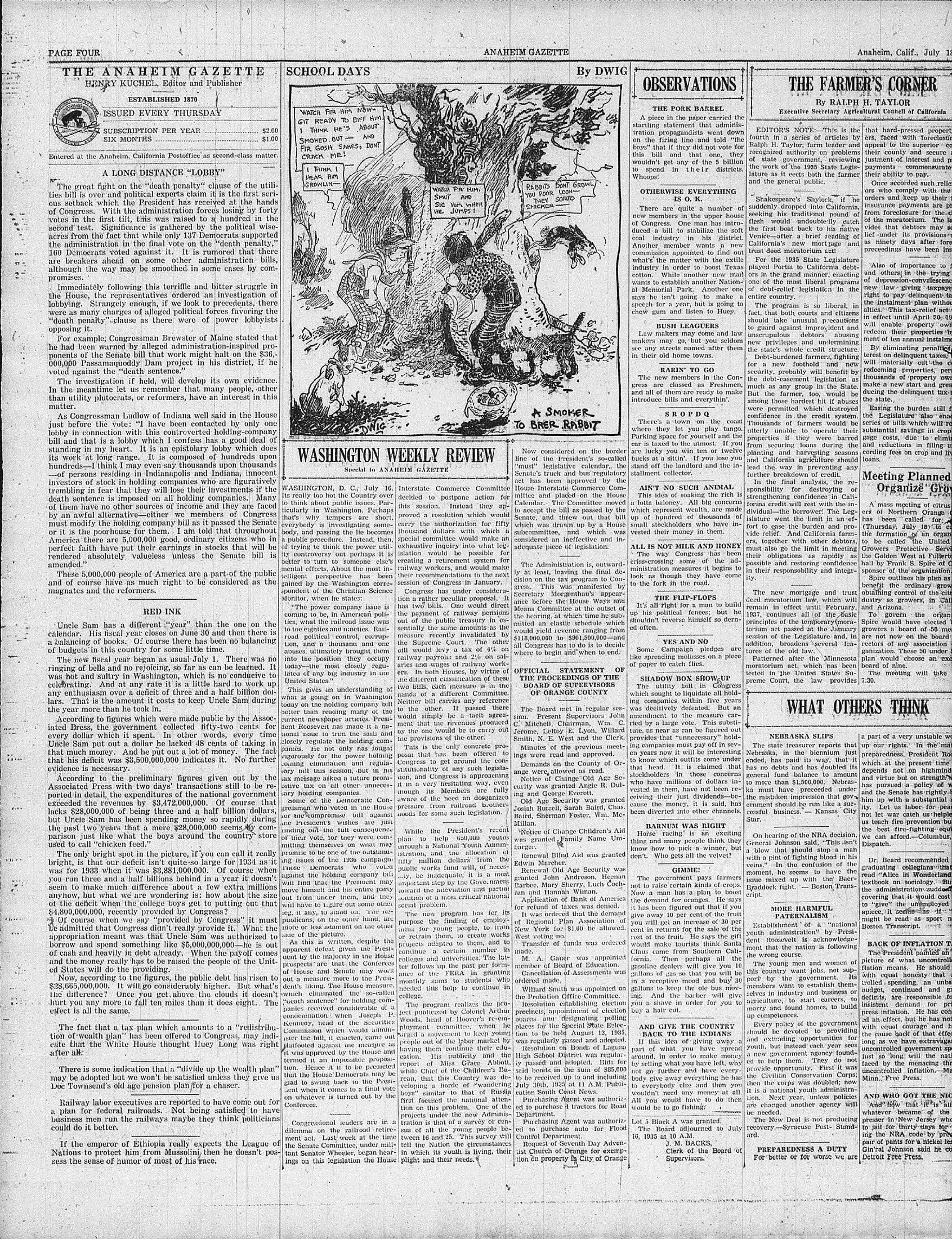
SCHOOL DAYS
By DWIG
WATCH FIR HIM NOW-GIT READY TO DIFF HIM.
I THINK HE'S ABOUT SMOKED OUT — AND FIR GOSH SAHES, DON'T CRACK ME!
I THINK I HEAR HIM GROWLIN—
WATCH FIR HIM, SMUT AND SIC HIM WHEN HE JUMPS!
RABBITS DONT GROWL YOU POOR LOOK—they SORTO SHICKER—
A SMOKER TO BRER RABBIT
WASHINGTON WEEKLY REVIEW
Now considered on the border line of the President's so-called OBSESSION
THE B
A piece in startling stance propelling on the firin boys" that if this bill a wouldn't get to spend Whoops!
OTHERW
There are new members of Congress.
duced a bill coal industry
Another commission what's the m industry in cotton. Wh wants to est al Memorial says he isn't speech for a chew gum a
BUS
Law makers may see any street in their old
RAF
The new grees are c and all of the introduce bill
S
There's a where they Parking space car is taxed are lucky you bucks at a si
WASHINGTON, D. C., July 16. Its really too hot the Country over to think about public issues. Particularly in Washington. Perhaps that's why tempers are short, everybody is investigating somebody, and passing the lie becomes a public procedure. Instead, then, of trying to think the power utility controversy out perhaps it is better to turn to someone else's mental efforts. About the most intelligent perspective has been gained by the Washington correspondent of the Christian-Science Monitor, when he states:
"The power company issue is coming to be, in American politics, what the railroad issue was to the eighties and nineties. Railroad political control, corruption, and a thousand and one abuses, ultimately brought them into the position they occupy today—the most closely regulated of any big industry in the United States."
This gives an understanding of what is going on in Washington today on the holding company bill better than reading many of the current newspaper articles. President Roosevelt has made it a national issue to trim the sails and closely regulate the holding companies. He not only has fought vigorously for the power holding coming elimination and regulatory bill this session, but in his tax message asked a future primitive tax on all other unnecessary holding companies.
Some of the Democratic Congressmen who voted in the House for the compromise bill against one President's wishes are just finding out the full consequence of their vote, for they were committing themselves on what may promise to be one of the outstanding issues of the 1936 campaign. Those Democrats who voted against the holding company bill
Interstate Commerce Committee decided to postpone action for this session. Instead they approved a resolution which would carry the authorization for fifty thousand dollars with which a special committee would make an exhaustive inquiry into what legislation would be possible for creating a retirement system for railway workers, and would make their recommendations to the next session of Congress in January.
Congress has under consideration a rather peculiar proposal. It has two bills. One would direct the payment of railway pensions out of the public treasury in essentially the same amounts as the measure recently invalidated by the Supreme Court. The other bill would levy a tax of 4% on railway payrolls and 2% on salaries and wages of railway workers. In both Houses, by virtue of one different classification of these two bills, each measure is in the hands of a different Committee. Neitner bill carries any reference to the other. If passed there would simply be a tacit agreement that the revenues produced by the one would be to carry out the provisions of the other.
This is the only concrete proposal that has been offered to Congress to get around the constitutionality of any such legislation, and Congress is approaching it in a very hesitating way, even though its Members are fully aware of the need an doorganized pressure from railroad brotherhoods for some such legislation.
While the President's recent plan to help 650,000 youths through a National Youth Administration, and the allocation of fifty million dollars from the public works fund will, of necessity, be inadequate it is a most now considered on the border line of the President's so-called "must" legislative calendar, the Senate's truck and bus regulatory act has been approved by the House Interstate Commerce Committee and placed on the House Calendar. The Committee moved to accept the bill as passed by the Senate, and threw out that bill which was drawn up by a House subcommittee, and which was considered an ineffective and inadequate piece of legislation.
The Administration is, outwardly at least, leaving the final decision on the tax program to Congress. This was manifested by Secretary Morgenthau's appearance before the House Ways and Means Committee at the outset of the hearing, at which time he submitted an elastic schedule which would yield revenue ranging from $118,000,000 to $901,500,000—and all Congress has to do is to decide where to begin and when to end.
OFFICIAL STATEMENT OF THE PROCEEDINGS OF THE BOARD OF SUPERVISORS OF ORANGE COUNTY
The Board met in regular session. Present Supervisors John C. Mitchell, Chairman, Wm. C. Jerome, LeRoy E. Lyon, Willard Smith, N. E. West and the Clerk.
Minutes of the previous meetings were read and approved.
Demands on the County of Orange were allowed as read.
Notice of Change Old Age Security was granted Angie R. Dulging and George Everett.
Old Age Security was granted Josiah Russell, Sarah Baird, Chas. Baird, Sherman Foster, Wm. McMillan.
Notice of Change Children's Aid was granted Family Name Umbarger.
Renewal Blind Aid was granted Edwin Marcher.
Renewal Old Age Security was
tax message asked a future promotive tax on all other unnecessary holding companies.
Some of the Democratic Congressmen who voted in the House for the compromise bill against one President's wishes are just finding out the full consequence of their vote, for they were committing themselves on what may promise to be one of the outstanding issues of the 1930 campaign. Those Democrats who voted against the holding company bill will find that the President may move himself and his entire party out from uncerer, and they will have to figure out some other, it any, to stand on. The republicans, on the other hand, are more or less adamant on the other side of the picture.
As this is written, despite the apparent defeat given the President by the majority in the House prospects are that the Conferences of House and Senate may work out a measure more to the President's liking. The House measure, which eliminated the so-called "death sentence" for holding companies received considerable of a concentration when Joseph P. Kennedy, head of the Securities Commission which would administer the bill, it enacted, came out plattform against one measure as it was approved by the House and termed it an impossible proposition. Hence it is to be predicted that the House Democrats may be glad to swing back to the President when it comes to a final vote on whatever is turned out by the Conferences.
Congressional leaders are in a dilemma on the railroad retirement act. Last week at the time the Senate Committee, under militant Senator Wheeler, began hearings on this legislation the House
While the President's recent plan to help 650,000 youths through a National Youth Administration, and the allocation of fifty million dollars from the public works fund will, of necessity, be inadequate, it is a most important step by the Government toward the alleviation and partial solution of a most critical national social problem.
The new program has for its purpose the finding of employment for young people, to train or retrain them, to create works projects adapted to them, and to continue a certain number in colleges and universities. The latter follows up the past per formation of the FERA in granting monthly sums to students who needed this help to continue in college.
The program realizes the project publicized by Colonel Arthur Woods, head of Hoover's re-employment committee, when he argued a movement to keep young people out of the labor market by having them continue their education. His publicity and the report of Miss Grace Abbott, while Chief of the Children's Bureau, that this Country was developing a horde of "wandering boys" similar to that of Russia first focused the national attention on this problem. One of the projects under the new Administration is that of a survey or census of all the young people between 16 and 25. This survey will tell the Nation the circumstances in which its youth is living, their plight and their needs.
Notice of Change Old Age Security was granted Angie R. Dulling and George Everett.
Old Age Security was granted Josiah Russell, Sarah Baird, Chas Baird, Sherman Foster, Wm. McMillan.
Notice of Change Children's Aid was granted Family Name Umbarger.
Renewal Blind Aid was granted Edwin Marcher.
Renewal Old Age Security was granted John Andreson, Heenan Barbee, Mary Sherry, Luch Cochran and Hannah Wiman.
Application of Bank of America for refund of taxes was denied.
It was ordered that the demand of Regional Plan Association of New York for $1.00 be allowed. West voting no.
Transfer of funds was ordered made.
M. A. Gauer was appointed member of Board of Education.
Cancellation of Assessments was ordered made.
Willard Smith was appointed on the Probation Office Committee.
Resolution establishing election precincts, appointment of election poorest and designating polling places for the Special State Election to be held August 13, 1935, was regularly passed and adopted.
Resolution on Bonds of Laguna High School District was regularly passed and adopted. Bids for said bonds in the sum of $85,000 to be received up to and including July 30th, 1935 at 11 A.M. Publication South Coast News.
Purchasing Agent was authorized to purchase 4 tractors for Road Department.
Purchasing Agent was authorized to purchase auto for Flood Control Department.
Request of Seventh Day Adventist Church of Orange for exemption on property in City of Orange
OBSERVATIONS
THE PORK BARREL
A piece in the paper carried the startling statement that administration propagandists went down on the firing line and told "the boys" that if they did not vote for this bill and that one, they wouldn't get any of the 5 billion to spend in their districts. Whoops!
OTHERWISE EVERYTHING IS O. K.
There are quite a number of new members in the upper house of Congress. One man has introduced a bill to stabilize the soft coal industry in his district. Another member wants a new commission appointed to find out what's the matter with the extile industry in order to boost Texas cotton. While another new man wants to establish another National Memorial Park. Another one says he isn't going to make a speech for a year, but is going to chew gum and listen to Huey.
BUSH LEAGUERS
Law makers may come and law makers may go; but you seldom see any streets named after them in their old home towns.
RARIN' TO GO
The new members in the Congress are classed as Freshmen, and all of them are ready to make introduce bills and everythin'.
S R O P D Q
There's a town on the coast where they let you play tango. Parking space for yourself and the car is taxed to the utmost. If you are lucky you win ten or twelve bucks at a sittin'. If you lose you
THE FARMER'S CORNER
By RALPH H. TAYLOR
Executive Secretary Agricultural Council of California
EDITOR'S NOTE:—This is the fourth in a series of articles by Ralph H. Taylor, farm leader and recognized authority on problems of state government, reviewing the work of the 1935 State Legislature as it ects both the farmer and the general public.
Shakespeare's Shylock, if he suddenly dropped into California, seeking his traditional pound of flesh would undoubtedly catch the first boat back to his native Venice—a brief reading of California's new mortgage and trust deed moratorium set!
For the 1935 State Legislature played Portia to California debtors in the grand manner, enacting one of the most liberal programs of debt-relief legislation in the entire country.
The program is so liberal, in fact, that both courts and citizens should take unusual precautions to guard against improvident and unscrupulous debtors abusing new privileges and undermining the state's whole credit structure.
Debt-burdened farmers, fighting for a new foothold and new security, probably will benefit by the debt-casement legislation as much as any group in the State. But the farmer, too, would be among those hardest hit if abuses were permitted which destroyed confidence in the credit system. Thousands of farmers would be utterly unable to operate their properties if they were barred from securing loans during the planting and harvesting seasons and California agriculture should that hard-pressed propertyers, faced with foreclosure appeal to the superior county and secure a justment of interest and payments commensurate their ability to pay.
Once accorded such reliefs who comply with their orders and keep up their insurance payments are priced from foreclosure for the debt of the moratorium. The lawsVIDES that debtors may sell lie under its provisions as ninety days after foreclosure have been insisted upon.
Also of importance to farmers in the trying depression-convalescence new law giving taxpayer right to pay delinquent taxes the instalment plan without altties. This tax-relief act is effect until April 20, 1939 will enable property owners redeem their properties by ment of ten annual instalments.
By eliminating penalties, terrest on delinquent taxes, will materially cut the redeeming properties, per thousands of property owners make a new start and greatly reducing the delinquent tax on the state.
Easing the burden still for the Legislature also enacts series of bills which will reduce substantial savings in cropage costs, due to eliminations and reductions in filing cording fees on crop and livestock loans.
RARIN' TO GO
The new members in the Congress are classed as Freshmen, and all of them are ready to make introduce bills and everythin'.
S R O P D Q
There's a town on the coast where they let you play tango. Parking space for yourself and the car is taxed to the utmost. If you are lucky you win ten or twelve bucks at a sittin'. If you lose you stand off the landlord and the installment collector.
AIN'T NO SUCH ANIMAL
This idea of soaking the rich is a lotta baloney. All big concerns which represent wealth, are made up of hundred of thousands of small stockholders who have invested their money in them.
ALL IS NOT MILK AND HONEY
The way Congress has been criss-crossing some of the administration measures it begins to look as though they have come to the fork in the road.
THE FLIP-FLOPS
It's all right for a man to build up his political fences; but he shouldn't reverse himself so derned often.
YES AND NO
Some Campaign pledges are like spreading molasses on a piece of paper to catch flies.
SHADOW BOX SHOW UP
The utility bill in Congress which sought to liquidate all holding companies within five years was decisively defeated. But an amendment to the measure carried by a large vote. This substitute, as near as can be figured out provides that "unnecessary" holding companies must pay off in seven years now it will be interesting to know which outfits come under that head. It is claimed that stockholders in those concerns who have millions of dollars invested in them, have not been receiving their just dividends—because the money, it is said, has been diverted into other channels.
BARNUM WAS RIGHT
Horse racing is an exciting thing and many people think they know how to pick a winner, but don't. Who gets all the velvet?
GIMME!
NEBRASKA SLIPS
The state treasurer reports that Nebraska, in the biennium just ended, has paid its way, that it has no debts and has doubled its general fund balance to amount to more than $1,500,000. Nebraska must have preceded under the mistaken impression that government should be run like a successful business. — Kansas City Star.
On hearing of the NRA decision, General Johnson said, "This isn't a blow that should stop a man with a pint of fighting blood in his veins." In the confusion of the moment, he seems to have the part of a very unstable world up our rights. In the mid-preparedness, President Roosevelt which at the present time depends not on high-minded and virtue but on strength has pursued a policy of war and the Senate has rightly him up with a substantiality. Let us labor for peace not let war catch us help us teach fire prevention but the best fire-fighting equipment can afford.—Columbus, Dispatch.
Dr. Beard recommended graduating collegians treated "Alice in Wonderland."
BARNUM WAS RIGHT
Horse racing is an exciting thing and many people think they know how to pick a winner, but don't. Who gets all the velvet?
GIMME!
The government pays farmers not to raise certain kinds of crops. Now a man has a plan to boost the demand for oranges. He says it has been figured out that if you give away 10 per cent of the fruit you will get an increase of 30 per cent in returns for the sale of the rest of the fruit. He says the gift would make tourists think Santa Claus came from Southern California. Then perhaps all the gasoline dealers will give you 10 gallons of gas so that you will be in a receptive mood and buy 30 gallons to keep the ole bus moving. And the barber will give you a shave in order for you to buy a hair cut.
AND GIVE THE COUNTRY BACK TO THE INDIANS
If this idea of giving away a part of what you have spread around, in order to make money by selling what you have left, why not go further and have everybody give away everything he has to everybody else and then you wouldn't need any money at all. All you would have to do then would be to go fishing:
Lot 5 Black A was granted.
The Board adjourned to July 10, 1935 at 10 A.M.
J. M. BACKS,
Clerk of the Board of Supervisors,
On hearing of the NRA decision, General Johnson said, "This isn't a blow that should stop a man with a pint of fighting blood in his veins." In the confusion of the moment, he seems to have the issue mixed up with the Baer-Braddock fight. — Boston Transcript.
MORE HARMFUL PATERNALISM
Establishment of a "national youth administration" by President Roosevelt is acknowledgment that the nation is following the wrong course.
The young men and women of this country want jobs, not support by the government. Its members want to establish themselves in industry and business or agriculture, to start careers, to marry and found homes, to build up competences.
Every policy of the government should be devoted to providing and extending opportunities for youth, but instead each year sees a new government agency founded to help them. They do not provide opportunity. First it was the Civilian Conservation Corps; then the corps was doubled; now it is a national youth administration. Next year, unless policies are changed another agency will be needed.
The New Deal is not producing recovery—Syracuse Post-Standard.
PREPAREDNESS A DUTY
For better or for worse we are
Dr. Beard recommended graduating collegians that read "Alice in Wonderland" textbook on sociology. But the administration suddow covered that it would cost too "give" the unemployed apiece, it seems as if it might be read as sporting Boston Transcript.
BACK OF INFLATION T
The President painted an picture of what uncontrolled flation means. He should with equal honesty that trolled spending, an unbalanced budget, continued and gave deficits, are responsible for insistent demand for press inflation. He has conceived an effect, but he has not with equal courage and had the cause back of that effect long as we have extravagant uncontrolled government spent just so long will the nation faced by the menacing third uncontrolled inflation—Ma Minn., Free Press.
AND WHO GOT THE NICHT
And how that it is all whatever became of the presser in New Jersey who to jail for thirty days for ing the NRA code by pre-pair of pants for a nickel less Gin'ral Johnson said he coDetroit Free Press.