anaheim-gazette 1935-07-11
Scanned page
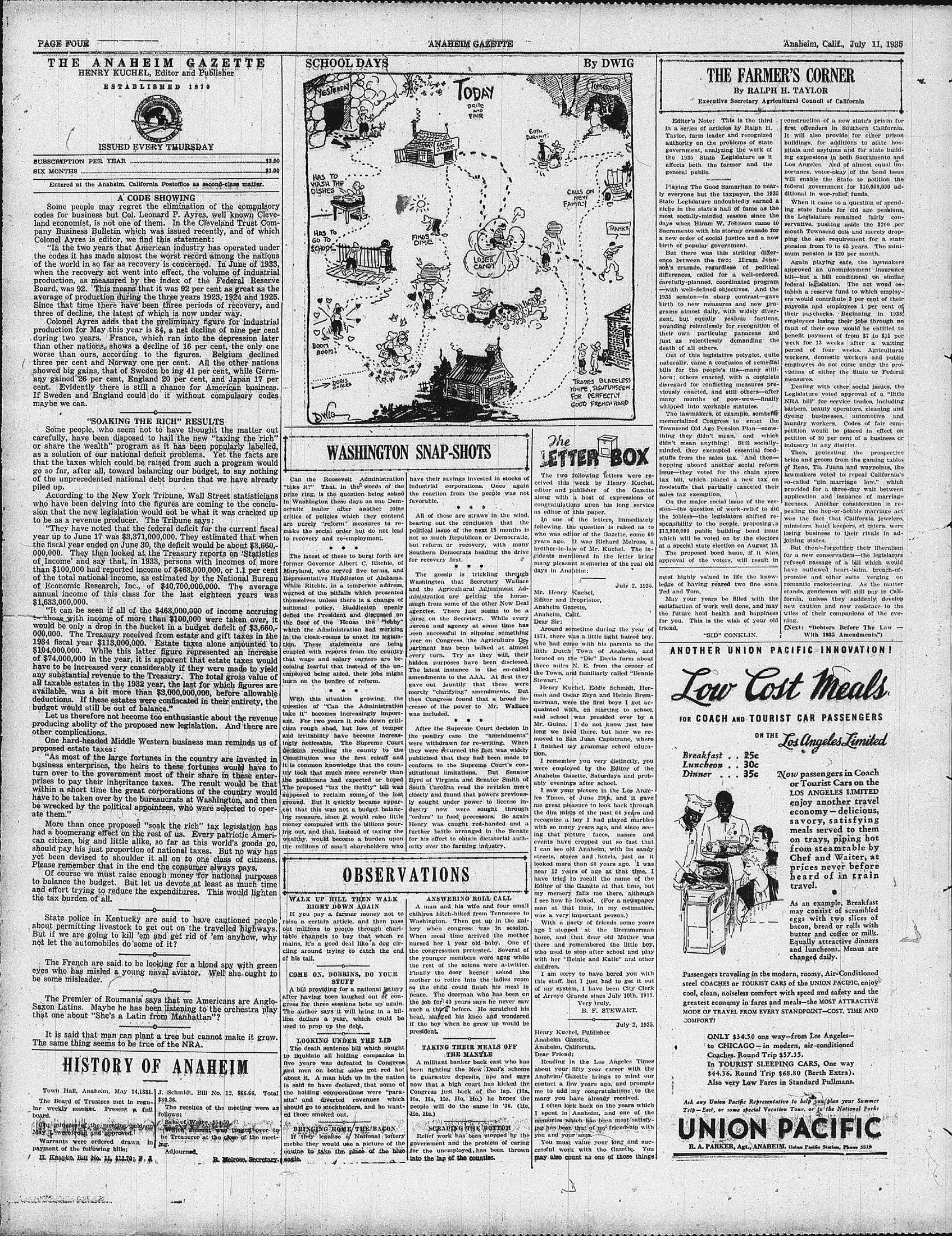
Searchable text
THE ANAHEIM GAZETTE
HENRY KUCHEL, Editor and Publisher
ESTABLISHED 1879
ISSUED EVERY THURSDAY
SUBSCRIPTION PER YEAR ... $2.00
SIX MONTHS ... $1.00
Entered at the Anaheim, California Postoffice as second-class matter.
A CODE SHOWING
Some people may regret the elimination of the compulsory codes for business but Col. Leonard P. Ayres, well known Cleveland economist, is not one of them. In the Cleveland Trust Company Business Bulletin which was issued recently, and of which Colonel Ayres is editor, we find this statement:
"In the two years that American industry has operated under the codes it has made almost the worst record among the nations of the world in so far as recovery is concerned. In June of 1933, when the recovery act went into effect, the volume of industrial production, as measured by the index of the Federal Reserve Board, was 92. This means that it was 92 per cent as great as the average of production during the three years 1923, 1924 and 1925. Since that time there have been three periods of recovery, and three of decline, the latest of which is now under way.
Colonel Ayres adds that the preliminary figure for industrial production for May this year is 84, a net decline of nine per cent during two years. France, which ran into the depression later than other nations, shows a decline of 16 per cent, the only one worse than ours, according to the figures. Belgium declined three per cent and Norway one per cent. All the other nations showed big gains, that of Sweden being 41 per cent, while Germany gained 26 per cent, England 20 per cent, and Japan 17 per cent. Evidently there is still a chance for American business. If Sweden and England could do it without compulsory codes maybe we can."
"SOAKING THE RICH" RESULTS
Some people, who seem not to have thought the matter out carefully, have been disposed to hail the new "taxing the rich" or share the wealth" program as it has been popularly labelled, as a solution of our national deficit problems. Yet the facts are
"SOAKING THE RICH” RESULTS
Some people, who seem not to have thought the matter out carefully, have been disposed to hail the new “taxing the rich” or share the wealth” program as it has been popularly labelled, as a solution of our national deficit problems. Yet the facts are that the taxes which could be raised from such a program would go so far, after all, toward balancing our budget, to say nothing of the unprecedented national debt burden that we have already piled up.
According to the New York Tribune, Wall Street statisticians who have been delving into the figures are coming to the conclusion that the new legislation would not be what it was cracked up to be as a revenue producer. The Tribune says:
“They have noted that the federal deficit for the current fiscal year up to June 17 was $3,371,000,000. They estimated that when the fiscal year ended on June 30, the deficit would be about $3,660,-000,000. They then looked at the Treasury reports on ‘Statistics of Income’ and say that, in 1933, persons with incomes of more than $100,000 had reported income of $468,000,000, or 1.1 per cent of the total national income, as estimated by the National Bureau of Economic Research, Inc., of $40,700,000,000. The average annual income of this class for the last eighteen years was $1,633,000,000.
“It can be seen if all of the $468,000,000 of income accruing to those with income of more than $100,000 were taken over, it would be only a drop in the bucket in a budget deficit of $3,660,-000,000. The Treasury received from estate and gift taxes in the 1934 fiscal year $113,000,000. Estate taxes alone amounted to $104,000,000. While this latter figure represented an increase of $74,000,000 in the year, it is apparent that estate taxes would have to be increased very considerably if they were made to yield any substantial revenue to the Treasury. The total gross value of all taxable estates in the 1932 year, the last for which figures are available, was a bit more than $2,000,000,000, before allowable deductions. If these estates were confiscated in their entirety, the budget would still be out of balance.”
Let us therefore not become too enthusiastic about the revenue producing abolity of the proposed new legislation. And there are other complications.
One hard-headed Middle Western business man reminds us of proposed estate taxes:
“As most of the large fortunes in the country are invested in business enterprises, the heirs to these fortunes would have to turn over to the government most of their share in these enterprises to pay their inheritance taxes. The result would be that within a short time the great corporations of the country would have to be taken over by the bureaucrats at Washington, and then be wrecked by the political appointees, who were selected to operate them.”
More than once proposed “soak the rich” tax legislation has had a boomerang effect on the rest of us. Every patriotic American citizen, big and little alike, so far as this world’s goods go, should pay his just proportion of national taxes. But no way has yet been devised to shoulder it all on to one class of citizens. Please remember that in the end the consumer always pays.”
More than once proposed "soak the rich" tax legislation has had a boomerang effect on the rest of us. Every patriotic American citizen, big and little alike, so far as this world's goods go, should pay his just proportion of national taxes. But no way has yet been devised to shoulder it all on to one class of citizens. Please remember that in the end the consumer always pays.
Of course we must raise enough money for national purposes to balance the budget. But let us devote at least as much time and effort trying to reduce the expenditures. This would lighten the tax burden of all.
State police in Kentucky are said to have cautioned people about permitting livestock to get out on the travelled highways. But if we are going to kill 'em and get rid of 'em anyhow, why not let the automobiles do some of it?
The French are said to be looking for a blond spy with green eyes who has misled a young naval aviator. Well she ought to be some misleader.
The Premier of Roumania says that we Americans are Anglo-Saxon Latins. Maybe he has been listening to the orchestra play that one about "She's a Latin from Manhattan"?
It is said that man can plant a tree but cannot make it grow. The same thing seems to be true of the NRA.
HISTORY OF ANAHEIM
Town Hall, Anaheim, May 14, 1881.
The Board of Trustees met in regular weekly session. Present a full board.
The minutes of the meeting held on May 14 were read and approved.
Warrants were ordered drawn in payment of the following bills:
H. Knapko, Bill No. 11, $13.70; H. J.
J. Schmidt, Bill No. 12, $66.66. Total $50.36.
The receipts of the meeting were as follows:
Saldo of Water, $54.50.
Which amount was tendered over to the Treasurer at the close of the meeting.
Adjourned.
R. Melrose, Secretary.
SCHOOL DAYS
By DWIG
YESTERDAY
TODAY
DRITE AND FAIR
TONIGHT
CANDY STORE
GOSH DURMNT!
HAS TO WASH THE DISHES
CALLS ON NEW FAMILY
HAS TO GO TO SCHOOL
FINDS DIME
LOSES CANDY
THANKS
BOOM BOOM!
DORIS ENTERS
TRADES BLADELESS KNIFE, SIGHTUNSEEM FOR PERFECTLY GOOD FRENCH HARD
WASHINGTON SNAP-SHOTS
The LETTER BOX
WASHINGTON SNAP-SHOTS
Can the Roosevelt Administration "take it?" That, in the words of the prize ring, is the question being asked in Washington these days as one Democratic leader after another joins critics of policies which they contend are purely "reform" measures to remake the social order but do not lead to recovery and re-employment.
The latest of these to burst forth are former Governor Albert C. Ritchie, of Maryland, who served five terms, and Representative Huddleston of Alabama. While Ritchie, in a temperate address, warned of the pitfalls which presented themselves unless there is a change of national policy, Huddleston openly defied the President and discussed on the floor of the House the "lobby" which the Administration had working in the cloak-rooms to enact its legislation. These statements are being coupled with reports from the country that wage and salary earners are becoming fearful that instead of the unemployed being aided, their jobs might burn on the bonfire of reform.
With this situation growing, the question of "Can the Administration take it" becomes increasingly important. For two years it rode down criticism rough shod, but loss of temper and irritability have become increasingly noticeable. The Supreme Court decision recalling the county to the Constitution was the first rebuff and it is common knowledge that the country took that much more serenely than the politicians had expected or hoped. The proposed "tax the thrifty" bill was supposed to reclaim some of the lost ground. But it quickly became apparent that this was not a budget balancing measure, since it would raise little money compared with the billions pouring out, and that, instead of taxing the wealthy, would become a burden upon the millions of small shareholders who have their savings invested in stocks of industrial corporations. Once again the reaction from the people was not favorable.
All of these are straws in the wind, bearing out the conclusion that the political issue of the next 15 months is not so much Republican or Democratic, but reform or recovery, with many Southern Democrats heading the drive for recovery first.
The gossip is trickling through Washington that Secretary Wallace and the Agricultural Adjustment Administration are getting the horsehaugh from some of the other New Deal agencies. There just seems to be a curse on the Secretary. While every bureau and agency at some time has seen successful in slipping something over on Congress, the Agriculture Department has been balked at almost every turn. Try as they will, their hidden purposes have been disclosed. The latest instance is the so-called amendments to the AAA. At first they gave out jauntily that these were merely "clarifying" amendments. But then Congress found that a broad increase of the power to Mr. Wallace was included.
After the Supreme Court decision in the poultry case the "amendments" were withdrawn for re-writing. When they were returned the fact was widely publicized that they had been made to conform to the Supreme Court's constitutional limitations. But Senator Byrd of Virginia and Senator Smith of South Carolina read the revision more closely and found that powers previously sought under power to license industry now were sought through "orders" to food precessors. So again Henry was caught red-handed and a further battle arranged in the Senate for his effort to obtain dictatorial authority over the farming industry.
The two following letters were received this week by Henry Kuchel, editor and publisher of the Gazette along with a host of expressions of congratulations upon his long service as editor of this paper.
In one of the letters, immediately following, the question is raised as to who was editor of the Gazette, some 60 years ago. It was Richard Melrose, a brother-in-law of Mr. Kuchel. The incidents mentioned in the letter bring many pleasant memories of the real old days in Anaheim:
July 2, 1935.
Mr. Henry Kuchel,
Editor and Proprietor,
Anahelm Gazette,
Anahelm, Calif.
Dear Sir:
Around sometime during the year of 1871, there was a little light haired boy, who had come with his parents to the little Dutch Town of Anaheim, and located on the "Die" Davis farm about three miles N. E. from the center of the Town, and familiarly called "Bennie Stewart."
Henry Kuchel, Eddie Schmidt, Herman and Oscar Zeyn and Heinie Bremerman, were the first boys I got acquainted with, on starting to school, said school was presided over by a Mr. Guinn. I do not know just how long we lived there, but later we removed to San Juan Capistrano, where I finished my grammar school education.
I remember you very distinctly, you were employed by the Editor of the Anaheim Gazette, Saturdays and probably evenings after school.
I saw your picture in the Los Angeles Times, of June 29th, and it gave me great pleasure to look back through the dim mists of the past 64 years and recognize a boy I had played marbles with so many years ago, and since seeing that picture faces, names and events have cropped out so fast that I can see old Anaheim, with its sandy streets, stores and hotels, just as it looked more than 60 years ago. I was near 12 years of age at that time.
the politicians had expected or hoped
The proposed "tax the thrifty" bill was supposed to reclaim some of the lost ground. But it quickly became apparent that this was not a budget balancing measure, since it would raise little money compared with the billions pouring out, and that, instead of taxing the wealthy, would become a burden upon the millions of small shareholders who
OBSERVATIONS
WALK UP HILL THEN WALK RIGHT DOWN AGAIN
If you pay a farmer money not to raise a certain article, and then pass out millions to people through charitable channels to buy that which remains, it's a good deal like a dog circling around trying to catch the end of his tail.
COME ON. DOBBINS, DO YOUR STUFF
A bill providing for a national lottery after having been laughed out of congress for three sessions bobs up again. The author says it will bring in a billion dollars a year, which could be used to prop up the debt.
LOOKING UNDER THE LID
The death sentence bill which sought to liquidate all holding companies in five years was defeated in Congress and men on both sides got red hot about it. A man high up in the nation is said to have declared that some of the holding corporations were "parasites" and diverted revenues which should go to stockholders, and he wanted those smoked out.
BRINGING HOME/THE BACON
If they legalize a National lottery mebbe they would use a picture of the equine to take the place of the blue eagle.
ANSWERING ROLL CALL
A man and his wife and four small children hitch-hiked from Tennessee to Washington. Then got up in the gallery when congress was in session. When meal time arrived the mother nursed her 1 year old baby. One of the congressmen protested. Several of the younger members wore agog while the rest of the solons were a-twitter. Finally the door keeper asked the mother to retire into the ladies room so the child could finish his meal in peace. The doorman who has been on the job for 40 years says he never saw such a thing before. He scratched his head, slapped his knee and wondered if the boy when he grew up would be president.
TAKING THEIR MEALS OFF THE MANTLE
A militant banker back east who has been fighting the New Deal's scheme to guarantee deposits, ups and says now that a high court has kicked the Congress just back of the lap. (Ha, Ha, Ha, Ho, Ho.) he hopes the people will do the same in '36. (He, He, He.)
SCRAPING THE BOTTOM
Relief work has been stopped by the government and the problem of caring for the unemployed, has been thrown into the lap of the counties.
I saw your picture in the Los Angeles Times, of June 29th, and it gave me great pleasure to look back through the dim mists of the past 64 years and recognize a boy I had played marbles with so many years ago, and since seeing that picture faces, names and events have cropped out so fast that I can see old Anaheim, with its sandy streets, stores and hotels, just as it looked more than 60 years ago. I was near 12 years of age at that time, I have tried to recall the name of the Editor of the Gazette at that time, but my memory fails me there, although I see how he looked. (For a newspaper man at that time, in my estimation, was a very important person.)
With a party of friends some years ago I stopped at the Bremmerman home, and that dear old Mother was there and remembered the little boy, who used to stop after school and play with her "Heinie and Katie" and other children.
I am sorry to have bored you with this stuff, but I just had to get it out of my system. I have been City Clerk of Arroyo Grande since July 10th, 1911.
Very truly,
B. F. STEWART.
July 2, 1935.
Henry Kuchel, Publisher
Anaheim Gazette,
Anaheim, California.
Dear Friend:
Reading in the Los Angeles Times about your fifty year career with the Anaheim Gazette brings to mind our contact a few years ago, and prompts me to add my congratulations to the many you have already received.
I often look back on the years which I spent in Anaheim, and one of the memories which has been most satisfying has been that of my friendship with you and your sons.
You must value your long and successful work with the Gazette. You may also count as one of those things
THE FARMER'S CORNER
By RALPH H. TAYLOR
Executive Secretary Agricultural Council of California
Editor's Note: This is the third in a series of articles by Ralph H. Taylor, farm leader and recognized authority on the problems of state government, analyzing the work of the 1935 State Legislature as it affects both the farmer and the general public.
Playing The Good Samaritan to nearly everyone but the taxpayer, the 1935 State Legislature undoubtedly earned a niche in the state's hall of fame as the most socially-minded session since the days when Hiram W. Johnson came to Sacramento with his stormy crusade for a new order of social justice and a new birth of popular government.
But there was this striking difference between the two; Hiram Johnson's crusade, regardless of political differences, called for a well-ordered, carefully-planned, coordinated program—with well-defined objectives. And the 1935 session—in sharp contrast—gave birth to new measures and new programs almost daily, with widely divergent, but equally zealous factions, pounding relentlessly for recognition of their own particular panaceas and just as relentlessly demanding the death of all others.
Out of this legislative polyglot, quite naturally, came a confusion of remedial bills for the people's ill—many still-born; others enacted, with a complete disregard for conflicting measures previously enacted, and still others—after many months of pow-wow—finally whipped into workable statutes.
The lawmakers, of example, somberly memorialized Congress to enact the Townsend Old Age Pension Plan—something they didn't mean, and which didn't mean anything! Still socially-minded, they exempted essential food-stuffs from the sales tax. And then—construction of a new state's prison for first offenders in Southern California. It will also provide for other prison buildings, for additions to state hospitals and asylums and for state building extensions in both Sacramento and Los Angeles. And of almost equal importance, voter-okay of the bond issue will enable the State to petition the federal government for $10,000,000 additional in war-relief funds.
When it came to a question of spending state funds for old age pensions, the Legislature remained fairly conservative, pushing aside the $200 per month Townsend dole and merely dropping the age requirement for a state pension from 70 to 65 years. The minimum pension is $20 per month.
Again playing safe, the lawmakers approved an unemployment insurance bill—but a bill conditional on similar federal legislation. The act would establish a reserve fund to which employers would contribute 3 per cent of their payrolls and employees 1 per cent of their paychecks. Beginning in 1938, employees losing their jobs through no fault of their own would be entitled to benefit payment of from $7 to $15 per week for 13 weeks after a waiting period of four weeks. Agricultural workers, domestic workers and public employees do not come under the provisions of either the State or Federal measures.
Dealing with other social issues, the Legislature voted approval of a "little NRA bill" for service trades, including barbers, beauty operators, cleaning and dyeing businesses, automotive and laundry workers. Codes of fair competition would be placed in effect on petition of 80 per cent of a business or industry in any district.
Then, protecting the prospective bride and groom from the gaming tables
ANOTHER UNION PACIFIC INNOVATION!
Low Cost Meals
FOR COACH AND TOURIST CAR PASSENGERS
ON THE Los Angeles Limited
Breakfast . . 25c
Luncheon . . 30c
Dinner . . 35c
Now passengers in Coach or Tourist Cars on the LOS ANGELES LIMITED enjoy another travel economy—delicious, savory, satisfying meals served to them on trays, piping hot from steamtable by Chef and Waiter, at prices never before
Passengers traveling in the modern, roomy, Air-Conditioned steel COACHES or TOURIST CARS of the UNION PACIFIC, enjoy cool, clean, noiseless comfort with speed and safety and the greatest economy in fares and meals—the MOST ATTRACTIVE MODE OF TRAVEL FROM EVERY STANDPOINT—COST, TIME AND COMFORT!
ONLY $34.50 one way—from Los Angeles—to CHICAGO—in modern, air-conditioned Coaches. Round Trip $57.35.
In TOURIST SLEEPING CARS, One way $44.36. Round Trip $68.80 (Berth Extra).
Also very Low Fares in Standard Pullmans.
Ask any Union Pacific Representative to help you plan your Summer Trip—East, or some special Vacation Tour, or to the National Parks
UNION PACIFIC
R. A. PARKER, Agt., ANAHEIM. Union Pacific Station, Phone 3519