anaheim-gazette 1935-06-13
Scanned page
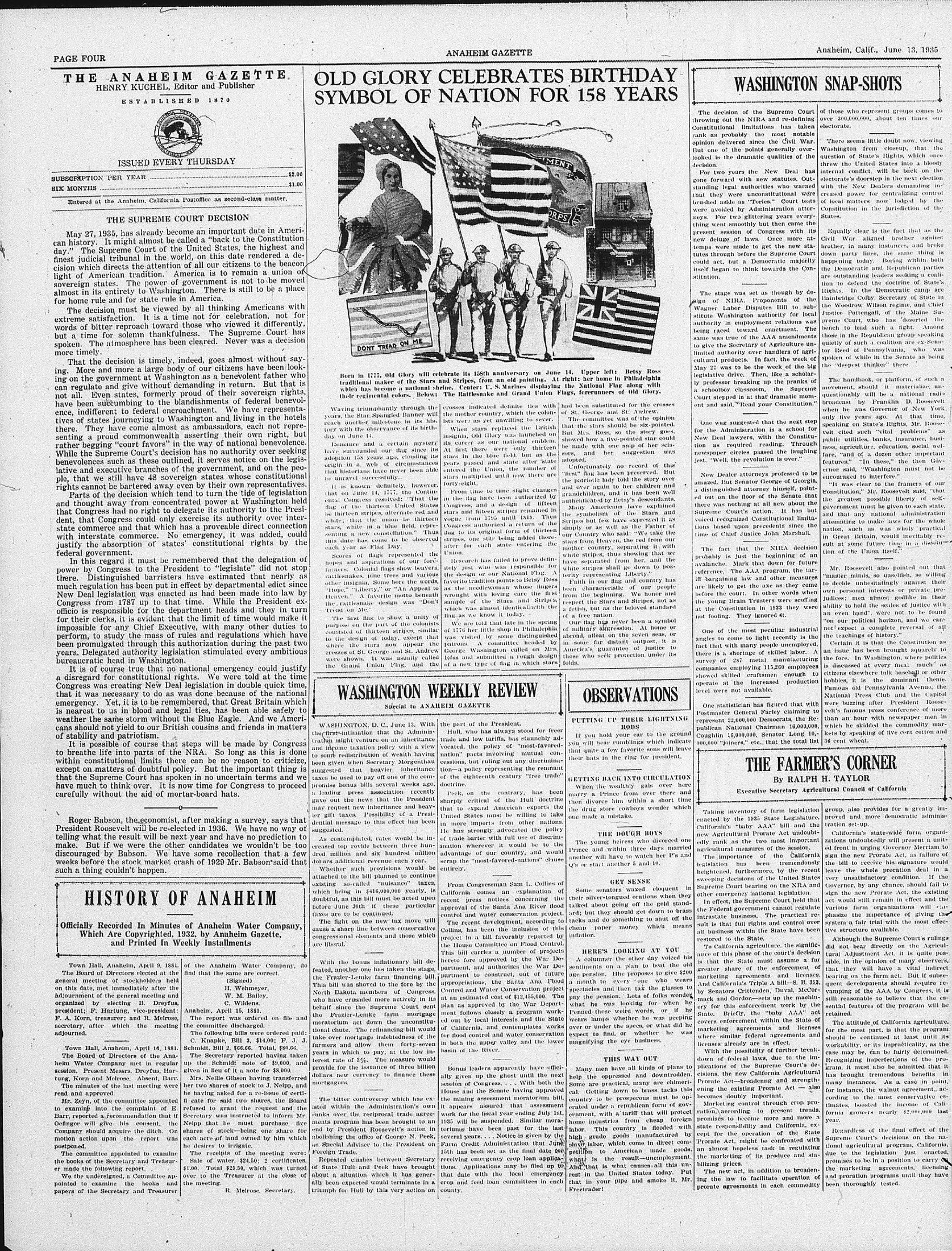
Searchable text
THE ANAHEIM GAZETTE
HENRY KUCHEL, Editor and Publisher
ESTABLISHED 1870
ISSUED EVERY THURSDAY
SUBSCRIPTION PER YEAR ... $2.00
SIX MONTHS ... $1.00
Entered at the Anaheim, California Postoffice as second-class matter.
THE SUPREME COURT DECISION
May 27, 1935, has already become an important date in American history. It might almost be called a "back to the Constitution day." The Supreme Court of the United States, the highest and finest judicial tribunal in the world, on this date rendered a decision which directs the attention of all our citizens to the beacon light of American tradition. America is to remain a union of sovereign states. The power of government is not to be moved almost in its entirety to Washington. There is still to be a place for home rule and for state rule in America.
The decision must be viewed by all thinking Americans with extreme satisfaction. It is a time not for celebration, not for words of bitter reproach toward those who viewed it differently, but a time for solemn thankfulness. The Supreme Court has spoken. The atmosphere has been cleared. Never was a decision more timely.
That the decision is timely, indeed, goes almost without saying. More and more a large body of our citizens have been looking on the government at Washington as a benevolent father who can regulate and give without demanding in return. But that is not all. Even states, formerly proud of their sovereign rights, have been succumbing to the blandishments of federal benevolence, indifferent to federal encroachment. We have representatives of states journeying to Washington and living in the hotels there. They have come almost as ambassadors, each not representing a proud commonwealth asserting their own right, but rather begging "court favors" in the way of national benevolence. While the Supreme Court's decision has no authority over seeking benevolences such as these outlined, it serves notice on the legislature.
More and more a large body of our citizens have been looking on the government at Washington as a benevolent father who can regulate and give without demanding in return. But that is not all. Even states, formerly proud of their sovereign rights, have been succumbing to the blandishments of federal benevolence, indifferent to federal encroachment. We have representatives of states journeying to Washington and living in the hotels there. They have come almost as ambassadors, each not representing a proud commonwealth asserting their own right, but rather begging "court favors" in the way of national benevolence. While the Supreme Court's decision has no authority over seeking benevolences such as these outlined, it serves notice on the legislative and executive branches of the government, and on the people, that we still have 48 sovereign states whose constitutional rights cannot be bartered away even by their own representatives.
Parts of the decision which tend to turn the tide of legislation and thought away from concentrated power at Washington held that Congress had no right to delegate its authority to the President, that Congress could only exercise its authority over interstate commerce and that which has a proveable direct connection with interstate commerce. No emergency, it was added, could justify the absorption of states' constitutional rights by the federal government.
In this regard it must be remembered that the delegation of power by Congress to the President to "legislate" did not stop there. Distinguished barristers have estimated that nearly as much regulation has been put in effect by departmental edict since New Deal legislation was enacted as had been made into law by Congress from 1787 up to that time. While the President ex-officio is responsible for the department heads and they in turn for their clerks, it is evident that the limit of time would make it impossible for any Chief Executive, with many other duties to perform, to study the mass of rules and regulations which have been promulgated through this authorization during the past two years. Delegated authority legislation stimulated every ambitious bureaucratic head in Washington.
It is of course true that no national emergency could justify a disregard for constitutional rights. We were told at the time Congress was creating New Deal legislation in double quick time, that it was necessary to do as was done because of the national emergency. Yet, it is to be remembered, that Great Britain which is nearest to us in blood and legal ties, has been able safely to weather the same storm without the Blue Eagle. And we Americans should not yield to our British cousins and friends in matters of stability and patriotism.
It is possible of course that steps will be made by Congress to breathe life into parts of the NRA. So long as this is done within constitutional limits there can be no reason to criticize, except on matters of doubtful policy. But the important thing is that the Supreme Court has spoken in no uncertain terms and we have much to think over. It is now time for Congress to proceed carefully without the aid of mortar-board hats.
Roger Babson, the economist, after making a survey, says that President Roosevelt will be re-elected in 1936. We have no way of telling what the result will be next year and have no prediction to make. But if we were the other candidates we wouldn't be too discouraged by Babson. We have some recollection that a few weeks before the stock market crash of 1929 Mr. Babson said that such a thing couldn't happen.
Roger Babson, the economist, after making a survey, says that President Roosevelt will be re-elected in 1936. We have no way of telling what the result will be next year and have no prediction to make. But if we were the other candidates we wouldn't be too discouraged by Babson. We have some recollection that a few weeks before the stock market crash of 1929 Mr. Babson said that such a thing couldn't happen.
HISTORY OF ANAHEIM
Officially Recorded In Minutes of Anaheim Water Company, Which Are Copyrighted, 1932, by Anaheim Gazette, and Printed In Weekly Installments
Town Hall, Anaheim, April 9, 1881.
The Board of Directors elected at the general meeting of stockholders held on this date, met immediately after the adjournment of the general meeting and organized by electing B. Dreyfus, president; F. Hartung, vice-president; F. A. Korn, treasurer; and R. Melrose, secretary, after which the meeting adjourned.
Town Hall, Anaheim, April 16, 1881.
The Board of Directors of the Anaheim Water Company met in regular session. Present Messrs. Dreyfus, Hartung, Korn and Melrose, Absent, Barr.
The minutes of the last meeting were read and approved.
Mr. Zeyn, of the committee appointed to examine into the complaint of E. Barr, reported a recommendation that if Oefinger will give his consent, the Company should acquire the ditch. On motion action upon the report was postponed.
The committee appointed to examine the books of the Secretary and Treasurer made the following report.
We the undersigned, a Committee appointed to examine the books and papers of the Secretary and Treasurer of the Anaheim Water Company, do find that the same are correct.
(Signed)
H. Wehmeyer,
W. M. Bailey,
C. Wildens.
Anaheim, April 15, 1881.
The report was ordered on file and the committee discharged.
The following bills were ordered paid:
C. Knapke, Bill 3, $14.00; F. J. J. Schmidt, Bill 2, $66.66. Total, $80.66.
The Secretary reported having taken up the Schmidt note of $9,000, and given in lieu of it a note for $8,000.
Mrs. Nellie Gibson having transferred her two shares of stock to J. Nelpp, and he having asked for a re-issue of certificate for said two shares, the Board refused to grant the request and the Secretary was instructed to inform Mr. Nelpp that he must purchase five shares of stock—being one share for each acre of land owned by him which he desires to irrigate.
The receipts of the meeting were:
Sale of water, $24.50; 2 certificates, $1.00. Total $25.50, which was turned over to the Treasurer at the close of the meeting.
R. Melrose, Secretary.
With the best feated another, the Frazier-L., This bill was North Dakota who have crucified since the Frazier-moratorium national chute, take over more farmers and years in which interest rate of provide for the dollars new mortgagors.
The bitter cried within ranks over the ments program end by Presidio abolishing them as Special Ad Foreign Trade.
Repeated cloister State Hull about a situationally been expected triumph for H...
OLD GLORY CELEBRATES BIRTHDAY SYMBOL OF NATION FOR 158 YEARS
Born in 1777, Old Glory will celebrate its 158th anniversary on June 14. Upper left: Betsy Ross traditional maker of the Stars and Stripes, from an old painting. At right: her home in Philadelphia which has become a national shrine. Center: U. S. Marines displaying the National Flag along with their regimental colors. Below: The Rattlesnake and Grand Union Flags, forerunners of Old Glory.
Waving triumphantly through the years, the Star Spangled Banner will reach another milestone in its history with the observance of its birthday on June 14.
Ronance and a certain mystery have surrounded our flag since its adoption 158 years ago, clouding its origin in a web of circumstances.
crosses indicated definite ties with the mother country, which the colonists were as yet unwilling to sever.
When stars replaced the British insignia, Old Glory was launched on its career as our national emblem. At first there were only thirteen stars in the blue field, but as the years passed and state after state had been substituted for the crosses of St. George and St. Andrew.
The committee was of the opinion that the stars should be six-pointed But Mrs. Ross, so the story goes showed how a five-pointed star could be made with one snip of her seasors, and her suggestion was adopted.
Waving triumphantly through the years, the Star, Spangled Banner will reach another milestone in its history with the observance of its birthday on June 14.
Romance and a certain mystery have surrounded our flag since its adoption 158 years ago, clouding its origin in a web of circumstances that historians have never been able to unravel successfully.
It is known definitely, however, that on June 14, 1777, the Continental Congress resolved: "That the flag of the thirteen United States be thirteen stripes, alternate red and white; that the union be thirteen stars, white in a blue field, representing a new constellation." Thus this date has come to be observed each year as Flag Day.
Scores of flags represented the hopes and aspirations of our forefathers. Colonial flags show beavers, rattlesnakes, pine trees and various other insignia. Some bore the words, "Hope," "Liberty," or "An Appeal to Heaven."
A favorite motto beneath the rattlesnake design was "Don't tread on Me."
The first flag to show a unity of purpose on the part of the colonists consisted of thirteen stripes, similar to the design of today, except that where the stars now appear the crosses of St. George and St. Andrew were shown. It was usually called the Grand Union Flag, and the crosses indicated definite ties with the mother country, which the colonists were as yet unwilling to sever.
When stars replaced the British insignia, Old Glory was launched on its career as our national emblem. At first there were only thirteen stars in the blue field, but as the years passed and state after state entered the Union, the number of stars multiplied until now there are forty-eight.
From time to time slight changes in the flag have been authorized by Congress, and a design of fifteen stars and fifteen stripes remained in vogue from 1795 until 1815. Then Congress authorized a return of the flag to its original form of thirteen stripes, one star being added thereafter for each state entering the Union.
Research has failed to prove definitively just who was responsible for the design or our National Flag. A favorite tradition points to Betsy Ross as the needlewoman whose fingers wrought with loving care the first sample of the Stars and Stripes, which was almost identical with the flag as we know it today.
We are told that late in the spring of 1776 her little shop in Philadelphia was visited by some distinguished patrons. A committee headed by George Washington called on Mrs. Ross and submitted a rough design of a new type of flag in which stars had been substituted for the crosses of St. George and St. Andrew.
The committee was of the opinion that the stars should be six-pointed But Mrs. Ross, so the story goes showed how a five-pointed star could be made with one snip of her scissors, and her suggestion was adopted.
Unfortunately no record of this "first" flag has been preserved. But the patriotic lady told the story over and over again to her children and grandchildren, and it has been well authenticated by Betsy's descendants.
Many Americans have explained the symbolism of the Stars and Stripes but few have expressed it as simply or as well as the Father of our Country who said: "We take the stars from Heaven, the red from our mother country, separating it with white stripes, thus showing that we have separated from her, and the white stripes shall go down to posterior representation Liberty."
Faith in our flag and country has been characteristic of our people from the beginning. We honor and respect the Stars and Stripes, not as a fetish, but as the beloved standard of a free nation.
Our flag has never been a symbol of military aggression. At home on abroad, affloat on the seven seas, or in some far distant outpost, it is America's guarantee of justice those who seek protection under it folds.
WASHINGTON, D.C., June 13. With the first intimation that the Administration might venture on an inheritance and income taxation policy with a view to some redistribution of wealth having been given when Secretary Morgenthau suggested that heavier inheritance taxes be used to pay off one of the compromise bonus bills several weeks ago, a leading press association recently gave out the news that the President may request new inheritance and heavier gift taxes. Possibility of a Presidential message to this effect has been suggested.
As contemplated, rates would be increased top rovide between three hundred million and six hundred million dollars additional revenue each year.
Whether such provisions would be attached to the bill planned to continue existing specified "unisence" taxes,
the part of the President.
Hull, who has always stood for freer trade and low tariffs, has staunchly advocated, the policy of "most-favored-nation" pacts involving mutual concessions, but ruling out any discrimination—a policy representing the remnant of the eighteenth century "free trade" doctrine.
Peck, on the contrary, has been sharply critical of the Hull doctrine that to expand American exports the United States must be willing to take in more imports from other nations. He has strongly advocated the policy of trade barter with full use of discrimination wherever it would be to the advantage of our country, and would scrap the "most-favored-nations" clause entirely.
OBSERVATIONS
PUTTING UP THEIR LIGHTN RODS
If you hold your ear to the glove you will hear rumblings which in that quite a few favorite sons will their hats in the ring for preside
GETTING BACK INTO CIRCULA
When the wealthy gals over marry a Prince from over there then divorce him within a short time drug store cowboys wonder one made a mistake.
THE DOUGH BOYS
The young heiress who divorced Prince and within three days m another will have to watch her PQ's or start another 5 and 10.
GET SENSE
promise bonus this several weeks ago,
a leading press association recently gave out the news that the President may request new inheritance and heavier gift taxes. Possibility of a Presidential message to this effect has been suggested.
As contemplated, rates would be increased top rovide between three hundred million and six hundred million dollars additional revenue each year.
Whether such provisions would be attached to the bill planned to continue existing so-called "nuisance" taxes, which bring in $416,000,000 yearly, is doubtful, as this bill must be acted upon before June 30th if these particular taxes are to be continued.
The fight on the new tax move will cause a sharp line between conservative congressional elements and those which are liberal.
With the bonus inflationary bill defeated, another one has taken the stage, the Frazier-Lemke farm financing bill. This bill was shoved to the fore by the North Dakota members of Congress, who have crusaded more actively in its behalf since the Supreme Court sent the Frazier-Lemke farm mortgage moratorium act down the unconstitutional chute. The refinancing bill would take over mortgage indebtedness of the farmers and allow them forty-seven years in which to pay, at the low interest rate of 3%. The measure would provide for the issuance of three billion dollars new currency to finance these mortgagors.
The bitter controversy which has existed within the Administration's own ranks over the reeprocal trade agreements program has been brought to an end by President Roosevelt's action in abolishing the office of George N. Peek, as Special Adviser to the President on Foreign Trade.
Repeated clashes between Secretary of State Hull and Peek have brought about a situation which it has generally been expected would terminate in a triumph for Hull by this very action on peck, on the contrary, has been sharply critical of the Hull doctrine that to expand American exports the United States must be willing to take in more imports from other nations. He has strongly advocated the policy of trade barter with full use of discrimination wherever it would be to the advantage of our country, and would scrap the "most-favored-nations" clause entirely.
From Congressman Sam L. Collins of California comes an explanation of recent press notices concerning the approval of the Santa Ana River flood control and water conservation project.
The recent development, according to Collins, has been the inclusion of this project in a bill favorably reported by the House Committee on Flood Control. This bill carries a number of projects heretofore approved by the War Department, and authorizes the War Department to construct, out of future appropriations, the Santa Ana Flood Control and Water Conservation project at an estimated cost of $12,455,000. The plan as approved by the War Department follows closely a program worked out by local interests and the State of California, and contemplates works for flood control and water conservation in both the upper valley and the lower basin of the River.
Bonus leaders apparently have officially given up the ghost until the next session of Congress. With both the House and the Senate having approved the mining assessment moratorium bill, it appears assured that assessment work for the fiscal year ending July 1st, 1935 will be suspended. Similar moratoriums have been past for the last several years. Notice is given by the Farm Credit Administration that June 15th has been set as the final date for receiving emergency crop loan applications. Applications may be filed up to that date with the local emergency crop and feed loan committees in each county.
When the wealthy gains over marry a Prince from over there then divorce him within a short time the drug store cowboys wonder one made a mistake.
THE DOUGH BOYS
The young heiress who divorced Prince and within three days married another will have to watch her PQ's or start another 5 and 10.
GET SENSE
Some senators waxed eloquent their silver-tongued orations when talked about going off the gold ward; but they should get down to tacks and do something to shut off cheap paper money which inflates.
HERE'S LOOKING AT YOU
A columner the other day voiced sentiments on a plan to beat the age pension. He proposes to give a month to every one who spectacles and then tax the glass pay the pension. Lots of folks want what he was looking for when Penned those weird words, or wears lamps whether he was paid over or under the specs, or what he expect to find, or whether he magnifying the eye business.
THIS WAY OUT
Many men have all kinds of plans help the oppressed and downtrodden. Some are practical, many are charal. Getting down to brass task country to be prosperous must be created under a republican form of government, with a tariff that will home industries from cheap labor. This country is flooded high grade goods manufacture slave labor, which come in direct petition to American made what is the result—unemployment. And that is what causes all this rest in the United States today that in your pipe and smoke I Freetrader!
BIRTHDAY
18 YEARS
Anaheim, Calif., June 13, 1935
WASHINGTON SNAP-SHOTS
The decision of the Supreme Court throwing out the NIRA and re-defining Constitutional limitations has taken rank as probably the most notable opinion delivered since the Civil War. But one of the points generally overlooked is the dramatic qualities of the decision.
For two years the New Deal has gone forward with new statutes. Outstanding legal authorities who warned that they were unconstitutional were brushed aside as "Tories." Court tests were avoided by Administration attorneys. For two glittering years everything went smoothly but then came the present session of Congress with its new deluge of laws. Once more attempts were made to get the new statutes through before the Supreme Court could act, but a Democratic majority itself began to think towards the Constitution.
The stage was set as though by design of NIRA. Proponents of the Wagner Labor Disputes Bill to substitute Washington authority for local authority in employment relations was being raced toward enactment. The same was true of the AAA amendments to give the Secretary of Agriculture unlimited authority over handlers of agricultural products. In fact, the week of May 27 was to be the week of the big legislative drive. Then, like a scholarly professor breaking up the pranks of a schoolboy classroom, the Supreme Court stepped in at that dramatic moment and said, "Read your Constitution."
One wag suggested that the next step for the Administration is a school for New Deal lawyers, with the Constitution as required reading. Through newspaper circles passed the laughing jest, "Well, the revolution is over."
of those who represent groups comes to over 300,000,000, about ten times our electorate.
There seems little doubt now, viewing Washington from closeup, that the question of State's Rights, which once threw the United States into a bloody internal conflict, will be kick on the electorate's doorstep in the next election with the New Dealers demanding increased power for centralizing control of local matters now lodged by the Constitution in the jurisdiction of the States.
Equally clear is the fact that as the Civil War aligned brother against brother, in many instances, and broke down party lines, the same thing is happening today. Boring within both the Democratic and Republican parties are outstanding leaders seeking a coalition to defend the doctrine of State's Rights. In the Democratic camp are Bainbridge Colby, Secretary of State in the Woodrow Wilson regime, and Chief Justice Pattengall, of the Maine Supreme Court, who has 'deserted' the bench to lead such a light. Among those in the Republican group speaking quietly of such a coalition are ex-Senator Reed of Pennsylvania, who was spoken of while in the Senate as being the "deepest thinker" there.
The handbook, or platform, of such a movement, should it materialize, unquestionably will be a national radio broadcast by Franklin D. Roosevelt when he was Governor of New York only five years ago. At that time, speaking on State's Rights, Mr. Roosevelt cited such "vital problems" as public utilities, banks, insurance, business, agriculture, education, social welfare, "and of a dozen other important features," "In these," the then Gov-
SUBSERVATIONS
GING UP THEIR LIGHTNING RODS
hold your ear to the ground hear rumblings which indicate a few favorite sons will leave in the ring for president.
BACK INTO CIRCULATION
the wealthy gals over here Prince from over there and force him within a short time store cowboys wonder which is a mistake.
THE DOUGH BOYS
young heiress who divorced one within three days married will have to watch her P's and put another 5 and 10.
GET SENSE
May 27 was to be the week of the big legislative drive. Then, like a scholarly professor breaking up the pranks of a schoolboy classroom, the Supreme Court stepped in at that dramatic moment and said, "Read your Constitution."
One wag suggested that the next step for the Administration is a school for New Deal lawyers, with the Constitution as required reading. Through newspaper circles passed the laughing jest, "Well, the revolution is over."
New Dealer attorneys professed to be amazed. But Senator George of Georgia, a distinguished attorney himself, pointed out on the floor of the Senate that there was nothing at all new about the Supreme Court's action. It has but voiced recognized Constitutional limitations based upon precedents since the time of Chief Justice John Marshall.
The fact that the NIRA decision probably is just the beginning of an avalanche. Mark that down for future reference. The AAA program, the tariff bargaining law and other measures are likely to get the axe as they come before the court. In other words when the young Brain Trusters were scoffling at the Constitution in 1933 they were not fooling. They ignored it.
One of the most peculiar industrial angles to come to light recently is the fact that with many people unemployed, there is a shortage of skilled labor. A survey of 287 metal manufacturing companies employing 115,260 employees showed skilled craftsmen enough to operate at the increased production level were not available.
One statistician has figured that with Postmaster General Farley claiming to represent 22,000,000 Democrats, the Republican National Chairman 16,000,000, Coughlin 16,000,000, Senator Long 10,-000,000 "joiners," etc., that the total list
THE FARMER'S CORNER
By RALPH H. TAYLOR
Executive Secretary Agricultural Council of California
Taking inventory of farm legislation enacted by the 1935 State Legislature, California's "baby AAA" bill and the new Agricultural Prorate Act undoubtedly rank as the two most important agricultural measures of the session.
The importance of the California legislation has been tremendously heightened, furthermore, by the recent sweeping decisions of the United States group, also provides for a greatly improved and more democratic administration set-up.
California's state-wide farm organizations undoubtedly will present a united front in urging Governor Merriam to sign the new Prorate Act, as failure of the bill to receive his signature would leave the whole proration deal in a very unsatisfactory condition. If the
THE DOUGH BOYS
young heiress who divorced one and within three days married will have to watch her P's and put another 5 and 10.
GET SENSE
senators waxed eloquent in over-tongued orations when they about going off the gold stand; they should get down to brass and do something to shut off the paper money which means
E'S LOOKING AT YOU
summer the other day voiced his votes on a plan to beat the old nation. He proposes to give $200 to every one who wears glasses and then tax the glasses to dispense. Lots of folks wonder why was looking for when he chose weird words, or if heamps whether he was peeping under the specs, or what did he find, or whether he was using the eye business.
THIS WAY OUT
men have all kinds of plans to oppress and downtrodden by practical, many are chimeric, sitting down to brass tacks this to be prosperous must be opener a republican form of government with a tariff that will protect industries from cheap foreignThis country is flooded with made goods manufactured by labor, which come in direct commerce to American made goods. In the result—unemployment it is what causes all this unhappy United States today. Put your pipe and smoke it, Mr. Pier!
Taking inventory of farm legislation enacted by the 1935 State Legislature. California’s “baby AAA” bill and the new Agricultural Prorate Act undoubtedly rank as the two most important agricultural measures of the session.
The importance of the California legislation has been tremendously heightened, furthermore, by the recent sweeping decisions of the United States Supreme Court bearing on the NRA and other emergency national legislation.
In effect, the Supreme Court held that the Federal government cannot regulate intrastate business. The practical result is that full rights and control over all business within the State have been restored to the State.
To California agriculture, the significance of this phase of the court’s decision is that the State must assume a far greater share of the enforcement of marketing agreements and licenses. And California’s Triple A bill—S. B. 353, by Senators Crittenden, Duval, McCormack and Gordon—sets up the machinery for this enforcement work by the State. Briefly, the “baby AAA” act covers enforcement within the State of marketing agreements and licenses where similar federal agreements and licenses already are in effect.
With the possibility of further breakdown of federal laws, due to the implications of the Supreme Court’s decisions, the new California Agricultural Prorate Act—broadening and strengthening the existing Prorate Act — also becomes doubly important.
Marketing control through crop prolation, according to present trends, promises to become more and more a state responsibility and California, except for the operation of the State Prorate Act, might be confronted with an almost hopeless task in regulating the marketing of its produce and stabilizing prices.
The new act, in addition to broadening the law to facilitate operation of prorate agreements in each commodity group, also provides for a greatly improved and more democratic administration set-up.
California’s state-wide farm organizations undoubtedly will present a united front in urging Governor Merriam to sign the new Prorate Act, as failure of the bill to receive his signature would leave the whole proration deal in a very unsatisfactory condition. If the Governor, by any chance, should fail to sign the new Prorate Act, the existing act would still remain in effect and the various farm organizations will capsize the importance of giving the system a fair trial with the most effective structure available.
Although the Supreme Court’s rulings did not bear directly on the Agricultural Adjustment Act, it is quite possible, in the opinion of many observers, that they will have a vital indirect bearing on the farm act. But if subsequent developments should require revamping of the AAA by Congress, it is still reasonable to believe that the essential features of the program will be retained.
The attitude of California agriculture, for the most part, is that the program should be continued at least until its workability, or its impracticality, as the case may be, can be fairly determined. Recognizing imperfections of the program, it must also be admitted that it has brought tremendous benefits in many instances. As a case in point, for instance, the walnut agreement., according to the most conservative estimates, boosted the income of California growers nearly $2,000,000 last year.
Regardless of the final effect of the Supreme Court’s decisions on the national agricultural program, California, due to the legislation just enacted, promises to be in a position to carry out the marketing agreements, licensing and proration programs until they have been thoroughly tested.