anaheim-gazette 1935-03-14
Scanned page
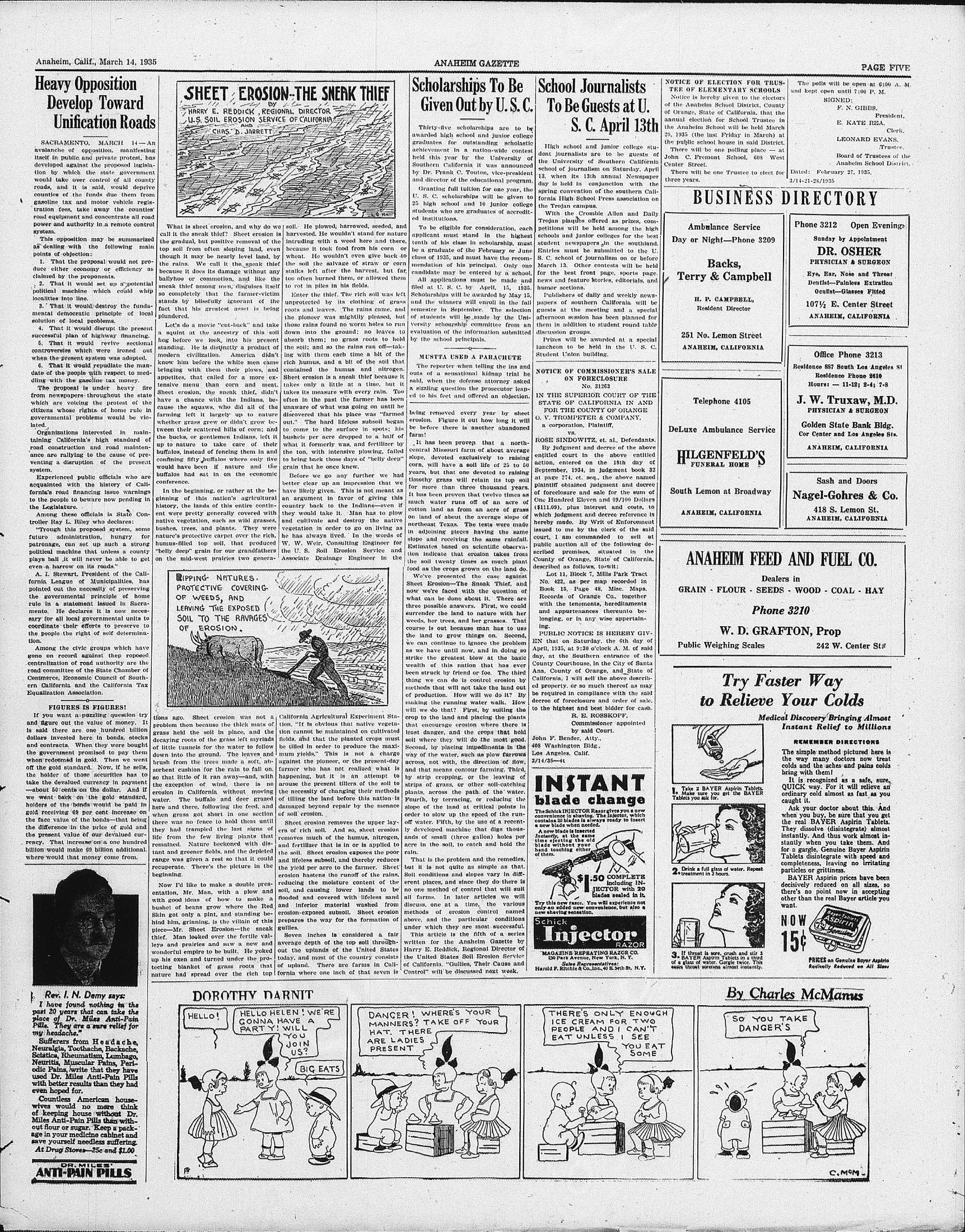
Searchable text
Heavy Opposition Develop Toward Unification Roads
SACRAMENTO, MARCH 14—An avalanche of opposition, manifesting itself in public and private protest, has developed against the proposed legislation by which the state government would take over control of all county roads, and it is said, would deprive counties of the funds due them from gasoline tax and motor vehicle registration fees, take away the counties' road equipment and concentrate all road power and authority in a remote control system.
This opposition may be summarized as dealing with the following main points of objection:
1. That the proposal would not produce either economy or efficiency as claimed by the proponents.
2. That it would set up a potential political machine which could whip localities into line.
3. That it would destroy the fundamental democratic principle of local solutions of local problems.
4. That it would disrupt the present successful plan of highway financing.
5. That it would revive sectional controversies which were ironed out when the present system was adopted.
6. That it would repudiate the mandate of the people with respect to meddling with the gasoline tax money.
The proposal is under heavy fire from newspapers throughout the state which are voicing the protest of the citizens whose rights of home rule in governmental problems would be violated.
Organizations interested in maintaining California's high standard of road construction and road maintenance are rallying to the cause of pre-
What is sheet erosion, and why do we call it the sneak thief? Sheet erosion is the gradual, but positive removal of the top soil from often sloping land, even though it may be nearly level land, by the rains. We call it the sneak thief because it does its damage without any ballyhoo or commotion, and like the sneak thief among men, disguises itself so completely that the farmer-victim stands by blissfully ignorant of the fact that his greatest asset is being plundered.
Let's do a movie "cut-back" and take a squint at the ancestry of this soil hog before we look into his present standing. He is distinctly a product of modern civilization. America didn't know him before the white men came bringing with them their plows, and appetites, that called for a more extensive menu than corn and meat. Sheet erosion, the sneak thief, didn't have a chance with the Indians, because the squaws, who did all of the farming left it largely up to nature whether grass grew or didn't grow between their scattered hills of corn; and the bucks, or gentlemen Indians, left it up to nature to take care of their buffalo, instead of fencing them in and confining fifty buffers where only five soil. He plowed, harrow harvested. He wouldn't intruding with a weed because it took food from wheat. He wouldn't evade the soil the salvage of stalks left after the haul too often burned them, or to rot in piles in his field.
Enter the thief. The richest unprotected by its cloth roots and leaves. The rafter the pioneer was mightily those rains found no work down into the ground; absorb them; no grass on the soil; and so the raining with them each time rich humus, and a bit of contained the humus. Sheet erosion is a sneak thief takes only a little at a takes its measure with even often in the past the far unaware of what was gold discovered that his place out." The hard lifeless to come to the surface bushels per acre dropped what it formerly was, and the ton, with intensive pressure to bring back those days.
6. That it would repudiate the mandate of the people with respect to meddling with the gasoline tax money.
The proposal is under heavy fire from newspapers throughout the state which are voicing the protest of the citizens whose rights of home rule in governmental problems would be violated.
Organizations interested in maintaining California's high standard of road construction and road maintenance are rallying to the cause of preventing a disruption of the present system.
Experienced public officials who are acquainted with the history of California's road financing issue warnings to the people to beware now pending in the Legislature.
Among these officials is State Controller Ray L. Riley who declares:
"Trough this proposed system, some future administration, hungry for patronage, can set up such a strong political machine that unless a county plays ball it will never be able to get even a harrow on its roads."
A. I. Stewart, President of the California League of Municipalities, has pointed out the necessity of preserving the governmental principle of home rule in a statement issued in Sacramento. He declares it is now necessary for all local governmental units to coordinate their efforts to preserve to the people the right of self determination.
Among the civic groups which have gone on record against the proposed centralization of road authority are the road committee of the State Chamber of Commerce, Economic Council of Southern California and the California Tax Equalization Association.
FIGURES IS FIGURES!
If you want a puzzling question try and figure out the value of money. It is said there are one hundred billion dollars invested here in bonds, stocks and contracts. When they were bought the government promised to pay them when redeemed in gold. Then we went off the gold standard. Now, if he sells, the holder of those securities has to take the devalued currency in payment—about 50 cents on the dollar. And if we went back on the gold standard, holders of the bonds would be paid in gold receiving 69 per cent increase on the face value of the bonds—that being the difference in the price of gold and the present value of our devalued currency. That increase on a one hundred billion would make 69 billion additional where would that money come from.
Sheet erosion was not a problem then because the thick mats of grass held the soil in place, and the decaying roots of the grass left myriads of little tunnels for the water to follow down into the ground. The leaves and brush from the trees made a soft, absorbent cushion for the rain to fall on so that little of it ran away—and, with the exception of wind, there is no erosion in California without moving water. The buffalo and deer grazed here and there, following the feed, and when grass got short in one section there was no fence to hold them until they had trampled the last signs of life from the few living plants that remained. Nature beckoned with distant and greener fields, and the depleted range was given a rest so that it could recuperate. There's the picture in the know him before the white men came bringing with them their plows, and appetites, that called for a more extensive menu than corn and meat. Sheet erosion, the sneak thief, didn't have a chance with the Indians, because the squaws, who did all of the farming left it largely up to nature whether grass grew or didn't grow between their scattered hills of corn; and the bucks, or gentlemen Indians, left it up to nature to take care of their buffalos, instead of fencing them in and confining fifty buffalos where only five would have been if nature and the buffalos had sat in on the economic conference.
In the beginning, or rather at the beginning of this nation's agricultural history, the lands of this entire continent were pretty generally covered with native vegetation, such as wild grasses, bushes, trees, and plants. They were nature's protective carpet over the rich, humus-filled top soil, that produced "belly deep" grain for our grandfathers on the mid-west prairies two generations ago. Sheet erosion was not a problem then because the thick mats of grass held the soil in place, and the decaying roots of the grass left myriads of little tunnels for the water to follow down into the ground. The leaves and brush from the trees made a soft, absorbent cushion for the rain to fall on so that little of it ran away—and, with the exception of wind, there is no erosion in California without moving water. The buffalo and deer grazed here and there, following the feed, and when grass got short in one section there was no fence to hold them until they had trampled the last signs of life from the few living plants that remained. Nature beckoned with distant and greener fields, and the depleted range was given a rest so that it could recuperate. There's the picture in the know him before the white men came bringing with them their plows, and appetites, that called for a more extensive menu than corn and meat. Sheet erosion, the sneak thief, didn't have a chance with the Indians, because the squaws, who did all of the farming left it largely up to nature whether grass grew or didn't grow between their scattered hills of corn; and the bucks, or gentlemen Indians, left it up to nature to take care of their buffalos, instead of fencing them in and confining fifty buffalos where only five would have been if nature and the buffalos had sat in on the economic conference.
In the beginning, or rather at the beginning of this nation's agricultural history, the lands of this entire continent were pretty generally covered with native vegetation, such as wild grasses, bushes, trees, and plants. They were nature's protective carpet over the rich, humus-filled top soil, that produced "belly deep" grain for our grandfathers on the mid-west prairies two genera...
the holder of those securities has to take the devalued currency in payment—about 50 cents on the dollar. And if we went back on the gold standard, holders of the bonds would be paid in gold receiving 69 per cent increase on the face value of the bonds—that being the difference in the price of gold and the present value of our devalued currency. That increase on a one hundred billion would make 69 billion additional where would that money come from.
Rev. I. N. Demy says:
I have found nothing in the past 20 years that can take the place of Dr. Miles Anti-Pain Pills. They are a sure relief for my headache."
Sufferers from Headache, Neuralgia, Toothache, Backache, Sciatica, Rheumatism, Lumbago, Neuritis, Muscular Pains, Periodic Pains, write that they have used Dr. Miles Anti-Pain Pills with better results than they had even hoped for.
Countless American housewives would no more think of keeping house without Dr. Miles Anti-Pain Pills than without flour or sugar. Keep a package in your medicine cabinet and save yourself needless suffering.
At Drug Stores—25c and $1.00
DR. MILES' ANTI-PAIN PILLS
so that little of it ran away—and, with the exception of wind, there is no erosion in California without moving water. The buffalo and deer grazed here and there, following the feed, and when grass got short in one section there was no fence to hold them until they had trampled the last signs of life from the few living plants that remained. Nature beckoned with distant and greener fields, and the depleted range was given a rest so that it could recuperate. There's the picture in the beginning.
Now I'd like to make a double presentation, Mr. Man, with a plow and with good ideas of how to make a bushel of beans grow where the Red Skin got only a pint, and standing behind him, grinning, is the villain of this piece—Mr. Sheet Erosion—the sneak thief. Man looked over the fertile valleys and prairies and saw a new and wonderful empire to be built. He yoked up his oxen and turned under the protecting blanket of grass roots that nature had spread over the rich top reducing the moisture content soil, and causing lower flooded and covered with and inferior material with erosion-exposed subsoll. She prepares the way for the gullies.
Seven inches is consid average depth of the top out the uplands of the U today, and most of the coun of upland. There are far fornla where one inch of t
INAHEIM GAZETTE
ON THE SNEEK THIEF
NAL DIRECTOR
OF CALIFORNIA
soil. He plowed, harrowed, seeded, and harvested. He wouldn't stand for nature intruding with a weed here and there, because it took food from his corn or wheat. He wouldn't even give back to the soil the salvage of straw or corn stalks left after the harvest, but far too often burned them, or allowed them to rot in piles in his fields.
Enter the thief. The rich soil was left unprotected by its clothing of grass roots and leaves. The rains came, and the pioneer was mightily pleased, but those rains found no worm holes to run down into the ground; no leaves to absorb them; no grass roots to hold the soil; and so the rains ran off—taking with them each time a bit of the rich humus, and a bit of the soil that contained the humus and nitrogen. Sheet erosion is a sneak thief because it takes only a little at a time, but it takes its measure with every rain. Too often in the past the farmer has been unaware of what was going on until he discovered that his place was "farmed out." The hard lifeless subsoil began to come to the surface in spots; his bushels per acre dropped to a half of what it formerly was, and fertilizer by the ton, with intensive plowing, failed to bring back those days of "belly deep."
Scholarships To Be Given Out by U. S. C.
Thirty-five scholarships are to be awarded high school and junior college graduates for outstanding scholastic achievement in a nation-wide contest held this year by the University of Southern California it was announced by Dr. Frank C. Touton, vice-president and director of the educational program.
Granting full tuition for one year, the U. S. C. scholarships will be given to 25 high school and 10 junior college students who are graduates of accredited institutions.
To be eligible for consideration, each applicant must stand in the highest tenth of his class in scholarship, must be a graduate of the February or June class of 1935, and must have the recommendation of his principal. Only one candidate may be entered by a school.
All applications must be made and filed at U. S. C. by April, 15, 1935. Scholarships will be awarded by May 15, and the winners will enroll in the fall semester in September. The selection of students will be made by the University scholarship committee from an evaluation of the information submitted by the school principals.
MUSTTA USED A PARACHUTE
The reporter when telling the ins and outs of a sensational kidnap trial he said, when the defense attorney asked a sizzling question the prosecutor leaped to his feet and offered an objection.
being removed every year by sheet erosion. Figure it out how long it will be before there is another abandoned farm!
It has been proven that a north-central Missouri farm of about average slope, devoted exclusively to raising
School Journalists To Be Guests at U. S. C. April 13th
High school and junior college student journalists are to be guests of the University of Southern California school of journalism on Saturday, April 13, when its 13th annual Newspaper day is held in conjunction with the spring convention of the southern California High School Press association on the Trojan campus.
With the Cromble Allen and Daily Trojan plaques offered as prizes, competitions will be held among the high schools and junior colleges for the best student newspapers in the southland. Entries must be submitted to the U. S. C. school of journalism on or before March 13. Other contests will be held for the best front page, sports page, news and feature stories, editorials, and humor sections.
Publishers of daily and weekly newspapers of southern California will be guests at the meeting and a special afternoon session has been planned for them in addition to student round table discussion groups.
Prizes will be awarded at a special luncheon to be held in the U. S. C. Student Union building.
NOTICE OF COMMISSIONER'S SALE ON FORECLOSURE
No. 31263
IN THE SUPERIOR COURT OF THE STATE OF CALIFORNIA IN AND FOR THE COUNTY OF ORANGE O. V. TROMPETER & COMPANY,
a corporation, Plaintiff,
vs.
ROSE SINDOWITZ, et. al., Defendants.
By judgment and decree of the above entitled court in the above entitled
The reporter when telling the ins and outs of a sensational kidnap trial he said, when the defense attorney asked a sizzling question the prosecutor leaped to his feet and offered an objection.
being removed every year by sheet erosion. Figure it out how long it will be before there is another abandoned farm!
It has been proven that a north-central Missouri farm of about average slope, devoted exclusively to raising corn, will have a soil life of 25 to 50 years, but that one devoted to raising timothy grass will retain its top soil for more than three thousand years. It has been proven that twelve times as much water runs off of an acre of cotton land as from an acre of grass on land of about the average slope of northeast Texas. The tests were made in adjoining pieces having the same slope and receiving the same rainfall. Estimates based on scientific observation indicate that erosion takes from the soil twenty times as much plant food as the crops grown on the land do.
We've presented the case against Sheet Erosion—The Sneak Thief, and now we're faced with the question of what can be done about it. There are three possible answers. First, we could currender the land to nature with her weeds, her trees, and her grasses. That course is out because man has to use the land to grow things on. Second, we can continue to ignore the problem as we have until now, and in doing so strike the greatest blow at the basic wealth of this nation that has ever been struck by friend or foe. The third thing we can do is control erosion by methods that will not take the land out of production. How will we do it? By making the running water walk. How will we do that? First, by suiting the crop to the land and placing the plants that encourage erosion where there is least danger, and the crops that hold soil where they will do the most good. Second, by placing impediments in the way of the water, such as plow furrows across, not with, the direction of flow, and that means contour farming. Third, by strip cropping, or the leaving of strips of grass, or other soil-catching plants, across the path of the water. Fourth, by terracing, or reducing the slope of the land at critical points in order to slow up the speed of the runoff water. Fifth, by the use of a recently developed machine that digs thousands of small (three gallon) holes per acre in the soil, to catch and hold the rain.
That is the problem and the remedies, but it is not quite as simple as that.
NOTICE OF COMMISSIONER'S SALE ON FORECLOSURE
No. 31263
IN THE SUPERIOR COURT OF THE STATE OF CALIFORNIA IN AND FOR THE COUNTY OF ORANGE
O. V. TROMPETER & COMPANY,
a corporation, Plaintiff,
ROSE SINDOWITZ, et al., Defendants.
By judgment and decree of the above entitled court in the above entitled action, entered on the 18th day of September, 1934, in judgment book 32 at page 274, et seq., the above named plaintiff obtained judgment and decree of foreclosure and sale for the sum of One Hundred Eleven and 09/100 Dollars ($111.09), plus interest and costs, to which judgment and decree reference is hereby made. By Writ of Enforcement issued to me by the clerk of the said court, I am commanded to sell at public auction all of the following described premises, situated in the County of Orange, State of California, described as follows: to-wit:
Lot 11, Block 7, Mills Park Tract
No. 422, as per map recorded in Book 15, Page 48, Misc. Maps, Records of Orange Co., together with the tenements, hereditaments and appurtenances thereunto belonging, or in any wise appertaining.
PUBLIC NOTICE IS HEREBY GIVEN that on Saturday, the 6th day of April, 1935, at 9:30 o'clock A.M. of said day, at the Southern entrance of the County Courthouse, in the City of Santa Ana, County of Orange, and State of California, I will sell the above described property, or so much thereof as may be required in compliance with the said decree of foreclosure and order of sale, to the highest and best bidder for cash.
R. E. ROSSKOPF,
Commissioner appointed
by said Court.
John F. Bender, Atty.
408 Washington Bldg.
Los Angeles, Calif.
3/14/35-4t
Sheet erosion removes the upper layers of rich soil. And so, sheet erosion moves much of the humus, nitrogen, and fertilizer that is in or is applied to the soil. Sheet erosion exposes the poor and lifeless subsolls, and thereby reduces the yield per acre to the farmer. Sheet erosion hastens the runoff of the rains, reducing the moisture content of the soil, and causing lower lands to be flooded and covered with lifeless sand and inferior material washed from erosion-exposed subsolls. Sheet erosion prepares the way for the formation of uplands.
Seven inches is considered a fair average depth of the top soil throughout the uplands of the United States today, and most of the country consists of upland. There are farms in California where one inch of that seven is by strip cropping, or the leaving of strips of grass, or other soil-catching plants, across the path of the water. Fourth, by terracing, or reducing the slope of the land at critical points in order to slow up the speed of the runoff water. Fifth, by the use of a recently developed machine that digs thousands of small (three gallon) holes per acre in the soil, to catch and hold the rain.
That is the problem and the remedies, but it is not quite as simple as that. Soil conditions and slopes vary in different places, and since they do there is no one method of control that will suit all farms. In later articles we will discuss, one at a time, the various methods of erosion control named above, and the particular conditions under which they are most successful.
This article is the fifth of a series written for the Anaheim Gazette by Harry E. Reddick, Regional Director of the United States Soil Erosion Service of California. "Guilles, Their Cause and Control" will be discussed next week.
INSTANT blade change
The Schick INJECTOR Razor gives you a new convenience in shaving. The Injector, which contains 20 blades is always ready to insert a new blade when needed.
A new blade is inserted Instantly, at the same time injecting the old blade without your hand touching either of them.
$1.50 COMPLETE INCLUDING INJECTOR WITH 20 BLADES sealed in it.
Try this new razor. You will experience not only an added new convenience, but also a new shaving sensation.
Schick Injector RAZOR
MAGAZINE REPEATING RAZOR CO.
230 Park Avenue, New York, N.Y.
Sales Representatives:
Harold F. Ritchie & Co., Inc., 40 E. 34th St. N.Y.
NOTICE OF ELECTION FOR TRUSTEE OF ELEMENTARY SCHOOLS
Notice is hereby given to the electors of the Anaheim School District, County of Orange, State of California, that the annual election for School Trustee in the Anaheim School will be held March 29, 1935 (the last Friday in March) at the public school house in said District.
There will be one polling place — at John C. Fremont School, 608 West Center Street.
There will be one Trustee to elect for three years.
The polls will be open at 6:00 A.M. and kept open until 7:00 P.M.
SIGNED:
F. N. GIBBS,
President,
E. KATE REA,
Clerk,
LEONARD EVANS,
Trustee,
Board of Trustees of the Anaheim School District.
Dated: February 27, 1935.
3/14-21-28/1935
BUSINESS DIRECTORY
Ambulance Service
Day or Night—Phone 3209
Backs, Terry & Campbell
H. P. CAMPBELL,
Resident Director
251 No. Lemon Street
ANAHEIM, CALIFORNIA
Phone 3212 Open Evenings
Sunday by Appointment
DR. OSHER
PHYSICIAN & SURGEON
Eye, Ear, Nose and Throat
Dentist—Painless Extration
Oculist—Glasses Fitted
107½ E. Center Street
ANAHEIM, CALIFORNIA
Office Phone 3213
Residence 887 South Los Angeles St
Residence Phone 2610
Hours: — 11-12; 2-4; 7-8
Telephone 4105
DeLuxe Ambulance Service
HILGENFELD'S
J. W. Truxaw, M.D.
PHYSICIAN & SURGEON
Golden State Bank Bldg.
Cor Center and Los Angeles Sts.
ANAHEIM, CALIFORNIA
Telephone 4105
DeLuxe Ambulance Service
HILGENFELD'S
FUNERAL HOME
South Lemon at Broadway
ANAHEIM, CALIFORNIA
Residence 887 South Los Angeles St
Residence Phone 2610
Hours: — 11-12; 2-4; 7-8
J. W. Truxaw, M.D.
PHYSICIAN & SURGEON
Golden State Bank Bldg.
Cor Center and Los Angeles Sts.
ANAHEIM, CALIFORNIA
Sash and Doors
Nagel-Gohres & Co.
418 S. Lemon St.
ANAHEIM, CALIFORNIA
ANAHEIM FEED AND FUEL CO.
Dealers in
GRAIN - FLOUR - SEEDS - WOOD - COAL - HAY
Phone 3210
W. D. GRAFTON, Prop
Public Weighing Scales 242 W. Center St.
Try Faster Way to Relieve Your Colds
Medical Discovery Bringing Almost Instant Relief to Millions
REMEMBER DIRECTIONS
The simple method pictured here is the way many doctors now treat colds and the aches and pains colds bring with them!
It is recognized as a safe, sure, QUICK way. For it will relieve an ordinary cold almost as fast as you caught it.
Ask your doctor about this. And when you buy, be sure that you get the real BAYER Aspirin Tablets. They dissolve (disintegrate) almost instantly. And thus work almost instantly when you take them. And for a gargle, Genuine Bayer Aspirin Tablets disintegrate with speed and completeness, leaving no irritating particles or grittiness.
1. Take 2 BAYER Aspirin Tablets. Make sure you get the BAYER Tablets you ask for.
2. Drink a full glass of water. Repeat
1. Take 2 BAYER Aspirin Tablets. Make sure you get the BAYER Tablets you ask for.
2. Drink a full glass of water. Repeat treatment in 2 hours.
3. If throat is sore, crush and stir 3 BAYER Aspirin Tablets in a third of a glass of water. Gargle twice. This eases throat soreness almost instantly.
It is recognized as a safe, sure QUICK way. For it will relieve an ordinary cold almost as fast as you caught it.
Ask your doctor about this. And when you buy, be sure that you get the real BAYER Aspirin Tablets. They dissolve (disintegrate) almost instantly. And thus work almost instantly when you take them. And for a gargle, Genuine Bayer Aspirin Tablets disintegrate with speed and completeness, leaving no irritating particles or grittiness.
BAYER Aspirin prices have been decisively reduced on all sizes, so there's no point now in accepting other than the real Bayer article you want.
NOW
15¢
PRICES on Genuine Bayer Aspirin Radically Reduced on All Sizes
By Charles McManus
ONLY ENOUGH FOR TWO AND I CAN'T SEE YOU EAT SOME
SO YOU TAKE DANGER'S
C.MO M.