anaheim-gazette 1935-02-28
Scanned page
Searchable text
THE ANAHEIM GAZETTE
HENRY KUCHEL, Editor and Publisher
ESTABLISHED 1870
ISSUED EVERY THURSDAY
SUBSCRIPTION PER YEAR ... $2.00
SIX MONTHS ... $1.00
Entered at the Anaheim, California Postoffice as second-class matter.
ANAHEIM MOURNS JOHN H. COOK
For more than a year Anaheim residents have watched the health of John H. Cook, a pioneer bean grower of the county and of recent decades a large citrus holder, hoping against hope that he would regain strength to take his usual vigorous part in community affairs. Naturally, the city was shocked Sunday when it learned the popular councilman had died of heart failure.
Although he aspired to a few public positions, Mr. Cook always took a foremost part in civic affairs. He was a loyal friend and a respected foe, and the type of leader who didn't straddle public issues. He fought hard for what he believed was right, and for many years has been an ardent advocate of flood control. On two occasions, in 1916 and again in 1923, when flood waters surged through Anaheim and threatened considerable damage, Mr. Cook took active charge of the work to protect the city and ranches from damage. When public money was not forthcoming, he spent his own for the good of the community.
Cognizant of labors well performed, fellow citizens sent him to the council for two terms, beginning in 1912, and again in 1932 picked him to serve again.
Anaheim mourns John Cook. He was a good father, a good citizen, a good friend and a good civic official.
THE “IFS” ARE IMPORTANT
If Dame Fortune smiles hard enough, and the pro-rate works well enough, local orange growers may get more than a dollar a field box for their fruit this year.
DWYER FAVORS FRAZIER-LEMKE BILL
John J. Dwyer, popular Anaheim citrus grower who has spent
the council for two terms, beginning in 1912, and again in 1932 picked him to serve again.
Anaheim mourns John Cook. He was a good father, a good citizen, a good friend and a good civic official.
THE "IFS" ARE IMPORTANT
If Dame Fortune smiles hard enough, and the pro-rate works well enough, local orange growers may get more than a dollar a field box for their fruit this year.
DWYER FAVORS FRAZIER-LEMKE BILL
John J. Dwyer, popular Anaheim citrus grower who has spent most of a year helping Orange county farmers solve financial worries involving heavy mortgages and high interest, has reason to be proud of his record.
Few Anaheimers, and not many more residents of the county, realize that 129 petitions have been filed through his offices in the past year. These were appeals from farmers, large and small, to alleviate their financial plight and save their equity in property severely deflated by economic forces beyond their control. Of these, 66 have been "very agreeably settled," according to the modest words of our own conciliation commissioner.
Mr. Dwyer, himself a farmer and for many years a director of the Anaheim Citrus association, knows the farmer's problems. He looks upon the much-cussed Frazier-Lemke bill as a means through which distressed tillers of the soil may help themselves back on their feet. He expects these benefits to grow considerably, now that the United States district court of appeals in Cincinnati has upheld the constitutionality of the act. Scope of the measure will be increased with amendments now referred to the house judiciary committee.
TAXES TREBLE THE RENT BILL
Mary Roberts Rinehart, popular author in speaking about the money housewives must spend, remarked:
"Her dollar is not a dollar at all. The actual necessities of living have consumed most of it, and taxes take the rest. That is, out of 29 billions spent each year, taxes take nine billions, food only seven and rent only three and a half."
WORK, OR DON'T EAT—IS NEW EDICT
California agriculturists who have been hard put to find enough seasonal labor to harvest specialty crops will hail with glee the edict of FERAdministrator Harry L. Hopkins, who has ordered from both direct and work relief rolls all able-bodied men who refuse to accept offers of private employment.
The effects of this order will aid California orange, lettuce, walnut, cantaloupe, watermelon and cotton growers. Not always, but occasionally, growers have found that hiring men away from relief rolls was all but impossible. This placed the farmer in a difficult position. He was paying taxes upon which the federal and state made loans to pay relief workers. The effect was to take the farmer's labor supply off the market and raise his costs disproportionately to his otherwise increased income.
At first thought this would appear to be an indictment of the laborer. While in some instances one is justified in this assumption, it is not true in all cases. Uncle Sam made stipulations which actually prevented the laborer from working for farmers or for other private enterprises. The string of control, as manifested in the steady march of bureaucracy to ascendancy in these United States, is the all-powerful one of economic necessity. Laborers, not certain of steady employment could ill afford to accept a the farmers had made in return forduction in the si would have other thus caused, did prices were mere the farmers' purchase otherwise. The in a rise in the income was cons farmers, the government site effect.
The non-agricultural farmers' purchases retarded with the addition, the no money in the public processing taxes was felt more levied by the drover.
PRINTING AND PRINTING ANOTHER
Printing and most stable industry the United States industries increase while most industries considerably less over 225,000 total amount of commercial print year. Newspaper wage earners, costs represent a National advitions for the most shown an increase dustry and has tunnity for "over are among the h
At first thought this would appear to be an indictment of the laborer. While in some instances one is justified in this assumption, it is not true in all cases. Uncle Sam made stipulations which actually prevented the laborer from working for farmers or for other private enterprises. The string of control, as manifested in the steady march of bureaucracy to ascendancy in these United States, is the all-powerful one of economic necessity. Laborers, not certain of steady employment, could ill afford to accept a few days' work and be dropped from relief rolls. Once on either direct or work relief lists, the laborer found more security in refusing to work for private industry than in risking getting back on the dole.
Obviously, these governmental restrictions work a hardship on both the relief worker and the farmer. It appears that Administrator Hopkins has awakened to this serious flaw, and has taken a step that covers only part of the trouble. He ought now to issue a rule permitting able-bodied direct and work relief workers to accept private employment whenever possible, with provisions that persons who thus build up their own resources will receive more lenient consideration from Uncle Sam if and when such private employment ceases.
FARM INCOME NOT HELPED BY GOVERNMENT PAYMENTS
Despite the fact that the government in 1934 paid to the farmers $557,000,000 which it obtained through processing taxes on farm products, there is little reason for believing that the farmers' income was any higher than it would have been if the government had not been involved in the situation, according to the Business Conditions Weekly of the Alexander Hamilton Institute.
Since the price level is fixed by the law of supply and demand, the true price level of farm products was reduced by the amount of the processing taxes. Consequently, the amount which the farmers received from the government was offset by the lower price level at which they sold their products. Without processing taxes and with the same quantity of products marketed the price index, based on 1929 as 100, would have been 67.8 in 1935 instead of 61.6. This higher price level would have provided the farmers with the same income as they received with lower prices and government payments. From the stand point of the money spent by consumers, they paid the farmers no more than they would have paid them if there had been no processing taxes.
This does not mean, however, that government payments to
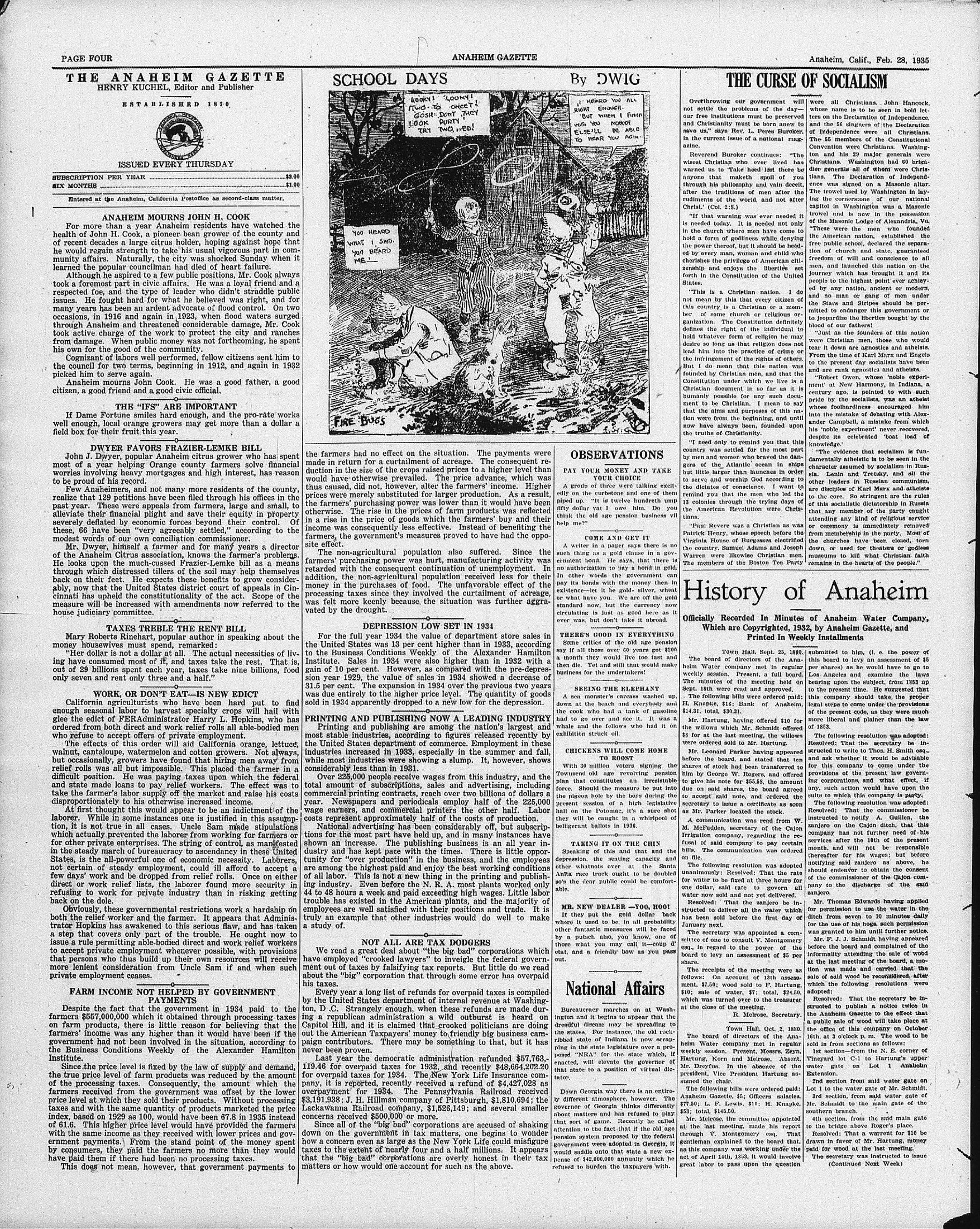
SCHOOL DAYS By DWIG
LOOKY! LOOKY!
TWO TO ONEET!
GOSH: DON'T THEY
LOOK PURTY!
TRY TWO, ED!
I HEARD YOU ALL
RIGHT ENOUGH.
BUT WHEN I FINISH
WITH YOU NOBOO!
ELSE'LL BE ABLE
TO HEAR YOU AGAIN.
YOU HEARD
WHAT I SAID.
YOU HEARD
ME!
FIRE BUGS
the farmers had no effect on the situation. The payments were made in return for a curtailment of acreage. The consequent reduction in the size of the crops raised prices to a higher level than would have otherwise prevailed. The price advance, which was thus caused, did not, however, alter the farmers' income. Higher prices were merely substituted for larger production. As a result, the farmers' purchasing power was lower than it would have been otherwise. The rise in the prices of farm products was reflected in a rise in the price of goods which the farmers' buy and their income was consequently less effective. Instead of benefiting the farmers, the government's measures proved to have had the opposite effect.
The non-agricultural population also suffered. Since the farmers' purchasing power was hurt, manufacturing activity was retarded with the consequent continuation of unemployment. In addition, the non-agricultural population received less for their money in the purchases of food. The unfavorable effect of the processing taxes since they involved the curtailment of acreage, was felt more keenly because the situation was further aggravated by the drought.
DEPRESSION LOW SET IN 1934
For the full year 1934 the value of department store sales in the United States was 13 per cent higher than in 1933, according to the Business Conditions Weekly of the Alexander Hamilton Institute. Sales in 1934 were also higher than in 1932 with a gain of 10 per cent. However, as compared with the pre-depression year 1929, the value of sales in 1934 showed a decrease of 31.5 per cent. The expansion in 1934 over the previous two years was due entirely to the higher price level. The quantity of goods sold in 1934 apparently dropped to a new low for the depression.
PRINTING AND PUBLISHING NOW A LEADING INDUSTRY
Printing and publishing are among the nation's largest and most stable industries, according to figures released recently by the United States department of commerce. Employment in these industries increased in 1938, especially in the summer and fall, while most industries were showing a slump. It, however, shows considerably less than in 1931.
Over 225,000 people receive wages from this industry, and the total amount of subscriptions, sales and advertising, including commercial printing contracts, reach over two billions of dollars a year. Newspapers and periodicals employ half of the 225,000 wage earners, and commercial printers the other half. Labor costs represent approximately half of the costs of production.
National advertising has been considerably off, but subscriptions for the most part have held up, and in many instances have shown an increase. The publishing business is an all year industry and has kept pace with the times. There is little opportunity for "over production" in the business, and the employees are among the highest paid and enjoy the best working conditions.
OBSERVATIONS
PAY YOUR MONEY AND TAKE YOUR CHOICE
A group of three were talking excitedly on the curbstone and one of them piped up. "It is twelve hundred ump fifty dollar vat I owe him. Do you think the old age pension business will help me?"
COME AND GET IT
A writer in a paper says there is no such thing as a gold clause in a government bond. He says, that there is no authorization to pay a bond in gold. In other words the government can pay its bonds with the money then in existence—let it be gold- silver, wheat or what have you. We are off the gold standard now, but the currency now circulating is just as good here as it ever was, but don't take it abroad.
THERE'S GOOD IN EVERYTHING
Some critics of the old age pension say if all those over 60 years got $200 a month they would live too fast and then die. Yet and still that would make business for the undertakers!
SEEING THE ELEPHANT
A sea monster's carcass washed up, down at the beach and everybody and the cook who had a tank of gasoline had to go over and see it. It was a whale and the fellows who had it on exhibition struck oil.
CHICKENS WILL COME HOME TO ROOST
With 30 million voters signing the Townsend old age revolving pension plan that constitutes an irresistible force. Should the measure be put into the pigeon hole by the boys during the present session of a high legislative hall on the Potomac, it's a sure shot they will be caught in a whirlpool of belligerant ballots in 1936.
TAKING IT ON THE CHIN
Speaking of this and that and the depression, the seating capacity and other whatnots over at the Santa
Over 225,000 people receive wages from this industry, and the total amount of subscriptions, sales and advertising, including commercial printing contracts, reach over two billions of dollars a year. Newspapers and periodicals employ half of the 225,000 wage earners, and commercial printers the other half. Labor costs represent approximately half of the costs of production.
National advertising has been considerably off, but subscriptions for the most part have held up, and in many instances have shown an increase. The publishing business is an all year industry and has kept pace with the times. There is little opportunity for "over production" in the business, and the employees are among the highest paid and enjoy the best working conditions of all labor. This is not a new thing in the printing and publishing industry. Even before the N. R. A. most plants worked only 44 to 48 hours a week and paid exceeding high wages. Little labor trouble has existed in the American plants, and the majority of employees are well satisfied with their positions and trade. It is truly an example that other industries would do well to make a study of.
NOT ALL ARE TAX DODGERS
We read a great deal about "the big bad" corporations which have employed "crooked lawyers" to inveigle the federal government out of taxes by falsifying tax reports. But little do we read about the "big" corporation that through some error has overpaid his taxes.
Every year a long list of refunds for overpaid taxes is compiled by the United States department of internal revenue at Washington, D.C. Strangely enough, when these refunds are made during a republican administration a wild outburst is heard on Capitol Hill, and it is claimed that crooked politicians are doing out the American Taxpayers' money to friendly big business campaign contributors. There may be something to that, but it has never been proven.
Last year the democratic administration refunded $57,763,119.46 for overpaid taxes for 1932, and recently $48,664,202.20 for overpaid taxes for 1934. The New York Life Insurance company, it is reported, recently received a refund of $4,427,028 as overpayment for 1934. The Pennsylvania Railroad received $3,191,938; J. H. Hillman company of Pittsburgh, $1,810,694; the Lackawanna Railroad company, $1,526,149; and several smaller concerns received $500,000 or more.
Since all of the "big bad" corporations are accused of shaking down on the government in tax matters, one begins to wonder how a concern even as large as the New York Life could misfigure taxes to the extent of nearly four and a half millions. It appears that the "big bad" corporations are overly honest in their tax matters or how would one account for such as the above.
TAKING IT ON THE CHIN
Speaking of this and that and the depression, the seating capacity and other whatnots over at the Santa Anita race track ought to be doubled so's the dear public could be comfortable.
MR. NEW DEALER —YOO, HOO!
If they put the gold dollar back where it used to be, in all probability other fantastic measures will be faced by a putsch also, you know, one of those what you may call it—coup d'etat, and a friendly bow as you pass out.
National Affairs
Bureaucracy marches on at Washington and it begins to appear that the dreadful disease may be spreading to the states. For instance, the old rock-ribbed state of Indiana is now scraping in the state legislature over a proposed "NRA" for the state which, if enacted, will elevate the governor of that state to a position of virtual dictator.
Down Georgia way there is an entirely different atmosphere, however. The governor of Georgia thinks differently about matters and has refused to play that sort of game. Recently he called attention to the fact that if the old age pension system proposed by the federal government were adopted in Georgia, it would saddle onto that state a new expense of $42,000,000 annually which he refused to burden the taxpayers with.
THE CURSE OF SOCIALISM
Overthrowing our government will not settle the problems of the day—our free institutions must be preserved and Christianity must be born anew to save us," says Rev. L. Peres Buroker, in the current issue of a national magazine.
Reverend Buroker continues: "The wisest Christian who ever lived has warned us to 'Take heed lost there be anyone that maketh spoil of you through his philosophy and vain deceit, after the traditions of men after the rudiments of the world, and not after Christ.' (Col. 2:8.)"
"If that warning was ever needed it is needed today. It is needed not only in the church where men have come to hold a form of godliness while denying the power thereof, but it should be heeded by every man, woman and child who cherishes the privilege of American citizenship and enjoys the liberties set forth in the Constitution of the United States.
'This is a Christian nation. I do not mean by this that every citizen of this country is a Christian or a member of some church or religious organization. The Constitution definitely defines the right of the individual to hold whatever form of religion he may desire so long as that religion does not lead him into the practice of crime or the infringement of the rights of others. But I do mean that this nation was founded by Christian men, and that the Constitution under which we live is a Christian document in so far as it is humanly possible for any such document to be Christian. I mean to say that the aims and purposes of this nation were from the beginning, and until now have always been, founded upon the truths of Christianity.
"I need only to remind you that this country was settled for the most part by men and women who braved the dan-were all Christians. John Hancock, whose name is to be seen in bold letters on the Declaration of Independence, and the 56 singers of the Declaration of Independence were all Christians. The 55 members of the Constitutional Convention were Christians. Washington and his 29 major generals were Christians. Washington had 60 brigadier generals all of whom were Christians. The Declaration of Independence was signed on a Masonic altar. The trowel used by Washington in laying the cornerstone of our national capitol in Washington was a Masonic trowel and is now in the possession of the Masonic Lodge of Alexandria, Va.
These were the men who founded the American nation, established the free public school, declared the separation of church and state, guaranteed freedom of will and conscience to all men, and launched this nation on the journey which has brought it and its people to the highest point ever achieved by any nation, ancient or modern, and no man or gang of men under the Stars and Stripes should be permitted to endanger this government or to jeopardize the liberties bought by the blood of our fathers!
Just as the founders of this nation were Christian men, those who would tear it down are agnostics and atheists. From the time of Karl Marx and Engela to the present day socialists have been and are rank agnostics and atheists.
Robert Owen, whose 'noble experiment' at New Harmony, in Indiana, a century ago, is pointed to with such pride by the socialists, was an atheist whose foolhardiness encouraged him into the mistake of debating with Alexander Campbell, a mistake from which his 'noble experiment' never recovered, despite its celebrated 'boat load of knowledge.'"
"The evidence that socialism is fundamentally atheistic is to be seen in the..."
History of Anaheim
Officially Recorded In Minutes of Anaheim Water Company, Which are Copyrighted, 1932, by Anaheim Gazette, and Printed In Weekly Installments
Town Hall, Sept. 25, 1880.
The board of directors of the Anaheim Water company met in regular weekly session. Present, a full board. The minutes of the meeting held on Sept. 18th were read and approved.
The following bills were ordered paid: H. Knapke, $16; Bank of Anaheim, $14.31, total, $30.31.
Mr. Hartung, having offered $10 for the willows which Mr. Schmidt offered $8 for at the last meeting, the willows were ordered sold to Mr. Hartung.
Mr. Leonard Parker having appeared before the board, and stated that ten shares of stock had been transferred to him by George W. Rogers, and offered to give his note for $55.58, the amount due on said shares, the board agreed to accept said note, and ordered the secretary to issue a certificate as soon as Mr. Parker located the stock.
A communication was read from W. M. McFadden, secretary of the Cajon Irrigation company, regarding the refusal of said company to pay certain bills. The communication was ordered on file.
The following resolution was adopted:
Resolved: That the secretary be instructed to write to Thos. H. Smith esq., and ask whether it would be advisable for this company to come under the provisions of the present law governing corporations, and what effect, if any, such action would have upon the suits to which this company is party.
The following resolution was adopted:
Resolved: That the commissioner be instructed to notify A. Guillen, the zanjero on the Cajon ditch, that this company has not further need of his services after the 10th of the present month, and will not be responsible thereafter for his wages; but before notifying said zanjero as above, he
ON THE CHIN
and that and the
rating capacity and
at the Santa
ought to be doubled
could be comforthim by George W. Rogers, and offered
to give his note for $55.58, the amount
due on said shares, the board agreed
to accept said note, and ordered the
secretary to issue a certificate as soon
as Mr. Parker located the stock.
A communication was read from W.
M. McFadden, secretary of the Cajon
Irrigation company, regarding the refusal of said company to pay certain
bills. The communication was ordered
on file.
The following resolution was adopted
unanimously: Resolved: That the rate
for water to be fixed at three hours for
one dollar, said rate to govern all
water now sold and not yet delivered.
Resolved: That the zanjero be instructed to deliver all the water which
has been sold before the first day of January next.
The secretary was appointed a committee of one to consult V. Montgomery esq., in regard to the power of the board to levy an assessment of $5 per share.
The receipts of the meeting were as follows: On account of 13th assessment, $7.50; wood sold to F. Hartung, $10; sale of water, $7; total, $24.50, which was turned over to the treasurer at the close of the meeting.
R. Melrose, Secretary.
Town Hall, Oct. 2, 1880.
The board of directors of the Anaheim Water company met in regular weekly session. Present, Messrs. Zeyn,
Hartung, Korn and Melrose. Absent,
Mr. Dreyfus. In the absence of the president, Vice President Hartung assumed the chair.
The following bills were ordered paid:
Anahelm Gazette, $5; Officers salaries, $77.50; L. F. Lewis, $10; H. Knapke, $53; total, $145.50.
Mr. Melrose, the committee appointed at the last meeting, made his report through V. Montgomery esq. That gentleman explained to the board that, as this company was working under the act of April 14th, 1853, it would involve great labor to pass upon the question provisions of the present law governing corporations, and what effect, if any, such action would have upon the suits to which this company is party.
The following resolution was adopted: Resolved: That the commissioner be instructed to notify A. Guillen, the zanjero on the Cajon ditch, that this company has not further need of his services after the 10th of the present month, and will not be responsible thereafter for his wages; but before notifying said zanjero as above, he should endeavor to obtain the consent of the commissioner of the Cajon company to the discharge of the said zanjero.
Mr. Thomas Edwards having applied for permission to use the water in the ditch from seven to 10 minutes daily for the use of his hogs, such permission was granted to him until further notice.
Mr. F. J. J. Schmidt having appeared before the board and complained of the informality attending the sale of wodd at the last meeting of the board, motion was made and carried that the sale of said wood be reconsidered, after which the following resolutions were adopted:
Resolved: That the secretary be instructed to publish a notice twice in the Anaheim Gazette to the effect that a public sale of wood will take place at the office of this company on October 16th, at 3 o'clock p.m. The wood to be sold in from sections as follows:
1st section—from the N. E. corner of Vineyard lot C-1 to Hartung's upper water gate on Lot 1 Anaheim Extension.
2nd section from said water gate on Lot 1 to the water gate of Mr. Schmidt.
3rd section from said water gate of Mr. Schmidt to the main gate of the southern branch.
4th section from the said main gate to the bridge above Roger's place.
Resolved: That a warrant for $10 be drawn in favor of Mr. Hartung, money paid for wood at the last meeting.
The secretary was instructed to issue
(Continued Next Week)