anaheim-gazette 1935-02-14
Scanned page
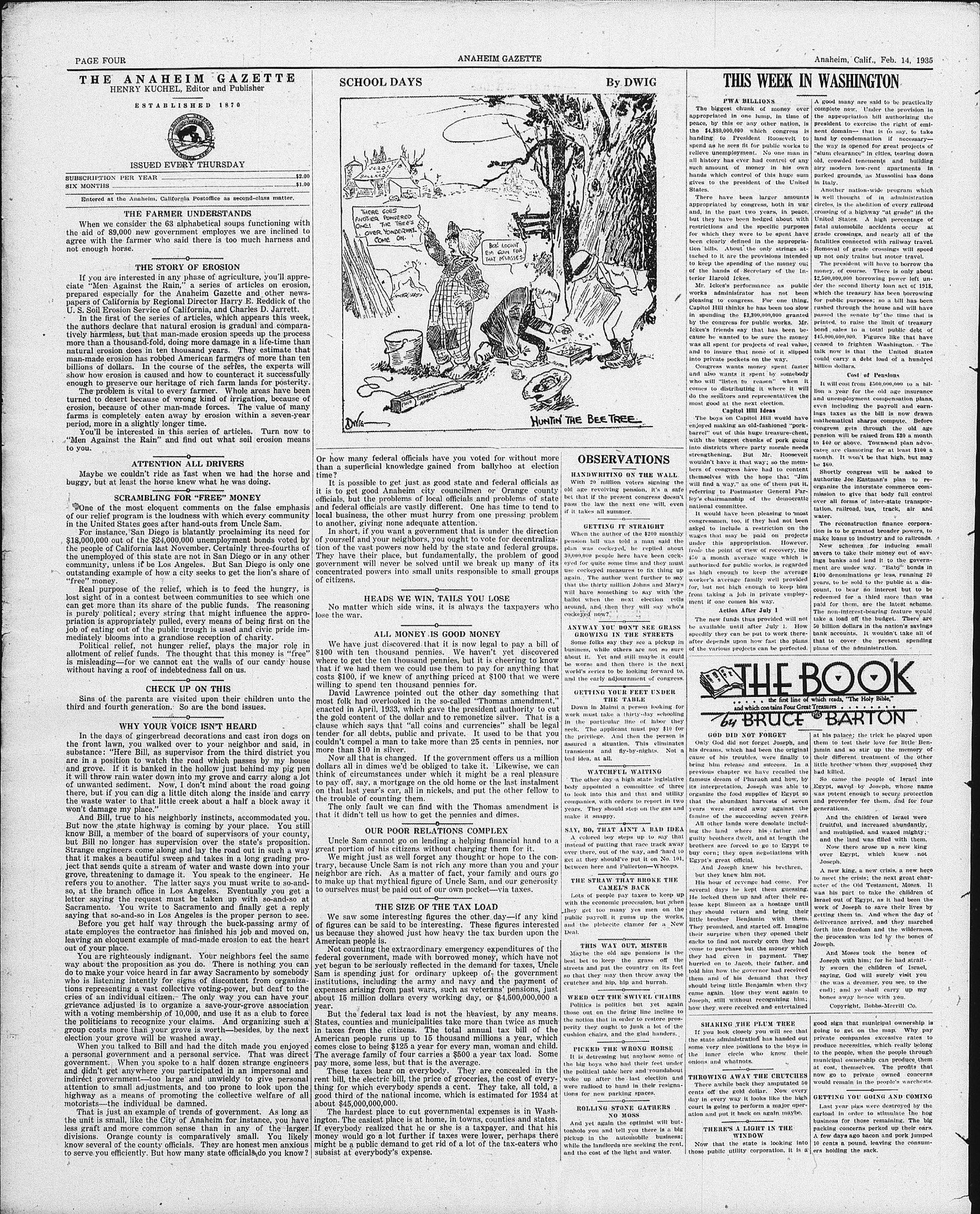
Searchable text
THE ANAHEIM GAZETTE
HENRY KUCHEL, Editor and Publisher
ESTABLISHED 1870
ISSUED EVERY THURSDAY
SUBSCRIPTION PER YEAR ... $2.00
SIX MONTHS ... $1.00
Entered at the Anaheim, California Postoffice as second-class matter.
THE FARMER UNDERSTANDS
When we consider the 63 alphabetical soups functioning with the aid of 89,000 new government employees we are inclined to agree with the farmer who said there is too much harness and not enough horse.
THE STORY OF EROSION
If you are interested in any phase of agriculture, you'll appreciate "Men Against the Rain," a series of articles on erosion, prepared especially for the Anaheim Gazette and other newspapers of California by Regional Director Harry E. Reddick of the U. S. Soil Erosion Service of California, and Charles D. Jarrett.
In the first of the series of articles, which appears this week, the authors declare that natural erosion is gradual and comparatively harmless, but that man-made erosion speeds up the process more than a thousand-fold, doing more damage in a life-time than natural erosion does in ten thousand years. They estimate that man-made erosion has robbed American farmers of more than ten billions of dollars. In the course of the series, the experts will show how erosion is caused and how to counteract it successfully enough to preserve our heritage of rich farm lands for posterity.
The problem is vital to every farmer. Whole areas have been turned to desert because of wrong kind of irrigation, because of erosion, because of other man-made forces. The value of many farms is completely eaten away by erosion within a seven-year period, more in a slightly longer time.
You'll be interested in this series of articles. Turn now to "Men Against the Rain" and find out what soil erosion means to you.
man-made erosion has robbed American farmers of more than ten billions of dollars. In the course of the series, the experts will show how erosion is caused and how to counteract it successfully enough to preserve our heritage of rich farm lands for posterity.
The problem is vital to every farmer. Whole areas have been turned to desert because of wrong kind of irrigation, because of erosion, because of other man-made forces. The value of many farms is completely eaten away by erosion within a seven-year period, more in a slightly longer time.
You'll be interested in this series of articles. Turn now to "Men Against the Rain" and find out what soil erosion means to you.
ATTENTION ALL DRIVERS
Maybe we couldn't ride as fast when we had the horse and buggy, but at least the horse knew what he was doing.
SCRAMBLING FOR “FREE” MONEY
One of the most eloquent comments on the false emphasis of our relief program is the loudness with which every community in the United States goes after hand-outs from Uncle Sam.
For instance, San Diego is blatantly proclaiming its need for $18,000,000 out of the $24,000,000 unemployment bonds voted by the people of California last November. Certainly three-fourths of the unemployed of this state are not in San Diego or in any other community, unless if be Los Angeles. But San Diego is only one outstanding example of how a city seeks to get the lion's share of "free" money.
Real purpose of the relief, which is to feed the hungry, is lost sight of in a contest between communities to see which one can get more than its share of the public funds. The reasoning is purely political; every string that might influence the appropriation is appropriately pulled, every means of being first on the job of eating out of the public trough is used and civic pride immediately blooms into a grandiose reception of charity.
Political relief, not hunger relief, plays the major role in allotment of relief funds. The thought that this money is "free" is misleading—for we cannot eat the walls of our candy house without having a roof of indebtedness fall on us.
CHECK UP ON THIS
Sins of the parents are visited upon their children unto the third and fourth generation. So are the bond issues.
WHY YOUR VOICE ISN'T HEARD
In the days of gingerbread decorations and cast iron dogs on the front lawn, you walked over to your neighbor and said, in substance: "Here Bill, as supervisor from the third district you are in a position to watch the road which passes by my house and grove. If it is banked in the hollow just behind my pig pen it will throw rain water down into my grove and carry along a lot of unwanted sediment. Now, I don't mind about the road going there, but if you can dig a little ditch along the inside and carry the waste water to that little creek about a half a block away it won't damage my place."
And Bill, true to his neighborly instincts, accommodated you. But now the state highway is coming by your place. You still know Bill, a member of the board of supervisors of your county, but Bill no longer has supervision over the state's proposition. Strange engineers come along and lay the road out in such a way that it makes a beautiful sweep and takes in a long grading pro-
are in a position to watch the road which passes by my house and grove. If it is banked in the hollow just behind my pig pen it will throw rain water down into my grove and carry along a lot of unwanted sediment. Now, I don't mind about the road going there, but if you can dig a little ditch along the inside and carry the waste water to that little creek about a half a block away it won't damage my place."
And Bill, true to his neighborly instincts, accommodated you. But now the state highway is coming by your place. You still know Bill, a member of the board of supervisors of your county, but Bill no longer has supervision over the state's proposition. Strange engineers come along and lay the road out in such a way that it makes a beautiful sweep and takes in a long grading project that sends quite a stream of water and waste down into your grove, threatening to damage it. You speak to the engineer. He refers you to another. The latter says you must write to so-and-so, at the branch office in Los Angeles. Eventually you get a letter saying the request must be taken up with so-and-so at Sacramento. You write to Sacramento and finally get a reply saying that so-and-so in Los Angeles is the proper person to see.
Before you get halfway through the buck-passing army of state employees the contractor has finished his job and moved on, leaving an eloquent example of mad-made erosion to eat the heart out of your place.
You are righteously indignant. Your neighbors feel the same way about the proposition as you do. There is nothing you can do to make your voice heard in far away Sacramento by somebody who is listening intently for signs of discontent from organizations representing a vast collective voting-power, but deaf to the cries of an individual citizen. The only way you can have your grievance adjusted is to organize a save-your-grove association with a voting membership of 10,000, and use it as a club to force the politicians to recognize your claims. And organizing such a group costs more than your grove is worth—besides, by the next election your grove will be washed away.
When you talked to Bill and had the ditch made you enjoyed a personal government and a personal service. That was direct government. When you spoke to a half dozen strange engineers and didn't get anywhere you participated in an impersonal and indirect government—too large and unwieldy to give personal attention to small adjustments, and too prone to look upon the highway as a means of promoting the collective welfare of all motorists—the individual be damned.
That is just an example of trends of government. As long as the unit is small, like the City of Anaheim for instance, you have less graft and more common sense than in any of the larger divisions. Orange county is comparatively small. You likely know several of the county officials. They are honest men anxious to serve you efficiently. But how many state officials do you know?
ANAHEIM GAZETTE
SCHOOL DAYS
By DWIG
THERE GOES ANOTHER POWERED ONE! THE TREE'S OVER YONDERWAT COME ON.
BOY! LOOK IT EM COIN FOR THAT MALSSSES.
DWIG
HUNTIN' THE BEE TREE.
Or how many federal officials have you voted for without more than a superficial knowledge gained from ballyhoo at election time?
It is possible to get just as good state and federal officials as it is to get good Anaheim city councilmen or Orange county officials, but the problems of local officials and problems of state and federal officials are vastly different. One has time to tend to local business, the other must hurry from one pressing problem to another, giving none adequate attention.
In short, if you want a government that is under the direction of yourself and your neighbors, you ought to vote for decentralization of the vast powers now held by the state and federal groups. They have their place, but fundamentally, the problem of good government will never be solved until we break up many of its concentrated powers into small units responsible to small groups of citizens.
HEADS WE WIN, TAILS YOU LOSE
No matter which side wins, it is always the taxpayers who lose the war.
ALL MONEY IS GOOD MONEY
We have just discovered that it is now legal to pay a bill of $100 with ten thousand pennies. We haven't yet discovered where to get the ten thousand pennies, but it is cheering to know that if we had them we could use them to pay for anything that costs $100, if we knew of anything priced at $100 that we were willing to spend ten thousand pennies for.
David Lawrence pointed out the other day something that most folk had overlooked in the so-called "Thomas amendment," enacted in April, 1933, which gave the president authority to cut the gold content of the dollar and to remonetize silver. That is a clause which says that "all coins and currencies" shall be legal tender for all debts, public and private. It used to be that you couldn't compel a man to take more than 25 cents in pennies, nor more than $10 in silver.
Now all that is changed. If the government offers us a million dollars all in dimes we'd be obliged to take it. Likewise, we can think of circumstances under which it might be a real pleasure to pay off, say, a mortgage on the old home or the last instalment on that last year's car, all in nickels, and put the other fellow to the trouble of counting them.
The only fault we can find with the Thomas amendment is that it didn't tell us how to get the pennies and dimes.
OUR POOR RELATIONS COMPLEX
Uncle Sam cannot go on lending a helping financial hand to a great portion of his citizens without charging them for it.
We might just as well forget any thought or hope to the con-
OBSERVATIONS
HANDWRITING ON THE WALL
With 20 million voters signing the old age revolving pension, it's a safe bet that if the present congress doesn't pass the law the next one will, even if it takes all summer.
GETTING IT STRAIGHT
When the author of the $200 monthly pension bill was told a man said the plan was cockeyed, he replied about 30,000,000 people here have been cockeyed for quite some time and they must use cockeyed measures to fix thing up again. The author went further to say that the thirty million Johns and Marys will have something to say with the ballot when the next election rolls around, and then they will say who's cockeyed now?
ANYWAY YOU DON'T SEE GRASS GROWING IN THE STREETS
Some folks say they see a pickup in business, while others are not so sure about it. Yet and still maybe it could be worse and then there is the next world's series to be looking forward to, and the early adjournment of congress.
GETTING YOUR FEET UNDER THE TABLE
Down in Maini a person looking for work must take a thirty-day schooling in the particular line of labor they seek. The applicant must pay $10 for the privilege. And then the person is assured a situation. This eliminates transients and fly-by-nights. Not a bad idea, at all.
WATCHFUL WAITING
The other day a high state legislative body appointed a committee of three to look into this and that and utility companies, with orders to report in two years. They should step on the gas and make it snappy.
SAY, BO, THAT AINT A BAD IDEA
A colored boy steps up to say that instead of putting that race track away over there, out of the way, and hard to
OUR POOR RELATIONS COMPLEX
Uncle Sam cannot go on lending a helping financial hand to a great portion of his citizens without charging them for it.
We might just as well forget any thought or hope to the contrary, because Uncle Sam is not rich any more than you and your neighbor are rich. As a matter of fact, your family and ours go to make up that mythical figure of Uncle Sam, and our generosity to ourselves must be paid out of our own pocket—via taxes.
THE SIZE OF THE TAX LOAD
We saw some interesting figures the other day—if any kind of figures can be said to be interesting. These figures interested us because they showed just how heavy the tax burden upon the American people is.
Not counting the extraordinary emergency expenditures of the federal government, made with borrowed money, which have not yet begun to be seriously reflected in the demand for taxes, Uncle Sam is spending just for ordinary upkeep of the government institutions, including the army and navy and the payment of expenses arising from past wars, such as veterans' pensions, just about 15 million dollars every working day, or $4,500,000,000 a year.
But the federal tax load is not the heaviest, by any means. States, counties and municipalities take more than twice as much in taxes from the citizens. The total annual tax bill of the American people runs up to 15 thousand millions a year, which comes close to being $125 a year for every man, woman and child. The average family of four carries a $500 a year tax load. Some pay more, some less, but that is the average.
These taxes bear on everybody. They are concealed in the rent bill, the electric bill, the price of groceries, the cost of everything for which everybody spends a cent. They take, all told, a good third of the national income, which is estimated for 1934 at about $45,000,000,000.
The hardest place to cut governmental expenses is in Washington. The easiest place is at home, in towns, counties and states. If everybody realized that he or she is a taxpayer, and that his money would go a lot further if taxes were lower, perhaps there might be a public demand to get rid of a lot of the tax-eaters who subsist at everybody's expense.
WATCHFUL WAITING
The other day a high state legislative body appointed a committee of three to look into this and that and utility companies, with orders to report in two years. They should step on the gas and make it snappy.
SAY, BO, THAT AIN't A BAD IDEA
A colored boy steps up to say that instead of putting that race track away over there, out of the way, and hard to get at they should've put it on No. 101, between here and Fullerton—Whoops.
THE STRAW THAT BROKE THE CAMEL'S BACK
Lots of people pay taxes to keep up with the economic procession, but when they get too many yes men on the public payroll it gums up the works, and the plebeciate clamor for a New Deal.
THIS WAY OUT, MISTER
Maybe the old age pensions is the best bet to keep the grass off the streets and put the country on its feet so that they may then throw away the crutches and hip, hip and hurrah.
WEED OUT THE SWIVEL CHAIRS
Politics is politics but yet again those out on the firing line incline to the notion that in order to restore prosperity they ought to junk a lot of the cushion chairs, and the glad handers.
PICKED THE WRONG HORSE
It is detressing but anyhow some of the big boys who had their feet under the political table here and roundabout woke up after the last election and were radioed to hand in their resignations for new parking spaces.
ROLLING STONE GATHERS NO MOSS
And yet again the optimist will buttonhole you and tell you there is a big pickup in the automobile business; while the landlords are seeking the rent, and the cost of the light and water.
THIS WEEK IN WASHINGTON
PWA BILLIONS
The biggest chunk of money ever appropriated in one lump, in time of peace, by this or any other nation, is the $4,880,000,000 which congress is handing to President Roosevelt to spend as he sees fit for public works to relieve unemployment. No one man in all history has ever had control of any such amount of money in his own hands which control of this huge sum gives to the president of the United States.
There have been larger amounts appropriated by congress, both in war and, in the past two years, in peace, but they have been hedged about with restrictions and the specific purposes for which they were to be spent have been clearly defined in the appropriation bills. About the only strings attached to it are the provisions intended to keep the spending of the money out of the hands of Secretary of the Interior Harold Ickes.
Mr. Ickes's performance as public works administrator has not been pleasing to congress. For one thing, Capitol Hill thinks he has been too slow in spending the $3,300,000,000 granted by the congress for public works. Mr. Ickes's friends say that has been because he wanted to be sure the money was all spent for projects of real value, and to insure that none of it slipped into private pockets on the way.
Congress wants money spent faster and also wants it spent by somebody who will "listen to reason" when it comes to distributing it where it will do the senators and representatives the most good at the next election.
Capitol Hill Ideas
The boys on Capitol Hill would have enjoyed making an old-fashioned "pork-barrel" out of this huge treasure-chest, with the biggest chunks of pork going into districts where party morale needs
A good many are said to be practically complete now. Under the provision in the appropriation bill authorizing the president to exercise the right of eminent domain—that is to say, to take land by condemnation if necessary—the way is opened for great projects of "slum clearance" in cities, tearing down old, crowded tenements and building airy modern low-rent apartments in parked grounds, as Mussolini has done in Italy.
Another nation-wide program which is well thought of in administration circles, is the abolition of every railroad crossing of a highway "at grade" in the United States. A high percentage of fatal automobile accidents occur at grade crossings, and nearly all of the fatalities connected with railway travel. Removal of grade crossings will speed up not only trains but motor travel.
The president will have to borrow the money, of course. There is only about $2,500,000,000 borrowing power left under the second liberty loan act of 1918, which the treasury has been borrowing for public purposes; so a bill has been rushed through the house and will have passed the senate by the time thsI is printed, to raise the limit of treasury bond sales to a total public debt of $45,000,000,000. Figures like that have ceased to frighten Washington. The talk now is that the United States could carry a debt load of a hundred billion dollars.
Cost of Pensions
It will cost from $500,000,000 to a billion a year for the old age insurance and unemployment compensation plans, even including the payroll and earnings taxes as the bill is now drawn mathematical sharps compute. Before congress gets through the old age pension will be raised from $30 a month to $40 or above. Townsend plan advocates are clamoring for at least $100 a
Congress wants money spent faster and also wants it spent by somebody who will "listen to reason" when it comes to distributing it where it will do the senators and representatives the most good at the next election.
Capitol Hill Ideas
The boys on Capitol Hill would have enjoyed making an old-fashioned "pork-barrel" out of this huge treasure-chest, with the biggest chunks of pork going into districts where party morale needs strengthening. But Mr. Roosevelt wouldn't have it that way; so the members of congress have had to content themselves with the hope that "Jim will find a way," as one of them put it, referring to Postmaster General Farley's chairmanship of the democratic national committee.
It would have been pleasing to most congressmen, too, if they had not been asked to include a restriction on the wages that may be paid on projects under this appropriation. However, from the point of view of recovery, the $50 a month average wage which is authorized for public works, is regarded as high enough to keep the average worker's average family well provided for, but not high enough to keep him from taking a job in private employment if one comes his way.
Action After July 1
The new funds thus provided will not be available until after July 1. How speedily they can be put to work thereafter depends upon how fast the plans of the various projects can be perfected.
GOD DID NOT FORGET
Only God did not forget Joseph, and his dreams, which had been the original cause of his troubles, were finally to bring him release and success. In a previous chapter we have recalled the famous dream of Pharaoh and how, by its interpretation, Joseph was able to organize the food supplies of Egypt so that the abundant harvests of seven years were stored away against the famine of the succeeding seven years.
All other lands were desolate including the land where his father and guilty brothers dwelt, and at length the brothers are forced to go to Egypt to buy corn; they open negotiations with at his palace; the trick he played upon them to test their love for little Benjamin and so stir up the memory of their different treatment of the other little brother whom they supposed they had killed.
So came the people of Israel into Egypt, saved by Joseph, whose name was potent enough to secure protection and provender for them, and for four generations.
And the children of Israel were fruitful, and increased abundantly, and multiplied, and waxed mighty; and the land was filled with them.
Now there arose up a new king over Egypt, which knew not could carry a debt load of a hundred billion dollars.
Cost of Pensions
It will cost from $500,000,000 to a billion a year for the old age insurance and unemployment compensation plans, even including the payroll and earnings taxes as the bill is now drawn mathematical sharps compute. Before congress gets through the old age pension will be raised from $30 a month to $40 or above. Townsend plan advocates are clamoring for at least $100 a month. It won't be that high, but may be $60.
Shortly congress will be asked to authorize Joe Eastman's plan to reorganize the interstate commerce commission to give that body full control over all forms of inter-state transportation, railroad, bus, track, air and water.
The reconstruction finance corporation is to be granted broader powers, to make loans to industry and to railroads.
New schemes for inducing small savers to take their money out of savings banks and lend it to the government are under way. "Baby" bonds in $100 denominations or less, running 20 years, to be sold to the public at a discount, to bear no interest but to be redeemed for a third more than was paid for them, are the latest scheme. The non-interest-bearing feature would take a load off the budget. There are 50 billion dollars in the nation's savings bank accounts. It wouldn't take all of that to cover the present spending plans of the administration.
FURIOUS WAITING
A high state legislative committee of three members and that utility orders to report in two should step on the gas and bring him release and success. In a previous chapter we have recalled the famous dream of Pharaoh and how, by its interpretation, Joseph was able to organize the food supplies of Egypt so that the abundant harvests of seven years were stored away against the famine of the succeeding seven years.
All other lands were desolate including the land where his father and guilty brothers dwelt, and at length the brothers are forced to go to Egypt to buy corn; they open negotiations with Egypt's great official.
And Joseph knew his brethren, but they knew him not.
His hour of revenge had come. For several days he kept them guessing. He locked them up and after their release kept Simeon as a hostage until they should return and bring their little brother Benjamin with them. They promised, and started off. Imagine their surprise when they opened their sacks to find not merely corn they had come to purchase but the money which they had given in payment. They hurried on to Jacob, their father, and told him how the governor had received them and of his demand that they should bring little Benjamin when they came again. How they went again to Joseph, still without recognizing him; how they were received and entertained
SHAKING THE PLUM TREE
If you look closely you will see that the state administration has handed out some very nice positions to the boys in the inner circle who know their onions and whatnots.
THROWING AWAY THE CRUTCHES
There awhile back they amputated 50 cents off the gold dollar. Now every day in every way it looks like the high court is going to perform a major operation and put it back on again maybe.
THERE'S A LIGHT IN THE WINDOW
Now that the state is looking into those public utility corporation, it is a good sign that municipal ownership is going to get on the map. Why pay private companies excessive rates to produce necessities, which really belong to the people, when the people through municipal ownership can produce them at cost, themselves. The profits that now go to private owned concerns would remain in the people's war chests.
GETTING YOU GOING AND COMING
Last year pigs were destroyed by the carload in order to stimulate the hog business for those remaining. The big packing concerns perked up their ears. A few days ago bacon and pork jumped 10 cents a pound, leaving the consumers holding the sack.