anaheim-gazette 1935-01-17
Scanned page
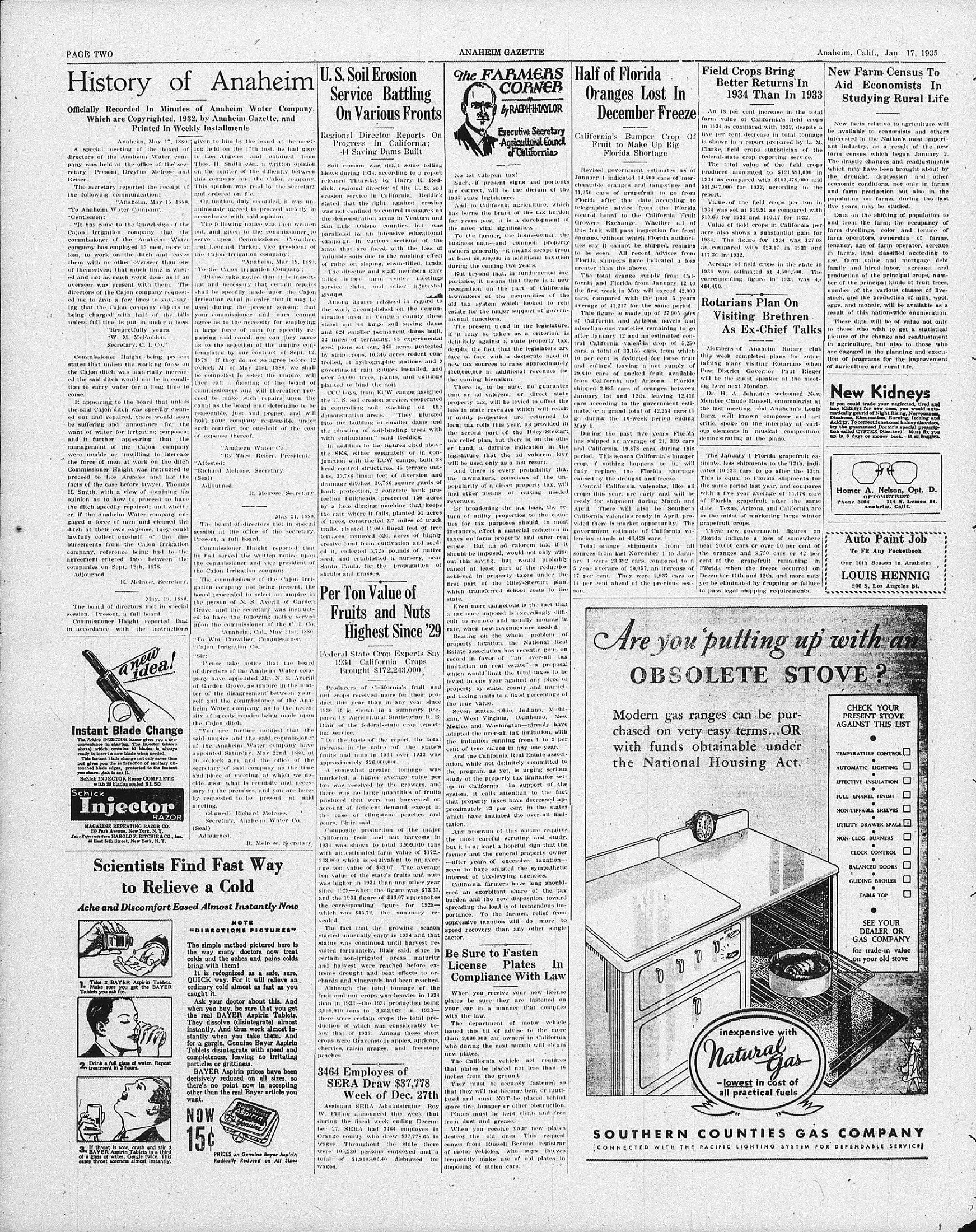
Searchable text
History of Anaheim
Officially Recorded In Minutes of Anaheim Water Company. Which are Copyrighted, 1932, by Anaheim Gazette, and Printed In Weekly Installments
Anaheim, May 17, 1880.
A special meeting of the board of directors of the Anaheim Water company was held at the office of the secretary, Present, Dreyfus, Melrose and Reiser.
The secretary reported the receipt of the following communication:
"Anaheim, May 15, 1880.
"To Anaheim Water Company.
"Gentlemen:
"It has come to the knowledge of the Cajon Irrigation company that the commissioner of the Anaheim Water company has employed 15 men, more or less, to work on the ditch and leaves them with no other overseer than one of themselves; that much time is wasted and not as much work done as if an overseer was present with them. The directors of the Cajon company requested me to drop a few lines to you, saying that the Cajon company objects to being charged with half of the bills unless full time is put in under a boss.
"Respectfully yours,
"W. M. McFadden,
Secretary, C. L. Co."
Commissioner Haight being present states that unless the working force on the Cajon ditch was materially increased the said ditch would not be in condition to carry water for a long time to come.
It appearing to the board that unless the said Cajon ditch was speedily cleaned out and repaired, there would soon be suffering and annoyance for the want of water for irrigating purposes; and it further appearing that the management of the Cajon company were unable or unwilling to increase given to him by the board at the meeting held on the 17th inst., he had gone to Los Angeles and obtained from Thos. H. Smith esq., a written opinion on the matter of the difficulty between this company and the Cajon company. This opinion was read by the secretary and ordered on file.
On motion, duly seconded, it was unanimously agreed to proceed strictly in accordance with said opinion.
The following notice was then written out, and given to the commissioner to serve upon Commissioner Crowther, and Leonard Parker, vice president of the Cajon Irrigation company:
"Anaheim, May 19, 1880.
"To the Cajon Irrigation Company:
"Please take notice that it is important and necessary that certain repairs shall be speedily made upon the Cajon irrigation canal in order that it may be used during the present season; that your commissioner and ours cannot agree as to the necessity for employing a large force of men for speedily repairing said canal, nor can they agree as to the selection of the umpire contemplated by our contract of Sept. 12, 1878. If they do not so agree before 12 o'clock M. of May 21st, 1880, we shall be compelled to select the umpire, will then call a meeting of the board of commissioners and will thereafter proceed to make such repairs upon the canal as the board may determine to be reasonable, just and proper, and will hold your company responsible under such contract for one-half of the cost of expense thereof.
"Anaheim Water Co.
"By Theo. Reiser, President."
states that unless the working force on the Cajon ditch was materially increased the said ditch would not be in condition to carry water for a long time to come.
It appearing to the board that unless the said Cajon ditch was speedily cleaned out and repaired, there would soon be suffering and annoyance for the want of water for irrigating purposes; and it further appearing that the management of the Cajon company were unable or unwilling to increase the force of men at work on the ditch Commissioner Haight was instructed to proceed to Los Angeles and lay the facts of the case before lawyer Thomas H. Smith, with a view of obtaining his opinion as to how to proceed to have the ditch speedily repaired; and whether, if the Anaheim Water company engaged a force of men and cleaned the ditch at their own expense, they could lawfully collect one-half of the disbursements from the Cajon Irrigation company, reference being had to the agreement entered into between the companies on Sept. 12th, 1878.
Adjourned.
R. Melrose, Secretary.
May, 19, 1880.
The board of directors met in special session. Present, a full board.
Commissioner Haight reported that in accordance with the instructions
May 21, 1880.
The board of directors met in special session at the office of the secretary. Present, a full board.
Commissioner Haight reported that he had served the written notice upon the commissioner and vice president of the Cajon Irrigation company.
The commissioner of the Cajon Irrigation company not being present, the board proceeded to select an umpire in the person of N. S. Averill of Garden Grove, and the secretary was instructed to have the following notice served upon the commissioner of the C. L. Co.
"Anaheim, Cal., May 21st, 1880."
To Wm. Crowther, Commissioner.
"Cajon Irrigation Co."
Sir:
"Please take notice that the board of directors of the Anaheim Water company have appointed Mr. N. S. Averill of Garden Grove, as umpire in the matter of the disagreement between yourself and the commissioner of the Anaheim Water company, as to the necessity of speedy repairs being made upon the Cajon ditch.
"You are further notified that the said umpire and the said commissioner of the Anaheim Water company have appointed Saturday, May 22nd, 1880, at 10 o'clock a.m., and the office of the secretary of said company as the time and place of meeting, at which we decide upon what is requisite and necessary in the premises, and you are hereby requested to be present at said meeting."
(Signed) Richard Melrose,
Secretary, Anaheim Water Co.
(Seal)
Adjourned.
R. Melrose, Secretary.
Instant Blade Change
The Schick INJECTOR Razor gives you a new convenience in shaving. The Injector (shown above) which contains 20 blades is always ready to insert a new blade when needed.
This instant blade change not only saves time but gives you the satisfaction of sanitary un-touched blade edges, protected to the instant you shave. Ask to see it.
Schick INJECTOR RAZOR COMPLETE with 20 blades sealed $1.50
Schick Injector Razor
MAGAZINE REPEATING RAZOR CO.
230 Park Avenue, New York, N.Y.
Sales Representatives: HAROLD F. RITCHIE & CO., Inc.
40 East 34th Street, New York, N.Y.
Scientists Find Fast Way to Relieve a Cold
Ache and Discomfort Eased Almost Instantly Now
NOTE
"DIRECTIONS PICTURES"
The simple method pictured here is the way many doctors now treat colds and the aches and pains colds bring with them!
It is recognized as a safe, sure, QUICK way. For it will relieve an ordinary cold almost as fast as you caught it.
Ask your doctor about this. And when you buy, be sure that you get the real BAYER Aspirin Tablets. They dissolve (disintegrate) almost instantly. And thus work almost instantly when you take them. And for a gargle, Genuine Bayer Aspirin Tablets disintegrate with speed and completeness, leaving no irritating particles or grittiness.
BAYER Aspirin prices have been decisively reduced on all sizes, so there's no point now in accepting other than the real Bayer article you want.
NOW
15¢
PRICES on Genuine Bayer Aspirin Radically Reduced on All Sizes
ANAHEIM GAZETTE
U.S. Soil Erosion Service Battling On Various Fronts
Regional Director Reports On Progress In California; 44 Saving Dams Built
Soil erosion was dealt some telling blows during 1934, according to a report released Thursday by Harry E. Reddick, regional director of the U. S. soil erosion service in California. Reddick stated that the fight against erosion was not confined to control measures on the demonstration areas in Ventura and San Luis Obispo counties but was paralleled by an intensive educational campaign in various sections of the state that are faced with the loss of valuable soils due to the washing effect of rains on sloping, clean-tilled, lands.
The director and staff members gave talks before farm center meetings service clubs, and other interested groups.
Among figures released in regard to the work accomplished on the demonstration area in Ventura county these stand out 44 large soil saving dams and 624 smaller permanent dams built, 33 miles of terracing, 88 experimental seed plots set out, 365 acres protected by strip crops, 10,346 acres rodent controlled, 11 hydrographic stations and 9 government rain gauges installed, and over 50,000 trees, plants, and cuttings planted to bind the soil.
CCC boys, from ECW camps assigned the U. S. soil erosion service, cooperated in controlling soil washing on the demonstration areas. "They plunged into the building of smaller dams and the planting of soil-binding trees with enthusiasm," said Reddick.
In addition to the figures cited above the SES, either separately or in conjunction with the U.S. Soil Erosion Service Battling On Various Fronts
No ad valorem tax!
Such, if present signs and portents are correct, will be the dictum of the 1935 state legislature.
And to California agriculture, which has borne the brunt of the tax burden for years past, it is a development of the most vital significance.
To the farmer, the home-owner, the business man—and common property owners generally—it means escape from at least 60,000,000 in additional taxation during the coming two years.
But beyond that, in fundamental importance, it means that there is a new recognition on the part of California lawmakers of the inequalities of the old tax system which looked to real estate for the major support of governmental functions.
The present trend in the legislature, if it may be taken as a criterion, is definitely against a state property tax, despite the fact that the legislators are face to face with a desperate need of new tax sources to raise approximately $100,000,000 in additional revenues for the coming biennium.
There is, to be sure, no guarantee that an ad valorem, or direct state property tax, will be levied to offset the loss in state revenues which will result if utility properties are returned to local tax rolls this year, as provided in the second part of the Riley-Stewart tax relief plan, but there is, on the other hand, a definite indication in the legislature that the ad valorem levy
Half of Florida Oranges Lost In December Freeze
California’s Bumper Crop Of Fruit to Make Up Big Florida Shortage
Revised government estimates as January 1 indicated 14,500 cars of mealtable oranges and tangerines and 11,250 cars of grapefruit to go from Florida after that date according to telegraphic advice from the Florida control board to the California Fruit Growers Exchange. Whether all this fruit will pass inspection for frost damage, without which Florida authorities say it cannot be shipped, remains to be seen. All recent advises from Florida shippers have indicated a lower than the above.
The total orange supply from California and Florida from January 12 is the first week in May will exceed 42,000 cars compared with the past 5 years average of 41,217 for the same period.
This figure is made up of 27,905 cars of California and Arizona navels and miscellaneous varieties remaining to be after January 12 and an estimated central California valencia crop of 5,242 cars, a total of 33,155 cars, from which 10 per cent is deducted for loose fruit and cullage, leaving a net supply of 29,846 cars of packed fruit available from California and Arizona. Florida shipped 2,085 cars of oranges between January 1st and 12th, leaving 12,441 cars according to the government estimate, or a grand total of 42,254 cars going during the 16-week period ending May 5.
During the past five years Florida has shipped an average of 21,339 cars and California, 19,878 cars, during this period. This season California’s bumps...
Per Ton Value of Fruits and Nuts Highest Since '29
Federal-State Crop Experts Say 1934 California Crops Brought $172,243,000
Producers of California's fruit and nut crops received more for their product this year than in any year since 1930. It is shown in a summary prepared by Agricultural Statistician R. E. Blair of the federal-state crop reporting service.
"On the basis of the report, the total increase in the value of the state's fruits and nuts in 1934 over 1933 was approximately $26,000,000."
A somewhat greater tonnage was marketed, a higher average value per ton was received by the growers, and there was no large quantities of fruits produced that were not harvested on account of deficient demand, except in the case of clingstone peaches and pears, Blair said.
Composite production of the major California fruit and nut harvests in 1934 was shown to total 3,999,010 tons with an estimated farm value of $172,-243,000 which is equivalent to an average tonne value of $43.07. The average new tax sources to raise approximately $100,000,000 in additional revenues for the coming biennium.
There is, to be sure, no guarantee that an ad valorem, or direct state property tax, will be levied to offset the loss in state revenues which will result if utility properties are returned to local tax rolls this year, as provided in the second part of the Riley-Stewart tax relief plan, but there is, on the other hand, a definite indication in the legislature that the ad valorem levy will be used only as a last resort.
And there is every probability that the lawmakers, conscious of the unpopularity of a direct property tax, will find other means of raising needed revenues.
By broadening the tax base, the return of utility properties to the counties for tax purposes should, in most instances, effect a material reduction in taxes on farm property and other real estate. But an ad valorem tax, if it should be imposed, would not only wipe out this saving, but would probably cancel at least part of the reduction achieved in property taxes under the first part of the Riley-Stewart plan, which transferred school costs to the state.
Even more dangerous is the fact that a tax once imposed is exceedingly difficult to remove and usually mounts in rate, when new revenues are needed.
Bearing on the whole problem of property taxation, the National Real Estate association has recently gone on record in favor of "an over-all tax limitation on real estate"—a proposal which would limit the total taxes to be levied in one year against any piece of property by state, county and municipal taxing units to a fixed percentage of the true value.
Seven states—Ohio, Indiana, Michigan," West Virginia, Oklahoma, New Mexico and Washington—already have adopted the over-all tax limitation, with the limitation running from 1 to 2 per cent of true values in any one year.
And the California Real Estate association, while not definitely committed to the program as yet, is urging serious study of the property tax limitation setup in California. In support of the system, it calls attention to the fact that property taxes have decreased approximately 23 per cent in the states which have initiated the over-all limitation.
Any program of this nature requires the most careful scrutiny and study, but it is at least a hopeful sign that the farmer and the general property owner—after years of excessive taxation—seem to have enlisted the sympathetic
marketed, a higher average value per ton was received by the growers, and there was no large quantities of fruits produced that were not harvested on account of deficient demand, except in the case of clingstone peaches and pears, Blair said.
Composite production of the major California fruit and nut harvests in 1934 was shown to total 3,999,010 tons with an estimated farm value of $172,-243,000 which is equivalent to an average ton value of $43.07. The average ton value of the state's fruits and nuts was higher in 1934 than any other year since 1929—when the figure was $73.37, and the 1934 figure of $43.07 approaches the corresponding figure for 1928—which was $45.72, the summary revealed.
The fact that the growing season started unusually early in 1934 and that status was continued until harvest resulted fortunately, Blair said, since in certain non-irrigated areas maturity and harvest were reached before extreme drought and heat effects to orchards and vineyards had been reached.
Although the total tonnage of the fruit and nut crops was heavier in 1934 than in 1933—the 1934 production being 3,999,010 tons to 3,852,962 in 1933—there were certain crops the total production of which was considerably below that of 1933. Among these short crops were Gravenstein apples, apricots, cherries, raisin grapes, and freestone peaches.
3464 Employees of SERA Draw $37,778 Week of Dec. 27th
Assistant SERA Administrator Roy W. Pilling announced this week that during the fiscal week ending December 27, SERA had 3464 employees in Orange county who drew $37,778.65 in wages. Throughout the state there were 109,230 persons employed and a total of $1,910,406.40 disbursed for wages.
Be Sure to Fasten License Plates In Compliance With Law
When you receive your new license plates be sure they are fastened on your car in a manner that complies with the law.
The department of motor vehicle issued this bit of advice to the more than 2,000,000 car owners in California who during the next month will obtain new plates.
The California vehicle act requires that plates be placed not less than 16 inches from the ground.
They must be securely fastened so that they will not become bent or mutilated and must NOT be placed behind spare tire, bumper or other obstruction.
Plates must be kept clean and free from dust and grease.
When you receive your new plates destroy the old ones. This request comes from Russell Bevans, registrar of motor vehicles, who says thieves frequently make use of old plates in disposing of stolen cars.
Field Crops Bring Better Returns In 1934 Than In 1933
An 18 per cent increase in the total farm value of California's field crops in 1934 as compared with 1933, despite a five per cent decrease in total tonnage is shown in a report prepared by L. M. Clarke, field crops statistician of the federal-state crop reporting service.
The total value of the field crops produced amounted to $121,891,000 in 1934 as compared with $103,478,000 and $81,947,000 for 1932, according to the report.
Value of the field crops per ton in 1934 was set at $16.91 as compared with $13.66 for 1933 and $10.17 for 1932.
Value of field crops in California per acre also shows a substantial gain for 1934. The figure for 1934 was $27.08 as compared with $23.17 in 1933 and $17.36 in 1932.
Acreage of field crops in the state in 1934 was estimated at 4,500,500. The corresponding figure in 1933 was 4,464,400.
Rotarians Plan On Visiting Brethren As Ex-Chief Talks
Members of Anaheim Rotary club this week completed plans for entertaining many visiting Rotarians when Past District Governor Paul Rieger will be the guest speaker at the meeting here next Monday.
Dr. H. A. Johnston welcomed New Member Claude Russell, entomologist at the last meeting, and Anaheim's Louis Danz, well known composer and art critic, spoke on the interplay at various elements in musical composition, demonstrating at the piano.
The January 1 Florida grapefruit es-
New Farm Census To Aid Economists In Studying Rural Life
New facts relative to agriculture will be available to economists and others interested in the Nation's most important industry, as a result of the new farm census which began January 2. The drastic changes and readjustments which may have been brought about by the drought, depression and other economic conditions, not only in farms and farm production but also in the population on farms, during the last five years, may be studied.
Data on the shifting of population to and from the farm; the occupancy of farm dwellings, color and tenure of farm operators, ownership of farms, tenancy, age of farm operator, acreage in farms, land classified according to use, farm value and mortgage debt family and hired labor, acreage and production of the principal crops, number of the principal kinds of fruit trees, number of the various classes of livestock, and the production of milk, wool, eggs, and mohair, will be available as a result of this nation-wide enumeration.
These data will be of value not only to those who wish to get a statistical picture of the change and readjustment in agriculture, but also to those who are engaged in the planning and execution of programs for the improvement of agriculture and rural life.
New Kidneys
If you could trade your neglected tired and lazy Kidneys for new ones, you would automatically get rid of Night Rising, Nervousness, Dizziness, Rheumatism, Burning Tickling and Addity. To correct functional kidney disorders try the guaranteed Doctor's special prescription called CYSTEX (Siss-tex). Must fix you up in 8 days or money back. At all braggards.
leaving a net supply of packed fruit available in Florida and Arizona. Florida 55 cars of oranges between and 12th, leaving 12,415 going to the government estimate and total of 42,254 cars to the 16-week period ending.
The past five years Florida an average of 21,339 cars, 19,878 cars, during this season California's bumper thing happens to it. will be the Florida shortage drought and freeze. California valencias, like all ear, are early and will be shipment during March and we will also be Southern valencias ready in April, pro's market opportunity. The estimate of California vals at 46,429 cars.
Large ships from all last November 1 to January 23,392 cars, compared to a age of 20,057, an increase of They were 2,937 cars or ahead of the previous sea-taining many visiting Rotarians when Past District Governor Paul Rieger will be the guest speaker at the meeting here next Monday.
Dr. H. A. Johnston welcomed New Member Claude Russell, entomologist at the last meeting, and Anaheim's Louis Danz, well known composer and art critic, spoke on the interplay at various elements in musical composition, demonstrating at the piano.
The January 1 Florida grapefruit estimate, less shipments to the 12th, indicates 10,233 cars to go after the 12th. This is equal to Florida shipments for the same period last year, and compares with a five year average of 14,476 cars of Florida grapefruit after the same date. Texas, Arizona and California are in the midst of marketing large winter grapefruit crops.
These new government figures on Florida indicate a loss of somewhere near 20,000 cars or over 50 per cent of the oranges and 8,750 cars or 42 per cent of the grapefruit remaining in Fibrida when the freeze occurred on December 11th and 12th, and more may yet be eliminated by dropping or failure to pass legal shipping requirements.
Are you putting up with an OBSOLETE STOVE?
Modern gas ranges can be purchased on very easy terms...OR with funds obtainable under the National Housing Act.
CHECK YOUR PRESENT STOVE AGAINST THIS LIST
- TEMPERATURE CONTROL
- AUTOMATIC LIGHTING
- EFFECTIVE INSULATION
- FULL ENAMEL FINISH
- NON-TIPPABLE SHELVES
- UTILITY DRAWER SPACE
- NON-CLOG BURNERS
- CLOCK CONTROL
- BALANCED DOORS
EFFECTIVE INSULATION
FULL ENAMEL FINISH
NON-TIPPABLE SHELVES
UTILITY DRAWER SPACE
NON-CLOG BURNERS
CLOCK CONTROL
BALANCED DOORS
GLIDING BROILER
TABLE TOP
SEE YOUR DEALER OR GAS COMPANY
for trade-in value on your old stove.
inexpensive with Natural Gas
- lowest in cost of all practical fuels
SOUTHERN COUNTIES GAS COMPANY
CONNECTED WITH THE PACIFIC LIGHTING SYSTEM FOR DEPENDABLE SERVICES