anaheim-gazette 1935-01-10
Scanned page
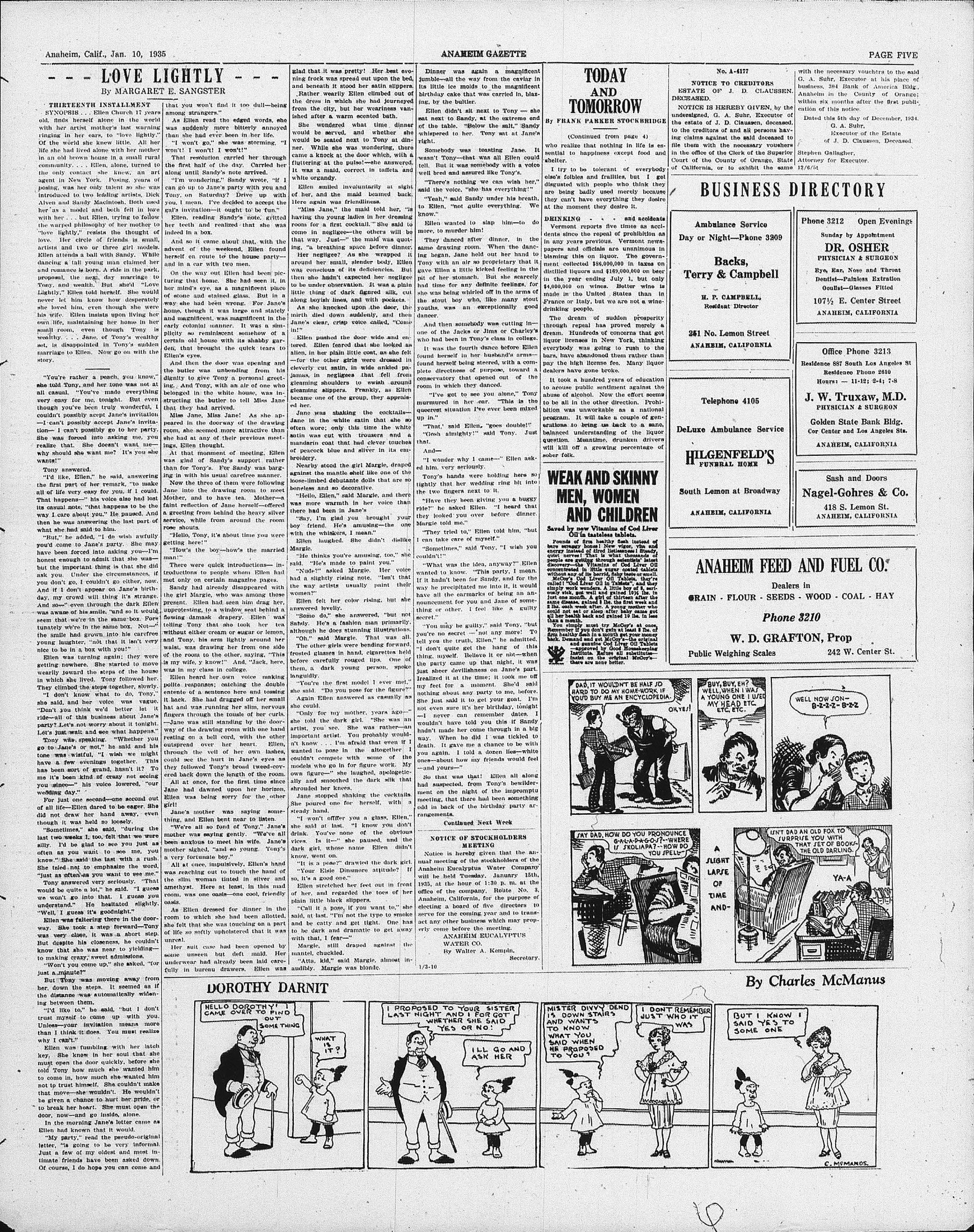
Searchable text
LOVE LIGHTLY
By MARGARET E. SANGSTER
THIRTEENTH INSTALLMENT
SYNOPSIS ... Ellen Church 17 years old, finds herself alone in the world with her artist mother's last warning ringing in her ears, to "love lightly." Of the world she knew little. All her life she had lived alone with her mother in an old brown house in a small rural community... Ellen, alone, turned to the only contact she knew, an art agent in New York. Positing, years of posing, was her only talent so she was introduced to two leading artists, Dick Alven and Sandy Macintosh. Both used her as a model and both fell in love with her... but Ellen, trying to follow the warped philosophy of her mother to "love lightly," resists the thought of love. Her circle of friends is small, artists and two or three girl models. Ellen attends a ball with Sandy. While dancing a tall young man claimed her and romance is born. A ride in the park, proposal, the next day marriage to Tony, and wealth. But she'd "Love Lightly," Ellen told herself. She would never let him know how desperately she loved him, even though she were his wife. Ellen insists upon living her own life, maintaining her home in her small room, even though Tony is wealthy... Jane, of Tony's wealthy set, is disappointed in Tony's sudden marriage to Ellen. Now go on with the story.
"You're rather a peach, you know," she told Tony, and her tone was not at all casual. "You've made everything very easy for me, tonight. But even though you've been truly wonderful, I couldn't possibly accept Jane's invitation—I can't possibly go to her party. She was forced into asking me, you realize that. She doesn't want me—why should she want me? It's you she wants."
As Ellen read the edged words, she was suddenly more bitterly annoyed than she had ever been in her life.
"I won't go," she was storming, "I won't! I won't!" That resolution carried her through the first half of the day. Carried her along until Sandy's note arrived.
"I'm wondering," Sandy wrote, "if I can go up to Jane's party with you and Tony, on Saturday? Drive up with you, I mean. I've decided to accept the gal's invitation—it ought to be fun."
Ellen, reading Sandy's note, gritted her teeth and realized that she was indeed in a box.
And so it came about that, with the advent of the weekend, Ellen found herself en route to the house party—and in a car with two men.
On the way out Ellen had been picturing that home. She had seen it, in her mind's eye, as a magnificent place of stone and stained glass. But in a way she had been wrong. For Jane's home, though it was large and stately and magnificent, was magnificent in the early colonial manner. It was a simplicity so reminiscent somehow of a certain old house with its shabby garden, that brought the quick tears to Ellen's eyes.
And then the door was opening and the butter was unbending from his dignity to give Tony a personal greeting. And Tony, with an air of one who belonged in the white house, was instructing the butler to tell Miss Jane that they had arrived.
Miss Jane, Miss Jane! As she appeared in the doorway of the drawing room, she seemed more attractive than she had at any of their previous meetings, Ellen thought.
At that moment of meeting, Ellen was glad that it was pretty much frock was spread out and beneath it stood her. Rather wearily Ellen the dress in which she from the city, but here ished after a warm scar.
She wondered what would be served, and would be seated next to her. While she was wished a knock at the door fluttering at the pulse! It was a maid, correct white organdy.
Ellen smiled involuntarily of her, and the maid Here again was friendly.
"Miss Jane," the maid having the young ladies room for a first cocktail come in negligee—the way. Just—"the thing, 'a breathing space.' Her negligee? As she around her small, silent was conscious of its do then she hadn't expected to be under observation; little thing of dark fi' along boyish lines, and
As she knocked upon mirth died down suddenly Jane's clear, crisp voice!
Ellen pushed the door tered. Ellen feared that alien, in her plain little—for the other girls we cleverly cut satin, in w jamas, in negligees t gleaming shoulders to gleaming slippers. Frie became one of the grounded her.
Jane was shaking Jane in the white satin often wore; only this satin was cut with tran mandarin coat that had of peacock blue and silk brodery.
"You're rather a peach, you know," she told Tony, and her tone was not at all casual. "You've made everything very easy for me, tonight. But even though you've been truly wonderful, I couldn't possibly accept Jane's invitation—I can't possibly go to her party. She was forced into asking me, you realize that. She doesn't want me—why should she want me? It's you she wants!"
Tony answered.
"I'd like, Ellen," he said, answering the first part of her remark, "to make all of life very easy for you, if I could. That happens—" his voice also had lost its casual note, "that happens to be the way I care about you." He paused. And then he was answering the last part of what she had said to him.
"But," he added, "I do wish awfully you'd come to Jane's party. She may have been forced into asking you—I'm honest enough to admit that she did ask you. Under the circumstances, if you don't go, I couldn't go either, now. And if I don't appear on Jane's birthday, my crowd will thing it's strange. And so—" even through the dark Ellen was aware of his smile, "and so it would seem that we're in the same box. Forunately we're in the same box. Not—" the smile had grown into his carefree young laughter, "not that it isn't very nice to be in a box with you!"
Ellen was turning again; they were getting nowhere. She started to move wearily toward the steps of the house in which she lived. Tony followed her. They climbed the steps together, slowly.
"I don't know what to do, Tony," she said, and her voice was vague. "Don't you think we'd better let it ride—all of this business about Jane's party? Let's not worry about it tonight. Let's just wait and see what happens."
Tony was speaking. "Whether you go to Jane's or not," he said and his tone was wistful, "I wish we might have a few evenings together. This has been sort of grand, hasn't it? To me it's been kind of crazy not seeing you since—" his voice lowered, "our wedding day."
For just one second—one second out of all life—Ellen dared to be eager. She did not draw her hand away, even though it was held so loosely.
"Sometimes," she said, "during the last two weeks I, too, felt that we were silly. I'd be glad to see you just as often as you want to see me, you know." She said the last with a rush. She tried not to emphasize the word, she told not to emphasize the word,
And then the door was opening and the butler was unbending from his dignity to give Tony a personal greeting. And Tony, with an air of one who belonged in the white house, was instructing the butler to tell Miss Jane that they had arrived.
Miss Jane, Miss Jane! As she appeared in the doorway of the drawing room, she seemed more attractive than she had at any of their previous meetings, Ellen thought.
At that moment of meeting, Ellen was glad of Sandy's support rather than for Tony's. For Sandy was bargaining in with his usual carefree manner.
Now the three of them were following Jane into the drawing room to meet Mother, and to have tea. Mother—a faint reflection of Jane herself—offered a greeting from behind the heavy silver service, while from around the room rose shouts.
"Hello, Tony, it's about time you were getting here!"
"How's the boy—how's the married man!"
There were quick introductions—introductions to people whom Ellen had met only on certain magazine pages.
Sandy had already disappeared with the girl Margie, who was among those present. Ellen had seen him drag her, unprotesting, to a window seat behind a flowing damask drapery. Ellen was telling Tony that she took her tea without either cream or sugar or lemon, and Tony, his arm lightly around her waist, was drawing her from one side of the room to the other, saying, "This is my wife, y know!" And, "Jack, here, was in my class in college.
Ellen heard her own voice making polite responses; catching the double entente of a sentence here and tossing it back. She had dragged off her small hat and was running her slim, nervous fingers through the tulle of her curls. —Jane was still standing by the doorway of the drawing room with one hand resting on a bell cord, with the other outspread over her heart. Ellen, through the veil of her own lashes, could see the hurt in Jane's eyes as they followed Tony's broad tweed-covered back down the length of the room.
All at once, for the first time since Jane had dawned upon her horizon, Ellen was being sorry for the other girl!
Jane's mother was saying something, and Ellen bent near to listen.
"We're all so fond of Tony," Jane's mother was saying gently. "We've all been anxious to meet his wife. Jane's mother sighed, "and so young. Tony's a very fortunate boy."
All at once, impulsively, Ellen's hand cleverly cut satin, in which James, in negligees to gleaming shoulders to gleaming slippers. Fraser became one of the grounded her.
Jane was shaking Jane in the white satin often wore; only this satin was cut with tricolor coat that had of peacock blue and silk broidery.
Nearby stood the girl against the mantle shoulder loose-limbed debutante of boneless and so decorated.
"Hello, Ellen," said Mr. Maison was more warmth in there had been in Jane?
"Say I'm glad you boy friend. He's amused with the whiskers, I met Ellen laughed. She Margie.
He thinks you're amused said. "He's made to pardon Nude?" asked Margie although he does stunned "Oh," said Margie.
The other girls were h frosted glasses in hand before carefully rouged them, a dark young languidly.
"You're the first mod she said. 'Do you pose Again Ellen answered she could.
Only for my mother she told the dark girl artist, you see. She important artist. Youn't know... I'm afraid wanted to pose in these couldn't compete with models who go in for fine own figure—" she laughs ally and smoothed their shrouded her knees.
Jane stopped shaking She poured one for her steady hand.
"I won't ooffer you she said at last. 'I'll drink. You've none of vices. Is it—" she put dark girl whose name knew went on.
"It is a pose?" drawled Your Elise Dinsmore
me it's been kind of crazy not seeing you since—" his voice lowered, "our wedding day."
For just one second—one second out of all life—Ellen dared to be eager. She did not draw her hand away, even though it was held so loosely.
"Sometimes," she said, "during the last two weeks I, too, felt that we were silly. I'd be glad to see you just as often as you want to see me, you know." She said the last with a rush. She tailed not to emphasize the word, "just as often as you want to see me."
Tony answered very seriously. "That would be quite a lot," he said. "I guess we won't go into that. I guess you understand." He hesitated slightly. "Well, I guess it's goodnight."
Ellen was faltering there in the doorway. She took a step forward—Tony was very close, it was a short step. But despite his closeness, he couldn't know that she was near to yielding—to making crazy, sweet admissions.
"Won't you come up," she asked, "for just a minute?"
But Tony was moving away from her, down the steps. It seemed as if the distance was automatically widening between them.
"I'd like to," he said, "but I don't trust myself to come up with you. Unless—your invitation means more than I think it does. You must realize why I can't."
Ellen was fumbling with her latch key. She knew in her soul that she must open the door quickly, before she told Tony how much she wanted him to come in, how much she wanted him not to trust himself. She couldn't make that move—she wouldn't. He wouldn't be given a chance to hurt her pride, or to break her heart. She must open the door, now—and go inside, alone.
In the morning Jane's letter came as Ellen had known that it would.
"My party," read the pseudo-original letter, "is going to be very informal. Just a few of my oldest and most intimate friends have been asked down. Of course, I do hope you can come and
All at once, for the first time since Jane had dawned upon her horizon, Ellen was being sorry for the other girl!
Jane's mother was saying something, and Ellen bent near to listen.
"We're all so fond of Tony," Jane's mother was saying gently. "We've all been anxious to meet his wife. Jane's mother sighed, "and so young. Tony's a very fortunate boy."
All at once, impulsively, Ellen's hand was reaching out to touch the hand of the slim woman tinted in silver and amethyst. Here at least, in this mad room, was one oasis—one cool, friendly oasis.
As Ellen dressed for dinner in the room to which she had been allotted, she felt that she was touching on a part of life so softly upholstered that it was unreal.
Her suit case had been opened by some unseen but deft maid. Her underwear had already been laid carefully in bureau drawers. Ellen was
own figure—she laughs ally and smoothed the shrouded her knees.
Jane stopped shaking. She poured one for her steady hand.
"I won't offffer you she said at last. "I drink. You've none of vices. Is it—" she puff dark girl, whose name know, went on.
"It is a pose?" drawled "Your Elsie Dinsmore so, it's a good one."
Ellen stretched her feet of her, and regarded the plain little black slipper.
"Call it a pose, if you said, at last. 'I'm not tha and be catty and get to be dark and dramat with that, I fear—"
Margie, still drapered mantel, chuckled.
"Atta, kid," said Margie was b
DOROTHY DARNIT
glad that it was pretty! Her best evening frock was spread out upon the bed, and beneath it stood her satin slippers.
Rather wearily Ellen climbed out of the dress in which she had journeyed from the city, but her weariness vanished after a warm scented bath.
She wondered what time dinner would be served, and whether she would be seated next to Tony at dinner. While she was wondering, there came a knock at the door which, with a fluttering at the pulse!—she answered. It was a maid, correct in taffeta and white organdy.
Ellen smiled involuntarily at sight of her, and the maid beamed back. Here again was friendliness.
"Miss Jane," the maid told her, "is having the young ladies in her dressing room for a first cocktail. She said to come in negligee—the others will be that way. Just—" the maid was quoting, "a breathing space before dinner.
Her negligee? As she wrapped it around her small, slender body, Ellen was conscious of its deficiencies. But then she hadn't expected her negligee to be under observation. It was a plain little thing of dark figured silk, cut along boyish lines, and with pockets.
As she knocked upon the door, the mirth died down suddenly, and then Jane's clear, crisp voice called, "Come in!"
Ellen pushed the door wide and entered. Ellen feared that she looked as alien, in her plain little coat, as she felt—for the other girls were dressed in cleverly cut satin, in wide ankle pajamas, in negligees that fell from gleaning shoulders to swish around gleaming slippers. Frankly, as Ellen became one of the group, they appraised her.
Jane was shaking the cocktails—Jane in the white satin that she so often wore; only this time the white satin was cut with trousers and a mandarin coat that had clever touches of peacock blue and silver in its embroidery.
Dinner was again a magnificent jumble—all the way from the caviar in its little ice molds to the magnificent birthday cake that was carried in, blazing, by the buftler.
Ellen didn't sit next to Tony — she sat next to Sandy, at the extreme end of the table. "Below the salt," Sandy whispered to her. Tony sat at Jane's right.
Somebody was toasting Jane. It wasn't Tony—that was all Ellen could tell. But it was somebody with a voice well bred and assured like Tony's.
"There's nothing we can wish her," said the voice, "she has everything!"
"Yeah," said Sandy under his breath, to Ellen, "not quite everything. We know."
Ellen wanted to slap him—to do more, to murder him!
They danced after dinner, in the same drawing room. When the dancing began, Jane held out her hand to Tony with an air so proprietary that it gave Ellen a little kicked feeling in the pit of her stomach. But she scarcely had time for any definite feelings, for she was being whirled off in the arms of the stout boy who, like many stout youths, was an exceptionally good dancer.
And then somebody was cutting in—one of the Jacks or Jims or Charley's who had been in Tony's class in college.
It was the fourth dance before Ellen found herself in her husband's arms—found herself being steered, with a complete directness of purpose, toward a conservatory that opened out of the room in which they danced.
"I've got to see you alone," Tony murmured in her ear. "This is the queerest situation I've ever been mixed up in."
"That,' said Ellen, "goes double!"
"Gosh almighty!" said Tony. Just that.
And—
"I wonder why I came—" Ellen ask-
TODAY AND TOMORROW
By FRANK PARKER STOCKBRIDGE
(Continued from page 4) who realize that nothing in life is essential to happiness except food and shelter.
I try to be tolerant of everybody else's folbles and frailties, but I get disgusted with people who think they are being badly used merely because they can't have everything they desire at the moment they desire it.
DRINKING and accidents
Vermont reports five times as accidents since the repeal of prohibition as in any years previous. Vermont newspapers and officials are unanimous in blaming this on liquor. The government collected $88,000,000 in taxes on distilled liquors and $169,000,000 on beer in the year ending July 1, but only $4,000,000 on wines. Better wine is made in the United States than in France or Italy, but we are not a wine-drinking people.
The dream of sudden prosperity through repeal has proved merely a dream. Hundreds of concerns that got liquor licenses in New York, thinking everybody was going to rush to the bars, have abandoned them rather than pay the high license fee. Many liquor dealers have gone broke.
It took a hundred years of education to arouse public sentiment against the abuse of alcohol. Now the effort seems to be all in the other direction. Prohibition was unworkable as a national program. It will take a couple of generations to bring us back to a sane, balanced understanding of the liquor question. Meantime, drunken drivers will kill off a growing percentage of sober folk.
cleverly cut satin, in wide ankled pajamas, in negligees that fell from gleaming shoulders to swish around gleaming slippers. Frankly, as Ellen became one of the group, they appraised her.
Jane was shaking the cocktails—Jane in the white satin that she so often wore; only this time the white satin was cut with trousers and a mandarin coat that had clever touches of peacock blue and sliver in its embroidery.
Nearby stood the girl Margie, draped against the mantle shelf like one of the loose-limbed debutante dolls that are so boneless and so decorative.
"Hello, Ellen," said Margie, and there was more warmth in her voice than there had been in Jane's.
"Say, I'm glad you brought your boy friend. He's amusing—the one with the whiskers, I mean."
Ellen laughed. She didn't dislike Margie.
"He thinks you're amusing, too," she said. "He's made to paint you."
"Nude?" asked Margie. Her voice had a slightly rising note. "Isn't that the way artists usually paint their women?"
Ellen felt her color rising, but she answered levelly.
"Some do," she answered, "but not Sahdy. He's a fashion man primarily, although he does stunning illustrations."
"Oh," said Margie. That was all.
The other girls were bending forward, frosted glasses in hand, cigarettes held before carefully rouged lips. One of them, a dark young person, spoke languidly.
"You're the first model I ever met," she said. "Do you pose for the figure?"
Again Ellen answered as casually as she could.
"Only for my mother, years ago—she told the dark girl. 'She was an artist, you see. She was rather—an important artist. You probably wouldn't know... I'm afraid that even if I wanted to pose in the altogether I couldn't compete with some of the models who go in for figure work. My own figure—" she laughed, apologetically and smoothed the dark silk that shrouded her knees.
Jane stopped shaking the cocktails. She poured one for herself, with a steady hand.
"I won't offfer you a glass, Ellen," she said at last. "I know you don't drink. You've none of the obvious vices. Is it—" she paused, and the dark girl, whose name Ellen didn't know, went on.
"It is a pose?" drawled the dark girl.
"Your Elsie Dinsmore attitude? If found herself being steered, with a complete directness of purpose, toward a conservatory that opened out of the room in which they danced.
"I've got to see you alone," Tony murmured in her ear. "This is the queerest situation I've ever been mixed up in."
"That,' said Ellen, "goes double!" Gosh almighty!' said Tony. Just that.
And—
"I wonder why I came—" Ellen asked him, very seriously.
Tony's hands were holding here so tightly that her wedding ring bit into the two fingers next to it.
"Have they been giving you a buggy ride?" he asked Ellen. "I heard that they looked you over before dinner. Margie told me."
"They tried to," Ellen told him, "but I can take care of myself."
"Sometimes," said Tony, "I wish you couldn't."
"What was the idea, anyway?" Ellen wanted to know. "This party, I mean. If it hadn't been for Sandy, and for the way he precipitated me into it, it would have all the earmarks of being an announcement for you and Jane of something or other. I feel like a guilty secret."
"You may be guilty," said Tony, "but you're no secret — not any more! To tell you the truth, Ellen," he admitted, "I don't quite get the hang of this thing, myself. Believe it or not—when the party came up that night, it was just sheer devilishness on Jane's part. Realized it at the time; it took me off my feet for a moment. She'd said nothing about any party to me, before. She just said it to get your goat. I'm not even sure it's her birthday, tonight — I never can remember dates. I wouldn't have told you this if Sandy hadn't made her come through in a big way. When he did I was tickled to death. It gave me a chance to be with you again. I told a dozen lies—white ones—about how my friends would feel—and yours—"
So that was that! Ellen all along had suspected, from Tony's bewilderment on the night of the impromptu meeting, that there had been something odd in back of the birthday party arrangements.
Continued Next Week
NOTICE OF STOCKHOLDERS MEETING
Notice is hereby given that the annual meeting of the stockholders of the Anaheim Eucalyptus Water Company will take place on Thursday at 10:30 AM at The Anaheim Eucalyptus Water Company building located at 2450 Washburn Avenue in Anaheim, California.
DAD, IT WOULDN'T BE HALF SO HARD TO DO MY HOME-WORK IF YOU BUY ME AN ENCYCLOPEDIA.
SAY DAD, HOW DO YOU PRONounce GAL-A-PAG-O-S?--WHERE IS SKOLIAPA?--HOW DO YOU SPELL-
own figure—she laughed, apologetically and smoothed the dark silk that shrouded her knees.
Jane stopped shaking the cocktails. She poured one for herself, with a steady hand.
"I won't offfer you a glass, Ellen," she said at last. "I know you don't drink. You've none of the obvious vices. Is it—" she paused, and the dark girl, whose name Ellen didn't know, went on.
"It is a pose?" drawled the dark girl.
"Your Elsie Dinsmore attitude? If so, it's a good one."
Ellen stretched her feet out in front of her, and regarded the toes of her plain little black slippers.
"Call it a pose, if you want to," she said, at last. "I'm not the type to smoke and be catty and get tight. One has to be dark and dramatic to get away with that, I fear—"
Margie, still draped against the mantel, chuckled.
"Atta, kid," said Margie, almost inaudibly. Margie was blonde.
So that was that! Ellen all along had suspected, from Tony's bewilderment on the night of the impromptu meeting, that there had been something odd in back of the birthday party arrangements.
Continued Next Week
NOTICE OF STOCKHOLDERS MEETING
Notice is hereby given that the annual meeting of the stockholders of the Anaheim Eucalyptus Water Company will be held Tuesday, January 15th, 1935, at the hour of 1:30 p.m. at the office of the company, Route No. 3, Anaheim, California, for the purpose of electing a board of five directors to serve for the coming year and to transact any other business which may properly come before the meeting.
ANAHEIM EUCALYPTUS
WATER CO.
By Walter A. Kempin,
Secretary.
1/3-10
NO. A-4177
NOTICE TO CREDITORS
ESTATE OF J. D. CLAUSSEN.
DECEASED.
NOTICE IS HEREBY GIVEN, by the undersigned, G. A. Suhr, Executor of the estate of J. D. Claussen, deceased, to the creditors of and all persons having claims against the said deceased to file them with the necessary vouchers in the office of the Clerk of the Superior Court of the County of Orange, State of California, or to exhibit the same with the necessary vouchers to the said G. A. Suhr, Executor at his place of business, 304 Bank of America Bldg., Anaheim in the County of Orange; within six months after the first publication of this notice.
Dated this 5th day of December, 1934.
G. A. Suhr,
Executor of the Estate
of J. D. Claussen, Deceased.
Stephen Gallagher,
Attorney for Executor.
12/6/5t
BUSINESS DIRECTORY
Ambulance Service
Day or Night—Phone 3209
Backs,
Terry & Campbell
H. P. CAMPBELL,
Resident Director
251 No. Lemon Street
ANAHEIM, CALIFORNIA
Phone 3212 Open Evenings
Sunday by Appointment
DR. OSHER
PHYSICIAN & SURGEON
Eye, Ear, Nose and Throat
Dentist—Painless Extration
Ooilst—Glasses Fitted
107½ E. Center Street
ANAHEIM, CALIFORNIA
Office Phone 3213
Residence 887 South Los Angeles St
Residence Phone 2610
Hours: — 11-12; 2-4; 7-8
Telephone 4105
DeLuxe Ambulance Service
HILGENFELD'S
J. W. Truxaw, M.D.
PHYSICIAN & SURGEON
Golden State Bank Bldg.
Cor Center and Los Angeles Sts.
ANAHEIM, CALIFORNIA
Telephone 4105
DeLuxe Ambulance Service
HILGENFELD'S
FUNBRAL HOME
South Lemon at Broadway
ANAHEIM, CALIFORNIA
J. W. Truxaw, M.D.
PHYSICIAN & SURGEON
Golden State Bank Bldg.
Cor Center and Los Angeles Sts.
ANAHEIM, CALIFORNIA
Sash and Doors
Nagel-Gohres & Co.
418 S. Lemon St.
ANAHEIM, CALIFORNIA
ANAHEIM FEED AND FUEL CO.
Dealers in
GRAIN - FLOUR - SEEDS - WOOD - COAL - HAY
Phone 3210
W. D. GRAFTON, Prop
Public Weighing Scales 242 W. Center St.
OH, YES!
BUY, BUY, EH?
WELL, WHEN I WAS A YOUNG ONE I WED MY HEAD ETC, ETC.
WELL NOW SONB-Z-Z-Z-B-Z-Z
ISN'T DAD AN OLD FOX TO SURPRISE YOU WITH THAT SET OF BOOKS THE OLD DARLING.
HOW DO YOU PRONOUNCE G-A-L-A-PAG-O-S?--WHERE IS SKOLIAPA?--HOW DO YOU SPELL?
A SLIGHT LAPSE OF TIME AND-
ISN'T DAD AN OLD FOX TO SURPRISE YOU WITH THAT SET OF BOOKS THE OLD DARLING.
YA-A
By Charles McManus
DEND
I DONT REMEMBER JUST WHO IT WAS
BUT I KNOW I SAID YES TO SOME ONE
C. MFMANOS.