anaheim-gazette 1935-01-03
Scanned page
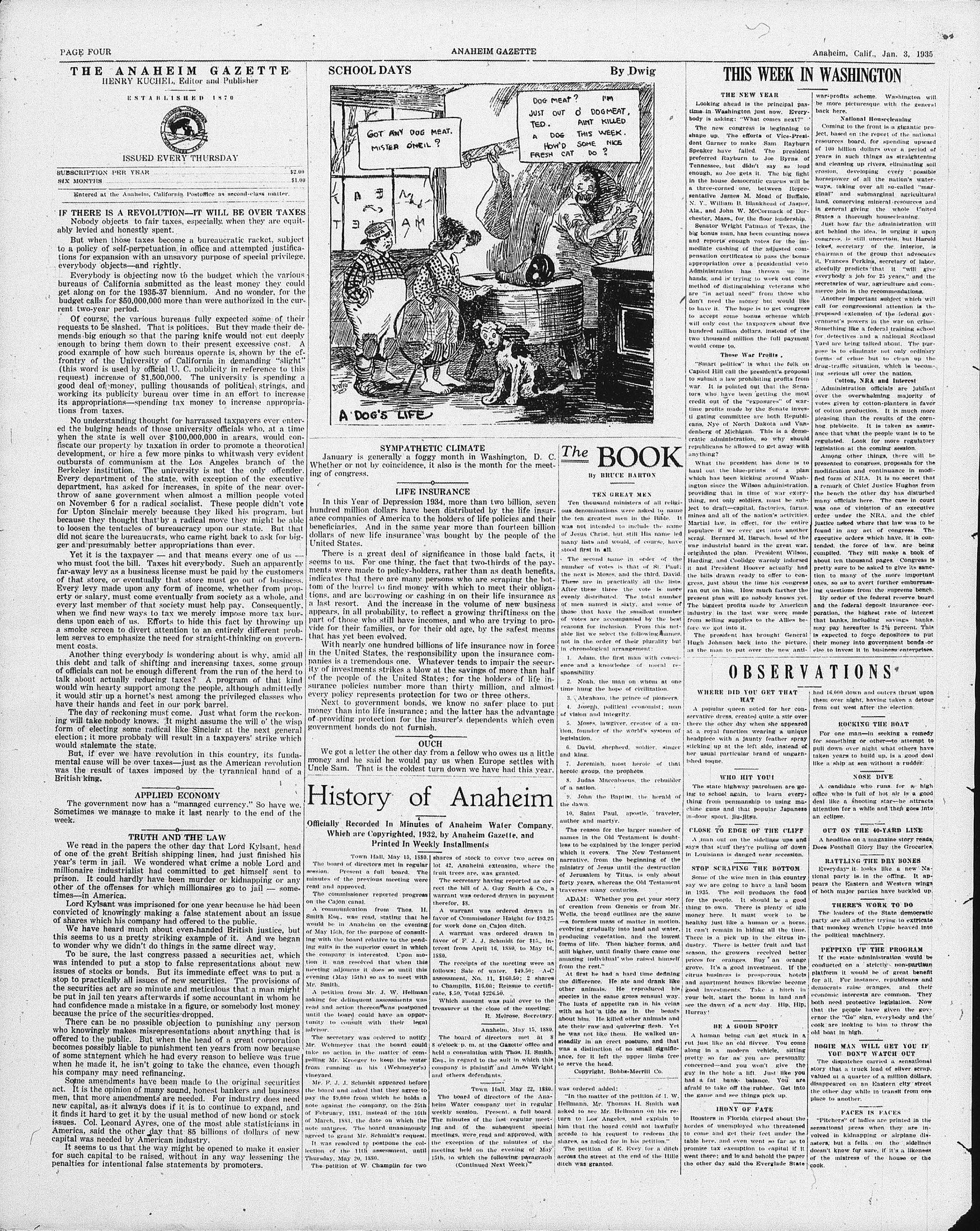
Searchable text
THE ANAHEIM GAZETTE
HENRY KUCHEL, Editor and Publisher
ESTABLISHED 1870
ISSUED EVERY THURSDAY
SUBSCRIPT PER YEAR $2.00
SIX MONTHS $1.00
Entered at the Anaheim, California Postoffice as second-class matter.
IF THERE IS A REVOLUTION—IT WILL BE OVER TAXES
Nobody objects to fair taxes, especially when they are equitably levied and honestly spent.
But when those taxes become a bureaucratic racket, subject to a policy of self-perpetuation in office and attempted justifications for expansion with an unsavory purpose of special privilege, everybody objects—and rightly.
Everybody is objecting now to the budget which the various bureaus of California submitted as the least money they could get along on for the 1935-37 biennium. And no wonder, for the budget calls for $50,000,000 more than were authorized in the current two-year period.
Of course, the various bureaus fully expected some of their requests to be slashed. That is politices. But they made their demands big enough so that the paring knife would not cut deeply enough to bring them down to their present excessive cost. A good example of how such bureaus operate is shown by the effort of the University of California in demanding "slight" (this word is used by official U. C. publicity in reference to this request) increase of $1,500,000. The university is spending a good deal of money, pulling thousands of political strings, and working its publicity bureau over time in an effort to increase its appropriations—spending tax money to increase appropriations from taxes.
No understanding thought for harrassed taxpayers ever entered the bulging heads of those university officials who, at a time when the state is well over $100,000,000 in arrears, would confiscate our property by taxation in order to promote a theoretical development, or hire a few more pinks to whitwash very evident
No understanding thought for harrassed taxpayers ever entered the bulging heads of those university officials who, at a time when the state is well over $100,000,000 in arears, would confiscate our property by taxation in order to promote a theoretical development, or hire a few more pinks to whitwash very evident outbursts of communism at the Los Angeles branch of the Berkeley institution. The university is not the only offender. Every department of the state, with exception of the executive department, has asked for increases, in spite of the near overthrow of sane government when almost a million people voted on November 6 for a radical socialist. These people didn't vote for Upton Sinclair merely because they liked his program, but because they thought that by a radical move they might be able to loosen the tentacles of bureaucracy upon our state. But that did not scare the bureaucrats, who came right back to ask for bigger and presumably better appropriations than ever.
Yet it is the taxpayer — and that means every one of us — who must foot the bill. Taxes hit everybody. Such an apparently far-away levy as a business license must be paid by the customers of that store, or eventually that store must go out of business. Every levy made upon any form of income, whether from property or salary, must come eventually from society as a whole, and every last member of that society must help pay. Consequently, when we find new ways to tax we merely impose more tax burdens upon each of us. Efforts to hide this fact by throwing up a smoke screen to divert attention to an entirely different problem serves to emphasize the need for straight-thinking on government costs.
Another thing everybody is wondering about is why, amid all this debt and talk of shifting and increasing taxes, some group of officials can not be enough different from the run of the herd to talk about actually reducing taxes? A program of that kind would win hearty support among the people, although admittedly it would stir up a hornet's nest among the privileged classes who have their hands and feet in our pork barrel.
The day of reckoning must come. Just what form the reckoning will take nobody knows. It might assume the will o' the wisp form of electing some radical like Sinclair at the next general election; it more probaly will result in a taxpayers' strike which would stalemate the state.
But, if ever we have revolution in this country, its fundamental cause will be over taxes—just as the American revolution was the result of taxes imposed by the tyrannical hand of a British king.
APPLIED ECONOMY
The government now has a "managed currency." So have we. Sometimes we manage to make it last nearly to the end of the week.
TRUTH AND THE LAW
We read in the papers the other day that Lord Kylsant, head of one of the great British shipping lines, had just finished his year's term in jail. We wondered what crime a noble Lord and millionaire industrialist had committed to increase appropriations from taxes.
APPLIED ECONOMY
The government now has a "managed currency." So have we. Sometimes we manage to make it last nearly to the end of the week.
TRUTH AND THE LAW
We read in the papers the other day that Lord Kylsant, head of one of the great British shipping lines, had just finished his year's term in jail. We wondered what crime a noble Lord and millionaire industrialist had committed to get himself sent to prison. It could hardly have been murder or kidnapping or any other of the offenses for which millionaires go to jail — sometimes—in America.
Lord Kylsant was imprisoned for one year because he had been convicted of knowingly making a false statement about an issue of shares which his company had offered to the public.
We have heard much about even-handed British justice, but this seems to us a pretty striking example of it. And we began to wonder why we didn't do things in the same direct way.
To be sure, the last congress passed a securities act, which was intended to put a stop to false representations about new issues of stocks or bonds. But its immediate effect was to put a stop to practically all issues of new securities. The provisions of the securities act are so minute and meticulous that a man might be put in jail ten years afterwards if some accountant in whom he had confidence made a mistake in a figure, or somebody lost money because the price of the securities dropped.
There can be no possible objection to punishing any person who knowingly makes misrepresentations about anything that is offered to the public. But when the head of a great corporation becomes possibly liable to punishment ten years from now because of some statement which he had every reason to believe was true when he made it, he isn't going to take the chance, even though his company may need refinancing.
Some amendments have been made to the original securities act. It is the opinion of many sound, honest bankers and business men, that more amendments are needed. For industry does need new capital, as it always does if it is to continue to expand, and it finds it hard to get it by the usual method of new bond or stock issues. Col. Leonard Ayres, one of the most able statisticians in America, said the other day that 85 billions of dollars of new capital was needed by American industry.
It seems to us that the way might be opened to make it easier for such capital to be raised, without in any way lessening the penalties for intentional false statements by promoters.
SCHOOL DAYS
By Dwig
GOT ANY DOG MEAT.
MISTER ONEIL?
DOG MEAT? I'M
JUST OUT OF DOGMEAT,
TED. AINT KILLED
A DOG THIS WEEK.
HOW'D SOME NICE
FRESH CAT DO?
A DOG'S LIFE
SYMPATHETIC CLIMATE
January is generally a foggy month in Washington. D. C.
SYMPATHETIC CLIMATE
January is generally a foggy month in Washington, D. C.
Whether or not by coincidence, it also is the month for the meeting of congress.
LIFE INSURANCE
In this Year of Depression 1934, more than two billion, seven hundred million dollars have been distributed by the life insurance companies of America to the holders of life policies and their beneficiaries. And in the same year more than fourteen billion dollars of new life insurance was bought by the people of the United States.
There is a great deal of significance in those bald facts, it seems to us. For one thing, the fact that two-thirds of the payments were made to policy-holders, rather than as death benefits, indicates that there are many persons who are scraping the bottom of the barrel to find money with which to meet their obligations, and are borrowing or cashing in on their life insurance as a last resort. And the increase in the volume of new business appears, in all probability, to reflect a growing thriftiness on the part of those who still have incomes, and who are trying to provide for their families, or for their old age, by the safest means that has yet been evolved.
With nearly one hundred billions of life insurance now in force in the United States, the responsibility upon the insurance companies is a tremendous one. Whatever tends to impair the security of investments strikes a blow at the savings of more than half of the people of the United States; for the holders of life insurance policies number more than thirty million, and almost every policy represents protection for two or three others.
Next to government bonds, we know no safer place to put money than into life insurance; and the latter has the advantage of providing protection for the insurer's dependents which even government bonds do not furnish.
OUCH
We got a letter the other day from a fellow who owes us a little money and he said he would pay us when Europe settles with Uncle Sam. That is the coldest turn down we have had this year.
History of Anaheim
Officially Recorded In Minutes of Anaheim Water Company. Which are Copyrighted, 1932, by Anaheim Gazette, and Printed In Weekly Installments
Town Hall, May 15, 1880.
The board of directors met in regular shares of stock to cover two acres on lot 42, Anaheim extension, where the
History of Anaheim
Officially Recorded In Minutes of Anaheim Water Company. Which are Copyrighted, 1932, by Anaheim Gazette, and Printed in Weekly Installments
Town Hall, May 15, 1880.
The board of directors met in regular session. Present a full board. The minutes of the previous meeting were read and approved.
The commissioner reported progress on the Cajon canal.
A communication from Thos. H. Smith Esq., was read, stating that he would be in Anaheim on the evening of May 15th, for the purpose of consulting with the board relative to the pending suits in the superior court in which the company is interested. Upon motion it was resolved that when this meeting adjourns it does so until this evening (May 15th) so as to meet with Mr. Smith.
A petition from Mr. J. W. Hellman asking for delinquent assessments was read and action thereon was postponed until the board could have an opportunity to consult with their legal advisor.
The secretary was ordered to notify Mr. Wehmeyer that the board could take no action in the matter of compelling Mr. Kroeger to keep the water from running in his (Wehmeyer’s) vineyard.
Mr. F. J. J. Schmidt appeared before the board and asked that they agree to pay the $9,000 from which he holds a note against the company, on the 25th of February, 1881, instead of the 16th of March, 1881, the date on which the note matures. The board unanimously agreed to grant Mr. Schmidt's request.
It was resolved to postpone the collection of the 11th assessment, until Thursday, May 20, 1880.
The petition of W. Champlin for two shares of stock to cover two acres on lot 42, Anaheim extension, where the fruit trees are, was granted.
The secretary having reported as correct the bill of A. Guy Smith & Co., a warrant was ordered drawn in payment therefor, $8.
A warrant was ordered drawn in favor of Commissioner Haight for $93.25 for work done on Cajon ditch.
A warrant was ordered drawn in favor of F. J. J. Schmidt for $15., interest from April 16, 1880, to May 16, 1880.
The receipts of the meeting were as follows: Sale of water, $49.50; A-C assessment, No. 11, $160.50; 2 shares to Champlin, $16.00; Reissue to certificate, $.50, Total $226.50.
Which amount was paid over to the treasurer at the close of the meeting:
R. Melrose, Secretary,
Anaheim, May 15, 1880.
The board of directors met at 8 o'clock p.m. at the Gazette office and held a consultation with Thos. H. Smith, Esq., in regard to the suit in which this company is plaintiff and Amos Wright and others defendants.
Town Hall, May 22, 1880.
The board of directors of the Anaheim Water company met in regular weekly session. Present a full board. The minutes of the last regular meeting and of the subsequent special meetings, were read and approved, with the exception of the minutes of the meeting held on the evening of May 15th, to which the following paragraph (Continued Next Week)
was ordered added:
"In the matter of the petition of I. W. Hellmann, Mr. Thomas H. Smith was asked to see Mr. Hellmann on his return to Los Angeles, and explain to him that the board could not lawfully accede to his request to redeem the shares, as asked for in his petition."
The petition of E. Evey for a ditch across the street at the end of the Hillie ditch was granted.
8. Judas Maccabaeus, rebuilder of a nation.
9. John the Baptist, herald of the dawn.
10. Saint Paul, apostle, traveler and martyr.
The reason for the larger number of names in the Old Testament is doubtless to be explained by the longer period which it covers. The New Testament narrative, from the beginning of the ministry of Jesus until the destruction of Jerusalem by Titus, is only about forty years, whereas the Old Testament traverses many centuries.
ADAM: Whether you get your story of creation from Genesis or from Mr. Wells, the broad outlines are the same—a formless mass of matter in motion, evolving gradually into land and water, producing vegetation, and the lowest forms of life. Then higher forms, and still higher, until finally there came one amazing individual who raised himself from the rest."
At first he had a hard time defining the difference. He ate and drank like other animals. He reproduced his species in the same gross sensual way. The lusts of appetite ran in his veins with as hot a tide as in the beasts about him. He killed other animals and ate their raw and quivering flesh. Yet he was not like them. He walked unsteadily in an erect posture, and that was a distinction of no small significance, for it left the upper limbs free to serve the head.
Copyright, Bobbs-Merrill Co.
THIS WEEK IN WASHINGTON
THE NEW YEAR
Looking ahead is the principal pastime in Washington just now. Everybody is asking: "What comes next?"
The new congress is beginning to shape up. The efforts of Vice-President Garner to make Sam Rayburn Speaker have failed. The president preferred Rayburn to Joe Byrns of Tennessee, but didn't say so loud enough, so Joe gets it. The big fight in the house democratic caucus will be a three-corned one, between Representative James M. Mead of Buffalo, N.Y., William B. Blankhead of Jasper, Ala., and John W. McCormack of Dorschester, Mass., for the floor leadership.
Senator Wright Patman of Texas, the big bonus man, has been counting noses and reports enough votes for the immediate cashing of the adjusted compensation certificates to pass the bonus appropriation over a presidential veto. Administration has thrown up its hands, and is trying to work out some method of distinguishing veterans who are "in actual need" from those who don't need the money but would like to have it. The hope is to get congress to accept some bonus scheme which will only cost the taxpayers about five hundred million dollars, instead of the two thousand million the full payment would come to.
Those War Profits.
"Smart politics" is what the folk on Capitol Hill call the president's proposal to submit a law prohibiting profits from war. It is pointed out that the Senators who have been getting the most credit out of the "exposures" of wartime profits made by the Senate investigating committee are both Republicans, Nye of North Dakota and Vandenberg of Michigan. This is a democratic administration, so why should republicans be allowed to get away with anything?
war-profits scheme. Washington will be more picturesque with the general back here.
National Housecleaning
Coming to the front is a gigantic project, based on the report of the national resources board, for spending upward of 100 billion dollars over a period of years in such things as straightening and cleaning up rivers, eliminating soil erosion, developing every possible horsepower of all the nation's waterways, taking over all so-called "marginal" and submarginal agricultural land, conserving mineral resources and in general giving the whole United States a thorough housecleaning.
Just how far the administration will get behind the idea, in urging it upon congress, is still uncertain, but Harold Ickes, secretary of the interior, is chairman of the group that advocates it, Frances Perkins, secretary of labor, gleefully predicts that it "will give everybody a job for 25 years," and the secretaries of war, agriculture and commerce join in the recommendations.
Another important subject which will call for congressional attention is the proposed extension of the federal government's powers in the war on crime. Something like a federal training school for detectives and a national Scotland Yard are being talked about. The purpose is to eliminate not only ordinary forms of crime but to clean up the drug-traffic situation, which is becoming serious all over the nation.
Cotton, NRA and Interest
Administration officials are jubilant over the overwhelming majority of votes given by cotton-planters in favor of cotton production. It is much more pleasing than the results of the corn-hog plebiscite. It is taken as assurance that what the people want is to be regulated. Look for more regulatory legislation at the coming session.
Among other things, there will be
"Smart politics" is what the folk on Capitol Hill call the president's proposal to submit a law prohibiting profits from war. It is pointed out that the Senators who have been getting the most credit out of the "exposures" of wartime profits made by the Senate investigating committee are both Republicans, Nye of North Dakota and Vandenberg of Michigan. This is a democratic administration, so why should republicans be allowed to get away with anything?
What the president has done is to haul out the blue-prints of a plan which has been kicking around Washington since the Wilson administration, providing that in time of war everything, not only soldiers, must be subject to draft—capital, factories, farms, mines and all of the nation's activities. Martial law, in effect, for the entire populace if we ever get into another scrape. Bernard M. Baruch, head of the war industrial board in the great war, originated the plan. President Wilson, Harding, and Coolidge warmly indorsed it and President Hoover actually had the bills drawn ready to offer to congress, just about the time his congress ran out on him. How much farther the present plan will go nobody knows yet. The biggest profits made by American industry in the last war were made from selling supplies to the Allies before we got into it.
The president has brought General Hugh Johnson back into the picture, as the man to put over the new anti-drug-traffic situation, which is becoming serious all over the nation.
Cotton, NRA and Interest
Administration officials are jubilant over the overwhelming majority of votes given by cotton-planters in favor of cotton production. It is much more pleasing than the results of the corn-hog plebiscite. It is taken as assurance that what the people want is to be regulated. Look for more regulatory legislation at the coming session.
Among other things, there will be presented to congress proposals for the modification and continuance in modified form of NRA. It is no secret that a remark of Chief Justice Hughes from the bench the other day has disturbed many officials here. The case in court was one of violation of an executive order under the NRA, and the chief justice asked where that law was to be found in any act of congress. The executive orders which have, it is contended, the force of law, are being compiled. They will make a book of about ten thousand pages. Congress is pretty sure to be asked to give its sanction to many of the more important ones, so as to avert further embarrassing questions from the supreme bench.
By order of the federal reserve board and the federal deposit insurance corporation, the highest rate of interest that banks, including savings banks, may pay hereafter is 2½ percent. This is expected to force depositors to put their money into government bonds or else to invest it in business enterprises.
OBSERVATIONS
WHERE DID YOU GET THAT HAT
A popular queen noted for her conservative dress, created quite a stir over there the other day when she appeared at a royal function wearing a unique headpiece with a jaunty feather spray sticking up at the left side, instead of her usual particular brand of ungarnished toque.
WHO HIT YOU!
The state highway patrolmen are going to school again, to learn everything from penmanship to using machine guns and that popular Japanese in-door sport, jiu-jitsu.
CLOSE TO EDGE OF THE CLIFF
A man out on the sidelines ups and says that stuff they're pulling off down in Louisiana is dangled near secession.
STOP SCRAPING THE BOTTOM
had 16,000 down and outers thrust upon them over night, having taken a detour from out west after the election.
ROCKING THE BOAT
For one man—in seeking a remedy for something or other—to attempt to pull down over night what others have taken years to build up, is a good deal like a ship at sea without a rudder.
NOSE DIVE
A candidate who runs for a high office who is full of hot air is a good deal like a shooting star—the attracts attention for a while and then goes into an eclipse.
OUT ON THE 40-YARD LINE
A headline on a magazine story reads: Does Football Glory Buy the Groceries.
RATTLING THE DRY BONES
Everyday it looks like a new Na-
WHO HIT YOU!
The state highway patrolmen are going to school again, to learn everything from penmanship to using machine guns and that popular Japanese in-door sport, jiu-jitsu.
CLOSE TO EDGE OF THE CLIFF
A man out on the sidelines ups and says that stuff they're pulling off down in Louisiana is danger near secession.
STOP SCRAPING THE BOTTOM
Some of the wise men in this country say we are going to have a land boom in 1935. The soil produces the food for the people. It should be a good thing to own. There is plenty of idle money here. It must work to be healthy just like a human or a horse. It can't remain in hiding all the time. There is a pick up in the citrus industry. There is better fruit and last season, the growers received better prices for oranges. Buy an orange grove. It's a good investment. If the citrus business is prosperous, hotels and apartment houses likewise become good investments. Take a hitch in your belt, start the boom in land and see the dawn of a new day. Hip, Hip, Hurray!
BE A GOOD SPORT
A human being can get stuck in a rut just like an old fliver. You come along in a modern vehicle, sitting pretty so far as you are personally concerned—and you won't give the guy in the hole a lift. Just like you had a fat bank balance. You are afraid to take off the rubber. Get into the game and see things pick up.
IRONY OF FATE
Boosters in Florida chirped about the hordes of unemployed who threatened to come and get their feet under the table here, and even went so far as to promise tax exemption to capital if it went there; and lo and behold the paper the other day said the Everglade State
NOSE DIVE
A candidate who runs for a high office who is full of hot air is a good deal like a shooting star—he attracts attention for a while and then goes into an eclipse.
OUT ON THE 40-YARD LINE
A headline on a magazine story reads: Does Football Glory Buy the Groceries.
RATTLING THE DRY BONES
Everyday it looks like a new National party is in the offing. It appears the Eastern and Western wings of both major parties have buckled up.
THERE'S WORK TO DO
The leaders of the State democratic party are all afutter trying to extricate that monkey wrench Uppie heaved into the political machinery.
PEPPING UP THE PROGRAM
If the state administration would be conducted on a strictly non-partisan platform it would be of great benefit for all. For instance, republicans and democrats raise oranges, and their economic interests are common. They both need protective legislation. Now that the people have given the governor the "Go" sign, everybody and the cook are looking to him to throw the old boat in high.
BOGIE MAN WILL GET YOU IF YOU DON'T WATCH OUT
The dispatches carried a sensational story that a truck load of silver scrap, valued at a quarter of a million dollars, disappeared on an Eastern city street the other day while in transit from one place to another.
FACES IS FACES
"Pitchers" of ladies are printed in the sensational press when they are involved in kidnapping or airplane disasters, but a fella on the sidelines doesn't know for sure, if it's a likeness of the mistress of the house or the cook.