anaheim-gazette 1934-12-20
Scanned page
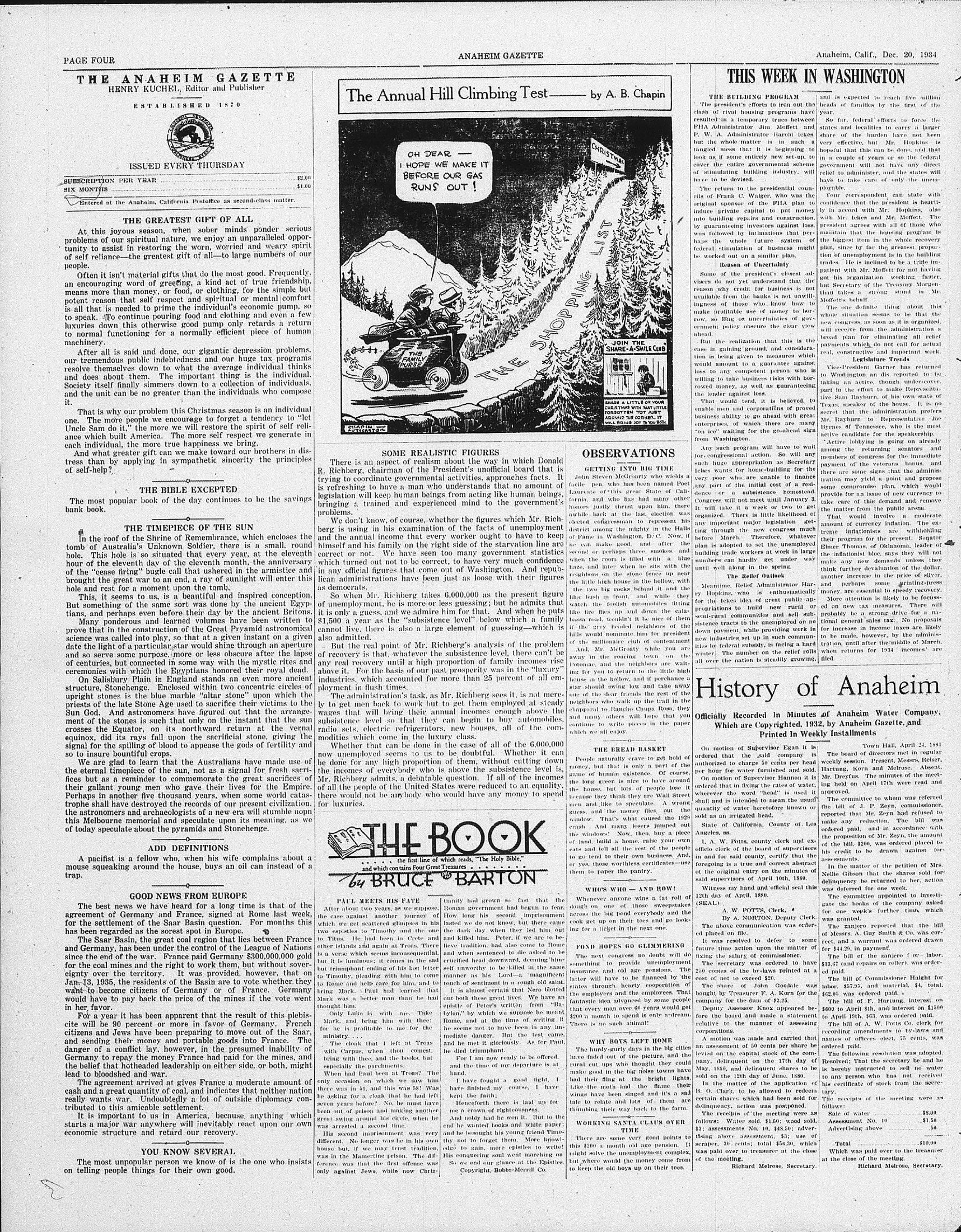
Searchable text
THE ANAHEIM GAZETTE
HENRY KUCHEL, Editor and Publisher
ESTABLISHED 1870
ISSUED EVERY THURSDAY
SUBSCRIPTION PER YEAR $2.00
SIX MONTHS $1.00
Entered at the Anaholm, California Postoffice as second-class matter.
THE GREATEST GIFT OF ALL
At this joyous season, when sober minds ponder serious problems of our spiritual nature, we enjoy an unparalleled opportunity to assist in restoring the worn, worried and weary spirit of self reliance—the greatest gift of all—to large numbers of our people.
Often it isn't material gifts that do the most good. Frequently, an encouraging word of greeting, a kind act of true friendship, means more than money, or food, or clothing, for the simple but potent reason that self respect and spiritual or mental comfort is all that is needed to prime the individual's economic pump, so to speak. To continue pouring food and clothing and even a few luxuries down this otherwise good pump only retards a return to normal functioning for a normally efficient piece of human machinery.
After all is said and done, our gigantic depression problems, our tremendous public indebtedness and our huge tax programs resolve themselves down to what the average individual thinks and does about them. The important thing is the individual. Society itself finally simmers down to a collection of individuals, and the unit can be no greater than the individuals who compose it.
That is why our problem this Christmas season is an individual one. The more people we encourage to forget a tendency to "let Uncle Sam do it," the more we will restore the spirit of self reliance which built America. The more self respect we generate in each individual, the more true happiness we bring.
And what greater gift can we make toward our brothers in dis-
resolve themselves down to what the average individual thinks and does about them. The important thing is the individual. Society itself finally simmers down to a collection of individuals, and the unit can be no greater than the individuals who compose it.
That is why our problem this Christmas season is an individual one. The more people we encourage to forget a tendency to "let Uncle Sam do it," the more we will restore the spirit of self reliance which built America. The more self respect we generate in each individual, the more true happiness we bring.
And what greater gift can we make toward our brothers in distress than by applying in sympathetic sincerity the principles of self-help?
THE BIBLE EXCEPTED
The most popular book of the day continues to be the savings bank book.
THE TIMEPIECE OF THE SUN
In the roof of the Shrine of Remembrance, which encloses the tomb of Australia's Unknown Soldier, there is a small, round hole. This hole is so situated that every year, at the eleventh hour of the eleventh day of the eleventh month, the anniversary of the "cease firing" bugle call that ushered in the armistice and brought the great war to an end, a ray of sunlight will enter this hole and rest for a moment upon the tomb.
This, it seems to us, is a beautiful and inspired conception. But something of the same sort was done by the ancient Egyptians, and perhaps even before their day by the ancient Britons.
Many ponderous and learned volumes have been written to prove that in the construction of the Great Pryamid astronomical science was called into play, so that at a given instant on a given date the light of a particular star would shine through an aperture and so serve some purpose, more or less obscure after the lapse of centuries, but connected in some way with the mystic rites and ceremonies with which the Egyptians honored their royal dead.
On Salisbury Plain in England stands an even more ancient structure, Stonehenge. Enclosed within two concentric circles of upright stones is the blue marble "altar stone" upon which the priests of the late Stone Age used to sacrifice their victims to the Sun God. And astronomers have figured out that the arrangement of the stones is such that only on the instant that the sun crosses the Equator, on its northward return at the vernal equinox, did its rays fall upon the sacrificial stone, giving the signal for the spilling of blood to appease the gods of fertility and so to insure bountiful crops.
We are glad to learn that the Australians have made use of the eternal timepiece of the sun, not as a signal for fresh sacrifices but as a reminder to commemorate the great sacrifices of their gallant young men who gave their lives for the Empire. Perhaps in another five thousand years, when some world catastrophe shall have destroyed the records of our present civilization, the astronomers and archaeologists of a new era will stumble uopn this Melbourne memorial and speculate upon its meaning, as we of today speculate about the pyramids and Stonehenge.
ADD DEFINITIONS
A pacifist is a fellow who, when his wife complains about a mouse squeaking around the house, buys an oil can instead of a
ADD DEFINITIONS
A pacifist is a fellow who, when his wife complains about a mouse squeaking around the house, buys an oil can instead of a trap.
GOOD NEWS FROM EUROPE
The best news we have heard for a long time is that of the agreement of Germany and France, signed at Rome last week, for the settlement of the Saar Basin question. For months this has been regarded as the sorest spot in Europe.
The Saar Basin, the great coal region that lies between France and Germany, has been under the control of the League of Nations since the end of the war. France paid Germany $300,000,000 gold for the coal mines and the right to work them, but without sovereignty over the territory. It was provided, however, that on Jan. 13, 1935, the residents of the Basin are to vote whether they want to become citizens of Germany or of France. Germany would have to pay back the price of the mines if the vote went in her favor.
For a year it has been apparent that the result of this plebiscite will be 90 percent or more in favor of Germany. French citizens and Jews have been preparing to move out of the Saar, and sending their money and portable goods into France. The danger of a conflict lay, however, in the presumed inability of Germany to repay the money France had paid for the mines, and the belief that hotheaded leadership on either side, or both, might lead to bloodshed and war.
The agreement arrived at gives France a moderate amount of cash and a great quantity of coal, and indicates that neither nation really wants war. Undoubtedly a lot of outside diplomacy contributed to this amicable settlement.
It is important to us in America, because anything which starts a major war anywhere will inevitably react upon our own economic structure and retard our recovery.
YOU KNOW SEVERAL
The most unpopular person we know of is the one who insists on telling people things for their own good.
The Annual Hill Climbing Test——by A. B. Chapin
OH DEAR —
I HOPE WE MAKE IT
BEFORE OUR GAS
RUNS OUT!
THE SHOPPING LIST
JOIN THE
SHARE-A-SMILE CLUB
SHARE A LITTLE OF YOUR CHRISTMAS WITH THAT LITTLE FORGOTTEN TOT JUST AROUND THE CORNER, IT WILL BRING JOY TO YOU BOTH.
SOME REALISTIC FIGURES
OBSERVATIONS
SOME REALISTIC FIGURES
There is an aspect of realism about the way in which Donald R. Richberg, chairman of the President's unofficial board that is trying to coordinate governmental activities, approaches facts. It is refreshing to have a man who understands that no amount of legislation will keep human beings from acting like human beings, bringing a trained and experienced mind to the government's problems.
We don't know, of course, whether the figures which Mr. Richberg is using in his examination of the facts of unemployment and the annual income that every worker ought to have to keep himself and his family on the right side of the starvation line are correct or not. We have seen too many government statistics which turned out not to be correct, to have very much confidence in any official figures that come out of Washington. And republican administrations have been just as loose with their figures as democrats.
So when Mr. Richberg takes 6,000,000 as the present figure of unemployment, he is more or less guessing; but he admits that it is only a guess, and we admire him for that. And when he puts $1,500 a year as the "subsistence level" below which a family cannot live, there is also a large element of guessing—which is also admitted.
But the real point of Mr. Richberg's analysis of the problem of recovery is that, whatever the subsistence level, there can't be any real recovery until a high proportion of family incomes rise above it. For the basis of our past prosperity was in the "luxury" industries, which accounted for more than 25 percent of all employment in flush times.
The administration's task, as Mr. Richberg sees it, is not merely to get men back to work but to get them employed at steady wages that will bring their annual incomes enough above the subsistence level so that they can begin to buy automobiles, radio sets, electric refrigerators, new houses, all of the commodities which come in the luxury class.
Whether that can be done in the case of all of the 6,000,000 now unemployed seems to us to be doubtful. Whether it can be done for any high proportion of them, without cutting down the incomes of everybody who is above the subsistence level is, Mr. Richberg admits, a debatable question. If all of the incomes of all the people of the United States were reduced to an equality, there would not be anybody who would have any money to spend for luxuries.
OBSERVATIONS
GETTING INTO BIG TIME
John Steven McGroarty who wield facile pen, who has been named H. Laureate of this great State of California, and who has had many honors justly thrust upon him, awhile back at the last election he elected congressman to represent district among the mighty in the House of Fame in Washington, D.C. Now he can make good, and after second or perhaps three smokes, when the room is filled with a haze, and later when he sits with neighbors on the stone fence up next the little high house in the hollow, with two big rocks behind it and a lilac bush in front, and while he watches the foolish automobiles flit like fire flies up and down the cobbasa road, wouldn't it be nice if if the grey headed neighbors of hills would nominate him for president of the millionaire club of contention?
And, Mr. McGroarty while you away in the roaring town on Potomac, and the neighbors are waiting for you to return to the little house in the hollow, and if perchance star should swing low and take one of the dear friends the rest of neighbors who walk up the trail in chaparral to Rancho Chupa Rosa, and many others will hope that continue to write pieces in the paper which we all enjoy.
THE BREAD BASKET
People naturally crave to get hold money, but that is only a part of game of human existence. Of course the long green is nice to have around the house, but lots of people lose because they think they are Wall Street men and like to speculate. A writer guesses, and the money files out a window. That's what caused the crash. And many losers jumped on the windows! Now, then, buy a pile of land, build a home, raise your eats and tell all the rest of the people to go tend to their own business. Or yes, those worthless certificates—
Mr. Richberg admits, a debatable question. If all of the incomes of all the people of the United States were reduced to an equality, there would not be anybody who would have any money to spend for luxuries.
THE BOOK
the first line of which reads, "The Holy Bible," and which contains Four Great Treasures by BRUCE BARTON
PAUL MEETS HIS FATE
After about two years, as we suppose, the case against another journey of which we get scattered glimpses in his two espistles to Timothy and the one to Titus. He had been in Crete and other islands and again at Troas. There is a verse which seems inconsequential, but it is luminous; it comes in the sad but triumphant ending of his last letter to Timothy, pleading with him to come to Rome and help care for him, and to bring Mark. Paul had learned that Mark was a better man than he had thought him.
Only Luke is with me. Take Mark, and bring him with thee: for he is profitable to me for the ministry.....
The cloak that I left at Troas with Carpus, when thou comest, bring with thee, and the books, but especially the parchments.
When had Paul been at Troas? The only occasion on which we saw him there was in 51, and this was 58! Was he asking for a cloak that he had left seven years before? No, he must have been out of prison and making another great swing around his circle, when he was arrested a second time.
His second imprisonment was very different. No longer was he in his own house but, if we may trust tradition, was in the Mamertine prison. The difference was that the first offense was only against Jews, while now Christians had grown so fast that the Roman government had begun to fear. How long his second imprisonment lasted we do not know, but there came the dark day when they led him out and killed him. Peter, if we are to believe tradition, had also come to Rome and when sentenced to die asked to be crucified head downward, deeming himself unworthy to be killed in the same manner as his Lord—a magnificent touch of sentiment in a rough old saint.
It is almost certain that Nero blotted out both these great lives. We have an epistle of Peter's written from "Babylon," by which we suppose he meant Rome, and at the time of writing it he seems not to have been in any immediate danger. But the test came, and he met it gloriously. As for Paul, he died triumphant.
For I am now ready to be offered, and the time of my departure is at hand.
I have fought a good fight. I have finished my course. I have kept the faith;
Henceforth there is laid up for me a crown of righteousness.
And nobly had he won it. But to the end he wanted books and white paper; and he besought his young friend Timothy not to forget them. More knowledge to gain, more epistles to write! His conquering soul went marching on.
So we end our glance at the Epistles.
Copyright, Bobbs-Merrill Co.
WHO'S WHO — AND HOW!
Whenever anyone wins a fat rook dough on one of those sweepstakes across the big pond everybody and cook get up on their toes and go lying for a ticket in the next one.
FOND HOPES GO GLIMMERING
The next congress no doubt will something to provide unemployment insurance and old age pensions. Latter will have to be financed by states through hearty cooperation the employers and the employees. The fantastic idea advanced by some people that every man over 60 years would $200 a month to spend is only a drear. There is no such animal!
WHY BOYS LEFT HOME
The hurdy-gurly days in the big city have faded out of the picture, and rural cut ups who thought they could make good in the big noise towns had their fling at the bright light. Like the moth and the flame wings have been singed and it's a tale to relate and lots of them thumbing their way back to the far.
WORKING SANTA CLAUS OVER TIME
There are some very good points this $200 a month old age pension might solve the unemployment comp but where would the money come from to keep the old boys up on their toe
THIS WEEK IN WASHINGTON
THE BUILDING PROGRAM
The president's efforts to iron out the clash of rival housing programs have resulted in a temporary truce between FHA Administrator Jim Moffett and P. W. A. Administrator Harold Ickes, but the whole matter is in such a tangled mess that it is beginning to look as if some entirely new set-up, to cover the entire governmental scheme of stimulating building industry, will have to be devised.
The return to the presidential councils of Frank C. Walger, who was the original sponsor of the FHA plan to induce private capital to put money into building repairs and construction, by guaranteeing investors against loss, was followed by intimations that perhaps the whole future system of federal stimulation of business might be worked out on a similar plan.
Reason of Uncertaintty
Some of the president's closest advisers do not yet understand that the reason why credit for business is not available from the banks is not unwillingness of those who know how to make profitable use of money to borrow, so long as uncertainties of government policy obscure the clear view ahead.
But the realization that this is the case in gaining ground, and consideration is being given to measures which would amount to a guarantee against loss to any competent person who is willing to take business risks with borrowed money, as well as guaranteeing the lender against loss.
That would tend, it is believed, to enable men and corporations of proved business ability to go ahead with great enterprises, of which there are many "on ice" waiting for the go-ahead sign from Washington.
Any such program will have to wait for congressional action. So will any and is expected to reach five million heads of families by the first of the year.
So far, federal efforts to force the states and localities to carry a larger share of the burden have not been very effective, but Mr. Hopkins is hopeful that this can be done, and that in a couple of years or so the federal government will not have any direct relief to administer, and the states will have to take care of only the unemployable.
Your correspondent can state with confidence that the president is heartily in accord with Mr. Hopkins, also with Mr. Ickes and Mr. Moffett. The president agrees with all of those who maintain that the housing program is the biggest item in the whole recovery plan, since by far the greatest proportion of unemployment is in the building trades. He is inclined to be a trifle impatient with Mr. Moffett for not having got his organization working faster, but Secretary of the Treasury Morgenthau takes a strong stand in Mr. Moffett's behalf.
The one definite thing about this whole situation seems to be that the new congress, as soon as it is organized, will receive from the administration a broad plan for eliminating all relief payments which do not call for actual real, constructive and important work.
Legislature Trends
Vice-President Garner has returned to Washington an dis reported to be taking an active, though under-cover, part in the effort to make Representative Sam Rayburn, of his own state of Texas, speaker of the house. It is no secret that the administration prefers Mr. Rayburn to Representative Joe Byrnes of Tennessee, who is the most active candidate for the speakership.
Active lobbying is going on already among the returning senators and members of congress for the immediate
SERVATIONS
BING INTO BIG TIME
Even McGroarty who wields a
who has been named Poet
of this great State of Calilifornia who has had many other
thrust upon him, there
look at the last election was
aggressman to represent his
long the mighty in the Halls
Washington, D.C. Now, if
take good, and after the
superhaps three smokes, and
room is filled with a blue
later when he sits with the
on the stone fence up near
high house in the hollow, with
big rocks behind it and the
front, and while they
foolish automobiles fitting
up and down the calawouldn't it be nice of them
by headed neighbors of the
nominate him for president
dionaire club of contentment.
McGroaty while you are
the roaring town on the
and the neighbors are waitto return to the little high
hollow, and if perchance a
swing low and take away
dear friends the rest of the
who walk up the trail in the
to Rancho Chupa Rosa, they
others will hope that you
write pieces in the paper
will enjoy.
E BREAD BASKET
Naturally crave to get hold of
that is only a part of the human existence. Of course,
green is nice to have around
but lots of people lose it
they think they are Wall Street
like to speculate. A wrong
the money files, out the
That's what caused the 1929
and many losers jumped out
ers! Now, then, buy a piece
build a home, raise your own
all the rest of the people
to their own business. And,
use worthless certificates—use
SERVATIONS
Any such program will have to wait for congressional action. So will any such huge appropriation as Secretary Leses wants for home-building for the very poor who are unable to finance any part of the initial cost of a residence or a subsistence homestead. Congress will not meet until January 3. It will take it a week or two to get organized. There is little likelihood of any important major legislation getting through the new congress much before March. Therefore, whatever plan is adopted to set the unemployed building trade workers at work in large numbers can hardly get under way until well along in the spring.
The Relief Outlook
Meantime, Relief Administrator Harry Hopkins, who is enthusiastically for the Ickes idea of great public appropriations to build new rural or semi-rural communities and sell subsistence tracts to the unemployed on no down payment, while providing work in new industries set up in such communities by federal subsidy, is facing a hard winter. The number on the relief rolls all over the nation is steadily growing,
History of Anaheim
Officially Recorded In Minutes of Anaheim Water Company, Which are Copyrighted, 1932, by Anaheim Gazette, and Printed In Weekly Installments
On motion of Supervisor Egan it is ordered that the said company is authorized to charge 50 cents per head per hour for water furnished and sold.
On motion of Supervisor Hannon it is ordered that in fixing the rates of water, wherever the word "head" is used it shall and is intended to mean the usual quantity of water heretofore known or sold as an irrigated head.
State of California, County of Los Angeles, ss.
I. A. W. Potts, county clerk and ex-officio clerk of the board of supervisors in and for said county, certify that the foregoing is a true and correct abstract
Vice-President Garner has returned to Washington an dis reported to be taking an active, though under-cover, part in the effort to make Representative Sam Rayburn, of his own state of Texas, speaker of the house. It is no secret that the administration prefers Mr. Rayburn to Representative Joe Byrnes of Tennessee, who is the most active candidate for the speakership.
Active lobbying is going on already among the returning senators and members of congress for the immediate payment of the veterans bonus, and there are some signs that the administration may yield a point and propose some compromise plan, which would provide for an issue of new currency to take care of this demand and remove the matter from the public arena.
That would involve a moderate amount of currency inflation. The extreme inflationists are withholding their program for the present. Senator Elmer Thomas, of Oklahoma, leader of the inflationist bloc, says they will not make any new demands unless they think further devaluation of the dollar another increase in the price of silver, and perhaps some printing-press money, are essential to speedy recovery.
More attention is likely to be focussed on new tax measures. There will probably be a strong drive for a national general sales tax. No proposals for increase in income taxes are likely to be made, however, by the administration, until after the middle of March, when returns for 1934 incomes are filed.
Town Hall, April 24, 1881
The board of directors met in regular weekly session. Present, Messrs. Reiler, Hartung, Korn and Melrose. Absent, Mr. Dreyfus. The minutes of the meeting held on April 17th were read and approved.
The committee to whom was referred the bill of J. P. Zeyn, commissioner, reported that Mr. Zeyn had refused to make any reduction. The bill was ordered paid, and in accordance with the proposition of Mr. Zeyn, the amount of the bill, $200, was ordered placed to his credit to be drawn against for assessments.
In the matter of the petition of Mrs.
On motion of Supervisor Hannon it is ordered that in fixing the rates of water, wherever the word "head" is used it shall and is intended to mean the usual quantity of water heretofore known or sold as an irrigated head.
State of California, County of Los Angeles, ss.
I. A. W. Potts, county clerk and ex officio clerk of the board of supervisors in and for said county, certify that the foregoing is a true and correct abstract of the original entry on the minutes of said supervisors of April 10th, 1880.
Witness my hand and official seal this 12th day of April, 1880.
(A. W. POTTS, Clerk,
By A. NORTON, Deputy Clerk)
The above communication was ordered placed on file.
It was resolved to defer to some future time action upon the matter of fixing the salary of commissioner.
The secretary was ordered to have 250 copies of the by-laws printed at a cost of not to exceed $20.
The share of John Goodale was bought by Treasurer F. A. Korn for the company for the sum of $2.25.
Deputy Assessor Knox appeared before the board and made a statement relative to the manner of assessing corporations.
A motion was made and carried that an assessment of 50 cents per share be levied on the capital stock of the company, delinquent on the 17th day of May, 1880, and delinquent shares to be sold on the 12th day of June, 1880.
In the matter of the application of B. O. Clark, to be allowed to redeem certain shares which had been sold for delinquency, action was postponed.
The receipts of the meeting were as follows: Water sold, $1.50; wood sold, $3; assessments No. 10, $48.50; advertising above assessment, $3; use of scraper, 30 cents; total $56.30, which was paid over to treasurer at the close of the meeting.
Richard Melrose, Secretary.
Mr. Dreyfus. The minutes of the meeting held on April 17th were read and approved.
The committee to whom was referred the bill of J. P. Zeyn, commissioner, reported that Mr. Zeyn had refused to make any reduction. The bill was ordered paid, and in accordance with the proposition of Mr. Zeyn, the amount of the bill, $200, was ordered placed to his credit to be drawn against assessments.
In the matter of the petition of Mrs. Nellie Gibson that the shares sold for delinquency be returned to her, action was deferred for one week.
The committee appointed to investigate the books of the company asked for one week's further time which was granted.
The zanjero reported that the bill of Messrs. A. Guy Smith & Co. was correct, and a warrant was ordered drawn for $44.29, in payment.
The bill of the zanjero for labor, $13.67 (and repairs on roller), was ordered paid.
The bill of Commissioner Halight for labor, $57.95, and material, $4, total, $62.05 was ordered paid.
The bill of F. Hartung, interest on $600 to April 8th, and interest on $1500 to April 19th, $63, was ordered paid.
The bill of A. W. Potts Co. clerk for recording amendments to by-laws and names of officers elect, 75 cents, was ordered paid.
The following resolution was adopted. Resolved; That the secretary be and he is hereby instructed to sell no water to any person who has not received his certificate of stock from the secretary.
The receipts of the meeting were as follows:
Sale of water ...$8.00
Assessment No. 10 ...$1.50
Advertising above ...50
Total ...$10.00
Which was paid over to the treasurer at the close of the meeting.
Richard Melrose, Secretary.