anaheim-gazette 1934-12-06
Scanned page
Searchable text
THE ANAHEIM GAZETTE
HENRY KUCHEL, Editor and Publisher
ESTABLISHED 1870
ISSUED EVERY THURSDAY
SUBSCRIPTION PER YEAR ... $2.00
SIX MONTHS ... $1.00
Entered at the Anaheim, California Postoffice as second-class matter.
AUTOMOBILES AND SAFETY
We understand that the makers of the 1935 automobiles will put less stress on the speed of which their cars are capable and more on such safety features as unshatterable glass, low center of gravity, reliability of brakes and ease of control, as well as economy in gas and oil consumption. It seems to us that they have gone about as far as necessary in the matter of speed. There are few, if any, cars now on the market that cannot be pushed up to 60 or more miles per hour. And for most drivers on most roads that is faster than considerations of safety warrant.
There is a steadily growing number of fatal automobile accidents, as the speed of cars increases and the mileage of hard-surfaced roads multiplies. Most of these accidents are unnecessary. Leaving out of consideration the fools who try to drive after they have had a few drinks, there is an irresistible temptation, particularly to the young and reckless, to step on the gas when the road ahead seems clear, regardless of what may be approaching from the cross-roads.
Some bright fellow remarked that the weakest point of every car is "the nut that holds the steering wheel." Even the most careful driver has to reckon with the "nut" who may be driving another car on the same road.
As winter sets in the risk of driving is increased. Careful analysis of some thousands of motoring accidents shows that more of them occur between daylight and dark, in the twilight hours, than either in broad daylight or after dark. Headlights do little but confuse in the half-light just after the sun has set, and the driver's instinct is not to rely on them.
We think that the greatest room for improvement in automobiles is in this matter of headlights. The genius who will dis-
Some bright fellow remarked that the weakest point of every car is "the nut that holds the steering wheel." Even the most careful driver has to reckon with the "nut" who may be driving another car on the same road.
As winter sets in the risk of driving is increased. Careful analysis of some thousands of motoring accidents shows that more of them occur between daylight and dark, in the twilight hours, than either in broad daylight or after dark. Headdlights do little but confuse in the half-light just after the sun has set, and the driver's instinct is not to rely on them.
We think that the greatest room for improvement in automobiles is in this matter of headlights. The genius who will discover a way to light one's own road without blinding approaching drivers has a fortune waiting for him to pick up.
TIT FOR TAT
When you argue with a fool, he is doing the same thing.
A NEGLECTED ISSUE
Now that the long-range weather prophets have got into the movies, we may look for all the other kinds of soothsayers and clairvoyants to get their turn on the screen, as some of them are already doing on the radio.
We have no desire to disparage the scientific attainments of the professor whose explanation of why we may look forward to an even more severe winter than last has lately been featured in the news reels. But granting that he knows his onions, we beg leave to doubt the possibility, as yet, of telling this week what the weather will be next week, beyond the ordinary seasonal variations.
The value of that sort of prediction is that it gives people something interesting to talk about, as the weather has always done from the beginning of time. And, unlike many other interesting things that people are talking about in these days, discussion of the weather seldom stirs up serious controversy. Nobody tries to organize a movement to make the weather different from what it may happen to be. We never heard of a candidate for office who promised that, if he were elected, the weather would be adjusted to suit everybody. We heard candidates promise almost everything else, but weather is one — perhaps the only — important matter which almost everybody recognizes as beyond human control.
Considering some of the foolish promises and predictions that were made in various parts of the country in the political campaign just ended, however, we wonder why the weather was so generally overlooked. If people are foolish enough to believe in the possibility of carrying out some of the wild projects which some candidates advocated, why shouldn't they be foolish enough to believe that a particular man or party can do something about the weather? At least, somebody might promise that if elected he would arrange to have a glass roof put over his home state, or at least his election district.
We commend that idea to politicians looking for an issue.
THEY'RE STILL WITH US
A lot of fellows who say they never started drinking until the advent of prohibition, forgot to stop drinking when prohibition left us.
JAPAN THE INCOMPREHENSIBLE
Nothing that we have read or heard throws a stronger light
the weather? At least, somebody might promise that if elected he would arrange to have a glass roof put over his home state, or at least his election district.
We commend that idea to politicians looking for an issue.
THEY'RE STILL WITH US
A lot of fellows who say they never started drinking until the advent of prohibition, forgot to stop drinking when prohibition left us.
JAPAN THE INCOMPREHENSIBLE
Nothing that we have read or heard throws a stronger light upon the difference between the Japanese and every other nation in the world than the consternation in Japanese officialdom because the police guard attending the Mikado took the wrong turning the other day and piloted the Imperial car along a street which had not been properly prepared for his coming. A police inspector attempted suicide to wipe out the dishonor he felt over the incident. Other officials were locked up to prevent them from killing themselves. At last accounts it seemed as though the cabinet minister responsible for the police would have to resign his office, if not even to commit hari-kari.
That is a situation incomprehensible to the citizens of a democracy. Back of it lies the insurmountable difficulty of dealing with Japanese diplomats on level terms. They are a superior race, in their own estimation, superior to all the rest of the world. Their emperor is the direct descendant of the Sun God, and is far superior to any earthly power. Every Japanese owes his life to the Mikado, whose will is the sole basic law of the land. What the Mikado wills his subjects will gladly lay down their lives for.
Just now Japan is demanding naval equality with Great Britain and the United States. It has refused to recognize the right of any other nation or of the League of Nations to raise any question about its occupation of Manchuria. Withdrawing from the League, Japan will not say yes or no to the inquiry whether it is or is not fortifying the Ladrone Islands as a naval base. It begins to look as if Japan were ambitious to occupy the position which Germany, under the Kaiser, used to hold, that of the potential trouble-maker of the world.
APPLY THE AAA SCHEME
This would be a better world if 90 per cent of the ideas for making the world better could be plowed under.
NO MATTER HOW YOU SLICE IT
Two commodities on which there has been no restriction of production are banana oil and baloney.
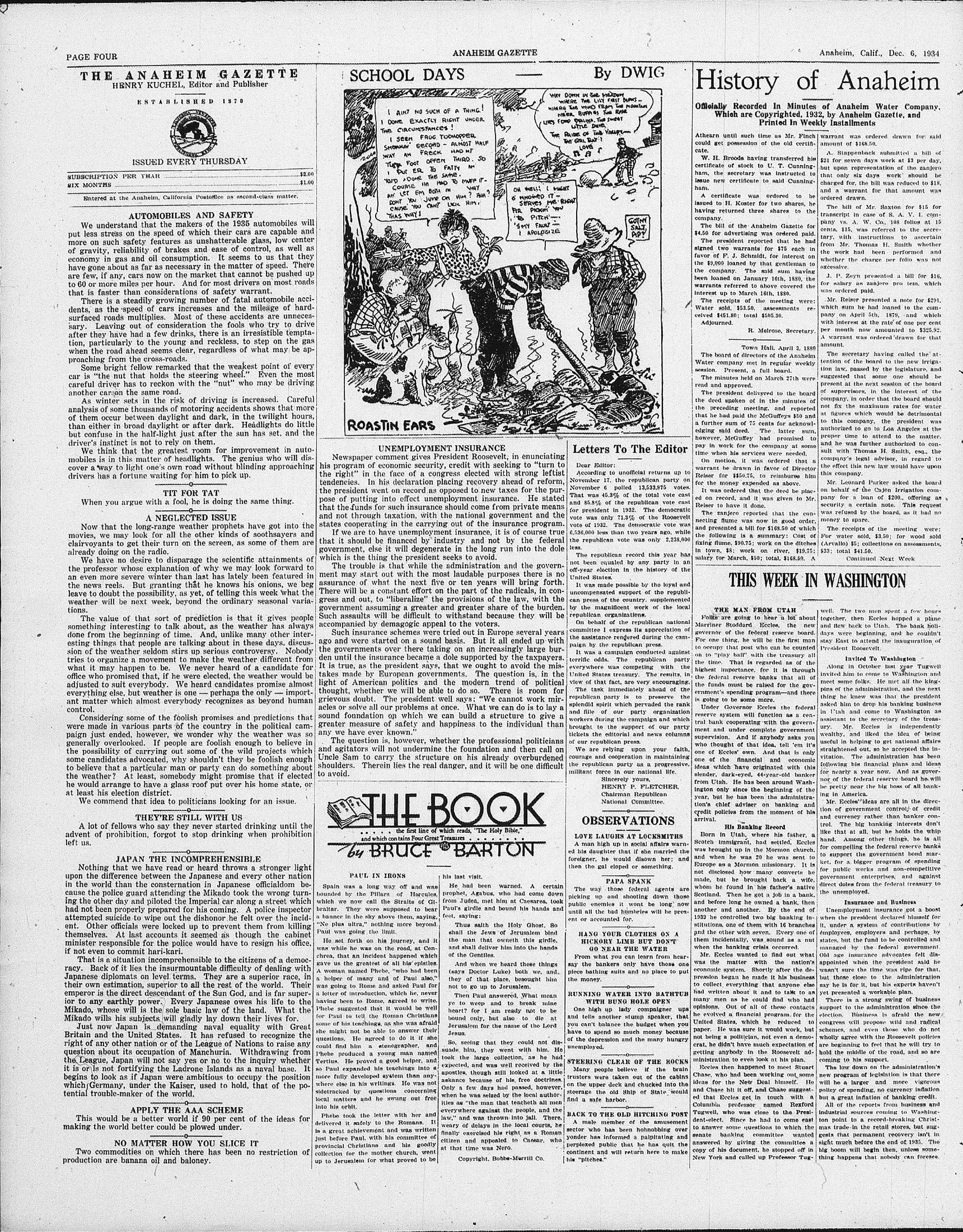
SCHOOL DAYS — By DWIG
I AIN'T NO SUCH OF A THING!
I DONE EXACTLY RIGHT UNDER THE CIRCUMSTANCES!
I SEEN FROG TODHOPPER SHOWN’ SECOND – ALMOST HALF WAY AM FRECK HAD MY TURN FOOT OFFEN THIRD. SO I PUT ER TO FATTY MY YOU’D DOE THE SAME.
COURSE HE HAD TO MUFF IT- AN LET EM BOTH IN WHY DON’T YOU JUMP ON HUM? HUM?
CAUSE YOU CAN’T LICK HIM! THAS WHY!
WAY DOWN IN THE MEadow WHERE THE LILY FIRST BLAWS— WHERE THE VIND FROM THE MOUNTAIN NEER BUFFLES THE ROSE LIES FOUND BEAUTIFUL. THE SWEET LITTLE DRIVE.
THE PRIDE OF THE VALLEY— THE GIRL BAY! LOVE
OH WELL! I MIGHT 6 HOWED IT— SERVES ME RIGHT FOR PICKIN’ YOU TO PITCH’— 'MY FAULT— I APOLOGIZE
ROASTIN EARS
UNEMPLOYMENT INSURANCE
Newspaper comment gives President Roosevelt, in enunciating
UNEMPLOYMENT INSURANCE
Newspaper comment gives President Roosevelt, in enunciating his program of economic security, credit with seeking to "turn to the right" in the face of a congress elected with strong leftist tendencies. In his declaration placing recovery ahead of reform, the president went on record as opposed to new taxes for the purpose of putting into effect unemployment insurance. He stated that the funds for such insurance should come from private means and not through taxation, with the national government and the states cooperating in the carrying out of the insurance program.
If we are to have unemployment insurance, it is of course true that it should be financed by industry and not by the federal government, else it will degenerate in the long run into the dole which is the thing the president seeks to avoid.
The trouble is that while the administration and the government may start out with the most laudable purposes there is no assurance of what the next five or ten years will bring forth. There will be a constant effort on the part of the radicals, in congress and out, to "liberalize" the provisions of the law, with the government assuming a greater and greater share of the burden. Such assaults will be difficult to withstand because they will be accompanied by demagogic appeal to the voters.
Such insurance schemes were tried out in Europe several years ago and were started on a sound basis. But it all ended up with the governments over there taking on an increasingly large burden until the insurance became a dole supported by the taxpayers. It is true, as the president says, that we ought to avoid the mistakes made by European governments. The question is, in the light of American politics and the modern trend of political thought, whether we will be able to do so. There is room for grievous doubt. The president well says: "We cannot work miracles or solve all our problems at once. What we can do is to lay a sound foundation on which we can build a structure to give a greater measure of safety and happiness to the individual than any we have ever known."
The question is, however, whether the professional politicians and agitators will not undermine the foundation and then call on Uncle Sam to carry the structure on his already overburdened shoulders. Therein lies the real danger, and it will be one difficult to avoid.
Letters To The Editor
Dear Editor:
According to unofficial returns up November 17, the republican party voted November 6 polled 13,533,975 votes That was 45.3% of the total vote and 85.8% of the republican vote for president in 1932. The democratic vote was only 71.3% of the Roosevelt vote of 1932. The democratic vote was 6,536,000 less than two years ago, when the republican vote was only 2,238,less.
The republican record this year not been equaled by any party in off-year election in the history of United States.
It was made possible by the loyal uncompensated support of the republican press of the country, supplemented by the magnificent work of the low republican organizations.
On behalf of the republican nation committee I express its appreciation for assistance rendered during the campaign by the republican press.
It was a campaign conducted against terrific odds. The republican party everywhere was competing with United States treasury. The results view of that fact, are very encouraging.
The task immediately ahead of republican party is to preserve splendid spirit which pervaded the race and file of our party organization workers during the campaign and which brought to the support of our party tickets the editorial and news column of our republican press.
We are relying upon your fair courage and cooperation in maintaining the republican party as a progressively militant force in our national life.
Sincerely yours,
HENRY P. FLETCHER,
Chairman Republican National Committee.
OBSERVATIONS
LOVE LAUGHS AT LOCKSMITH
A man high up in social affairs waged his daughter that if she married foreigner, he would disown her; and then the gal eloped or something.
PAUL IN IRONS
Spain was a long way off and was bounded by the Pillars of Hercules, which we now call the Straits of Gibraltar. They were supposed to bear a banner in the sky above them, saying, "Ne plus ultra," nothing more beyond. Paul was going the limit.
He set forth on his journey, and it was while he was on the road, at Cenchrea, that an incident happened which gave us the greatest of all his epistles. A woman named Phebe, "who had been a helper of many and of Paul also," was going to Rome and asked Paul for a letter of introduction, which he, never having been to Rome, agreed to write. Phebe suggested that it would be well for Paul to tell the Roman Christians some of his teachings, as she was afraid she might not be able to answer their questions. He agreed to do it if she could find him a stenographer, and Phebe produced a young man named Tertius. He proved a good helper, and so Paul expanded his teachings into a more fully developed system than anywhere else in his writings. He was not sidetracked by questions concerning local matters and he swung out free into his orbit.
Phebe took the letter with her and delivered it safely to the Romans. It is a great achievement and was written just before Paul, with his committee of provincial Christians and his goodly collection for the mother church, went up to Jerusalem for what proved to be his last visit.
He had been warned. A certain prophet, Agabus, who had come down from Judea, met him at Caesarea, took Paul's girdle and bound his hands and feet, saying:
Thus saith the Holy Ghost, So shall the Jews of Jerusalem bind the man that owneth this girdle, and shall deliver him into the hands of the Gentiles.
And when we heard these things (says Doctor Luke) both we, and they of that place, besought him not to go up to Jerusalem.
Then Paul answered, What mean ye to weep and to break mine heart? for I am ready not to be bound only, but also to die at Jerusalem for the name of the Lord Jesus.
So, seeing that they could not dissuade him, they went with him. He took the large collection, as he had expected, and was well received by the apostles, though still looked at a little askance because of his free doctrines. Only a few days had passed, however, when he was seized by the local authorities as "the man that teacheth all men everywhere against the people, and the law," and was thrown into jail. There, weary of delays in the local courts, he finally exercised his right as a Roman citizen and appealed to Caesar, who at that time was Nero.
Copyright, Bobbs-Merrill Co.
OBSERVATIONS
LOVE LAUGHS AT LOCKSMITH
A man high up in social affairs wamed his daughter that if she married foreigner, he would disown her; and then the gal eloped or something.
PAPA SPANK
The way those federal agents picked up and shooting down the public enemies it wont be long until all the bad hombres will be present or accounted for.
HANG YOUR CLOTHES ON A HICKORY LIMB BUT DON'T GO NEAR THE WATER
From what you can learn from her say the bankers only have those pieces bathing suits and no place to put the money.
RUNNING WATER INTO BATHTU WITH BUNG HOLE OPEN
One high up lady compalnerer and tells another stump speaker, that you can't balance the budget when you have to spend so much money because of the depression and the many hung unemployed.
STEERING CLEAR OF THE ROACH
Many people believe if the bra trustees were taken out of the cable on the upper deck and chucked into steerage the old Ship of State would find a safe harbor.
BACK TO THE OLD HITCHING POINT
A male member of the amusement sector who has been hobnobbing over yonder has informed a palpitating perplexed public that he has quit continent and will return here to make his "pitches."
History of Anaheim
Officially Recorded In Minutes of Anaheim Water Company,
Which are Copyrighted, 1932, by Anaheim Gazette, and Printed In Weekly Installments
Athearn until such time as Mr. Finch could get possession of the old certificate.
W. H. Broods having transferred his certificate of stock to U. T. Cunningham, the secretary was instructed to issue new certificate to said Cunningham.
A certificate was ordered to be issued to H. Koster for two shares, he having returned three shares to the company.
The bill of the Anaheim Gazette for $4.50 for advertising was ordered paid.
The president reported that he had signed two warrants for $75 each in favor of F. J. Schmidt, for interest on the $9,000 loaned by that gentleman to the company. The said sum having been loaned on January 16th, 1880, the warrants referred to above covered the interest up to March 16th, 1880.
The receipts of the meeting were: Water sold, $53.50; assessments received $451.80; total $505.30.
Adjourned.
R. Melrose, Secretary.
Town Hall, April 3, 1880
The board of directors of the Anaheim Water company met in regular weekly session. Present, a full board.
The minutes held on March 27th were read and approved.
The president delivered to the board the deed spoken of in the minutes of the preceding meeting, and reported that he had paid the McGuffeys $50 and a further sum of 75 cents for acknowledging said deed. The latter sum, however, McGuffey had promised to pay in work for the company at some time when his services were needed.
warrant was ordered drawn for said amount of $168.50.
A. Stappenback submitted a bill of $21 for seven days work at $3 per day, but upon representation of the zanjero that only six days work should be charged for, the bill was reduced to $18, and a warrant for that amount was ordered drawn.
The bill of Mr. Saxton for $15 for transcript in case of S. A. V. I. company vs. A. W. Co., 108 folios at 15 cents, $15, was referred to the secretary, with instructions to ascertain from Mr. Thomas H. Smith whether the work had been performed and whether the charge per folio was not excessive.
J. P. Zeyn presented a bill for $16, for salary as zanjero pro tem, which was ordered paid.
Mr. Reiser presented a note for $291, which sum he had loaned to the company on April 5th, 1879, and which with interest at the rate of one per cent per month now amounted to $325.92. A warrant was ordered drawn for that amount.
The secretary having called the attention of the board to the new irrigation law, passed by the legislature, and suggested that some one should be present at the next session of the board of supervisors, in the interest of the company, in order that the board should not fix the maximum rates for water at figures which would be detrimental to this company, the president was authorized to go to Los Angeles at the proper time to attend to the matter, and he was further authorized to consult with Thomas H. Smith, esq., the company's legal advisor, in regard to
THIS WEEK IN WASHINGTON
THE MAN FROM UTAH
Folks are going to hear a lot about Marriner Stoddard Eccles, the new governor of the federal reserve board. For one thing, he will be the first man to occupy that post who can be counted on to "play ball" with the treasury all the time. That is regarded as of the highest importance, for it is through the federal reserve banks that all of the funds must be raised for the government's spending program—and there is going to be some more.
Under Governor Eccles the federal reserve system will function as a central bank cooperating with the government and under complete government supervision. And if anybody asks you who thought of that idea, tell 'em it's one of Eccles' own. And that is only one of the financial and economic ideas which have originated with this slender, dark-eyed, 44-year-old banker from Utah. He has been around Washington only since the beginning of the year, but he has been the administration's chief adviser on banking and credit policies from the moment of his arrival.
His Banking Record
Born in Utah, where his father, a Scotch immigrant, had settled, Eccles was brought up in the Mormon church, and when he was 20 he was sent to Europe as a Mormon missionary. It well. The two men spent a few hours together, then Eccles hopped a plane and flew back to Utah. The bank holidays were beginning, and he couldn't stay East to attend the inauguration of President Roosevelt.
Invited To Washington
Along in October last year Tugwell invited him to come to Washington and meet some folks. He met all the kingpins of the administration, and the next thing he knew was that the president asked him to drop his banking business in Utah and come to Washington as assistant to the secretary of the treasury. Mr. Eccles is independently wealthy, and liked the idea of being useful in helping to get national affairs straightened out, so he accepted the invitation. The administration has been following his financial plans and ideas for nearly a year now. And as governor of the federal reserve board he will be pretty near the big boss of all banking in America.
Mr. Eccles' ideas are all in the direction of government control, of credit and currency rather than banker control. The big banking interests don't like that at all, but he holds the whip hand. Among other things, he is all for compelling the federal reserve banks to support the government bond market, for a bigger program of spending for public works and non-competitive
SERVATIONS
BROUGHS AT LOCKSMITHS
high up in social affairs warnter that if she married the
one would disown her; and
real eloped or something.
PAPA SPANK
that those federal agents are
and shooting down those
ties it wont be long now
the bad hombries will be pressunted for.
YOUR CLOTHES ON A
MERY LIMB BUT DON'T
NEAR THE WATER
that you can learn from hearrankers only have those one
ing suits and no place to put
WATER INTO BATHTUB
IN BUNG HOLE OPEN
up lady compaigner ups
another stump speaker, that
balance the budget when you
and so much money because
session and the many hungry
CLEAR OF THE ROCKS
people believe if the brain
are taken out of the cabins
or deck and chucked into the
old Ship of State would
harbor.
THE OLD HITCHING POST
member of the amusement
has been hobnobbing over
informed a palpitating and
public that he has quit the
and will return here to make
His Banking Record
Born in Utah, where his father, a Scotch immigrant, had settled, Eccles was brought up in the Mormon church,
and when he was 20 he was sent to Europe as a Mormon missionary. It is not disclosed how many converts he made, but he brought back a wife, whom he found in his father's native Scotland. Then he got a job in a bank, and before long he owned a bank, then another and another. By the end of 1932 he controlled two big banking institutions, one of them with 16 branches and the other with seven. Every one of them incidentally, was sound as a nut when the banking crisis occurred.
Mr. Eccles wanted to find out what was the matter with the nation's economic system. Shortly after the depression began he made it his business to collect everything that anyone else had written about it and to talk to as many men as he could find who had opinions. Out of all of these contacts he evolved a financial program, for the United States, which he reduced to paper. He was sure it would work, but not being a politician, not even a democrat, he didn't have much expectation of getting anybody in the Roosevelt administration to even look at his plan.
Eccles then happened to meet Stuart Chase, who had been working out some ideas for the New Deal himself. He and Chase hit it off, and Chase suggested that Eccles get in touch with a Columbia professor named Rexford Tugwell, who was close to the President-elect. Since he had to come east to answer some questions to which the senate banking committee wanted answered by giving the committee a copy of his document, he stopped off in New York and called up Professor Tug-