anaheim-gazette 1934-11-29
Scanned page
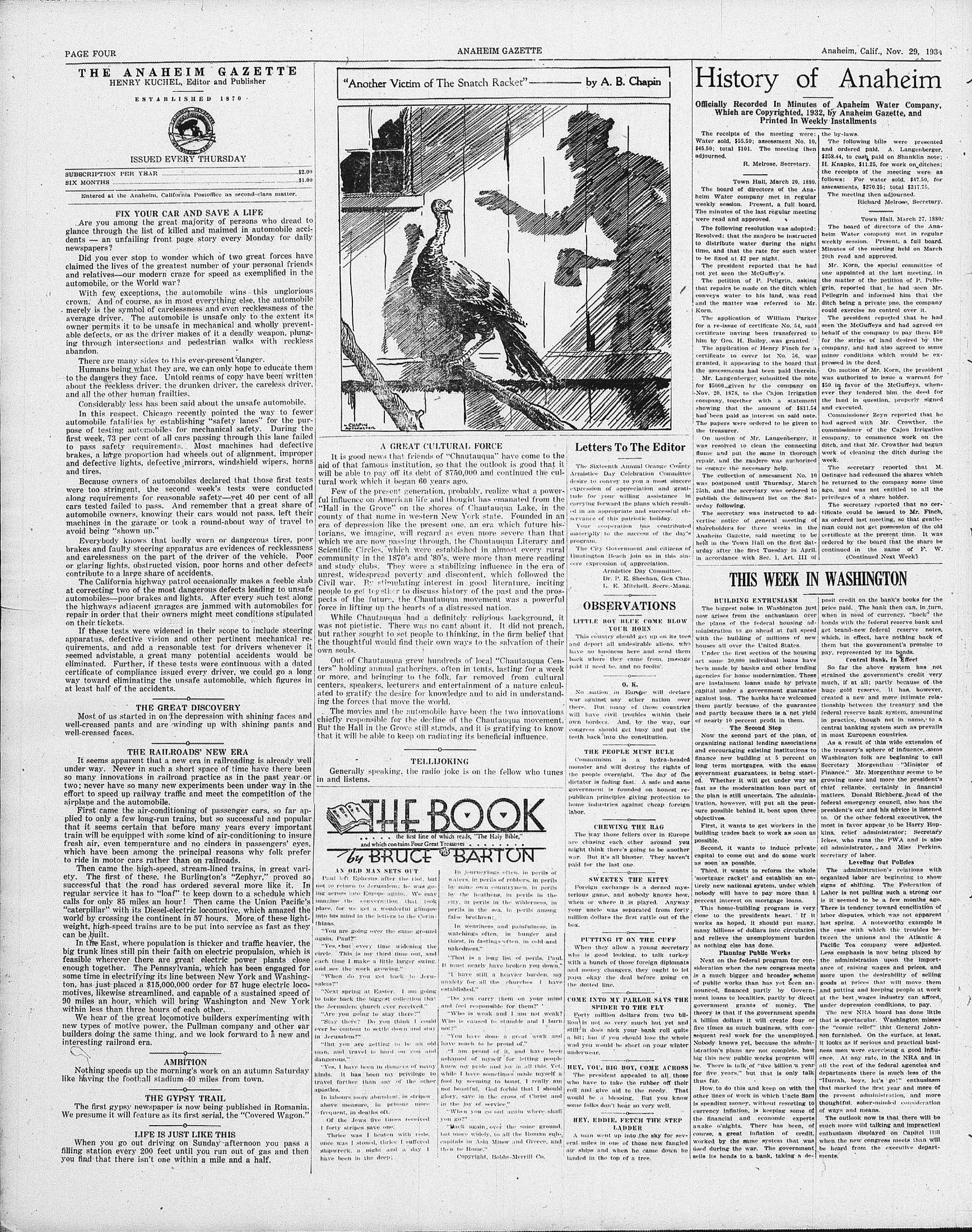
Searchable text
THE ANAHEIM GAZETTE
HENRY KUCHEL, Editor and Publisher
ESTABLISHED 1870
ISSUED EVERY THURSDAY
SUBSCRIPTION PER YEAR ... $2.00
SIX MONTHS ... $1.00
Entered at the Anaheim, California Postoffice as second-class matter.
FIX YOUR CAR AND SAVE A LIFE
Are you among the great majority of persons who dread to glance through the list of killed and maimed in automobile accidents — an unfailing front page story every Monday for daily newspapers?
Did you ever stop to wonder which of two great forces have claimed the lives of the greatest number of your personal friends and relatives—our modern craze for speed as exemplified in the automobile, or the World war?
With few exceptions, the automobile wins this unglorious crown. And of course, as in most everything else, the automobile merely is the symbol of carelessness and even recklessness of the average driver. The automobile is unsafe only to the extent its owner permits it to be unsafe in mechanical and wholly preventable defects, or as the driver makes of it a deadly weapon, plunging through intersections and pedestrian walks with reckless abandon.
There are many sides to this ever-present danger.
Humans being what they are, we can only hope to educate them to the dangers they face. Untold reams of copy have been written about the reckless driver, the drunken driver, the careless driver, and all the other human frailties.
Considerably less has been said about the unsafe automobile.
In this respect, Chicago recently pointed the way to fewer automobile fatalities by establishing "safety lanes" for the purpose of testing automobiles for mechanical safety. During the first week, 73 per cent of all cars passing through this lane failed to pass safety requirements. Most machines had defective brakes, a large proportion had wheels out of alignment, improper
Humans being what they are, we can only hope to educate them to the dangers they face. Untold reams of copy have been written about the reckless driver, the drunken driver, the careless driver, and all the other human frailties.
Considerably less has been said about the unsafe automobile.
In this respect, Chicago recently pointed the way to fewer automobile fatalities by establishing "safety lanes" for the purpose of testing automobiles for mechanical safety. During the first week, 73 per cent of all cars passing through this lane failed to pass safety requirements. Most machines had defective brakes, a large proportion had wheels out of alignment, improper and defective lights, defective mirrors, windshield wipers, horns and tires.
Because owners of automobiles declared that those first tests were too stringent, the second week's tests were conducted along requirements for reasonable safety—yet 40 per cent of all cars tested failed to pass. And remember that a great share of automobile owners, knowing their cars would not pass, left their machines in the garage or took a round-about way of travel to avoid being "shown up."
Everybody knows that badly worn or dangerous tires, poor brakes and faulty steering apparatus are evidences of recklessness and carelessness on the part of the driver of the vehicle. Poor or glaring lights, obstructed vision, poor horns and other defects contribute to a large share of accidents.
The California highway patrol occasionally makes a feeble stab at correcting two of the most dangerous defects leading to unsafe automobiles—poor brakes and lights. After every such test along the highways adjacent garages are jammed with automobiles for repair in order that their owners might meet conditions stipulated on their tickets.
If these tests were widened in their scope to include steering apparatus, defective vision and other pertinent mechanical requirements, and add a reasonable test for drivers whenever it seemed advisable, a great many potential accidents would be eliminated. Further, if these tests were continuous with a dated certificate of compliance issued every driver, we could go a long way toward eliminating the unsafe automobile, which figures in at least half of the accidents.
THE GREAT DISCOVERY
Most of us started in on the depression with shining faces and well-creased pants and are winding up with shining pants and well-creased faces.
THE RAILROADS' NEW ERA
It seems apparent that a new era in railroading is already well under way. Never in such a short space of time have there been so many innovations in railroad practice as in the past year or two; never have so many new experiments been under way in the effort to speed up railway traffic and meet the competition of the airplane and the automobile.
First came the air-conditioning of passenger cars, so far applied to only a few long-run trains, but so successful and popular that it seems certain that before many years every important train will be equipped with some kind of air-conditioning to insure fresh air, even temperature and no cinders in passengers' eyes, which have been among the principal reasons why folk prefer to ride in motor cars rather than on railroads.
Then came the high-speed, stream-lined trains, in great vari-
so many innovations in railroad practice as in the past year or two; never have so many new experiments been under way in the effort to speed up railway traffic and meet the competition of the airplane and the automobile.
First came the air-conditioning of passenger cars, so far applied to only a few long-run trains, but so successful and popular that it seems certain that before many years every important train will be equipped with some kind of air-conditioning to insure fresh air, even temperature and no cinders in passengers' eyes, which have been among the principal reasons why folk prefer to ride in motor cars rather than on railroads.
Then came the high-speed, stream-lined trains, in great variety. The first of these, the Burlington's "Zephyr," proved so successful that the road has ordered several more like it. In regular service it has to "loaf" to keep down to a schedule which calls for only 85 miles an hour! Then came the Union Pacific's "caterpillar" with its Diesel-electric locomotive, which amazed the world by crossing the continent in 57 hours. More of these lightweight, high-speed trains are to be put into service as fast as they can be built.
In the East, where population is thicker and traffic heavier, the big trunk lines still pin their faith on electric propulsion, which is feasible wherever there are great electric power plants close enough together. The Pennsylvania, which has been engaged for some time in electrifying its line between New York and Washington, has just placed a $15,000,000 order for 57 huge electric locomotives, likewise streamlined, and capable of a sustained speed of 90 miles an hour, which will bring Washington and New York within less than three hours of each other.
We hear of the great locomotive builders experimenting with new types of motive power, the Pullman company and other car builders doing the same thing, and we look forward to a new and interesting railroad era.
AMBITION
Nothing speeds up the morning's work on an autumn Saturday like having the football stadium 40 miles from town.
THE GYPSY TRAIL
The first gypsy newspaper is now being published in Romania. We presume it will feature as its first serial, the "Covered Wagon."
LIFE IS JUST LIKE THIS
When you go out driving on Sunday afternoon you pass a filling station every 200 feet until you run out of gas and then you find that there isn't one within a mile and a half.
ANAHEIM GAZETTE
“Another Victim of The Snatch Racket” by A. B. Chapin
A GREAT CULTURAL FORCE
It is good news that friends of “Chautauqua” have come to the
A GREAT CULTURAL FORCE
It is good news that friends of "Chautauqua" have come to the aid of that famous institution, so that the outlook is good that it will be able to pay off its debt of $750,000 and continued the cultural work which it began 60 years ago.
Few of the present generation, probably, realize what a powerful influence on American life and thought has emanated from the "Hall in the Grove" on the shores of Chautauqua Lake, in the county of that name in western New York state. Founded in an era of depression like the present one, an era which future historians, we imagine, will regard as even more severe than that which we are now passing through, the Chautauqua Literary and Scientific Circles, which were established in almost every rural community in the 1870's and '80's, were more than mere reading and study clubs. They were a stabilizing influence in the era of unrest, widespread poverty and discontent, which followed the Civil war. By stimulating interest in good literature, inciting people to get together to discuss history of the past and the prospects of the future, the Chautauqua movement was a powerful force in lifting up the hearts of a distressed nation.
While Chautauqua had a definitely religious background, it was not pietistic. There was no cant about it. It did not preach, but rather sought to set people to thinking, in the firm belief that the thoughtful would find their own ways to the salvation of their own souls.
Out of Chautauqua grew hundreds of local "Chautauqua Centers" holding annual gatherings, often in tents, lasting for a week or more, and bringing to the folk, far removed from cultural centers, speakers, lecturers and entertainment of a nature calculated to gratify the desire for knowledge and to aid in understanding the forces that move the world.
The movies and the automobile have been the two innovations chiefly responsible for the decline of the Chautauqua movement. But the Hall in the Grove still stands, and it is gratifying to know that it will be able to keep on radiating its beneficial influence.
TELLIJOKING
Generally speaking, the radio joke is on the fellow who tunes in and listens.
THE BOOK
the first line of which reads, "The Holy Bible," and which contains Four Great Treasures
by BRUCE BARTON
Letters To The Editor
The Sixteenth Annual Orange County Armlistice Day Celebration Committee desire to convey to you a most sincere expression of appreciation and gratitude for your willing assistance in carrying forward the plans which resulted in an appropriate and successful service of this patriotic holiday.
Your cooperation has contributed materially to the success of the day's program.
The City Government and citizens of Huntington Beach join us in this sincere expression of appreciation.
Armlistice Day Committee:
Dr. P. E. Sheehan, Gen Chu
L. E. Mitchell, Secrec.-Manz
OBSERVATIONS
LITTLE BOY BLUE COME BLOW YOUR HORN
This country should get up on its toe and deport all undesirable aliens, who have no business here and send their back where they came from, passage paid if need be, and no foolin'.
0. K.
No nation in Europe will declare war against any other nation over there. But many of those countries will have civil troubles within their own borders. And, by the way, our congress should get busy and put the teeth back into the constitution.
THE PEOPLE MUST RULE
Communism is a hydra-headed monster and will destroy the rights of the people overnight. The day of the dictator is fading fast. A safe and sanction government is founded on honest republican principles giving protection to home industries against cheap foreign labor.
CHEWING THE RAG
The way those fellers over in Europe are chasing each other around you might think there's going to be another war. But it's all bluster. They haven'paid for the last one.
AN OLD MAN SETS OUT
Paul left Ephesus after the riot, but not to return to Jerusalem; he was going across into Europe again. We may imagine the conversation that took place, for we get a wonderful glimpse into his mind in the letters to the Corinthians.
"You are going over the same ground again, Paul?"
"Yes, but every time widening the circle. This is my third time out, and each time I make a little larger swing, and see the work growing."
"When do you get back to Jerusalem?"
"Next spring at Easter. I am going to take back the biggest collection that the Jerusalem church ever received."
"Are you going to stay there?"
"Stay there? Do you think I could ever be content to settle down and stay in Jerusalem?"
"But you are getting to be an old man, and travel is hard on you and dangerous."
"Yes, I have been in dangers of many kinds. It has been my privilege to travel farther than any of the other apostles.
In labours more abundant, in stripes above measure, in prisons more frequent, in deaths oft.
Of the Jews five times received 1 forty stripes save one.
Thrice was I beaten with rods, once was I stoned, thrice I suffered shipwreck, a night and a day I have been in the deep;
History of Anaheim
Officially Recorded In Minutes of Anaheim Water Company,
Which are Copyrighted, 1932, by Anaheim Gazette, and Printed In Weekly Installments
The receipts of the meeting were:
Water sold, $55.50; assessment No. 10,
$45.50; total $101. The meeting then adjourned.
R. Melrose, Secretary.
Town Hall, March 20, 1880.
The board of directors of the Anaheim Water company met in regular weekly session. Present, a full board. The minutes of the last regular meeting were read and approved.
The following resolution was adopted: Resolved: that the zanjero be instructed to distribute water during the night time, and that the rate for such water to be fixed at $2 per night.
The president reported that he had not yet seen the McGuffey's.
The petition of P. Pellgrin, asking that repairs be made on the ditch which conveys water to his land, was read and the matter was referred to Mr. Korn.
The application of William Parker for a re-issue of certificate No. 54, said certificate having been transferred to him by Geo. H. Bailey, was granted.
The application of Henry Finch for a certificate to cover lot No. 56, was granted, it appearing to the board that the assessments had been paid therein.
Mr. Langenberger submitted the note for $5000 given by the company on Nov. 20, 1878, to the Cajon Irrigation company, together with a statement showing that the amount of $811.54 had been paid as interest on said note. The papers were ordered to be given to the treasurer.
On motion of Mr. Langenberger, it was resolved to clean the connecting flume and put the same in thorough repair and the reservoir was authorized.
The following bills were presented and ordered paid:
A. Langenberger, $258.44, to cash paid on Shanklin note;
H. Knapke, $11.25, for work on ditches; the receipts of the meeting were as follows: For water sold, $47.50, for assessments, $270.25; total $317.75.
The meeting then adjourned.
Richard Melrose, Secretary.
Town Hall, March 27, 1880:
The board of directors of the Anaheim Water company met in regular weekly session. Present, a full board. Minutes of the meeting held on March 20th read and approved.
Mr. Korn, the special committee of one appointed at the last meeting, in the matter of the petition of P. Pellegrin, reported that he had seen Mr. Pellegrin and informed him that the ditch being a private one, the company could exercise no control over it.
The president reported that he had seen the McGuffeys and had agreed on behalf of the company to pay them $50 for the strips of land desired by the company, and had also agreed to some minor conditions which would be expressed in the deed.
On motion of Mr. Korn, the president was authorized to issue a warrant for $50 in favor of the McGuffeys, whenever they tendered him the deed for the land in question, properly signed and executed.
Commissioner Zeyn reported that he had agreed with Mr. Crowther, the commissioner of the Cajon Irrigation company, to commence work on the ditch, and that Mr. Crowther had begun work of cleaning the ditch during the week.
THIS WEEK IN WASHINGTON
BUILDING ENTHUSIASM
The biggest noise in Washington just now arises from the enthusiasm over the plans of the federal housing administration to go ahead at full speed with the building of millions of new houses all over the United States.
Under the first section of the housing act some 30,000 individual loans have been made by banks and other lending agencies for home modernization. These are instalment loans made by private capital under a government guarantee against loss. The banks have welcomed them partly because of the guarantee and partly because there is a net yield of nearly 10 percent profit in them.
The Second Step
Now the second part of the plan, of organizing national lending associations and encouraging existing institutions to finance new building at 5 percent on long term mortgages, with the same government guarantees, is being started. Whether it will get under way as fast as the modernization loan part of the plan is still uncertain. The administration, however, will put all the pressure possible behind it, bent upon three objectives.
First, it wants to get workers in the building trades back to work as soon as possible.
Second, it wants to induce private capital to come out and do some work as soon as possible.
Third, it wants to reform the whole position credit on the bank's books for the price paid. The bank then can, in turn, when in need of currency, "hook" the bonds with the federal reserve bank and get brand-new federal reserve notes, which, in effect, have nothing back of them but the government's promise to pay, represented by its bonds.
Central Bank, In Effect
So far the above system has not strained the government's credit very much, if at all; partly because of the huge gold reserve. It has, however, created a new and more intimate relationship between the treasury and the federal reserve bank system, amounting in practice, though not in name, to a central banking system such as prevails in most European countries.
As a result of this wide extension of the treasury's sphere of influence, some Washington folk are beginning to call Secretary Morgenthau "Minister of Finance." Mr. Morgenthau seems to be growing more and more the president's chief reliance, certainly in financial matters. Donald Richberg, head of the federal emergency council, also has the president's ear and his advice is listened to. Of the other federal executives, the most in favor appear to be Harry Hopkins, relief administrator; Secretary Ickes, who runs the PWA and is also oil administrator; and Miss Perkins, secretary of labor.
Leveling Out Policies
The administration's relations with
WING THE RAG
Those fellers over in Europe reach other around you there's going to be another all bluster. They haven't last one.
TEN THE KITTY
Exchange is a derned mysite and nobody knows how. Are it played. Anyway was separated from forty miles the first rattle out of the
IT ON THE CUFF
Allow a young secretary to look at, to talk turkey of those foreign diplomats managers, they ought to let the deal before going on.
MY PARLOR SAYS THE MER TO THE FLY
On dollars from two billion very much but yet and quick your bank roll quite you should lose the whole deal before going on.
BIG BOY, COME ACROSS
Not appealed to all those take the rubber off their aid to the needy. That oblessing. But you know don't hear so very well.
E, FETCH THE STEP LADDER
Set up into the sky for sev-one of those new fangled when he came down he top of a tree.
Planning Public Works
Next on the federal program for consideration when the new congress meets is a much bigger and broader scheme of public works than has yet been announced, financed partly by Government loans to localities, partly by direct government grants of money. The theory is that if the government spends a billion dollars it will create four or five times as much business, with consequent real work for the unemployed. Nobody knows yet, because the administration's plans are not complete, how big this new public works program will be. There is talk of "five billion a year for five years," but that is only talk thus far.
How to do this and keep on with the other lines of work in which Uncle Sam is spending money, without resorting to currency inflation, is keeping some of the financial and economic experts awake o'nights. There has been, of course, a great inflation of credit, worked by the same system that was used during the war. The government sells its bonds to a bank, taking a degining out Policies
The administration's relations with organized labor are beginning to show signs of shifting. The Federation of Labor is not pulling such a strong oar is it seemed to be a few months ago. There is tendency toward conciliation of labor disputes, which was not apparent last spring. A noteworthy example is the ease with which the troubles between the unions and the Atlantic & Pacific Tea company were adjusted. Less emphasis is now being placed by the administration upon the importance of raising wages and prices, and more upon the desirability of selling goods at prices that will move them and putting and keeping people at work at the best wages industry can afford, under depression conditions, to pay.
The new NRA board has done little that is spectacular. Washington misses the "comic relief" that General Johnson furnished. On the surface, at least, it looks as if serious and practical business men were exercising a good influence. At any rate, in the NRA and in all the rest of the federal agencies and departments there is much less of the "Hurrah, boys, let's go!" enthusiasm that marked the first year and more of the present administration, and more thoughtful, sober-minded consideration of ways and means.
The outlook now is that there will be much more wild talking and impractical enthusiasm displayed on Capitol Hill when the new congress meets than will be heard from the executive departments.