anaheim-gazette 1934-11-08
Scanned page
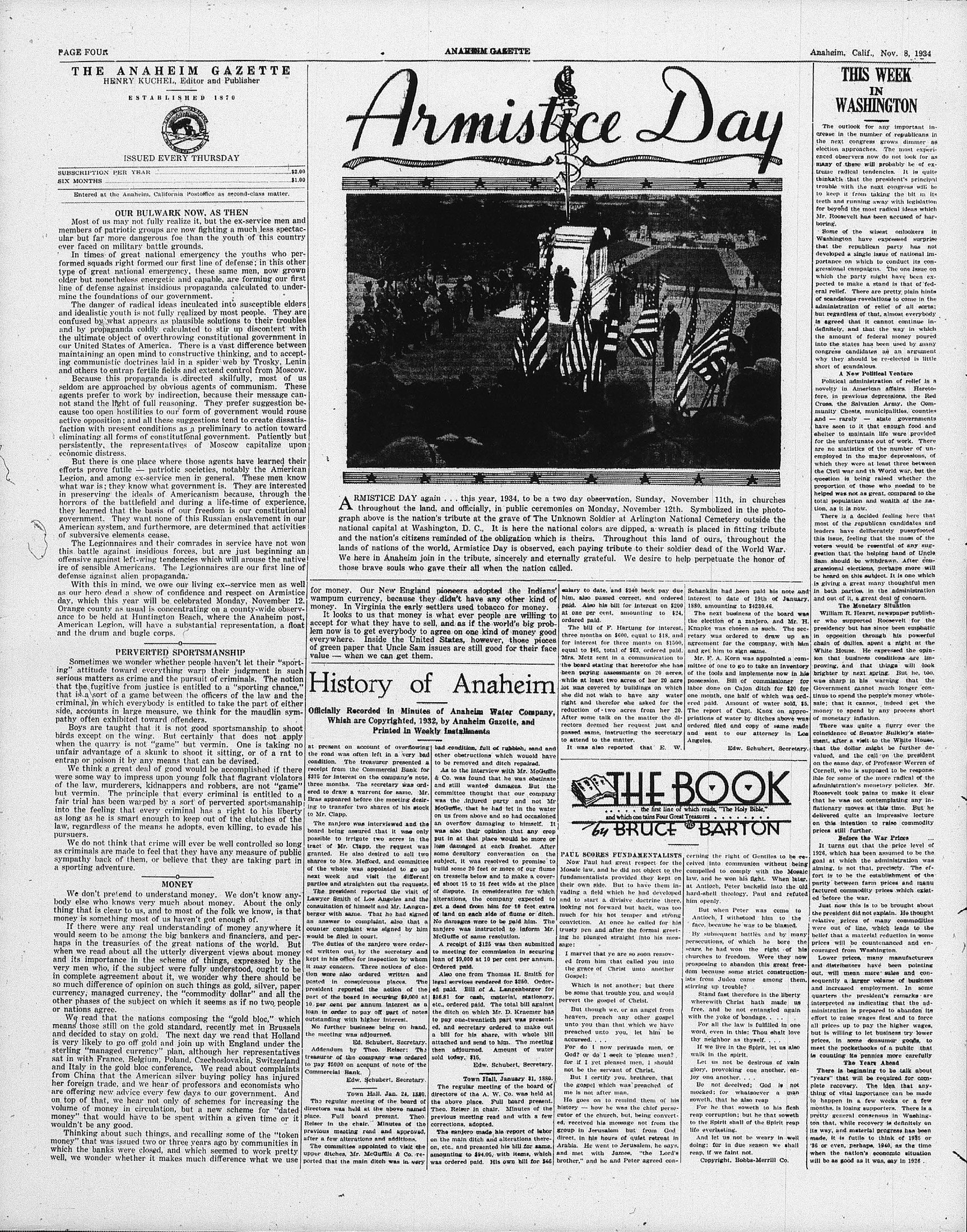
Searchable text
THE ANAHEIM GAZETTE
HENRY KUCHEL, Editor and Publisher
ESTABLISHED 1870
ISSUED EVERY THURSDAY
SUBSCRIPTION PER YEAR ... $2.00
SIX MONTHS ... $1.00
Entered at the Anaheim, California Postoffice as second-class matter.
OUR BULWARK NOW, AS THEN
Most of us may not fully realize it, but the ex-service men and members of patriotic groups are now fighting a much less spectacular but far more dangerous foe than the youth of this country ever faced on military battle grounds.
In times of great national emergency the youths who performed squads right formed our first line of defense; in this other type of great national emergency, these same men, now grown older but nonetheless energetic and capable, are forming our first line of defense against insidious propaganda calculated to undermine the foundations of our government.
The danger of radical ideas inculcated into susceptible elders and idealistic youth is not fully realized by most people. They are confused by what appears as plausible solutions to their troubles and by propaganda coldly calculated to stir up discontent with the ultimate object of overthrowing constitutional government in our United States of America. There is a vast difference between maintaining an open mind to constructive thinking, and to accepting communistic doctrines laid in a spider web by Trosky, Lenin and others to entrap fertile fields and extend control from Moscow.
Because this propaganda is directed skilfully, most of us seldom are approached by obvious agents of communism. These agents prefer to work by indirection, because their message cannot stand the light of full reasoning. They prefer suggestion because too open hostilities to our form of government would rouse active opposition; and all these suggestions tend to create dissatisfaction with present conditions as a preliminary to action toward eliminating all forms of constitutional government. Patiently but persistently, the representatives of Moscow capitalize upon economic distress.
Because this propaganda is directed skilfully, most of us seldom are approached by obvious agents of communism. These agents prefer to work by indirection, because their message cannot stand the light of full reasoning. They prefer suggestion because too open hostilities to our form of government would rouse active opposition; and all these suggestions tend to create dissatisfaction with present conditions as a preliminary to action toward eliminating all forms of constitutional government. Patiently but persistently, the representatives of Moscow capitalize upon economic distress.
But there is one place where those agents have learned their efforts prove futile — patriotic societies, notably the American Legion, and among ex-service men in general. These men know what war is; they know what government is. They are interested in preserving the ideals of Americanism because, through the horrors of the battlefield and during a life-time of experience, they learned that the basis of our freedom is our constitutional government. They want none of this Russian enslavement in our American system, and furthermore, are determined that activities of subversive elements cease.
The Legionnaires and their comrades in service have not won this battle against insidious forces, but are just beginning an offensive against left-wing tendencies which will arouse the native ire of sensible Americans. The Legionnaires are our first line of defense against alien propaganda.
With this in mind, we owe our living ex-service men as well as our hero dead a show of confidence and respect on Armistice day, which this year will be celebrated Monday, November 12. Orange county as usual is concentrating on a county-wide observance to be held at Huntington Beach, where the Anaheim post, American Legion, will have a substantial representation, a float and the drum and bugle corps.
PERVERTED SPORTSMANSHIP
Sometimes we wonder whether people haven't let their "sporting" attitude toward everything warp their judgment in such serious matters as crime and the pursuit of criminals. The notion that the fugitive from justice is entitled to a "sporting chance," that is a sort of a game between the officers of the law and the criminal, in which everybody is entitled to take the part of either side, accounts in large measure, we think for the maudlin sympathy often exhibited toward offenders.
Boys are taught that it is not good sportsmanship to shoot birds except on the wing. But certainly that does not apply when the quarry is not "game" but vermin. One is taking no unfair advantage of a skunk to shoot it sitting, or of a rat to entrap or poison it by any means that can be devised.
We think a great deal of good would be accomplished if there were some way to impress upon young folk that flagrant violators of the law, murderers, kidnappers and robbers, are not "game" but vermin. The principle that every criminal is entitled to a fair trial has been warped by a sort of perverted sportsmanship into the feeling that every criminal has a right to his liberty as long as he is smart enough to keep out of the clutches of the law, regardless of the means he adopts, even killing, to evade his pursuers.
We do not think that crime will ever be well controlled so long as criminals are made to feel that they have any measure of public sympathy back of them, or believe that they are taking part in a sporting adventure.
were some way to impress upon young folk that flagrant violators of the law, murderers, kidnappers and robbers, are not "game" but vermin. The principle that every criminal is entitled to a fair trial has been warped by a sort of perverted sportsmanship into the feeling that every criminal has a right to his liberty as long as he is smart enough to keep out of the clutches of the law, regardless of the means he adopts, even killing, to evade his pursuers.
We do not think that crime will ever be well controlled so long as criminals are made to feel that they have any measure of public sympathy back of them, or believe that they are taking part in a sporting adventure.
MONEY
We don't pretend to understand money. We don't know anybody else who knows very much about money. About the only thing that is clear to us, and to most of the folk we know, is that money is something most of us haven't got enough of.
If there were any real understanding of money anywhere it would seem to be among the big bankers and financiers, and perhaps in the treasuries of the great nations of the world. But when we read about all the utterly divergent views about money and its importance in the scheme of things, expressed by the very men who, if the subject were fully understood, ought to be in complete agreement about it, we wonder why there should be so much difference of opinion on such things as gold, silver, paper currency; managed currency, the "commodity dollar" and all the other phases of the subject on which it seems as if no two people or nations agree.
We read that the nations composing the "gold bloc," which means those still on the gold standard, recently met in Brussels and decided to stay on gold. The next day we read that Holland is very likely to go off gold and join up with England under the sterling "managed currency" plan, although her representatives sat in with France, Belgium, Poland, Czechoslovakia, Switzerland and Italy in the gold bloc conference. We read about complaints from China that the American silver buying policy has injured her foreign trade, and we hear of professors and economists who are offering new advice every few days to our government. And on top of that, we hear not only of schemes for increasing the volume of money in circulation, but a new scheme for "dated money" that would have to be spent within a given time or it wouldn't be any good.
Thinking about such things, and recalling some of the "token money" that was issued two or three years ago by communities in which the banks were closed, and which seemed to work pretty well, we wonder whether it makes much difference what we use
ANAHEIM GASETTE
Armistice Day
ARMISTICE DAY again ... this year, 1934, to be a two day observation, Sunday, November 12th. Graph above is the nation's tribute at the grave of The Unknown Soldier at Arlington National capital at Washington, D.C., It is here the national colors are dipped, a wreath and the nation's citizens reminded of the obligation which is theirs. Throughout this land lands of nations of the world, Armistice Day is observed, each paying tribute to their soldier. We here in Anaheim join in the tribute, sincerely and eternally grateful. We desire to he those brave souls who gave their all when the nation called.
for money. Our New England pioneers adopted the Indians' wampum currency, because they didn't have any other kind of money. In Virginia the early settlers used tobacco for money.
It looks to us that money is what ever people are willing to accept for what they have to sell, and as if the world's big problem now is to get everybody to agree on one kind of money good everywhere. Inside the United States, however, those pieces of green paper that Uncle Sam issues are still good for their face value — when we can get them.
History of Anaheim
Officially Recorded In Minutes of Anaheim Water Company, Which are Copyrighted, 1932, by Anaheim Gazette, and Printed In Weekly Installments
at present on account of overflowing the road was often left in a very bad condition. The treasurer presented a receipt from the Commercial Bank for $375 for interest on the company's note, three months. The secretary was ordered to draw a warrant for same. Mr. Bras appeared before the meeting desiring to transfer two shares of his stock to Mr. Clapp.
The zanjero was interviewed and the board being assured that it was only possible to irrigate two acres in the tract of Mr. Clapp, the request was granted. He also desired to sell two shares to Mrs. Mefford, and committee of the whole was appointed to go up bad condition, full of rubbish, sand and other obstructions which would have to be removed and ditch repaired.
As to the interview with Mr. McGuffie & Co. was found that he was obstructive and still wanted damages. But the committee thought that our company was the injured party and not Mr. McGuffie, that he had let in the water on us from above and so had occasioned an overflow damaging to himself. It was also their opinion that any crop put in at that place would be more or less damaged at each freshet. After some desultory conversation on the subject, it was resolved to promise to build some 20 feet or more of our flume salary to date, and $240 back pay due him, also passed correct, and ordered paid. Also his bill for interest on $200 at one per cent, amounting to $24, ordered paid.
The bill of F. Hartung for interest, three months on $600, equal to $18, and for interest for three montes on $1500, equal to $45, total of $63, ordered paid. Mrs. Metz sent in a communication to the board stating that heretoof she has been paying assessments on 20 acres, while at least two acres of her 20 acre lot was covered by buildings on which she did not wish to have any water right and therefor she asked for the reduction of two acres from her 20. After some talk on the matter the directors deemed her request just and passed same, instructing the secretary to attend to the matter.
It was also reported that E. W.
PAUL SCORES FUNDAMENTALISTS
Now Paul had great respect for the Mosaic law, and he did not object to the
PAUL SCORES FUNDAMENTALISTS
Now Paul had great respect for the Mosaic law, and he did not object to the fundamentalists provided they kept on their own side. But to have them invading a field which he had developed and to start a divisive doctrine there, looking not forward but back, was too much for his hot temper and strong conviction. At once he called for his trusty pen and after the formal greeting he plunged straight into his message:
I marvel that ye are so soon removed from him that called you into the grace of Christ unto another Gospel:
Which is not another; but there be some that trouble you, and would pervert the gospel of Christ.
But though we, or an angel from heaven, preach any other gospel unto you than that which we have preached unto you, let him be accursed. . .
For do I now persuade men, or God? or do I seek to please men? for if I yet pleased men, I should not be the servant of Christ.
But I certify you, brethren, that the gospel which was preached of me is not after man.
He goes on to remind them of his history — how he was the chief persecutor of the church, but, being converted, received his message not from the group in Jerusalem but from God direct, in his hours of quiet retreat in Arabia. He went to Jerusalem, he says, and met with James, "the Lord's brother," and he and Peter agreed con-
THIS WEEK
IN
WASHINGTON
The outlook for any important increase in the number of republicans in the next congress grows dimmer as election approaches. The most experienced observers now do not look for as many of these will probably be of extreme radical tendencies. It is quite thinkable that the president's principal trouble with the next congress will be to keep it from taking the bit in its teeth and running away with legislation for beyond the most radical ideas which Mr. Roosevelt has been accused of harboring.
Some of the wisest onlookers in Washington have expressed surprise that the republican party has not developed a single issue of national importance on which to conduct its congressional campaigns. The one issue on which the party might have been expected to make a stand is that of federal relief. There are pretty plain hints of scandalous revelations to come in the administration of relief of all sorts; but regardless of that, almost everybody is agreed that it cannot continue indefinitely, and that the way in which the amount of federal money poured into the states has been used by many congress candidates as an argument why they should be re-elected is little short of scandalous.
A New Political Venture
Political administration of relief is a novelty in American affairs. Heretofore, in previous depressions, the Red Cross, the Salvation Army, the Community Chests, municipalities, counties and — rarely — state governments have seen to it that enough food and shelter to maintain life were provided for the unfortunate out of work. There are no statistics of the number of unemployed in the major depressions, of
vation, Sunday, November 11th, in churches
day, November 12th. Symbolized in the photolier at Arlington National Cemetery outside the
are dipped, a wreath is placed in fitting tribute
Throughout this land of ours, throughout the
tribute to their soldier dead of the World War.
ful. We desire to help perpetuate the honor of
and $240 back pay due
used correct, and ordered
bill for interest on $200
nt, amounting to $24.
F. Hartung for interest,
on $600, equal to $18, and
for three months on $1500,
total of $63, ordered paid.
t in a communication to
ng that heretoof she has
assessments on 20 acres,
two acres of her 20 acre
d by buildings on which
ash to have any water
refor he asked for the
two acres from her 20.
k on the matter the diher request just and
instructing the secretary
the matter.
reported that E. W.
Schanklin had been paid his note and
interest to date of 19th of January,
1880, amounting to $4230.46.
The next business of the board was
the election of a zanjero, and Mr. H.
Knapke was chosen as such. The secretary was ordered to draw up an agreement for the company, with him
and get him to sign same.
Mr. F. A. Korn was appointed a committee of one to go to take an inventory
of the tools and implements now in his possession. Bill of commissioner for labor done on Cajon ditch for $20 for one month, one half of which was ordered paid. Amount of water sold, $5.
The report of Capt. Knox on appropriations of water by ditches above was ordered filed and copy of same made and sent to our attorney in Los Angeles.
Edw. Schubert, Secretary.
THE BOOK
the first line of which reads, "The Holy Bible,"
and which contains Four Great Treasures
BRUCE BARTON
cerning the right of Gentiles to be received into communion without being compelled to comply with the Moral short of scandalous.
A New Political Venture
Political administration of relief is a novelty in American affairs. Heretofore, in previous depressions, the Red Cross, the Salvation Army, the Community Chests, municipalities, counties and — rarely — state governments have seen to it that enough food and shelter to maintain life were provided for the unfortunate out of work. There are no statistics of the number of unemployed in the major depressions, of which they were at least three between the Civil war and th World war, but the question is being raised whether the proportion of those who needed to be helped was not as great, compared to the total population and wealth of the nation, as it is now.
There is a decided feeling here that most of the republican candidates and leaders have deliberately pussyfooted this issue, feeling that the mass of the voters would be resentful of any suggestion that the helping hand of Uncle Sam should be withdrawn. After congressional elections, perhaps more will be heard on this subject. It is one which is giving a great many thoughtful men in both parties, in the administration and out of it, a great deal of concern.
The Monetary Situation
William R. Hearst, newspaper publisher who supported Roosevelt for the presidency but has since been emphatic in opposition through his powerful chain of dailies, spent a night at the White House. He expressed the opinion that business conditions are improving, and that things will look brighter by next spring. But he, too, was sharp in his warning that the Government cannot much longer continue to spend the people's money wholesale; that it cannot, indeed get the money to spend by any process short of monetary inflation.
There was quite a flurry over the coincidence of Senator Bulkley's statement, after a visit to the White House, that the dollar might be further devalued, and the call on the president on the same day, of Professor Werren of Cornell, who is supposed to be responsible for some of the more radical of the administration's monetary policies. Mr. Roosevelt took pains to make it clear that he was not contemplating any inflationary moves at this time. But he delivered quite an impressive lecture on this intention to raise commodity prices still further.
Before the War Prices
It turns out that the price level of 1926, which has been assumed to be the goal at which the administration was aiming, is not that precisely. The ef-
THE BOOK
and which contains Four Great Treasures
BRUCE BARTON
FUNDAMENTALISTS and great respect for the he did not object to the was provided they kept on. But to have them in-which he had developed divisive doctrine there, toward but back, was too hot temper and strong once he called for his after the formal greet- straight into his mes- ye are so soon remov- that called you into Christ unto another.
not another; but there trouble you, and would apel of Christ.
we, or an angel from such any other gospel in that which we have to you, let him be now persuade men, or seek to please men? pleased men, I should servant of Christ.
by you, brethren, that which was preached of her man.
to remind them of his he was the chief perse- church, but, being convert- message not from the alam but from God hours of quiet retreat in that to Jerusalem, he says, James, "the Lord's and Peter agreed con-cerning the right of Gentiles to be received into communion without being compelled to comply with the Mosale law, and he won his fight. When later, at Antloch, Peter backslid into the old hard-shell theology. Paul and refuted him openly.
But when Peter was come to Antloch, I withstood him to the face, because he was to be blamed.
By subsequent battles and by many persecutions, of which he bore the scars, he had won the right of his churches to freedom. Were they now prosposing to abandon this great freedom because some strict constructionists from Judea came among them, stirring up trouble?
Stand fast therefore in the liberty wherewith Christ hath made us free, and be not entangled again with the yoke of bondage. . .
For all the law is fulfilled in one word, even in this: Thou shalt love thy neighbor as thyself. . .
If we live in the Spirit, let us also walk in the spirit.
Let us not be desirous of vain glory, provoking one another, enjoy one another. . .
Be not deceived; God is not mocked; for whatsoever a man soweth, that he also reap.
For he that soweth to his flesh reap corruption; but he that soweth to the Spirit shall of the Spirit reap life everlasting.
And let us not be weary in well doing: for in due season we shall reap, if we faint not.
Copyright, Bobbs-Merrill Co.
ible for some of the more radical of the administration's monetary policies. Mr. Roosevelt took pains to make it clear that he was not contemplating any inflationary moves at this time. But he delivered quite an impressive lecture on this intention to raise commodity prices still further.
Before the War Prices .... It turns out that the price level of 1926, which has been assumed to be the goal at which the administration was aiming, is not that, precisely. The effort is to be the establishment of the parity between farm prices and manufactured commodity prices which existed before the war.
Just now this is to be brought about the president did not explain. He thought relative prices of many commodities were out of line, which leads to the belief that a material reduction in some prices will be countenanced and encouraged from Washington.
Lower prices, many manufacturers and distributors have been pointing out, will mean more sales and consequently a larger volume of business and increased employment. In some quarters the president's remarks are interpreted as indicating that the administration is prepared to abandon its effort to raise wages first and to force all prices up to pay the higher wages, but is willing to let business try lower prices, in some consumer goods, to meet the pocketbooks of a public that is counting its pennies more carefully.
The Years Ahead
There is beginning to be talk about "years" that will be required for complete recovery. The idea that anything of vital importance can be made to happen in a few weeks or a few months, is losing supporters. There is a pretty general consensus in Washington that, while recovery is definitely on its way, and material progress has been made, it is futile to think of 1935 or '36 or even, perhaps, 1940, as the time when the nation's economic situation will be as good as it was, say in 1926.