anaheim-gazette 1934-10-18
Scanned page
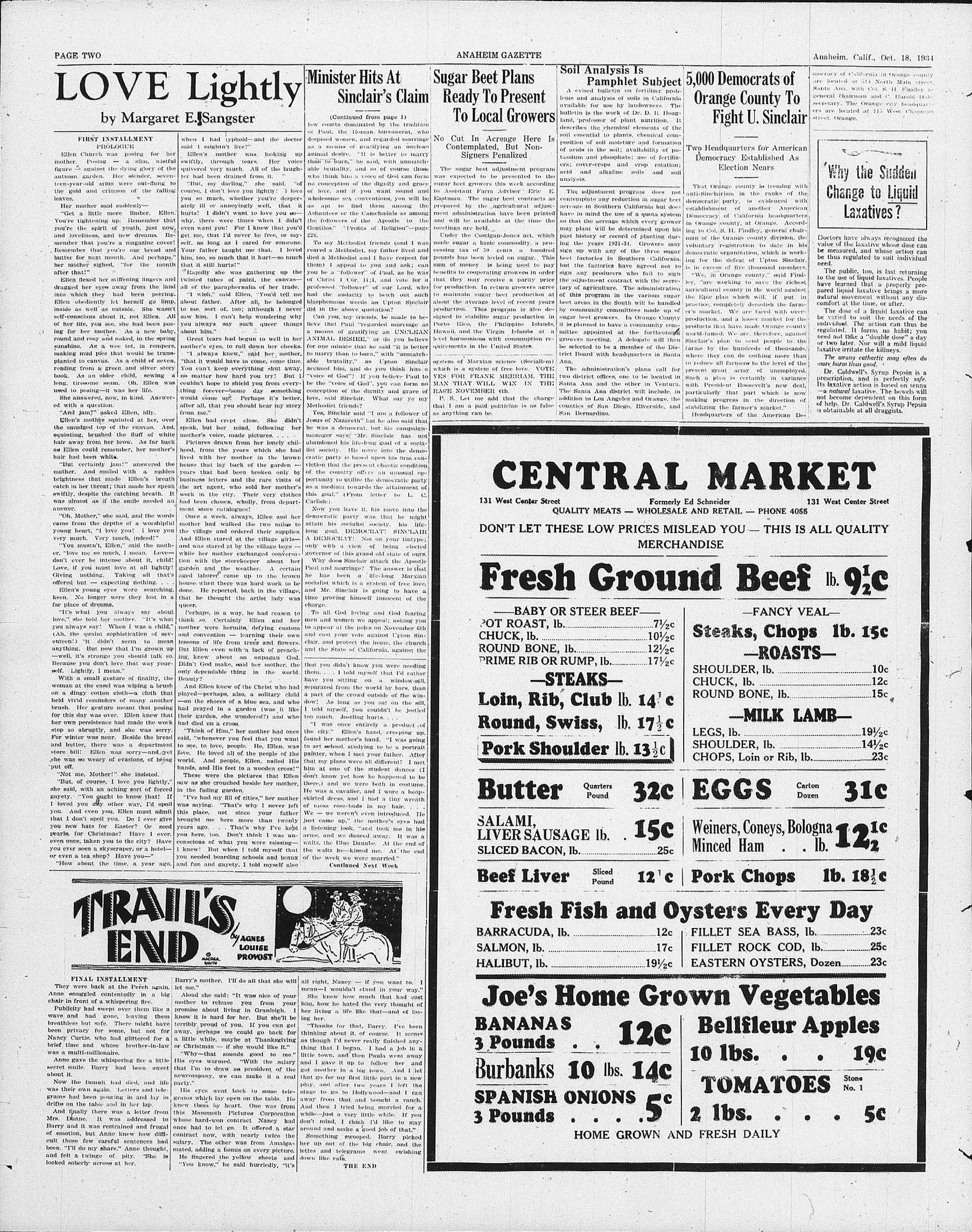
Searchable text
LOVE Lightly
by Margaret E. Sangster
FIRST INSTALLMENT
PROLOGUE
Ellen Church was posing for her mother. Posing — a slim, wistful figure — against the dying glory of the autumn garden. Her slender, seventeen-year-old arms were out-flung to the gold and crimson of the falling leaves.
Her mother said suddenly—
"Get a little more limber, Ellen. You're tightening up. Remember that you're the spirit of youth, just now, and loveliness, and new dreams. Remember that you're a magazine cover! Remember that you're our bread and butter for next month. And perhaps," her mother sighed, "for the month after that!"
Ellen flexed her stiffening fingers and dragged her eyes away from the land into which they had been peering. Ellen obediently let herself go limp, inside as well as outside. She wasn't self-conscious about it, not Ellen. All of her life, you see, she had been posing for her mother. As a new baby, round and rosy and naked, in the spring sunshine. As a wee tot, in rompers, making mud pies that would be transplanted to canvas. As a child of seven, reading from a green and silver story book. As an older child, sewing a long, tiresome seam. Oh, Ellen was used to posing—it was her life.
She answered, now, in kind. Answered with a question.
"And jam?" asked Ellen, idly.
Ellen's mother squinted at her, over the smudged top of the canvas. And, squinting, brushed the fluff of white hair away from her brow. As far back as Ellen could remember, her mother's hair had been white.
when I had typhoid—and the doctor said I mightn't live?"
Ellen's mother was looking up swiftly, through tears. Her voice quivered very much. All of the laughter had been drained from it.
"But, my darling," she said, "of course, I don't love you lightly! I love you so much, whether you're desperately ill or annoyingly well, that it hurts! I didn't want to love you so—why, there were times when I didn't even want you! For I knew that you'd get me, that I'd never be free, or myself, as long as I cared for someone. Your father taught me that. I loved him, too, so much that it hurt—so much that it still hurts!"
Rapidly she was gathering up the twisted tubes of paint, the canvas—all of the paraphernalia of her trade.
"I wish," said Ellen, "You'd tell me about father. After all, he belonged to me, sort of; too; although I never saw him. I can't help wondering why you always say such queer things about him."
Great tears had begun to well in her mother's eyes, to roll down her cheeks.
"I always knew," said her mother, "that it would have to come, some time. You can't keep everything shut away, no matter how hard you try! But I couldn't hope to shield you from everything forever—some day something would come up! Perhaps it's better, after all, that you should hear my story from me."
Ellen had crept close. She didn't speak, but her mind, following her mother's voice, made pictures.
Pictures drawn from her lonely childhood, from the years which she had lived with her mother in the brown Minister In Sincerity
(Continued)
law courts dominion of Paul, the Roman despised women, as a means of great animal desire. "Than to burn," he able brutality, and who think him a way no conception of the of love, and if you wholesome sex coars as apt to find Ashantees or the followers of the Gentiles." "Prolific 226."
To my Methodist reared a Methodist died a Methodist at them) I appeal to you be a "follower of Christ I Cor., professed "follower had the audacity blasphemous words did in the above can.
Can you, my triumphant that Paul was a means of gratitude for one minute than to marry than to be able brutality," accused him, and "voice of God"? I be the "voice of God" conception of the love, said Sinclair Methodist friends?
Yes, Sinclair sailed Jesus of Nazareth: he was a democratic manager says; "M man abandoned his life-list society. His renaissance party is based
planted to canvas. As a child of seven,
reading from a green and silver story
book. As an older child, sewing a
long, tiresome seam. Oh, Ellen was
used to posing—it was her life.
She answered, now, in kind. Answered
with a question.
"And jam?" asked Ellen, idly.
Ellen's mother squinted at her, over
the smudged top of the canvas. And,
squinting, brushed the fluff of white
hair away from her brow. As far back
as Ellen could remember, her mother's
hair had been white.
"But certainly jam!" answered the
mother. And smiled with a sudden
brightness that made Ellen's breath
catch in her throat; that made her speak
swiftly, despite the catching breath. It
was almost as if the smile needed an answer.
"Oh, Mother," she said, and the words
came from the depths of a worshipful
young heart, "I love you! I love you
very much. Very much, indeed."
"You mustn't, Ellen," said the mother,
"love me so much, I mean. Love—
don't ever be intense about it, child!
Love, if you must love at all lightly!
Giving nothing. Taking all that's
offered but — expecting nothing. . .
Ellen's young eyes were searching,
keen. No longer were they lost in a
far place of dreams.
"It's what you always say about
love," she told her mother. "It's what
you always say! When I was a child,"
(Ah, the quaint sophistication of seventeen!) "it didn't seem to mean
anything. But now that I'm grown up—well, it's strange you should talk so.
Because you don't love that way yourself. Lightly, I mean."
With a small gesture of finality, the
woman at the easel was wiping a brush
on a dingy cotton cloth—a cloth that
held vivid reminders of many another
brush. Her gesture meant that posing
for this day was over. Ellen knew that
her own persistence had made the work
stop so abruptly, and she was sorry.
For winter was near. Beside the bread
and butter, there was a department
store bill! Ellen was sorry—and yet
she was so weary of evasions, of being
put off.
"Not me, Mother!" she insisted.
"But, of course, I love you lightly," she said, with an aching sort of forced gayety. "You ought to know that! If I loved you any other way, I'd spoil you. And even you, Ellen must admit that I don't spoil you. Do I ever give you new hats for Easter? Or seed pearls, for Christmas? Have I ever,
even once, taken you to the city? Have
you ever seen a skyscraper, or a hotel—or even a tea shop? Have you—"
"How about the time, a year ago,
that it would have to come, some time.
You can't keep everything shut away,
no matter how hard you try! But I couldn't hope to shield you from everything forever—some day something
would come up! Perhaps it's better,
after all, that you should hear my story
from me."
Ellen had crept close. She didn't
speak, but her mind, following her
mother's voice, made pictures. . .
Pictures drawn from her lonely chilhood, from the years which she had lived with her mother in the brown house that lay back of the garden — years that had been broken only by business letters and the rare visits of the art agent, who sold her mother's work in the city. Their very clothes had been chosen, wholly, from department store catalogues!
Once a week, always, Ellen and her
mother had walked the two miles to
the village and ordered their supplies.
And Ellen stared at the village girls—
and was stared at by the village boys — while her mother exchanged conversation with the storekeeper about her garden and the weather. A certain aged laborer came up to the brown house when there was hard work to be done. He reported, back in the village,
that he thought the artist lady was queer.
Perhaps, in a way, he had reason to think so. Certainly Ellen and her mother were hermits, defying custom and convention — learning their own lessons of life from trees and flowers. But Ellen even with a lack of preaching, knew about an unpagan God. Didn't God make, said her mother, the only dependable thing in the world. Beauty?
And Ellen knew of the Christ who had played—perhaps, also, a solitary child—on the shores of a blue sea, and who had prayed in a garden (was it like their garden, she wondered?) and who had died on a cross.
"Think of Him," her mother had once said, "whenever you feel that you want to see, to love, people. He, Ellen, was love. He loved all of the people of the world. And people, Ellen, nailed His hands, and His feet to a wooden cross!"
These were the pictures that Ellen saw as she crouched beside her mother,
in the fading garden.
"I've had my fill of cities," her mother was saying. "That's why I never left this place, not since your father brought me here more than twenty years ago. . . That's why I've kept you here, too. Don't think I was unconscious of what you were missing—I knew! But when I told myself that you needed boarding schools and beaux and fun and gayety, I told myself also
that you didn't know them. . . I told me have you sitting separated from the part of the crowd dow! As long as I told myself, you too much. Jostling.
"I was once enthe city." Ellen's found her mother's to art school, study painter, when I met that my plans were him at one of the don't know yet how there.) and we wee-He was a cavalier,
skirted dress, and I of moss rose-buds We — we weren't just came up," then a listening look," arms and we dance waltz, the Blue Danze the waltz he—kisses of the week we wee-
"Not me, Mother!" she insisted.
"But, of course, I love you lightly," she said, with an aching sort of forced gayety. "You ought to know that! If I loved you any other way, I'd spoil you. And even you, Ellen must admit that I don't spoil you. Do I ever give you new hats for Easter? Or seed pearls, for Christmas? Have I ever, even once, taken you to the city? Have you ever seen a skyscraper, or a hotel—or even a tea shop? Have you—"
"How about the time, a year ago."
These were the pictures that Ellen saw as she crouched beside her mother, in the fading garden.
"I've had my fill of cities," her mother was saying. "That's why I never left this place, not since your father brought me here more than twenty years ago. That's why I've kept you here, too. Don't think I was unconscious of what you were missing—I knew! But when I told myself that you needed boarding schools and beaux and fun and gayety, I told myself also
FINAL INSTALLMENT
They were back at the Perch again. Anne smuggled contentedly in a big chair in front of a whispering fire.
Publicity had swept over them like a wave and had gone, leaving them breathless but safe. There might have been privacy for some, but not for Nancy Curtis, who had glittered for a brief time and whose brother-in-law was a multi-millionaire.
Anne gave the whispering fire a little secret smile. Barry had been sweet about it.
Now the tumult had died, and life was their own again. Letters and telegrams had been pouring in and lay in drifts on the table and in her lap.
And finally there was a letter from Mrs. Duane. It was addressed to Barry and it was restrained and frugal of emotion, but Anne knew how difficult those few careful sentences had been. "I'll do my share," Anne thought, and felt a twinge of pity. "She is looked soberly across at her.
Barry's mother. I'll do all that she will let me."
Aloud she said: "It was nice of your mother to release you from your promise about living in Granleigh. I know it is hard for her. But she'll be terribly proud of you. If you can get away, perhaps we could go back for a little while, maybe at Thanksgiving or Christmas — if she would like it."
"Why—that sounds good to me." His eyes warmed. "With the salary that I'm to draw as president of the new company, we can make it a real party."
His eyes went back to some telegrams which lay open on the table. He knew them by heart. One was from this Mammoth Pictures Corporation whose hard-won contract Nancy had once had to let go. It offered a star contract now, with nearly twice the salary. The other was from Amalgamated, adding a bonus on every picture.
He fingered the yellow sheets and "You know," he said hurriedly, "it's all right, Nancy — mean—I wouldn't say."
She knew how much him, how he hated her living a life liking her.
"Thanks for that, thinking about it, oo as though I'd never thing that I began. Little town, and then and I gave it up to got another in a big that go for my first play, and after two stage to go to Hollow away from that an And then I tried be while—just a very don't mind, I think around and make a lot."
Something swooped her up out of the letters and telegrams down like rain.
THE
MINISTER HITS AT SINCLAIR’S CLAIM
(Continued from page 1)
law courts dominated by the tradition of Paul, the Roman bureaucrat, who despised women, and regarded marriage as a means of gratifying an unclean animal desire. “It is better to marry than to burn,” he said, with unmatchable brutality, and so of course those who think him a voice of God can form no conception of the dignity and grace of love, and if you want sound and wholesome sex conventions, you will be apt to find them among the Ashantees or the Camchadals as among the followers of the Apostle to the Gentiles.” “Prolits of Religion”—page 226.
To my Methodist friends (and I was reared a Methodist, my father lived and died a Methodist and I have respect for them) I appeal to you and ask; can you be a “follower” of Paul, as he was of Christ 1 Cor. 11;1, and vote for a professed “follower” of our Lord, who had the audacity to beich out such blasphemous words as Upton Sinclair did in the above quotation?
Can you, my friends, be made to believe that Paul “regarded marriage as a means of gratifying an UNCLEAN ANIMAL DESIRE,” or do you believe for one minute that he said “it is better to marry than to burn,” with “unmatchable brutality,” as Upton Sinclair accused him, and do you think him a “voice of God?” If you believe Paul to be the “voice of God”, you can form no conception of the dignity and grace of love, said Sinclair. What say ye my Methodist friends?
Yes, Sinclair said “I am a follower of Jesus of Nazareth” but he also said that he was a democrat, but his campaign-manager says: “Mr. Sinclair has not abandoned his life-long goal of a socialist society. His move into the democratic party is based upon his firm conviction.
SUGAR BEET PLANS READY TO PRESENT TO LOCAL GROWERS
No Cut In Acreage Here Is Contemplated, But Non-Signers Penalized
The sugar beet adjustment program was expected to be presented to the sugar beet growers this week according to Assistant Farm Advisor Eric E. Eastman. The sugar beet contracts as prepared by the agricultural administration have been printed and will be available at the time the meetings are held.
Under the Costigan-Jones act, which made sugar a basic commodity, a processing tax of 50 cents a hundred pounds has been levied on sugar. This sum of money is being used to pay benefits to cooperating growers in order that they may receive a parity price for production. In return growers agree to maintain sugar beet production at about the average level of recent years production. This program is also designed to stabilize sugar production in Porto Rico, the Philippine Islands, Hawaii, and the Virgin Islands at a level harmonious with consumption requirements in the United States.
system of Marxian science (Socialism) which is a system of free love. VOTE YES FOR FRANK MERRIAM. THE MAN THAT WILL WIN IN THE RAGE NOVEMBER 6th.
P. S. Let me add that the charge that I am a paid politician is as false as anything can be.
SOIL ANALYSIS IS PAMPHLET SUBJECT
A evised bulletin on fertilizer problems and analysis of soils in California available for use by landowners. The bulletin is the work of Dr. D. R. Hoagland, professor of plant nutrition. It describes the chemical elements of the soil essential to plants, chemical composition of soil moisture and formation of acids in the soil; availability of potassium and phosphate; use of fertilizers; cover-crops and crop rotation; acid and alkaline soils and soil analysis.
The adjustment program does not contemplate any reduction in sugar beet acreage in Southern California but does have in mind the use of a quota system so that the acreage which every grower may plant will be determined upon his past history or record of planting during the years 1931-34. Growers may sign up with any of the three sugar beet factories in Southern California, but the factories have agreed not to sign any producers who fail to sign the adjustment contract with the secretary of agriculture. The administration of this program in the various sugar beet areas in the South will be handled by community committees made up of sugar beet growers. In Orange County it is planned to have a community committee appointed at the forthcoming growers meeting. A delegate will then be selected to be a member of the District Board with headquarters in Santa Ana.
The administration’s plans call for two district offices, one to be located in Santa Ana and the other in Ventura. The Santa Ana district will include, in addition to Los Angeles and Orange, the counties of San Diego, Riverside, and San Bernardino.
CENTRAL
131 West Center Street
Formerly E
QUALITY MEATS — WHOLESALE
DON'T LET THESE LOW PRICES MISSED
MERCHA
Fresh Ground
—BABY OR STEER BEEF—
POT ROAST, lb. 7½c
CHUCK, lb. 10½c
ROUND BONE, lb. 12½c
PRIME RIB OR RUMP, lb. 17½c
—STEAKS—
Loin, Rib, Club lb. 14½c
Round, Swiss, lb. 17½c
Pork Shoulder lb. 13½c
Butter Quarters Pound 32c
SALAMI,
LIVER SAUSAGE lb. 15c
SLICED BACON, lb. 25c
Continued Next Week
don't know yet how he happened to be there.) and we were both in costume.
He was a cavalier, and I wore a hoop-skirted dress, and I had a tiny wreath of moss rose-buds in my hair.
We — we weren't even introduced. He just came up," the mother's eyes had a listening look, "and took me in his arms, and we danced away. It was a waltz, the Blue Danube. At the end of the waltz he—kissed me. At the end of the week we were married."
Continued Next Week
Butter Quarters Pound 32c
SALAMI, LIVER SAUSAGE lb. 15c
SLICED BACON, lb. 25c
Beef Liver Sliced Pound 12¹c
Fresh Fish and Oy
BARRACUDA, lb. 12c
SALMON, lb. 17c
HALIBUT, lb. 19½c
Joe's Home Grocery
BANANAS 3 Pounds . . 12c
Burbanks 10 lbs. 14c
SPANISH ONIONS 3 Pounds . . . 5c
HOME GROWN AND
all right, Nancy — if you want to. I mean—I wouldn't stand in your way."
She knew how much that had cost him, how he hated the very thought of her living a life like that—and of losing her.
"Thanks for that, Barry. I've been thinking about it, of course. It seems as though I'd never really finished anything that I began. I had a job in a little town, and then Paula went away and I gave it up to follow her and got another in a big town. And I let that go for my first little part in a new play, and after two years I left the stage to go to Hollywood—and I ran away from that and bought a ranch. And then I tried being married for a while—just a very little while. If you don't mind, I think I'd like to stay around and make a good job of that."
Something swooped. Barry picked her up out of the big chair, and the lettes and telegrams went swishing down like rain.
THE END
5,000 Democrats of Orange County To Fight U. Sinclair
Two Headquarters for American Democracy Established As Election Nears
That Orange county is teeming with anti-Sinclairism in the ranks of the democratic party, is evidenced with establishment of another American Democracy of California headquarters in Orange county, at Orange. According to Col. S. H. Findley, general chairman of the Orange county division, the voluntary registration to date in his democratic organization, which is working for the defeat of Upton Sinclair, is in excess of five thousand members.
"We, in Orange county," said Findley, "are working to save the richest agricultural county in the world against the Epic plan which will, if put in practice, completely demolish the farmer's market. We are faced with overproduction, and a lesser market for the products that have made Orange county world-famed. We are, therefore, against Sinclair's plan to send people to the farms by the hundreds of thousands; where they can do nothing more than to reduce all farmers to the level of the present great army of unemployed. Such a plan is certainly in variance with President Roosevelt's new deal, particularly that part which is now making progress in the direction of stabilizing the farmer's market."
Headquarters of the American Democratic of California in Orange county are located at 514 North Main street, Santa Ana, with Col. S. H. Findley as general chairman and C. Harold Dale secretary. The Orange city headquarters are located at 115 West Chapman street, Orange.
Doctors have always recognized the value of the laxative whose dose can be measured, and whose action can be thus regulated to suit individual need.
The public, too, is fast returning to the use of liquid laxatives. People have learned that a properly prepared liquid laxative brings a more natural movement without any discomfort at the time, or after.
The dose of a liquid laxative can be varied to suit the needs of the individual. The action can thus be regulated. It forms no habit; you need not take a "double dose" a day or two later. Nor will a mild liquid laxative irritate the kidneys.
The wrong cathartic may often do more harm than good.
Dr. Caldwell's Syrup Pepsin is a prescription, and is perfectly safe. Its laxative action is based on senna—a natural laxative. The bowels will not become dependent on this form of help. Dr. Caldwell's Syrup Pepsin is obtainable at all druggists.
GROUND BEEF lb. 9½c
BEEF—
7½c
10½c
12½c
17½c
lb. 14¹c
lb. 17½c
lb. 13½c
—FANCY VEAL—
Steaks, Chops lb. 15c
—ROASTS—
SHOULDER, lb. 10c
CHUCK, lb. 12c
ROUND BONE, lb. 15c
—MILK LAMB—
LEGS, lb. 19½c
SHOULDER, lb. 14½c
CHOPS, Loin or Rib, lb. 23c
32c EGGS Carton Dozen 31c
15c 25c Weiners, Coneys, Bologna Minced Ham . . lb. 12½c
32c EGGS Carton Dozen 31c
15c Weiners, Coneys, Bologna Minced Ham . lb. 12½c
12¹c Pork Chops 1lb. 18½c
and Oysters Every Day
12c FILLET SEA BASS, lb. 23c
17c FILLET ROCK COD, lb. 25c
19½c EASTERN OYSTERS, Dozen 23c
Grown Vegetables
12c Bellfleur Apples
10 lbs. . . 19c
TOMATOES Stone No. 1
2 lbs. . . . 5c
GROWN AND FRESH DAILY