anaheim-gazette 1934-07-12
Scanned page
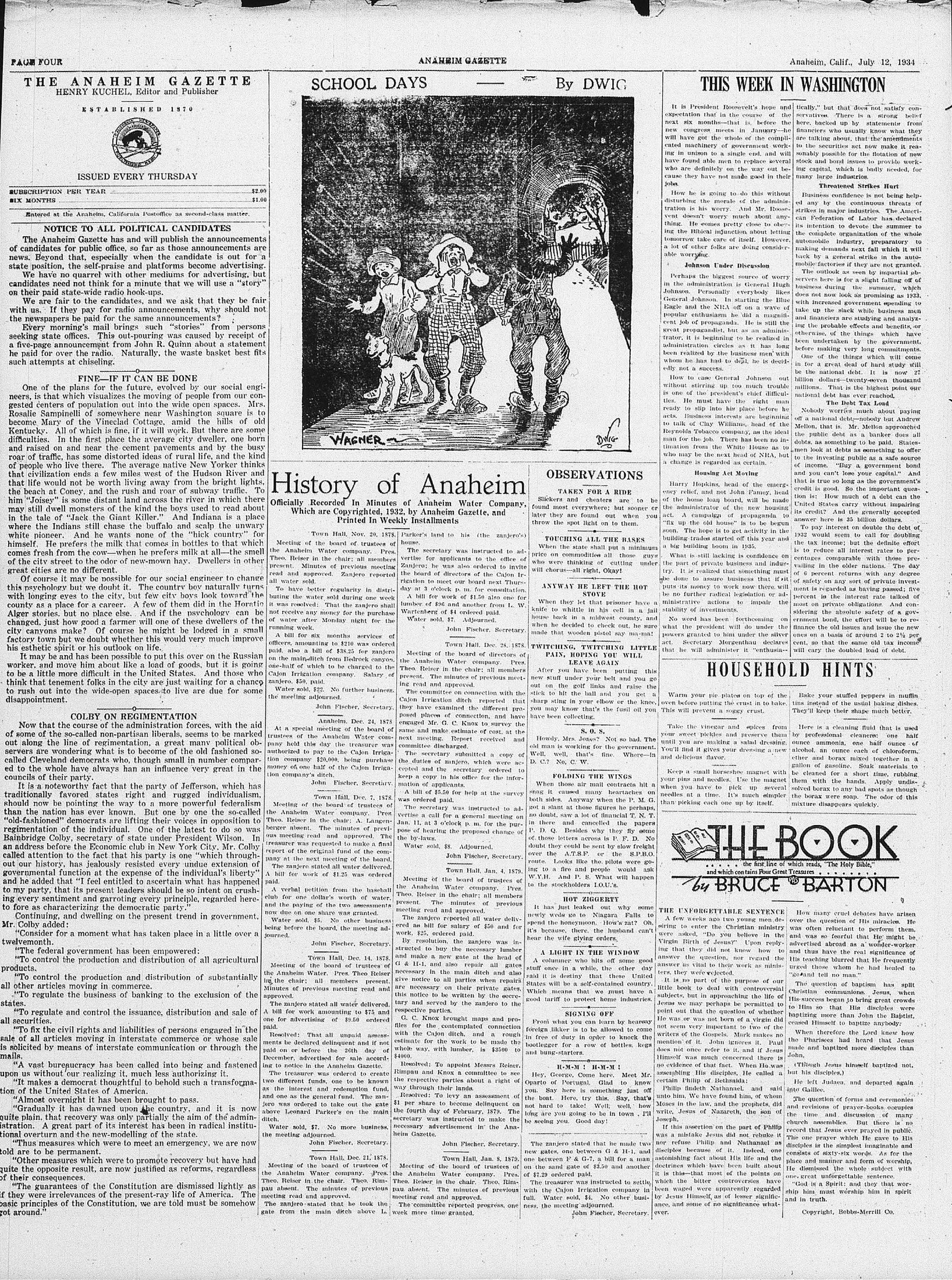
Searchable text
THE ANAHEIM GAZETTE
HENRY KUCHEL, Editor and Publisher
ESTABLISHED 1970
ISSUED EVERY THURSDAY
SUBSCRIPTION PER YEAR $2.00
SIX MONTHS $1.00
Entered at the Anaheim, California Postoffice as second-class matter.
NOTICE TO ALL POLITICAL CANDIDATES
The Anaheim Gazette has and will publish the announcements of candidates for public office, so far as those announcements are news. Beyond that, especially when the candidate is out for a state position, the self-praise and platforms become advertising.
We have no quarrel with other mediums for advertising, but candidates need not think for a minute that we will use a "story" on their paid state-wide radio hook-ups.
We are fair to the candidates, and we ask that they be fair with us. If they pay for radio announcements, why should not the newspapers be paid for the same announcements?
Every morning's mail brings such "stories" from persons seeking state offices. This out-pouring was caused by receipt of a five-page announcement from John R. Quinn about a statement he paid for over the radio. Naturally, the waste basket best fits such attempts at chiseling.
FINE—IF IT CAN BE DONE
One of the plans for the future, evolved by our social engineers, is that which visualizes the moving of people from our congested centers of population out into the wide open spaces. Mrs. Rosalie Sampinelli of somewhere near Washington square is to become Mary of the Vineclad Cottage, amid the hills of old Kentucky. All of which is fine, if it will work. But there are some difficulties. In the first place the average city dweller, one born and raised on and near the cement pavements and by the busy roar of traffic, has some distorted ideas of rural life, and the kind of people who live there. The average native New Yorker thinks that civilization ends a few miles west of the Hudson River and
FINE—IF IT CAN BE DONE
One of the plans for the future, evolved by our social engineers, is that which visualizes the moving of people from our congested centers of population out into the wide open spaces. Mrs. Rosalie Sampinelli of somewhere near Washington square is to become Mary of the Vineclad Cottage, amid the hills of old Kentucky. All of which is fine, if it will work. But there are some difficulties. In the first place the average city dweller, one born and raised on and near the cement pavements and by the busy roar of traffic, has some distorted ideas of rural life, and the kind of people who live there. The average native New Yorker thinks that civilization ends a few miles west of the Hudson River and that life would not be worth living away from the bright lights, the beach at Coney, and the rush and roar of subway traffic. To him "Joisey" is some distant land across the river in which there may still dwell monsters of the kind the boys used to read about in the tale of "Jack the Giant Killer." And Indiana is a place where the Indians still chase the buffalo and scalp the unwary white pioneer. And he wants none of the "hick country" for himself. He prefers the milk that comes in bottles to that which comes fresh from the cow—when he prefers milk at all—the smell of the city street to the odor of new-mown hay. Dwellers in other great cities are no different.
Of course it may be possible for our social engineer to change this psychology but we doubt it. The country boy naturally turns with longing eyes to the city, but few city boys look toward the county as a place for a career. A few of them did in the Horatio Alger stories, but no place else. And if the psychology can be changed, just how good a farmer will one of these dwellers of the city canyons make? Of course he might be lodged in a small factory town but we doubt whether this would very much improve his esthetic spirit or his outlook on life.
It may be and has been possible to put this over on the Russian worker, and move him about like a load of goods, but it is going to be a little more difficult in the United States. And those who think that tenement folks in the city are just waiting for a chance to rush out into the wide-open spaces to live are due for some disappointment.
COLBY ON REGIMENTATION
Now that the course of the administration forces, with the aid of some of the so-called non-partisan liberals, seems to be marked out along the line of regimentation, a great many political observers are wondering what is to become of the old fashioned so-called Cleveland democrats who, though small in number compared to the whole have always han an influence very great in the councils of their party.
It is a noteworthy fact that the party of Jefferson, which has traditionally favored states right and rugged individualism, should now be pointing the way to a more powerful federalism than the nation has ever known. But one by one the so-called "old-fashioned" democrats are lifting their voices in opposition to regimentation of the individual. One of the latest to do so was Bainbridge Colby, secretary of state under President Wilson. In an address before the Economic club in New York City, Mr. Colby called attention to the fact that his party is one "which throughout our history, has jealously resisted every undue extension of governmental function at the expense of the individual's liberty" and he added that "I feel entitled to ascertain what has happened to my party, that its present leaders should be so intent on crushing every sentiment and garroting every principle, regarded here-
History
Officially Recorded In Which are Copyrs Print
Town Hall, N
Meeting of the board of the Anaheim Water company Theo. Reiser in the chair; present. Minutes of previous read and approved. Zanjil all water sold.
To have better regularity butting the water sold during it was resolved: That they not receive any money for it of water after Monday morning week.
A bill for six months officers, amounting to $210 paid, also a bill of $38.25 on the main-ditch from Bedford one-half of which to be cha- Cajon Irrigation company; zanjero, $50, paid.
Water sold, $22. No further meeting adjourned.
John Fischer
Anahelm, D
At a special meeting of trustees of the Anaheim Water company held this day the treasurer authorized to pay to the Citation company $20,000, being money of one half of the Citation company's ditch.
John Fischer
Town Hall, N
Meeting of the board of the Anaheim Water company Theo. Reiser in the chair; burgery absent. The minute meeting read and appraisal treasurer was requested to report of the original fund o pany at the next meeting o f The zanjero stated all water A bill for work of $1.25 w paid.
A verbal petition from t he club for one dollar's worth and the paying of th e true
should now be pointing the way to a more powerful federism than the nation has ever known. But one by one the so-called "old-fashioned" democrats are lifting their voices in opposition to regimentation of the individual. One of the latest to do so was Bainbridge Colby, secretary of state under President Wilson. In an address before the Economic club in New York City, Mr. Colby called attention to the fact that his party is one "which throughout our history, has jealously resisted every undue extension of governmental function at the expense of the individual's liberty" and he added that "I feel entitled to ascertain what has happened to my party, that its present leaders should be so intent on crushing every sentiment and garroting every principle, regarded here-to fore as characterizing the democratic party."
Continuing, and dwelling on the present trend in government, Mr. Colby added:
"Consider for a moment what has taken place in a little over a twelvemonth.
"The federal government has been empowered:
"To control the production and distribution of all agricultural products.
"To control the production and distribution of substantially all other articles moving in commerce.
"To regulate the business of banking to the exclusion of the states.
"To regulate and control the issuance, distribution and sale of all securities.
"To fix the civil rights and liabilities of persons engaged in the sale of all articles moving in interstate commerce or whose sale is solicited by means of interstate communication or through the mails.
"A vast bureaucracy has been called into being and fastened upon us without our realizing it, much less authorizing it.
"It makes a democrat thoughtful to behold such a transformation of the United States of America.
"Almost overnight it has been brought to pass.
"Gradually it has dawned upon the country, and it is now quite plain, that recovery was only partially the aim of the administration. A great part of its interest has been in radical institutional overturn and the new-modelling of the state.
"Thus measures which were to meet an emergency, we are now told are to be permanent.
"Other measures which were to promote recovery but have had quite the opposite result, are now justified as reforms, regardless of their consequences.
"The guarantees of the Constitution are dismissed lightly as if they were irrelevances of the present-ray life of America. The basic principles of the Constitution, we are told must be somehow got around."
SCHOOL DAYS By DWIG
WAGNER
History of Anaheim
Officially Recorded In Minutes of Anaheim Water Company,
Which are Copyrighted, 1932, by Anaheim Gazette, and Printed In Weekly Installments
Town Hall, Nov. 20, 1878.
Meeting of the board of trustees of Anaheim Water company. Pres. Theo. Reiser in the chair; all members sent. Minutes of previous meeting and approved. Zanjero reported water sold.
To have better regularity in distributing the water sold during one week was resolved: That the zanjero shall receive any money for the purchase water after Monday night for the evening week.
A bill for six months services of users, amounting to $210 was ordered also a bill of $38.25 for zanjero the main ditch from Bedrock canyon, half of which to be charged to the on Irrigation company. Salary of zanjero, $50, paid.
Water sold, $22. No further business, meeting adjourned.
John Fischer, Secretary.
Anaheim, Dec. 24, 1878.
At a special meeting of the board of trustees of the Anaheim Water company held this day the treasurer was nominated to pay to the Cajon Irriga-company $20,000, being purchase they off one half of the Cajon Irriga-company's ditch.
John Fischer, Secretary.
Town Hall, Dec. 7, 1878.
Meeting of the board of trustees of Anaheim Water company. Pres. Theo. Reiser in the chair; A. Langen-er absent. The minutes of previ-meeting read and approved. The suruer was requested to make a final part of the original fund of the com- at the next meeting of the board. The zanjero stated all water delivered. All for work of $1.25 was ordered verbal petition from the baseball for one dollar's worth of water.
Parker's land to his (the zanjero)'s house.
The secretary was instructed to advertise for applicants to the office of Zanjero; he was also ordered to invite the board of directors of the Cajon Irrigation to meet our board next Thursday at 3 o'clock p.m. for consultation.
A bill for work of $1.50 also one for lumber of $96 and another from L. W. Wartenberg of $4 ordered paid.
Water sold, $7. Adjourned.
John Fischer, Secretary.
Town Hall, Dec. 28, 1878.
Meeting of the board of directors of the Anaheim Water company. Pres. Theo. Reiser in the chair; all members present. The minutes of previous meeting read and approved.
The committee on connection with the Cajon Irrigation ditch reported that they have examined the different proposed places of connection, and have engaged Mr. G. C. Knox to survey the same and make estimate of cost, at the next meeting. Report received and committee discharged.
The secretary submitted a copy of the duties of zanjero, which were accepted and the secretary ordered to keep a copy in his office for the information of applicants.
A bill of $5.50 for help at the survey was ordered paid.
The secretary was instructed to advertise a call for a general meeting on Jan. 11, at 3 o'clock p.m. for the purpose of hearing the proposed change of the by-laws.
Water sold, $8. Adjourned.
John Fischer, Secretary.
Town Hall, Jan. 4, 1879.
Meeting of the board of trustees of the Anaheim Water company. Pres. Theo. Reiser in the chair; all members present.
The minutes of previous observations
TAKEN FOR A RIDE
Slickers and cheaters are to be found most everywhere; but sooner or later they are found out when you throw the spot light on to them.
TOUCHING ALL THE BASES
When the state shall put a minimum price on commodities all those guys who were thinking of cutting under will chorus—all right, Okay!
ANYWAY HE LEFT THE HOT STOVE
When they let that prisoner have a knife to whittle in his cell in a jail house back in a midwest county, and when he decided to check out, he sure made that wooden pistol say ma-ma!
TWITCHING, TWITCHING LITTLE PAIN, HOPING YOU WILL LEAVE AGAIN
After you have been putting this new stuff under your belt and you go out on the golf links and raise the stick to hit the ball and you get a sharp sting in your elbow or the knee, you may know that's the fusil oil you have been collecting.
S. O. S.
Howdy, Mrs. Jones? Not so bad. The old man is working for the government. Well, well, that's fine. Where—in D.C.? No, C.W.
FOLDING THE WINGS
When those air mail contracts hit a snag it caused many heartaches on both sides. Anyway when the P. M. G got a slant at those figures he perhaps, no doubt, saw a lot of financial T.N.T. in there and cancelled the papers P.D.Q. Besides why they fly some of those letters across is P.F.D. No doubt they could be sent by slow freight over the A.T.S.F. or the S.P.B.O. route. Looks like the pilots were going to a fire and people would ask W.Y.H. And P.S. What will happen to the stockholders I.O.U.'s.
HOT ZIGGERTY
The secretary was instructed to advertise a call for a general meeting on Jan. 11, at 3 o'clock p.m. for the purpose of hearing the proposed change of the by-laws.
Water sold, $8. Adjourned.
John Fischer, Secretary.
Town Hall, Jan. 4, 1879.
Meeting of the board of trustees of the Anaheim Water company. Pres. Theo Reiser in the chair; all members present. The minutes of previous meeting read and approved.
The zanjero reported all water delivered as bill for salary of $50 and for work, $25, ordered paid.
By resolution, the zanjero was instructed to buy the necessary lumber and make a new gate at the head of G & H-1, and also repair all gates necessary in the main ditch and also give notice to all parties when repairs are necessary on their private gates, this notice to be written by the secretary and served by the zanjero to the respective parties.
G. C. Knox brought maps and profiles for the contemplated connection with the Cajon ditch, and a rough estimate for the work to be made the whole way, with lumber, is $3500 to $4000.
Resolved: To appoint Messrs Reiser, Rimpau and Knox a committee to see the respective parties about a right of way through their lands.
Resolved: To levy an assessment of $1 per share to become delinquent on the fourth day of February, 1879. The secretary was instructed to make the necessary advertisement in the Anaheim Gazette.
John Fischer, Secretary.
Town Hall, Jan. 8, 1879.
Meeting of the board of trustees of the Anaheim Water company. Pres. Theo Reiser in the chair. Theo Rimpau absent. The minutes of previous meeting read and approved.
The committee reported progress, one week more time granted.
The zanjero stated that he made two new gates, one between G & H-1, and one between F & G-7, a bill for a man on the sand gate of $3.50 and another of $7.29 ordered paid.
The treasurer was instructed to settle with the Cajon Irrigation company in full. Water sold, $4. No other business, the meeting adjourned.
John Fischer, Secretary.
HOT ZIGGERTY
It has just leaked out why some newly weds go to Niagara Falls to spend the honeymoon. How's zat? Oh, it's because, there, the husband can't hear the wife giving orders.
A LIGHT IN THE WINDOW
A columner who hits off some good stuff once in a while, the other day said it is destiny that these United States will be a self-contained country. Which means that we must have a good tariff to protect home industries.
SIGNING OFF
From what you can learn by hearsay foreign likker is to be allowed to come in free of duty in order to knock the bootleger for a row of bottles, kegs and bung-starters.
H-M-M! H-M-M!
Hey, George, Come here. Meet Mr. Oparto of Portugal. Glad to know you. Say here is something just off the boat. Here, try this. Say, that's not hard to take! Well, well, how long are you going to be in town . I'll be seeing you. Good day!
The zanjero stated that he made two new gates, one between G & H-1, and one between F & G-7, a bill for a man on the sand gate of $3.50 and another of $7.29 ordered paid.
The treasurer was instructed to settle with the Cajon Irrigation company in full. Water sold, $4. No other business, the meeting adjourned.
THIS WEEK IN WASHINGTON
It is President Roosevelt's hope and expectation that in the course of the next six months—that is, before the new congress meets in January—the will have got the whole of the complicated machinery of government working in unison to a single end, and will have found able men to replace several who are definitely on the way out because they have not made good in their jobs.
How he is going to do this without disturbing the morale of the administration is his worry. And Mr. Roosevelt doesn't worry much about anything. He comes pretty close to obeying the Biblical injunction about letting tomorrow take care of itself. However, a lot of other folks are doing considerable worrying.
Johnson Under Discussion
Perhaps the biggest source of worry in the administration is General Hugh Johnson. Personally everybody likes General Johnson. In starting the Blue Eagle and the NRA off on a wave of popular enthusiasm he did a magnificent job of propaganda. He is still the great propagandist, but as an administrator, it is beginning to be realized in administration circles as it has long been realized by the business men with whom he has had to deal, he is decidedly not a success.
How to case General Johnson out without stirring up too much trouble is one of the president's chief difficulties. He must have the right man ready to slip into his place before he acts. Business interests are beginning to talk of Clay Williams, head of the Reynolds Tobacco company, as the ideal man for the job. There has been no intimation from the White House as to who may be the next head of NRA, but a change is regarded as certain.
Housing Act Moving
Threatened Strikes Hurt
Business confidence is not being helped any by the continuous threats of strikes in major industries. The American Federation of Labor has declared its intention to devote the summer to the complete organization of the whole automobile industry, preparatory to making demands next fall which it will back by a general strike in the automobile factories if they are not granted.
The outlook as seen by impartial observers here is for a slight falling off of business during the summer, which does not now look as promising as 1933, with increased government spending to take up the slack while business men and financiers are studying and analyzing the probable effects and benefits, or otherwise, of the things which have been undertaken by the government, before making very long commitments.
One of the things which will come in for a great deal of hard study will be the national debt. It is now 27 billion dollars—twenty-seven thousand millions. That is the highest point our national debt has ever reached.
The Debt Tax Load
Nobody worries much about paying off a national debt—nobody but Andrew Mellon, that is. Mr. Mellon approached the public debt as a banker does all debts, as something to be paid. Statesmen look at debts as something to offer to the investing public as a safe source of income. "Buy a government bond and you can't lose your capital." And
How to ease General Johnson out without stirring up too much trouble is one of the president's chief difficulties. He must have the right man ready to slip into his place before he acts. Business interests are beginning to talk of Clay Williams, head of the Reynolds Tobacco company, as the ideal man for the job. There has been no intimation from the White House as to who may be the next head of NRA, but a change is regarded as certain.
Housing Act Moving
Harry Hopkins, head of the emergency relief, and not John Famey, head of the home loan board, will be made the administrator of the new housing act. A campaign of propaganda to "fix up the old house" is to be begun soon. The hope is to get activity in the building trades started off this year and a big building boom in 1935.
What is still lacking is confidence on the part of private business and industry. It is realized that something must be done to assure business that it puts its money to work now there will be no further radical legislation or administrative actions to impair the stability of investments.
No word has been forthcoming on what the president will do under the powers granted to him under the silver act. Secretary Morgenthau declares that he will administer it "enthusia--
HOUSEHOLD HINTS
Warm your pie plates on top of the oven before putting the crust in to bake. This will prevent a soggy crust.
Take the vinegar and spices from your sweet pickles and preserve them until you are making a salad dressing. You'll find it gives your dressing a new and delicious flavor.
Keep a small horseshoe magnet with your pins and needles. Use the magnet when you have to pick up several needles at a time. It's much simpler than picking each one up by itself.
Bake your stuffed peppers in muffins instead of the usual baking dishes. They'll keep their shape much better.
Here is a cleaning fluid that is used by professional cleaners: one half ounce ammonia, one half ounce of alcohol, an ounce each of chloroform, ether and borax mixed together in a gallon of gasoline. Soak materials to be cleaned for a short time, rubbing them with the hands. Apply undissolved borax to any bad spots as though the borax were soap. The odor of this mixture disappears quickly.
THE UNFORGETTABLE SENTENCE
A few weeks ago two young men desiring to enter the Christian ministry were asked, "Do you believe in the Virgin Birth of Jesus?" Upon replying that they did not know how to answer the question, nor regard the answer as vital to their work as ministers, they were rejected.
It is no part of the purpose of our little book to deal with controversial subjects, but in approaching the life of Jesus we may perhaps be permitted to point out that the question of whether He was or was not born of a virgin did not seem very important to two of the writers of the Gospels. Mark makes no mention of it. John ignores it. Paul does not once refer to it, and if Jesus Himself was much concerned there is no evidence of that fact. When He was assembling His disciples, He called a certain Philip of Bethsaida:
Philip findeth Nathanael, and said unto him, We have found him, of whom Moses in the law, and the prophets, did write, Jesus of Nazareth, the son of Joseph.
If this assertion on the part of Philip was a mistake Jesus did not rebuke it nor refuse Philip and Nathanael as disciples because of it. Indeed, one astonishing fact about His life and the doctrines which have been built about it is this—that most of the points on which the bitter controversies have been waged were apparently regarded by Jesus Himself, us of lesser significance, and some of no significance whatever.
How many cruel debates have arisen over the question of His miracles. He was often reluctant to perform them, and was so fearful that He might be advertised abroad as a wonder-worker and thus have the real significance of His teaching blurred that He frequently urged those whom he had healed to "go and tell no man."
The question of baptism has split Christian communions. Jesus, when His success began to bring great crowds to Him so that His disciples were baptizing more than John the Baptist, ceased Himself to baptize anybody:
When therefore the Lord knew how the Pharisees had heard that Jesus made and baptized more disciples than John.
(Though Jesus himself baptized not, but his disciples.)
He left Judaea, and departed again into Galilee.
The question of forms and ceremonies and revisions of prayer-books occupies the time and discussion of many church assemblies. But there is no record that Jesus ever prayed in public. The one prayer which He gave to His disciples is the simplest imaginable and consists of sixty-six words. As for the place and manner and form of worship, He dismissed the whole subject with one, great unforgettable sentence.
"God is a Spirit; and they that worship him must worship him in spirit and in truth.
Copyright, Bobbs-Merrill Co.