anaheim-gazette 1934-07-05
Scanned page
Searchable text
THE ANAHEIM GAZETTE
HENRY KUCHEL, Editor and Publisher
ESTABLISHED 1870
ISSUED EVERY THURSDAY
SUBSCRIPT PER YEAR $2.00
SIX MONTHS $1.00
Entered at the Anaheim, California Postoffice as second-class matter.
UTOPIANS, BEWARE OF HIDDEN PURPOSES
Police Chief James Davis of Los Angeles, speaking in Anaheim at a meeting sponsored by the Mother Colony chapter, D. A. R., took the lid off red and communistic methods of teaching by indirection. Among other agencies mentioned by the speaker, he named the Utopians, claiming that communist leaders in Southern California organized the movement. Most members of the society, however, are not communists, and were they aware of such leadership would be the first to denounce efforts to spread undesired propaganda.
Chief Davis is in a position to know what he is talking about. Just because he waves the danger flag over the organization is no indication that American government will be undermined by infiltration of communistic ideas. Any organization amounts to just what its membership makes it.
Since members of the Utopian society, in all the instances of which we are personally aware, are loyal Americans, there does not seem to be great danger of any menace arising from it, although it may have been organized by communists, as charged.
The only point at issue here, of course, is for members of the organization to be alert to any undermining influence which might direct them to un-American beliefs and deeds. Propaganda of this type is dangerous because it is subtle; cloaked in such innocent and idealistic clothing as pledges to keep law and order, honor and defend the Stars and Stripes and uphold the Constitution, the members may be unprepared to resist sly suggestions that our social order should be altered, first, ever so slightly.
Changing our social program with our eyes open is safe and sane; permitting communist leaders to guide such changes, how-
not seem to be great danger of any menace arising from it, although it may have been organized by communists, as charged.
The only point at issue here, of course, is for members of the organization to be alert to any undermining influence which might direct them to un-American beliefs and deeds. Propaganda of this type is dangerous because it is subtle; cloaked in such innocent and idealistic clothing as pledges to keep law and order, honor and defend the Stars and Stripes and uphold the Constitution, the members may be unprepared to resist sly suggestions that our social order should be altered, first, ever so slightly.
Changing our social program with our eyes open is safe and sane; permitting communist leaders to guide such changes, however, is dangerous.
COMEDY SKETCH
One of the greatest comedy sketches ever put on in Washington was the one in the senate committee hearing in which Professor Tugwell announced that he was a conservative, and was loudly cheered by Senators Norris and Wheeler.
LET'S SEE HOW THEY DO IT
The latest nation to default on its foreign debt is Germany. The argument is used that Germany is unable to pay, because of declining trade and for other reasons, which are too technical and voluminous to mention here. In fact, it is hardly necessary to mention them because we have heard them so often before, coming from Great Britain, France and other debt defaulters.
The only amusing thing about it, if there can be anything amusing about a debt default, is the way in which France and Great Britain are screaming and threatening over the German default. This shows that European statesmen, no matter how clever they may be, are sadly lacking in a sense of humor. The British and French defaulted on their debt to the United States, giving many reasons why they thought they were unable to pay. They were at a loss to understand why we could not accept their explanation of the situation. But when another nation defaults, and the default hits Great Britain and France, as well as the United States, screams of anguish which could be heard in the high heavens go up from Paris and London.
And London and Paris are now stating that they will compel Germany to pay. Great Britain is arranging to seize German accounts in Great Britain and to use measures to offset the defaults and France is preparing to follow suit. But if Uncle Sam were to adopt harsh methods in an effort to collect what the European nations owe him, there would be gnashing of teeth and cries of "Shylock" from every defaulting capital in Europe. Even our own internationalists would join in the chorus.
It is of course none of our business what measures Great Britain and France use to protect themselves against the German default. They are entitled, of course, to get what they can. But how about Uncle Sam? Our administration at Washington has taken a bold and determined verbal stand against debt cancellation. But merely going on record to say that the debtor nations ought to pay us and then relapsing into international slumber will not help much, although our position will help some because it will teach us not to lend money abroad to warring nations again.
But we should at least examine with interest the methods now used by Great Britain and France to collect from Germany. Maybe we can get on to some method of getting a little on our own account.
Britain and France use to protect themselves against the German default. They are entitled, of course, to get what they can. But how about Uncle Sam? Our administration at Washington has taken a bold and determined verbal stand against debt cancellation. But merely going on record to say that the debtor nations ought to pay us and then relapsing into international slumber will not help much, although our position will help some because it will teach us not to lend money abroad to warring nations again.
But we should at least examine with interest the methods now used by Great Britain and France to collect from Germany. Maybe we can get on to some method of getting a little on our own account.
OUR RESOURCEFUL PRESIDENT
Because of the dignity attaching to his office, the president of the United States cannot "cuss." So Mr. Roosevelt hired General Johnson.
NUDISTS AND THE NRA
The NRA is booming the nudist camps, according to a news service dispatch, which quotes one Mr. Knapp, a professor of nudism as stating:
"New leisure under the NRA is sending hordes of people to seek health and happiness with us. People have recently seen enough of misery and suffering to appreciate the importance of a sound body and laughter."
All of which is important if true. It far exceeds the predications of the most inveterate enemies of the NRA. Some of them have made the prophecy that the New Deal would eventually tax us out of our shirts, but none have been mean enough to say that it would make nudists of us.
WHEN PUNISHMENT PAYS
"Can you come out to our home right away, doctor?" telephoned little Mary. "Yes, but who is sick at your home," answered ye doc. "Everybody but me," replied Mary. "Papa gathered some mushrooms down in the pasture, and I was naughty so he wouldn't let me eat any of them."
IS THIS SURRENDER?
If the New Deal's planned economy means limitation of production, as in numerous AAA instances, it tackles our problems with superficial understanding. This idea of cutting down production in an age of plenty is anything but an aggressive tackling of our fundamental problems — it is surrender, but not statesmanship.
ANANEIM GAZETTE
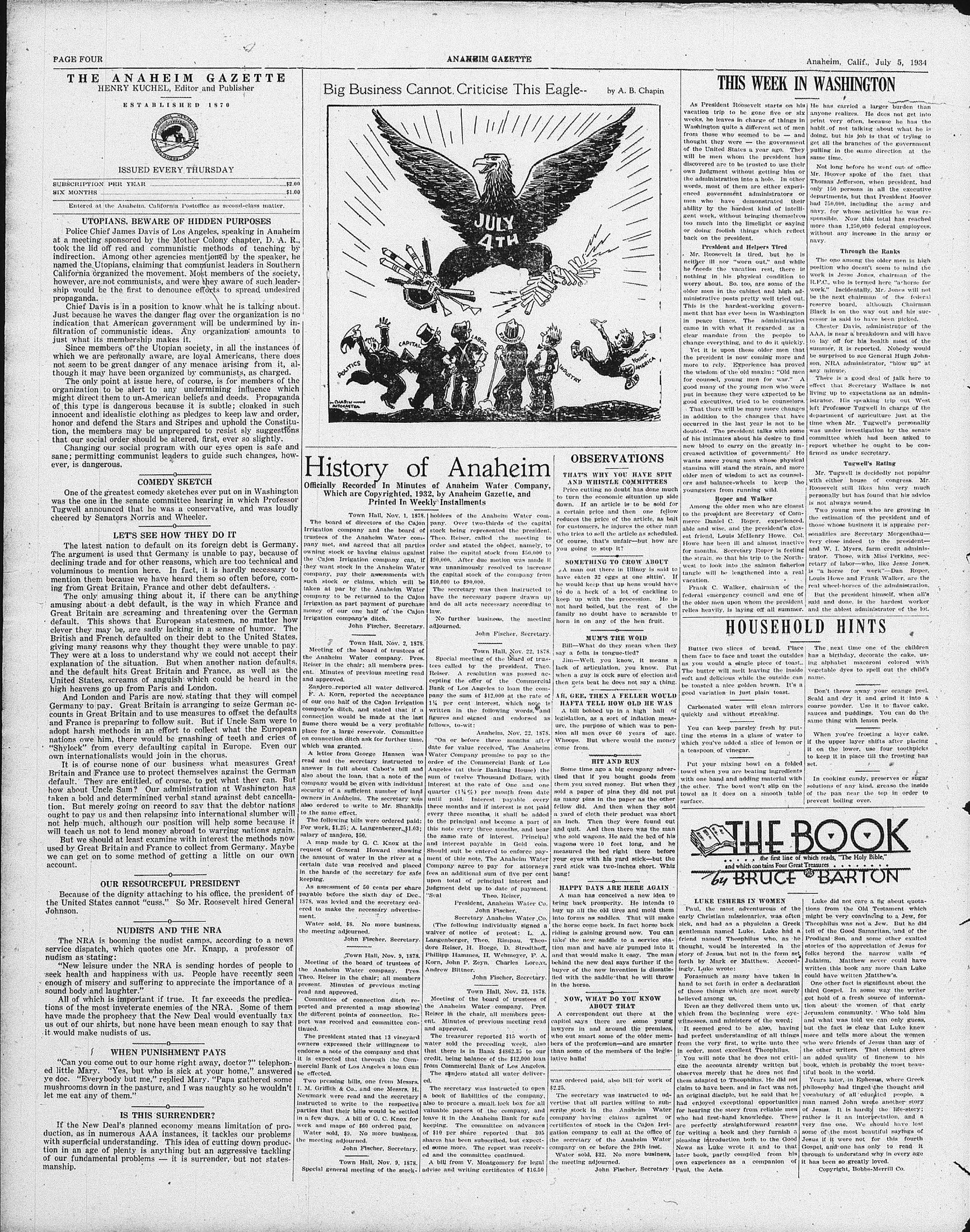
Big Business Cannot Criticise This Eagle-- by A. B. Chapin
JULY
4TH
POLITICS
CAPITAL
LABOR
FARMING
INDUSTRY
YOUNG AMERICA
History of Anaheim
Officially Recorded In Minutes of Anaheim Water Company,
Which are Copyrighted, 1932, by Anaheim Gazette, and Printed In Weekly Installments
Town Hall, Nov. 1, 1878.
The board of directors of the Cajon Irrigation company and the board of trustees of the Anaheim Water company met, and agreed that all parties owning stock or having claims against the Cajon Irrigation company can, if they want stock in the Anaheim Water company, pay their assessments with such stock or claims, which will be taken at par by the Anaheim Water company to be returned to the Cajon Irrigation as part payment of purchase money of our one half of the Cajon Irrigation company's ditch.
John Fischer, Secretary.
Town Hall, Nov. 2, 1878.
Meeting of the board of trustees of the Anaheim Water company. Pres. Reiser in the chair; all members present. Minutes of previous meeting read and approved.
Zanjero reported all water delivered.
F. A. Korn, reported the acceptance of our one half of the Cajon Irrigation company's ditch, and stated that if a connection would be made at the last flume there would be a very profitable place for a large reservoir. Committee on connection ditch ask for further time, which was granted.
A letter from George Hansen was read and the secretary instructed to answer in full about Cabot's bill and also about the loan, that a note of the company would be given with individual security of a sufficient number of land owners in Anaheim. The secretary was also ordered to write to Mr. Shanklin to the same effect.
The following bills were ordered paid: For work, $1.25; A. Langenberger, $1.03; salary of zanjero, $50.
A map made by G. C. Knox at the request of General Howard showing the amount of water in the river at certain date was received and placed holders of the Anaheim Water company. Over two-thirds of the capital stock being represented the president. Theo. Reiser, called the meeting to order and stated the object, namely, to raise the capital stock from $50,000 to $90,000. After due motion was made it was unanimously resolved to increase the capital stock of the company from $50,000 to $90,000.
The secretary was then instructed to have the necessary papers drawn up and do all acts necessary according to law.
No further business, the meeting adjourned.
John Fischer, Secretary.
Town Hall, Nov. 22, 1878.
Special meeting of the board of trustees called by the president. Theo. Reiser. A resolution was passed accepting the offer of the Commercial Bank of Los Angeles to loan the company the sum of $12,000 at the rate of 1¼ per cent interest, which note is written in the following words, and figures and signed and endorsed as follows, to-wit:
Anaheim, Nov. 22, 1878.
"On or before three months after-date for value received. The Anaheim Water Company promise to pay to the order of the Commercial Bank of Los Angeles (at their Banking House) the sum of twelve Thousand Dollars, with interest at the rate of One and one quarter (1¼%) per month from date until paid. Interest payable every three months and if interest is not paid every three months, it shall be added to the principal and become a part of this note every three months, and bear the same rate of interest. Principal and interest payable in Gold coin. Should suit be entered to enforce payment of this note. The Anaheim Water Company agree to pay for attorneys.
OBSERVATIONS
THAT'S WHY YOU HAVE SPIT AND WHISTLE COMMITTEES
Price cutting no doubt has done much to turn the economic situation up side down. If an article is to be sold for a certain price and then one fellow reduces the price of the article, as bait for customers, he injures the other man who tries to sell the article as scheduled. Of course, that's unfair—but how are you going to stop it?
SOMETHING TO CROW ABOUT
A man out there in Illinoy is said to have eaten 32 eggs at one sittin'. If he would keep that up hens would have to do a heck of a lot of cackling to keep up with the procession. He is not hard boiled, but the rest of the family no doubt have to scramble to horn in on any of the hen fruit.
MUM'S THE WOID
Bill—What do they mean when they say a fella is tongue-tied?
Jim—Well, you know, it means a lack of articulation, you know. But when a guy is cock sure of election and then gets beat he does not say a thing.
AH, GEE, THEN A FELLERWOULD HAFTA TELL HOWOLD HE WAS
A bill bobbed up in a high hall of legislation, as a sort of inflation measure, the purpose of which was to pension all men over 60 years of age. Whoops. But where would the money come from.
HIT AND RUN
Some time ago a big company advertised that if you bought goods from them you saved money. But when they sold a paper of pins they did not put as many pins in the paper as the other fellow did. And then when they sold a yard of cloth their product was short an inch. Then they were found out and quit. And then there was the man who sold wagons. He said the bed of his wagons were 10 feet long, and he measured the bed right there before your eyes with his yard stick—but the yard stick was two-inches short. Whiz
also about the loan, that a note of the company would be given with individual security of a sufficient number of land owners in Anaheim. The secretary was also ordered to write to Mr. Shanklin to the same effect.
The following bills were ordered paid: For work, $1.25; A. Langenberger, $1.03; salary of zanjero, $50.
A map made by G. C. Knox at the request of General Howard showing the amount of water in the river at a certain date was received and placed in the hands of the secretary for safe keeping.
As assessment of 50 cents per share payable before the sixth day of Dec., 1878, was levied and the secretary ordered to make the necessary advertisement.
Water sold, $8. No more business, the meeting adjourned.
John Fischer, Secretary.
Town Hall, Nov. 9, 1878.
Meeting of the board of trustees of the Anaheim Water company. Pres. Theo. Reiser in the chair; all members present. Minutes of previous meting read and approved.
Committee of connection ditch reported and presented a map showing the different points of connection. Report was received and committee continued.
The president stated that 13 vineyard owners expressed their willingness to endorse a note of the company and that it is expected that through the Commercial Bank of Los Angeles a loan can be effected.
Two pressing bills, one from Messrs. I. M. Griffith & Co., and one Messrs. H. Newmark were read and the secretary instructed to write to the respective parties that their bills would be settled in a few days. A bill of G. C. Knox for work and maps of $60 ordered paid.
Water sold, $9. No more business, the meeting adjourned.
John Fischer, Secretary.
Town Hall, Nov. 9, 1878.
Special general meeting of the stock-
sum of twelve Thousand Dollars, with interest at the rate of One and one quarter (1¼%) per month from date until paid. Interest payable every three months and if interest is not paid every three months, it shall be added to the principal and become a part of this note every three months, and bear the same rate of interest. Principal and interest payable in Gold coin. Should suit be entered to enforce payment of this note, The Anaheim Water Company agree to pay for attorneys fees an additional sum of five per cent upon total of principal interest and judgment debt up to date of payment.
Seal
Theo. Reiser,
President, Anaheim Water Co.
John Fischer,
Secretary Anaheim Water Co.
(The following individually signed a waiver of notice of protest: L. A. Langenberger, Theo. Rimpau, Theodore Reiser, H. Boege, D. Strodthoff, Phillipp Hammes, H. Wehmeyer, F. A. Korn, John P. Zeyn, Charles Lorenz, Andrew Bittner.
John Fischer, Secretary.
Town Hall, Nov. 23, 1878.
Meeting of the board of trustees of the Anaheim Water company. Pres. Reiser in the chair, all members present. Minutes of previous meeting read and approved.
The treasurer reported $15 worth of water sold the preceding week, also that there is in Bank $4862.35 to our credit, being balance of the $12,000 loan from Commercial Bank of Los Angeles.
The zanjero stated all water delivered.
The secretary was instructed to open a book of liabilities of the company, also to procure a small lock box for all valuable papers of the company, and leave it in the Anaheim Bank for safe keeping. The committee on advances of $10 per share reported that 305 shares has been subscribed, but expected some more. The report was received and the committee continued.
A bill from V. Montgomery for legal advise and writing certificates of $16.50
was ordered paid, also bill for work of $2.25.
The secretary was instructed to advertise that all parties willing to subscribe stock in the Anaheim Water company having claims against or certificates of stock in the Cajon Irrigation company to call at the office of the secretary of the Anaheim Water company on or before the 29th inst.
Water sold, $32. No more business, the meeting adjourned.
John Fischer, Secretary
THIS WEEK IN WASHINGTON
As President Roosevelt starts on his vacation trip to be gone five or six weeks, he leaves in charge of things in Washington quite a different set of men from those who seemed to be — and thought they were — the government of the United States a year ago. They will be men whom the president has discovered are to be trusted to use their own judgment without getting him or the administration into a hole. In other words, most of them are either experienced government administrators or men who have demonstrated their ability by the hardest kind of intelligent work, without bringing themselves too much into the limelight or saying or doing foolish things which reflect back on the president.
President and Helpers Tired
Mr. Roosevelt is tired, but he is neither ill nor "worn out," and while he needs the vacation rest, there is nothing in his physical condition to worry about. So, too, are some of the older men in the cabinet and high administrative posts pretty well tried out. This is the hardest-working government that has ever been in Washington in peace times. The administration came in with what it regarded as a clear mandate from the people to change everything, and to do it quickly.
Yet it is upon these older men that the president is now coming more and more to rely. Experience has proved the wisdom of the old maxim: "Old men for counsel, young men for war." A good many of the young men who were put in because they were expected to be good executives, tried to be counselors.
That there will be many more changes in addition to the changes that have occurred in the last year is not to be doubted. The president talks with some of his intimates about his desire to find new blood to carry on the greatly increased activities of governments. He has carried a larger burden than anyone realizes. He does not get into print very often, because he has the habit of not talking about what he is doing, but his job is that of trying to get all the branches of the government pulling in the same direction at the same time.
Not long before he went out of office Mr. Hoover spoke of the fact that Thomas Jefferson, when president, had only 150 persons in all the executive departments, but that President Hoover had 750,000, including the army and navy, for whose activities he was responsible. Now this total has reached more than 1,250,000 federal employees, without any increase in the army or navy.
Through the Ranks
The one among the older men in high position who doesn't seem to mind the work is Jesse Jones, chairman of the R.F.C., who is termed here "a horse for work." Incidentally, Mr. Jones will not be the next chairman of the federal reserve board, although Chairman Black is on the way out and his successor is said to have been picked.
Chester Davis, administrator of the AAA, is near a breakdown and will have to lay off for his health most of the summer, it is reported. Nobody would be surprised to see General Hugh Johnson, NRA administrator, "blow up" at any minute.
There is a good deal of talk here to effect that Secretary Wallace is not living up to expectations as an administrator. His speaking trip out West left Professor Tugwell in charge of the department of agriculture just at the time when Mr. Tugwell's personality was under investigation by the senate committee which had been asked to report whether he ought to be confirmed as under secretary.
RVATIONS
YOU HAVE SPIT
BLE COMMITTEES
No doubt has done much
economic situation up side
article is to be sold for
and then one fellow
of the article, as bait
injures the other man
the article as scheduled.
is unfair—but how are
up it?
TO CROW ABOUT
There in Illinoi is said to
eggs at one sittin'. If
at up hens would have
a lot of cackling to
the procession. He is
but the rest of the
have to scramble to
of the hen fruit.
THE WOID
they mean when they
languge-tled?
You know, it means a
tion, you know. But
ck sure of election and
does not say a thing.
A FELLER WOULD
HOW OLD HE WAS
up in a high hall of
sort of inflation measof which was to pen60 years of age.
there would the money
AND RUN
a big company adverbought goods from
money. But when they
pins they did not put
the paper as the other
then when they sold
their product was short
they were found out
when there was the man.
He said the bed of his
feet long, and he
right there before
his yard stick—but the
two-inches short. Whiz
more to rely. Experience has proved
the wisdom of the old maxim: "Old men
for counsel, young men for war." A good many of the young men who were put in because they were expected to be good executives, tried to be counselors.
That there will be many more changes in addition to the changes that have occurred in the last year is not to be doubted. The president talks with some of his intimates about his desire to find new blood to carry on the greatly increased activities of governments. He wants more young men whose physical stamina will stand the strain, and more older men of wisdom to act as counselors and balance-wheels to keep the youngsters from running wild.
Roper and Walker
Among the older men who are closest to the president are Secretary Daniel C. Roper, experienced, able and wise, and the president's closest friend, Louis McHenry Howe. Col. Howe has been ill and almost inactive for months. Secretary Roper is feeling the strain, so that his trip to the Northwest to look into the salmon fisheries tangle will be lengthened into a real vacation.
Frank C. Walker, chairman of the federal emergency council and one of the older men upon whom the president relies heavily, is laying off all summer.
HOUSEHOLD HINTS
Butter two slices of bread. Place them face to face and toast the outsides as you would a single piece of toast.. The butter will melt leaving the inside soft and delicious while the outside can be toasted a nice golden brown. It's a good variation in just plain toast.
Carbonated water will clean mirrors quickly and without streaking.
You can keep parsley fresh by putting the stems in a glass of water to which you've added a slice of lemon or a teaspoon of vinegar.
Put your mixing bowl on a folded towel when you are beating ingredients with one hand and adding material with the other. The bowl won't slip on the towel as it does on a smooth table surface.
The next time one of the children has a birthday, decorate the cake, using alphabet macaroni colored with vegetable dyes to spell out the child's name.
Don't throw away your orange peel. Scald and dry it and grind it into a coarse powder. Use it to flavor cake, sauces and puddings. You can do the same thing with lemon peels.
When you're frosting a layer cake, if the upper layer shifts after placing it on the lower, use four toothpicks to keep it in place till the frosting has set.
In cooking candy, preserves or sugar solutions of any kind, grease the inside of the pan near the top in order to prevent boiling over.
THE BOOK
the first line of which reads, "The Holy Bible," and which contains Four Great Treasures
THE BOOK
the first line of which reads, "The Holy Bible," and which contains Four Great Treasures
by BRUCE BARTON
LUKE USHERS IN WOMEN
Paul, the most adventurous of the early Christian missionaries, was often sick, and had as a physician a Greek gentleman named Luke. Luke had a friend named Theophilus who, as he thought, would be interested in the story of Jesus, but not in the form set forth by Mark or Matthew. Accordingly, Luke wrote:
Forasmuch as many have taken in hand to set forth in order a declaration of those things which are most surely believed among us.
Even as they delivered them unto us, which from the beginning were eyewitnesses, and ministers of the word;
It seemed good to be also, having had perfect understanding of all things from the very first, to write unto thee in order, most excellent Theophilus.
You will note that he does not criticize the accounts already written but observes merely that he does not find them adapted to Theophilus. He did not claim to have been, and in fact was not, an original disciple, but he said that he had enjoyed exceptional opportunities for hearing the story from reliable men who had first-hand knowledge. These are perfectly straightforward reasons for writing a book and they furnish a pleasing introduction both to the Good News as Luke wrote it and to that later book, partly compiled from his own experiences as a companion of Paul, the Acts.
Luke did not care a fig about quotations from the Old Testament which might be very convincing to a Jew, for Theophilus was not a Jew. But he did tell of the Good Samaritan, and of the Prodigal Son, and some other exalted estories of the appreciation of Jesus for folks beyond the narrow walls of Judaism. Matthew never could have written this book any more than Luke could have written Matthew's.
One other fact is significant about the third Gospel. In some way the writer got hold of a fresh source of information about the women of that early Jerusalem community. Who told him and what was told we can only guess, but the fact is clear that Luke knew more and tells more about the women who were friends of Jesus than any of the other writers. That element gives an added quality of fineness to his book, which is probably the most beautiful book in the world.
Years later, in Ephesus, where Greek philosophy had tinged the thought and vocabulary of all educated people, a man named John wrote another story of Jesus. It is hardly the life-story; rather is it an interpretation, and a very fine one. We should have lost some of the most beautiful sayings of Jesus if it were not for this fourth Gospel, and one has only to read it through to understand why in every age it has been so greatly loved.
Copyright, Bobbs-Merrill Co.