anaheim-gazette 1934-07-05
Scanned page
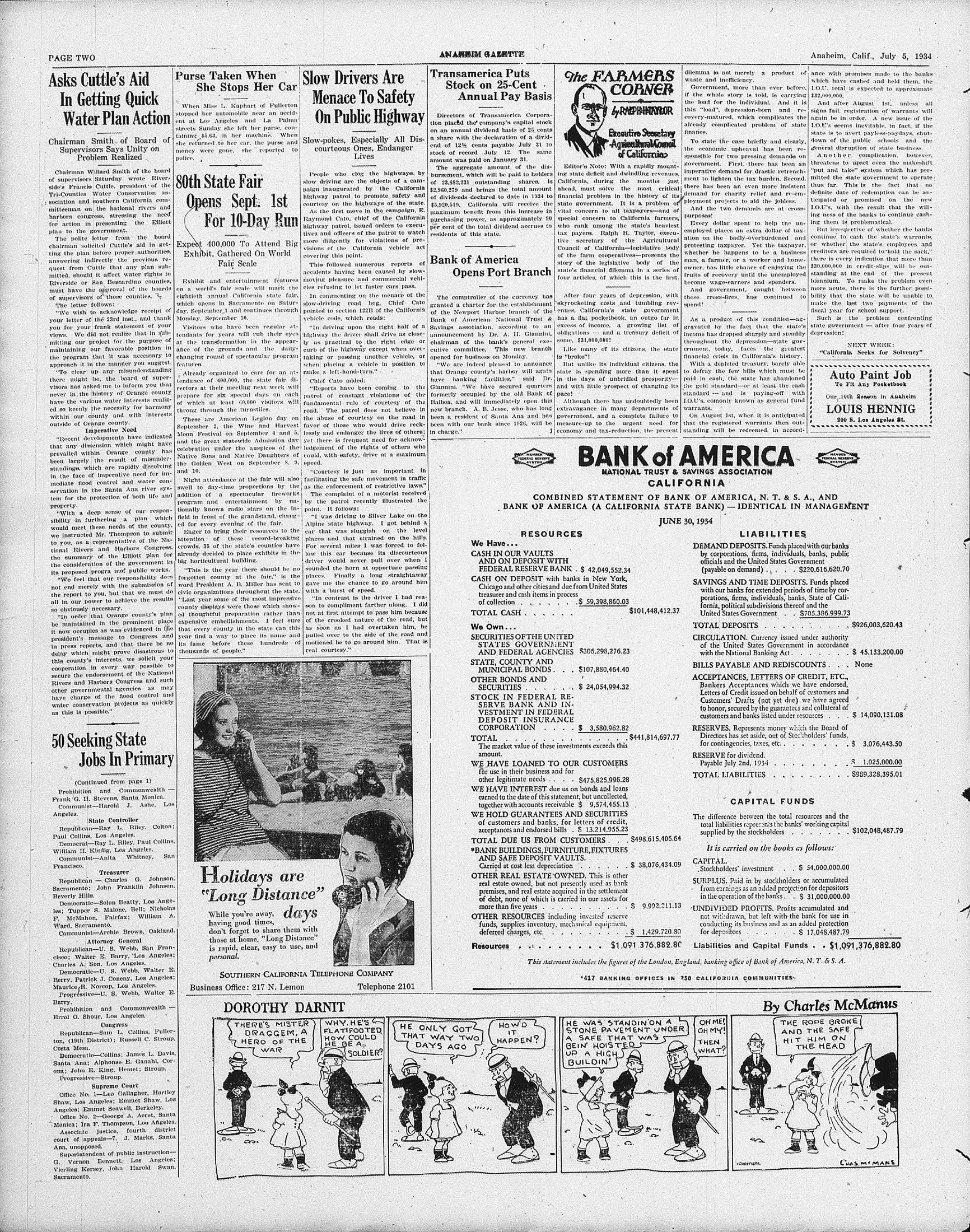
Searchable text
Asks Cuttle’s Aid In Getting Quick Water Plan Action
Chairman Smith of Board of Supervisors Says Unity on Problem Realized
Chairman Willard Smith of the board of supervisors Saturday wrote Riverside’s Francis Cuttle, president of the Tri-Counties Water Conservation association and southern California committee on the national rivers and harbors congress, stressing the need for action in presenting the Elliott plan to the government.
The polite letter from the board chairman solicited Cuttle’s aid in getting the plan before proper authorities, answering indirectly the previous request from Cuttle that any plan submitted, should it affect water rights in Riverside or San Bernardino counties, must have the approval of the boards of supervisors of those counties.
The letter follows:
“We wish to acknowledge receipt of your letter of the 23rd inst., and thank you for your frank statement of your views. We did not realize that in submitting our project for the purpose of maintaining our favorable position in the program that it was necessary to approach it in the manner you suggest.
“To clear up any misunderstanding there might be, the board of supervisors has asked me to inform you that never in the history of Orange county have the various water interests realized so keenly the necessity for harmony within our county and with interests outside of Orange county.
Imperative Need
“Recent developments have indicated that any dissension which might have prevailed within Orange county has resulted in misunderstanding.”
"To clear up any misunderstanding there might be, the board of supervisors has asked me to inform you that never in the history of Orange county have the various water interests realized so keenly the necessity for harmony within our county and with interests outside of Orange county.
Imperative Need
"Recent developments have indicated that any dissension which might have prevailed within Orange county has been largely the result of misunderstandings, which are rapidly dissolving in the face of imperative need for immediate flood control and water conservation in the Santa Ana river system for the protection of both life and property.
"With a deep sense of our responsibility in furthering a plan which would meet these needs of the county, we instructed Mr. Thompson to submit to you, as a representative of the National Rivers and Harbors Congress, the summary of the Elliott plan for the consideration of the government in its proposed progra mof public works.
"We feel that our responsibility does not end merely with the submission of the report to you, but that we must do all in our power to achieve the results so obviously necessary.
"In order that Orange county's plan be maintained in the prominent place it now occupies as was evidenced in the president's message to Congress and in press reports, and that there be no delay which might prove disastrous to this county's interests, we solicit your cooperation in every way possible to secure the endorsement of the National Rivers and Harbors Congress and such other governmental agencies as may have charge of the flood control and water conservation projects as quickly as this is possible."
50 Seeking State Jobs In Primary
(Continued from page 1)
Prohibition and Commonwealth — Frank G. H. Stevens, Santa Monica.
Communist—Harold J. Ashe, Los Angeles.
State Controller
Republican—Ray L. Riley, Colton; Paul Collins, Los Angeles.
Democrat—Ray L. Riley, Paul Collins, William H. Kindig, Los Angeles.
Communist—Anita Whitney, San Francisco.
(Continued from page 1)
Prohibition and Commonwealth — Frank G. H. Stevene, Santa Monica.
Communist—Harold J. Ashe, Los Angeles.
State Controller
Republican—Ray L. Riley, Colton; Paul Collins, Los Angeles.
Democrat—Ray L. Riley, Paul Collins, William H. Kindig, Los Angeles.
Communist—Anita Whitney, San Francisco.
Treasurer
Republican — Charles G. Johnson, Sacramento; John Franklin Johnson, Beverly Hills.
Democratic—Solon Beatty, Los Angeles; Tupper S. Malone, Bell; Nicholas F. McMahon, Fairfax; William A. Ward, Sacramento.
Communist—Archie Brown, Oakland.
Attorney General
Republican—U. S. Webb, San Francisco; Walter E. Barry, Los Angeles; Charles A. Son, Los Angeles.
Democratic—U. S. Webb, Walter E. Berry, Patrick J. Coneny, Los Angeles; Maurice R. Norcop, Los Angeles.
Progressive—U. S. Webb, Walter E. Barry.
Prohibition and Commonwealth — Errol O. Shour, Los Angeles.
Congress
Republican—Sam L. Collins, Fullerton, (19th District); Russell C. Stroup, Costa Mesa.
Democratic—Collins; James L. Davis, Santa Ana; Alphonse E. Ganahl, Corona; John E. King, Hemet; Stroup.
Progressive—Stroup.
Supreme Court
Office No. 1—Leo Gallagher, Hartley Shaw, Los Angeles; Emmet Shaw, Los Angeles; Emmet Seawell, Berkeley.
Office No. 2—George A. Acret, Santa Monica; Ira F. Thompson, Los Angeles.
Associate justice, fourth district court of appeals—7. J. Marks, Santa Ana, unopposed.
Superintendent of public instruction—G. Vernon Bennett, Los Angeles; Vierling Kersey, John Harold Swan, Sacramento.
Holidays are "Long Distance"
While you're away, days having good times,
don't forget to share them with those at home. "Long Distance" is rapid, clear, easy to use, and personal.
SOUTHERN CALIFORNIA TELEPHONE C
Business Office: 217 N. Lemon
DOROTHY DARNIT
Slow Drivers Are Menace To Safety On Public Highway
Slow-pokes, Especially All Discourteous Ones, Endanger Lives
People who clog the highways by slow driving are the objects of a campaign inaugurated by the California highway patrol to promote safety and courtesy on the highways of the state.
As the first move in the campaign, E. Raymond Cato, chief of the California highway patrol, issued orders to executives and officers of the patrol to watch more diligently for violations of provisions of the California vehicle act covering this point.
This followed numerous reports of accidents having been caused by slow-moving pleasure and commercial vehicles refusing to let faster cars pass.
In commenting on the menace of the slow-driving road hog, Chief Cato pointed to section 122B of the California vehicle code, which reads:
"In driving upon the right half of a highway the driver shall drive as closely as practical to the right edge or curb of the highway except when overtaking or passing another vehicle, or when placing a vehicle in position to make a left-hand-turn."
Chief Cato added:
"Reports have been coming to the patrol of constant violations of the fundamental rule of courtesy of the road. The patrol does not believe in the abuse of courtesy on the road in favor of those who would drive recklessly and endanger the lives of others; yet there is frequent need for acknowledgment of the rights of others who could, with safety, drive at a maximum"
Transamerica Puts Stock on 25-Cent Annual Pay Basis
Directors of Transamerica Corporation placed the company's capital stock on an annual dividend basis of 25 cents a share with the declaration of a dividend of 12½ cents payable July 31 to stock of record July 12. The same amount was paid on January 31.
The aggregate amount of the disbursement, which will be paid to holders of 23,682,231 outstanding shares, is $2,960,279 and brings the total amount of dividends declared to date in 1934 to $5,920,519. California will receive the maximum benefit from this increase in purchasing power, as approximately 90 per cent of the total dividend accrues to residents of this state.
Bank of America Opens Port Branch
The comptroller of the currency has granted a charter for the establishment of the Newport Harbor branch of the Bank of American National Trust & Savings association, according to an announcement by Dr. A. H. Giannini, chairman of the bank's general executive committee. This new branch opened for business on Monday.
"We are indeed pleased to announce that Orange county's harbor will again have banking facilities," said Dr. Giannini. "We have secured quarters formerly occupied by the old Bank of Balboa, and will immediately open this new branch. A. B. Jesse, who has long been a resident of Santa Ana and has been with our bank since 1926, will be in charge."
Editor's Note: With a rapidly mounting state deficit and dwindling revenues, California, during the months just ahead, must solve the most critical financial problem in the history of its state government. It is a problem of vital concern to all taxpayers—and of special concern to California farmers, who rank among the state's heaviest tax payers. Ralph H. Taylor, executive secretary of the Agricultural Council of California—legislative body of the farm cooperatives—presents the story of the legislative body of the state's financial dilemma in a series of four articles, of which this is the first.
After four years of depression, with skyrocketing costs and tumbling revenues, California's state government has a flat pocketbook, an outgo far in excess of income, a growing list of obligations — and a treasury deficit of some, $31,000,000!
Like many of its citizens, the state is "broke!" But unlike its individual citizens, the state is spending more than it spent in the days of unbridled prosperity—and with little prospect of changing its pace!
Although there has undoubtedly been extravagance in many departments of government, and a complete failure to measure-up to the urgent need for economy and tax-reduction, the present
BANK OF A
NATIONAL TRUST & S
CALIFORNIA STATES
COMBINED STATEMENT OF BAN
BANK OF AMERICA (A CALIFORNIA STATE)
JUNE
RESOURCES
We Have...
CASH IN OUR VAULTS
AND ON DEPOSIT WITH
FEDERAL RESERVE BANK. $ 42,049,552.34
CASH ON DEPOSIT with banks in New York,
Chicago and other cities and due from United States
treasurer and cash items in process
of collection. $ 59,398,860.03
TOTAL CASH. $101,448,412.37
We Own...
SECURITIES OF THE UNITED
STATES GOVERNMENT
AND FEDERAL AGENCIES $306,298,276.23
STATE, COUNTY AND
MUNICIPAL BONDS. $107,880,464.40
OTHER BONDS AND
SECURITIES. $ 24,054,994.32
STOCK IN FEDERAL RESERVE BANK AND INVESTMENT IN FEDERAL
DEPOSIT INSURANCE
CORPORATION. $ 3,580,962.82
TOTAL. $441,814,697.77
The market value of these investments exceeds this amount.
WE HAVE LOANED TO OUR CUSTOMERS
for use in their business and for
other legitimate needs. $475,825,996.28
WE HAVE INTEREST due us on bonds and loans
earned to the date of this statement, but uncollected,
together with accounts receivable $ 9,574,455.13
WE HOLD GUARANTEES AND SECURITIES
of customers and banks, for letters of credit,
acceptances and endorsed bills. $ 13,214,955.23
TOTAL DUE US FROM CUSTOMERS. $498,615,406.64
*BANK BUILDINGS, FURNITURE, FIXTURES
AND SAFE DEPOSIT VAULTS.
Carried at cost less depreciation. $ 38,076,434.09
WE HAVE INTEREST due us on bonds and loans earned to the date of this statement, but uncollected, together with accounts receivable $ 9,574,455.13
WE HOLD GUARANTEES AND SECURITIES of customers and banks, for letters of credit, acceptances and endorsed bills . $ 13.214.955.23
TOTAL DUE US FROM CUSTOMERS . $ 498,615,406.64
*BANK BUILDINGS, FURNITURE, FIXTURES AND SAFE DEPOSIT VAULTS.
Carried at cost less depreciation . $ 38,076,434.09
OTHER REAL ESTATE OWNED. This is other real estate owned, but not presently used as bank premises, and real estate acquired in the settlement of debt, none of which is carried in our assets for more than five years . $ 9,992,211.13
OTHER RESOURCES including invested reserve funds, supplies inventory, mechanical equipment, deferred charges, etc. . $ 1,429,720.80
Resources . $1,091,376,882.80
This statement includes the figures of the London, England.
*417 BANKING OFFICES IN
Y DARNIT
With a rapidly mountand dwindling revenues,
the months just
ave the most critical
in the history of its
out. It is a problem of
all taxpayers—and of
to California farmers,
the state's heaviest
of depression, with
rests and tumbling reveals the state government
notebook, an outgo far in
a growing list of
and a treasury deficit of
its citizens, the state
individual citizens, the
more than it spent
unbridled prosperity—
prospect of changing its
has undoubtedly been
many departments of
a complete failure to
the urgent need for
reduction, the present
dilemma is not merely a product of waste and inefficiency.
Government, more than ever before,
if the whole story is told, is carrying the load for the individual. And it is this "load", depression-born and recovery-matured, which complicates the already complicated problem of state finance.
To state the case briefly and clearly,
the economic upheaval has been responsible for two pressing demands on government. First, there has been an imperative demand for drastic retrenchment to lighten the tax burden. Second, there has been an even more insistent demand for charity relief and re-employment projects to aid the jobless.
And the two demands are at cross-fires!
Every dollar spent to help the unemployed places an extra dollar of taxation on the badly-overburdened and protesting taxpayer. Yet the taxpayer, whether he happens to be a business man, a farmer, or a worker and homeowner, has little chance of enjoying the fruits of recovery until the unemployed become wage-earners and spenders.
And government, caught between these cross-fires, has continued to spend!
As a product of this condition—aggravated by the fact that the state's income has dropped sharply and steadily throughout the depression—state government, today, faces the greatest financial crisis in California's history.
With a depleted treasury, barely able to defray the few bills which must be paid in cash, the state has abandoned the gold standard—or at least the cash standard — and is paying-off with I.O.U.'s, commonly known as general fund warrants.
On August 1st, when it is anticipated that the registered warrants then outstanding will be redeemed, in accordance with promises made to the banks which have cashed and held them, the I.O.U. total is expected to approximate $32,000,000.
And after August 1st, unless all signs fail, registration of warrants will again be in order. A new issue of the I.O.U.'s seems inevitable, in fact, if the state is to avert payless-paydays, shutdown of the public schools and the general disruption of state business.
Another complication, however, threatens to upset even the makeshift "put and take" system which has permitted the state government to operate thus far. This is the fact that no definite date of redemption can be anticipated or promised on the new I.O.U.'s, with the result that the willingness of the banks to continue cashing them is problematical.
But irrespective of whether the banks continue to cash the state's warrants, or whether the state's employees and creditors are required to "hold the sack," there is every indication that more than $30,000,000 in credit-slips will be outstanding at the end of the present biennium. To make the problem even more acute, there is further possibility that the state will be unable to make the last two payments of the fiscal year for school support.
Such is the problem confronting state government — after four years of depression!
NEXT WEEK:
"California Seeks for Solvency"
Auto Paint Job
To Fit Any Pocketbook
Our 10th Season in Anaheim
LOUIS HENNIG
200 S. Los Angeles St.
BANK of AMERICA
INTERNATIONAL TRUST & SAVINGS ASSOCIATION
CALIFORNIA
STATEMENT OF BANK OF AMERICA, N. T. & S. A., AND
(CALIFORNIA STATE BANK) — IDENTICAL IN MANAGEMENT
JUNE 30, 1934
LIABILITIES
DEMAND DEPOSITS. Funds placed with our banks by corporations, firms, individuals, banks, public officials and the United States Government (payable on demand). $220,616,620.70
SAVINGS AND TIME DEPOSITS. Funds placed with our banks for extended periods of time by corporations, firms, individuals, banks, State of California, political subdivisions thereof and the United States Government. $705,386,999.73
TOTAL DEPOSITS. $926,003,620.43
CIRCULATION. Currency issued under authority of the United States Government in accordance with the National Banking Act. $45,133,200.00
BILLS PAYABLE AND REDISCOUNTS. None
ACCEPTANCES, LETTERS OF CREDIT, ETC., Bankers Acceptances which we have endorsed, Letters of Credit issued on behalf of customers and Customers' Drafts (not yet due) we have agreed to honor, secured by the guarantees and collateral of customers and banks listed under resources. $14,090,131.08
RESERVES. Represents money which the Board of Directors has set aside, out of Stockholders' funds, for contingencies, taxes, etc. $3,076,443.50
RESERVE for dividend. Payable July 2nd, 1934. $1,025,000.00
TOTAL LIABILITIES. $989,328,395.01
CAPITAL FUNDS
The difference between the total resources and the total liabilities represents the banks' working capital supplied by the stockholders. $102,048,487.79
It is carried on the books as follows:
CAPITAL.
Stockholders' investment. $54,000,000.00
TOTAL LIABILITIES . . $989,328,395.01
CAPITAL FUNDS
The difference between the total resources and the total liabilities represents the banks' working capital supplied by the stockholders . . $102,048,487.79
It is carried on the books as follows:
CAPITAL.
Stockholders' investment . . $ 54,000,000.00
SURPLUS. Paid in by stockholders or accumulated from earnings as an added protection for depositors in the operation of the banks . . $ 31,000,000.00
UNDIVIDED PROFITS. Profits accumulated and not withdrawn, but left with the bank for use in conducting its business and as an added protection for depositors . . $ 17,048,487.79
Liabilities and Capital Funds . . $1,091,376,882.80
figures of the London, England, banking office of Bank of America, N. T. & S. A.
BANKING OFFICES IN 250 CALIFORNIA COMMUNITIES
By Charles McManus