anaheim-gazette 1934-05-10
Scanned page
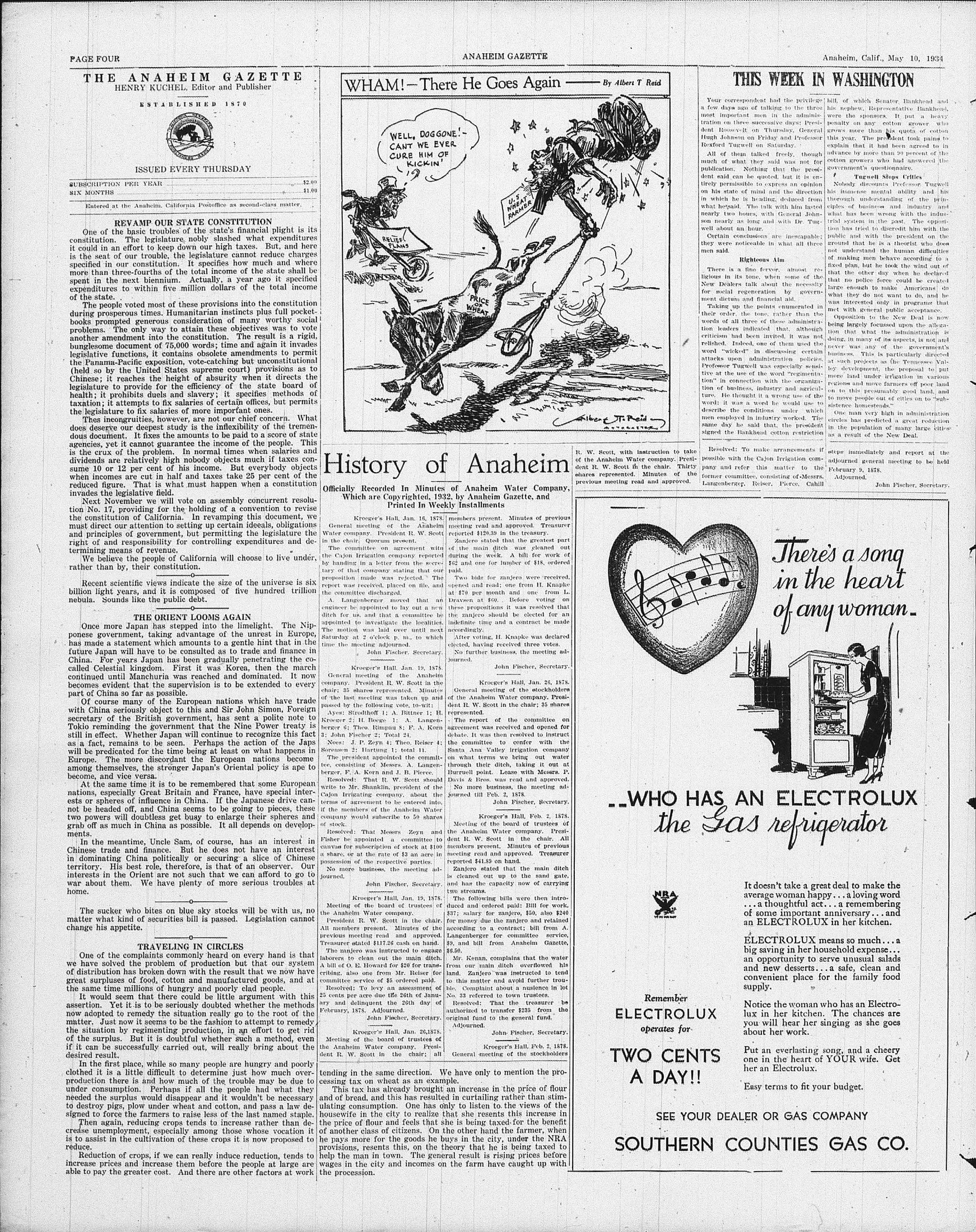
Searchable text
THE ANAHEIM GAZETTE
HENRY KUCHEL, Editor and Publisher
ESTABLISHED 1870
ISSUED EVERY THURSDAY
SUBSCRIPTION PER YEAR $2.00
SIX MONTHS $1.00
Entered at the Anaheim, California Postoffice as second-class matter.
REVAMP OUR STATE CONSTITUTION
One of the basic troubles of the state's financial plight is its constitution. The legislature nobly slashed what expenditures it could in an effort to keep down our high taxes. But, and here is the seat of our trouble, the legislature cannot reduce charges specified in our constitution. It specifies how much and where more than three-fourths of the total income of the state shall be spent in the next biennium. Actually, a year ago it specified expenditures to within five million dollars of the total income of the state.
The people voted most of these provisions into the constitution during prosperous times. Humanitarian instincts plus full pocket-books prompted generous consideration of many worthy social problems. The only way to attain these objectives was to vote another amendment into the constitution. The result is a rigid, bunglesome document of 75,000 words; time and again it invades legislative functions, it contains obsolete amendments to permit the Panama-Pacific exposition, vote-catching but unconstitutional (held so by the United States supreme court) provisions as to Chinese; it reaches the height of absurdity when it directs the legislature to provide for the efficiency of the state board of health; it prohibits duels and slavery; it specifies methods of taxation; it attempts to fix salaries of certain offices, but permits the legislature to fix salaries of more important ones.
Theses incongruities, however, are not our chief concern. What does deserve our deepest study is the inflexibility of the tremendous document. It fixes the amounts to be paid to a score of state agencies, yet it cannot guarantee the income of the people. This is the crux of the problem. In normal times when salaries and dividends are relatively high nobody objects much if taxes con-
the Panama-Pacific exposition, vote-catching but unconstitutional (held so by the United States supreme court) provisions as to Chinese; it reaches the height of absurdity when it directs the legislature to provide for the efficiency of the state board of health; it prohibits duels and slavery; it specifies methods of taxation; it attempts to fix salaries of certain offices, but permits the legislature to fix salaries of more important ones.
Thes incongruities, however, are not our chief concern. What does deserve our deepest study is the inflexibility of the tremendous document. It fixes the amounts to be paid to a score of state agencies, yet it cannot guarantee the income of the people. This is the crux of the problem. In normal times when salaries and dividends are relatively high nobody objects much if taxes consume 10 or 12 per cent of his income. But everybody objects when incomes are cut in half and taxes take 25 per cent of the reduced figure. That is what must happen when a constitution invades the legislative field.
Next November we will vote on assembly concurrent resolution No. 17, providing for the holding of a convention to revise the constitution of California. In revamping this document, we must direct our attention to setting up certain ideeals, obligations and principles of government, but permitting the legislature the right of and responsibility for controlling expenditures and determining means of revenue.
We believe the people of California will choose to live under, rather than by, their constitution.
Recent scientific views indicate the size of the universe is six billion light years, and it is composed of five hundred trillion nebula. Sounds like the public debt.
THE ORIENT LOOMS AGAIN
Once more Japan has stepped into the limelight. The Japanese government, taking advantage of the unrest in Europe, has made a statement which amounts to a gentle hint that in the future Japan will have to be consulted as to trade and finance in China. For years Japan has been gradually penetrating the co-called Celestial kingdom. First it was Korea, then the march continued until Manchuria was reached and dominated. It now becomes evident that the supervision is to be extended to every part of China so far as possible.
Of course many of the European nations which have trade with China seriously object to this and Sir John Simon, Foreign secretary of the British government, has sent a polite note to Tokio reminding the government that the Nine Power treaty is still in effect. Whether Japan will continue to recognize this fact as a fact, remains to be seen. Perhaps the action of the Japs will be predicated for the time being at least on what happens in Europe. The more discordant the European nations become among themselves, the stronger Japan’s Oriental policy is ape to become, and vice versa.
At the same time it is to be remembered that some European nations, especially Great Britain and France, have special interests or spheres of influence in China. If the Japanese drive cannot be headed off, and China seems to be going to pieces, these two powers will doubtless get busy to enlarge their spheres and grab off as much in China as possible. It all depends on developments.
In the meantime, Uncle Sam, of course, has an interest in Chinese trade and finance. But he does not have an interest in dominating China politically or securing a slice of Chinese territory. His best role, therefore, is that of an observer. Our
At the same time it is to be remembered that some European nations, especially Great Britain and France, have special interests or spheres of influence in China. If the Japanese drive cannot be headed off, and China seems to be going to pieces, these two powers will doubtless get busy to enlarge their spheres and grab off as much in China as possible. It all depends on developments.
In the meantime, Uncle Sam, of course, has an interest in Chinese trade and finance. But he does not have an interest in dominating China politically or securing a slice of Chinese territory. His best role, therefore, is that of an observer. Our interests in the Orient are not such that we can afford to go to war about them. We have plenty of more serious troubles at home.
The sucker who bites on blue sky stocks will be with us, no matter what kind of securities bill is passed. Legislation cannot change his appetite.
TRAVELING IN CIRCLES
One of the complaints commonly heard on every hand is that we have solved the problem of production but that our system of distribution has broken down with the result that we now have great surpluses of food, cotton and manufactured goods, and at the same time millions of hungry and poorly clad people.
It would seem that there could be little argument with this assertion. Yet it is to be seriously doubted whether the methods now adopted to remedy the situation really go to the root of the matter. Just now it seems to be the fashion to attempt to remedy the situation by regimenting production, in an effort to get rid of the surplus. But it is doubtful whether such a method, even if it can be successfully carried out, will really bring about the desired result.
In the first place, while so many people are hungry and poorly clothed it is a little difficult to determine just how much overproduction there is and how much of the trouble may be due to under consumption. Perhaps if all the people had what they needed the surplus would disappear and it wouldn't be necessary to destroy pigs, plow under wheat and cotton, and pass a law designed to force the farmers to raise less of the last named staple.
Then again, reducing crops tends to increase rather than decrease unemployment, especially among those whose vocation it is to assist in the cultivation of these crops it is now proposed to reduce.
Reduction of crops, if we can really induce reduction, tends to increase prices and increase them before the people at large are able to pay the greater cost. And there are other factors at work
ANAHEIM GAZETTE
WHAM!—There He Goes Again — By Albert T. Reid
WELL, DOGGONE!—CANT WE EVER CURE HIM OF KICKIN'
U.S. WHEAT FARMER
RELIEF PLANS
PRICE OF WHEAT
Albert J. T. Reid
History of Anaheim
Officially Recorded In Minutes of Anaheim Water Company, Which are Copyrighted, 1932, by Anaheim Gazette, and Printed In Weekly Installments
Kroeger's Hall, Jan. 16, 1878.
General meeting of the Anaheim Water company. President R. W. Scott in the chair. Quorum present.
The committee on agreement with the Cajon Irrigation company reported by handing in a letter from the secretary of that company stating that our proposition made was rejected. The report was received, placed on file, and the committee discharged.
A. Langenberger moved that an engineer be appointed to lay out a new ditch for us, and that a committee be appointed to investigate the localities. The motion was laid over until next Saturday at 2 o'clock p.m., to which time the meeting adjourned.
John Fischer, Secretary.
Kroeger's Hall, Jan. 19, 1878.
General meeting of the Anaheim company. President R. W. Scott in the chair; 35 shares represented. Minutes of the last meeting was taken up and passed by the following vote, to-wit:
Ayes: Strodthoff 1; A. Bittner 1; H. Kroeger 2; H. Boege 1; A. Langenberger 6; Theo. Rimpau 8; F. A. Korn 3; John Fischer 2; Total 24.
Noes: J. P. Zeyn 4; Theo. Reiser 4; Sorensen 2; Hartung 1; total 11.
The president appointed the committee, consisting of Messrs. A. Langenberger, F. A. Korn and J. B. Pierce.
Resolved: That R. W. Scott should write to Mr. Shanklin, president of the Cajon Irrigation company, about the terms of agreement to be entered into if the members of the Anaheim Water company would subscribe to 50 shares of stock.
Resolved: That Messrs. Zeyn and Fisher be appointed a committee to canvas for subscription of stock at $100 a share, or at the rate of $3 an acre in possession of the respective parties.
No more business, the meeting adjourned.
R. W. Scott, with instruction to take part of the Anaheim Water company. President R. W. Scott in the chair. This shares represented. Minutes of previous meeting read and approved.
Zanjero stated that the greatest part of the main ditch was cleaned out during the week. A bill for work of $62 and one for lumber of $18, ordered paid.
Two bids for zanjero were received, opened and read; one from H. Knapke at $70 per month and one from L. Dravsen at $60. Before voting on these propositions it was resolved that the zanjero should be elected for an indefinite time and a contract be made accordingly.
After voting, H. Knapke was declared elected, having received three votes.
No further business, the meeting adjourned.
John Fischer, Secretary.
Kroeger's Hall, Jan. 26, 1878.
General meeting of the stockholders of the Anaheim Water company. President R. W. Scott in the chair; 35 shares represented.
The report of the committee on agreement was received and opened for debate. It was then resolved to instruct the committee to confer with the Santa Ana Valley irrigation company on what terms we bring out water through their ditch, taking it out at Burruell point. Lease with Messrs. P. Davis & Bros. was read and approved.
No more business, the meeting adjourned till Feb. 2, 1878.
John Fischer, Secretary.
Kroeger's Hall, Feb. 2, 1878.
Meeting of the board of trustees of the Anaheim Water company. President R. W. Scott in the chair. All members present. Minutes of previous meeting read and approved. Treasurer reported $41.89 on hand.
Zanjero stated that the main ditch
Resolved: That R. W. Scott should write to Mr. Shanklin, president of the Cajon Irrigating company, about the terms of agreement to be entered into if the members of the Anaheim Water company would subscribe to 50 shares of stock.
Resolved: That Messrs Zeyn and Fisher be appointed a committee to canvas for subscription of stock at $100 a share, or at the rate of $3 an acre in possession of the respective parties.
No more business, the meeting adjourned.
John Fischer, Secretary.
Kroeger's Hall, Jan. 19, 1878.
Meeting of the board of trustees of the Anaheim Water company.
President R. W. Scott in the chair. All members present. Minutes of the previous meeting read and approved. Treasurer stated $117.26 cash on hand.
The zanjero was instructed to engage laborers to clean out the main ditch. A bill of O. E. Howard for $20 for transcribing, also one from Mr. Reiser for committee service of $5 ordered paid.
Resolved: To levy an assessment of 25 cents per acre due the 26th day of February, 1878. Adjourned.
John Fischer, Secretary.
Kroeger's Hall, Jan. 26, 1878.
Meeting of the board of trustees of the Anaheim Water company. President R. W. Scott in the chair; all attending in the same direction. We have only to mention the processing tax on wheat as an example.
This tax has already brought an increase in the price of flour and of bread, and this has resulted in curtailing rather than stimulating consumption. One has only to listen to the views of the housewife in the city to realize that she resents this increase in the price of flour and feels that she is being taxed for the benefit of another class of citizens. On the other hand the farmer, when he pays more for the goods he buys in the city, under the NRA provisions, resents this, on the theory that he is being taxed to help the man in town. The general result is rising prices before wages in the city and incomes on the farm have caught up with the procession.
THIS WEEK IN WASHINGTON
Your correspondent had the privilege a few days ago of talking to the three most important men in the administration on three successive days: President Roosevelt on Thursday, General Hugh Johnson on Friday and Professor Rexford Tugwell on Saturday.
All of them talked freely, though much of what they said was not for publication. Nothing that the president said can be quoted, but it is entirely permissible to express an opinion on his state of mind and the direction in which he is heading, deduced from what he said. The talk with him lasted nearly two hours, with General Johnson nearly as long and with Dr. Tugwell about an hour.
Certain conclusions are inescapable; they were noticeable in what all three men said.
Righteous Aim
There is a fine fervor, almost religious in its tone, when some of the New Dealers talk about the necessity for social regeneration by government dictum and financial aid.
Taking up the points enumerated in their order, the tone, rather than the words of all three of these administration leaders indicated that, although criticism had been invited, it was not relished. Indeed, one of them used the word "wicked" in discussing certain attacks upon administration policies. Professor Tugwell was especially sensitive at the use of the word "regimentation" in connection with the organization of business, industry and agriculture. He thought it a wrong use of the word: it was a word he would use to describe the conditions under which men employed in industry worked. The same day he said that, the president signed the Bankhead cotton restriction bill, of which Senator Bankhead and his nephew, Representative Bankhead, were the sponsors. It put a heavy penalty on any cotton grower who grows more than his quota of cotton this year. The president took pains to explain that it had been agreed to in advance by more than 90 percent of the cotton growers who had answered the government's questionnaire.
Tugwell Stops Critics
Nobody discounts Professor Tugwell his immense mental ability and his thorough understanding of the principles of business and industry and what has been wrong with the industrial system in the past. The opposition has tried to discredit him with the public and with the president on the ground that he is a theorist who does not understand the human difficulties of making men behave according to a fixed plan, but he took the wind out of that the other day when he declared that no police force could be created large enough to make Americans do what they do not want to do, and he was interested only in programs that met with general public acceptance.
Opposition to the New Deal is now being largely focussed upon the allegation that what the administration is doing, in many of its aspects, is not and never was any of the government's business. This is particularly directed at such projects as the Tennessee Valley development, the proposal to put more land under irrigation in various regions and move farmers off poor land on to this presumably good land, and to move people out of cities on to "subsistence homesteads."
One man very high in administration circles has predicted a great reduction in the population of many large cities as a result of the New Deal.
Professor Tugwell was especially sensitive at the use of the word "regimentation" in connection with the organization of business, industry and agriculture. He thought it a wrong use of the word: it was a word he would use to describe the conditions under which men employed in industry worked. The same day he said that, the president signed the Bankhead cotton restriction.
Resolved: To make arrangements if possible with the Cajon Irrigation company and refer this matter to the former committee, consisting of Messrs. Langenberger, Reiser, Pierce, Cahill
Steps immediately and report at the adjourned general meeting to be held February 9, 1878.
Adjourned.
John Fischer, Secretary.
There's a song in the heart of any woman.
WHO HAS AN ELECTROLUX
the Gas refrigerator
WHO HAS AN ELECTROLUX
the Gas refrigerator
It doesn't take a great deal to make the average woman happy...a loving word
...a thoughtful act...a remembering of some important anniversary...and
an ELECTROLUX in her kitchen.
ELECTROLUX means so much...a big saving in her household expense...
an opportunity to serve unusual salads and new desserts...a safe, clean and convenient place for the family food supply.
Remember
ELECTROLUX
operates for
TWO CENTS
A DAY!!
Notice the woman who has an Electrolux in her kitchen. The chances are you will hear her singing as she goes about her work.
Put an everlasting song, and a cheery one in the heart of YOUR wife. Get her an Electrolux.
Easy terms to fit your budget.
SEE YOUR DEALER OR GAS COMPANY
SOUTHERN COUNTIES GAS CO.