anaheim-gazette 1934-04-12
Scanned page
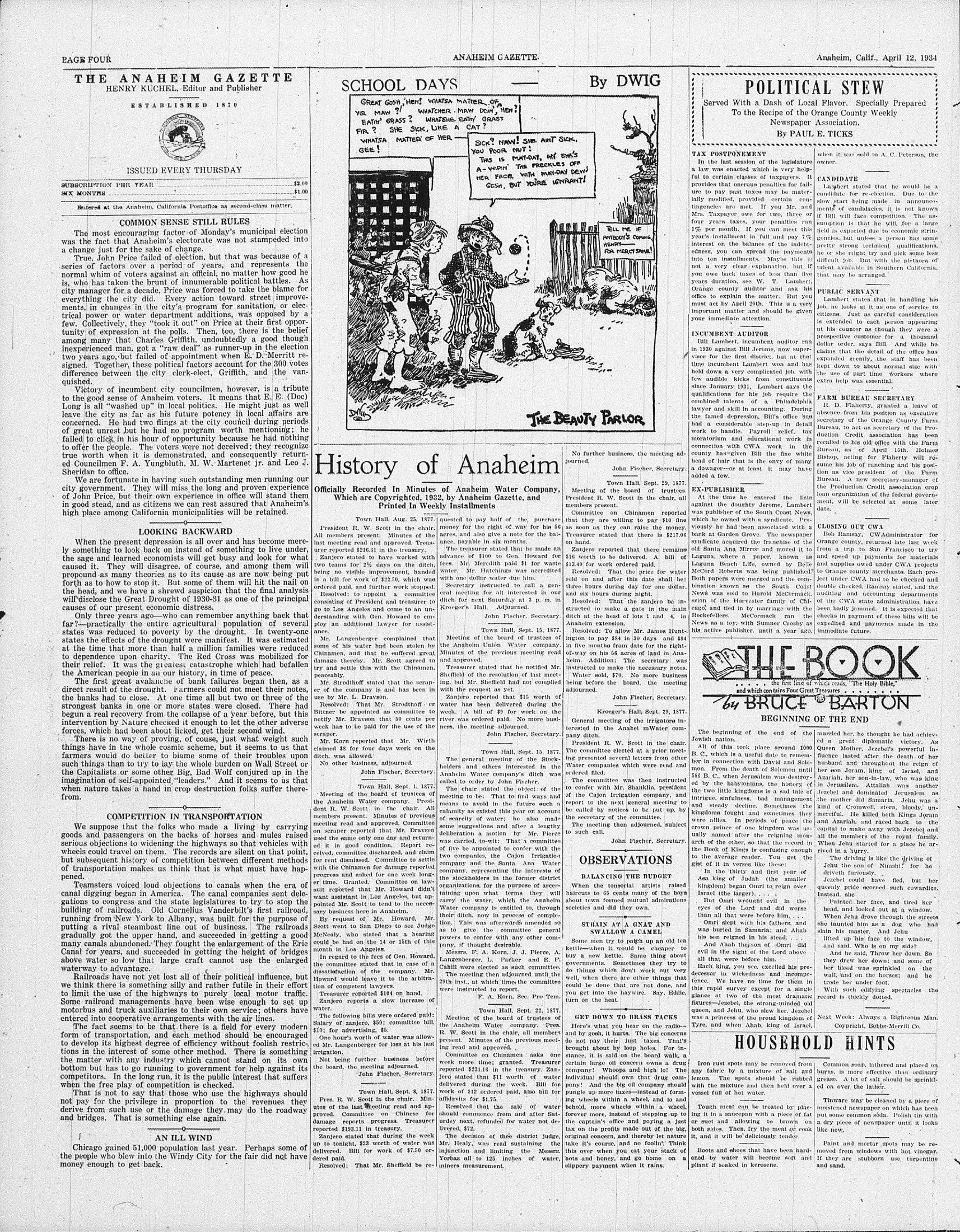
Searchable text
THE ANAHEIM GAZETTE
HENRY KUCHEL, Editor and Publisher
ESTABLISHED 1870
ISSUED EVERY THURSDAY
SUBSCRIPTION PER YEAR $2.00
SIX MONTHS $1.00
Entered at the Anaheim, California Postoffice as second-class matter.
COMMON SENSE STILL RULES
The most encouraging factor of Monday's municipal election was the fact that Anaheim's electorate was not stampeded into a change just for the sake of change.
True, John Price failed of election, but that was because of a series of factors over a period of years, and represents the normal whim of voters against an official, no matter how good he is, who has taken the brunt of innumerable political battles. As city manager for a decade, Price was forced to take the blame for everything the city did. Every action toward street improvements, in changes in the city's program for sanitation, or electrical power or water department additions, was opposed by a few. Collectively, they "took it out" on Price at their first opportunity of expression at the polls. Then, too, there is the belief among many that Charles Griffith, undoubtedly a good though inexperienced man, got a "raw deal" as runner-up in the election two years ago, but failed of appointment when E. D. Merritt resigned. Together, these political factors account for the 300 votes difference between the city clerk-elect, Griffith, and the vanquished.
Victory of incumbent city councilmen, however, is a tribute to the good sense of Anaheim voters. It means that E. E. (Doc) Long is all "washed up" in local politics. He might just as well leave the city as far as his future potency in local affairs are concerned. He had two flings at the city council during periods of great unrest but he had no program worth mentioning; he failed to click in his hour of opportunity because he had nothing to offer the people. The voters were not deceived; they recognize true worth when it is demonstrated, and consequently return-
Together, these political factors account for the 300 votes difference between the city clerk-elect, Griffith, and the vanquished.
Victory of incumbent city councilmen, however, is a tribute to the good sense of Anaheim voters. It means that E. E. (Doc) Long is all "washed up" in local politics. He might just as well leave the city as far as his future potency in local affairs are concerned. He had two flings at the city council during periods of great unrest but he had no program worth mentioning; he failed to click in his hour of opportunity because he had nothing to offer the people. The voters were not deceived; they recognize true worth when it is demonstrated, and consequently returned Councilmen F. A. Yungbluth, M. W. Martenet jr. and Leo J. Sheridan to office.
We are fortunate in having such outstanding men running our city government. They will miss the long and proven experience of John Price, but their own experience in office will stand them in good stead, and as citizens we can rest assured that Anaheim's high place among California municipalities will be retained.
LOOKING BACKWARD
When the present depression is all over and has become merely something to look back on instead of something to live under, the sage and learned economists will get busy and look for what caused it. They will disagree, of course, and among them will propound as many theories as to its cause as are now being put forth as to how to stop it. But some of them will hit the nail on the head, and we have a shrewd suspicion that the final analysis will disclose the Great Drought of 1930-31 as one of the principal causes of our present economic distress.
Only three years ago—who can remember anything back that far?—practically the entire agricultural population of several states was reduced to poverty by the drought. In twenty-one states the effects of the drought were manifest. It was estimated at the time that more than half a million families were reduced to dependence upon charity. The Red Cross was mobilized for their relief. It was the greatest catastrophe which had befallen the American people in all our history, in time of peace.
The first great avalanche of bank failures began then, as a direct result of the drought. Farmers could not meet their notes, the banks had to close. At one time all but two or three of the strongest banks in one or more states were closed. There had begun a real recovery from the collapse of a year before, but this intervention by Nature checked it enough to let the other adverse forces, which had been about licked, get their second wind.
There is no way of proving, of course, just what weight such things have in the whole cosmic scheme, but it seems to us that farmers would do better to biame some of their troubles upon such things than to try to lay the whole burden on Wall Street or the Capitalists or some other Big, Bad Wolf conjured up in the imagination of self-appointed “leaders.” And it seems to us that when nature takes a hand in crop destruction folks suffer therefrom.
COMPETITION IN TRANSPORTATION
We suppose that the folks who made a living by carrying goods and passengers on the backs of horses and mules raised serious objections to widening the highways so that vehicles with wheels could travel on them. The records are silent on that point, but subsequent history of competition between different methods of transportation makes us think that is what must have hap-
COMPETITION IN TRANSPORTATION
We suppose that the folks who made a living by carrying goods and passengers on the backs of horses and mules raised serious objections to widening the highways so that vehicles with wheels could travel on them. The records are silent on that point, but subsequent history of competition between different methods of transportation makes us think that is what must have happened.
Teamsters voiced loud objections to canals when the era of canal digging began in America. The canal companies sent delegations to congress and the state legislatures to try to stop the building of railroads. Old Cornelius Vanderbilt’s first railroad, running from New York to Albany, was built for the purpose of putting a rival steamboat line out of business. The railroads gradually got the upper hand, and succeeded in getting a good many canals abandoned. They fought the enlargement of the Erie Canal for years, and succeeded in getting the height of bridges above water so low that large craft cannot use the enlarged waterway to advantage.
Railroads have not yet lost all of their political influence, but we think there is something silly and rather futile in their effort to limit the use of the highways to purely local motor traffic. Some railroad managements have been wise enough to set up motorbus and truck auxiliaries to their own service; others have entered into cooperative arrangements with the air lines.
The fact seems to be that there is a field for every modern form of transportation, and each method should be encouraged to develop its highest degree of efficiency without foolish restrictions in the interest of some other method. There is something the matter with any industry which cannot stand on its own bottom but has to go running to government for help against its competitors. In the long run, it is the public interest that suffers when the free play of competition is checked.
That is not to say that those who use the highways should not pay for the privilege in proportion to the revenues they derive from such use or the damage they may do the roadway and bridges. That is something else again.
AN ILL WIND
Chicago gained 51,000 population last year. Perhaps some of the people who blew into the Windy City for the fair did not have money enough to get back.
SCHOOL DAYS — By DWIG
GREAT GOSH, HEN! WHATSA MATTER OF YIR MAW? WHATCHER. MAW DOH', HEN?
EATIN' GRASS? WHATSHE EATIN' GRASS FIR? SHE SICK, LIKE A CAT?
WHATSA MATTER OF HER GEE!
SICK? NAW! SHE AINT SICK,
YOU POOR NUT!
THIS IS MAY-DAY, ANY SHE'S A-WIPIN' THE PRECKLES OFF HER FACE WITH MAY-DAY DEW!
GOSH. BUT YOU'RE IGNRANT!
TELL ME IF ANYBOOY'S COMING,
HENRY—FOR MERCY SPHERE!
THE BEAUTY PARLOR
History of Anaheim
Officially Recorded In Minutes of Anaheim Water Company,
Which are Copyrighted, 1932, by Anaheim Gazette, and Printed In Weekly Installments
Town Hall, Aug. 25, 1877.
President R. W. Scott in the chair.
All members present. Minutes of the last meeting read and approved. Treasurer reported $216.61 in the treasury.
Zanjero stated to have worked with two teams for 2½ days on the ditch, being no visible improvement, handed in a bill for work of $22.50, which was ordered paid, and further work stopped.
Resolved: to appoint a committee consisting of President and treasurer to go to Los Angeles and come to an understanding with Gen. Howard to employ an additional lawyer for assistance.
Mr. Langenberger complained that some of his water had been stolen by Chinamen, and that he suffered great damage thereby. Mr. Scott agreed to try and settle this with the Chinamen, peaceably.
Mr. Strodthoff stated that the scraper of the company is and has been in use by Mr. L. Dravson.
Resolved: That Mr. Strodthoff or Bittner be appointed as committee to notify Mr. Dravson that 50 cents per week has to be paid for the use of the scraper.
Mr. Korn reported that Mr. Wirth claimed $8 for four days work on the ditch, was allowed.
No other business, adjourned.
John Fischer, Secretary.
Town Hall, Sept. 1, 1877.
Meeting of the board of trustees of the Anaheim Water company. President R. W. Scott in the chair.
All members present. Minutes of previous meeting read and approved. Committee on scraper reported that Mr. Dravsen used the same only one day and returned it in good condition. Report received, committee discharged, and claim for rent dismissed. Committee to settle with the Chinamen for damage reported
No further business, the meeting adjourned.
John Fischer, Secretary.
Town Hall, Sept. 15, 1877.
Meeting of the board of trustees of the Anaheim Union Water company. Minutes of the previous meeting read and approved.
Treasurer stated that he notified Mr. Sheffield of the resolution of last meeting, but Mr. Sheffield had not complied with the request as yet.
Zanjero reported that $15 worth of water has been delivered during the week. A bill of $9 for work on the river was ordered paid. No more business, the meeting adjourned.
John Fischer, Secretary.
Town Hall, Sept. 15, 1877.
The general meeting of the Stockholders and others interested in the Anaheim Water company's ditch was called to order by John Fischer.
The chair stated the object of the meeting to be: That to find ways and means to avoid in the future such a calamity as existed this year on account of scarcity of water; he also made some suggestions and after a lengthy deliberation a motion by Mr. Pierce was carried, to-wit: That a committee of five be appointed to confer with the two companies, the Cajon Irrigation company and the Santa Ana Water company representing the interest of
OBSERVATIONS
Town Hall, Sept. 1, 1877.
Meeting of the board of trustees of the Anaheim Water company. President R. W. Scott in the chair. All members present. Minutes of previous meeting read and approved. Committee on scraper reported that Mr. Dravsen used the same only one day and returned it in good condition. Report received, committee discharged, and claim for rent dismissed. Committee to settle with the Chinamen for damage reported progress and asked for one week longer time. Granted. Committee on lawsuit reported that Mr. Howard didn't want assistant in Los Angeles, but appointed Mr. Scott to tend to the necessary business here in Anaheim.
By request of Mr. Howard, Mr. Scott went to San Diego to see Judge McNealy, who stated that a hearing could be had on the 14 or 15th of this month in Los Angeles.
In regard to the fees of Gen. Howard, the committee stated that in case of a dissatisfaction of the company, Mr. Howard would leave it to the arbitration of competent lawyers.
Treasurer reported $104 on hand.
Zanjero reports a slow increase of water.
The following bills were ordered paid: Salary of zanjero, $50; committee bill, $10; for advertising, $5.
One hour's worth of water was allowed Mr. Langenberger for loss at his last irrigation.
Not being further business before the board, the meeting adjourned.
John Fischer, Secretary.
Town Hall, Sept. 8, 1877.
Pres. R. W. Scott in the chair. Minutes of the last meeting read and approved. Committee on Chinese for damage reports progress. Treasurer reported $193.11 in treasury.
Zanjero stated that during the week up to tonight, $23 worth of water was delivered. Bill for work of $7.50 ordered paid.
Resolved: That Mr. Sheffield be re-
The chair stated the object of the meeting to be: That to find ways and means to avoid in the future such a calamity as existed this year on account of scarcity of water; he also made some suggestions and after a lengthy deliberation a motion by Mr. Pierce was carried, to-wit: That a committee of five be appointed to confer with the two companies, the Cajon Irrigation company and the Santa Ana Water company, representing the interests of the stockholders in the former district organizations, for the purpose of ascertaining upon what terms they will carry the water, which the Anaheim Water company is entitled to, through their ditch, now in process of completion. This was afterwards amended so as to give the committee general powers to confer with any other company, if thought desirable.
Messrs. F. A. Korn, J. J. Pierce, A. Langenberger, L. Parker and E. F. Cahill were elected as such committee.
The meeting then adjourned until the 29th inst., at which time the committee were instructed to report.
F. A. Korn, Sec. Pro Tem.
Town Hall, Sept. 22, 1877.
Meeting of the board of trustees of the Anaheim Water company. Pres. R. W. Scott in the chair, all members present. Minutes of the previous meeting read and approved.
Committee on Chinamen asks one week more time; granted. Treasurer reported $231.16 in the treasury. Zanjero stated that $11 worth of water delivered during the week. Bill for work of $12 ordered paid, also bill for afilavits for $1.75.
Resolved that the sale of water should commence from and after Saturday next, refunded for water not delivered, $72.
The decision of the tree district judge, Mr. Healy, was read sustaining the injunction and limiting the Messrs. Yorbas all to 125 inches of water, miners measurement.
The committee was then instructed to confer with Mr. Shanklin, president of the Cajon Irrigation company, and report to the next general meeting be called by noticees to be put up, by the secretary of the committee.
The meeting then adjourned, subject to such call.
John Fischer, Secretary.
OBSERVATIONS
BALANCING THE BUDGET
When the tonsorial artists raise haircuts to 65 cents many of the best about town formed mutual admiration societies and did they own.
STRAIN AT A GNAT AND SWALLOW A CAMEL
Some men try to patch up an old kettle—when it would be cheaper to buy a new kettle. Same thing about governments. Sometimes they try do things which don't work out well, when there are other things that could be done that are not done, and you get into the haywire. Say, Edc turn on the heat.
GET DOWN TO BRASS TACKS
Here's what you hear on the radio and by gooh, it hurts. The big concern does not pay their just taxes. That brought about by loop holes. For instance, it is said on the board walks certain large oil concerns owns a drug company! Whoops and high lo! The individual should own that drug company! And the big oil company shows pungle up more taxes—instead of forming wheels within a wheel, and lo at behold, more wheels within a whale forever more, instead of stepping up the captain's office and paying a jut tax on the profits made out of the original concern, and thereby let nature take it's course, and no foolin'! This this over when you eat your stack hots and honey, and go home on slippery payment when it rains.
POLITICAL STEW
Served With a Dash of Local Flavor. Specially Prepared
To the Recipe of the Orange County Weekly
Newspaper Association.
By PAUL E. TICKS
TAX POSTPONEMENT
In the last session of the legislature a law was enacted which is very helpful to certain classes of taxpayers. It provides that onerous penalties for failure to pay past taxes may be materially modified, provided certain contingencies are met. If you Mr. and Mrs. Taxpayer owe for two, three or four years taxes, your penalties ran 1% per month. If you can meet this year's installment in full and pay 7% interest on the balance of the indebtedness, you can spread the payments into ten installments. Maybe this is not a very clear explanation, but if you owe back taxes of less than five years duration, see W. T. Lambert, Orange county auditor and ask his office to explain the matter. But you must act by April 20th. This is a very important matter and should be given your immediate attention.
INCUMBENT AUDITOR
Bill Lambert, incumbent auditor ran in 1930 against Bill Jerome, now supervisor for the first district, but at that time incumbent Lambert won and has held down a very complicated job, with few audible kicks from constituents since January 1931. Lambert says the qualifications for his job require the combined talents of a Philadelphia lawyer and skill in accounting. During the famed depression, Bill's office had a considerable step-up in detail work to handle. Payroll relief, tax moratorium and educational work in connection with CWA work in the county has given Bill the fine white when it was sold to A. C. Peterson, the owner.
CANDIDATE
Lambert stated that he would be a candidate for re-election. Due to the slow start being made in announcements of candidacies, it is not known if Bill will face competition. The assumption is that he will, for a large field is expected due to economic stringencies, but unless a person has some pretty strong technical qualifications, he or she might try and pick some less difficult job. But with the plethora of talent available in Southern California, that may be arranged.
PUBLIC SERVANT
Lambert states that in handling his job, he looks at it as one of service to citizens. Just as careful consideration is extended to each person appearing at his counter as though they were a prospective customer for a thousand dollar order, says Bill. And while he claims that the detail of the office has expanded greatly, the staff has been kept down to about normal size with the use of part-time workers where extra help was essential.
FARM BUREAU SECRETARY
R. D. Flaherty, granted a leave of absence from his position as executive secretary of the Orange County Farm Bureau, to act as secretary of the Production Credit association has been recalled to his old office with the Farm Bureau, as of April 15th. Holmes Bishop, acting for Flaherty will re-
John Fischer, Secretary.
Town Hall, Sept. 29, 1877.
W. Scott in the chair, all present.
On Chinamen reported were willing to pay $10 fine they can raise the money stated that there is $217.06 reported that there remains to be delivered. A bill of work ordered paid.
That the price for water after this date shall be; during day for one dollar, days during night.
That the zanjero be in make a gate in the main head of lots 1 and 4, in extension.
To allow Mr. James Huntley $84 in 30 days and $84 from date for the right-ais 56 acres of land in Anation: The secretary was to make the necessary notes. Old, $70. No more business on the board, the meeting John Fischer, Secretary.
Proteger's Hall, Sept. 29, 1877.
Meeting of the irrigators in the Anahel mWater com-R. W. Scott in the chairtee elected at a prior meeting several letters from other companies which were read and submitted was then instructed with Mr. Shanklin, president on Irrigation company, and the next general meeting to notifyes to be put up, by way of the committee.
Then adjourned, subject to John Fischer, Secretary.
ERVATIONS
The beginning of the end of the Jewish nation.
All of this took place around 1000 B.C., which is a useful date to remember in connection with David and Solomon. From the death of Solomon until 586 B.C., when Jerusalem was destroyed by the babylonians, the history of the two little kingdoms is a sad tale of intrigue, sinfulness, bad management and steady decline. Sometimes the kingdome fought and sometimes they were allies. In periods of peace the crown prince of one kingdom was usually named after the reigning monarch of the other, so that the record in the Book of Kings is confusing enough to the average reader. You get the gist of it in verses like these:
time incumbent Lambert won and has held down a very complicated job, with few audible kicks from constituents since January 1931. Lambert says the qualifications for his job require the combined talents of a Philadelphia lawyer and skill in accounting. During the famed depression, Bill's office has had a considerable step-up in detail work to handle. Payroll relief, tax moratorium and educational work in connection with CWA work in the county has given Bill the fine white head of hair that is the envy of many a dowager—or at least it may have added a few.
EX-PUBLISHER
At the time he entered the lists against the doughty Jerome, Lambert was publisher of the South Coast News, which he owned with a syndicate. Previously he had been associated with a bank at Garden Grove. The newspaper syndicate acquired the franchise of the old Santa Ana Mirror and moved it to Laguna, where a paper, known as Laguna Beach Life, owned by Belle McCord Roberts was being published. Both papers were merged and the combination known as the South Coast News was sold to Harold McCormack, seion of the Harvester family of Chicago, and tied in by marriage with the Rockefellers. McCormack ran the News as a toy, with Sumner Crosby as his active publisher, until a year ago,
CLOSING OUT CWA
Bob Ramsay, CWAdministrator for Orange county, returned late last week from a trip to San Francisco to try and speed up payments for materials and supplies owed under CWA projects to Orange county merchants. Each project under CWA had to be checked and double checked, Ramsay stated, and the auditing and accounting departments of the CWA state administration have been badly jammed. It is expected that checks in payment of these bills will be expedited and payments made in the immediate future.
THE BOOK
the first line of which reads, "The Holy Bible,
and which con tains Four Great Treasures
BEGINNING OF THE END
married her, he thought he had achieved a great diplomatic victory. As Queen Mother, Jezebel's powerful influence lasted after the death of her husband and throughout the reign of her son Joram, king of Israel, and Azariah, her son-in-law, who was king in Jerusalem, Attaliah was another Jezebel and dominated Jerusalem as the mother did Samarla. Jehua was a kind of Cromwell, stern, bloody, unmerciful. He killed both Kings Joram and Azariah, and raced back to the capital to make away with Jezebel and all the members of the royal family. When Jehu started for a place he arrived in a hurry.
The driving is like the driving of Jehu the son of Nimshif; for he
RESERVATIONS
NANCING THE BUDGET
The tonsorial artists raised 65 cents many of the boys formed mutual admirations and did they own.
KNAT AT A GNAT AND ALLOW A CAMEL
A try to patch up an old tea can it would be cheaper to kettle. Same thing about us. Sometimes they try to which don't work out very there are other things that one that are not done, and so do the haywire. Say, Eddle, heat.
DOWN TO BRASS TACKS
What you hear on the radio—it hurts. The big concerns their just taxes. That's about by loop holes. For in-said on the board walk, a oil concern owns a drug Whoops and high lo! The should own that drug com- the big oil company should more taxes—instead of form within a wheel, and lo and re wheels within a wheel, instead of stepping-up to its office and paying a just profits made out of the big, pecern, and thereby let nature curse, and no foolin'! Think when you eat your stack of money, and go home on a moment when it rains.
586 B. C., when Jerusalem was destroyed by the babylonians, the history of the two little kingdoms is a sad tale of intrigue, sinfulness, bad management and steady decline. Sometimes the kingdom fought and sometimes they were allies. In periods of peace the crown prince of one kingdom was usually named after the reigning monarch of the other, so that the record in the Book of Kings is confusing enough to the average reader. You get the gist of it in verses like these:
In the thirty and first year of Asa king of Judah (the smaller kingdom) began Omri to reign over Israel (the larger). . .
But Omri wrought evil in the eyes of the Lord and did worse than all that were before him.
Omri slept with his fathers, and was buried in Samaria; and Ahab his son reigned in his stead. . .
And Ahab the son of Omri did evil in the sight of the Lord above all that were before him.
Each king, you see, excelled his predecessor in wickedness and incompetence. We have no time for them in this rapid survey except for a single glance at two of the most dramatic figures—Jezebel, the strong-minded queen, and Jehu, who slew her. Jezebel was a princess of the proud kingdom of Tyre, and when Ahab, king of Israel,
Next Week: Always a Righteous Man.
Copright, Bobbs-Merrill Co.
HOUSEHOLD HINTS
Iron rust spots may be removed from any fabric by a mixture of salt and lemon. The spots should be rubbed with the mixture and then held over a vessel full of hot water.
Tough meat can be treated by placing it in a saucepan with a piece of fat or suet and allowing to brown on both sides. Then, fry the meat or cook it, and it will be deliciously tender.
Boots and shoes that have been hardened by water will become soft and pliant if soaked in kerosene.
Common soap, lathered and placed on burns, is more effective than ordinary grease. A bit of salt should be sprinkled on over the lather.
Tinware may be cleaned by a piece of moistened newspaper on which has been put some common soda. Polish tin with a dry piece of newspaper until it looks like new.
Paint and mortar spots may be removed from windows with hot vinegar. If they are stubborn use turpentine and sand.