anaheim-gazette 1934-03-22
Scanned page
Searchable text
THE ANAHEIM GAZETTE
HENRY KUCHEL, Editor and Publisher
ESTABLISHED 1870
ISSUED EVERY THURSDAY
SUBSCRIPTION PER YEAR $2.00
SIX MONTHS $1.00
Entered at the Annheim, California Postoffice as second-class matter.
FULL SPEED AHEAD — IN REVERSE
If you want to get a true picture of upside down conditions which brought unprecedented social and economic revolution in the last few years, take a look at the democratic party. Till after the last election it made a great holler against concentration of power in the federal government. Since Roosevelt's ascendency to the White House, however, the democrats proceed not only to concentrate power at Washington, but actually to start down the long path leading to a national, in distinction to a federal, government.
These precipitate changes make the thoughtful ponder over where we are going. They lead us to believe that even the leaders of our government themselves do not know where the path goes. Naturally, the tendency toward change alarms persons who had confidence in the old balanced form of federal government, in state rights and individual freedom. Seeing air-mail contracts cancelled without a semblance of a trial and then refusing to permit injured parties to sue the government for damages adds uncertainty to uncertain times.
This condition gives a picture of change. In fact, the credo of the present democratic leaders seems to be to change the old order if for no good reason than just to change it.
We grant that drastic alterations in our economic and social systems are necessary, but we insist that the public good is best served when individual justice is maintained. After all, the government is made up of us as individuals. When our individual rights are threatened, we as individuals feel uncertain. This uncertainty reflects itself in mass psychology and mass uncertainty—the basic problem of today.
This condition gives a picture of change. In fact, the credo of the present democratic leaders seems to be to change the old order if for no good reason than just to change it.
We grant that drastic alterations in our economic and social systems are necessary, but we insist that the public good is best served when individual justice is maintained. After all, the government is made up of us as individuals. When our individual rights are threatened, we as individuals feel uncertain. This uncertainty reflects itself in mass psychology and mass uncertainty—the basic problem of today.
WHY NOT CHANGE IT, TOO?
Just think how many more bureaus and commissions we could have in Washington if the English alphabet contained about a dozen more letters.
WHO WILL WE GO TO WAR WITH NEXT?
We have been reading with a good deal of disturbance of mind about the warlike gestures between nations which are being made in many parts of the world. We deplore war, as every responsible human being must, yet we feel impelled to admit that humanity has not yet reached such a stage that it can run its affairs without going to war.
Something is wrong with our so-called civilization, when nations must still resort to bloodshed to settle economic differences. For all our reading of history leads us to believe that wars, except on religious grounds, have always had an economic basis. Some nation thinks it is being cornered by other nations, or is not getting its fair share of trade, or it wants to trade where the other nation thinks its rights are paramount, or to possess some territory belonging to another nation. So the politicians stir up the people and make them believe their homes and families are in danger and the "national honor" has been smirched, until everybody is ready to go to war and kill the people of the other nation.
We shouldn't be so much concerned if the skirts of our own nation were entirely clear in this matter of war. We figured out the other day that no person ever reached the age of 40 in the United States without going through at least one war, and nobody ever lived to be sixty without going through two wars. That brings it right home to us, or so it would seem. It was only 36 years after the Revolution that we were again at war with Great Britain; 34 years after that we were marching on Mexico. Fifteen years later North and South were in battle array against each other. It was 37 years after that before we went to war with Spain, but only 19 years later when we were at war with Germany. It is now 16 years since our country has been at war. We would hesitate to predict that anyone now 16 will live to be forty without seeing us in another war.
We recommend these thoughts to anybody who thinks it doesn't make any difference how we deal with “foreigners.” International goodwill is surely as important as domestic prosperity.
AN ADMINISTRATION ALPHABET
We went to the trouble the other day to check up on the alphabetical bureaus in Washington under the New Deal. We thought we might like to use a few of the letters ourselves, but there doesn't seem to be much left except Q, X, Y and Z. But folks are getting so used to seeing a lot of initials in print, without parties to sue the government for damages adds uncertainty to uncertain times.
This condition gives a picture of change. In fact, the credo of the present democratic leaders seems to be to change the old order if for no good reason than just to change it.
We grant that drastic alterations in our economic and social systems are necessary, but we insist that the public good is best served when individual justice is maintained. After all, the government is made up of us as individuals. When our individual rights are threatened, we as individuals feel uncertain. This uncertainty reflects itself in mass psychology and mass uncertainty—the basic problem of today.
WHY NOT CHANGE IT, TOO?
Just think how many more bureaus and commissions we could have in Washington if the English alphabet contained about a dozen more letters.
WHO WILL WE GO TO WAR WITH NEXT?
We have been reading with a good deal of disturbance of mind about the warlike gestures between nations which are being made in many parts of the world. We deplore war, as every responsible human being must, yet we feel impelled to admit that humanity has not yet reached such a stage that it can run its affairs without going to war.
Something is wrong with our so-called civilization, when nations must still resort to bloodshed to settle economic differences. For all our reading of history leads us to believe that wars, except on religious grounds, have always had an economic basis. Some nation thinks it is being cornered by other nations, or is not getting its fair share of trade, or it wants to trade where the other nation thinks its rights are paramount, or to possess some territory belonging to another nation. So the politicians stir up the people and make them believe their homes and families are in danger and the “national honor” has been smirched, until everybody is ready to go to war and kill the people of the other nation.
We shouldn’t be so much concerned if the skirts of our own nation were entirely clear in this matter of war. We figured out the other day that no person ever reached the age of 40 in the United States without going through at least one war, and nobody ever lived to be sixty without going through two wars. That brings it right home to us, or so it would seem. It was only 36 years after the Revolution that we were again at war with Great Britain; 34 years after that we were marching on Mexico. Fifteen years later North and South were in battle array against each other. It was 37 years after that before we went to war with Spain, but only 19 years later when we were at war with Germany. It is now 16 years since our country has been at war. We would hesitate to predict that anyone now 16 will live to be forty without seeing us in another war.
We recommend these thoughts to anybody who thinks it doesn’t make any difference how we deal with “foreigners.” International goodwill is surely as important as domestic prosperity.
AN ADMINISTRATION ALPHABET
We went to the trouble the other day to check up on the alphabetical bureaus in Washington under the New Deal. We thought we might like to use a few of the letters ourselves, but there doesn’t seem to be much left except Q, X, Y and Z. But folks are getting so used to seeing a lot of initials in print, without parties to sue the government for damages adds uncertainty to uncertain times.
This condition gives a picture of change. In fact, the credo of the present democratic leaders seems to be to change the old order if for no good reason than just to change it.
We grant that drastic alterations in our economic and social systems are necessary, but we insist that the public good is best served when individual justice is maintained. After all, the government is made up of us as individuals. When our individual rights are threatened, we as individuals feel uncertain. This uncertainty reflects itself in mass psychology and mass uncertainty—the basic problem of today.
WHY NOT CHANGE IT, TOO?
Just think how many more bureaus and commissions we could have in Washington if the English alphabet contained about a dozen more letters.
WHO WILL WE GO TO WAR WITH NEXT?
We have been reading with a good deal of disturbance of mind about the warlike gestures between nations which are being made in many parts of the world. We deplore war, as every responsible human being must, yet we feel impelled to admit that humanity has not yet reached such a stage that it can run its affairs without going to war.
Something is wrong with our so-called civilization, when nations must still resort to bloodshed to settle economic differences. For all our reading of history leads us to believe that wars, except on religious grounds, have always had an economic basis. Some nation thinks it is being cornered by other nations, or is not getting its fair share of trade, or it wants to trade where the other nation thinks its rights are paramount, or to possess some territory belonging to another nation. So the politicians stir up the people and make them believe their homes and families are in danger and the “national honor” has been smirched, until everybody is ready to go to war and kill the people of the other nation.
We shouldn’t be so much concerned if the skirts of our own nation were entirely clear in this matter of war. We figured out the other day that no person ever reached the age of 40 in the United States without going through at least one war, and nobody ever lived to be sixty without going through two wars. That brings it right home to us, or so it would seem. It was only 36 years after the Revolution that we were again at war with Great Britain; 34 years after that we were marching on Mexico. Fifteen years later North and South were in battle array against each other. It was 37 years after that before we went to war with Spain, but only 19 years later when we were at war with Germany. It is now 16 years since our country has been at war. We would hesitate to predict that anyone now 16 will live to be forty without seeing us in another war.
We recommend these thoughts to anybody who thinks it doesn’t make any difference how we deal with “foreigners.” International goodwill is surely as important as domestic prosperity.
AN ADMINISTRATION ALPHABET
We went to the trouble the other day to check up on the alphabetical bureaus in Washington under the New Deal. We thought we might like to use a few of the letters ourselves, but there doesn’t seem to be much left except Q, X, Y and Z. But folks are getting so used to seeing a lot of initials in print, without parties to sue the government for damages adds uncertainty to uncertain times.
This condition gives a picture of change. In fact, the credo of the present democratic leaders seems to be to change the old order if for no good reason than just to change it.
We grant that drastic alterations in our economic and social systems are necessary, but we insist that the public good is best served when individual justice is maintained. After all, the government is made up of us as individuals. When our individual rights are threatened, we as individuals feel uncertain. This uncertainty reflects itself in mass psychology and mass uncertainty—the basic problem of today.
WHY NOT CHANGE IT, TOO?
Just think how many more bureaus and commissions we could have in Washington if the English alphabet contained about a dozen more letters.
WHO WILL WE GO TO WAR WITH NEXT?
We have been reading with a good deal of disturbance of mind about the warlike gestures between nations which are being made in many parts of the world. We deplore war, as every responsible human being must, yet we feel impelled to admit that humanity has not yet reached such a stage that it can run its affairs without going to war.
Something is wrong with our so-called civilization, when nations must still resort to bloodshed to settle economic differences. For all our reading of history leads us to believe that wars, except on religious grounds, have always had an economic basis. Some nation thinks it is being cornered by other nations, or is not getting its fair share of trade, or it wants to trade where the other nation thinks its rights are paramount, or to possess some territory belonging to another nation. So the politicians stir up the people and make them believe their homes and families are in danger and the “national honor” has been smirched, until everybody is ready to go to war and kill the people of the other nation.
We shouldn’t be so much concerned if the skirts of our own nation were entirely clear in this matter of war. We figured out the other day that no person ever reached the age of 40 in the United States without going through at least one war, and nobody ever lived to be sixty without going through two wars. That brings it right home to us, or so it would seem. It was only 36 years after the Revolution that we were again at war with Great Britain; 34 years after that we were marching on Mexico. Fifteen years later North and South were in battle array against each other. It was 37 years after that before we went to war with Spain, but only 19 years later when we were at war with Germany. It is now 16 years since our country has been at war. We would hesitate to predict that anyone now 16 will live to be forty without seeing us in another war.
We recommend these thoughts to anybody who thinks it doesn’t make any difference how we deal with “foreigners.” International goodwill is surely as important as domestic prosperity.
AN ADMINISTRATION ALPHABET
We went to the trouble the other day to check up on the alphabetical bureaus in Washington under the New Deal. We thought we might like to use a few of the letters ourselves, but there doesn’t seem to be much left except Q, X, Y and Z. But folks are getting so used to seeing a lot of initials in print, without parties to sue the government for damages adds uncertainty to uncertain times.
This condition gives a picture of change. In fact, the credo of the present democratic leaders seems to be to change the old order if for no good reason than just to change it.
We grant that drastic alterations in our economic and social systems are necessary, but we insist that the public good is best served when individual justice is maintained. After all, the government is made up of us as individuals. When our individual rights are threatened, we as individuals feel uncertain. This uncertainty reflects itself in mass psychology and mass uncertainty—the basic problem of today.
WHY NOT CHANGE IT, TOO?
Just think how many more bureaus and commissions we could have in Washington if the English alphabet contained about a dozen more letters.
WHO WILL WE GO TO WAR WITH NEXT?
We have been reading with a good deal of disturbance of mind about the warlike gestures between nations which are being made in many parts of the world. We deplore war, as every responsible human being must, yet we feel impelled to admit that humanity has not yet reached such a stage that it can run its affairs without going to war.
Something is wrong with our so-called civilization, when nations must still resort to bloodshed to settle economic differences. For all our reading of history leads us to believe that wars, except on religious grounds, have always had an economic basis. Some nation thinks it is being cornered by other nations, or is not getting its fair share of trade, or it wants to trade where the other nation thinks its rights are paramount, or to possess some territory belonging to another nation. So the politicians stir up the people and make them believe their homes and families are in danger and the “national honor” has been smirched, until everybody is ready to go到 war and kill the people of the other nation.
We shouldn’t be so much concerned if the skirts of our own nation were entirely clear in this matter of war. We figured out the other day that no person ever reached the age of 40 in the United States without going through at least one war, and nobody ever lived to be sixty without going through two wars. That brings it right home to us, or so it would seem. It was only 36 years after the Revolution that we were again at war with Great Britain; 34 years after that we were marching on Mexico. Fifteen years later North and South were in battle array against each other. It was 37 years after that before we went to war with Spain, but only 19 years later when we were at war with Germany. It is now 16 years since our country has been at war. We would hesitate to predict that anyone now 16 will live to be forty without seeing us in another war.
We recommend these thoughts to anybody who thinks it doesn’t make any difference how we deal with “foreigners.” International goodwill is surely as important as domestic prosperity.
AN ADMINISTRATION ALPHABET
We went to the trouble the other day to check up on the alphabetical bureaus in Washington under the New Deal. We thought we might like to use a few of the letters ourselves, but there doesn’t seem to be much left except Q, X, Y and Z. But folks are getting so used to seeing a lot of initials in print, without parties to sue the government for damages adds uncertainty to uncertain times.
This condition gives a picture of change. In fact, the credo of the present democratic leaders seems to be to change the old order if for no good reason than just to change it.
We grant that drastic alterations in our economic and social systems are necessary, but we insist that the public good is best served when individual justice is maintained. After all, the government is made up of us as individuals. When our individual rights are threatened, we as individuals feel uncertain. This uncertainty reflects itself in mass psychology and mass uncertainty—the basic problem of today.
WHY NOT CHANGE IT, TOO?
Just think how many more bureaus and commissions we could have in Washington if the English alphabet contained about a dozen more letters.
WHO WILL WE GO TO WAR WITH NEXT?
We have been reading with a good deal of disturbance of mind about the warlike gestures between nations which are being made in many parts of the world. We deplore war, as every responsible human being must,yet we feel impelled to admit that humanity has not yet reached such a stage that it can run its affairs without going to war.
Something is wrong with our so-called civilization, when nations must still resort to bloodshed to settle economic differences. For all our reading of history leads us to believe that wars,except on religious grounds,have always had an economic basis. Some nation thinks it is being cornered by other nations,or is not getting its fair share of trade,or it wants to trade where the other nation thinks its rights are paramount,orto possess some territory belongingto another nation.Sothepoliticiansstirupthepeopleandmakethembelievetheiomeswouldaveithavemotionswithoutgoingtowarwithspainbutonly19yearslaterwhenweweratwarwithgermany.itisnow16yearslaterwhenweweratwarwithgermany.itisnow16yearslaterwhenweweratwarwithgermany.itisnow16yearslaterwhenweweratwarwithgermany.itisnow16yearslaterwhenweweratwarwithgermany.itisnow16yearslaterwhenweweratwarwithgermany.itisnow16yearslaterwhenweweratwarwithgermany.itisnow16yearslaterwhenweweratwarwithgermany.itisnow16yearslaterwhenweweratwarwithgermany.itisnow16yearslaterwhenweweratwarwithgermany.itisnow16yearslaterwhenweweratwarwithgermany.itisnow16yearslaterwhenweweratwarwithgermany.itisnow16yearslaterwhenweweratwarwithgermany.itisnow16yearslaterwhenweweratwarwithgermany.itisnow16yearslaterwhenweweratwarwithgermany.itisnow16yearslaterwhenweweratwarwithgermany.itisnow16yearslaterwhenweweratwarwithgermany.itisnow16yearslaterwhenweweratwarwithgermany.itisnow16yearslaterwhenweweratwarwithgermany.itisnow16yearslaterwhenweweratwarwithgermany.itisnow16yearslaterwhenweweratwarwithgermany.itisnow16yearslaterwhenweweratwarwithgermany.itisnow16yearslaterwhenweweratwarwithgermany.itisnow16yearslaterwhenweweratwarwithgermany.itisnow16yearslaterwhenweweratwarwithgermany.itisnow16yearslaterwhenweweratwarwithgermany.itisnow16yearslaterwhenweweratwarwithgermany.itisnow16yearslaterwhenweweratwarwithgermany.itisnow16yearslaterwhenweweratwarwithgermany.itisnow16yearslaterwhenweweratwarwithgermany.itisnow16yearslaterwhenweweratwarwithgermany.itisnow16yearslaterwhenweweratwarwithgermany.itisnow16yearslaterwhenweweratwarwithgermany.itisnow16yearslaterwhenweweratwarwithgermany.itisnow16yearslaterwhenweweratwarwithgermany.itisnow16yearslaterwhenweweratwarwithgermany.itisnow16yearslaterwhenweweratwarwithgermany.itisnow16yearslaterwhenweweratwarwithgermany.itisnow16yearslaterwhenweweratwarwithgermany.itisnow16yearslaterwhenweweratwarwithgermany.itisnow16yearslaterwhenweweratwarwithgermany.itisnow16yearslaterwhenweweratwardurantionsofotherdiesinternationaleconomicsinternationaleconomicsinternationaleconomicsinternationaleconomicsinternationaleconomicsinternationaleconomicsinternationaleconomicsinternationaleconomicsinternationaleconomicsinternationaleconomicsinternationaleconomicsinternationaleconomicsinternationaleconomicsinternationaleconomicsinternationaleconomicsinternationaleconomicsinternationaleconomicsinternationaleconomicsinternationaleconomicsinternationaleconomicsinternationaleconomicsinternationaleconomicsinternationaleconomicsinternationaleconomicsinternationaleconomicsinternationaleconomicsinternationaleconomicsinternationaleconomicsinternationaleconomicsinternationaleconomicsinternationaleconomicsinternationaleconomicsinternationaleconomicsinternationaleconomicsinternationaleconomicsinternationaleconomicsinternationaleconomicsinternationaleconomicsinternationaleconomicsinternationaleconomicsinternationaleconomicsinternationaleconomicsinternationaleconomicsinternationaleconomicsinternationaleconomicsinternationaleconomicsinternationалеconomicsinternationалеconomicsinternationалеconomicsinternationалеconomicsinternationалеconomicsinternationалеconomicsinternationалеconomicsinternationалеconomicsinternationалеconomicsinternationалеономICSинTERNATIONALEкономICSинTERNATIONALEкономICSинTERNATIONALEкономICSинTERNATIONALEкономICSинTERNATIONALEкономICSинTERNATIONALEкономICSинTERNATIONALEкономICSинTERNATIONALEкономICSинTERNATIONALEкономICSинTERNATIONALEкономICSинTERNATIONALEкономICSинTERNATIONALEкономICSинTERNATIONALEкономICSинTERNATIONALEкономICSинTERNATIONALEкономICSинTERNATIONALEкономICSинTERNATIONALEмономICSинTERNATIONALEмономICSинTERNATIONALEмономICSинTERNATIONALEмономICSинTERNATIONALEмономICSинTERNATIONALEмономICSинTERNATIONALEмономICSинTERNATIONALEмономICSинTERNATIONALEмономICSінTERNATIONALEмономICSінTERNATIONALEмономICSінTERNATIONALEмономICSінTERNATIONALEмономICSінTERNATIONALEмономICSінTERNATIONALEмономICSінTERNATIONALEмономICSінTERNATIONALEмономICSінTERNATIONALEмономICSінTERNATIONALEмономICSінTERNATIONALEмономICSінTERNATIONALEмомCSSінTERNATIONALEмомCSSінTERNATIONALEмомCSSінTERNICATIONСимплисінTERNICATIONСимплисінTERNICATIONСимплисінTERNICATIONСимплисінTERNICATIONСимплисінTERNICATIONСимплисінTERNICATIONСимплисінTERNICATIONСимплисінTERNICATIONСимплисінTERNICATIONСимплисінTERNICATIONСимплисінTERNICATIONСимплисінTERNICATIONСимплисінTERNICATIONСимплисінTERNICATIONСимплисінTERNICATIONСимплисінTERNICATIONСимплисінTERNICATIONСимплисінTERNICATIONСимплисінTERNICATIONСимплисінTERNICATIONСимплисінTERNICATIONСимплисіНТИНТИНТИНТИНТИНТИНТИНТИНТИНТИНТИНТИНТИНТИНТИНТИНТИНТИНТИнтинтинтинтинтинтинтинтинтинтинтинтинтинтинтинтинтинтинтинтинтинтинтинтинтинтинтинтинтинтиинтиинтиинтиинтиинтиинтиинтиинтиинтиинтиинтиинтиинтиинтиинтиинтиинтиинтиинтиинтиинтиинтиинтиинтиинтиинтиинтиинтиинтиинтиинтиинтиинутитинтинтинтинтинтинтинтинтинтинтинтинttyтитttttttttttttttttttttttttttttttttttttttttttttttttttttttttttttttTTTTTTTTTTTTTTTTTTTTTTTTTTTTTTTTTTTTTTTTTTTTTTTTTTTTTTTTTTTTTTTTTTTTTTTTTTTTTTTTTTTTTTTTTTTTTTTTTTTTTTTTTTTTTTTTTTTTTTTTTT TT TT TT TT TT TT TT TT TT TT TT TT TT TT TT TT TT TT TT TT TT TT TT TT TT TT TT TT TT TT TT TT TT TT TT TT TT TT TT TT TT TT TT TT TT TT TT TT TT TT TT TT TT TT TT TT TT TT TT TT TT TT TT TT TT TT TT ТТ ТТ ТТ ТТ ТТ ТТ ТТ ТТ ТТ ТТ ТТ ТТ ТТ ТТ ТТ ТТ ТТ ТТ ТТ ТТ ТТ ТТ ТТ ТТ ТТ ТТ ТТ ТТ ТТ ТТ ТТ ТТ ТТ ТТ ТТ ТТ ТТ ТТ ТТ ТТ ТТ тт тт тт тт тт тт тт тт тт тт тт тт тт тт тт тт тт тт тт тт тт тт тт тт тт тт тт тт тт тт тт тт тт тт тт тт тт тт тт тт тт тт тт тт тт тт тт тт тт тт тты тты тты тты тты тты тты тты тты тты тты тты тты тты тты тты тты тты тты ττ ττ ττ ττ ττ ττ ττ ττ ττ ττ ττ ττ ττ ττ ττ ττ ττ ττ ττ ττ ττ ττ ττ ττ ττ ττ ττ ττ ττ ττ ττ ττ ττ ττ ττ ττ ττ მსაცემა მსაცემა მსაცემა მსაცემა მსაცემა მსაცემა მსაცემა მსაცემა მსაცემა მსაცემა
We recommend these thoughts to anybody who thinks it doesn't make any difference how we deal with "foreigners." International goodwill is surely as important as domestic prosperity.
AN ADMINISTRATION ALPHABET
We went to the trouble the other day to check up on the alphabetical bureaus in Washington under the New Deal. We thought we might like to use a few of the letters ourselves, but there doesn't seem to be much left except Q, X, Y and Z. But folks are getting so used to seeing a lot of initials in print, without being sure what they mean, that we thought we'd try to make a sort of dictionary arrangement of them. Here they are:
AAA—Agricultural Relief Administration.
CAB—Consumers Advisory Board.
CCC—Civilian Conservation Corps.
CSB—Central Statistic Board.
CWA—Civil Works Administration.
DLB—Deposit Liquidation Board.
EC—Executive Council.
EHC—Emergency Housing Corporation.
EHEA—Electric Home and Farm Authority.
FACA—Federal Alcohol Control Administration.
FCA—Farm Credit Administration.
FCT—Federal Coordinator of Transportation.
FDIC—Federal Deposit Insurance Corporation.
FERA—Federal Emergency Relief Administration.
FESB—Federal Employment Stabilization Board.
FHLB—Federal Home Loan Bank Board.
HOLC—Home Owners Loan Corporation.
IAB—Industrial Advisory Board.
LAB—Labor Advisory Board.
NCB—National Compliance Board.
NEC—National Emergency Council.
NLB—National Labor Board.
NRA—National Recovery Administration.
PAB—Petroleum Industry Association.
PWA—Public Works Administration.
SAB—Science Advisory Board.
TVA—Tennessee Valley Authority.
USES—United States Employment Service.
We have left out a lot of initials which were in use before the New Deal came, like those of the Federal Reserve Board, the Reconstruction Finance Corporation, the Veterans Relief Administration and others. But we must not omit to list one set of initials of greater consequence than all the others.
-FDR—the man who's running the whole show!
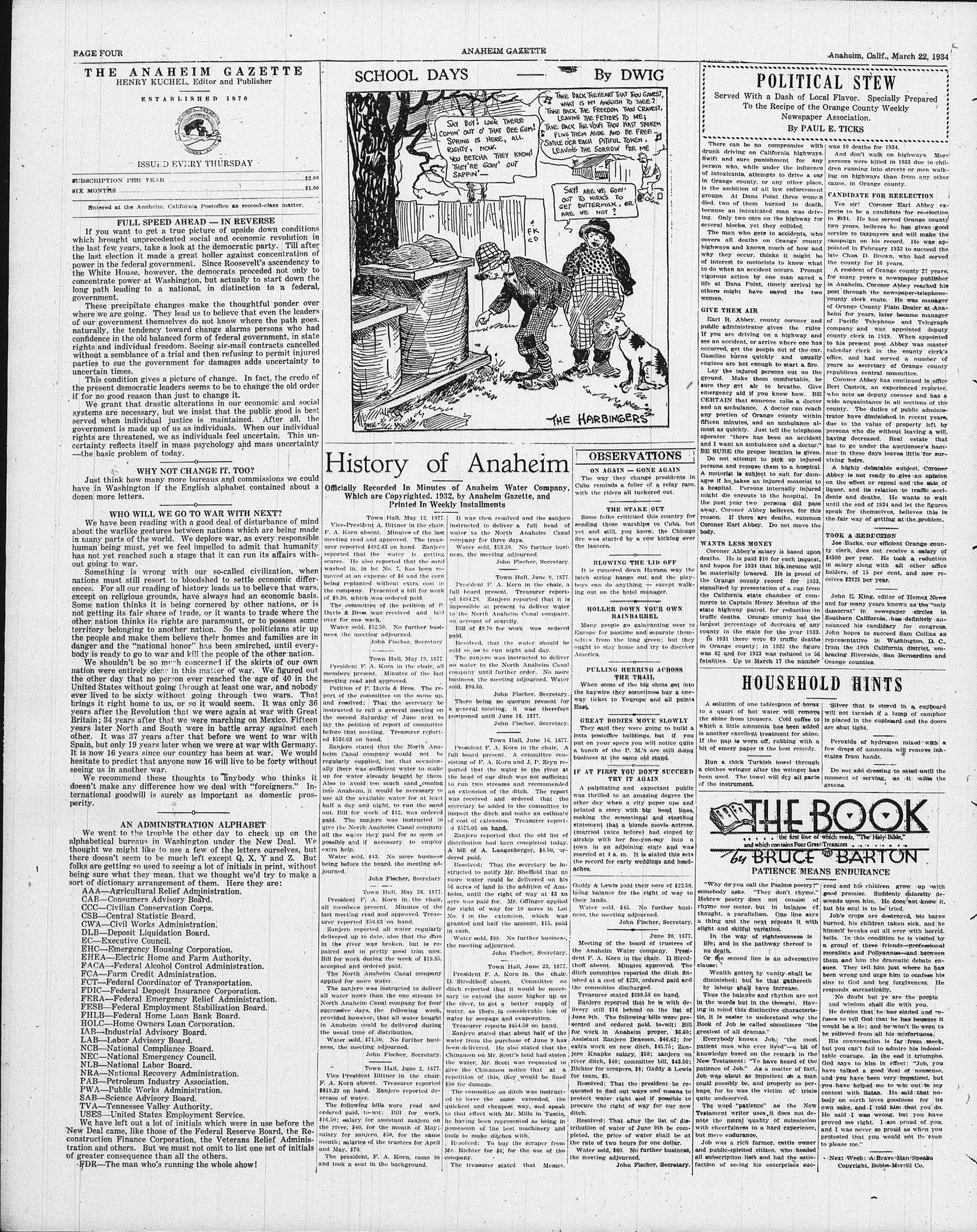
SCHOOL DAYS — By DWIG
SAY BOY! LOOK THERE COMIN' OUT O' THAT BEE GUM!
SPRING IS HERE, ALL RIGHTY, NOW.
YOU BETCHA THEY KNOW!
THEY'RE GOIN' OUT SAPPIN'
TAKE BACK THE HEART THAT THOU GANEST,
WHAT IS MY ANGUSH TO THEE?
TAKE BACK THE FREEDOM THOU CRAVEST,
LEAVING THE FETTERS TO ME;
TAKE BACK THE VOWS THOU HAST SPOKEN
FLING THEM ASIDE AND BE FREE
SMILE OVER EACH PITIFUL TOKEN,
LEAVING THE SORROW FOR ME
SAY! ARE WE GOIN'
OUT TO KIRK'S TO GET BUTTERMILK, OR
ARE WE NOT?
THE HARBINGERS
History of Anaheim
Officially Recorded In Minutes of Anaheim Water Company, Which are Copyrighted, 1932, by Anaheim Gazette, and Printed In Weekly Installments
Town Hall, May 12, 1877.
Vice-President A. Bittner in the chair. F. A. Korn absent. Minutes of the last meeting read and approved. The treasurer reported $492.43 on hand. Zanjero reported that the water is getting scarce. He also reported that the sand washed in, in lot No. 7, has been removed at an expense of $6 and the corn being replanted without extra cost to the company. Presented a bill for work of $9.30, which was ordered paid.
The committee of the petition of P. Davis & Bros. was received and laid over for one week.
Water sold, $52.50. No further business, the meeting adjourned.
John Fischer, Secretary.
Town Hall, June 9, 1877.
President F. A. Korn in the chair, a full board present. Treasurer reported $494.28. Zanjero reported that it impossible at present to deliver water to the North Anaheim Canal company, on account of scarcity.
Bill of $9.70 for work was ordered paid.
Resolved, that the water should be sold so as to run night and day.
The zanjero was instructed to deliver no water to the North Anaheim Canal company until further order. No more business, the meeting adjourned. Water sold, $90.50.
John Fischer, Secretary.
There being no quorum present for a general meeting, it was therefore postponed until June 16, 1877.
John Fischer, Secretary.
Town Hall, June 16, 1877.
President F. A. Korn in the chair. A full board present. A committee consisting of F. A. Korn and J. P. Zeyn reported that the water in the river at the head of our ditch was not sufficient to run two streams and recommended an extension of the ditch. The report was received and ordered that the secretary be added to the committee to inspect the ditch and make an estimate of cost of extension. Treasurer reported $575.05 on hand.
Zanjero reported that the old list of distribution had been completed today. A bill of A. Langenberger, $8.50, ordered paid.
Resolved: That the secretary be in charge of distribution.
OBSERVATIONS
ON AGAIN — GONE AGAIN
The way they change presidents in Cuba reminds a feller of a relay race with the riders all tuckered out.
THE STAKE OUT
Some folks criticized this country for sending those warships to Cuba, but yet and still, you know, the Chicago fire was started by a cow kicking over the lantern.
BLOWING THE LID OFF
It is rumored down Havana way that latch string hangs out and the play boys can do anything — except walking out on the hotel manager.
HOLLER DOWN YOUR OWN RAINBARREL
Many people go galavanting over Europe for pastime and separate them selves from the long green; but they ought to stay home and try to discover America.
PULLING HERRING ACROSS THE TRAIL
When some of the big shots get into the haywire they sometimes buy a one-way ticket to Yourope and all point East.
GREAT BODIES MOVE SLOWLY
They said they were going to build a lotta postoffice buildings, but if you put on your specs you will notice quite a bunch of the P.M.'s are still doing business at the same old stand.
IF AT FIRST YOU DONT SUCCEED TRY IT AGAIN
A palpitating and expectant public was thrilled to an amazing degree that other day when a city paper ups and printed a story with big head lines making the sensational and startling statement that a blonde movie actress (married twice before) had eloped by airship with her fee-yon-cay into town in an adjoining state and was married at 4 a.m. It is stated this set the record for early weddings and headaches.
up for water already bought by them. Also to avoid too much sand coming into Anaheim, it would be necessary to use all the available water for at least half a day and night, to run the sand out. Bill for work of $12, was ordered paid. The zanjero was instructed to give the North Anaheim Canal company all the water they paid for as soon as possible and if necessary to employ extra help.
Water sold, $43. No more business being before the board, the meeting adjourned.
John Fischer, Secretary
Town Hall, May 26, 1877.
President F. A. Korn in the chair, all members present. Minutes of the last meeting read and approved. Treasurer reported $56.63 on hand.
Zanjero reported all water regularly delivered up to date, also that the dam in the river was broken, but is repaired and in pretty good trim now. Bill for work during the week of $19.85, accepted and ordered paid.
The North Anaheim Canal company applied for more water.
The zanjero was instructed to deliver all water more than the one stream to North Anaheim Canal company for four successive days, the following week, provided however, that all water bought in Anaheim could be delivered during the usual time of distribution.
Water sold, $71.50. No further business, the meeting adjourned.
John Fischer, Secretary.
Town Hall, June 23, 1877.
President F. A. Korn in the chair, D. Strodthoff absent. Committee on ditch reported that it would be necessary to extend the same higher up on the river, to get a better supply of water, as there is considerable loss of water by seepage and evaporation.
Treasurer reports $654.50 on hand.
Zanjero stated that about half of the water from the purchase of June 9 has been delivered. He also stated that the Chinamen on Mr. Scott's land had stolen the water, Mr. Scott was requested to give the Chinamen notice that at a repetition of this, they would be fined $50 for damage.
The committee on ditch was instructed to have the same extended, the quickest and cheapest way, and speak to that effect with Mr. Mills in Tustin, he having been represented as being in possession of the best machinery and tools to make ditches with.
Resolved: To buy the scraper from Mr. Richter for $8; for the use of the company.
The treasurer stated that Messrs.
A palpitating and expectant public was thrilled to an amazing degree the other day when a city paper ups and printed a story with big head lines making the sensational and startling statement that a blonde movie actress (married twice before) had eloped by airship with her fee-yon-say into town in an adjoining state and was married at 4 a.m. It is stated this set the record for early weddings and headaches.
Gaddy & Lewis paid their note of $22.50 being balance for the right of way to their lands.
Water sold, $45. No further business, the meeting adjourned.
John Fischer, Secretary
June 30, 1877
Meeting of the board of trustees of the Anaheim Water company. President F. A. Korn in the chair. D Strodthoff absent. Minutes approved. The ditch committee reported the ditch finished at a cost of $220, ordered paid and the committee discharged.
Treasurer stated $680.58 on hand.
Zanjero reported that he is with delivery still $16 behind on the list of June 9th. The following bills were presented and ordered paid, to-wit: Bill for work in Anaheim proper, $6.60; Assistant Zanjero Dravsen, $46.62; for extra work on new ditch, $45.75; Zanjero Knapke salary, $50; zanjero or river ditch, $40; committee bill, $43.50; Richter for scrapers, $8; Gaddy & Lewis for team, $5.
Resolved: That the president be requested to find out ways and means to protect water right and if possible to procure the right of way for our new ditch.
Resolved: That after the list of distribution of water of June 9th be completed, the price of water shall be at the rate of two hours for one dollar.
Water sold, $60. No further business, the meeting adjourned.
John Fischer, Secretary.
POLITICAL STEW
Served With a Dash of Local Flavor. Specially Prepared
To the Recipe of the Orange County Weekly
Newspaper Association.
By PAUL E. TICKS
There can be no compromise with drunk driving on California highways. Swift and sure punishment for any person who, while under the influence of intoxicants, attempts to drive a car in Orange county, or any other place, is the ambition of all law enforcement groups. At Dana Point three women died, two of them burned to death, because an intoxicated man was driving. Only two cars on the highway for several blocks, yet they collided.
The man who gets to accidents, who covers all deaths on Orange county highways and knows much of how and why they occur, thinks it might be of interest to motorists to know what to do when an accident occurs. Prompt vigorous action by one man saved a life at Dana Point, timely arrival by others might have saved the two women.
GIVE THEM AIR
Earl R. Abbey, county coroner and public administrator gives the rules. If you are driving on a highway and see an accident, or arrive where one has occurred, get the people out of the car. Gasoline burns quickly and usually engines are hot enough to start a fire.
Lay the injured persons out on the ground. Make them comfortable, be sure they get air to breathe. Give emergency aid if you know how. BE CERTAIN that someone calls a doctor and an ambulance. A doctor can reach any portion of Orange county within fifteen minutes, and an ambulance almost as quickly. Just tell the telephone operator "there has been an accident and I want an ambulance and a doctor." BE SURE the proper location is given.
was 10 deaths for 1934.
And don't walk on highways. More persons were killed in 1933 due to children running into streets or men walking on highways than from any other cause, in Orange county.
CANDIDATE FOR REELECTION
Yes sir! Coroner Earl Abbey expects to be a candidate for re-election in 1934. He has served Orange county two years, believes he has given good service to taxpayers and will make the campaign on his record. He was appointed in February 1932 to succeed the late Chas. D. Brown, who had served the county for 16 years.
A resident of Orange county 27 years, for many years a newspaper publisher in Anaheim, Coroner Abbey reached his post through the newspaper-telephone-county clerk route. He was manager of Orange County Plain Dealer at Anaheim for years, later became manager of Pacific Telephone and Telegraph company and was appointed deputy county clerk in 1919. When appointed to his present post Abbey was master calendar clerk in the county clerk's office, and had served a number of years as secretary of Orange county republican central committee.
Coroner Abbey has continued in office Bert Casteix, an experienced reporter, who acts as deputy coroner and has a wide acquaintance in all sections of the county. The duties of public administrator have diminished in recent years, due to the value of property left by persons who die without leaving a will, having decreased. Real estate that has to go under the auctioneer's hammer in these days leaves little for surviving
INVESTATIONS
AIN — GONE AGAIN
they change presidents in
thes a feller of a relay race.
ers all tuckered out.
THE STAKE OUT
is criticized this country for
use warships to Cuba, but
il, you know, the Chicago
ted by a cow kicking over
ING THE LID OFF
red down Havana way the
hangs out and the playanything — except walkthe hotel manager.
R DOWN YOUR OWN
RAINBARREL
ole go galavanting over to
bastime and separate themthe long green; but they
home and try to discover
G HERRING ACROSS
THE TRAIL
of the big shots get into
they sometimes buy a oneto Yourope and all points
ODIES MOVE SLOWLY
they were going to build a
cee buildings, but if you
species you will notice quite
the P. M.'s are still doing
the same old stand.
AT YOU DONT SUCCEED
RY IT AGAIN
and expectant public
to an amazing degree the
then a city paper ups and
bury with big head lines,
sensational and startling
at a blonde movie actress,
face before) had eloped by
her fee-yon-eay into a
adjoining state and was
a.m. It is stated this sets
or early weddings and head-
ENGINEES are hot enough to start a fire.
Lay the injured persons out on the ground. Make them comfortable, be sure they get air to breathe. Give emergency aid if you know how. BE CERTAIN that someone calls a doctor and an ambulance. A doctor can reach any portion of Orange county within fifteen minutes, and an ambulance almost as quickly. Just tell the telephone operator "there has been an accident and I want an ambulance and a doctor." BE SURE the proper location is given.
Do not attempt to pick up injured persons and remove them to a hospital. A motorist is subject to suit for damages if he takes an injured motorist to a hospital. Persons internally injured might die enroute to the hospital. In the past year two persons did pass away, Coroner Abbey believes, for this reason. If there are deaths, summon Coroner Earl Abbey. Do not move the body.
WANTS LESS MONEY
Coroner Abbey's salary is based upon deaths. He is paid $10 for each inquest, and hopes for 1934 that his income will be materially lowered. He is proud of the Orange county record for 1933, signalized by presentation of a cup from the California state chamber of commerce to Captain Henry Meehan of the state highway patrol, for reduction in traffic deaths. Orange county had the largest percentage of decrease of any county in the state for the year 1933.
In 1931 there were 69 traffic deaths in Orange county; in 1932 the figure was 82 and for 1933 was reduced to 50 fatalities. Up to March 17 the number
TOOK A REDUCTION
Joe Backs, our efficient Orange county clerk, does not receive a salary of $4500 per year. He took a reduction in salary along with all other office holders, of 15 per cent, and now receives $3825 per year.
John E. King, editor of Hemet News and for many years known as the "only democrat" in newspaper circles in Southern California, has definitely announced his candidacy for congress. John hopes to succeed Sam Collins as representative in Washington, D.C., from the 19th California district, embracing Riverside, San Bernardino and Orange counties.
HOUSEHOLD HINTS
A solution of one tablespoon of borax to a quart of hot water will remove the shine from trousers. Cold coffee to which a little ammonia has been added is another excellent treatment for shine. If the nap is worn off, rubbing with a bit of emery paper is the best remedy.
Run a thick Turkish towel through a clothes wringer after the wringer has been used. The towel will dry all parts of the instrument.
Silver that is stored in a cupboard will not tarnish if a lump of camphor is placed in the cupboard and the doors are shut tight.
Peroxide of hydrogen mixed with a few drops of ammonia will remove inkstains from hands.
Do not add dressing to salad until the moment of serving, as it wilts the greens.
THE BOOK
the first line of which reads, "The Holy Bible," and which contains Four Great Treasures
by BRUCE BARTON
"Why do you call the Psalms poetry?" somebody asks. "They don't rhyme." Hebrew poetry does not consist of rhyme nor meter, but in balance of thought, a parallelism. One line says a thing and the next repeats it with slight and skilful variation.
In the way of righteousness is life; and in the pathway thereof is no death.
Or the second line is an adversative clause:
Wealth gotten by vanity shall be diminished; but he that gathereth by labour shall have increase.
Thus the balance and rhythm are not in the words but in the thought. Having in mind this distinctive characteristic, it is easier to understand why the Book of Job is called sometimes "the greatest of all dramas."
Everybody knows Job, "the most patient man who ever lived"—a bit of knowledge based on the remark in the New Testament: "Ye have heard of the patience of Job." As a matter of fact, Job was about as impatient as a man could possibly be, and properly so perhaps, for he was the victim of trials quite undeserved.
The word "patience" as the New Testament writer uses, it does not denote the moral quality of submission with cheerfulness to a hard experience, but mere endurance.
Job was a rich farmer, cattle owner and public-spirited citizen, who headed all subscription lists and had the satisfaction of seeing his enterprises succeed and his children grow up with good promise. Suddenly calamity descends upon him. He does not know it, but his soul is to be tried.
Job's crops are destroyed, his barns burned, his children taken sick, and he himself breaks out all over with horrid boils. In this condition he is visited by a group of three friends—professional morallists and Pollyannas—and between them and him the dramatic debate ensues. They tell him just where he has been wrong and urge him to confess his sins to God and beg forgiveness. He responds earnestly,
No doubt but ye are the people and wisdom shall die with you.
He denies that he has sinned and refuses to tell God that he has because it would be a lie; and he won't lie even to be relieved from all his misfortunes.
His conversation is far from meek, but you can't fail to admire his indomitable courage. In the end it triumphs. God says to him in effect: "Job, you have talked a good deal of nonsense, and you have been very impatient, but you have helped me to win out in my contest with Satan. He said that nobody on earth loves goodness for its own sake, and I told him that you do. He said I was wrong, but you have proved me right. I am proud of you, and I was never so proud as when you protested that you would not lie even to please me."
Next Week: A Brave Man Speaks
Copyright, Bobbs-Merrill Co.