anaheim-gazette 1934-03-08
Scanned page
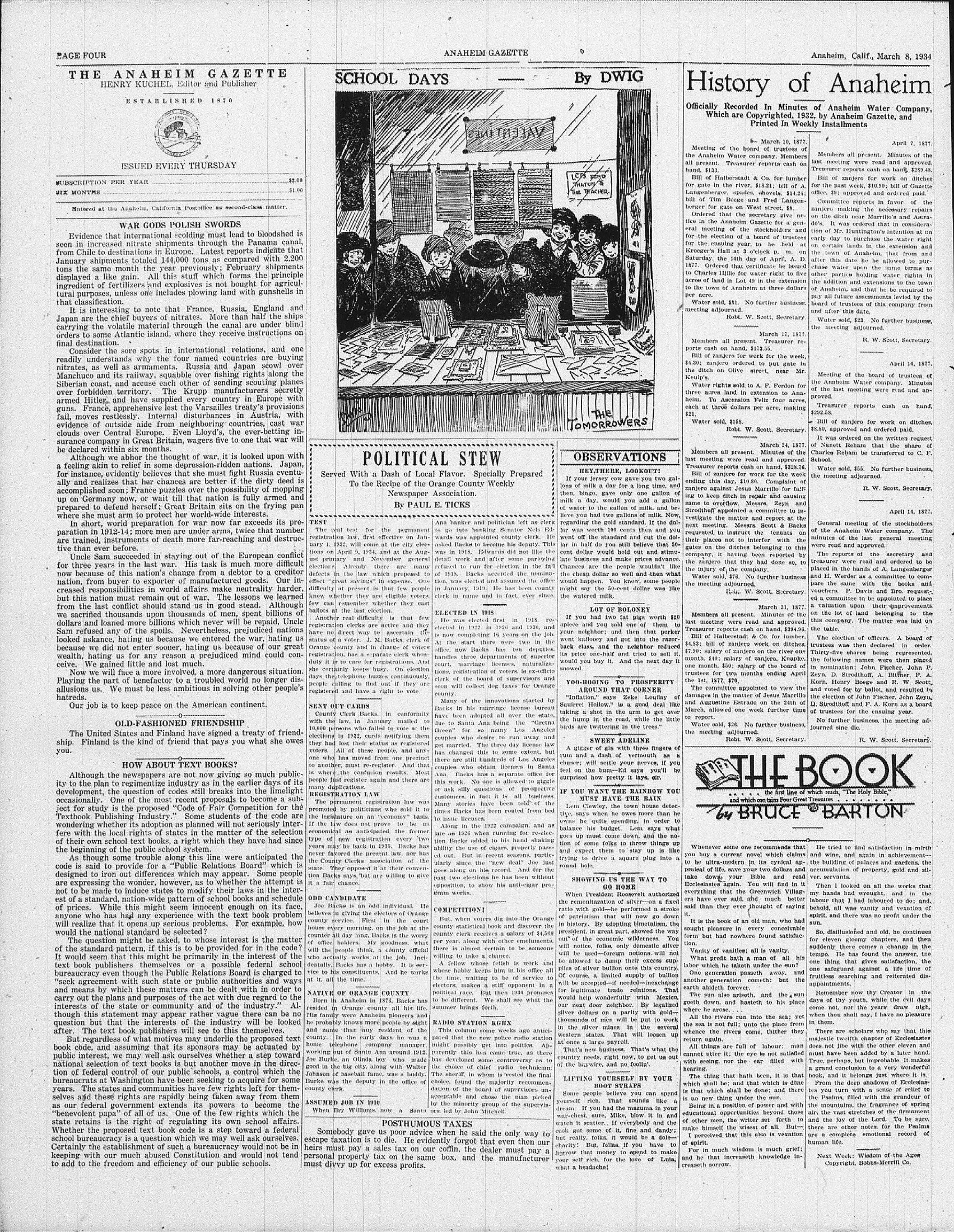
Searchable text
THE ANAHEIM GAZETTE
HENRY KUCHEL, Editor and Publisher
ESTABLISHED 1870
ISSUED EVERY THURSDAY
SUBSCRIPTION PER YEAR $2.00
SIX MONTHS $1.00
Entered at the Anaheim, California Postoffice as second-class matter.
WAR GODS POLISH SWORDS
Evidence that international scolding must lead to bloodshed is seen in increased nitrate shipments through the Panama canal, from Chile to destinations in Europe. Latest reports indicate that January shipments totaled 144,000 tons as compared with 2,200 tons the same month the year previously; February shipments displayed a like gain. All this stuff which forms the principle ingredient of fertilizers and explosives is not bought for agricultural purposes, unless one includes plowing land with gunshells in that classification.
It is interesting to note that France, Russia, England and Japan are the chief buyers of nitrates. More than half the ships carrying the volatile material through the canal are under blind orders to some Atlantic island, where they receive instructions on final destination.
Consider the sore spots in international relations, and one readily understands why the four named countries are buying nitrates, as well as armaments. Russia and Japan scowl over Manchuco and its railway, squabble over fishing rights along the Siberian coast, and accuse each other of sending scouting planes over forbidden territory. The Krupp manufacturers secretly armed Hitler, and have supplied every country in Europe with guns. France, apprehensive lest the Varsailles treaty's provisions fail, moves restlessly. Internal disturbances in Austria, with evidence of outside aide from neighboring countries, cast war clouds over Central Europe. Even Lloyd's, the ever-betting insurance company in Great Britain, wagers five to one that war will be declared within six months.
Although we abhor the thought of war, it is looked upon with
nitrates, as well as armaments. Russia and Japan scowl over Manchuco and its railway, squabble over fishing rights along the Siberian coast, and accuse each other of sending scouting planes over forbidden territory. The Krupp manufacturers secretly armed Hitler, and have supplied every country in Europe with guns. France, apprehensive lest the Varsailles treaty's provisions fail, moves restlessly. Internal disturbances in Austria, with evidence of outside aide from neighboring countries, cast war clouds over Central Europe. Even Lloyd's, the ever-betting insurance company in Great Britain, wagers five to one that war will be declared within six months.
Although we abhor the thought of war, it is looked upon with a feeling akin to relief in some depression-ridden nations. Japan, for instance, evidently believes that she must fight Russia eventually and realizes that her chances are better if the dirty deed is accomplished soon; France puzzles over the possibility of mopping up on Germany now, or wait till that nation is fully armed and prepared to defend herself; Great Britain sits on the frying pan where she must arm to protect her world-wide interests.
In short, world preparation for war now far exceeds its preparation in 1912-14; more men are under arms, twice that number are trained, instruments of death more far-reaching and destructive than ever before.
Uncle Sam succeeded in staying out of the European conflict for three years in the last war. His task is much more difficult now because of this nation's change from a debtor to a creditor nation, from buyer to exporter of manufactured goods. Our increased responsibilities in world affairs make neutrality harder, but this nation must remain out of war. The lessons we learned from the last conflict should stand us in good stead. Although we sacrificed thousands upon thousands of men, spent billions of dollars and loaned more billions which never will be repaid, Uncle Sam refused any of the spoils. Nevertheless, prejudiced nations looked askance, hating us because we entered the war, hating us because we did not enter sooner, hating us because of our great wealth, hating us for any reason a prejudiced mind could conceive. We gained little and lost much.
Now we will face a more involved, a more dangerous situation. Playing the part of benefactor to a troubled world no longer disallusions us. We must be less ambitious in solving other people's hatreds.
Our job is to keep peace on the American continent.
OLD-FASHIONED FRIENDSHIP
The United States and Finland have signed a treaty of friendship. Finland is the kind of friend that pays you what she owes you.
HOW ABOUT TEXT BOOKS?
Although the newspapers are not now giving so much publicity to the plan to regimentize industry as in the earlier days of its development, the question of codes still breaks into the limelight occasionally. One of the most recent proposals to become a subject for study is the proposed "Code of Fair Competition for the Textbook Publishing Industry." Some students of the code are wondering whether its adoption as planned will not seriously interfere with the local rights of states in the matter of the selection of their own school text books, a right which they have had since the beginning of the public school system.
As though some trouble along this line were anticipated the code is said to provide for a "Public Relations Board" which is
Although the newspapers are not now giving so much publicity to the plan to regimentize industry as in the earlier days of its development, the question of codes still breaks into the limelight occasionally. One of the most recent proposals to become a subject for study is the proposed "Code of Fair Competition for the Textbook Publishing Industry." Some students of the code are wondering whether its adoption as planned will not seriously interfere with the local rights of states in the matter of the selection of their own school text books, a right which they have had since the beginning of the public school system.
As though some trouble along this line were anticipated the code is said to provide for a "Public Relations Board" which is designed to iron out differences which may appear. Some people are expressing the wonder, however, as to whether the attempt is not to be made to induce states to modify their laws in the interest of a standard, nation-wide pattern of school books and schedule of prices. While this might seem innocent enough on its face, anyone who has had any experience with the text book problem will realize that it opens up serious problems. For example, how would the national standard be selected?
The question might be asked, to whose interest is the matter of the standard pattern, if this is to be provided for in the code? It would seem that this might be primarily in the interest of the text book publishers themselves or a possible federal school bureaucracy even though the Public Relations Board is charged to "seek agreement with such state or public authorities and ways and means by which these matters can be dealt with in order to carry out the plans and purposes of the act with due regard to the interests of the state or community and of the industry." Although this statement may appear rather vague there can be no question but that the interests of the industry will be looked after. The text book publishers will see to this themselves.
But regardless of what motives may underlie the proposed text book code, and assuming that its sponsors may be actuated by public interest, we may well ask ourselves whether a step toward national selection of text books is but another move in the direction of federal control of our public schools, a control which the bureaucrats at Washington have been seeking to acquire for some years. The states and communities have few rights left for themselves and these rights are rapidly being taken away from them as our federal government extends its powers to become the "benevolent papa" of all of us. One of the few rights which the state retains is the right of regulating its own school affairs. Whether the proposed text book code is a step toward a federal school bureaucracy is a question which we may well ask ourselves. Certainly the establishment of such a bureaucracy would not be in keeping with our much abused Constitution and would not tend to add to the freedom and efficiency of our public schools.
SCHOOL DAYS — By DWIG
VALENTINE
LETS SEND THATUM TO THE TEACHER.
THE TOMORROWERS
POLITICAL STEW
Served With a Dash of Local Flavor. Specially Prepared
To the Recipe of the Orange County Weekly
Newspaper Association.
By PAUL E. TICKS
TEST
The real test for the permanent registration law, first effective on January 1, 1932, will come at the city elections on April 9, 1934, and at the August primary and November general elections. Already there are many defects in the law which proposed to effect "great savings" in expense. One difficulty at present is that few people know whether they are eligible voters, few can remember whether they cast ballots at the last election.
Another real difficulty is that few registration clerks are active and they have no direct way to ascertain the status of a voter. J. M. Backs, clerk of Orange county and in charge of voters registration, has a separate clerk whose duty it is to care for registrations. And she certainly keeps busy. On election days the telephone buzzes continuously, people calling to find out if they are registered and have a right to vote.
SENT OUT CARDS
County Clerk Backs, in conformity with the law, in January mailed to 10,000 persons who failed to vote at the elections in 1932, cards notifying them they had lost their status as registered voters. All of these people, and anyone who has moved from one precinct to another, must re-register. And that is where the confusion results. Most people just register again and there are many duplications.
REGISTRATION LAW
The permanent registration law was promoted by politicians who sold it to the legislature on an "economy" basis. If the law does not prove to be as economical as anticipated, the former type of new registration every two years may be back in 1935. Backs has never favored the present law, nor has the County Clerks association of the state. They opposed it at their convenance.
Ana banker and politician left as clerk to go into banking Senator Nels Edwards was appointed county clerk. He asked Backs to become his deputy. This was in 1918. Edwards did not like the detail work and after some parleying refused to run for election in the fall of 1918. Backs accepted the nomination, was elected and assumed the office in January 1919. He has been county clerk in name and in fact, ever since.
ELECTED IN 1918
He was elected first in 1918, re-elected in 1922, in 1926 and 1930, and is now completing 16 years on the job. At the start there were two in the office, now Backs has ten deputies, handles three departments of superior court, marriage licenses, naturalizations, registration of voters, is ex-officio clerk of the board of supervisors and soon will collect dog taxes for Orange county.
Many of the innovations started by Backs in his marriage license bureau have been adopted all over the state, due to Santa Ana being the "Gretna Green" for so many Los Angeles couples who desire to run away and get married. The three day license law has changed this to some extent, but there are still hundreds of Los Angeles couples who obtain licenses in Santa Ana. Backs has a separate office for this work. No one is allowed to giggle or ask silly questions of prospective customers, in fact it is all business. Many stories have been told of the times Backs has been routed from bed to issue licenses.
Along in the 1922 campaign, and as late as 1926 when running for re-election Backs added to his hand shaking ability the use of cigars, properly passed out. But in recent seasons, particularly since the "new deal" Joe Just goes along on his record. And for the
OBSERVATIONS
HEY,THERE,LOOKOUT!
If your Jersey cow gave you two gallons of milk a day for a long time, and then, bingo, gave only one gallon of milk a day, would you add a gallon of water to the gallon of milk, and believe you had two gallons of milk. Not regarding the gold standard. If the dollar was worth 100 cents then and you went off the standard and cut the dollar in half do you still believe that 5 cent dollar would hold out and stimulate business and make prices advance? Chances are the people wouldn't lift the cheap dollar so well and then what would happen. You know, some people might say the 50-cent dollar was lily the watered milk.
LOT OF BOLONEY
If you had two fat pigs worth $ apiece and you sold one of them your neighbor; and then that pork went kafkaey and got into the razo back class, and the neighbor reduce its price one-half and tried to sell would you buy it. And the next day snowed.
YOO-HOOING TO PROSPERITY
AROUND THAT CORNER
"I inflation," says Zeke Loutlay Squirrel Hollow," is a good deal little taking a shot in the arm to get over the hump in the road, while the little birds are twittering in the trees."
SWEET ADRLINE
A gigger of gin with three fingers rum and a dash of vermouth as chaser; will settle your nerves, if you feel on the burn—Ed says you'll surprised how pretty it lays, sir.
IF YOU WANT THE RAINBOW YOU MUST HAVE THE RAIN
Lem Clewley, the town house detective, says when he owes more than he owns he quits spending, in order balance his budget. Lem says who goes up must come down, and the nation of some folks to throw things up and expect them to stay up is likely trying to drive a square plug into a round hole.
REGISTRATION LAW
The permanent registration law was promoted by politicians who sold it to the legislature on an "economy" basis. If the law does not prove to be as economical as anticipated, the former type of new registration every two years may be back in 1935. Backs has never favored the present law, nor has the County Clerks association of the state. They opposed it at their convention Backs says, but are willing to give it a fair chance.
ODD CANDIDATE
Joe Backs is an odd individual. He believes in giving the electors of Orange county service. First in the court house every morning, on the job at the counter all day long, Backs is the worry of office holders. My goodness, what will the people think, a county official who actually works at the job. Incidentally, Backs has a hobby. It is service to his constituents. And he works at it, all the time.
NATIVE OF ORANGE COUNTY
Born in Anaheim in 1876, Backs has resided in Orange county all his life. His family were Anaheim pioneers and he probably knows more people by sight and name than any resident of the county. In the early days he was a home telephone company manager, working out of Santa Ana around 1912. Joe Burke, an Olinda boy who made good in the big city, along with Walter Johnson of baseball fame, was a buddy. Burke was the deputy in the office of county clerk.
ASSUMED JOB IN 1910
When Bry Williams, now a Santa Ana,Backs has a separate office for this work. No one is allowed to giggle or ask silly questions of prospective customers, in fact it is all business. Many stories have been told of the times Backs has been routed from bed to issue licenses.
Along in the 1922 campaign, and as late as 1826 when running for re-election Backs added to his hand shaking ability the use of cigars, properly passed out. But in recent seasons, particularly since the "new deal" Joe just goes along on his record. And for the past two elections he has been without opposition, to show his anti-cigar program works.
COMPETITION1
But, when voters dig into the Orange county statistical book and discover the county clerk receives a salary of $4,500 per year, along with other emoluments, there is almost certain to be someone willing to take a chance.
A fellow whose fetish is work and whose hobby keeps him in his office all the time, waiting to be of service to electors, makes a stiff opponent in a political race. But then 1934 promises to be different. We shall see what the summer brings forth.
RADIO STATION KGHX
This column some weeks ago anticipated that the new police radio station might possibly get into politics. Apparently this has come true, as there has developed some controversy as to the choice of chief radio technician. The sheriff, in whom is vested the final choice, found the majority recommendation of the board of supervisors unacceptable and chose the man picked by the minority group of the supervisors, led by John Mitchell.
POSTHUMOUS TAXES
Somebody gave us poor advice when he said the only way to escape taxation is to die. He evidently forgot that even then our heirs must pay a sales tax on our coffin, the dealer must pay a personal property tax on the same box, and the manufacturer must divvy up for excess profits.
IF YOU WANT THE RAINBOW YOU MUST HAVE THE RAIN
Lem Clewley, the town house detective, says when he owes more than he owns he quits spending, in order to balance his budget. Lem says who goes up must come down, and the notion of some folks to throw things up and expect them to stay up is like trying to drive a square plug into a round hole.
SHOWING US THE WAY TO GO HOME
When President Roosevelt authorizes the remonitization of silver—on a fix ratio with gold—he performed a stroke of patriotism that will now go down in history. By adopting bimetalism, the president, in great part, showed the way out of the economic wilderness. You will notice, folks, only domestic silver will be used—foreign notions will no be allowed to dump their excess supplies of silver bullion onto this country. Of course, a limited supply of bullion will be accepted—if needed—inexchange for legitimate trade relations. That would help wonderfully with Mexico our next door neighbor. By legalize silver dollars on a parity with gold-thousands of men will be put to work in the silver mines in the several western states. That will loosen us at once a large payroll.
LIFTING YOURSELF BY YOUR BOOT STRAPS
Some people believe you can spend yourself rich. That sounds like a dream. If you had the mazuma in your war-chest, sure, Mike, blow it in and watch it scatter. If everybody and the cook got some of it, fine and dandy but really, folks, it would be a dole-charity! But, fellas, if you have to borrow that money to spend to make your self rich, for the love of Lula what a headache!
History of Anaheim
Officially Recorded In Minutes of Anaheim Water Company,
Which are Copyrighted, 1932, by Anaheim Gazette, and
Printed In Weekly Installments
March 10, 1877.
Meeting of the board of trustees of
the Anaheim Water company. Members
all present. Treasurer reports cash on
hand, $133.
Bill of Halberstadt & Co. for lumber
for gate in the river, $18.21; bill of A.
Langenberger, spades, ehovels, $14.24;
bill of Tim Boege and Fred Langenberger for gate on West street, $8.
Ordered that the secretary give notice
in the Anaheim Gazette for a general
meeting of the stockholders and
for the election of a board of trustees
for the ensuing year, to be held at
Kroeger's Hall at 3 o'clock p. m. on
Saturday, the 14th day of April, A. D.
1877. Ordered that certificate be issued
to Charles Hille for water right to five
acres of land in Lot 49 in the extension
to the town of Anaheim at three dollars per acre.
Water sold, $81. No further business,
meeting adjourned.
Robt. W. Scott, Secretary.
March 17, 1877.
Members all present. Treasurer reports cash on hand, $173.55.
Bill of zanjero for work for the week,
$4.30; zanjero ordered to put gate in
the ditch on Olive street, near Mr.
Keulp's.
Water rights sold to A. F. Ferdon for
three acres land in extension to Anaheim.
To Ascension Feliz four acres,
each at three dollars per acre, making
$21.
Water sold, $158.
Robt. W. Scott, Secretary.
March 24, 1877.
Members all present. Minutes of the last meeting were read and approved.
Members all present. Minutes of the last meeting were read and approved.
Treasurer reports cash on hand, $289.48.
Bill of zanjero for work on ditches
for the past week, $10.90; bill of Gazette office, $9; approved and ordered paid.
Committee reports in favor of the
zanjero making the necessary repairs
on the ditch near Marrillo's and Astrado's. It was ordered that in consideration of Mr. Huntington's intention at an early day to purchase the water right on certain lands in the extension and the town of Anaheim, that from and after this date he be allowed to purchase water upon the same terms as other parties holding water rights in the addition and extensions to the town of Anaheim, and that he be required to pay all future assessments levied by the board of trustees of this company from and after this date.
Water sold, $23. No further business,
the meeting adjourned.
R. W. Scott, Secretary.
April 14, 1877.
Meeting of the board of trustees of
the Anaheim Water company. Minutes
of the last meeting were read and approved.
Treasurer reports cash on hand, $292.58.
Bill of zanjero for work on ditches,
$8.80, approved and ordered paid.
It was ordered on the written request
of Nanett Reham that the share of Charlce Reham be transferred to C. F. School.
THERE, LOOKOUT!
Seey cow gave you two gallons a day for a long time, and gave only one gallon of milk would you add a gallon to the gallon of milk, and be given two gallons of milk. Now, the gold standard. If the dollar 100 cents then and you standard and cut the dollar you still believe that 50 would hold out and stimulate and make prices advance. The people wouldn't like dollar so well and then what you know, some people the 50-cent dollar was like milk.
OT OF BOLONEY
And two fat pigs worth $20 you sold one of them to porr; and then that porker pay and got into the razor and the neighbor reduced the half and tried to sell it, buy it. And the next day itING TO PROSPERITY AND THAT CORNER
Says Zeke Loulay of low," is a good deal like not in the arm to get over the road, while the little littering in the trees."
WEET ADRLINE
Of gin with three fingers of dash of vermouth as a settle your nerves, if youbum—Ed says you'll be now pretty it lays, air.
ANT THE RAINBOW YOU HAVE THE RAIN
Hey, the town house detects when he owes more than he misses spending, in order to budget. Lem says what it come down, and the no-folks to throw things up them to stay up is like give a square plug into a
ERVATIONS
March 24, 1877.
Members all present. Minutes of the last meeting were read and approved. Treasurer reports cash on hand, $328.76.
Bill of zanjero for work for the week ending this day, $10.80. Complaint of zanjero against Jesus Marrillo for failing to keep ditch in repair and causing same to overflow. Messrs. Zeyn and Strodthoff appointed a committee to investigate the matter and report at the next meeting. Messrs. Scott & Backs requested to instruct the tenants on their places not to interfere with the gates on the ditches belonging to this company, it having been reported by the zanjero that they had done so, to the injury of the company.
Water sold, $76. No further business the meeting adjourned.
Robt. W. Scott, Secretary.
March 31, 1877.
Members all present. Minutes of the last meeting were read and approved. Treasurer reports cash on hand, $394.96.
Bill of Halberstadt & Co. for lumber, $4.83; bill of zanjero work on ditches, $7.90; salary of zanjero on the river one month, $40; salary of zanjero, Knapke, one month, $50; salary of the board of trustees for two months ending April the 1st, 1877, $70.
The committee appointed to view the damages in the matter of Jesus Marrillo and Augustine Estrado on the 24th of March, allowed one week further time to report.
Water sold, $26. No further business, the meeting adjourned.
Robt. W. Scott, Secretary.
April 14, 1877.
Meeting of the board of trustees of the Anaheim Water company. Minutes of the last meeting were read and approved.
Treasurer reports cash on hand, $292.58.
Bill of zanjero for work on ditches, $8.80, approved and ordered paid.
It was ordered on the written request of Nanett Reham that the share of Charles Reham be transferred to C. F. School.
Water sold, $55. No further business, the meeting adjourned.
R. W. Scott, Secretary.
April 14, 1877.
General meeting of the stockholders of the Anaheim Water company. The minutes of the last general meeting were read and approved.
The reports of the secretary and treasurer were read and ordered to be placed in the hands of A. Langenberger and H. Werder as a committee to compare the same with the books and vouchers. P. Davis and Bro. requested a committee to be appointed to place a valuation upon their improvements on the lot of land belonging to the this company. The matter was laid on the table.
The election of officers. A board of trustees was then declared in order. Thirty-five shares being represented, the following names were then placed in nomination: John Fischer, John P. Zeyn, D. Strodthoff, A. Bitner, F. A. Korn, Henry Boege and R. W. Scott, and voted for by ballot, and resulted in the election of John Fischer, John Zeyn, D. Strodthoff and F. A. Korn as a board of trustees for the ensuing year.
No further business, the meeting adjourned sine die.
R. W. Scott, Secretary.
THE BOOK
the first line of which reads "The Holy Bible," and which contains Four Great Treasures
by BRUCE WITH BARTON
Whenever some one recommends that you buy a current novel which claims to be ultra-modern in its cynical appraisal of life, save your two dollars and He tried to find satisfaction in mirth and wine, and again in achievement—the building of palaces and gardens, the accumulation of property, gold and sil-
WHENVER SOME ONE RECOMMends that you buy a current novel which claims to be ultra-modern in its cynical appraisal of life, save your two dollars and take down your Bible and read Ecclesiastes again. You will find in it everything that the Greenwich Villagers have ever said, and much better said than they ever thought of saying it.
It is the book of an old man, who had sought pleasure in every conceivable form but had nowhere found satisfaction.
Vanity of vanities; all is vanity.
What profit hath a man of all his labor which he taketh under the sun?
One generation passeth away, and another generation cometh: but the earth abideth forever.
The sun also ariseth, and the sun goeth down, and hasteth to his place where he arose.
All the rivers run into the sea; yet the sea is not full; unto the place from whence the rivers come, thither they return again.
All things are full of labour; man cannot utter it; the eye is not satisfied with seeing, nor the ear filled with hearing.
The thing that hath been, it is that which shall be; and that which is done is that which shall be done; and there is no new thing under the sun.
Being in a position of power and with educational opportunities beyond those of other men, the writer set forth to make himself the wisest of all. But—I perceived that this also is vexation of spirit.
For in much wisdom is much grief; and he that increaseth knowledge increases sorrow.
He tried to find satisfaction in mirth and wine, and again in achievement—the building of palaces and gardens, the accumulation of property, gold and silver, servants.
Then I looked on all the works that my hands had wrought, and in the labour that I had laboured to do: and behold, all was vanity and vexation of spirit, and there was no profit under the sun.
So, disillusioned and old, he continues for eleven gloomy chapters, and then suddenly there comes a change in the tempo. He has found the answer, the one thing that gives satisfaction, the one safeguard against a life time of fruitless searching and reiterated disappointments.
Remember now thy Creator in the days of thy youth, while the evil days come not, nor the years draw nigh, when thou shalt say, I have no pleasure in them.
There are scholars who say that this majestic twelfth chapter of Ecclesiastes does not jibe with the other eleven and must have been added by a later hand. True, perhaps, but improbable. It makes a grand conclusion to a very wonderful book, and it belongs just where it is.
From the deep shadowes of Ecclesiastes you turn with a sense of relief to the Psalms, filled with the grandeur of the mountains, the fragrance of spring air, the vast stretches of the firmament and the joy of the Lord. To be sure, there are other notes, for the Psalms are a complete emotional record of human life.
Next Week: Wisdom of the Ages
Copyright, Bobbs-Merrill Co.