anaheim-gazette 1934-03-01
Scanned page
Searchable text
THE ANAHEIM GAZETTE
HENRY KUCHEL, Editor and Publisher
ESTABLISHED 1870
ISSUED EVERY THURSDAY
SUBSCRIPTION PER YEAR ... $2.00
SIX MONTHS ... $1.00
Entered at the Anaheim, California Postoffice as second-class matter.
ROOSEVELT GRANDSTANDING
Two sour notes spoil President Roosevelt's political harmony within the last month. Instead of trying to gloss over these glaring mistakes, like several markedly pro-administration papers attempt in apologetic editorials, we believe the purposes of clarity of public thinking and intelligent direction call for a candid and frank expression of opinion. This does not necessarily mean that we are against the president's entire program; rather, that certain psychological phases of it cause harmful reactions.
Responsibility for cancelling air-mail contracts rests squarely upon Roosevelt's shoulders. Attempts to place it upon Patronage-Dispenser Farley are cowardly, and unworthy of the White House. The flimsy excuse of rebuking Col. Charles Lindberg for appealing to his president in protest of manifest injustices upon the airplane industry smacks of insincerity. The plain truth is that the flying colonel is right, the airplane industry was convicted without even a trial, let alone a fair one. Hints that graft, collusion and fraud existed throughout the fabrication of air-mail contracts failed of verification, nor were they sufficiently strong to justify the drastic action.
As the truth develops from a myriad of reports, it appears the whole action was nothing but a grandstand play. Roosevelt and Farley wanted to "get something" on Ex-Postmaster General Brown. The evident purpose was to make political capital out of the current investigation by Senator Black and his committee. This means was used to convict Brown by the court of public opinion without giving the latter a fair chance to present his case—at least, not till the grandstand act had succeeded in casting
even a trial, let alone a fair one. Hints that graft, conduit and fraud existed throughout the fabrication of air-mail contracts failed of verification, nor were they sufficiently strong to justify the drastic action.
As the truth develops from a myriad of reports, it appears the whole action was nothing but a grandstand play. Roosevelt and Farley wanted to "get something" on Ex-Postmaster General Brown. The evident purpose was to make political capital out of the current investigation by Senator Black and his committee. This means was used to convict Brown by the court of public opinion without giving the latter a fair chance to present his case—at least, not till the grandstand act had succeeded in casting a black cloud upon the previous administration.
Upon this altar of political trickery, not less than five fine young army fliers sacrificed their lives.
For the sake of trying to win a few more seats in congress, or hold all those now in democratic folds, President Roosevelt cancelled air-mail contracts, resulting in sending those army fliers to their death. The best policy under present conditions, it seems to us, is to turn the air mail back to private firms and then proceed upon a just and orderly plan of eliminating whatever evidence of collusion, fraud or graft that develop without first looking to political fortunes instead of to the nation's welfare.
The other sour note concerns Roosevelt's childish remarks when he signed the newspaper code. Indeed, when one considers the history of that particular code, the president's statement is unworthy of him; it must have been written by someone else.
Get this background straight. Since NRA was proposed, even persons close to the administration openly doubt if the emergency program would conform to the United States constitution. Despite this, the impression was let out that if necessary the constitution must be scrapped to make way for the recovery program. And plans for making NRA permanent now are underway, although by law emergency measures become inoperative after 1935. In the face of this Roosevelt and Johnson at first refused to permit the newspapers to write into their code the guarantee of freedom of the press. That insistence was the real reason why it was not approved for many months. But newspapermen, who fought for ages for freedom of the press were not willing to give up the gains they had made. Freedom of the press was important enough to write in the constitution. If that document was to be discarded by the administration, the newspapers had no thought of having themselves bound to possible dictatorship. Granting that the constitution will remain and will be adhered to, writing the clause into the code was only repetition—no harm done, and unforeseen contingencies provided against.
The spoiled-boy attitude of the president clearly is evident in his following comment:
"It is pure surplusage. While it has no meaning it is permitted to stand merely because it has been requested and because it could have no such legal effects as would bar its inclusion. Of course, a man does not consent to what he does not consent to. But if the president should find it necessary to modify this code, the circumstance that the modification was not consented to would not affect whatever obligations the non-consenter would have. . . . The recitation of the freedom of the press clause in the code has no more place here than would the recitation of the whole constitution or the ten commandments."
Just because he can not have his own way in every particular, President Roosevelt best not develop a complaining whine that might defeat his whole program and do irreparable damage to the country."
it could have no such legal effects as would bar its inclusion. Of course, a man does not consent to what he does not consent to. But if the president should find it necessary to modify this code, the circumstance that the modification was not consented to would not affect whatever obligations the non-consenter would have. The recitation of the freedom of the press clause in the code has no more place here than would the recitation of the whole constitution or the ten commandments."
Just because he can not have his own way in every particular, President Roosevelt best not develop a complaining whine that might defeat his whole program and do irreparable damage to the country.
THE MOULD OF LIFE
The socialist politician out in Arizona who was caught tunneling into a bank evidently thought there were better ways of "going after" capital than the soap box method.
DEATH RIDES ON GAS STEEDS
Despite the fact that accidents decreased, fewer persons were injured, and fewer pedestrians, drivers and vehicles were involved in automobile accidents in 1933 than in 1932, the death toll increased.
Safety bureau officials of the department of motor vehicles, in announcing automobile fatalities in 1933, also submit elaborate statistics, giving the accidents, deaths and injuries for each month; the persons killed and accidents in both rural and city areas; type of accidents, increased number of drunk drivers, and other data. Still, no effective way has been found to halt the deadly toll of highway accidents. Passing laws does no good, building faster speedways does not aid; repeal is co-incident with an increase of 26 per cent in either driver or pedestrian "who had been drinking," and a fatality list in this class of accidents 40 per cent greater than the previous year.
Pounding sense and caution into the heads of drivers is one and the same thing. The problem seems hopeless.
ADD DEFINITIONS
An old-timer is one who can remember when he was instructed to get some new talking machine needles, as there was company coming Sunday.
Latest typographical error makes "Undies" read "Nudies".
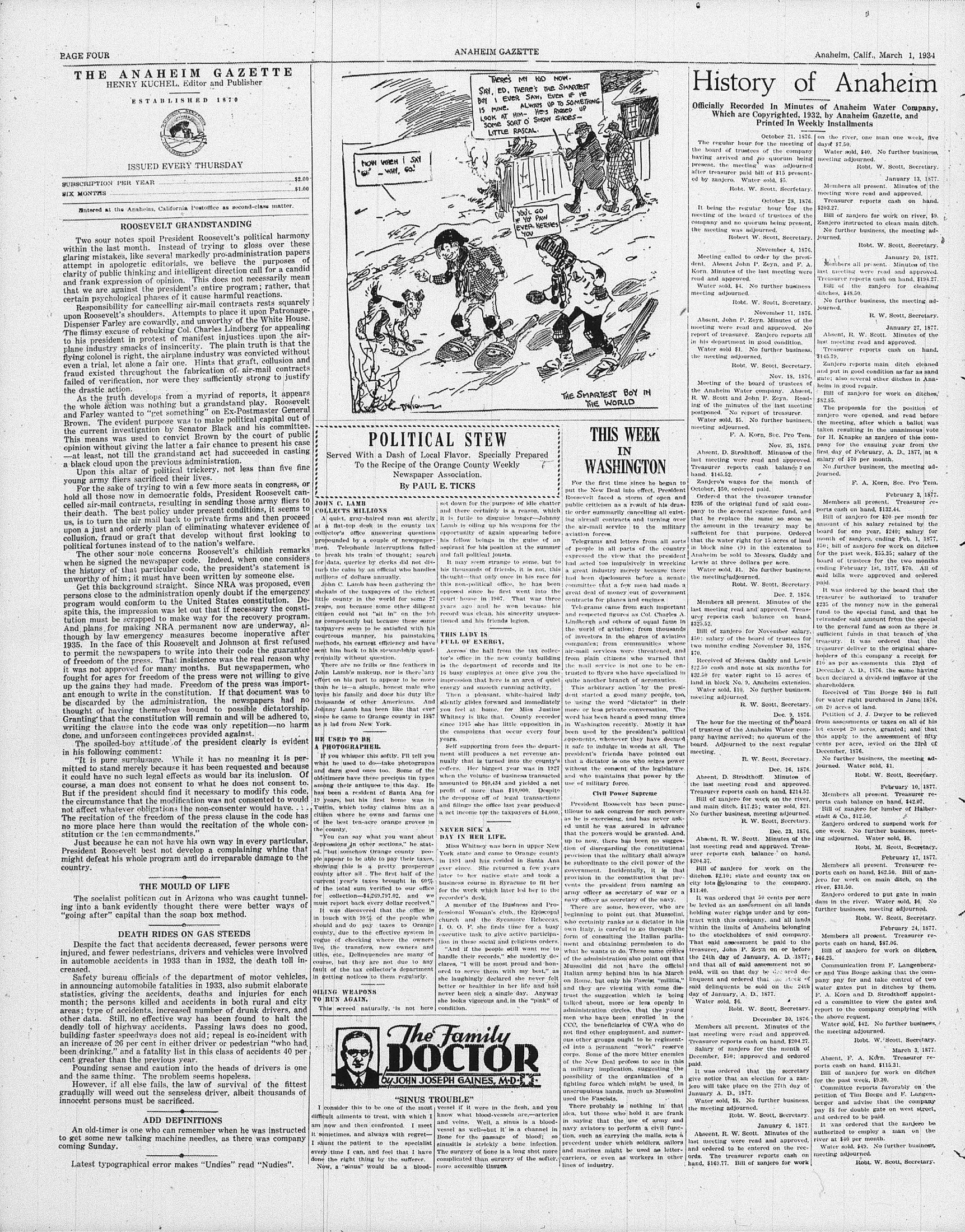
THERE'S MY KID NOW.
SAY, ED, THERE'S THE SMARTEST
BOY I EVER SAW, EVEN IF HE
IS MINE. ALWAYS UP TO SOMETHING.
LOOK AT HIM—HE'S RRSED UP
SOME SORT OF SHOW SHOES—
LITTLE RASCAL.
NOW WHEN I SAY
"GO - WAY, GO!"
YOU'LL GO
IF YOU PAW
EVER KETCHES
YOU
THE SMARTEST BOY IN
THE WORLD
POLITICAL STEW
Served With a Dash of Local Flavor. Specially Prepared
THIS WEEK
IN
POLITICAL STEW
Served With a Dash of Local Flavor. Specially Prepared
To the Recipe of the Orange County Weekly
Newspaper Association.
By PAUL E. TICKS
JOHN C. LAMB
COLLECTS MILLIONS
A quiet, gray-haired man sat alertly at a flat-top desk in the county tax collector's office answering questions propounded by a couple of newspapermen. Telephonic interruptions failed to break his train of thought; search for data, queries by clerks did not disturb the calm by an official who handles millions of dollars annually.
John C. Lamb has been gathering the shekals of the taxpayers of the richest little county in the world for some 27 years, not because some other diligent citizen could not "sit in" on the job as competently but because these same taxpayers seem to be satisfied with his courteous manner, his painstaking methods, his earnest efficiency and have sent him back to his stewardship quadrennially without question.
There are no frills or fine feathers in John Lamb's makeup, nor is there any effort on his part to appear to be more than he is—a simple, honest male who loves his family and does his duty like thousands of other Americans. And Johnny Lamb has been like that ever since he came to Orange county in 1887 as a lad from New York.
HE USED TO BE A PHOTOGRAPHER.
If you whisper this softly, I'll tell you what he used to do—take photographs and darn good ones too. Some of the old-timers have these precious tin types among their antiques to this day. He has been a resident of Santa Ana for 19 years, but his first home was in Tustin, which today claims him as a citizen where he owns and farms one of the best ten-acre orange groves in the county.
“You can say what you want about depressions in other sections,” he stated, “but somehow Orange county people appear to be able to pay their taxes, showing this is a pretty prosperous set down for the purpose of idle chatter and there certainly is a reason, which it is futile to disguise longer—Johnny Lamb is oiling up his weapons for the opportunity of again appearing before his fellow beings in the guise of an aspirant for his position at the summer and fall political jousts.
It may seem strange to some, but to his thousands of friends, it is not, this thought—that only once in his race for this non-political office, he has been opposed since he first went into the court house in 1907. That was three years ago and he won because his record was clean, his sincerity unquestioned and his friends legion.
THIS LADY IS FULL OF ENERGY.
Across the hall from the tax collector's office in the new county building is the department of records and its 16 busy employees at once give you the impression that here is an area of quiet energy and smooth running activity.
Then a pleasant, white-haired lady silently glides forward and immediately you feel at home, for Miss Justine Whitney is like that. County recorder since 1915 she has little opposition in the campaigns that occur every four years.
Self supporting from fees the department still produces a net revenue annually that is turned into the county's coffers. Her biggest year was in 1927 when the volume of business transacted amounted to $60,434 and yielded a net profit of more than $10,000. Despite the dropping off of legal transactions and filings the office last year produced a net income for the taxpayers of $4,000.
NEVER SICK A DAY IN HER LIFE.
Miss Whitney was born in upper New York state and came to Orange county in 1891 and has resided in Santa Ana ever since. She returned a few years
THIS WEEK IN WASHINGTON
For the first time since he began to put the New Deal into effect, President Roosevelt faced a storm of open and public criticism as a result of his dractic order summarily cancelling all existing airmail contracts and turning over the air-mail service to the military aviation forces.
Telegrams and letters from all sorts of people in all parts of the country expressed the view that the president had acted too impulsively in wrecking a great industry merely because they had been disclosures before a senate committee that a few men had made great deal of money out of government contracts for planes and engines.
Telegrams came from such important and respected figures as Col. Charles A Lindbergh and others of equal fame in the world of aviation; from thousand of investors in the shares of aviation companies; from communities whose air-mail services were threatened, and from plain citizens who warned that the mail service is not one to be trusted to flyers who have specialized in quite another branch of aeronautics.
This arbitrary action by the president started a good many people, too to using the word "dictator" in their more or less private conversation. The word has been heard a good many times in Washington recently. Most it has been used by the president's political opponents, whenever they have deemed it safe to indulge in words at all. The president's friends have pointed out that a dictator is one who seizes power without the consent of the legislature and who maintains that power by the use of military force.
Civil Power Supreme
President Roosevelt has been punculous to ask congress for such power as he is exercising, and has never asked until he was assured in advance that the powers would be granted. And up to now, there has been no suggestion of disregarding the constitutional provision that the military shall always be subordinate to the civil power of the government. Incidentally, it is that
old-timers have these precious tin types among their antiques to this day. He has been a resident of Santa Ana for 19 years, but his first home was in Tustin, which today claims him as a citizen where he owns and farms one of the best ten-acre orange groves in the county.
"You can say what you want about depressions in other sections," he stated. "but somehow Orange county people appear to be able to pay their taxes, showing this is a pretty prosperous county after all. The first half of the current year's taxes brought in 60% of the total sum verified to our office for collection—$4,269,797.02, and we must report back every dollar received."
It was discovered that the office is in touch with 98% of the people who should and do pay taxes to Orange county, due to the effective system in vogue of checking where the owners live, the transfers, new owners and titles, etc., Delinquencies are many of course, but they are not due to any fault of the tax collector's department in getting notices to them regularly.
OILING WEAPONS TO RUN AGAIN.
This screed naturally, is not here
NEVER SICK A DAY IN HER LIFE.
Miss Whitney was born in upper New York state and came to Orange county in 1891 and has resided in Santa Ana ever since. She returned a few years later to her native state and took a business course in Syracuse to fit her for the work which later led her to the recorder's desk.
A member of the Business and Professional Woman's club, the Episcopal church and the Sycamore Rebeccas, I. O. O. F. she finds time for a busy executive task to give active participation in these social and religious orders.
"And if the people still want me to handle their records," she modestly declares, "I will be most proud and honored to serve them with my best," as she laughingly declared she never felt better or healthier in her life and had never been sick a single day. Anyway she looks vigorous and, in the "pink" of condition.
The Family DOCTOR
BY JOHN JOSEPH GAINES, M.D.
"SINUS TROUBLE"
I consider this to be one of the most difficult ailments to treat, with which I am now and then confronted. I meet it sometimes, and always with regret—I shunt the patient to the specialist every time I can, and feel that I have done the right thing by the sufferer.
Now, a "sinus" would be a blood-vessel if it were in the flesh, and you know what blood-vessels are—arteries and veins. Well, a sinus is a blood-vessel as well—but it is a channel in Bone for the passage of blood; so sinusitis is strickly a bone infection. The surgery of bone is a long shot more complicated than surgery of the soften, more accessible tissues.
Civil Power Supreme
President Roosevelt has been pungent to ask congress for such power as he is exercising, and has never asked until he was assured in advance that the powers would be granted. And up to now, there has been no suggestion of disregarding the constitutional provision that the military shall always be subordinate to the civil power of the government. Incidentally, it is that provision in the constitution that prevents the president from naming an army officer as secretary of war or a navy officer as secretary of the navy.
There are some, however, who are beginning to point out that Mussolini who certainly ranks as a dictator in his own Italy, is careful to go through the form of consulting the Italian parliament and obtaining permission to do what he wants to do. These same critics of the administration also point out that Mussolini did not have the officiate Italian army behind him in his March on Rome, but only his Fascist "militia," and they are viewing with some distrust the suggestion which is being talked about, more or less openly in administration circles, that the young men who have been enrolled in the CCC, the beneficiaries of CWA who do not find other employment, and numerous other groups ought to be regimented into a permanent "work" reserve corps. Some of the more bitter enemies of the New Deal professors to see in this a military implication, suggesting the possibility of the organization of a fighting force which might be used, in unscrupulous hands, much as Mussolini used the Fascists.
There probably is nothing in that idea, but those who hold it are frank in saying that the use of army and navy aviators to perform a civil function, such as carrying the mails, sets precedent under which soldiers, sailors and marines might be used as letter-carriers, or even as workers in other lines of industry.
History of Anaheim
Officially Recorded In Minutes of Anaheim Water Company,
Which are Copyrighted, 1932, by Anaheim Gazette, and
Printed In Weekly Installments
October 21, 1876.
The regular hour for the meeting of
the board of trustees of the company
having arrived and no quorum being
present, the meeting was adjourned
after treasurer paid bill of $15 presented
by zanjero. Water sold, $5.
Robt. W. Scott, Secrfetary.
October 28, 1876.
It being the regular hour for the
meeting of the board of trustees of the
company and no quorum being present,
the meeting was adjourned.
Robert W. Scott, Secretary.
November 4, 1876.
Meeting called to order by the president. Absent John P. Zeyn, and F. A.
Korn. Minutes of the last meeting were
read and approved.
Water sold, $4. No further business
meeting adjourned.
Robt. W. Scott, Secretary.
November 11, 1876.
Absent, John P. Zeyn. Minutes of the
meeting were read and approved. No
report of treasurer. Zanjero reports all
in his department in good condition.
Water sold $1. No further business,
the meeting adjourned.
Robt. W. Scott, Secretary.
Nov. 18, 1876.
Meeting of the board of trustees of
the Anaheim Water company. Absent,
R. W. Scott and John P. Zeyn. Reading
of the minutes of the last meeting postponed. No report of treasurer.
Water sold, $5. No further business,
meeting adjourned.
F. A. Korn, Sec. Pro Tem.
Nov. 25, 1876.
Absent, D. Strodthoff. Minutes of the
last meeting were read and approved.
on the river, one man one week, five days, $7.50.
Water sold, $40. No further business,
meeting adjourned.
Robt. W. Scott, Secretary.
January 13, 1877.
Members all present. Minutes of the
meeting were read and approved.
Treasurer reports cash on hand,
$203.27.
Bill of zanjero for work on river, $9.
Zanjero instructed to clean main ditch.
No further business, the meeting adjourned.
Robt. W. Scott, Secretary.
January 20, 1877.
Members all present. Minutes of the
last meeting were read and approved.
Treasurer reports cash on hand, $194.27.
Bill of the zanjero for cleaning ditches, $48.50.
No further business, the meeting adjourned.
R. W. Scott, Secretary.
January 27, 1877.
Absent, R. W. Scott. Minutes of the
last meeting read and approved.
Treasurer reports cash on hand,
$145.79.
Zanjero reports main ditch cleaned
and put in good condition as far as sand gate; also several other ditches in Anaheim in good repair.
Bill of zanjero for work on ditches,
$82.85.
The proposals for the position of
zanjero were opened, and read before
the meeting, after which a ballot was taken resulting in the unanimous vote for H. Knapke as zanjero of this company for the ensuing year from the first day of February, A. D., 1877, at a salary of $70 per month.
THIS WEEK IN WASHINGTON
first time since he began to deal into effect, President passed a storm of open and rumor as a result of his drastically cancelling all exist-contracts and turning over service to the military forces.
and letters from all sorts of all parts of the country were view that the president no impulsively in wrecking industry merely because there closures before a senate at a few men had made a money out of government planes and engines.
came from such important figures as Col. Charles A. and others of equal fame in aviation; from thousands in the shares of aviation from communities whose prices were threatened, and citizens who warned that device is not one to be enforced who have specialized in the branch of aeronautics.
The action by the president a good many people, too, word "dictator" in their private conversation. The senator heard a good many times on recently. Mostly it has by the president's political whenever they have deemedudge in words at all. The friends have pointed out or is one who seizes power consent of the legislature contains that power by the army force.
1 Power Supreme
Roosevelt has been punc-congress for such powers arising, and has never ask-was assured in advanceers would be granted. And, there has been no sugges-garding the constitutional at the military shall always be to the civil power of the incidentally it is that Robt. W. Scott, Secretary.
Nov. 18, 1876.
Meeting of the board of trustees of the Anaheim Water company. Absent, R. W. Scott and John P. Zeyn. Reading of the minutes of the last meeting postponed. No report of treasurer.
Water sold, $5. No further business, meeting adjourned.
F. A. Korn, Sec. Pro Tem.
Nov. 25, 1876.
Absent, D. Strodthoff. Minutes of the last meeting were read and approved. Treasurer reports cash balance on hand, $145.52.
Zanjero's wages for the month of October, $50, ordered paid.
Ordered that the treasurer transfer $236 of the original fund of said company to the general expense fund, and that he replace the same so soon as the amount in the treasury may be sufficient for that purpose. Ordered that the water right for 15 acres of land in block nine (9) in the extension to Anaheim be sold to Messrs. Gaddy and Lewis at three dollars per acre.
Water sold, $1. No further business, the meeting adjourned.
Robt. W. Scott, Secretary.
Dec. 2, 1876.
Members all present. Minutes of the last meeting read and approved. Treasurer reports cash balance on hand, $225.52.
Bill of zanjero for November salary, $50; salary of the board of trustees for two months ending November 30, 1876, $70.
Received of Messrs. Gaddy and Lewis $22.50 cash and note at six months for $22.50 for water right to 15 acres of land in block No. 9. Anaheim extension.
Water sold, $10. No further business, meeting adjourned.
R. W. Scott, Secretary.
Dec. 9, 1876.
The hour for the meeting of the board of trustees of the Anaheim Water company having arrived; no quorum of the board. Adjourned to the next regular meeting.
R. W. Scott, Secretary.
Dec. 16, 1876.
Absent, D. Strodthoff. Minutes of the last meeting read and approved. Treasurer reports cash on hand, $214.52.
Bill of zanjero for work on the river, and main ditch, $17.25; water sold, $21.No further business, meeting adjourned.
R. W. Scott, Secretary.
Dec. 23, 1876.
Absent, R. W. Scott. Minutes of the last meeting read and approved. Treasurer reports cash balance on hand, $204.37.
Bill of zanjero for work on the treasurer's main ditch cleaned and put in good condition as far as sand gate; also several other ditches in Anaheim in good repair.
Bill of zanjero for work on ditches,$82.85.
The proposals for the position of zanjero were opened, and read before the meeting, after which a ballot was taken resulting in the unanimous vote for H. Knapke as zanjero of this company for the ensuing year from the first day of February, A.D., 1877, at a salary of $70 per month.
No further business, the meeting adjourned.
F. A. Korn, Sec. Pro Tem.
February 3, 1877.
Members all present. Treasurer reports cash on hand, $132.44.
Bill of zanjero for $20 per month for amount of his salary retained by the board for one year, $240; salary for month of zanjero, ending Feb. 1, 1877,$50; bill of zanjero for work on ditches for the past week, $55.35; salary of the board of trustees for the two months ending February 1st, 1977,$70. All of said bills were approved and ordered paid.
It was ordered by the board that the treasurer be authorized to transfer $235 of the money now in the general fund to the special fund, and that he retransfer said amount from the special to the general fund as soon as there is sufficient funds in that branch of the treasury. It was ordered that the treasurer deliver to the original shareholders of this company a receipt for $10 as per assessments this 23rd of December A.D., 1876, the same having been declared a dividend in favor of the shareholders.
Received of Tim Boege $60 in full for water right purchased in June 1876.on 20 acres of land.
Petition of J. J. Dwyer to be relieved from assessments or taxes on all of his lot except 20 acres, granted; and that this apply to the assessment of fifty cents per acre, levied on the 23rd of December, 1876.
No further business, the meeting adjourned. Water sold,$1.
Robt. W. Scott, Secretary.
February 10, 1877.
Members all present. Treasurer reports cash balance on hand,$42.07.
Bill of zanjero for lumber of Halberstadt & Co.,$12.50.
Zanjero ordered to suspend work for one week. No further business, meeting adjourned.Water sold,$8.
Robt. M. Scott, Secretary.
February 17, 1877.
Members all present.Treasurer re-
Roosevelt has been punc-corrected for such powers excling, and has never ask-was assured in advanceers would be granted. And, there has been no sugges-garding the constitutional act to the military shall always be to the civil power of the Incidentally, it is that the constitution that pres-ident from naming an as secretary of war or a us secretary of the navy, some, however, who are point out that Mussolini, ranks as a dictator in his careful to go through the resulting the Italian parlia-taining permission to do so to do. These same critics obstruction also point out that I do not have the official behind him in his March on only his Fascist "militia," viewing with some disgust which is being more or less openly in circles, that the young have been enrolled in the defi-claries of CWA who do employment, and numer-ups ought to be regiment-manent "work" reserve of the more bitter enemies ideal profess to see in this application, suggesting the organization of a which might be used, in hands, much as Mussolini exists.
Robt. W. Scott, Secretary.
December 30, 1876.
Members all present. Minutes of the last meeting were read and approved. Treasurer reports cash on hand, $204.27.
Salary of zanjero for the month of December, $50; approved and ordered paid.
It was ordered that the secretary give notice that an election for a zanjero will take place on the 27th day of January A. D., 1877.
Water sold, $8. No further business, the meeting adjourned.
Robt. W. Scott, Secretary.
January 6, 1877.
Absent, R. W. Scott. Minutes of the last meeting were read and approved, and ordered to be entered on the records. The treasurer reports cash on hand, $169.77. Bill of zanjero for work
Robt. W. Scott, Secretary.
February 10, 1877.
Members all present. Treasurer reports cash balance on hand, $42.07.
Bill of zanjero for lumber of Halber-stadt & Co., $12.50.
Zanjero ordered to suspend work for one week. No further business, meet-ing adjourned. Water sold, $8.
Robt. M. Scott, Secretary.
February 17, 1877.
Members all present. Treasurer reports cash on hand, $62.50. Bill of zanjero for work on main ditch, on the river, $31.50.
Zanjero ordered to put gate in main dam in the river. Water sold, $6. No further business, meet-ing adjourned.
Robt. W. Scott, Secretary.
February 24, 1877.
Members all present. Treasurer reports cash on hand, $87.06.
Bill of zanjero for work on ditches, $46.25.
Communication from F. Langenberger and Tim Boege asking that the company pay for and take control of two water gates put in ditches by them. F. A. Korn and D. Strodthoff appointed a committee to view the gates and report to the company complying with the above request.
Water sold, $42. No further business, the meeting adjourned.
Robt. W. Scott, Secretary.
March 3, 1877.
Absent, F. A. Korn. Treasurer reports cash on hand, $115.31.
Bill of zanjero for work on ditches for the past week, $9.30.
Committee reports favorably on the petition of Tim Boege and F. Langenberger and advise that the company pay $8 for double gate on west street, and ordered to be paid.
It was ordered that the zanjero be authorized to employ a man on the river at $40 per month.
Water sold, $49. No further business, meet-ing adjourned.
Robt. W. Scott, Secretary.