anaheim-gazette 1934-02-22
Scanned page
Searchable text
RESCUING GEORGE WASHINGTON
George Washington has been rescued from the oblivion of perfection.
Till recent years, the father of our country was regarded with a school-book complex. We even believed the famed cherry tree story. Gradually, the genius who earned the reputation of being "first in war, first in peace, first in the hearts of his countrymen" began to lose color as he was pictured—austere, cold and logical, moved only by the high ideals of righteousness. Thus grew the perfect ideal of a man; and with it the threat that our first great hero would sink to oblivion, simply because his early ardent admirers like the book-selling and moral-lesson story-teller Parson Weems insisted upon stressing perfection. Their idol, even as a boy, could do no wrong; as a man, of course, he was pictured as so far above the ordinary mortal that we almost doubted if he breathed the same air and ate the same food and thought as other human beings.
This over-zealous, Puritanistic attitude began slowly to rob our first president of his natural charm, honest intelligence and real achievements. This was the situation when Rupert Hughes and other writers began to peep behind the scenes. In hitherto unpublished documents and letters and in contemporary articles and records, the true story of George Washington was unraveled. The first time one dared suggest the father of our country not only looked at but partook of wines and hard liquors the professional drys cried: "Sacrilegious!" The same attitude prevailed among extreme moralists when it was suggested that the young surveyor did anything but focus his eyes and entire attention upon the
This over-zealous, Puritanistic attitude began slowly to rob our first president of his natural charm, honest intelligence and real achievements. This was the situation when Rupert Hughes and other writers began to peep behind the scenes. In hitherto unpublished documents and letters and in contemporary articles and records, the true story of George Washington was unraveled. The first time one dared suggest the father of our country not only looked at but partook of wines and hard liquors the professional drys cried: "Sacrilegious!" The same attitude prevailed among extreme moralists when it was suggested that the young surveyor did anything but focus his eyes and entire attention upon the welfare of his country.
All these false gods of virtue fell with a thud the moment historians ploughed deeper than the surface. With the revelation that our first president's warm, personal charm made him many friends; that he wore an 8¼ hat and was a victim of constant colds; that he loved a party and had more than one love affair, we begin to see him as a real human being and not a piece of statuary.
We admire perfection, but we love humaneness.
WHY BLAME S. C. AND NOTRE DAME?
When the University of Southern California and Notre Dame were singled out of the multitude to cite as horrible examples of commercialism in football, they merely paid the price exacted of champions.
President-Emeritus Henry S. Pritchert of the Carnegie Foundation probably would be the first man in America to point an accusing finger at these same institutions were conditions in just the opposite extreme. Had American colleges turned up their noses to the popular clamor for a colorful, spectacular, honest game of football, and professional promoters stepped in the breach and reaped millions of dollars, this same critical old man very likely would have said, in effect: "Southern California and Notre Dame failed to live up to the high ideals of their founders. They deliberately refused to provide a clean sport for the general public to enthuse over, consequently thousands upon thousands of our sports-loving people have been bilked out of their earnings because of crookedness in the game; look at the scandals caused when quarterback of the Mucky-Wumps sold out to the gamblers and deliberately called a signal which cost the game. Football is in worse repute than horse-racing."
Undoubtedly, there is a tinge of commercialism in football. The same can be said of any place where money is handled, even when passing the basket at church. Some people naturally object to the $1.50 to $3.50 they pay for football tickets but gladly put out $10 for a ringside seat at a boxing match. And business managers of universities are selected to get the most money consistent with the demands of competition, of the general public, alumni and student body. The cry of commercialism would be made if but a dime were charged—and human nature is such that not many persons would go at that price.
What the good gentleman is squeemish about, however, is the ever-present question of how intellectual to make universities. He does not see how football gate receipts and class room work can mix. What he fails to understand is that students who now take their diversion in harmless enthusiasm over football may be just as good or superior to those students in the "good old days" who "shot craps" around the corner during odd hours.
Did the honorable critic ever question whether the $2,000 salary he got as a mere professor came from football gate receipts?
with the demands of competition, of the general public, humane and student body. The cry of commercialism would be made if but a dime were charged—and human nature is such that not many persons would go at that price.
What the good gentleman is squeemish about, however, is the ever-present question of how intellectual to make universities. He does not see how football gate receipts and class room work can mix. What he fails to understand is that students who now take their diversion in harmless enthusiasm over football may be just as good or superior to those students in the "good old days" who "shot craps" around the corner during odd hours.
Did the honorable critic ever question whether the $2,000 salary he got as a mere professor came from football gate receipts or through taxation? Of course not; he, like his brother of today, was glad to get his monthly check with which to pay grocery and meat bills, for intellectualism must be fed from the same world's supply and paid for through the same money, and lots of it, to pay their professors and meet maintenance charges.
THE MONEY QUESTION
As nearly as we can understand the money situation and the new gold valuation, it comes down to this:
A dollar is still one hundred cents. Ten cents still made a dime. Ten dollars is still one eagle. The "devaluation" of the dollar is not a reduction of the dollar to 59.04 cents, it is a reduction of 40.96 percent in the amount of gold that a dollar will buy. The price of gold is now $35 an ounce, instead of $21.26, or whatever the old price was.
The dollar, in other words, is now legally and permanently cheaper in the world's markets. It takes more dollars to buy commodities in international trade. We sell our surplus products to the rest of the world in dollar prices. Other nations have to acquire dollars in order to pay us for them. They get those dollars by the process known as "foreign exchange," which simplifies down to this:
A Frenchman, say, buys American cotton. His money is known as the franc. The franc has a fixed relation to the gold. This relation may vary by a small fraction, from day to day, depending upon the international demand for francs, but it is in effect a fixed relation; so many francs will buy an ounce of gold. Now, we know how many dollars an ounce of gold will buy—35 of them. The Frenchman, therefore, pays for his dollars as many francs as will buy the equivalent amount of gold, and uses those dollars to pay for his purchase of American cotton.
ELEVATOR DOLLAR
We wonder what Al Smith, who some time ago paid his respects to the baloney dollar, thinks of the elevator dollar, which goes up and down between 50 and 60 cents.
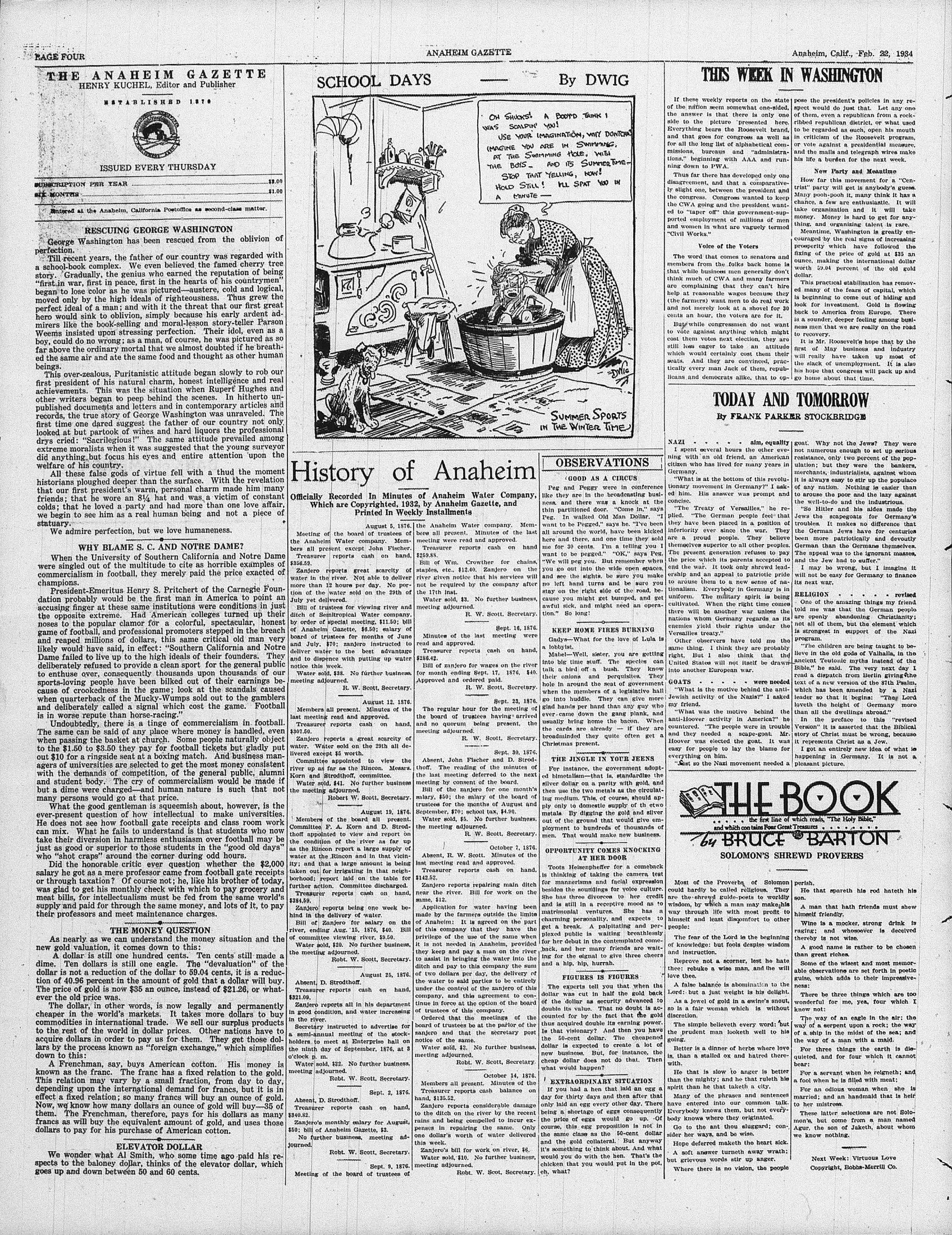
SCHOOL DAYS — By DWIG
OH SHUCKS! A BOOTD THINK I WAS SCALPIN' YOU!
USE YOUR IMAGINATION, WHY DON'T CALL (MAGINE YOU ARE IN SWIMMING AT THE SWIMMING HOLE, WITH THE BOYS) AND IT'S SUMMER TIME—STOP THAT YELLING, NOW!
HOLD STILL! I'LL SPAT YOU IN A MINUTE—
SUMMER SPORTS IN THE WINTER TIME
History of Anaheim
Officially Recorded In Minutes of Anaheim Water Company, Which are Copyrighted, 1932, by Anaheim Gazette, and Printed In Weekly Installments
August 5, 1876.
Meeting of the board of trustees of the Anaheim Water company. Members all present. Minutes of the last meeting were read and approved.
Treasurer reports cash on hand, $256.59.
Zanjero reports great scarcity of water in the river. Not able to deliver more than 12 hours per day. No portion of the water sold on the 29th of July yet delivered.
Bill of trustees for viewing river and ditch of Semitropical Water company, by order of special meeting, $11.50; bill of Anaheim Gazette, $6.50; salary of board of trustees for months of June and July, $70; zanjero instructed to deliver water to the best advantage and to dispense with putting up water notice this week.
Water sold, $38. No further business, meeting adjourned.
R. W. Scott, Secretary.
August 12, 1876.
Members all present. Minutes of the last meeting read and approved.
Treasurer reports cash on hand, $307.50.
Zanjero reports a great scarcity of water. Water sold on the 29th all delivered except $5 worth.
Committee appointed to view the river up as far as the Rincon. Messrs. Korn and Strodthoff, committee.
Water sold, $41. No further business the meeting adjourned.
Robert W. Scott, Secretary.
August 19, 1876.
Members of the board all present. Committee F. A. Korn and D. Strodthoff appointed to view and report on the condition of the river as far up as the Rincon report a large supply of water at the Rincon and in that vicinity; and that a large amount is being taken out for irrigating in that neigh-
the Anaheim Water company. Members all present. Minutes of the last meeting were read and approved.
Treasurer reports cash on hand, $259.88.
Bill of Wm. Crowther for chains, staples, etc., $12.40. Zanjero on the river given notice that his services will not be required by the company after the 17th inst.
Water sold, $3. No further business, meeting adjourned.
R. W. Scott, Secretary.
September 16, 1876.
Minutes of the last meeting were read and approved.
Treasurer reports cash on hand, $286.42.
Bill of zanjero for wages on the river for month ending Sept. 17, 1876, $40. Approved and ordered paid.
R. W. Scott, Secretary.
September 23, 1876.
The regular hour for the meeting of the board of trustees having arrived and no quorum being present, the meeting adjourned.
R. W. Scott, Secretary.
September 30, 1876.
Absent, John Fischer and D. Strodthoff. The reading of the minutes of the last meeting deferred to the next meeting by consent of the board.
Bill of the zanjero for one month's salary, $50; the salary of the board of trustees for the months of August and September, $70; school tax, $4.90.
Water sold, $5. No further business, the meeting adjourned.
R. W. Scott, Secretary.
October 7, 1876.
Absent, R. W. Scott. Minutes of the last meeting read and approved.
Treasurer reports cash on hand,
OBSERVATIONS
GOOD AS A CIRCUS
Peg and Peggy were in conference like they are in the broadcasting business, and there was a knock at the thin partitioned door. "Come in," says Peg. In walked Old Man Dollar. "I want to be Pegged," says he. "I've been all around the world, have been kicked here and there, and one time they sold me for 30 cents. I'm a telling you I want to be pegged." "OK," says Peg, "We will peg you. But remember when you go out into the wide open spaces, and see the sights, be sure you make no left hand turns and be sure you stay on the right side of the road, because you might get bumped, and get awful sick, and might need an operation." So long!
KEEP HOME FIRES BURNING
Gadys—What for the love of Lula is a lobbyist.
Mabel—Well, sister, you are getting into big time stuff. The species can talk a bird off a bush. They know their onions and perquisites. They hole in around the seat of government when the members of a legislative hall go into huddle. They can give more glad hands per hand than any guy who ever came down the gang plank, and usually bring home the bacon. When the cards are already — if they are broadminded they quite often get a Christmas present.
THE JINGLE IN YOUR JEENS
For instance, the government adopted bimetalism—that is, standardize the silver dollar on a parity with gold, and then use the two metals as the circulating medium. This, of course, should apply only to domestic supply of th etwo metals. By digging the gold and silver out of the ground that would give employment to hundreds of thousands of men. That would make new business.
OPPORTUNITY COMES KNOCKING AT HER DOOR
Toots Heisenpheffer for a comeback
Korn and Strodthoff, committee.
Water sold, $41. No further business the meeting adjourned.
Robert W. Scott, Secretary.
August 19, 1876.
Members of the board all present.
Committee F. A. Korn and D. Strodthoff appointed to view and report on the condition of the river as far up as the Rincon report a large supply of water at the Rincon and in that vicinity; and that a large amount is being taken out for irrigating in that neighborhood; report laid on the table for further action. Committee discharged.
Treasurer reports cash on hand, $384.59.
Zanjero reports being one week behind in the delivery of water.
Bill of Zanjero for salary on the river, ending Aug. 15, 1876, $40. Bill of committee viewing river, $9.50.
Water sold, $20. No further business, the meeting adjourned.
Robt. W. Scott, Secretary.
August 25, 1876.
Absent, D. Strodthoff.
Treasurer reports cash on hand, $321.09.
Zanjero reports all in his department in good condition, and water increasing in the river.
Secretary instructed to advertise for a semi-annual meeting of the stockholders to meet at Enterprise hall on the ninth day of September, 1876, at 3 o'clock p.m.
Water sold, $22. No further business, meeting adjourned.
Robt. W. Scott, Secretary.
Sept. 2, 1876.
Absent, D. Strodthoff.
Treasurer reports cash on hand, $340.82.
Zanjero's monthly salary for August, $50; bill of Anaheim Gazette, $3.
No further business, meeting adjourned.
Robt. W. Scott, Secretary.
Sept. 9, 1876.
Meeting of the board of trustees of
October 7, 1876.
Absent, R. W. Scott. Minutes of the last meeting read and approved.
Treasurer reports cash on hand, $142.52.
Zanjero reports repairing main ditch near the river. Bill for work on the same, $12.
Application for water having been made by the farmers outside the limits of Anaheim; It is agreed on the part of this company that they have the privilege of the use of the same when it is not needed in Anaheim, provided they keep and pay a man on the river to assist in bringing the water into the ditch and pay to this company the sum of two dollars per day, the delivery of the water to said parties to be entirely under the control of the zanjero of this company, and this agreement to continue in force at the option of the board of trustees of this company.
Ordered that the meetings of the board of trustees be at the parlor of the zanjero and that the secretary post notice of the same.
Water sold, $2. No further business, meeting adjourned.
Robt. W. Scott, Secretary.
October 14, 1876.
Members all present. Minutes of the Treasurer reports cash balance on hand, $135.52.
Zanjero reports considerable damage to the ditch on the river by the recent rains and being compelled to incur expenses in repairing the same. Only one dollar's worth of water delivered this week.
Zanjero's bill for work on river, $6.
Water sold, $10. No further business, meeting adjourned.
Robt. W. Scot, Secretary.
OPPORTUNITY COMES KNOCKING AT HER DOOR
Toots Heisenpheffer for a comeback is thinking of taking the camera test for mannerisms and facial expression besides the soundings for voice culture. She has three divorces to her credit and is still in a receptive mood as to matrimonial ventures. She has a charming personality, and expects to get a break. A palpitating and perplexed public is waiting breathlessly for her debut in the contemplated comeback, and her many friends are waiting for the signal to give three cheers and a hip, hip, hurrah.
FIGURES IS FIGURES
The experts tell you that when the dollar was cut in half the gold back of the dollar as security advanced to double its value. That no doubt is accounted for by the fact that the gold thus acquired double its earning power. Is that visionary? And then you have the 50-cent dollar. The cheapened dollar is expected to create a lot of new business. But, for instance, the cheap dollar does not do that. Then what would happen?
EXTRAORDINARY SITUATION
If you had a hen that laid an egg a day for thirty days and then after that only laid an egg every other day. There being a shortage of eggs consequently the price of eggs would go up. Of course, this egg proposition is not in the same class as the 50-cent dollar and the gold collateral. But anyway it's something to think about. And what would you do with the hen. That's the chicken that you would put in the pot, eh, what?
THIS WEEK IN WASHINGTON
If these weekly reports on the state of the nation seem somewhat one-sided, the answer is that there is only one side to the picture presented here. Everything bears the Roosevelt brand, and that goes for congress as well as for all the long list of alphabetical commissions, bureaus and "administrations," beginning with AAA and running down to PWA.
Thus far there has developed only one disagreement, and that a comparatively slight one, between the president and the congress. Congress wanted to keep the CWA going and the president wanted to "taper off" this government-supported employment of millions of men and women in what are vaguely termed "Civil Works."
Voice of the Voters
The word that comes to senators and members from the folks back home is that while business men generally don't think much of CWA and many farmers are complaining that they can't hire help at reasonable wages because they (the farmers) want men to do real work and not merely look at a shovel for 30 cents an hour, the voters are for it.
But while congressmen do not want to vote against anything which might cost them votes next election, they are still less eager to take an attitude which would certainly cost their seats. And they are convinced, practically every man Jack of them, republicans and democrats alike, that to oppose the president's policies in any respect would do just that. Let any one of them, even a republican from a rock-ribbed republican district, or what used to be regarded as such, open his mouth in criticism of the Roosevelt program, or vote against a presidential measure, and the mails and telegraph wires make his life a burden for the next week.
New Party and Meantime
How far this movement for a "Centrist" party will get is anybody's guess. Many pooh-pooh it, many think it has a chance, a few are enthusiastic. It will take organization and it will take money. Money is hard to get for anything, and organizing talent is rare.
Meantime, Washington is greatly encouraged by the real signs of increasing prosperity which have followed the fixing of the price of gold at $35 an ounce, making the international dollar worth 59.04 percent of the old gold dollar.
This practical stabilization has removed many of the fears of capital, which is beginning to come out of hiding and look for investment. Gold is flowing back to America from Europe. There is a sounder, deeper feeling among business men that we are really on the road to recovery.
It is Mr. Roosevelt's hope that by the first of May business and industry will really have taken up most of the slack of unemployment. It is also his hope that congress will pack up and go home about that time.
TODAY AND TOMORROW
BY FRANK PARKER STOCKBRIDGE
NAZI alm, equality
I spent several hours the other evening with an old friend, an American goat. Why not the Jews? They were not numerous enough to set up serious resistance, only two percent of the pop-
TODAY AND TOMORROW
BY FRANK PARKER STOCKBRIDGE
NAZI . . . alm, equality
I spent several hours the other evening with an old friend, an American citizen who has lived for many years in Germany.
"What is at the bottom of this revolutionary movement in Germany?" I asked him. His answer was prompt and concise.
"The Treaty of Versailles," he replied. "The German people feel that they have been placed in a position of inferiority ever since the war. They are a proud people. They believe themselves superior to all other peoples. The present generation refuses to pay the price which its parents accepted to end the war. It took only shrewd leadership and an appeal to patriotic pride to arouse them to a new sense of nationalism. Everybody in Germany is in uniform. The military spirit is being cultivated. When the right time comes there will be another war unless the nations whom Germany regards as its enemies yield their rights under the Versailles treaty."
Other observers have told me the same thing. I think they are probably right. But I also think that the United States will not itself be drawn into another European war.
GOATS . . . were needed
"What is the motive behind the anti-Jewish activity of the Nazis?" I asked my friend.
"What was the motive behind the anti-Hoover activity in America?" he countered. "The people were in trouble and they needed a scape-goat. Mr. Hoover was elected the goat. It was easy for people to lay the blame for everything on him."
Just so the Nazi movement needed a goat. Why not the Jews? They were not numerous enough to set up serious resistance, only two percent of the population; but they were the bankers, merchants, industrialists, against whom it is always easy to stir up the populace of any nation. Nothing is easier than to arouse the poor and the lazy against the well-to-do and the industrious.
"So Hitler and his aides made the Jews the scapegoats for Germany's troubles. It makes no difference that the German Jews have for centuries been more patriotically and devoutly German than the Germans themselves. The appeal was to the ignorant masses, and the Jew had to suffer."
I may be wrong, but I imagine it will not be easy for Germany to finance its next war.
RELIGION . . . revised
One of the amazing things my friend told me was that the German people are openly abandoning Christianity; not all of them, but the element which is strongest in support of the Nazi program.
"The children are being taught to believe in the old gods of Valhalla, in the ancient Teutonic myths instead of the Bible," he said. The very next day I read a dispatch from Berlin giving the text of a new version of the 87th Psalm, which has been amended by a Nazi leader so that it begins: "The Lord loveth the height of Germany more than all the dwellings abroad."
In the preface to this "revised Version" it is asserted that the Biblical story of Christ must be wrong, because it represents Christ as a Jew.
I got an entirely new idea of what is happening in Germany. It is not a pleasant picture.
THE BOOK
the first line of which reads, "The Holy Bible,
and which con tains Four Great Treasures"
by BRUCE BARTON
SOLOMON'S SHREWD PROVERBS
Most of the Proverbs of Solomon could hardly be called religious. They are the shrewd guide-posts to worldly wisdom, by which a man may make his way through life with most profit to himself and least discomfort to other people:
The fear of the Lord is the beginning of knowledge: but fools despise wisdom and instruction.
Reprove not a scorner, lest he hate thee: rebuke a wise man, and the will love thee.
A false balance is abomination to the Lord; but a just weight is his delight.
As a jewel of gold in a swine's snout, so is a fair woman which is without discretion.
The simple believeth every word; but the prudent man looketh well to his going.
Better is a dinner of herbs where love is, than a stalled ox and hatred therewith.
He that is slow to anger is better than the mighty; and he that ruleth his spirit than he that taketh a city.
Many of the phrases and sentences have entered into our common talk. Everybody knows them, but not everybody knows where they originated.
Go to the ant thou sluggard; consider her ways, and be wise.
Hope deferred maketh the heart sick.
A soft answer turneth away wrath; but grievous words stir up anger.
Where there is no vision, the people perish.
He that spareth his rod hateth his son.
A man that hath friends must shew himself friendly.
Wine is a mocker, strong drink is raging; and whosoever is deceived thereby is not wise.
A good name is rather to be chosen than great riches.
Some of the wisest and most memorable observations are set forth in poetic guise, which adds to their impressiveness:
There be three things which are too wonderful for me, yea, four which I know not:
The way of an eagle in the air; the way of a serpent upon a rock; the way of a ship in the midst of the sea; and the way of a man with a maid.
For three things the earth is disquieted, and for four which it cannot bear:
For a servant when he reigneth; and a fool when he is filled with meat;
For an odious woman when she is married; and an handmaid that is heir to her mistress.
These latter selections are not Solomon's, but come from a man named Agur, the son of Jaketh, about whom we know nothing.
Next Week: Virtuous Love
Copyright, Bobbs-Merrill Co.