anaheim-gazette 1934-02-01
Scanned page
Searchable text
THE ANAHEIM GAZETTE
HENRY KUCHEL, Editor and Publisher
ESTABLISHED 1870
ISSUED EVERY THURSDAY
SUBSCRIPTION PER YEAR ... $2.00
SIX MONTHS ... $1.00
Entered at the Anaheim, California Postoffice as second-class matter.
MUST WE REWRITE OUR IDEALS?
One of America's proudest boasts has been the fact that a "bare-footed boy with cheeks of tan" may rise by merit to be a leader of his country. Any American-born citizen, rich or poor, had an opportunity to become president. From the earliest days, particularly since Andrew Jackson turned the government over to the people in 1832, most of our strongest men were born in poverty, faced adversity, and overcame tremendous obstacles to be rewarded by public faith and public office. As late as 1932 we had as president a man who, as an orphan of tender years, fought adversity and won.
The picture has changed entirely. With the exception of Interior Secretary Ickes, every member of Roosevelt's cabinet and every important advisor inherited wealth and had a position made for him by an indulgent father. Of course, men now in office have individual merit. It is not the fact that they occupy office to which we object; it is the thought that, getting an initial boost by inherited position and wealth, are they qualified in fundamentals to handle our problems. Right now we are not even greatly concerned about that disturbing factor. We have too much confidence in the administration's purpose to question every step of its program.
The real puzzle to us is whether the New Deal of "endowed" leadership will supplant the glamour which made America the true land of opportunity—a country where inheritance and wealth, vital factors in the Old World, gave way before individual merit. The career of Lincoln, born in a log cabin and ascending to the highest office in the land, typifies America in her romantic 'teens.
which we object; it is the thought that, getting an initial boost by inherited position and wealth, are they qualified in fundamentals to handle our problems. Right now we are not even greatly concerned about that disturbing factor. We have too much confidence in the administration's purpose to question every step of its program.
The real puzzle to us is whether the New Deal of "endowed" leadership will supplant the glamour which made America the true land of opportunity—a country where inheritance and wealth, vital factors in the Old World, gave way before individual merit. The career of Lincoln, born in a log cabin and ascending to the highest office in the land, typifies America in her romantic 'teens. Our young democracy flourished and bloomed under this stimulous.
Is this period passing? Are we, as a nation, getting old? The fact that the present administration depends largely upon the council of men in their forties, many in their thirties and even some in their twenties, does not answer those questions. The important point is whether the age has arrived when inheritance of position and wealth, as in the Old World, will form a line of demarkation below which leadership will not have the opportunity to come. One or even two administrations of "endowed" men will not answer the question. The next decade, however, will give a clue; we trust regimentation of business and industry will not force such a result.
If so, America must rewrite her ideals.
WHAT BECOMES OF THE NATION'S DOLLAR?
An interesting and illuminating study of what becomes of the American dollar was compiled recently. Much fault may be found with it by individuals whose own experience in money matters might vary greatly from the general averages as published. However, when we consider that one per cent of the people in America control approximately 70 per cent of the national wealth; that the next three per cent control nearly a quarter of the national wealth; that the next three per cent control nearly a quarter of the national wealth; that about 75 per cent of the people control only about five per cent of the wealth, then we will not be prone to criticize the survey.
The dollar, according to this study, is divided as follows:
- Church ..... 3¼%
- Schools ..... 1½%
- Government ..... 4½%
- Crime ..... 8½%
- Miscellaneous ..... 13½%
Note that waste, luxury and crime consume about 44 per cent of the national income. Of equal astonishment, though known to every student of government finance, is that three-fourths of the national government expense is made up by costs incident to war—past, present and future.
Maladjustment is plainly evident. Churches and schools together get but little more than two cents out of every dollar. We have no quarrel with investment, wishing only that it were spread more evenly to the benefit of all the people. Waste amounting to 14 cents out of every dollar is inexcusable; crime's cost likewise cannot be condoned. Luxuries, thanks to our machine age, almost equal living costs.
Post depression studies probably will show considerable variance with pre- and depression surveys.
AMERICA IS GOING TO SCHOOL
There is more interest in politics, in the broad sense, in America today than there probably has been at any time since the earliest days of the republic. But it is politics with a difference. Political discussion in the past has centered mainly on personalities and parties. Today it centers around ideas.
Not since the Bryan campaign of 1896 have ideas been so dominant. Then, as now, everybody was discussing the economics of money and the silver question. But today's political discussions among men in the street cover a far wider range. There is an immense popular education in progress, out of which the American people are bound to emerge with a broader and sounder understanding of economic principles than most of us have ever had before.
One reason why ideas rather than personalities are in the saddle is the fact that the president has surrounded himself with scholars, men who have made a lifelong study of fundamentals, whose interests are not primarily political but lie in the broad fields of sociology and economics. It is easy to sneer at the "Brain Trust" but if we really believe that all college professors are ignoramuses, then why do we bother to send our sons and daughters to college? Those who profess to look with contempt upon learning are usually inspired by envy; they cannot tolerate the idea that someone else knows more than they do.
There is no longer any doubt that our whole social, economic and political scheme of things is being made over into something which, to most of us, will be both new and strange. It is therefore all to the good that so many people are debating with such eager interest the principles and purposes as well as the methods whereby the New Deal is being put into effect. They are preparing themselves to live in a reorganized society.
If money talks, Europe has reduced its conversation on war debts to a fain whisper.
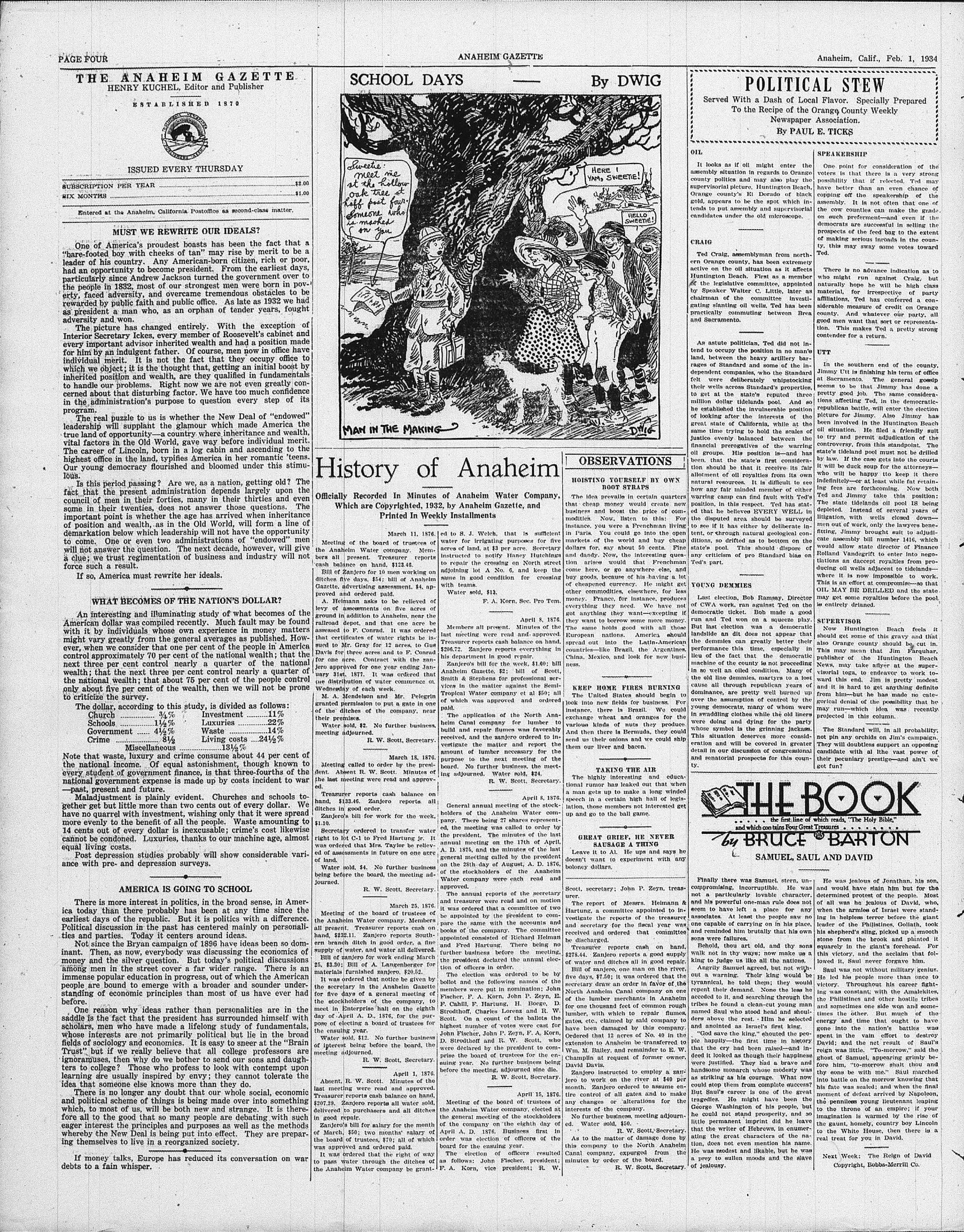
SCHOOL DAYS — By DWIG
Sweetie:
Meet me at the hollow oak tree at half post four. Someone who is masked on you
HERE I YAM, SWEETIE!
HELLO SWEETIE!
MAN IN THE MAKING
History of Anaheim
Officially Recorded In Minutes of Anaheim Water Company, Which are Copyrighted, 1932, by Anaheim Gazette, and Printed In Weekly Installments
March 11, 1876.
Meeting of the board of trustees of the Anaheim Water company. Members all present. Treasurer reports cash balance on hand, $123.46.
Bill of Zanjero for 10 men working on ditches five days, $54; bill of Anaheim Gazette, advertising assessment, $4, approved and ordered paid.
A. Helmann asks to be relieved of levy of assessments on five acres of ground in addition to Anaheim, near the railroad depot, and that one acre be assessed to F. Conrad. It was ordered that certificates of water rights be issued to Mr. Gray for 12 acres, to Gus Davis for three acres and to F. Conrad for one acre. Contract with the zanjero approved for one year ending January 31st, 1877. It was ordered that one distribution of water commence on Wednesday of each week.
M. A. Mendelson and Mr. Pelegrin granted permission to put a gate in one of the ditches of the company, near their premises.
Water sold, $2. No further business, meeting adjourned.
R. W. Scott, Secretary.
March 18, 1876.
Meeting called to order by the president. Absent R. W. Scott. Minutes of the last meeting were read and approved.
Treasurer reports cash balance on hand, $133.46. Zanjero reports all ditches in good order.
Zanjero's bill for work for the week, $1.10.
Secretary ordered to transfer water right to lot C-1 to Fred Hartung Jr. It was ordered that Mrs. Taylor be relieved of assessments in future on one acre of land.
Water sold, $4. No further business
OBSERVATIONS
HOISTING YOURSELF BY OWN BOOT STRAPS
The idea prevails in certain quarters that cheap money would create new business and boost the price of commodities. Now, listen to this: For instance, you were a Frenchman living in Paris. You could go into the open markets of the world and buy cheeseballs for, say about 50 cents. Fire and dandy. Now, the interesting question arises would that Frenchman come here, or go anywhere else, and buy goods, because of his having a lot of cheapened currency. He might get other commodities elsewhere, for less money. France, for instance, produces everything they need. We have not got anything they want—excepting they want to borrow some more money. The same holds good with all those European nations. America should spread out into the Latin-Americas countries—like Brazil, the Argentine China, Mexico, and look for new business.
KEEP HOME FIRES BURNING
The United States should begin to look into new fields for business. For instance, there is Brazil. We could exchange wheat and oranges for the various kinds of nuts they produce And then there is Bermuda, they could send us their onions and we could shi them our liver and bacon.
TAKING THE AIR
The highly interesting and educational rumor has leaked out that when a man gets up to make a long windspeech in a certain high hall of legislation, those members not interested go up and go to the ball game.
GREAT GRIEF, HE NEVER SAUSAGE A THING
Leave it to Al. He ups and says he doesn't want to experiment with any boloney dollars.
Treasurer reports cash balance on hand, $133.46. Zanjero reports all ditches in good order.
Zanjero's bill for work for the week, $1.10.
Secretary ordered to transfer water right to lot C-1 to Fred Hartung Jr. It was ordered that Mrs. Taylor be relieved of assessments in future on one acre of land.
Water sold, $4. No further business being before the board, the meeting adjourned.
R. W. Scott, Secretary.
March 25, 1876.
Meeting of the board of trustees of the Anaheim Water company. Members all present. Treasurer reports cash on hand, $232.11. Zanjero reports Southern branch ditch in good order, a fine supply of water, and water all delivered.
Bill of zanjero for work ending March 25, $3.30; Bill of A. Langenberger for materials furnished zanjero, $20.52.
It was ordered that notice be given by the secretary in the Anaheim Gazette for five days of a general meeting of the stockholders of the company, to meet in Enterprise hall on the eighth day of April A. D., 1876, for the purpose of electing a board of trustees for the ensuing year.
Water sold, $12. No further business of interest being before the board, the meeting adjourned.
R. W. Scott, Secretary.
April 1, 1876.
Absent, R. W. Scott. Minutes of the last meeting were read and approved. Treasurer reports cash balance on hand, $207.29. Zanjero reports all water sold, delivered to purchasers and all ditches in good repair.
Zanjero's bill for salary for the month of March, $50; two months' salary of the board of trustees, $70; all of which was approved and ordered paid.
It was ordered that the right of way to pass water through the ditches of the Anaheim Water company be granting adjourned. Water sold, $24.
R. W. Scott, Secretary.
April 8, 1876.
General annual meeting of the stockholders of the Anaheim Water company. There being 27 shares represented, the meeting was called to order by the president. The minutes of the last annual meeting on the 17th of April, A. D. 1875, and the minutes of the last general meeting called by the president on the 28th day of August, A. D. 1876, of the stockholders of the Anaheim Water company were each read and approved.
The annual reports of the secretary and treasurer were read and on motion it was ordered that a committee of two be appointed by the president to compare the same with the accounts and books of the company. The committee appointed consisted of Richard Heiman and Fred Hartung. There being no further business before the meeting, the president declared the annual election of officers in order.
The election was ordered to be by ballot and the following names of the members were put in nomination: John Fischer, F. A. Korn, John P. Zeyn, E. F. Cahill, F. Hartung, H. Boege, D. Strodthoff, Charles Lorenz and R. W. Scott. On a count of the ballots the highest number of votes were cast for John Fischer, John P. Zeyn, F. A. Korn, D. Strodthoff and R. W. Scott, who were declared by the president to comprise the board of trustees for the ensuing year. No further business being before the meeting, adjourned sine die.
R. W. Scott, Secretary.
April 15, 1876.
Meeting of the board of trustees of the Anaheim Water company, elected at the general meeting of the stockholders of the company on the eighth day of April A. D., 1876. Business first in order was election of officers of the board for the ensuing year.
The election of officers resulted as follows: John Fischer, president; F. A. Korn, vice president; R. W.
The highly interesting and educational rumor has leaked out that when a man gets up to make a long window speech in a certain high hall of legislation, those members not interested go up and go to the ball game.
GREAT GRIEF, HE NEVER SAUSAGE A THING
Leave it to Al. He ups and says he doesn't want to experiment with any boloney dollars.
Scott, secretary; John P. Zeyn, treasurer.
The report of Messrs. Helmann Hartung, a committee appointed to investigate the reports of the treasure and secretary for the fiscal year was received and ordered that committee be discharged.
Treasurer reports cash on hand, $278.44. Zanjero reports a good supply of water and ditches all in good repair.
Bill of zanjero, one man on the river five days, $7.50; it was ordered that the secretary draw an order in favor of the North Anaheim Canal company on one of the lumber merchants in Anaheim for one thousand feet of common rough lumber, with which to repair flume gates, etc., claimed by said company have been damaged by this company Ordered that 12 acres of No. 40 in the extension to Anaheim be transferred to Wm. M. Bailey, and remainder to E.W. Champlin at request of former owner David Davis.
Zanjero instructed to employ a zanjero to work on the river at $40 per month. Zanjero ordered to assume entire control of all gates and to make any changes or alterations for their interests of the company.
No further business, meeting adjourned. Water sold, $50.
R. W. Scott, Secretary.
As to the matter of damage done by this company to the North Anaheim Canal company, expurged from the minutes by order of the board.
R. W. Scott, Secretary
POLITICAL STEW
Served With a Dash of Local Flavor. Specially Prepared
To the Recipe of the Orange County Weekly
Newspaper Association.
By PAUL E. TICKS
OIL
It looks as if oil might enter the assembly situation in regards to Orange county politics and may also play the supervisorial picture. Huntington Beach, Orange county's El Dorado of black gold, appears to be the spot which intends to put assembly and supervisorial candidates under the old microscope.
CRAIG
Ted Craig, assemblyman from northern Orange county, has been extremely active on the oil situation as it affects Huntington Beach. First as a member of the legislative committee, appointed by Speaker Walter C. Little, later as chairman of the committee investigating slanting oil wells, Ted has been practically commuting between Brea and Sacramento.
As astute politician, Ted did not intend to occupy the position in no man's land, between the heavy artillery barrages of Standard and some of the independent companies, who the Standard felt were deliberately whipstocking their wells across Standard's properties, to get at the state's reputed three million dollar tidelands pool. And so he established the invulnerable position of looking after the interests of the great state of California, while at the same time trying to hold the scales of justice evenly balanced between the financial prerogatives of the warring oil groups. His position is—and has been that the state's first considerer.
SPEAKERSHIP
One point for consideration of the voters is that there is a very strong possibility that if relected, Ted may have better than an even chance of copping off the speakership of the assembly. It is not often that one of the cow counties can make the grade on such preferment—and even if the democrats are successful in selling the prospects of the feed bag to the extent of making serious inroads in the county, this may sway some votes toward Ted.
There is no advance indication as to who might run against Craig, but naturally hope he will be high class material, for irrespective of party affiliations. Ted has conferred a considerable measure of credit on Orange county. And whatever our party, all good men want that sort or representation. This makes Ted a pretty strong contender for a return.
UTT
In the southern end of the county, Jimmy Utt is finishing his term of office at Sacramento. The general gossip seems to be that Jimmy has done a pretty good job. The same considerations affecting Ted, in the democratic-republican battle, will enter the election picture for Jimmy. Also Jimmy has been involved in the Huntington Beach oil situation. He filed a friendly suit to try and permit adjudication of the controversy, from this standpoint. The state's tideland pool must not be drilled by law. If the case gets into the court
IN YOURSELF BY OWN BOOT STRAPS
reveals in certain quarters money would create new boost the price of comow, listen to this: For we were a Frenchman living you could go into the open the world and buy cheap say about 50 cents. Fine Now, the interesting question would that Frenchman or go anywhere else, and because of his having a lot of currency. He might get oddities, elsewhere, for lessence, for instance, produces they need. We have not they want—excepting if borrow some more money, holds good with all those nations. America should into the Latin-American trade Brazil, the Argentines, so, and look for new busiOME FIRES BURNING
States should begin to new fields for business. For here is Brazil. We could heat and oranges for the fruits of nuts they produce. Here is Bermuda, they could eat onions and we could ship beer and bacon.
KING THE AIR
interesting and educahas leaked out that when up to make a long winded certain high hall of legislmembers not interested get the ball game.
GRIEF, HE NEVER USAGE A THING
Al. He ups and says he to experiment with any rages of Standard and some of the independent companies, who the Standard felt were deliberately whipstocking their wells across Standard's properties, to get at the state's reputed three million dollar tidelands pool. And so he established the invulnerable position of looking after the interests of the great state of California, while at the same time trying to hold the scales of justice evenly balanced between the financial prerogatives of the warring oil groups. His position is—and has been, that the state's first consideration should be that it receive its fair allotment of oil royalties from its own natural resources. It is difficult to see how any fair minded member of either warring camp can find fault with Ted's position, in this respect. Ted has stated that he believes EVERY WELL in the disputed area should be surveyed to see if it has either by deliberate intent, or through natural geological conditions, so drifted as to bottom on the state's pool. This should dispose of any criticism of pro Standard bias on Ted's part.
YOUNG DEMMIES
Last election, Bob Ramsay, Director of CWA work, ran against Ted on the democratic ticket. Bob made a good run and Ted won on a squeeze play. But last election was a democratic landslide an dit does not appear that the demmies can greatly better their performance this time, especially in lieu of the fact that the democratic machine of the county is not proceeding in so well an oiled condition. Many of the old line demmies, martyrs to a lost cause all through republican years of dominance, are pretty well burned up over the assumption of control by the young democrats, many of whom were in swaddling clothes while the old liners were doing and dying for the party whose symbol is the grinning jackass. This situation deserves more consideration and will be covered in greater detail in our discussion of congressional and senatorial prospects for this county.
In the southern end of the county, Jimmy Utt is finishing his term of office at Sacramento. The general gossip seems to be that Jimmy has done a pretty good job. The same considerations affecting Ted, in the democratic-republican battle, will enter the election picture for Jimmy. Also Jimmy has been involved in the Huntington Beach oil situation. He filed a friendly suit to try and permit adjudication of the controversy, from this standpoint. The state's tideland pool must not be drilled by law. If the case gets into the courts it will be duck soup for the attorneys—who will be happy to keep it there indefinitely—or at least while fat retaining fees are forthcoming. Now both Ted and Jimmy take this position: The state tideland oil pool IS being depleted. Instead of several years of litigation, with wells closed down—men out of work, only the lawyers benefitting, Jimmy brought suit to adjudicate assembly bill number 1416, which would allow state director of Finance Rolland Vandegrift to enter into negotiations an daccept royalties from producing oil wells adjacent to tidelands—where it is now impossible to work. This is an effort at compromise—so that OIL MAY BE DRILLED and the state may get some royalties before the pool is entirely drained.
SUPERVISOR
Now Huntington Beach feels it should get some of this gravity and that also Orange county should be cut in. This may mean that Jim Farquhar, publisher of the Huntington Beach News, may take affyer at the supervisorial toga, to endeavor to work toward this end. Jim is pretty modest and it is hard to get anything definite from him—but he has made no categorical denial of the possibility that he may run—which idea was recently projected in this column.
The Standard will, in all probability, not pin any orchids on Jim's campaign. They will doubtless support an opposing candidate with al lthe vast power of their pecuniary prestige—and ain't we got fun?
Finally there was Samuel, stern, uncompromising, incorruptible. He was not a particularly lovable character, and his powerful one-man rule does not seem to have left a place for any associates. At least the people saw no one capable of carrying on in his place, and reminded him brutally that his own sons were failures.
Behold, thou art old, and thy sons walk not in thy ways; now make us a king to judge us like all the nations.
Angrily Samuel agreed, but not without a warning. Their king would be tyrannical, he told them; they would repent their demand. None the less he acceded to it, and searching through the tribes he found a clean-cut young man named Saul who stood head and shoulders above the rest. Him he selected and anointed as Israel's first king.
"God save the king," shouted the people happily—the first time in history that the cry had been raised—and indeed it looked as though their happiness were justified. They had a brave and handsome monarch whose modesty was as striking as his courage. What now could stop them from complete success? But Saul's career is one of the great tragedies. He might have been the George Washington of his people, but he could not stand prosperity, and so little permanent imprint did he leave that the writer of Hebrews, in enumerating the great characters of the nation, does not even mention his name. He was modest and likable, but he was a prey to sullen moods and the slave of jealousy.
He was jealous of Jonathan, his son, and would have slain him but for the determined protest of the people. Most of all was he jealous of David, who, when the armies of Israel were standing in helpless terror before the giant leader of the Philistines, Goliath, took his shepherd's sling, picked up a smooth stone from the brook and planted it squarely in the giant's forehead. For this victory, and the acclaim that followed it, Saul never forgave him.
Saul was not without military genius. He led his people more than once to victory. Throughout his career fighting was constant; with the Amalekites, the Philistines and other hostile tribes and sometimes one side won and sometimes the other. But much of the energy and time that ought to have gone into the nation's battles was spent in the vain effort to destroy David; and the net result of Saul's reign was little. "To-morrow," said the ghost of Samuel, appearing grimly before him, "to-morrow shalt thou and thy sons be with me." Saul marched into battle on the morrow knowing that his fate was sealed; and when the final moment of defeat arrived by Napoleon, the penniless young lieutenant leaping to the throne of an empire; if your imagination is warmed by the rise of the gaunt, homely, country boy Lincoln to the White House, then there is a real treat for you in David.
Next Week: The Reign of David
Copyright, Bobbs-Merrill Co.